engine oil AUDI S3 2009 Owner's Manual
[x] Cancel search | Manufacturer: AUDI, Model Year: 2009, Model line: S3, Model: AUDI S3 2009Pages: 324, PDF Size: 76.02 MB
Page 235 of 324
Checking and filling -
---------------------=----"=---------
0 Note
• Before winter sets in, have the coolant checked to see if the
coolant additive in your vehicle is sufficient to meet the climate
conditions. This is especially important if you live in a region where
the winter is extremely cold. If necessary, increase the proportion of
coolant additive to 60%.
• When adding coolant additive to your cooling system,
remember:
-We recommend using only coolant additive G12+ + (check the
label) for your vehicle. This coolant additive is available at autho
rized Audi dealers. Other types of antifreeze can significantly
reduce corrosion protection . The resulting corrosion can cause a
loss of coolant and serious engine damage .
• Do not add any type of radiator leak sealant to your vehicle's
engine coolant. Adding radiator repair fluid may adversely affect the
function and performance of your cooling system and could result
in damage not covered by your New Vehicle Limited Warranty .•
Checking the engine coolant level
The engine coolant level can be checked with a quick
glance.
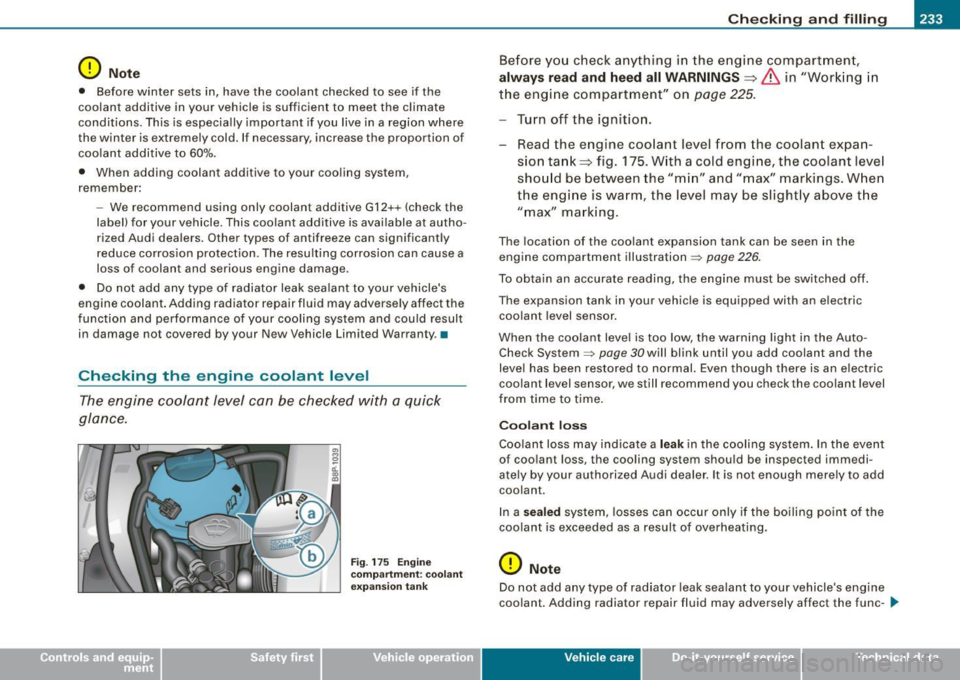
Fig . 175 Engine
compartment : coolant
expansion tank
Before you check anything in the engine compartment,
always read and heed all WARNINGS==> & in "Working in
the engine compartment" on
page 225.
Turn off the ignition.
Read the engine coolant level from the coolant expan
sion tank==> fig. 175. With a cold engine, the coolant level
should be between the "min" and "max" markings. When
the engine is warm, the level may be slightly above the
" max" marking.
The location of the coolant expansion tank can be seen in the
engine compartment illustration=>
page 226.
To obtain an accurate reading, the engine must be switched off.
The expansion tank in your vehicle is equipped with an electric
coolant level sensor.
When the coolant level is too low, the warning light in the Auto
Check System =>
page 30will blink until you add coolant and the
level has been restored to normal. Even though there is an electric
coolant level sensor, we still recommend you check the coolant level
from time to time.
Coolant loss
Coolant loss may indicate a leak in the cooling system. In the event
of coolant loss, the cooling system should be inspected immedi
ately by your authorized Audi dealer. It is not enough merely to add
coolant.
In a
sealed system, losses can occur only if the boiling point of the
coolant is exceeded as a result of overheating.
0 Note
Do not add any type of radiator leak sealant to your vehicle's engine
coolant. Adding radiator repair fluid may adversely affect the tune- _..
Vehicle care I I Technical data
Page 284 of 324
11111.___F_ u_ s _ e_s _ a_n _ d_ b_ u_lb _ s _______________________________________________ _
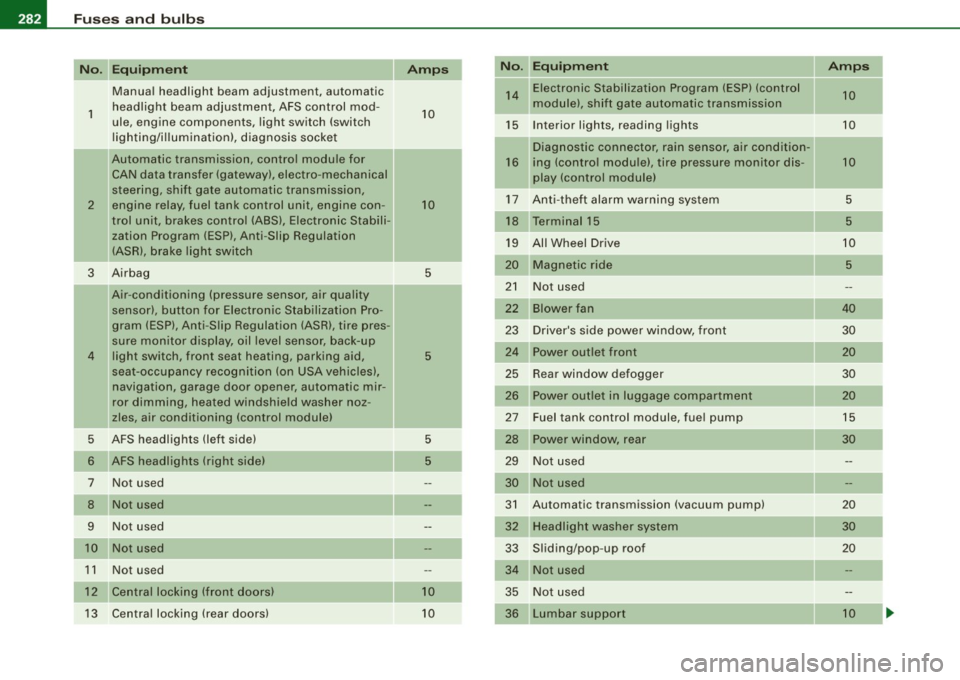
Equipment Amps No. Equipment Amps
Manual headlight beam adjustment, automatic 14 Electronic Stabilization Program (ESP) (control
10
1 headlight beam adjustment, AFS control mod-
10 module),
shift gate automatic transmission
ule, engine components, light switch (switch
15 Interior lights, reading lights 10
lighting/illumination), diagnosis socket
Diagnostic connector, rain sensor, a ir condit ion-
!! Automatic transmission, control module for
16 ing (control module), tire pressure monitor dis- 10
CAN data transfer (gateway), electro -mechanical
play (control module)
steering, shift gate automatic transmission, 17 Anti-theft alarm warning system 5
2 engine relay, fuel tank control unit, engine con
-10
trol unit, brakes control (ABS), Electronic Stabili- 18 Terminal 15
5
zation Program (ESP), Anti -Slip Regulation
19 All Wheel Drive
10
(ASR), brake light switch
-20 Magnetic ride 5
3 Airbag
5
-21 Not used
Air -conditioning (pressure sensor, air quality
sensor), button for Electronic Stabilization Pro- 22
Blower fan 40
gram (ESP), Anti -Slip Regulat ion (ASRl, tire pres -
23 Driver's side power window, front 30
sure mon itor display, oil level sensor, back-up
4 light switch, front seat heating, parking aid, 5 24 Power outlet front
20
seat-occupancy recognition (on USA vehicles), 25 Rear window defogger 30
navigation, garage door opener, automatic mir- 26 Power outlet in luggage compartment 20
ror dimming, heated windshield washer noz-
zles, air conditioning (control module) 27 Fuel tank control module, fuel pump 15
5 AFS headlights (left side)
5 28 Power
window, rear
30
6 AFS headlights (r ight side) 5 29 Not used
7 Not used 30 Not used
8 Not used 31 Automatic transmission (vacuum pump)
20
9 Not used 32 Headlight washer system 30
10 Not used
33 Sliding/pop-up roof
20
1 1 Not used 34 Not used
12 Central locking (front doors} 10 35 Not used
13 Central locking (rear doors) 10
36 Lumbar
support 10
Page 286 of 324

IIJII Fuses and bulbs i,.__....;,___;:,,;_,;,,.:_;__;;:_.:.:..:..=-=;____ ______________________ _
No. UEquipment Amps I No. Equipment Amps
F6 Steering wheel electronics, instrument cluster
5 F28
Not used
F7 Transmission control module 30 Fuse assignment in the left-side instrument
F29 50
F8 Navigation system, radio system 15/25 panel (special equipment)
Navigation system, digital radio, cell phone, TV F30 Power supply relay terminal
15 50
F9 equipment 5
F10 Engine control module, main relay 5/10 Variation
(2) with 54 Plug-in Fuses
F11 Not used No. Equipment
Amps
Control module for CAN data transfer (gateway) 5 F1
Vehicle
electrical system control unit (right)
30
F13 Engine control module 15/25 F2
ESP valves, Anti
-lock brake system (ABS) valves
20/30
F14 Ignition coils 20 F3 Not used
F15 Tank diagnosis, oxygen sensor 5/10 F4
Battery voltage
5
F16 Vehicle electrical system control unit (right) 30 F5 Horn
15
F17 Horn
15 F6 Engine components, fuel pump 15
F18 Audio amplifier 30 F7
Not used
F19 Front windshield wiper system 30 F8
Not used
F20 Water return
-flow pump, volume regulator valve F9 Engine components
10
F21 Oxygen sensor, vacuum pump 15 F10
Fuel tank control, mass air flow sensor
10
F22 Clutch pedal switch, brake light switch 5 F11 Oxygen sensors, in front of catalytic converter 10
F23 Engine relays, engine components
5/10/15 F12 Oxygen sensors, behind catalytic converter
10
F24 Engine components, water return-flow pump 10 F13 Automatic transmission
15
F25 Pump (ESP/ABS), ABS valve 30/40 F14 Not used
F26 Vehicle electrical system control unit (left)
30 F15 Water return-flow pump
10
F27 Secondary air pump 40 F16 Volume control valve
20
F17 Steering wheel electronics, instrument cluster
5
F18 Audio amplifier 30
F19 Navigation system, radio system 15/25
Page 287 of 324

_________________________________________________ F_ u_ s_ e_s _ a_n _ d_ b_ u_lb _ s __ ffllll
N "E .
o . qu1pm ent Amps I No. Equ ipment Amps
F20 Navigation system, digital radio, cell phone, TV
5 F44 Not used
equipm ent
F45 Not used
-
F21 Not used F46 Not used
Not used F47 Left-side lighting (electric system control unit)
30
F23 Engine control module, main re lay 10
Pump (ESP/ABS), ABS valve, Anti-lock brake sys-
F48 30/40
F24 Control module for CAN data transfer (gateway) 5 tern (ABS) valves
F25 Not used F49
Not used
Not us ed Not used
F27 Not used F51 Secondary air pump 40
Engine control module 15/25 F52 Power supply relay terminal 15 50
F29 Engine relays, eng ine components 5
F53 Fuse assign
ment in the left -side instrument
50
F30 Not used panel (special equipment)
F3 1 F
ront windshield wiper system
30
F54 Not use d •
F32 Not us ed
F33 Not used
Bulbs
F3 4 Not used
F35 Not used
Replacing light bulbs
F36 Not used F or your safety, we recommend that you have your autho -
rized Audi dealer replace burned out bulbs for you.
Not used
F37
F38 Eng ine components, ta nk diag nosis 10 It is becom ing increasingly more and more difficult to replace
vehic le light bu lbs since in many cases, other parts of the car must
F39 Clutch pedal switch, brake light switch 5 first be removed before you are able to get to the bulb . This applies
F40 Ignition coils 20 especia lly to the light bu lbs i n the front of your car which you can
only reach through the engine compartment .
F41 Not used
F42 Not used Sheet meta
l and bulb holders can have sharp edges t hat ca n cause
serious cuts, and parts must be correctly taken apart and then prop -
F43 Ignit ion coils 30 erly put back together
to he lp prevent breakage of parts and long
...
• Do-it -yourself service
Page 297 of 324
________________________________________________ E_ m_ e_r .::g :...e_ n _ c_,y'-- s_ i_t _u _a_ t_ i_o _n_ s _---JIIII
Lifting the vehicle
Important safety precautions
Be aware of the following hazards before lifting the vehicle with a
workshop hoist or floor jack:
• The vehicle should never be lifted or jacked up from underneath
the engine oil pan, the transmission housing, the front or rear axle
or the body side members. This could lead to serious damage.
• Use lifting equipment with padded contact surfaces to avoid
damage to the underbody or chassis frame.
• Alternatively, cover the contact surfaces on workshop hoist or
floor jack with rubber pads before lifting .
• Before driving over a workshop hoist, check that the vehicle
weight does not exceed the permissible lifting capacity of the hoist .
• Before driving over a workshop hoist, ensure that there is suffi
cient clearance between the hoist and low parts of the vehicle .
& WARNING
To reduce the risk of serious injury and vehicle damage:
• Always lift the vehicle only at the special workshop hoist and
floor jack lift points illustrated=> fig. 211 and=> fig. 212 .
• Failure to lift the vehicle at these points could cause the vehicle
to tilt or fall from a lift if there is a change in vehicle weight distri
bution and balance. This might happen, for example, when heavy
components such as the engine block or transmission are
removed .
• When removing such heavy components, anchor vehicle to
hoist or add corresponding weights to maintain the center of
gravity . Otherwise , the vehicle might tilt or slip off the hoist,
causing serious personal injury. •
Lifting with workshop hoist and with floor
jack
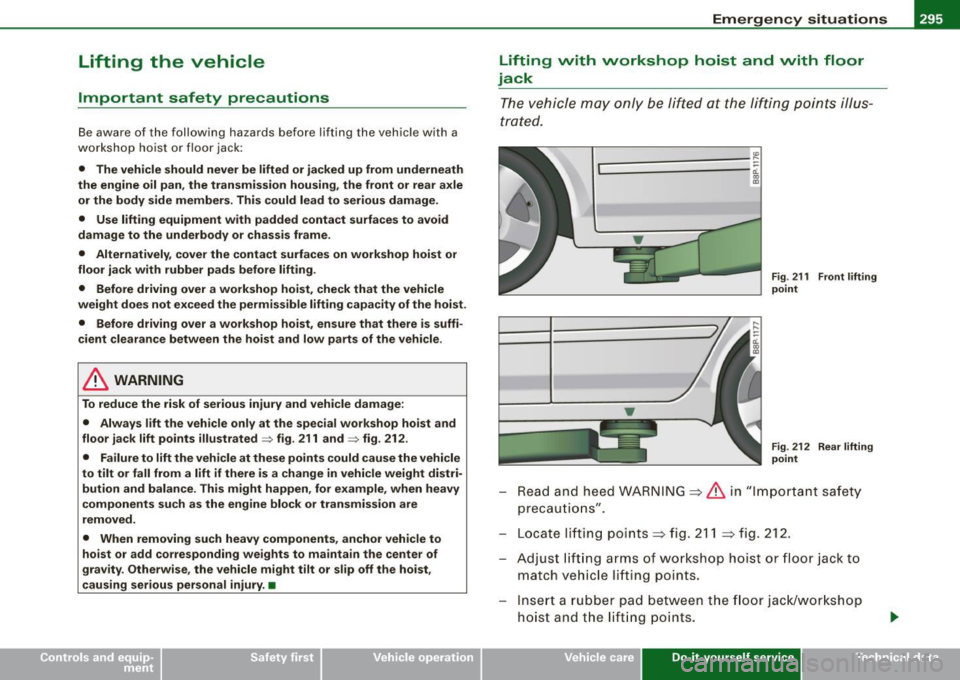
The vehicle may only be lifted at the lifting points illus
trated.
.... L===========::::==:: ~ 0:.
Fig . 211 Front lifting
point
Fig . 212 Rear lifting
point
Read and heed WARNING~ & in "Important safety
precautions ".
Locate lifting points~ fig. 211
~ fig. 212.
Adjust lift ing arms of workshop hoist or floor jack to
match vehicle lifting points.
Inse rt a rubber pad between the floor jack/workshop
hoist and the lifting points.
Vehicle care Do-it-yourself service irechnical data
Page 298 of 324
11111.___E_ m _ e _r-==g :...e_ n_ c...:y _ s_ i_t _u _a _t_ i_o _n_ s _______________________________________________ _
If you mu st lift your veh icle with a floor jack to work underneath , be
sure the vehicle is safely supported on stands intended for this
purpose .
Front lifting point
T he lifting point is located on the floor pan reinforcement about at
t he same leve l as t he jac k mou nti ng poi nt=>
pag e 295, fig. 2 11. Do
not lift the vehicle at the vertical sill reinforcement .
Rear lifting point
T he lifting point is located on the vertical reinforcement of the lower
sill for the o n board jack=>
page 295, fi g. 212 .
Lifting with vehicle jack
Refe r to=> page 276.
0 Note
• Be aware of the fo llo wi ng po ints before l ifting t he ve hicle :
- The vehicle should never be lifted or jacked up from under
neath the engine oil pan , the transmission housing , the front or
rear axle or the body side members . This could lead to serious
damage.
- To avoid damage to the underbody or chassis frame , a rubber
pad must be inserted between the floor jack and the lift points .
- Before driving over a workshop hoist, check that the vehi cle
weight does not exceed the permissible lifting capacity of the
hoist .
- Before driving over a workshop hoist , ensure that there is
sufficient clearance between the hoist and low parts of the
vehicle. •
Page 303 of 324
____________________________________________________________ D_ a _ t_a __ lllll
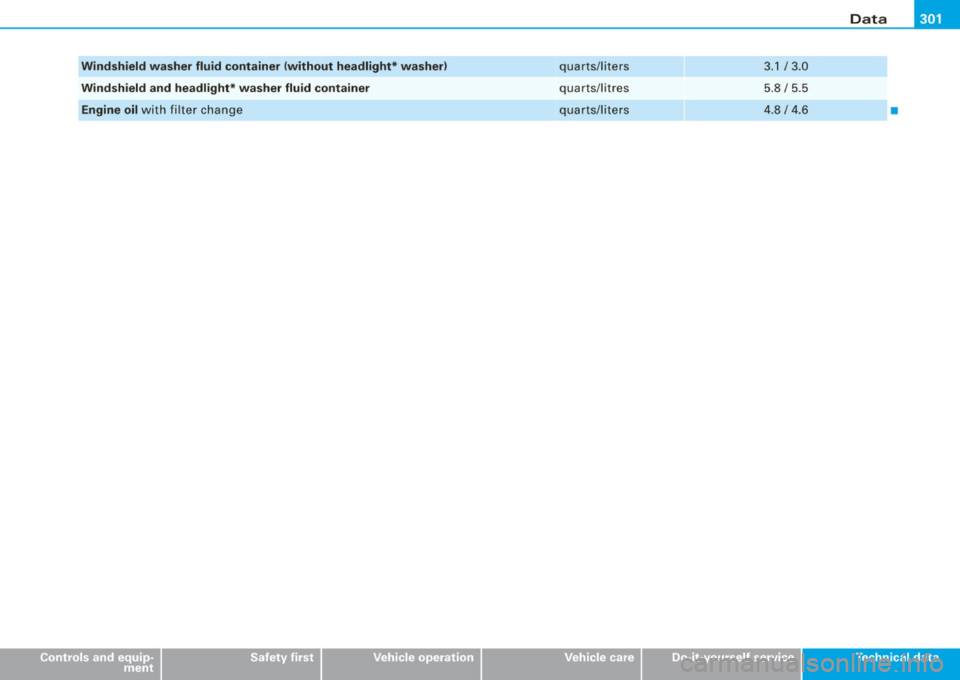
Wind shield wash er fluid container (without headlight * wash er)
Windshield and headl ight * w asher fluid cont ainer
Engine oil with filt e r ch ange
Controls and equip ment Safety first
Vehicle operation quarts/liters
quarts/litres
quarts/
liters
Vehicle care 3.1 / 3.0
5.8 / 5. 5
4.8 / 4.6
Do-it-yourself service
•
T ec hn ica l da ta
Page 304 of 324
___ D_ a_t _a ________________________________________________________ _
Applies to vehicles : wit h 3.2 liter 6-c yl. en gine
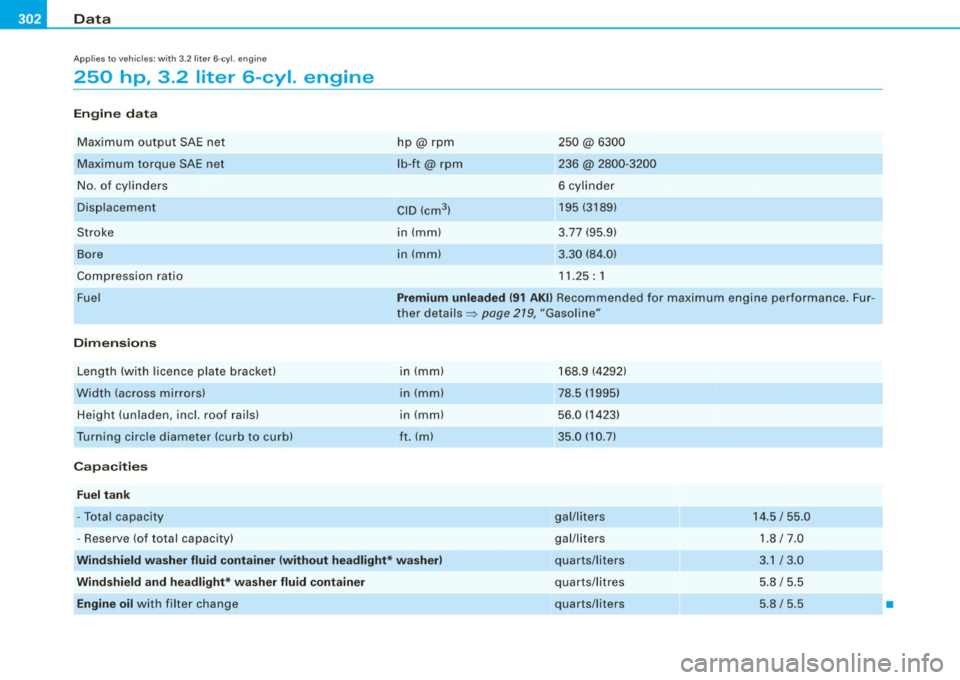
250 hp, 3 .2 liter 6-cyl. engine
Engine data
Max imum output SAE net
Maximum torque SAE net
No. of cy linders
Disp lacement
Stroke
Bo re
Comp ress ion ratio
Fuel
Dimensions
Length (with licence plate brac ket)
Width (across mirrors) Height (unladen, incl. roof rails)
Turning c ircle diameter (curb to curb)
Capacities
Fuel tank
- Total capacity
- Reserve (of total capacity) hp@ rpm
lb-ft@ rpm
CID (cm
3
)
in (mm)
in (m m) 250@6300
236 @ 2800-3200
6 cylinder 195 (3189)
3 .77 (95 .9)
3 .30 (84 .0)
11 .25 : 1
Premium unleaded {91 AKll Recommended for maximum engine performance . Fur
ther details =:>
page 219, "Gasoline"
in (m m)
in (m m)
in (mm)
ft . (ml 168
.9 ( 429 2)
78.5 (1995)
56.0 ( 14 23)
35 .0 (10 .7)
ga l/lit ers
gal/l iters 14.5 / 55
.0
1 .8/7 .0
Windshield washer fluid container (without headlight* washer )
Windshield and headlight* washer fluid container quarts/liters
quarts/l it res 3.
1 / 3.0
5 .8 / 5.5
Engine oil with filter change quarts/liters 5.8 / 5.5 •
Page 306 of 324
__ _.:C~ o'...'..n~ s~ u'..'..m ~ e~ r~ ln'....'...'.. f.::: o '...'..r ~m ~ a:_: t:.:. i.:::o '...'..n..:__ _____________________________________________ _
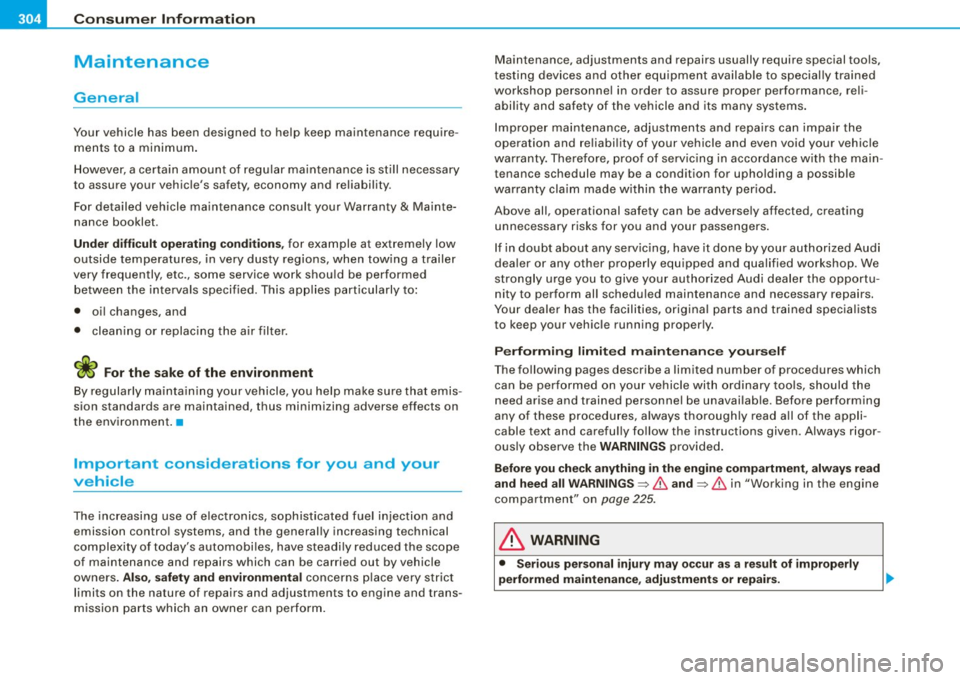
Maintenance
General
Your vehicle has been designed to help ke ep maintenance require
ments to a mi nim um .
Ho weve r, a certain a mount of regu lar maintenance is still necessary
to assure your vehicle's safety, economy and reliability.
For detailed vehicle maintenance consult your Warranty
& Main te
nance booklet.
Under d iffi cult op erating cond ition s, for example at extremely low
outside temperatures, in very dusty regions, when tow ing a trailer
very frequently, etc., some service work shou ld be performed
between the intervals specified. This app lies particularly to :
• oil changes, and
• clean ing or replac ing the air filter .
sion standards are maintained, thus minimizing adverse effects on
the environment .•
Important considerations for you and your
vehicle
The increasing use of electronics, sophisticated fuel injection and emission control systems, and the general ly increasing technical
complexity of today's automobi les, have steadily reduced the scope
of maintenance and repairs which can be carried out by vehicle
owners .
Also , safety and environm ental concerns p lace very s trict
limits on the nature of repairs and adjustments to engine and trans
mission parts which an owner can perform . Maintenance, adjustments and repairs usually require special tools,
t esting devices and other equipment availab le to special ly trained
workshop personne l in order to assure proper performance, reli
abi lity and safety of the vehicle and its many systems .
I mproper maintenance, adjustments and repa irs can impa ir the
operation and re liability of your vehicle and even void your vehic le
wa rranty. Therefore, proof of se rvic ing in accordance w ith the ma in
tenance schedule may be a condition for upholding a possible
war ranty claim made within the warranty period.
Above all, operational safety can be adverse ly affected, creating
unnecessary risks for you and your passengers .
I f in doubt about any servicing, have it done by your authori zed Audi
dea ler or any other properly equipped and qualified workshop . We
strongly urge you to give your authorized Audi dealer the opportu
nity to perform all schedu led maintenance and necessary repairs.
Your dealer has the facilities, origina l parts and trained special ists
to keep your vehicle running proper ly.
Performing limited ma intenan ce your self
The following pages describe a limited number of procedures which
can be performed on you r vehicle wi th ordinary too ls, should the
need arise and trained personnel be unavailab le . Before performing
any of the se procedu res, a lways thorough ly read a ll of the appli
cable text and carefu lly fo llow the instructions given . Always rigor
ous ly observe the
WARNINGS provided .
Before you check anything in the engine compartment , alway s re ad
and heed all WARNINGS=>
& and=> & in "Wo rking in the engine
compartment" on
page 225.
& WARNING
• Seriou s per son al injury may oc cur as a result of improperly
performed maintenan ce, adjustment s or repairs .
Page 307 of 324
------------------------------------------------=C :..:o=. n :..:..: s:..:u::.: m:...:..:. e::.:.. r..:l~ n .:..:f:..: o:.: r :..:m~ a::.:. ti:.:o::. n:....:__ _11111
& WA RNIN G (continu ed )
• Alway s be extremely careful when working on the v ehicle .
Alway s follo w commonly accepted safety pr actice s and general
c ommon sen se . Never risk per sonal inju ry .
• Do n ot attempt any of the m aint enance , check s or rep air s
de scribed on the following pages if you are not fully famili ar with
the se or othe r procedures with respect to the vehicle , or are u ncer
t a in ho w to pro ceed .
• Do not do any work w ithout the proper tool s and equipment .
Have the necessary work done by your authorized Audi de aler or
anothe r properly equipped and qual ified work shop .
• The engine compartment of any motor vehicle i s a potentially
h azardou s are a. Ne ver rea ch into the are a around or touch the
radiator fan. It is te mperature controlled and can switch on
s uddenly · even when the engine is off and the ignition key has
been remo ved . The radi ator fan switches on automat icall y when
the coolant reaches a certain temperature and will continue to run
until the coolant t emper ature drops .
• Alway s remo ve the ignition key befor e anyone get s under the
v ehi cle .
• Alway s support your vehicle with safety sta nd s if it i s nece s
sary to work underneath the vehicle . The ja ck supplied with the
vehi cle is not adequate for this p urpo se a nd co uld coll apse
c au sing ser iou s person al in jur y.
• If you m ust w ork under neath the vehi cle with the wheel s on
the ground , alway s make sure the vehicle is on lev el ground , that
the wheels are alway s secu rel y blocked and that the engine
c annot be started .
• Alway s make sure the t ran sm iss ion selector lever (automat ic
tran smi ssion ) is in "P " (Park position ) (automati c transmis sion) or
Neutr al ( ma nual transmission ) and the h and brake i s firmly
appli ed .
Controls and equip ment Safety first Vehicle operation
<£' For the sake of the environment
•
Changing the engine settings will adverse ly affect em ission
levels. This is detrimental to the environment and increases fuel
consu mption.
• Always observe environmenta l regulations when disposing of
old engine oil, used brake fluid, d irty engine coolant, spent batteries
or worn out tires .
• Undeployed airbag modules and pretensioners might be classi
fied as Perch lorate Material -special handling may apply, see
www.dtsc.ca.gov/hazardouswaste/perchlo rate. When the vehicle or
parts of the restraint system including airbag modules safety be lts
with pretensioners are scrapped, a ll applicable laws and regu la
tions must be observed. Your authorized Audi dealer is familiar with
these requirements and we recommend that you have your dea ler
perform this service for you. •
Additional accessories,
modifications and parts replacement
Additional accessories and parts
replacement
Al ways consult an authorized Au di de aler befo re
purchasing accessories.
Your vehicle incorporates the latest safety design features ensuring
a high standard of act ive and passive sa fety.
This safety could be compromised by non -approved changes to the
vehic le . Fo r th is reason, if par ts have t o be re p laced, please observe
the fo llowing points when insta lling additional accessories:
Approved Audi accessories and genuine Audi parts are available
from autho rized Audi dealers . .,_
Vehicle care Do-it-yourself service Tec hn ica l da ta