roof AUDI S3 2009 Owner's Manual
[x] Cancel search | Manufacturer: AUDI, Model Year: 2009, Model line: S3, Model: AUDI S3 2009Pages: 324, PDF Size: 76.02 MB
Page 209 of 324
_____________________________________________ C_ l_ e _a_ n_ in_ g_a _ n_d_ p_ r_ o_ t _e_ c_t _io _ n __ !II
•
High temperatures, as from exposure to intense sunlight, intens ify
the corrosive effect particularly when humidity is high as well.
Under ce rtain circumstances ,
weekly washing may be necessary .
Under other conditions, a monthly washing and waxing may be
adequate.
After the winter, the
underside of the vehicle should be thoroughly
washed, preferably in a professional car wash.
& WARNING
Always read and heed all WARNINGS and other information
=>
page 206 . •
Automatic car wash
The vehicle can be washed in almost any modern auto
matic car wash.
The vehicle paint is so durable that the vehicle can normally be
washed without problems in an automatic car wash . However , the
effect on the paint depends to a large extent on the design of the
facility, the filtering of the wash water, the type of wash and care
material, etc. If the paint has a dull appearance after going through
the car wash or is scratched, bring this to the attention of the oper
ator immediately . If necessary, use a different car wash .
Before going through a car wash, be sure to take the usual precau
tions such as closing the windows and panoramic sliding sunroof *.
Remove antenna if applicable.
If you have installed additional accessories on the vehicle -such as
spoilers, roof rack , etc. -it is best to ask the car wash operator if
these should be removed .
& WARNING
Always read and heed all WARNINGS and other information
=> page 206. •
Washing the vehicle by hand
A lot of water is needed when washing a vehicle by hand.
-Before you start washing, make sure you have read and
understood the WARNINGS=:>
& in "General informa
tion" on
page 206 .
-First soak all dried dirt until it is soft, then rinse it off.
- As you clean your vehicle, start with the roof and work
your way down to the bottom , using a sponge, a sponge
glove or a clean brush.
- Rinse the sponge or the sponge glove often, flushing it
clean each time.
- Use special car shampoo only for very persistent dirt.
- Rinse the car thoroughly with water.
- Use a chamois leather to gently wipe the exterior dry.
Use a separate sponge for cleaning the wheels, door sills and other
regions exposed to road dirt. In this way , you will not scratch the
paint with coarse particles imbedded in the sponge the next time
you wash the car.
& WARNING
• Do not clean the underside of the chassis, fenders, wheel
covers, or other hard to reach parts without protecting your hands
and arms. You may cut yourself on sharp-edged metal parts . .,
Vehicle care
I t •
Page 215 of 324

Cleaning and prote ction -
----------------
•
Chassis
Have the underco ating checke d for damage from time to
time .
The lower body shell of your Audi is a lso thorough ly protected
against corros ion.
Any damage to the undercoating caused by road hazards should be
repa ired p romptly.
& WARNING
Too mu ch undercoat ing in the wrong place s can cau se a fire.
• Do not app ly additional undercoating or rustproofing on or
near the exhau st manifold , ex haust p ipe s, cat alytic con verter or
heat shields . While d riving, the sub stan ce used for undercoating
c o uld overhe at and cause a fire.
• Alw ays read a nd heed all WARNINGS and other information
=> p age 206 . •
Care of interior
Aluminum trim
Use only neutral-pH products to remove spots and deposits from
a luminum surfaces. Chrome care products and alka line cleaners
w ill attack aluminum s urfaces and ca n damage them over time.
& WARNING
Alway s read and he ed all WARNINGS and other information
=> page 206. •
Fabrics and fabric coverings
Fabrics and fabric coverings (e.g. seats, door trim pane ls, etc.)
shou ld be c leaned at regular intervals with a vacuum cleaner . This
removes surface dirt partic les which could become embedded in
t he fabric through use. Steam clea ners shou ld not be used, because
the steam tends to push the dirt deeper into the fabric and lock it
there .
No rmal cleaning
Genera lly, we recommend using a soft sponge or a lint-free
microfiber c loth to the clean fabric. Brushes should only be used for
carpe ts and floor mats, since other fabric su rfaces co uld be harmed
by brushes.
N orma l surface stains can be cleaned using a commercially avail
able foam cleaner. Spread the foam on the surface o f the fabric with
a soft sponge and work it in gent ly. Do not saturate the fabric . Then
pat the foam dry us ing absorbent, dry cloths (e.g. microfiber cloth)
and vacuum it after it has dried completely.
C leaning stains
Stains caused by beverages (e.g. coffee, fruit juice, etc.) can be
t reated with a mild detergent so lution . Apply the detergent so lution
with a sponge. In the case of stubborn stains, a detergent paste can
be applied directly to the stain and worked into the fabric . After
wards, use copious amounts of clean water to remove the
re maining dete rgent . Apply the water w ith a damp cloth or sponge
and pat the fabric dry with an absorbent, dry c loth .
Stains from chocolate or makeup should have detergent paste (e.g .
ox -ga ll soap) rubbed into them. Afterwards, remove the soap with
water (damp sponge).
A lcoho l can be used to treat s tains from grease, oi l, lipst ick or a ba ll
point pen . Melted grease or dye must be patted off using absorbent
ma terial. It may be neces sary to retrea t the areas with de tergent
paste and water. _.,
Vehicle care
I t •
Page 230 of 324
-~_C_ h_e _c _ k_ i_n ...:::g::;...._ a_n_ d_ f_ i_ll _in -'g:::;.._ ___________________________________________ _
prevent the formation of harmful deposits, sometimes called
"sludge," that over time can lead to expensive repairs.
At the time of printing, engine oils available in the U .S . and Canada
that meet the exacting specifications of Audi oil standard VW 502 00
are synthetic engine oils. This does not mean, however, that every
synthetic engine oil will meet Audi oil standard VW 502 00. So
always be sure that you use an approved oil.
To help prevent the formation of harmful deposits use only oil with
the following specifications printed on the oil container:
Audi oil standard VW 502 00
Oil container labels may carry the specification singly or in combi
nation with other designations and oil quality standards.
Viscosity
Engine oils are graded according to their viscosity. The proper
viscosity grade oil for your engine depends on climactic or seasonal conditions where you drive. You can use oil with a viscosity grade of
SAE 5W40 across all temperature ranges for normal driving condi
tions .
However, if engine oil viscosity grade SAE 5W40 is not available, you
can also use viscosity grade SAE 5W-30 or SAE 0W-40 as long as it
meets Audi oil quality standard VW 502 00 specifications.
Because engine oil that meets the Audi oil standard may not be
available everywhere when you need it, we strongly recommend
that you always carry with you an extra quart {liter) of oil that
expressly conforms to the VW 502 00 specification, in case you have
to top off the oil while on the road.
Only if the level of the oil is at or below the minimum mark on the
oil dipstick -and no oil that expressly conforms to Audi oil standard
VW 502 00 specifications is available -may you top off with a high
quality engine oil, preferably synthetic -based, that meets ACEA A3,
ACEA A5 or ACEA B5, API SL or ILSAC GF-3 specifications, but even
then, only in viscosity grades SAE 5W -40, SAE 5W -30, or SAE 0W -40 .
However, during the entire time between oil change intervals, never top off with more than a total of 0
.5 qt/liter engine oil that does not
conform to Audi oil specification VW 502 00.
For more information about engine oil that has been approved for
your vehicle, please contact either your authorized Audi dealer or
Audi Customer Relations at 1 (800) 822-2834 or visit our web site at
www.audiusa.com or www.audicanada.ca. Here you will also find a
current list of oils (manufacturers, brand names etc.) that conform
to Audi oil standard VW 502 00.
Changing the engine oil
The engine oil and oil filter must be changed according to the
mileage (kilometers) and time intervals specified in your vehicle 's
Warranty
& Maintenance booklet. Do not exceed these intervals -
harmful deposits from old engine oil can reduce engine perfor
mance and can lead to expensive engine repairs.
Changing the oil at the recommended intervals is so very important
because the lubricating properties of oil decrease gradually during
normal vehicle use. If you are not sure when you have your oil
changed, ask your authorized Audi Service Advisor.
Under some circumstances the engine oil should even be changed
more frequently . Change oil more often if you drive mostly short
distances, operate the vehicle in dusty areas or mostly under stop
and-go traffic conditions, or when you use your vehicle where
temperatures stay below freezing point for long periods.
Detergent additives in the oil will make fresh oil look dark after the
engine has been running for a short time. This is normal and is not
a reason to change the oil more often than recommended .
Damage or malfunctions due to lack of maintenance
It is essential that you change your oil at the recommended intervals
using only engine oil that complies with Audi oil standard
VW 502 00 . Your New Vehicle Limited Warranty does not cover
damage or malfunctions due to failure to follow recommended
maintenance and use requirements as set forth in the Audi Owner's
Manual and Warranty & Maintenance booklet. Your dealer will have
to deny warranty coverage unless you present to the dealer proof in
~
Page 240 of 324
-~_C_ h_e _c _ k_ i_n ...:::g::;...._ a_n_ d_ f_ i_ll _in -'g:::;.._ ___________________________________________ _
We recommend that you use maintenance-free or cycle-resis
tant/leak-proof batteries according to the standards TL 825 06 (from
December 1997) and VW 7 50 73 (from August 2001 ).
Replacing the battery on vehicles with the 6-cylinder engine (battery
in the luggage compartment) should be carried by a qualified work
shop. On vehicles with the 6 -cylinder engine, please follow the
instructions on the battery cover.
0 Note
• All work on the battery requires technical knowledge. Please
contact an Audi dealership or another authorized facility for ques
tions about the battery -danger of acid burns and explosion hazard!
• Th e battery must not be opened! Do not try to change the
battery's liquid level, otherwise detonating gas will escape from the
battery -explosion hazard!
• The AGM battery in the luggage compartment cannot leak,
because the electrolyte for this battery is absorbed into a special
glass mat. This leak-proof battery must not be replace with a
conventional battery .
• Make sure the ventilation hose on the side of the battery is
connected, otherwise fumes or battery acid can leak out.
• Battery holder and terminals always have to be secured correctly.
• Before all work on the battery follow the warnings below::::,
& in
"Wor king on the battery" on page
238.
W For the sake of the environment
Because of the problem of proper disposal of a battery, we recom
mend your authorized Audi dealer change the battery for you.
Batteries contain sulfuric acid and lead and must always be
disposed of properly in compliance with all environmental regula
tions . Disposing of vehicle batteries improperly is very dangerous to
the environment. Make sure that the removed battery cannot over
balance, otherwise sulfuric acid might escape! •
Working on the battery
All work on the battery requires technical knowledge! Be
especially careful when working on or near the battery!
Before you check anything in the engine compartment,
always
read and heed all WARNINGS :::;, & in "Working in
the engine compartment" on
page 225.
Always heed the safety warnings, when working on the vehicle
battery or the vehicle electrical system to prevent injury.
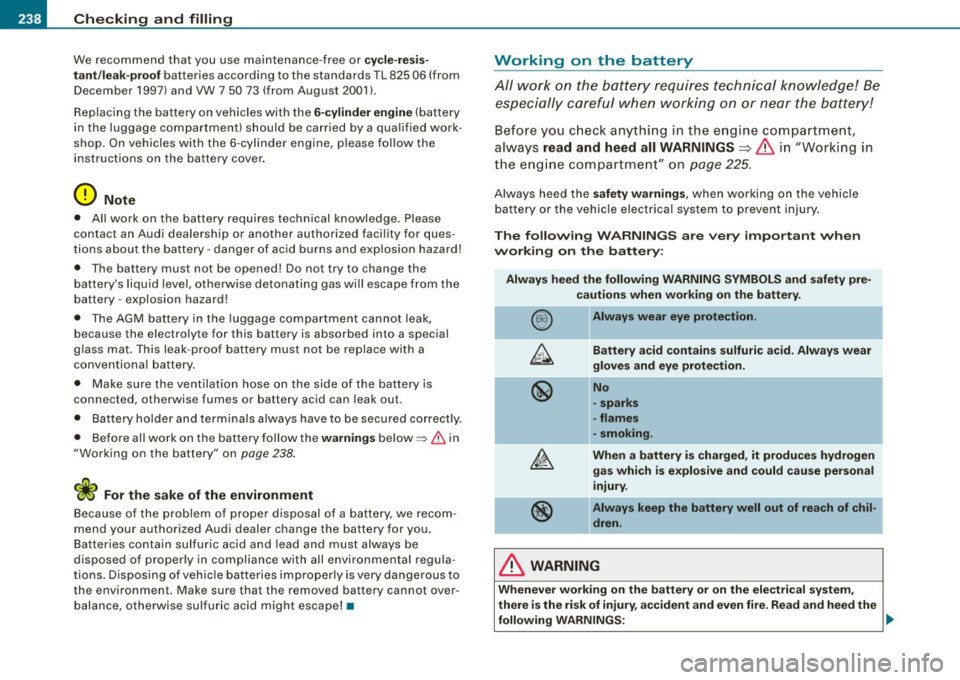
The following WARNINGS are very important when
working on the battery:
Always heed the following WARNING SYMBOLS and safety pre cautions when working on the battery.
@
Always wear eye protection.
Battery acid contains sulfuric acid. Always wear
gloves and eye protection.
No
- sparks
- flames
- smoking.
When a battery is charged, it produces hydrogen
gas which is explosive and could cause personal
injury.
Always keep the battery well out of reach of chil
dren .
& WARNING
Whenever working on the battery or on the electrical system,
there is the risk of injury, accident and even fire. Read and heed the
following WARNINGS:
~
Page 247 of 324
________________________________________________ T_ i _r_e _s_ a_n_ d_ w_ h_ e_e _ l_s __ _
•
Groove
means the space between two adjacent tread ribs.
Load ra ting (code)
means the maximum load that a tire is rated to carry for a given
inflation pressure. You may not find this information on all tires
because it is not required by law.
M ax im um l oad ra tin g
means the load rating for a tire at the maximum permissib le infla
tion pressure for that tire.
Ma ximum l oaded v ehi cle weigh t
means the sum of:
(a) Curb weight
(b) Accessory weight
(c) Vehic le capacity weight, and
(ct) Production options weight
M ax im um (p er mi ssibl e) infl ati on pr essur e
means the maximum cold inflation pressure to wh ich a tire may be
inflated. Also ca lled "maximum inflation pressure."
Normal occ upa nt wei ght
means 150 lbs. (68 kilograms) times the number of occupants
seated in the vehicle up to the to tal seating capacity of your vehicle.
O ccupant di stributi on
means distribution of occupants in a vehicle .
Outer di am eter
means the overall diameter of an inflated new tire.
O ve rall wi dth
means the linear distance between the exteriors of the sidewa lls of
an inflated tire, includ ing elevations due to labeling, decorations, or
protective bands or ribs.
Pl y
means a layer of rubber -coated para lle l cords.
P rodu ction opt io ns wei ght
means the combined weight of those installed regular production
options weighing over 5 lbs . (2.3 kg) in excess of those standard
i t ems wh ich they replace, not previously considered in curb weigh t
or accessory weight, including heavy duty brakes, ride levelers, roof
rack, heavy duty battery, and specia l trim .
Radi al p ly tire
means a pneumatic tire in which the ply cords that extend to the
beads are laid at substantially 90 degrees to the centerline of the
tread .
Reco mm ended infl ati on pr essu re
see => page 244, "Cold tire inflation pressure".
Rein force d tir e
means a tire designed to operate at higher loads and at higher infla
tion pressures than the corresponding standard tire. Reinforced
t ires my be identified as "XL", "xi", "EXTRA LOAD", or "RF" on the
sidewall.
R im
means a metal support for a tire or a tire and tube assembly upon
wh ich the t ire beads are seated.
Rim di amet er
means nominal diameter of the bead seat. If you change your whee l
size, you wi ll have to purchase new tires to match the new rim diam
eter .
Rim siz e de sig nation
means rim diameter and width.
Rim wid th
means nominal distance between rim flanges.
Vehicle care I t •
Page 270 of 324
___ T _i_r e_=- p_r_e _ s_ s_ u_r_ e _ m_ o_ n_i_t _o _r_ i _ n .,;:g ::;.._ s_ y=--- s_t _e _m_ * __________________________________________ _
• A wheel sensor or other component may have failed.
• During ini tializat ion the system has detected more tha n 4 wheels
on the vehicle, for example whi le driving next to another car with a
tire pressure monitoring system.
• A wheel change was made but the button
:=:, page 266, fig. 186
was not pressed.
• Audi Genuine Parts were not used for parts replacement .
• If snow chains are being used, system function can be compro
mised due to the shielding properties of the chains.
• The tire pressure monitoring system may not be avai lable
because of a radio malfunction.
• Transmitters with the same frequency, such as radio head
phones in the vehic le or radio equipment, can cause a temporary
disruption of the system through excessive electromagnetic fields .
• Eliminate the interference if possible and then proceed as
follows: Turn off the engine for 20 minutes. Then drive another 10
min. If the warning light comes on again, you shou ld con tact your
authorized Audi dealer immediately to have the prob lem corrected.
• Do not use commercially avai lab le tire sea lants . Otherwise, the
e lectrica l components of the tire pressure monitoring system wi ll
no longer work properly and the sensor for the tire p ressure moni
toring system wil l have to be rep laced by an authorized Audi dealer
or o ther qua lified workshop .•
Certification
This device complies with part 15 of the FCC rules and RSS -210.
Operation is subject to the following conditions:
• this device may not cause harmful interference, and
• this device must accept interference rece ived, including interfer
ence that may cause undesired operation.
The receiver 5WK49069 uses the same schematic, assemb ly, layout
and PCB as 5WK49097 . 5WK49097 is a multi channel receiver and 5WK49069 is a single channe
l receiver . They only differ in : SAW
Filter V1 _4 was changed from A2C00038979 to V1 _2 A2C00032378,
Inductor L5_3 and L6_233nH were changed to L5 _2 and L6 _247nH .
BAND PASS FILTER V3_2 was changed from A2C00038762 to V3_3
A2C00036085. V10 : ATIC75 C1, A2C000029505 was changed to V10 :
ATIC75 C2-Light, A2C000043220 . Q1 14.246MHz A2C00037710 was
changed to Q1 15.27MHz A2C00041280 . The BAND PASS FI LTER V2
is not populated .
These modifica tions were necessary to optimize the characteris tic
of the receiver.
Proof is shown with test report T30739 -00 -00KJ issued by Mikes
Testingpartners GmbH, Ohmstral5e 2-4 , 94342 Strasski rchen that
the receiver is be low the limit .•
Page 283 of 324

_________________________________________________ F_ u_ s_ e_s _ a_n _d_ b_ u _ lb_ s _ __._
The various electrical circuits are protected by fuses. The fuses are
clustered in a centralized unit. The unit is located behind the face
panel at the end of the instrument panel. The crank for operating
the sunroof in case of a power failure is a lso stored behind the face
panel
~ page 49.
Two spare fuses and a sticker identifying the fuses are located on
the inside of the fuse box cover.
You are well advised to keep a supply of spare fuses in your vehicle .
Fuses with the proper ampere ratings are available at your autho
rized Audi dealer.
& WARNING
Never replace a fuse with one that has a higher amperage rating.
• A fuse with a too high amperage could damage the electrical
part and cause a fire .
0 Note
• On no accoun t should fuses be repaired (e.g . patched up with tin
foil or wire) as this may cause serious damage elsewhere in the elec
trical circuit or cause fire.
• If a fuse blows repeatedly, do not keep replacing it. Instead, have
the cause for the repeated short circuit or overload tracked and
fixed. •
Fuse Location , Instrument Panel left
Fus es which can be replaced.
Fig . 201 Fuse carrier
behind the instrument
panel end face, cover
removed
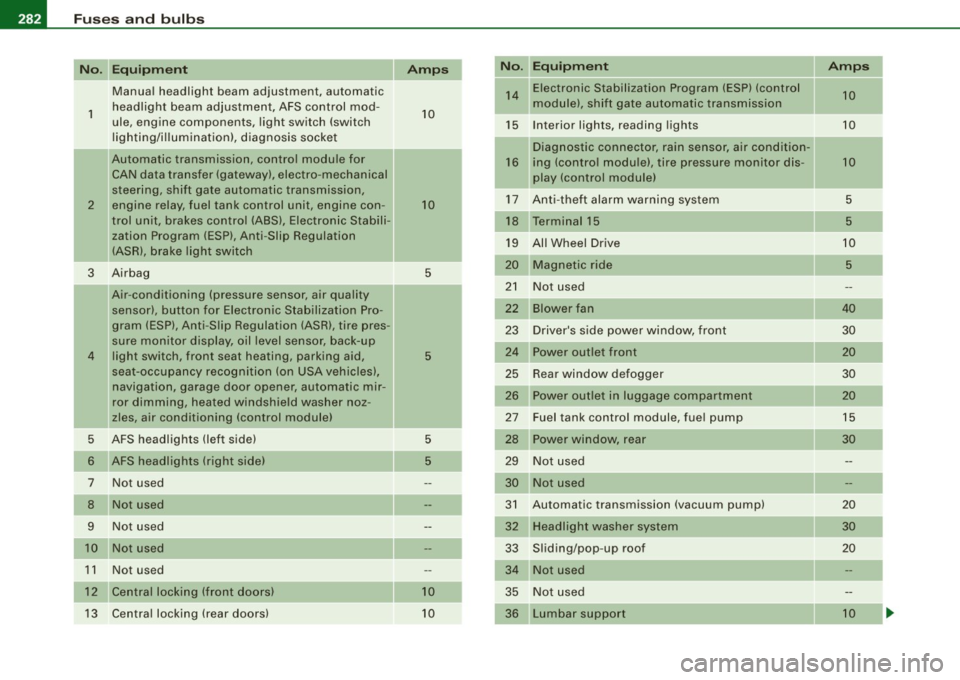
Note that the following table is accurate at the time of going to
press and is subject to change. In the event of discrepancies , the
label on the inside of the cover always takes precedence .
The power seats are protected by circuit breakers, which automati
cally reset after a few seconds after the overload has been reme -
died. .._
Vehicle care Do-it-yourself service irechnical data
Page 284 of 324
11111.___F_ u_ s _ e_s _ a_n _ d_ b_ u_lb _ s _______________________________________________ _
Equipment Amps No. Equipment Amps
Manual headlight beam adjustment, automatic 14 Electronic Stabilization Program (ESP) (control
10
1 headlight beam adjustment, AFS control mod-
10 module),
shift gate automatic transmission
ule, engine components, light switch (switch
15 Interior lights, reading lights 10
lighting/illumination), diagnosis socket
Diagnostic connector, rain sensor, a ir condit ion-
!! Automatic transmission, control module for
16 ing (control module), tire pressure monitor dis- 10
CAN data transfer (gateway), electro -mechanical
play (control module)
steering, shift gate automatic transmission, 17 Anti-theft alarm warning system 5
2 engine relay, fuel tank control unit, engine con
-10
trol unit, brakes control (ABS), Electronic Stabili- 18 Terminal 15
5
zation Program (ESP), Anti -Slip Regulation
19 All Wheel Drive
10
(ASR), brake light switch
-20 Magnetic ride 5
3 Airbag
5
-21 Not used
Air -conditioning (pressure sensor, air quality
sensor), button for Electronic Stabilization Pro- 22
Blower fan 40
gram (ESP), Anti -Slip Regulat ion (ASRl, tire pres -
23 Driver's side power window, front 30
sure mon itor display, oil level sensor, back-up
4 light switch, front seat heating, parking aid, 5 24 Power outlet front
20
seat-occupancy recognition (on USA vehicles), 25 Rear window defogger 30
navigation, garage door opener, automatic mir- 26 Power outlet in luggage compartment 20
ror dimming, heated windshield washer noz-
zles, air conditioning (control module) 27 Fuel tank control module, fuel pump 15
5 AFS headlights (left side)
5 28 Power
window, rear
30
6 AFS headlights (r ight side) 5 29 Not used
7 Not used 30 Not used
8 Not used 31 Automatic transmission (vacuum pump)
20
9 Not used 32 Headlight washer system 30
10 Not used
33 Sliding/pop-up roof
20
1 1 Not used 34 Not used
12 Central locking (front doors} 10 35 Not used
13 Central locking (rear doors) 10
36 Lumbar
support 10
Page 301 of 324
_________________________________________________ G_ e_ n_ e_r _a _l_ i_n _f_o _ r_ m_ a_ t _i _o _ n __ lftlll
left door jamb. It shows the month and year of production and the
vehicle identification number of your vehicle (perforation) as well as
the Gross Vehicle Weight Rating (GVWR) and the Gross Axle Weight
Rating (GAWR).
The high voltage warning label
is located on the lock carrier.
The spark ignition system complies with the Canadian
standard ICES-002. •
Weights
Gross Vehicle Weight Rating
The Gross Vehicle Weight Rating (GVWR), and the Gross Axle Weight
Rating (GAWR) for front and rear are listed on a sticker on the left
door jamb.
The Gross Vehicle Weight Rating includes the weight of the basic
vehicle plus full fuel tank, oil and coolant, plus maximum load,
which includes passenger weight (150 lbs/68 kg per designated
seating position) and luggage weight.
Gross Axle Weight Rating
The Gross Axle Weight Rating is the maximum load that can be
applied at each axle of the vehicle ~& .
Vehicle capacity weight
The vehicle capacity weight (max. load) is listed either on the
driver's side B-pillar or inside the fuel filler flap .
Roof weight
The maximum permissible roof weight is 165 lb (75 kgl. The roof
weight is made up of the weight of the roof rack system and the
weight of the object being transported~
page 91, "Loading the
roof rack".
Controls and equip ment Safety first Vehicle operation
& WARNING
•
The actual Gross Axle Weight Rating at the front and rear axles
should not exceed the permissible weights, and their combination
must not exceed the Gross Vehicle Weight Rating.
• Exceeding permissible weight ratings can result in vehicle
damage, accidents and personal injury.
0 Note
• The vehicle capacity weight figures apply when the load is
distributed evenly in the vehicle (passengers and luggage). When
transporting a heavy load in the luggage compartment, carry the
load as near to the rear axle as possible so that the vehicle's
handling is not impaired.
• Do not exceed the maximum permissible axle loads or the
maximum gross vehicle weight. Always remember that the vehicle's
handling will be affected by the extra load. Therefore, adjust your
speed accordingly.
• Always observe local regulations.•
Dimensions
The specifications refer to the basic model. Differences may occur
depending on the model type and options ordered, for example, tire
sizes.
0 Note
When driving up steep ramps, on rough roads, over curbs, etc. it is
important to remember that some parts of your vehicle, such as
spoilers or exhaust system components, may be close to the
ground. Be careful not to damage them. •
Vehicle care Do-it-yourself service Tec hn ica l da ta
Page 302 of 324
___ D_ a_t _a ________________________________________________________ _
Data
Applies to vehicles: with 2.0 liter TFSI 4-cy l. engine ,
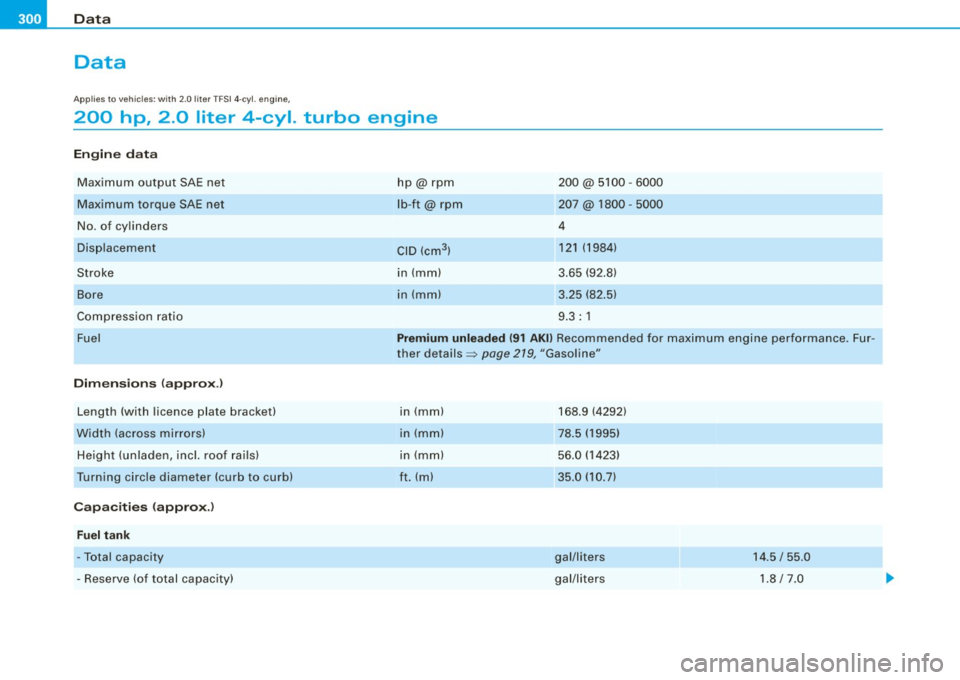
200 hp, 2.0 liter 4-cyl. turbo engine
Engine data
Maximum o utpu t SAE net
Maximum torque SAE net
No . of cy linders
Di spl aceme nt
Stro ke
Bore
Com press ion ra tio
Fuel
Dimens ions (appro x.)
Length (with licence plate brac ket)
Width (across mi rrors)
Heigh t (u nlade n, incl. roof rails)
T urning circle diameter (curb to curb)
Capacities (approx .)
Fuel tank
- Total capacity
- Reserve (of to tal capac ity) h
p@rp m
lb -ft@ rpm
CID (cm
3 )
in (mm)
in (mm)
200@ 5100 -6000
207 @ 1800 -50 00
4 121 ( 1984)
3.65 (9 2.8)
3.25 (82.5)
9 .3 : 1
Premium unleaded (91 AKI) R ecommended for maxi mum engine per formance . Fur
ther details =:>
page 279, "Gasoline"
in (mm)
in (m m)
in (m m)
ft. (ml
168.9 (429 2)
78 .5 (1995)
56.0 (1 423 )
35. 0 (10.7)
ga l/liters
gal/ liters 1 4 .5 / 55.0
1 .8/7. 0