warning lights AUDI S3 2009 Owner's Manual
[x] Cancel search | Manufacturer: AUDI, Model Year: 2009, Model line: S3, Model: AUDI S3 2009Pages: 324, PDF Size: 76.02 MB
Page 60 of 324
Clear vision
Igniti on ON , light swit ch at ::oo: or fD .
With the lights switched on, the brightness of instrument cluster
!i.e . needles, gauges and displays) and center console il lumination
can be adjusted.
0 Note
The instrument cluster and cent er console illumina tion (gauges and
needles) comes on when you swi tch on the igni tion and the
vehi cle
h eadlights are off .
Be aware of the following difference between
models built to US or Cana dian speci fica tions :
• USA model s: illumination of the in strument clu ster (gauges and
needle s), dash and center con sole around the gear shift lever i s
c o ntrolled by a light sensor lo cated in the instrument panel. The
i n strument panel ill umination will automatically become dimmer
a s th e daylight fades awa y and eventu ally w ill go out completel y
when outside l ight i s very low . Thi s is to remind you , the driver , to
swi tch on the headlight s befo re it get s to o dar k.
• Canada models: in strument panel illumination will stay bright
re gardle ss of the i ntens ity of ambient light . Al wa ys be aware of
change s in out sid e light conditi ons while you are d riving. Re spond
i n time t o fading daylight by turn ing the light swit ch to posit ion
fD
(or "AUTO" if your car is equipped with this feature) to turn on your
headlights . •
Ap plies to vehi cles: with b i-xeno n headli ghts
Bi-Xenon headlights*
After starting the engine, the bi -xenon headlights are automatica lly
adjus ted to the load and angle of the vehic le (for example , during
acce lerat ion and brak ing) . This prevents oncoming traffic fro m
experiencing unnecessary headlight g lare from your bi-xenon head
lights .
If the system is not operating properly, a warning symbol in the
Auto -Check Control is displayed ::::;,
page 33. •
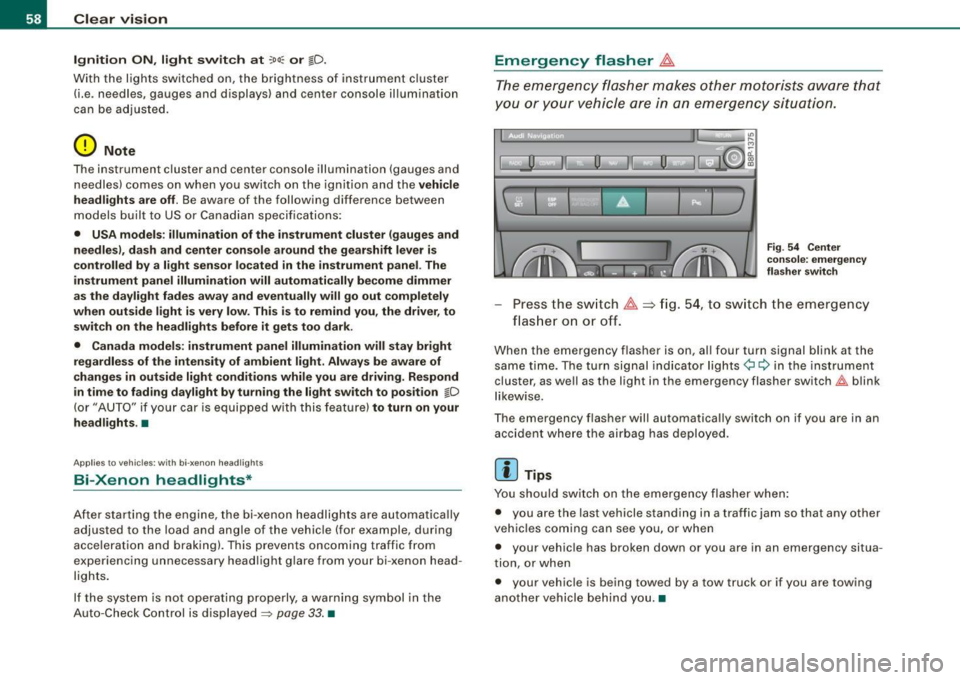
Emergency flasher ~
The emergency flasher mak es othe r moto rists aware that
you or your vehicle are in an emergency situation.
1 1 Q
-
II D ll1
[ Ii J
a
l 'l
"' " "'
J
Fi g. 5 4 Cen ter
co nso le : em erge ncy
fl as her swi tc h
Press the sw itch ~==>fig. 54, to sw itch the emergency
flas her on or off.
When the emergency flasher is on, al l four turn signal blink at the
same time. The turn signal indicator lights¢ Q in the inst rument
cluster, as we ll as the light in the emergency flasher switch~ blink
l ikew ise.
The emergency flasher will automatically switch on if you are in an accident where the airbag has deployed .
[ i ] Tips
You should switch on the emergency flasher when :
• you are the last vehicle standing in a traffic jam so that any other
veh ic les coming can see you, or when
• your vehic le has broken down or you are in an emergency situa
tion, or when
• your vehicle is being towed by a tow truck or if you are towing
another vehicle behind you. •
Page 68 of 324

Clear vision
& WARNING
Wiper blades are crucial for safe driving! Only in good condition
are they able to clear the windows properly to provide unre
stricted visibility. Worn or frayed wiper blades are a safety hazard!
=> page 67, "Replacing front wiper blades"
(D Note
In freezing or near freezing conditions:
• Always check that the wiper blades are not frozen to the glass
before you turn the wiper on. Loosen a wiper blade which is frozen
in place before operating the wiper to prevent damage to the wiper
blade or the wiper motor.
• Do not use the wiper to clear a frosted window . Using the wipers
as a convenient ice scraper will destroy the wiper blades.
[ i J Tips
For better rearward vision when parking, the rear window wiper is
automatically activated one time when the windshield wipers are
switched on and reverse gear is engaged. •
Applies to vehic les: w ith head light washer system
Headlight washer system
The headlight washer system cleans the headlights.
-Operate the windshield wiper/washer system=> page 63,
fig. 64 © with the headlights turned on by holding the
lever for longer than one second.
The washer jets extend forward out of the front bumper driven by
water pressure to spray the front headlights with water.
You should inspect the headlights regularly (for example when refu
eling) and clean off any solid dirt or insects from the lenses. To
ensure the system works properly in winter, keep the washer jets
free of snow and remove any ice using a de -icing spray. •
Service position
Replacing the windshield wiper blades is only possible
when you move the wiper arms into the service position. In
order to use the windshield wipers, the hood must be
completely closed. When there is a risk of frost, make sure
that the wiper blades are not frozen to the windshield.
Switch the ignition on.
Act ivate the service position by way of the driver infor
mation system =>
page 23.
(D Note
Never drive your vehicle when the windshield wiper arms are in the
service position and pulled away from the windshield. When you
drive faster than 4 mph (6 km/h), the wiper arms automatically
return back to the park position and could cause paint damage to
the engine hood!
[ i] Tips
• You can also turn on the service position, for example, if you
want to protect the windshield from icing by using a cover.
• Th e service position moves to
off automatically when you
operate the windshield wiper lever, or speed exceeds 4 mph
(6 km/h). •
Page 71 of 324
& WARNING (continued)
• For safety reasons, the windshield wiper blades should be
replaced once or twice a year. •
Mirrors
Manual anti -glare adjustment
Standard setting
- Move the small lever (located on the bottom edge of the
mirror) to the front.
Anti-glare setting - Move the small lever (located on the bottom edge of the
mirror) to the rear. •
Applies to veh icles: w it h a utom ati cally dim mi ng in sid e m ir ro r
Automatically dimming inside mirror
The automatic dimming function can be turned on and off
if required.
Controls and equip
ment
Fig . 69 Inside rear
view mirror
Clear vision
Disabling auto dimming
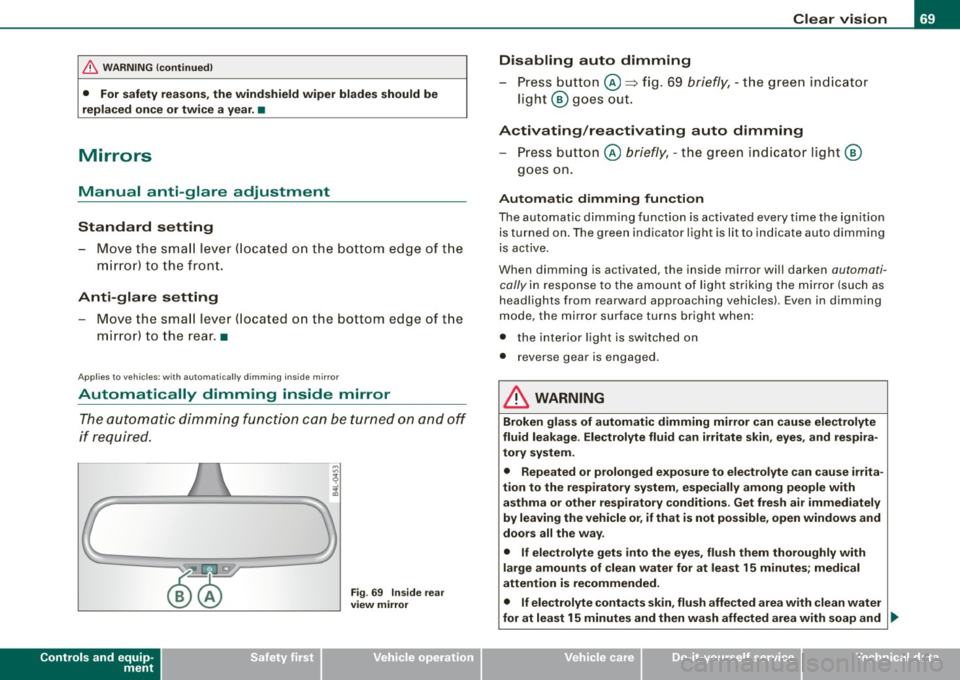
- Press button @=> fig. 69
briefly, -the green indicator
light ® goes out.
Activating/reactivating auto dimming Press button @
briefly, -the green indicator light ®
goes on.
Automatic dimming function
The automatic dimming function is activated every time the ignition
is turned on. The green indicator light is lit to indicate auto dimming
is active.
When dimming is activated, the inside mirror will darken
automati
cally
in response to the amount of light striking the mirror (such as
headlights from rearward approaching vehicles). Even in dimming
mode, the mirror surface turns bright when:
• the interior light is switched on
• reverse gear is engaged .
& WARNING
Broken glass of automatic dimming mirror can cause electrolyte
fluid leakage . Electrolyte fluid can irritate skin, eyes, and respira
tory system.
• Repeated or prolonged exposure to electrolyte can cause irrita
tion to the respiratory system, especially among people with
asthma or other respiratory conditions . Get fresh air immediately
by leaving the vehicle or, if that is not possible, open windows and
doors all the way.
• If electrolyte gets into the eyes, flush them thoroughly with
large amounts of clean water for at least 15 minutes; medical
attention is recommended.
• If electrolyte contacts skin, flush affected area with clean water
for at least 15 minutes and then wash affected area with soap and ._
I • •
Page 73 of 324
and farther away than when seen in a flat mirror. If you use this
mirror to esti mate distances of fo llowing vehicles when changing
lanes, you cou ld es timate incorrectly and cause an accident .
[ i] Tip s
If there shou ld be a malfunction in the electrica l system, you can
sti ll adjust the outside mirrors by pressing the edge of the mirror .•
Ap plie s to v ehicl es: wit h autom atic dim ming for out side m irro rs
Automatic dimming for outside mirrors
The outside mirrors are dimmed together with the automatic
dimming of the inside mir ror . When the ignition is switched on, the
mirrors darken automatical ly depending on the light striking them
(e .g. head lights from the rear) .
When the interior lighting is switched on and when reverse gear is
engaged , the mirrors are swi tched back to their original brightness
(not dimmed).
& WARNING
Broken glas s of automatic dimming mirror can c ause electrolyte
fluid le akage. Electrolyte fluid can ir ritate s kin , eyes , and re spir a
tory system .
• Repeated or prolonged e xposure to ele ctro lyte can cau se irrita
tion to the respi ratory sy stem , e specially among people with
asthm a or other respir atory co ndition s. G et fresh a ir i mmediately
by leaving the veh icle or , if that is not po ssible , open windows and
do ors all the way.
• If electrolyte get s into the eyes , flush them thoroughly with
large amounts of clean wate r fo r at least 15 minut es; medi cal
attention i s recommended .
• If ele ctrolyte cont acts sk in , flu sh affe cted are a with clean w ater
for at lea st 15 minute s and then wash affected area with soap and
Controls and equip
ment
Cl ea r vision
& WAR N IN G ( continued )
water; medic al attent ion is re commend ed . Thoroughly wash
affected clothing and shoes before reu se .
• If swallowed and person i s cons ciou s, rinse mouth w ith w ater
for at lea st 1 5 minute s. Do not indu ce vomitin g unles s instructed
to do so by medic al profession al. Get medi cal attent ion immed i
ately.
0 Note
Electrolyte leaki ng from a broken mirror g lass at tacks the veh ic le
paint and plastic surfaces . C lean up spilled electrolyte immediately
with c lear water and a sponge.
[ i ] Tips
• If automatic dimming for the inside mirror is swit ched off , the
out side m irrors are also not dimmed automati cally.
• Automatic di mming for the mirror only operates proper ly if the
sunshade * for the rear window is retracted, or the light striking the
ins ide mirror is not hindered by other ob jects. •
I • •
Page 97 of 324
Glove compartment
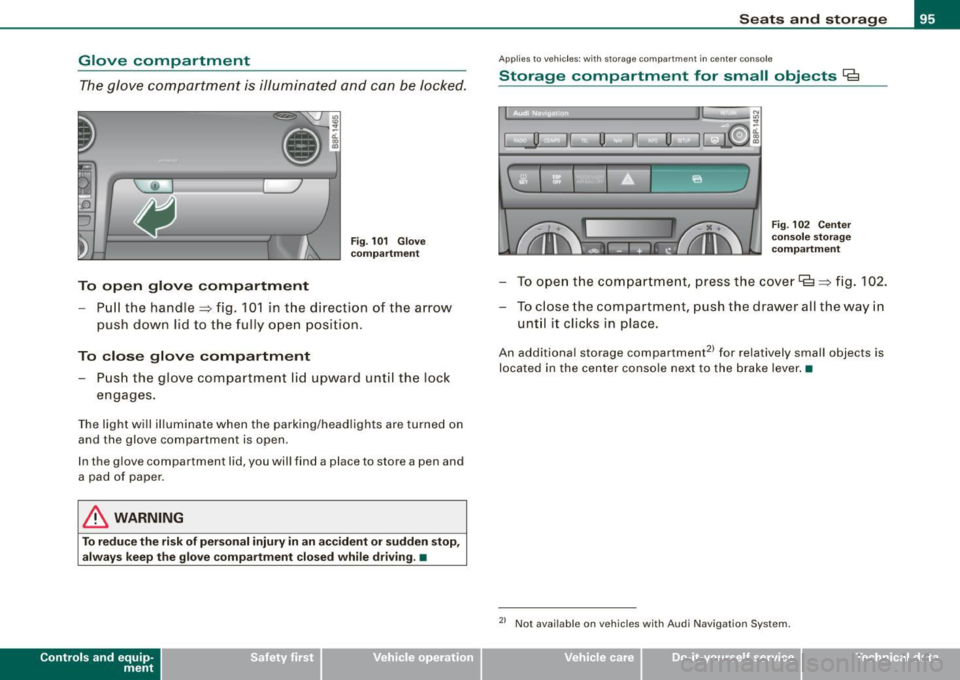
The glove compa rtmen t is illumin ated an d can be Jocke d.
"' 10 ., ~ a:. ., 03
To open glove compartment
Fi g. 101 Glove
c ompartment
- Pull the handle => fig. 10 1 in t he direction of the a rrow
p ush do wn lid to the fully o pen p osition .
To close glove compartment - Push the glove compartment lid upward unt il the loc k
engages.
T he light will il luminate when the parking/head lights are turned on
and the glove compartme nt is ope n.
I n the g love compartment lid, you wil l find a place to store a pen and
a pad of paper.
& WARNING
To reduce the risk of per sonal injury in an accident or sudden stop ,
always keep th e glove compa rtment closed while driving . •
Con tro ls and eq uip
ment
Seats and storag e
Applie s to veh ic les : w it h stora ge co mpart ment in cente r co nsole
Storage compartment for small objects Ca
I, __] II 0
l
l
I~ u
I
' Fig . 102 Center
c o nso le st orag e
co mpartm ent
- T o open th e c om partm ent, pre ss t he c ove r lg => fig. 102.
- To c lose the compa rtment, push the drawe r all the way in
unt il it clic ks in place.
An additiona l storage compartment2 1 for relatively small objects is
located in the cen ter console ne xt to the brake lever .•
2> Not avai lab le on veh ic le s with Audi Nav igat ion System .
Vehicle care I I irechnical data
Page 110 of 324
• ..__O_ n_ t_h _ e_ r_ o_ a_ d ____________________________________________________ _
Ignition lock and ignition switch
Ignition lock
The engine can be s tar ted or tu rned off with the ignition
key.
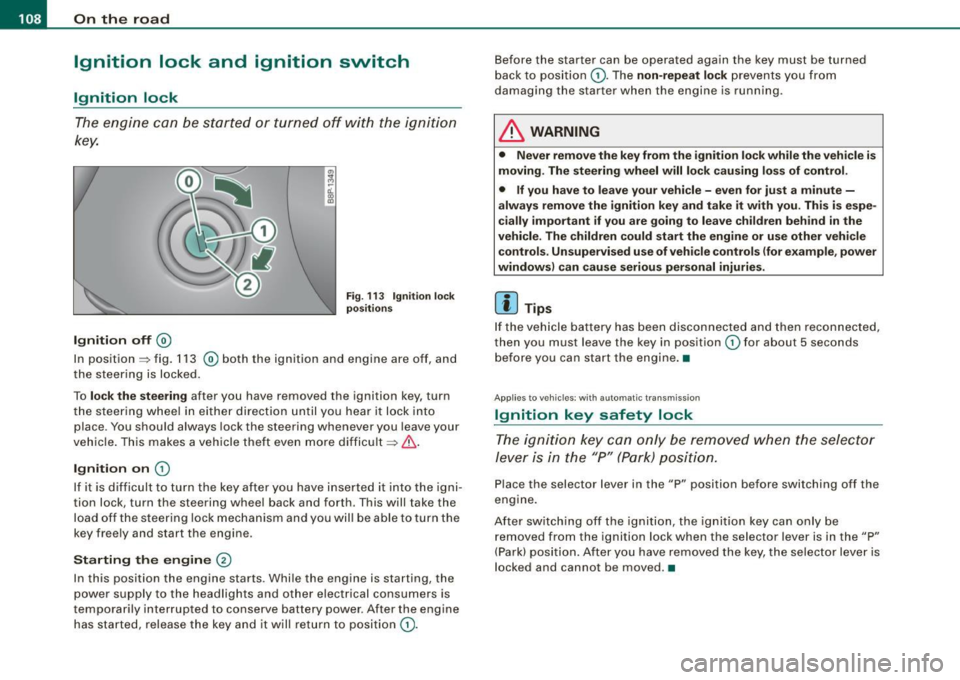
Ignition off ®
Fig . 11 3 Ignit ion lock
po sition s
In position => fig. 113 ® both the ignit ion and engine are off, and
the steering is locked .
To
lo ck the stee ring after you have removed the ignition key, turn
t he steering whee l in either direction until you hear i t lock into
place . You should always lock the steering whenever you leave your
vehic le . This makes a vehicle theft even more difficult => & .
Ignition on G)
If it is difficult to turn the key af ter you have inserted i t into the igni
tion lock, turn the steering wheel back and forth . This will take the
load off the steering lock mechanism and you wil l be able to turn the
key freely and start the engine .
Starting the engine @
In this position the engine starts . Whi le the engine is starting, the
power supply to the headlights and o ther elec trical consumers is
temporari ly interrupted to conserve battery power . After the engine
has started, release the key and it will return to position
G).
Before the starter can be operated again the key must be turned
back to posi tion
G) . The non -repeat lock prevents you from
damaging the starter when the engine is running.
& WARNING
• Never remove the key from the ign ition lo ck w hile the veh icle is
moving. The steering wheel will lo ck causing lo ss of control .
• If you h ave to leave your vehicle -even for just a minute -
alway s remove the ignition key and take it w ith you . Thi s is es pe
c ially important if you are going to leave ch ildren behind in the
vehicle. The children could start the engine or u se other vehi cle
c ontrol s. Unsupervi sed u se of veh icle cont rol s ( for e xamp le , powe r
window s) can cau se serious per sonal injurie s.
[ i ] Tips
If the veh icle battery has been disconnected and then reconnected,
then you must leave the key in position
G) for about 5 seconds
before you can start the engine .•
Ap plies to ve hicl es: w ith a utom at ic tra nsmi ss io n
Ignition key safety lock
The ign ition key can only be rem oved when the selec tor
le ver i s in the "P" (Par k) p osition.
Place the selector lever in the "P" position before switching off the
engine .
After switching off the ignition, the ignition key can only be
removed from the ignition lock when the se lector lever is in the "P"
(Park) position. A fter you have removed the key , the selector lever is
locked and cannot be moved .•
Page 115 of 324

On the road -
-------------------'
- Press the switch P111A in the center console ::::, page 112,
fig. 115. A short confirmation tone sounds and the diode
in the switch lights.
Switching off
-Drive forward faster than 10 mph (15 km/h), or
press the switch
P" 'A or
- switch off the ignition.
& WARNING
• The parking assist cannot replace the driver's attention. The
driver alone is responsible for parking and similar driving maneu
vers. Always watch where you are driving.
• Sensors have blind spots in which objects cannot be detected.
Pay special attention to small children and animals. They cannot
always be detected by the sensors -danger of an accident!
• Always pay attention to the area around the vehicle -using the
rearview mirror, too .
0 Note
Low obstacles already signaled by a warning can disappear from
the system's detection range as they are approached and will not
continue to be signaled. Objects such as barrier chains, trailer draw
bars, thin painted vertical poles, or fences may not be detected by
the system -risk of damage.
[ i] Tips
You can change the volume and pitch of the signals~ page 23. •
Con tro ls and eq uip
ment
Cruise control
Switching the system on
The cruise control system makes it possible to drive at a
constant speed starting at 20 mph (30 km/h).
A 1----....;
Fig. 116 Control lever
with set button
Fig . 117 Display:
Selected speed
- Pull the lever to position (D::::, fig. 116 to switch the
system on.
- Drive at the speed you wish to set.
- Press button
© to set that speed.
The display~ fig. 117 will show the set speed. The display may vary
depending on the type of display in your vehicle. The indicator light _.,
Vehicle care I I irechnical data
Page 129 of 324

________________________________________________ D_r_iv _ i _n_ g~ S_ a_ fe_ ly __ !II
Important things to do before driving
Safety is everybody's job! Vehicle and occupant safety
always depends on the informed and careful driver.
For your safety and the safety of your passengers, before
driving always:
-Make sure that all lights and signals are operat ing
correctly.
- Make sure that the tire pressure is correct.
- Make sure that all windows are clean and afford good
visibility to the outside.
- Secure all luggage and other items carefully =>
page 94.
-Make sure that noth ing can interfere w ith the pedals.
- Adjust front seat, head restraint and mirrors correctly for your height .
- Instruct passengers to adjust the head restraints
according to their height.
- Make sure to use the right ch ild restraint correctly to
protect children =>
page 169, "Child Safety ".
- Sit properly in your seat and make sure that your passen
gers do the same=>
page 74, "General recommenda
tions".
- Fasten your safety belt and wear it p roperly. Also instruct
your passengers to fasten the ir safety belts properly
=>
page 137. •
Controls and equip
ment Safety first
Vehicle operation
What impairs driving safety?
Safe driving is directly related to the condition of the
vehicle, the driver as well as the driver's ability to concen
trate on the road without being distracted.
The driver is responsible for the safety of the vehicle and all
of its occupants. If your ability to drive is impaired, safety
risks for everybody in the vehicle increase and you also
become a hazard to everyone else on the road =>& .There
fore:
Do not let yourself be distracted by passengers or by
using a cellular telephone .
NEVER drive when your driving ability is impaired (by
medications, alcohol, drugs, etc.).
- Observe all traffic laws, rules of the road and speed limits
and plain common sense .
- ALWAYS adjust your speed to road, traffic and weather
conditions.
- Take frequent breaks on long trips. Do not drive for more
than two hours at a stretch.
- Do NOT drive when you are tired, under pressure or when
you are stressed .
& WARNING
Impaired driving safety increases the risk of serious personal
injury and death whenever a vehicle is being used. •
Vehicle care Do-it-yourself service Technical data
Page 140 of 324

___ S_a_ f_ e_ t-= y_ b_e_ l_ t _s _______________________________________________ _
- Make sure that your passengers also b uckle up and prop
erly wea r th eir sa fety belts.
Protect children wit h a child restraint system appropriate
for the size and age.
The warning light i in the instrument cluster lights up when the
ignition is switched on as a reminder to fasten the safety belts. In
addition , you will hear a warning tone.
After the ignition is switched on, the warning light in the instrument cluster will a lways come on for about 6 seconds and if the driver has
not fastened the safety belt, a warning tone will also sound for
about 6 seconds . As soon as the driver has fastened the safety belt,
the warning tone will stop and the warning light will go out .
If the driver or front seat passenger have not buckled -up within
about 10 seconds after the warning tone has stopped and the
vehicle is moving faster than about 15 mph, the warning tone will
sound again for about 6 seconds and then stop for 24 seconds and
then repeat this reminder sequence for a maximum of 2 minutes. At
speeds be low 5 mph, the warning tone will not sound.
Fa sten your safe ty belt and m ake su re that your p assengers also
properl y put on th eir s afet y belts .
& WARNING
• Safety belt s are the single mo st effective mean s available to
reduce th e risk of ser ious injur y and death in a utomobile acci
dent s. For your prote ction and th at of your pas senger s, alwa ys
c orre ctl y we ar safety belt s when t he vehicle is moving .
• Failure t o pay att ention to th e warning light that co me on,
c ould lead to per sonal injury .•
Why safety belts?
Frontal co11isions and the law of physics
Front al crashes create very strong forces for pe ople riding
in vehicles.
F ig. 13 3 Unbel ted
o cc up ants i n a ve hicle
he ading for a wa ll
Fi g. 13 4 The vehi cle
c ras hes in to t he wa ll
The physical principles are simple. Both the vehicle and the passen
gers possess energy which varies with vehicle speed and body
we ight . Engineers cal l this energy "kinetic energy ."
T he higher the speed of the vehicle and the greater the vehic le's
we ight, the more energy that has to be "absorbed" in the crash .
Vehicle speed is the most significan t factor. If the speed doubles
from 15 to 30 mph (25 to 50 km/h), the energy increases 4 times! .,
Page 198 of 324
__ _:_:ln..:..t::.: e::.: l~ li :.;:g t:e::..: n..:.. t:...::. te::::..:: c~h :.:.n .:..: o:::.: l:.: o :.;g~ yL- ________________________________________ _
speed. This is most noticeable when turning the steering wheel at
low speeds (for example when parking), -more effort will be
required than usual.
• Be aware of the different than usual steering response and
adjust your steering force accordingly.
• Have the problem checked and set right by an authorized Audi
dealer as soon as possible.
• If a steering malfunction occurs, this is signaled with the or.
@ indicator lights and a warning tone, see.
[ i) Tips
• If the power steering system should fail, or if the engine is not
running (for example, while being towed), you will still be able to
steer the vehicle. However, more effort will be required to do so.
• If the power steering system is not functioning properly, contact
your authorized Audi dealer immediately.
Applies to vehicles: with All Wheel Drive
Driving with your quattro®
With All Wheel Drive, all four wheels are driven.
General information
With All Wheel Drive, power is distributed to all four wheels. This
happens automatically depending on your driving style and the
road conditions at the time. See also::::,
page 191, "Electronic differ
ential lock (EDU".
Winter tires
When driving in the winter, your vehicle with All Wheel Drive has an
advantage, even with regular tires. In winter road conditions it may
be advisable to mount winter tires (or all -season tires) for improved
driveability and braking: these tires must be mounted on
all four
wheels.
See also ::::, page 260, "Winter ti res".
Snow chains
Where snow chains are mandatory on certain roads, this normally
also applies to vehicles with all-wheel drive:::::,
page 261, "Snow
chains".
Replacing wheels/tires
Vehicles with All Wheel Drive must always have tires of the same
size. Also avoid tires with different tread depths. For details see
page ::::,
page 255, "New tires and replacing tires and wheels".
Off-Road driving?
Your Audi does not have enough ground clearance to be used as an
off-road vehicle. It is therefore best to avoid rough tracks and
uneven terrain as much as possible. Also refer to::::,
page 199.
& WARNING
Always adjust your driving to road and traffic conditions. Do not
let the extra safety afforded by the all-wheel drive tempt you into
taking extra risks.
• Although the quattro ®all-wheel drive is very effective, always
remember that braking capacity is limited by tire traction. You
should therefore not drive at excessive speeds on icy or slippery
road surfaces.
• On wet road surfaces, be careful not to drive too fast because
the front wheels could begin to slide on top of the water (hydro planing). If this should occur, you will have no warning from a
sudden increase in engine speed as with a front-wheel drive
vehicle. Always drive at speeds which are adjusted to the road
conditions -risk of crash!
n