warning AUDI S3 2010 Owners Manual
[x] Cancel search | Manufacturer: AUDI, Model Year: 2010, Model line: S3, Model: AUDI S3 2010Pages: 320, PDF Size: 75.34 MB
Page 181 of 320

_______________________________________________ C_h _ i_ld _ S_ a_ f_ e_ t..,:c y __ __
& WARNING (continued)
• Make sure that the PASSENGER AIR BAG OFF light comes on
and stays on all the time whenever the ignition is switched on.
• If the PASSENGER AIR BAG OFF light does not come on and stay
on, immediately install the rear-facing child safety seat in a rear
seating position and have the airbag system inspected by your
Audi dealer. •
Activating the convertible locking retractor
Use the convertible locking retractor to secure a child
restraint.
Always heed the child safety seat manufacturer 's instruc
tions when installing a child restraint in your vehicle. To
activate the convertible locking retractor:
- Place the child restraint on a seat, preferably on the rear
seat.
- Slowly pull the belt
all the way out.
- Route it around or through the child restraint belt path
=>& .
- Push the child safety seat down with your full weight to
get the safety belt really tight .
- Insert the belt tongue into the buckle for that seating
position.
- Gu ide the safety belt back into the retractor until the belt
lies flat and snug on the child safety seat.
Controls and equip
ment Safety first Vehicle operation
- You should
hear a "clicking" noise as the belt winds back
into the inertia reel. Test the convertible locking retractor
by pul ling on the belt. You should no longer be able to
pull the belt out of the retractor. The convertible locking
retractor is now activated .
- Make sure that the red release button is facing away from
the child restraint so that it can be unbuckled quickly.
- Pull on the belt to make sure the safety belt is properly
tight and fastened so that the seat cannot move forward
or sideways more than one inch (2.5 cm).
& WARNING
Using the wrong child restraint or an improperly installed child
restraint can cause serious personal injury or death in a crash.
• Always make sure that the safety belt retractor is locked when
installing a child safety seat. An unlocked safety belt retractor
cannot hold the child safety seat in place during normal driving or
in a crash.
• Always buckle the child safety seat firmly in place even if a
child is not sitting in it. A loose child safety seat can fly around
during a sudden stop or in a crash.
• Always make sure the seat backrest to which the child restraint
is installed is in an upright position and securely latched into place
and cannot fold forward. Otherwise, the seat back with the child
safety seat attached to it could fly forward in the event of an acci
dent or other emergency situation.
• Always read and heed all WARNINGS whenever using a child
restrained in a vehicle is being used=>
page 167 . Special precau
tions apply when installing a child safety seat on the front
passenger seat=>
page 147, "Child restraints on the front seat -
some important things to know". •
Vehicle care Do-it-yourself service Technical data
Page 182 of 320

_,___C_ h_il _d _ S_a_ f_ e _ t...:y ________________________________________________ _
Deactivating the convertible locking retractor The convertible locking retractor for child restraints will
be deactivated aut omatically when the belt is wound all
the way back into the retractor.
- Press the red button on the safety belt buckle . T he belt
tongue w ill pop out of the buckle .
- Guide t he safety belt a ll the way back into its stowed
position .
Always let the safety belt retract completely into its stowed position.
The safe ty belt can now be used as an ordinary safety belt without
the conv ertible locking retractor for child restraints.
If the conver tible locking ret ract or should be activa ted inadvert
ently, the safety belt must be unfastened and guided completely bac k into its stowed position to deactivate this feature. If the
convertible locking retractor is not deactivated , the safety belt will
gradually become tighter and uncomfortable to wear .
& WARNING
Improperly installed child safety seats increase the risk of seriou s
per sonal injury and death in a colli sion .
• Never unfa sten the safety belt to de activate the convertible
lock ing retra ctor for ch ild re straint s while the veh icle i s moving .
You would not be restrained and could be seriously injured in an
acc ident .
• Alway s read and heed all WARNINGS whenever using a child
rest rained in a vehi cle i s being used
=:> page 1 67. S pe cial pre cau
tions apply when installing a child safety seat on the front
pa ssenger seat =:>
pag e 147 , "Child restraint s on the front seat -
some important thing s to know ".•
LATCH Lower anchorages and
tethers for children
Child Restraint System anchors and how are
they related to child safety
T o prov ide a simpler and more practicable way to attach the child
restra int on the vehicle seat, Federa l regulations require spec ia l
lower anchorages in vehicles and devices on new child restraints to
attach to the vehicle anchorages .
The combination of the tether anchorages and the lower anchor
ages is now generally called the
LATCH system for " Lowe r Anchor
ages and Tethers for Children ."
Forward -facing child restraints manufactured after September 1,
1999, are required by U .S . federa l regu lations to comply with new
chi ld head movement performance requirements . These new
performance requiremen ts make a te ther necessary on most new
chi ld seats .
I nstalling a child restraint that requires a top tether without one can
seriously impair the performance o f the child restra int and its abi lity
to protect the child in a collision . Installing a child restraint that
r equires a top tethe r w ithout the top tether may be a v iolat ion o f
state law .
Ch ild restra int manufactu rers offer LATCH lower a nchorages on
their child seats with hook -on or push -on connectors attached to
adjustable straps .
I n addition to the LATCH lower anchorages, these ch ild restraint
systems usually require the use of tether straps to he lp keep the
chi ld restraint firmly in place .
& WARNING
Improper installatio n of child restraint s will increase the risk of
injury and death in a crash .
Page 183 of 320

& WARNING ! continued )
• Always follow the instructions provided by the manufacturer of
the child restraint you intend to install in your vehicle.
• Never install a child restraint without a properly attached top
tether strap if the child restraint manufacturer 's instructions
require the top tether strap to be used .
• Improper use of child restraint LATCH lower anchorage points
can lead to injury in a collision . The LATCH lower anchorage points
are designed to withstand only those loads imposed by correctly
fitted child restraint s.
• Never mount two child restraint systems on one LATCH lower
anchorage point .
• Never secure or attach any luggage or other item to the LATCH
lower anchorages.
[ i ) Tips
• I n Cana da, the te rms " top teth er" wit h "lo wer unive rsal a nchor
ages" (or "lower universal ancho rage bars") are used to describe the
sys te m.
• I n other countries, the term "ISO FIX " is used to descr ibe the
lo we r anc horages .•
Safety first
Location
!(l 10
0:. CD
"'
Child Safety
Fig. 151 S chem ati c
overview : LATCH
ancho rage point loc a
tion s
The i llustration shows the seating locations in your vehicle wh ich
are e quip ped wi th th e lowe r anchorages syste m.•
Description
Th e lo wer ancho rage posi tions ar e marke d for quic k
l oc atin g.
Vehicle care I I
Fig . 152 Rea r seat
back s: locator buttons
for low er anchor ages ..
irechnical data
Page 184 of 320

•---=C:...:.h.:.: i.:.:ld ::.....: S~ a::. f~ e~ t~ y~ ----------------------------------------------
Fig . 153 R ear s eats:
l ower anchor age
br acke t locat ions
Att achment lo cator m arke rs fo r low er a nchora ges
Circular locator bu ttons on the rear seatback indicate the lower
anchorage locations on the rear seating positions=> fig. 152 .
Lower anchorag es
The lower anchorage attachment poin ts a re located between the
rear seatback and rea r seat cushion => fig . 153.
Lower anchorages secure the ch ild restrain t in the seat without
using th e ve hicle's safety belts. Anchorages provide a secure and
easy-to -use attachment an d min imize the possibility of i mproper
child restraint insta llation.
All chi ld res traints manufactured after September 1, 2002 , must
have lower anchorage attachments for the LATCH system .
Remember that the lower anchorage points are only intended for
installation and attachment of child restra ints specifica lly certified
for use with LATCH lower anchorages. Child r estraints that are not
equipped with the lower anchorag e attachments can still be
installed in comp liance wi th the child restrain t manufac turer's
instructions on using vehicle sa fety be lts .
& WARNING
Improper use of LATCH lowe r anchorages can cau se seriou s
pe rsonal injury in an accident.
& W AR N ING (continu ed )
• Alway s care fully follow the child re str aints manufacturer' s
inst ructions fo r proper in stallatio n of the child re straint and
proper u se of th e lower anchor ages or safety belts in yo ur veh icle .
• Never secure o r att ach an y lugg ag e or other item s to the
LAT CH
lower an chorage s.
• Alway s read a nd heed the import ant infor mation about child
restraint s in thi s chapter and WARNINGS =>
page 167, "Child
Safety ".•
Installing a child restraint with LATCH lower
anchorages
Wh eneve r you install a chil d re straint al ways f ollow the
child restraint manufacturer's instructions .
Mounting
F ig . 15 4 Low er
an chor age s: pr ope r
m oun ting
- Remove the cover* to access the lower anchorage attach
ment po ints.
Make sure the seat bac k of the rear seat benc h is in the
upright posit ion and securely latched in place. ._
Page 185 of 320
- Attach both hook-on connectors with the spring catch release on the child safety seat onto the LATCH lower
anchorage so that the connectors lock into place
~ fig. 154.
- Pull on the connector attachments to make sure they are properly attached to the LATCH lower anchorage.
- Pull straps tight following the child restraint manufac
turer's instruct ions.
Releasing
- Loosen the tension on the straps following the child
restraint manufacturer's instructions .
- Depress the spring catches to release the anchorage
hooks from the lower anchorages.
Remember: Use tether straps to help keep the child restraint firmly
in place .
& WARNING
Improper use of the LATCH system can increase the risk of serious
personal injury and death in an accident.
• These anchors were developed only for child safety seats using
the "LATCH" system.
• Never attach other child safety seats, belts or other objects to
these anchors.
• Always make sure that you hear a click when latching the seat
in place. If you do not hear a click the seat is not secure and could
fly forward and hit the interior of the vehicle, or be ejected from
the vehicle.
Safety first
Child Safety
& WARNING
Improper installation of child restraints will increase the risk of
injury in an accident.
• Always follow the child restraint system manufacturer's
instructions for proper installation of the child restraint system
and proper use of tether straps as well as the lower anchorages or
safety belts in your vehicle.
• Always read and heed the important information and WARN
INGS about child safety and the installation of child restraint
systems~
page 167, "Child Safety" .•
Tether anchors and tether straps
Fig . 155 Tether
anchors: attachment
hook locations behind
the rear seatbacks
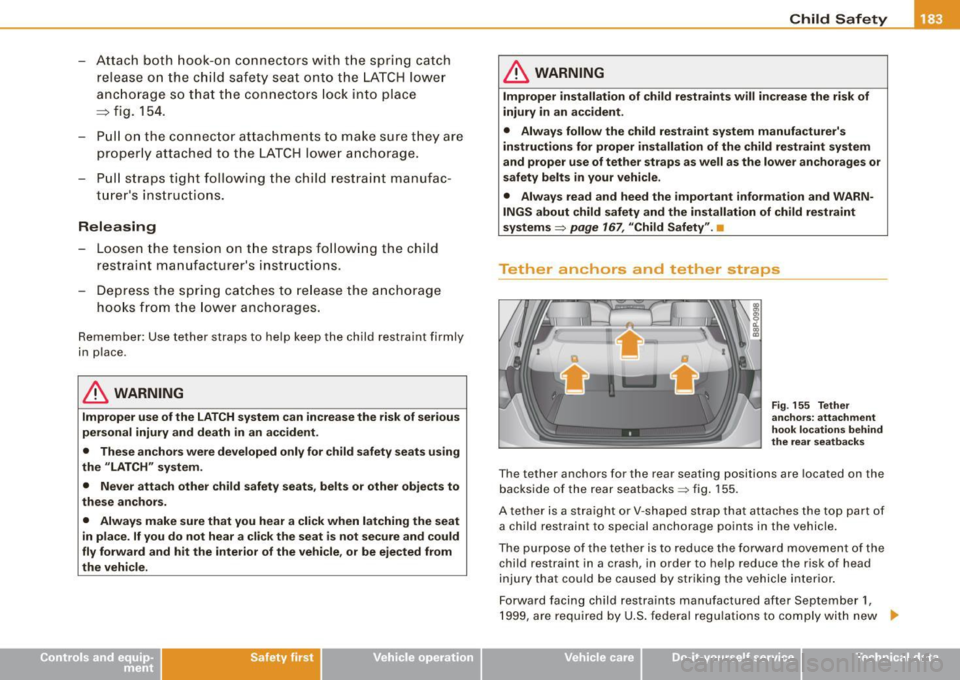
The tether anchors for the rear seating positions are located on the
backside of the rear seatbacks
~ fig. 155.
A tether is a straight or V-shaped strap that attaches the top part of
a child restraint to special anchorage points in the vehicle.
The purpose of the tether is to reduce the forward movement of the child res traint in a crash , in order to help reduce the risk of head
injury that could be caused by striking the vehicle interior.
Forward facing child restraints manufactured after September 1,
1999, are required by U.S. federal regulations to comply with new ..
Vehicle care I I irechnical data
Page 186 of 320

___ C_h_ i_ld _ S_ a_ f_ e_ t-= y'------------------------------------------------
child head movement performance requirements . T hese new
per forma nce r equ ireme nts m ak e a tether ne cessary on m ost new
ch ild s afe ty s eats .
& WARNING
Improper installation of child restraints will increase the risk of
injury and death in a crash .
• Always follow the instructions provided by the manufacturer of
the child restraint you intend to install in your Audi.
• Improper use of child restraint anchors (including tether
anchors) can lead to injury in a collision . The anchors are designed
to withstand only those loads imposed by correctly fitted child
restraints.
• Never mount two child restraint systems on one LATCH lower
anchor point .
• Never attach two child restraint systems to one tether strap or
tether anchorage .
• Never attach a tether strap to a tie-down hook in the luggage
compartment.
• Never use child restraint tether anchorages to secure safety
belts or other kinds of occupant restraints .
• Never secure or attach any luggage or other items to the LATCH
lower anchorages or to the tether anchors .
• If a tether or other strap is used to attach a child restraint to the
front passenger seat , make sure that it is not so tight , that it
causes the weight -sensing mat to measure more weight than is
actually on the seat .
• The heavier weight registered can make the Advanced Airbag
System work as though an adult were on the seat and deploy the
Advanced Airbag when it must be suppres sed causing serious or
even fatal injury to the child.
• If you must install a rearward facing child safety seat on the
front passenger seat because of exceptional circumstances and
the PASSENGER AIR BAG OFF light does not come on and stay on ,
& WARNING (continued)
immediately install the rear-facing child safety seat in a rear
seating position and have the airbag system inspected by your
Audi dealer . •
Installing the upper tether strap on the
anchorage
Installing the tether strap
F ig . 156 Tether strap:
proper routing and
mounting
Fig . 157 T ether strap:
proper r outing and
mounting
R el ease or dep lo y the tethe r strap on the chil d restraint
acco rding to the c hild restraint man ufacturer 's instr uc-
ti on s.
11'-
Page 187 of 320

_______________________________________________ C_h _ i_ld _ S_ a_ f_ e_ t..,:c y __ _
-Guide the upper tether strap under the rear head
restraint and into the rear cargo area==> fig. 157 (raise the
head restraint if necessary).
- Slide the tether strap hook over the anchor bracket.
- Pull on the tether strap hook so that the spring catch of
the hook engages .
- Tighten the tether strap firmly following the child
restraint manufacturer's instructions.
Releasing the tether strap
- Loosen the tension following the child restraint manufac
turer's inst ructions.
- Depress the spring catch on the hook and release it from
the anchorage.
0 Note
If you leave the child restraint with the tether strap firmly installed
for several days, this could leave a mark on the upholstery on the
seat cushion and backrest in the area where the tether strap was
installed. The upholstery would also be permanently stretched
around the tether strap. This applies especially to leather seats. •
Using tether straps on rearward-facing child
restraints
Currently, few rear-facing child restraint systems come with a tether.
P lease read and heed the child restraint system manufacturer's
instructions carefully to determine how to properly install the
tether.
Controls and equip ment Safety first Vehicle operation
& WARNING
A
child in a rearward-facing child safety seat installed on the front
passenger seat will be seriously injured and can be killed if the
front airbag inflates -even with an Advanced Airbag System .
• The inflating airbag will hit the child safety seat or infant
carrier with great force and will smash the child safety seat and
child against the backrest, center armrest, or door.
• A tight tether or other strap on a rearward-facing child restraint
attached to the front passenger seat can put too much pressure
on the weight-mat in the seat and register a heavier weight in the
Advanced Airbag System. The heavier weight registered can make
the system work as though an adult were on the seat and deploy
the Advanced Airbag when it must be suppressed causing serious
or even fatal injury to the child.
• If you must install a rearward facing child safety seat on the
front passenger seat because of exceptional circumstances and
the PASSENGER AIR BAG OFF light does not come on and stay on,
immediately install the rear -facing child safety seat in a rear
seating position and have the airbag system inspected by your
Audi dealer. •
Additional Information
Sources of information about child restraints
and their use
There are a number of sources of additional information about child
restraint selection, installation and use:
NHTSA advises that the best child safety seat is the one that fits
your child and fits in your vehicle, and that you will use correctly and
consistently.
Try before you buy!
Vehicle care Do-it-yourself service Technical data
Page 191 of 320
actual vehicle behavior. If the two do not match, for example when
th e vehicle begins to skid, ESP brakes the appropriate wheel auto
matical ly .
The vehicle is stabilized again by the forces acting on the wheel
during braking. With an oversteering vehicle (tendency for the rear
end to skid out of the curve), the brake application is mainly at the
front wheel on the outside of the curve, with an
understeering
vehicle (tendency to run wide in the curve) at the rear wheel on the
inside of the curve or additionally at the other wheels as needed.
This brake application is accompanied by noises.
ESP works in conjunction with ABS=>
page 192. If there is malfunc
tion in the ABS, ESP is also inoperative.
Activating
The ESP is automatica lly activated when the engine is started, and
it performs a self-test. As soon as the test is completed, the system
is in normal operating mode. With ASR deactivated, or with ESP/ASR
deactivated, pressing the button=>
page 188, fig. 158 returns the
system to normal operation.
Deactivating
ESP should normally be activated at all times because this ensures
optimum vehicle stability. Only in certain exceptional cases it does
make sense to deactivate Anti-Slip Regulation (ASR) or the Elec
tronic Stability Program (ESP) by pressing the button =>
page 188,
fig. 158. Both deactivation stages can only be activated from normal
mode .
Deactivating ASR
Tap the switch. Deactivation is indicated by slow flashing of the ESP
lamp in the instrument cluster. In certain situations (e .g. driving
with snow chains, in deep snow or on loose ground, or when
rocking the car free), it may be necessary to deactivate ASR.
Deactivating ESP/ASR
Press the button for more than 3 seconds. Deactivation is indicated
by the ESP lamp in the ins trument cluster staying on permanently.
Controls and equip
ment Safety first Vehicle operation
Intelligent technology
This
deactivates the Electronic Stability Program (ESP) in addition to
ASR. No Elec tronic Stability System operation and no Anti -Slip
Regulation is available across the entire speed range; ASR and ESP
are activated only when the brakes are used for the duration of the
braking action and remain active until a stable vehicle condition has
been reached. There is no driving situation which requires ESP to be
deactivated, so this should only be done if the driver's skill and the
traffic situation permit.
& WARNING
• The limits of physics cannot be suspended by ESP. Even in vehi
cles with ESP. you should always adapt your driving to road and
traffic conditions. This is particularly true on a slippery and wet
road . Do not be tempted by the increased safety provided to take
risks -danger of an accident!
• Please note that when ASR or ESP /ASR is deactivated , the drive
wheels can spin on icy and slippery roads and the vehicle can
break away -danger of skidding!
Electronic differential lock CED1
.)
The electronic differential lock monitors the rotational
speed of the drive wheels.
General notes
The elect ronic differential lock (EDU helps the car to start moving,
accelerate and c limb a gradient on surfaces providing poor or
a lmost no grip. Without EDL, this would be difficult, if not impos
s ible.
How the system works
The EDL operates automatical ly. It monitors the rotationa l speed of
the drive wheels on an axle with the help of the ABS sensors
=>
page 192. If a noticeable difference in rotational speed between
the drive wheels on one axle is detected (e.g. on slippery ground
on
one side),
the spinning wheel is braked, thereby transferring power
Vehicle care Do-it-yourself service Technical data
Page 192 of 320

-Intelligent technology
----'""------- ~---------------------------------------
to the other drive wheel or wheels (all-whee l drivel. This is done up
to a speed of about 60 mph (100 km/h). Noises from the brake
system signal that wheel spin is being controlled.
Driving off
When driving off, always be sure to keep road conditions in mind as
you accelerate. If one drive wheel spins because it is on a surface
with less grip, gradually increase the pressure on the accelerator
pedal until the car starts to move. The wheel less able to transfer
power spins .
Overheating of brakes
To prevent the disc brake of the braked wheel from overheating if
subjected to excessive loads, the EDL cuts out temporarily. The
vehicle remains operational and behaves in the same way as a
vehicle without EDL.
As soon as the brake has cooled down, EDL switches on again auto
matically.
& WARNING
• When accelerating on slippery surfaces, such as on ice or snow,
always be careful when depressing the accelerator pedal. Even
with the EDL working, the drive wheels can spin and reduce your
ability to control your car. -Risk of crash!
• The increased safety afforded by EDL does not mean that you
can take safety risks. Always adapt your driving style to the road
conditions and traffic situation.
[ i] Tips
If a fault occurs in the ABS, the EDL is also not functioning. This is
indicated by the ABS warning light=>
page 16. •
Anti-Slip Regulat ion System (ASR)
The Anti-Slip Regulation System prevents the driven
wheels from spinning when the car is accelerating.
General notes
The Anti-Slip Regulation System (ASR) is integrated in the electronic
stabilization program (ESP) . When the vehicle starts up and acceler
ates, the wheels are prevented from spinning by adjusting the
engine power to match the amount of grip available from the road
surface.
How the system works
ASR performs automatically, i.e. without the driver's intervention.
With the aid of the ABS sensors=>
page 192, ASR monitors the
speed of the driven wheels. If the wheels start to spin, the engine
torque is reduced automatically until the tires find enough grip to
lock onto the road surface. The system is active across the entire
speed range.
Th e ASR works in conjunction with the ABS. If a malfunction should
occur in the ABS, the ASR will also be out of action.
Activating
The ESP is automatically activated when the engine is started and it
performs a self -test. You can activate a deactivated ASR if required
by pressing the=>
page 188, fig. 158 button. When it is activated,
the message
ESP/ASR on appears briefly in the display.
Deactivating
You can deactivate the ASR if required by pressing the button (for
less than 3 seconds)=>
page 188, fig . 158. With the ASR deactivated,
the ESP check light comes on, see=>
page 13. The message ASR off
appears in the display as well.
The ASR should normally be activated all the time . Only in certain
exceptional situations when some slip is desirable does it make
sense to deactivate the ASR. Examples:
• when driving with tire chains
Page 193 of 320
• when driving in deep snow or on loose ground and
• when rocking the vehicle loose after it has become stuck.
When the abnormal situation is over, you should activate the ASR again.
& WARNING
The increased safety afforded by ASR does not mean that you can
take safety risks. Always adapt your driving style to the road
conditions and traffic situation.
[ i J Tips
To ensure that the ASR works properly, all four wheels must be fitted
with identical tires. Any differences in rolling radius of the tires can
cause the system to reduce engine power when this is not desired.
See also~
page 254, "New tires and replacing tires and wheels". •
Braking
Generat information
What affects braking efficiency?
Operating conditions and driving habits
The brakes on today's automobiles are still subject to wear,
depending largely on operating conditions and driving habits~& .
On vehicles that are either driven mostly in stop-and-go city traffic
or are driven hard, the brake pads should be checked by your autho
rized Audi dealer more often than specified in the
Warranty & Main
tenance booklet.
Failure to have your brake pads inspected can
result in reduced brake performance.
On steep slopes, you should use the braking effect of the engine.
This way, you prevent unnecessary wear on the brake system. If you
Controls and equip
ment Safety first Vehicle operation
Intelligent technology
must use your brakes, do not hold the brakes down continuously.
Pump the
brakes at intervals.
Moisture or road salt
If you are driving faster than 50 mph (80 km/h) and the windshield
wipers are on, the brake pads will briefly touch the brake discs in
regular intervals so as to improve reaction time when braking on
wet surfaces. You, the driver, will not notice anything .
Under certain conditions, for example, when driving through water
or very heavy rain, or even after washing your vehicle, the braking
effect can be reduced due to moisture (or in freezing conditions ice)
on the brake pads. A few cautious brake applications should dry off
the brake pads or remove any ice coatings .
The effectiveness of the brakes can be reduced when the vehicle is
driven on a salt-covered road and the brakes are not used . Likewise,
you clean off accumulated salt coating from brake discs and pads
with a few cautious applications of the brake~&.
Corrosion
There may be a tendency for dirt to build up on the brake pads and
corrosion to form on the discs if the car is not driven regularly or
only for short trips with little use of the brakes.
If the brakes are not used frequently, or if corrosion has formed on
the discs, it is advisable to clean off the pads and discs by braking
firmly a few times from a moderately high speed~& .
Faults in the brake system
If you should notice a sudden increase in brake pedal travel, then
one of the two brake circuits may have failed~ &.
Low brake fluid level
Malfunctions can occur in the brake system if the brake fluid level is
too low. The brake fluid level is monitored electronically.
Vehicle care Do-it-yourself service Technical data