parking brake AUDI S3 2010 User Guide
[x] Cancel search | Manufacturer: AUDI, Model Year: 2010, Model line: S3, Model: AUDI S3 2010Pages: 320, PDF Size: 75.34 MB
Page 118 of 320

• ..__T_ ra_ n_s_ m_ i_ s _s_ i_ o _n ___________________________________________________ _
The selector lever lock is effective only when the vehicle is
stationary and at speeds below 5 km/h. At higher speeds, the lock in
the N position is automatically switched off.
The selector lever is not locked when rapid shifts are made through
t he N position (e.g . from R to Dl. This allows you to "rock" the vehicle
if it becomes stuck . If the lever is in the N position for more than
1 second with the brake pedal not depressed, the selector lock
engages automatically.
Release b utt o n
The release button in the selector lever handle prevents accidental
shifts in to certain selector lever positions. When you press the
re lease button, the selector lever lock is cancelled. In the illustra
t ion, the positions in which the release button has to be pressed are
highlighted in color=>
page 115, fig. 115.
Igniti on k ey remo val lock
The ignition key can only be remove after the ignition is switched off
if the selector lever is in P . As long as the ignition key is removed, the
selector lever is locked in P.
[ i J Tip s
If the selector lever does not engage, there is a malfunction . The
engine is disabled to prevent the vehicle from driving off uninten
tiona lly. To a llow the selector lever to engage again, proceed as
follows: Press and release the brake pedal. •
Applies to vehicle s: wi ths troni c®
Driving Notes
The forward gears are shifted up or down automatically .
Starting from stop
-Step on and hold the brak e peda l.
Fig. 116 Sectio n fr om
c en ter console :
Se lec tor lever w ith
r e lea se butt on
- Ho ld t he release butt on (but to n in se lector lever) down,
move t he s elector lev er to th e desire d posi tion, fo r
e xam ple D
=> page 114, and release t he b utto n.
- Re lease the brake pe dal and accelerate =>& .
Stopping temporarily
- Bring t he vehicle to a full stop wit h the brake, e.g. at
traffic signals.
- Do not accelerate.
Pa rking
- Step on and ho ld the brake pedal=> & .
- Apply the parking brake firmly.
- Hold the re lease button down, move the s elector lever to
P and re lease the button . _.,
Page 119 of 320

_______________________________________________________ T_ ra_ n_s_ m __ is_s_ io_ n __ ftllll
Stopping on an inclin e
-Always hold the vehicle wit h the foot brake or par king
b rake in order to prevent "rollback"=> &. Do not try to
p reven t the ve hicle fr om rolling back by rewing the
e n gine while it is in ge ar.
Starting on a hill
- Appl y the hand brake firmly.
- Wit h the e ng in e in g ear, g ra du ally a ccel era te an d relea se
the hand bra ke .
The engi ne can only be started with the selector lever in P or N
=>
pa ge 107. At low ambient temperatures (14 °F / -10 °C), it is only
po ss ible to star t the eng ine with the se lec tor lever in P .
Whe n par king on leve l ground, it is su ff ic ient to place the selec to r
lever in P. On a steeply s loping road, you should first apply the
p ark ing bra ke fi rmly and th en place the s elec tor lev er in P . T hi s way,
you do not overload the paw l mechanis m and it is easier to move
t h e s elector lever out of P.
& WARNING
• Never leave your vehicle with the engine running while in gear.
If you must leave your vehicle with the engine running, set the
parking brake and engage the park lock .
• When the engine is running and the transmission is in gear (0 ,
S or R l or in "tiptronic " mode , it is essential that you stop the
vehicle w ith the footbrake . When idl ing , the transmission of power
does not stop completely -the vehicle "creeps ".
• Do not accelerate when you change the selector lever position
with the vehicle stationary and the engine running -risk of an acci
dent!
• Never place the selector lever in the R or N position while the
vehicle is moving - risk of an accident !
Controls and equip
ment
& WARNING (continued )
• If you have to bring your vehicle to a stop while on an incline,
keep the foot brake depressed all the way down so that the vehicle
does not start to roll backward . You should never hold the vehicle
using the clutch pedal if you are going to be stopped on an incline .
If you do , the clutch will start to slip when it overheats caused by
the constant overload. This is dangerous because if the vehicle starts to roll backward , you could cause an accident . If the clutch
should start to slip , you will feel the vehicle "jerk" and the selector
lever display will start blinking .
• Before driving down a steep slope , reduce your speed and shift
into a lower gear w ith "tiptronic ".
• Do not ride the brake s or apply the brake pedal too often or too
long . Constant brak ing causes the brakes to overheat and
substantially reduces braking performance , increases braking
distance or causes complete failure of the brake system . •
Ap plies to vehicl es: with s tr o n ic tra nsmiss ion a nd Hill Descent Ass ist
Hill Descent Assist
Hi ll Desc en t A ssist help s the driver when dr iv in g d own
i n cl ines.
H il l Descent Ass ist is activated b y press ing th e brake wh ile
descending when the selector lever is in D/S . The S tronic transm is
s io n au tomatically s hift s d own to a g ear sui tab le fo r the i nclin e. Hill
Descent Assist attempts to maintain the current vehicle speed when
t he braki ng occ urs, as fa r as physical an d techn ical limi ts al low. It
may be necessary to adjust the speed using the brakes .
H il l Descent Assist switches off when the incline level s out or when
the gas pedal is pressed .
On vehicles with cruise control*=>
page 11 0, Hill Descent Assist is
a lso ac tivated whe n the speed is se t. ..,.
I • •
Page 122 of 320
• ..__T_ r_a _n_ s_ m_ is_ s_io _ n ______________________________________________________ _
- With your right foot, step on the accelerator to the wide
open throttle position or Kickdown. The engine speed
settles at about
3,200 rpm.
Take your left foot off the brake.
The S tronic® in your vehicle is electronically controlled. A special
Launch Control Program provides th e best acceleration from a
standing start .
& WARNING
• Always adapt your driving to the traffic flow.
• Only use Launch Control when road and traffic conditions allow
it and other drivers will not be endangered or annoyed by your
driving and the acceleration of the vehicle.
• Make sure that ESP remains enabled. With the ESP disabled,
the vehicle could brake away, particularly on a slick and slippery
road -risk of skidding!
• Once acceleration is finished, switch ASR on again by briefly
pushing the ESP button . •
Ap plies to ve hicles : wit h S t ro ni c®
Back-up program
In the event of a system malfunction, there is an back-up
program.
In the event of system malfunction, the automatic transmission
switches to th e fail -safe mode . All o f the selec tor lever pos ition
displays for the automatic transmission are highlighted with a light
background in the instrument clust er display. In some cases you
cannot drive in the reverse gear any more .
If the transmission swi tches to fail-safe mode, you should take the
vehicle to an authorized Audi dealership as soon as possible to have
the condition corrected .•
A pp lies to veh ic les: w ith s tro nic®
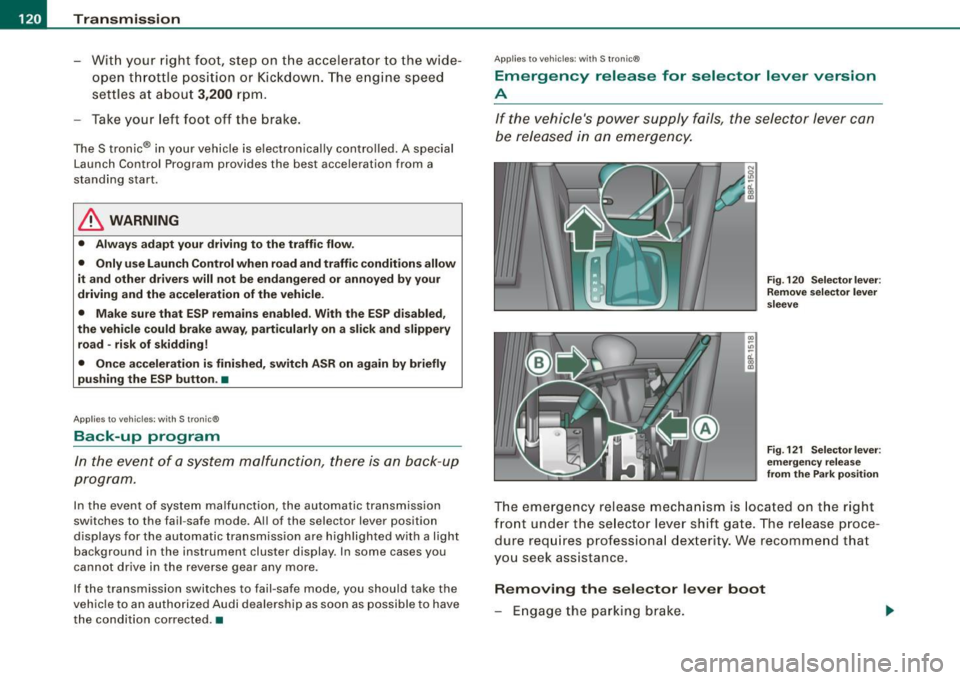
Emergency release for selector lever version
A
If the vehicle's power supply fails , the selector lever can
be released in an emergency.
Fig. 120 Selector lever :
Remove selector lever
sleeve
Fig . 121 Selector lever :
emergency release
from the Park position
The emergency release mechanism is located on the right
front under the selector lever shift gate. The release proce
dure requires professional dexter ity. We recommend that
you seek assistance.
Removing the selector lever boot
- Engage the parking brake.
Page 123 of 320
Transmission -_______________ ___.
- Remove the screwdriver from the vehicle tool kit. Use the
flat side of the reversible screwdriver blade~
page 268.
-Carefully pry the cover out with the screwdriver and pull
it ~
page 120, fig. 120 toward the shifter knob in the
direction of the arrow. The screwdriver must grip at the
lower edge of the cover to loosen it.
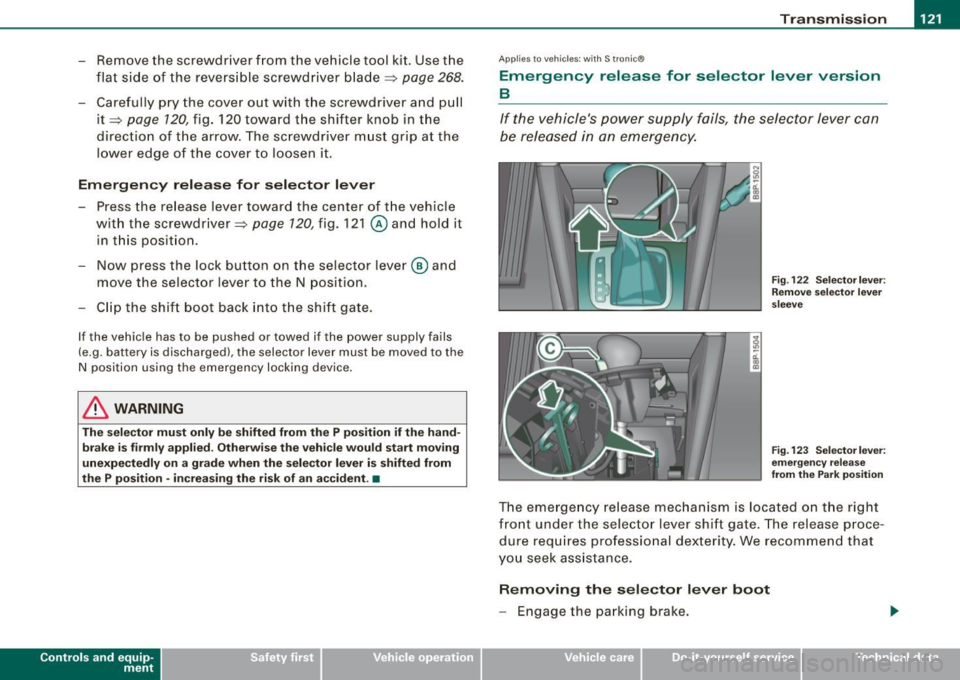
Emergency release for selector lever
-Press the release lever toward the center of the vehicle
with the screwdriver ~
page 120, fig. 121 @and hold it
in this position.
- Now press the lock button on the selector lever @ and
move the selector lever to the N position.
- Clip the shift boot back into the shift gate.
If the vehicle has to be pushed or towed if the power supply fails
(e.g. battery is discharged) , the selector lever must be moved to the
N position using the emergency locking device.
& WARNING
The selector must only be shifted from the P position if the hand
brake is firmly applied . Otherwise the vehicle would start moving
unexpectedly on a grade when the selector lever is shifted from
the P position -increasing the risk of an accident . •
Con tro ls and eq uip
ment
Ap plies to vehic les: with S tron ic®
Emergency release for selector lever version
B
If the vehicle's power supply fails, the selector lever can
be released in an emergency.
Fig . 122 Selector lever :
Remove selector lever
sleeve
Fig. 123 Selector lever:
emergency release
from the Park position
The emergency release mechanism is located on the right
front under the selector lever shift gate. The release proce
dure requires professional dexterity. We recommend that
you seek assistance.
Removing the selector lever boot
- Engage the parking brake.
Vehicle care I I irechnical data
Page 205 of 320
![AUDI S3 2010 User Guide [ i] Tips
• Do not tow a trailer during the break-in period of your vehicle.
• If you tow a trailer, your Audi may require more frequent mainte
nance due to the extr](/img/6/57545/w960_57545-204.png "AUDI S3 2010 User Guide [ i] Tips
• Do not tow a trailer during the break-in period of your vehicle.
• If you tow a trailer, your Audi may require more frequent mainte
nance due to the extr")
[ i] Tips
• Do not tow a trailer during the break-in period of your vehicle.
• If you tow a trailer, your Audi may require more frequent mainte
nance due to the extra load=> page 299 . •
Parking on a slope
-----------------
Do not park with a trailer on a slope. If it cannot be
avoided, do so only after doing the following:
When parking:
-Apply the foot brake.
- Have someone place chocks under both the vehicle and the trailer wheels .
- With chocks in place, slowly release the brakes until
wheel blocks absorb the load.
- Turn the wheels towards the curb.
- Apply the parking brake.
- Place an automatic transmission in
P, respectively a
manual transmission in first or reverse gear.
When restarting after parking:
- Start the engine.
- Shift transmission into gear.
- Release the parking brake and slowly pull out and away from the wheel blocks.
- Stop and have someone retrieve the wheel blocks.
Controls and equip
ment Safety first Vehicle operation
Trailer towing
[
i] Tips
If you move the selector lever of the automatic transmission to P
before applying the parking brake and before blocking the wheels,
you may have to use more force later to move the lever out of the
P
position .•
Vehicle care Do-it-yourself service Technical data
Page 226 of 320
-~_C_ h_e _c _ k_ i_n ...:::g::;...._ a_n_ d_ f_ i_ll _in -'g:::;.._ ___________________________________________ _
Closing the engine hood
- Pull the hood down until the pressure from the strut is
reduced.
- Let the hood
drop down and latch in place. Do not try to
push it shut;
it may fail to engage~& .
& WARNING
A hood that is not completely latched could fly up and block your
view while driving.
• When you close the engine hood, check it to make sure the
safety catch has properly engaged. The hood should be flush with
the surrounding vehicle body parts.
• If you notice while driving that the hood is not secured prop
erly, stop at once and close it. •
Working in the engine compartment
Be especially careful whenever you work in the engine
compartment!
Whenever you must perform any work in the engine compartment,
for example checking and filling different fluids, there is a risk of injury, burns and accidents. To prevent personal injury always
observe the following WARNINGS. The engine compartment of any
vehicle is a hazardous area!
=> &
& WARNING
To help avoid injury, before you check anything under the hood :
• Turn off the engine.
• Remove the ignition key.
• Set the parking brake fully .
& WARNING (continued)
• Move selector lever of automatic transmission to "P" {Park);
put manual transmission in Neutral.
• Always let the engine cool down. Hot components will burn
skin on contact.
• To reduce the risk of being burned, never open the hood if you
see or hear steam or coolant escaping from the engine compart
ment. Wait until no steam or coolant can be seen or heard before
carefully opening the hood .
• Keep children away from the engine compartment.
• Never spill fluids on hot engine components. They can cause a
fire.
• Never touch the radiator fan. The auxiliary electric fan is
temperature controlled and can switch on suddenly.
• Never open the coolant reservoir cap when the engine is still
warm. The coolant system is pressurized and hot coolant could
spray out!
• Protect your face, hands and arm from steam or hot engine
coolant by placing a thick rag over the cap when you open the
coolant reservoir.
• If work on the fuel system or the electrical system is necessary:
- Always disconnect the battery .
- Never smoke or work near heaters or open flames. Fluids in
the engine compartment could start a fire.
- Keep an approved fire extinguisher immediately available.
• To avoid electrical shock and personal injury while the engine
is running or being started, never touch :
- Ignition cables
- Other components of the high voltage electronic ignition
system.
• If you must perform a check or repair with the engine running: .,_
Page 227 of 320
_____________________________________________ C_h_ e;::..:. c:..:..k :..:..in ;..:..= g:.....:.; a:..:..n :....:d :..:....:. f.:.:il .:.:li :..:..n :.::g:!-_ ___,JIJIII
& WARNING !continued )
-First, fully apply the parking brake, move selector lever of
automatic transmission to "P" (Park); put manual transmission
in Neutral.
- Always use extreme caution to prevent clothing, jewelry, or
long hair from getting caught in the radiator fan, V-belts or
other moving parts, or from contacting hot parts. Tie back hair
before starting, and do not wear clothing that will hang or
droop into the engine .
• Minimize exposure to emission and chemical hazards
:=> &.
& WARNING
California Proposition 65 Warning :
• Engine exhaust , some of its constituents, and certain vehicle
components contain or emit chemicals known to the State of Cali
fornia to cause cancer and birth defects and reproductive harm . In
addition, certain fluids contained in vehicles and certain products
of component wear contain or emit chemicals known to the State
of California to cause cancer and birth defects or other reproduc
tive harm.
• Battery posts, terminals and related accessories contain lead
and lead compounds , chemicals known to the State of California
to cause cancer and reproductive harms. Wash hands after
handling.
0 Note
When adding fluids , always make sure that they are poured into the
proper container o r filler opening, otherwise serious damage to
vehicle systems will occur .
ffi For the sake of the environment
To detect leaks in time, inspect the vehicle floor pan from under
neath regularly. If you see spots from oil or other vehicle fluids, have
your vehicle inspected by an authorized Audi dealer .•
Engine compartment
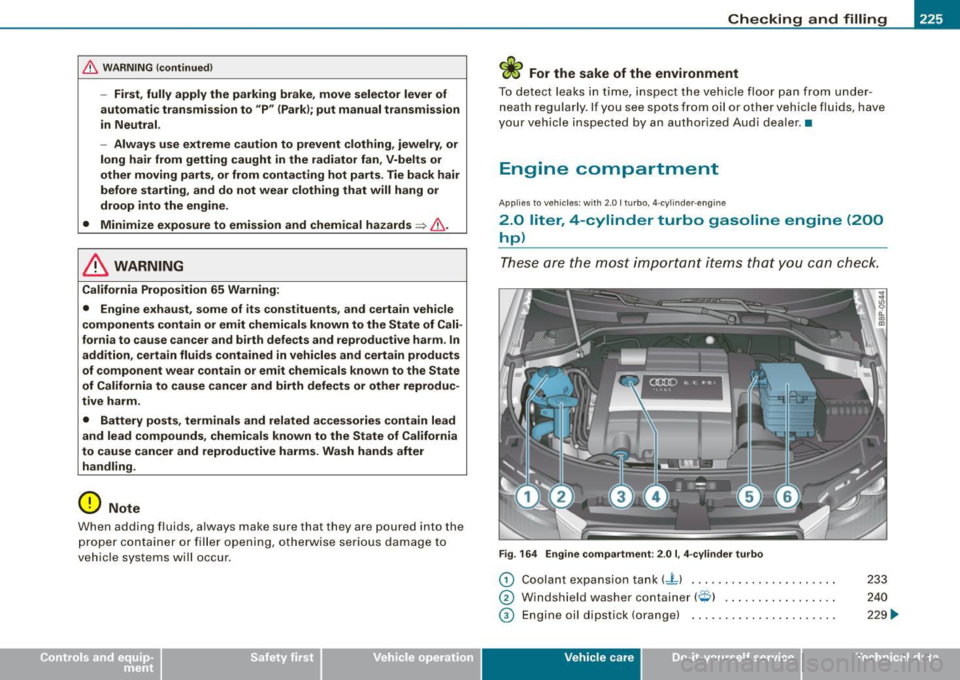
Ap plie s to veh icl es: wit h 2.0 I tur bo, 4-cy lind er•e ng ine
2.0 liter , 4-cylinder turbo gasoline engine (200
hp)
These are the most important items that you can check.
Fig. 164 Engine compartment : 2 .0 I , 4-cy linder turbo
G) Coolan t expansion tank (- L l .... ... .... .... ... .. . .
0 Windshield washer container (W ) ... .... ... ... ... .
© Eng ine oil d ipstick (orange) .. ...... ........ ..... .
Vehic le care I I
233
240
229 ~
irechnical data
Page 273 of 320
What do I do now? -__________________ __;__:....:....:..:: __ _
•
-All passengers should leave the car and move to a safe
location (for instance, behind the guardrail)~& .
- Apply the
parking brake firmly ~& .
- Move
selector lever to position Pon an automatic trans-
miss ion; put manual transmission in
first gear ~& .
-If you are towing a trailer : unhitch the trailer from your
vehicle.
- Take the
tool and the spare tire~ page 268 out of the
luggage compartment.
& WARNING
You or your passengers could be injured while changing a wheel if
you do not follow these safety precautions:
• If you have a flat tire, move a safe distance off the road. Turn off
the engine, turn the emergency flasher on and use other warning
devices to alert other motorists.
• Make sure that passengers wait
in a safe place away from the
vehicle and well away from the roadway and traffic.
• To help prevent the vehicle from moving suddenly and possibly
slipping off the jack, always fully set the parking brake and block
the wheel diagonally opposite the wheel being changed. When one
front wheel is lifted off the ground, placing the automatic trans
mission in "P" (Park), or engaging a gear in a manual transmission
will
not prevent the vehicle from moving.
• Before you change a wheel, be sure the ground is level and firm.
If necessary, use a sturdy board under the jack.
• After installing the spare wheel, make sure that you remount
the flat tire/wheel in its storage area properly and tighten the
knurled retaining screw securely. •
Changing a wheel
When you change a wheel, follow the sequence described
below step-by-step and exactly in that order.
1. Remove the decorative wheel cover*. For more details
see also
~ page 272, "Decorative wheel covers" or
~ page 273, "Wheels with cap-covered wheel bolts".
2. Loosen the
wheel bolts~ page 274.
3. Locate the proper mounting point for the jack and align
the jack below that point~
page 274.
4. Lift the car with the jack~ page 274.
5. Take the flat wheel off and then put the spare on
~ page 276.
6. Tighten all wheel bolts lightly .
7.
Lower the vehicle with the jack .
8. Use the wheel bolt wrench and
firmly tighten all wheel
bolts ~
page 274.
9. Put the decorative wheel cover* back on.
& WARNING
Always read and head all WARNINGS and information ::} & in
"Raising the vehicle" on
page 274 and ~ page 277. •
After changing a wheel
A wheel change is not complete without the following
actions.
- Store and secure the replaced wheel in the spare wheel
well. .,._
Do-it-yourself service
Page 277 of 320
What do I do now? -
------------------
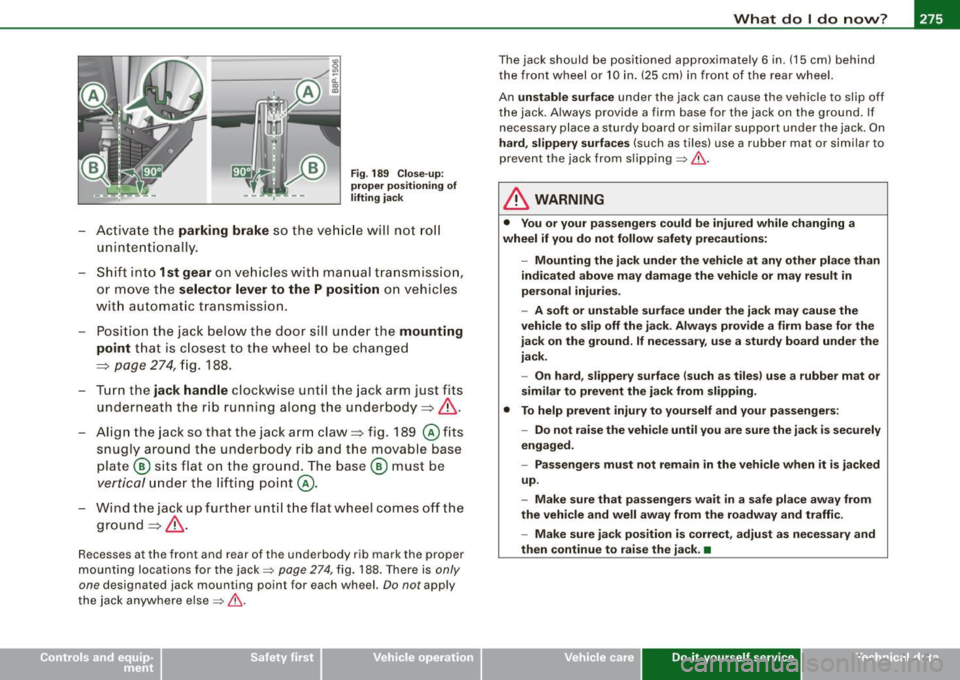
Fig. 189 Close-up:
proper positioning of
lifting jack
-Activate the parking brake so the vehicle will not roll
unintentionally.
- Shift into
1st gear on vehicles with manual transmission,
or move the
selector lever to the P position on vehicles
with automatic transmission.
- Position the jack below the door sill under the
mounting
point
that is closest to the wheel to be changed
=> page 274, fig. 188.
- Turn the
jack handle clockwise until the jack arm just fits
underneath the rib running along the underbody
=> &.
- Align the jack so that the jack arm claw => fig . 189 @ fits
snugly around the underbody rib and the movable base
plate @ sits flat on the ground. The base @ must be
vertical under the lifting point@.
- Wind the jack up further until the flat wheel comes off the
ground =>& .
Recesses at the front and rear of the underbody rib mark the proper
mounting locations for the jack ~
page 274, fig. 188. There is only
one
designated jack mounting point for each wheel. Do not apply
the jack anywhere else~& . The
jack should be positioned approximately 6 in. (15 cm) behind
the front wheel or 10 in. (25 cm) in front of the rear wheel.
An unstable surface under the jack can cause the vehicle to slip off
the jack. Always provide a firm base for the jack on the ground. If
necessary place a sturdy board or similar support under the jack. On
hard, slippery surfaces (such as tiles) use a rubber mat or similar to
prevent the jack from slipping ~& .
& WARNING
• You or your passengers could be injured while changing a
wheel if you do not follow safety precautions:
-Mounting the jack under the vehicle at any other place than
indicated above may damage the vehicle or may result in
personal injuries.
- A soft or unstable surface under the jack may cause the
vehicle to slip off the jack. Always provide a firm base for the
jack on the ground. If necessary, use a sturdy board under the
jack.
- On hard, slippery surface (such as tiles) use a rubber mat or
similar to prevent the jack from slipping.
• To help prevent injury to yourself and your passengers:
- Do not raise the vehicle until you are sure the jack is securely
engaged.
- Passengers must not remain in the vehicle when it is jacked
up.
- Make sure that passengers wait in a safe place away from
the vehicle and well away from the roadway and traffic.
- Make sure jack position is correct, adjust as necessary and
then continue to raise the jack. •
Vehicle care Do-it-yourself service irechnical data
Page 282 of 320

1111.___F_ u_ s _ e_s _ a_n _ d_ b_ u_lb _ s _______________________________________________ _
Equipment Amps No. Equipment Amps
Manual headlight beam adjustment, automatic
14 Electronic Stabilization Program (ESP) (control 10
1
headlight beam adjustment, AFS control mod-10
module), shift gate automatic transmission
ule, engine components, light switch (switch
15 Interior lights, reading lights 10
lighting/illumination), diagnosis socket
Diagnostic connector, rain sensor, air condition-
Automatic transmission, control module for
16 ing (control module), tire pressure monitor dis-10
CAN data transfer (gateway), electro -mechanical
play (control module)
2 steering, shift gate automatic transmission, 10 17 Anti-theft alarm warning system 5 engine relay, fuel tank control unit, engine con -
trol unit, brakes control (ABS), Electronic Stabili-
18 Diagnose Starter 5
zation Program (ESP), Anti -Slip Regulation (ASR) 19 All Wheel Drive 10
3
Airbag 5 20 Not used
!! Air-conditioning (pressure sensor, air quality
sensor), button for Electronic Stabilization Pro -
21 Not used
gram (ESP), Anti-Slip Regulat ion (ASR), tire pres-
22 Blower fan 40
sure monitor display, oil level sensor, back -up 23 Driver's side power window, front 30
4 light switch, front seat heating , parking aid, 5
seat-occupancy recognition (on USA vehicles), 24 Power outlet front 20
garage door opener, automatic mirror dimming, 25 Rear window defogger 30
headlight assistant, heated windshield washer
26 Power outlet in luggage compartment 20 nozzles, air conditioning (control module)
-27 Fuel tank control module, fuel pump 15
5 AFS headlights (left side) 5
AFS headlights (right side) 5 28 Power window, rear 30
7
Not used 29 Not used
Not used
30 Not used
9 Navigation system, radio system 15 31 Not used
10 digital
radio, cell phone, TV equipment 7,5 32 Not used
11 Automa tic mirror dimming, headlight assistan t 10 33 Sliding/pop-up roof 20
Central locking (front doors) 10 34 Not used
13 Central locking (rear doors) 10 35 Not used
36 Lumbar support 10