spare tire AUDI S3 2010 User Guide
[x] Cancel search | Manufacturer: AUDI, Model Year: 2010, Model line: S3, Model: AUDI S3 2010Pages: 320, PDF Size: 75.34 MB
Page 266 of 320

___ T _i_re _=- p_r_e _ s_ s_ u_r_ e _ m_ o_ n_i_t _o _r_ i _ n .,;:g ::;.._ s_ y=--- s_t _e _m_ * __________________________________________ _
& WARNING
• When the tire pressure monitoring system warning light is lit,
one or more of your tires is significantly underinflated. You should
stop and check your tires as soon as possible , and inflate them to
the proper pressure as indicated on the vehicle's tire pressure
label =>
page 246 . Driving on a significantly underinflated tire
causes the tire to overheat and can lead to tire failure. Underinfla
tion also is likely to impair the vehicle's handling and stopping
ability.
• Do not adjust tire pressure when tire temperature is excessive.
This could lead to serious tire damage and even cause the tire to
burst, with the additional danger of an accident.
~ For the sake of the environment
Driving with underinflated tires reduces fuel efficiency and tire
tread life.
[ i] Tips
• Each tire, including the spare , should be checked monthly when
the temperature of the tires is about the same as ambient air
temperature and set to the recommended inflation pressure as
specified on the tire pressure label=> page 246.
• Th e factory supplied spare wheel is equipped with a sensor for
the tire pressure monitoring system. As long as the spare wheel is
not mounted, the tire pressure of this tire will not be monitored.
• The tire pressure monitoring system helps the driver monitor tire
pressures, but the driver is still responsible for maintaining the
correct tire pressure.
• Tir e pressure must only be adjusted when the temperature of the
tires is about the same as ambient air temperature.
• When tires are replaced, the sensors and valves should not be
exchanged. The valve core, nut, valve sealing and seal washer (replacement kit) needs
to be replaced. If necessary, the valve and
the wheel electronics have to be replaced.
• Th e tire pressure monitoring system on your Audi was calibrated
using tires with the "AO" or "RO" identification. We recommend
using these tires.
• If you should put different wheels and tires on your vehicle (e.g.
winter wheels and tires), you must be certain that the wheels and
tires are compatible with the tire pressure monitoring system.
Otherwise the system will register a malfunction and a fault
message will be displayed. For more information, contact your
authorized Audi dealer.
• Adjust the tire pressure and store the pressure in the tire pres
sure monitoring system to the load you are carrying .
• For Declaration of Compliance to United States FCC and Industry
Canada regulations => page
302. •
Applies to vehic les: wi th tire pressure mon itoring sy s tem
Significant loss of air pressure
The yellow symbol appears in the event of a significant
loss of air pressure.
Fig. 178 Display:
yellow symbol with
message
Page 267 of 320

__________________________________________ T_i _r e-' p'-- r_e _s _s_ u_ re _ m _o _n_ i_t _o _r_ i _ n ..:g :a- s....:y:... s_ t _e_ m_ *_ ....... 1111
If the ( 'warn ing l ight in the instrument cluster comes on
and then the symbol appears in the display ==> page
264,
fig. 178, pressure in at least one tire is too low .
- Stop driving as soon as possible w ithout endangering
yourself and other drivers on the road .
- Inspect all tires.
Change the tire if necessary==> page
270.
The _ warning light in the instrument cluster comes on when the
tire is significant ly underinf lated .
In addition, the tire symbol
I appears in the display together with
the message
Pl ease chec k tir e pre ssure=> page 264, fig. 178.
After a few seconds , the message disappears again . If you would
like to show the message again, press the Set/Check button
=>
page 8, fig . 2 ® ·
[ i ] Tip s
• In the case of an intentiona l loss of air pressure, such as when
readjusting tire pressure, the pressure must be stored again after
ward =>
page 265.
• Tire pressure must only be adjusted when the temperature of the
tires is about the same as ambient air temperature.
• The ye llow symbol disappears when the tire pressure is
corrected and the new pressure is stored in the system=>
page 265.
• After changing a wheel or rep lacing a wheel with the spare tire
you have to adjust the tire pressures on all wheels . In addition, you
must then initialize the new tire pressures in the tire pressure moni
toring system=>
page 266. •
App lies to veh icles : wi th tir e pr ess ure mon it o ring sys tem
Storing tire pressures
Correct storage of specified pressure is the basic require
ment for reliable tire pressure monitoring.
I, _]
) )
1 '
Fi g. 179 Ca r: Tir e pres
s u re mon it o ring
system
In o rder for the tire pressure monitoring system to ope rate
appr opria tely, you have to re-save the specified pressures
whenever you adjust tire pressures, such as when the load
condition of yo ur veh ic le changes . Proceed as follows :
Corr ec ting tir e pressure
- Check the pressure in t he tires .
- Adjust air pressure as needed to comp ly with t he infor-
mation on the label located on the label located either on
the driver's side 8 -pillar or on the inside of the fuel filler
flap .
Saving tire pressur es
- Turn on the ignition .
- Press the button==> fig. 179 for approx imately 5 seconds .
You will hear a beep and the symbol in t he instrume nt
cluster flashes three t imes . ..,.
Vehicle care I I irechnical data
Page 268 of 320

___ T _i_r e_=- p_r_e _ s_ s_ u_r_ e _ m_ o_ n_i_t _o _r_ i _ n .,;:g ::;.._ s_ y=--- s_t _e _m_ * __________________________________________ _
All pressure warning indicators in the display will be canceled.
Following each intentional change in specified pressures, tire pres
sures must be saved again .
After the pressures are saved, the tire pressure monitoring system measures the current tire pressures and saves them as the new
specified pressures.
[ i ] Tip s
• The tire pressure is shown on the tire pressure label. The tire
pressure label is located either on the driver's side 8 -pillar or on the
inside of the fuel filler flap . The tire pressure label lists the recom
mended cold tire inflation pressures for the vehicle at its maximum
capacity weight and the tires that were on your vehicle at the time
it was manufactured. For recommended tire pressures for normal
load conditions, p lease see chapter=>
page 246.
• The tire pressure monitoring system helps the driver monitor t ire
pressures, but the driver is still responsible for mainta ining the
correct tire pressure. •
Applie s to v ehic les : wi th tir e pr essure monito ring syst em
Wheel change
If a wheel is changed, the wheels that were exchanged
have to be reprogrammed.
- Turn o n the igniti on.
- Press the button=>
page 265, fig. 179 for approximately 5
seco nds . You will he ar a beep and the symbol in the
button flas hes three times .
Programming is necessary :
• after the tires have been rotated on the vehicle, or the spare tire
is used, •
if tires with new wheel sensors are used .
All pressure warning indicators in the disp lay wil l be canceled . The
system malfunction error message will not disappear until the
vehic le is underway. With pressing the button=>
page 265, fig. 179,
t he reprogramming of the new sensors a nd storing of actua l pres
sures starts. This learning phase can take up to 10 minutes driving
time .
During the learning process the tire pressure monitoring system is
no t avai lable. •
Applies t o vehicl es: with tire pr essur e mon itoring syst em
Malfunctions *
A mal functi on can have various c auses.
Fig . 18 0 Di sp lay:
Syst em m alfunction
If the I warning l ight in the instrument clus ter flashes for approxi
mately one minute and then remains continuously illuminated and
additiona lly the
T M => fig. 180 symbol appears in the display, the
tire pressure monitoring system is not available. This can have
various causes .
• I f the message appears at the end of the learning process, the
system cannot recognize the wheels installed on the vehicle . This
can be because one or more whee ls without a whee l sensor were
insta lled. ..,_
Page 271 of 320
_______________________________________________ W_ h_ a _ t_d_ o_ l _d _o_ n_ o_ w_ ? _ __.ffllll
& WARNING !continued)
• Always make sure the spare tire and even a flat tire are secured
in place and not loose, otherwise they could fly forward, causing
personal injury to passengers in the vehicle in an accident or
sudden maneuver .
• Never use the jack supplied with your Audi on another vehicle,
particularly on a heavier one. The jack is only suitable for use on
the vehicle it came with. •
Ap plies to vehicles: w ith compact spare wheel
Compact spare wheel
The compact spare wheel is only intended to be used for
a short Nme.
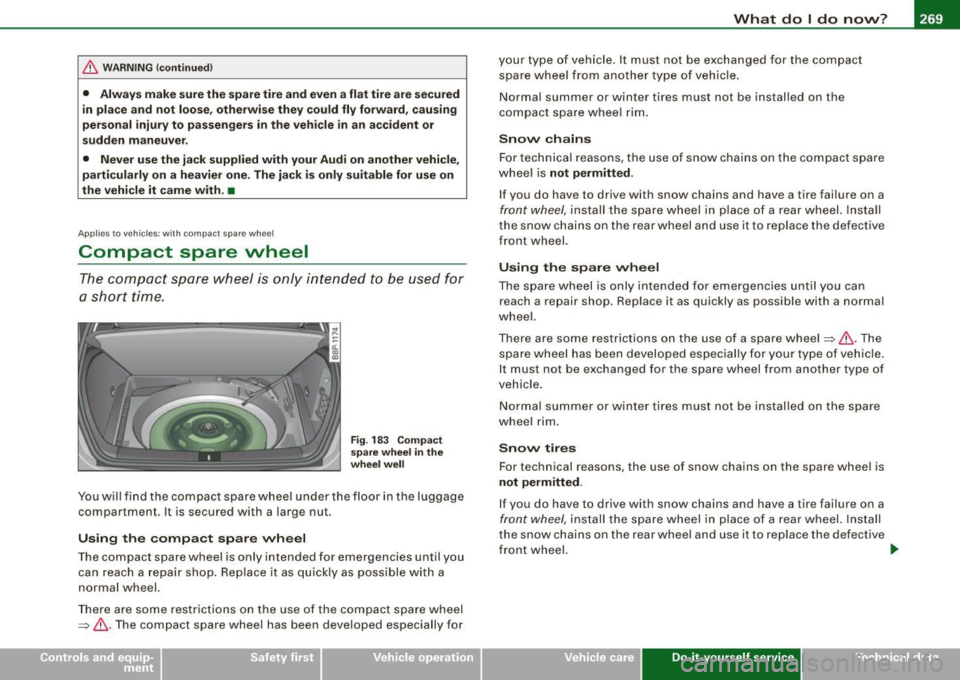
Fig . 183 Compact
spare wheel in the
wheel well
You will find the compact spare wheel under the floor in the luggage
compartment. It is secured with a large nut.
Using the compact spare wheel
The compact spare wheel is only intended for emergencies until you
can reach a repair shop. Replace it as quickly as possible with a
normal wheel.
There are some restrictions on the use of the compact spare wheel
=>
& -The compact spare wheel has been developed especially for your type of vehicle
. It must not be exchanged for the compact
spare wheel from another type of vehicle.
Normal summer or winter tires must not be installed on the
compact spare wheel rim.
Snow chains
For technical reasons, the use of snow chains on the compact spare
wheel is
not permitted .
If you do have to drive with snow chains and have a tire failure on a
front wheel, install the spare wheel in place of a rear wheel. Install
the snow chains on the rear wheel and use it to replace the defective
front wheel.
Using the spare wheel
The spare wheel is only intended for emergencies until you can
reach a repair shop. Replace it as quickly as possible with a normal
wheel.
There are some restrictions on the use of a spare wheel =>& .The
spare wheel has been developed especially for your type of vehicle.
I t must not be exchanged for the spare wheel from another type of
vehicle.
Normal summer or winter tires must not be installed on the spare
wheel rim .
Snow tires
For technical reasons , the use of snow chains on the spare wheel is
not permitted .
If you do have to drive with snow chains and have a tire failure on a
front wheel, install the spare wheel in place of a rear wheel. Install
the snow chains on the rear wheel and use it to replace the defective
front wheel.
t,.
Vehicle care Do-it-yourself service irechnical data
Page 272 of 320

-L_.:W:..:..: h..:. a :::.: t...:d::::.::: o:....:... I .:::d :.:o::....: n~ o::..: w.:..:. ? ______________________________________________ _
& WARNING
Always store jacking equipment, spare wheel in the luggage
compartment. Tighten screw for the spare wheel securely. Under
no circumstances should you store the spare wheel or jack and
tools unsecured in the passenger compartment. This could cause
serious personal injury to passengers
in the vehicle in case of a
collision.
• The compact spare tire is for temporary use only and is so
marked on the sidewalls.
• Do not drive at speeds exceeding 50 mph (80 km/hi with the
compact spare wheel mounted. Also rapid acceleration, hard
braking and hard cornering must be avoided to help prevent loss
of vehicle control.
• Any continuous road use of the compact spare tire may result
in tire failure, loss of vehicle control and injury to vehicle occu
pants.
• Do not put a snow chain on your compact spare tire. Due to the
smaller tire size, the chain will not fit properly and can thus
damage your vehicle. You could also lose the chain, as well as
control of the vehicle .
• If you have a flat front tire in road conditions which require
snow chains, first remove the undamaged rear wheel and mount
the compact spare wheel in its place. Then remove the damaged
front wheel, take the snow chains off it and attach them to the
wheel taken from the rear. This wheel can now be mounted on the
front with its snow chains. Check and adjust tire pressure promptly.
• Never use two or more compact spare tires at the same time.
0 Note
When using the compact spare wheel, note the following: •
After installing the compact spare wheel, the tire inflation pres
sure should be checked and, if necessary, increased to 60 psi (4 .2
barl.
• The load carrying capacity is marked on the tire sidewal ls and
must not be exceeded .
• After installing the compact spare wheel, make sure that you
remount the flat tire in its storage area properly .
• The compact spare tire should be properly remounted in its
storage area as soon as the standard road tire can be replaced.
• Because the compact spare tire was specifically designed for
your vehicle, it must not be used on any other vehicle . Likewise,
compact spare wheels from other vehic les must not be used on your
vehicle.
• The compact spare tire must not be mounted on any other
wheels, nor must standard tires, snow tires, wheel covers or trim
rings be used with the compact spare wheel. If such use is
attempted, damage to these items or other vehicle components
may occur.
[ i] Tips
Check the inflation pressure of the compact spare tire (60 psi/4 .2
bar) periodically to keep the tire ready for use .•
Wheel change
Before changing a wheel
Observe the following precautions for your own and your
passenger's safety when changing a wheel.
- After you experience a tire failure, pull the car well away
from moving traffic and try to reach level ground before
you stop
~ & . ~
Page 273 of 320
What do I do now? -__________________ __;__:....:....:..:: __ _
•
-All passengers should leave the car and move to a safe
location (for instance, behind the guardrail)~& .
- Apply the
parking brake firmly ~& .
- Move
selector lever to position Pon an automatic trans-
miss ion; put manual transmission in
first gear ~& .
-If you are towing a trailer : unhitch the trailer from your
vehicle.
- Take the
tool and the spare tire~ page 268 out of the
luggage compartment.
& WARNING
You or your passengers could be injured while changing a wheel if
you do not follow these safety precautions:
• If you have a flat tire, move a safe distance off the road. Turn off
the engine, turn the emergency flasher on and use other warning
devices to alert other motorists.
• Make sure that passengers wait
in a safe place away from the
vehicle and well away from the roadway and traffic.
• To help prevent the vehicle from moving suddenly and possibly
slipping off the jack, always fully set the parking brake and block
the wheel diagonally opposite the wheel being changed. When one
front wheel is lifted off the ground, placing the automatic trans
mission in "P" (Park), or engaging a gear in a manual transmission
will
not prevent the vehicle from moving.
• Before you change a wheel, be sure the ground is level and firm.
If necessary, use a sturdy board under the jack.
• After installing the spare wheel, make sure that you remount
the flat tire/wheel in its storage area properly and tighten the
knurled retaining screw securely. •
Changing a wheel
When you change a wheel, follow the sequence described
below step-by-step and exactly in that order.
1. Remove the decorative wheel cover*. For more details
see also
~ page 272, "Decorative wheel covers" or
~ page 273, "Wheels with cap-covered wheel bolts".
2. Loosen the
wheel bolts~ page 274.
3. Locate the proper mounting point for the jack and align
the jack below that point~
page 274.
4. Lift the car with the jack~ page 274.
5. Take the flat wheel off and then put the spare on
~ page 276.
6. Tighten all wheel bolts lightly .
7.
Lower the vehicle with the jack .
8. Use the wheel bolt wrench and
firmly tighten all wheel
bolts ~
page 274.
9. Put the decorative wheel cover* back on.
& WARNING
Always read and head all WARNINGS and information ::} & in
"Raising the vehicle" on
page 274 and ~ page 277. •
After changing a wheel
A wheel change is not complete without the following
actions.
- Store and secure the replaced wheel in the spare wheel
well. .,._
Do-it-yourself service
Page 274 of 320
-What d o I do novv ? PcV:I...__ ______________ _
- Put the tool case and the jack back in place in the luggage
compartment.
- Check the
tire pre ssure on the spare whee l immediately
after mounting it.
- As soon as possible, have the
tight ening torque s on all
wheel bo lts checked with a torque wrench . The correct
tightening torque is 90 ft lb (120 Nm) .
- Have the flat tire
repla ced as soon as possible.
[ i ] Tip s
• If you notice while changing a tire that the wheel bolts are
corroded and difficult to turn, then they should be replaced before
you check the tightening torque .
• Drive at reduced speed until you have the tightening to rques
checked .a
Ap plies to ve hicles: w it h full whee l co vers
Full wheel covers
The wheel covers must be removed to access the wheel
bolts.
Remo va l
- Pull the full wheel cov er off manually.
Inst alla tion
- First press the full wh eel cove r onto the rim at the cut -out
prov ided for the valve. Then engage the outer edge of the
f ull whe el cover in the steel rim. •
Applies to vehi cles : w it h deco ra tiv e wh eel co vers
Decorative whee l covers
The decorative wheel covers must be removed first to
access the wheel bolts .
Removing
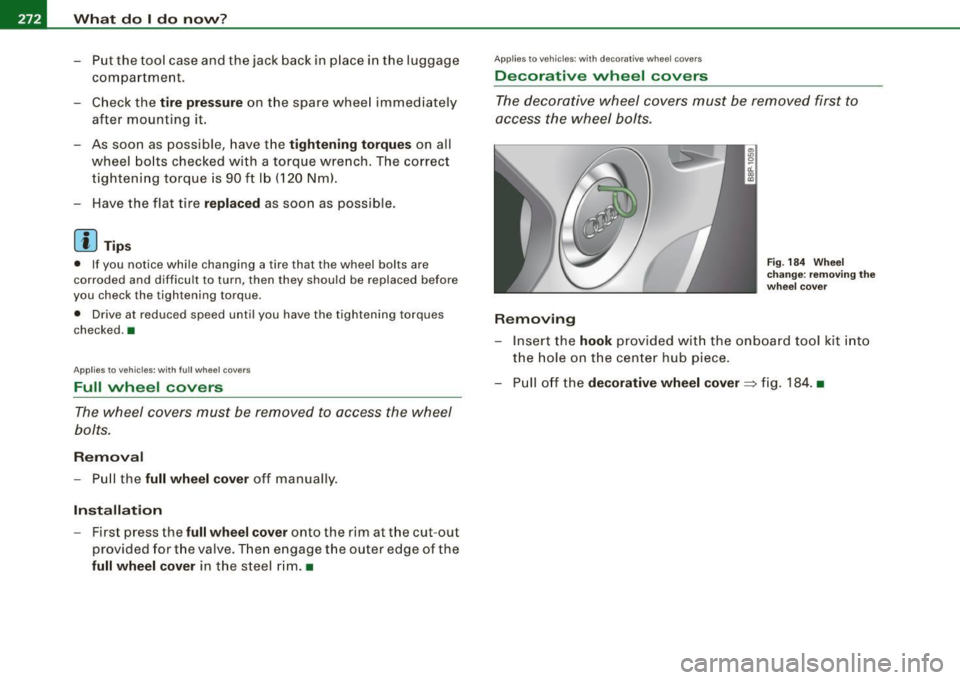
Fig. 18 4 Whee l
ch ange : remov in g th e
w hee l cover
- Inse rt the hook provid ed with the onboard tool kit into
t h e hole on the cen ter hub piece .
- P ull off the
d ecorative wheel cover => fig. 184. •
Page 278 of 320

llffl.,___W_ h_ a _ t_d_ o_ l _d _o_ n_ o_ vv_ ? ______________________________________________ _
Taking the wheel off /putt ing the spare on
Follow these instructions step-by-step for changing the
wheel
M
"' ;;; u.
1li
Fig . 190 Wheel
change : using the
screwdriver handle
(with the blade
removed) to turn the
bolts
Fig . 191 Wheel
change: alignment pin
inside the top hole
After you have loosened all wheel bolts and jacked the
vehicle off the ground, perform the following steps to
remove and replace the wheel:
Removing the wheel
- Use the hexagonal socket in the screwdriver handle to
completely turn out the topmost wheel bolt and set it
aside on a
clean surface~ fig. 190. - Screw the threaded end of the
alignment pin from the
tool kit hand-tight into the now vacant bolt hole
~ fig.191.
- Then completely unscrew the other wheel bolts as
described above.
Take off the wheel leaving the alignment pin in the bolt
hole.
Putting on the spare
- Lift the spare wheel up and carefully slide it over the
alignment pin to guide it in place.
- Use the hexagonal socket in the screwdriver handle to
screw in and tighten all wheel bolts
slightly.
Unscrew the alignment pin and insert and tighten the
remaining wheel bolt slightly like the rest.
- Turn the handle on the jack counter-clockwise to lower
the vehicle until the jack is fully released.
- Use the wheel bolt wrench to tighten all wheel bolts firmly ~
page 274. Tighten them crosswise , from one
bolt to the (approximately) opposite one, to keep the
wheel centered.
[ i ] Tips
Never try and use the hexagonal socket in the handle of the screw
driver to loosen or tighten the wheel bolts.
• Pull the reversible blade from the screwdriver before you use the
hexagonal socket in the handle to turn the wheel bolts.
• When mounting tires with
unidirectional tread design make sure
the tread pattern is pointed the right way=>
page 277. ~
Page 279 of 320
_____________________________________________ W_ h _a_t _ d_ o_ l _d _o _ n_o_ w_ ?_ . __ ffllll
•
• T he whe el bo lts should be cl ean and easy to turn . C heck for dirt
an d corro sion on the mati ng s urfaces o f both th e wheel a nd the
hub. Remove a ll dirt fro m these surfaces before remountin g the
whee l.•
Tires with unidirectional tread design
Tires with unidire ctional tread des ig n must be mou nted
w ith the ir tr ead patter n p oin ted in the right d irection .
Using a spare tire with a tread pattern intended for use
in a specific direction
Whe n u sin g a spare tir e with a trea d p att ern in te nd ed fo r use in a
sp ec if ic dir ection, p lease no te t he followin g:
• T he direction of rotation is ma rked by an arrow o n the side of the
ti re .
• I f the spare tire has to b e ins talled in the inco rrec t d irecti on in th e
e vent of a fla t tire , use t he sp are tir e only tem pora rily sin ce the ti re
wi ll not be ab le to achieve its o ptim um performance cha racteristics
wi th re gar d to aqua planing , n ois e an d wea r.
• W e rec omme nd t hat p arti cula r att enti on be pa id to th is f act
du ring w et we ather and th at you a djust you r sp eed to m atc h ro ad
condition s.
• Re place t he flat t ire w it h a n ew on e and have it insta lled on y our
v e hi cle as soo n as possi ble to res to re the ha nd ling a dvant ages of a
p roper ly pointed di re ction-d epe nde nt tire. •
Notes on wheel change
Ple ase r ead the inf ormatio n=> pa ge 254, "N ew tir es and r eplaci ng
ti res an d wheels" if yo u are g oin g to use a spare ti re wh ich is
d iff ere nt from the tires o n your vehi cle .
A fter you change a tire:
• Check the tire pressure on the spare immediately after
mounting.
• Have the wheel bolt tightening torque checked with a torque
wrench as soon as possible by your authorized Audi dealer or a qualified service station .
• On steel and alloy wheel rims, the wheel bolts are correctly tight
ened with a torque of 90 ft lb (120 Nml.
• If you notice while changing a tire that the wheel bolts are
corroded and difficult to turn , then they should be replaced before
you check the tightening torque.
• Replace the flat t ire with a new one and have it installed on your
vehicle as soon as possible . Remount the wheel cover .
Until then, drive with extra care and at reduced speeds.
& WARNING
• If you are going to equip your vehicle with tires or rims which
differ from those which were factory installed , then be sure to read
the information
=> page 254 , "New tires and replacing tires and
wheels ".
• Always make sure the damaged wheel or even a flat tire and
the jack and tool kit are properly secured in the luggage compart
ment and are not loose in the passenger compartment .
• In an accident or sudden maneuver they could fly forward,
injuring anyone in the vehicle .
• Always store damaged wheel , jack and tools securely in
luggage compartment . Otherwise , in an accident or sudden
maneuver they could fly forward, causing injury to passengers in
the vehicle . •
Do-it-yourself service
Page 316 of 320

___ A_ l..:,. p _ h_ a_ b_e _t_ic _ a_l _in _ d_e_ x ____________________________________________ _
Side airbags
Description .. ..... ....... .......
161
How they work . . . . . . . . . . . . . . . . . . . 162
Side curtain airbags ...... .... ..... .. 164
Description ... .... .... ... .... ... 164
How they work . . . . . . . . . . . . . . . . . . . 165
Safety ins tructions . . . . . . . . . . . . . . . 166
Side marker lights . . . . . . . . . . . . . . . . . . . 53
Ski sack . ...... .. .... .... ... .... ... . 85
Snow chains . . . . . . . . . . . . . . . . . . . . . . . 260
Sockets . .... .... .... .... ... .... .... 91
Sound system
Replacing ........ ... ..... .......
301
Sound system disp lay . ... .... .... .... 18
Sources of information about child restraints
and the ir use . .... .... ... .... ...
185
Spare tire . . . . . . . . . . . . . . . . . . . . . . . . . . 269
Spare wheel
See Spa re ti re ...... .... ........ . 269
Speed rating letter code . . . . . . . . . . . . . 256
Speed warning ... .... .... ... .... .... 33
Speed warning system ...... .... .... . 26
Speedometer . . . . . . . . . . . . . . . . . . . . . . . 10
Sta rting assistance ... .... .... ....... 287
Star ting on hi lls
H ill hold assist . .... ....... .......
110
Starting the engine ............. 106, 107
What should I do if the engine does not
star t? . . . . . . . . . . . . . . . . . . . . . . . . .
107
Steel wheels . . . . . . . . . . . . . . . . . . . . . . . 209
Steering . . . . . . . . . . . . . . . . . . . . . . . . . . . 105
Locking the steering . . . . . . . . . . . . . . 106
See also Electro-mechanical power assis t
16, 193
Steering wheel colum n
Adjusting ..... ... ..... .... .... ..
105
Steps for d eter mining correc t load limit 251
Stopping the engine ................. 108
Storage . .... .... ..... .. .... ..... ... 92
Compartments in the door tr ims .. ... 94
Cup holder rear center armrest ...... 90
Glove compartment . ...... .... .... 93
Small objects .......... ....... .... 93
Storage compartment
Increasing size ....... .... ... .. ....
81
Sun blind .. ...... .... .... .... ... .... 61
Sun visors .. ...... ....... .... .... ... 60
Sunroof
See panoramic sli din g sunroof ...... 49
Switches
Emergency flasher . . . . . . . . . . . . . . . .
56
Switching the air cond itioner (automatic)
on/off ... . ..... ..................
98
Symbols
T
Red symbols in the center display ... 28
Ye llow symbols in the center display . 29
Tachometer ...... ...... .... ... .. .... . 8
Tailgate
See Rea r lid ... ... .... .... .... .... 43
Techn ical modifications .. ............ 301
T emperature
Clima te controls .. ...... .. .... ....
99
Setting for the drive r's and front passen-
ger's side ..... ....... .. .. ... ... .
99
Tether anchors .... ... .... .... ...... 183
Teth er strap ... .. .. .. .... .... .... ... 183
The first 1,000 miles (1,500 km) and
afterwa rds ........ ... .. . ... ....
195
Tie -downs ....... .... .... ...... . 82, 133
Tips for the environment
Saving fuel .... .... .... .. .. .... ...
89
Tir e pressure . ...... ... ... ..... ..... 249
Tire pressure monitoring system ... .. . 263
Changing whee ls ... ........... ... 266
Dec laration of conformity ....... .. 267
Learning process . ...... .. .. .... .. 265
Loss of air pressur e ..... ... .... 12,264
Malfunctions . .... .... .... .... ... 266
Sensors . . . . . . . . . . . . . . . . . . . . . . . . . 256
Storing tire pressures ........ ..... 265
Tires and wheels ....... ... ... .... 256
Valves .......... ........ .... .... 256
Warning light . .... .... .... .... .... 35
Tir e se rvice life ...... .... .... ....... 253
Tires ............................ .. 242
Replacing ..... .... .... .. .. .. 254, 256
Service life . ... .... .... .... ...... 253
speed rating letter code .. ...... ... 256
Tire manufacturing dat e .... .... ... 256
Tir e specificat ions ..... ... .... .... 255
Tread depth ...... ........ ....... 253
Uniform tire quality grading ...... . 258
Winter tires ... ... ... .. ...... .... 259