airbag AUDI S3 2010 Workshop Manual
[x] Cancel search | Manufacturer: AUDI, Model Year: 2010, Model line: S3, Model: AUDI S3 2010Pages: 320, PDF Size: 75.34 MB
Page 175 of 320
- Push the child safety seat down with your full weight to get the safety belt really tight so that the seat cannot
move forward or sideways more than one inch (2.5 cm).
Infants up to about one year (20 lbs. or 9 kg) are best protected in
special infant carriers and child safety seats designed for their age
group. Many experts believe that infants and small children should
ride only in special restraints in which the child faces the back of the
vehicle. These infant seats support the baby's back, neck and head
in a crash
=> fig. 147.
The airbag on the passenger side makes the front seat a potentially dangerous place for a child to ride. The front seat is not the safest
place for a child in a forward-facing child seat. It is a very dangerous
place for an infant or a larger child in a rearward -facing seat.
& WARNING
Not using a child safety seat, using the wrong child safety seat or
improperly installing a child restraint increases the risk of serious
personal injury and death in a crash.
• Never install rear-facing child safety seats or infant carriers on
the front passenger seat -even with an Advanced Airbag System.
A child will be seriously injured and can be killed when the
inflating airbag hits the child safety seat or infant carrier with
great force and smashes the child safety seat and child against the
backrest, center armrest, door or roof =>
page 147, "Child
restraints on the front seat -some important things to know".
• Always install rear-facing child safety seats or infant carriers on
the rear seat.
• Never install a rear-facing child restraint in the forward-facing
direction. Such restraints are designed for the special needs of
infants and very small children and cannot protect them properly
if the seat is forward-facing.
• If you must install a rearward facing child safety seat on the
front passenger seat because of exceptional circumstances and
the PASSENGER AIR BAG OFF light does not come on and stay on,
Safety first
Child Safety
& WARNING !continued)
immediately install the rear-facing child safety seat in a rear
seating position and have the airbag system inspected by your
Audi dealer.
• Always read and heed all WARNINGS whenever using a child
restrained in a vehicle is being used=>
page 135, "Safety belts",
=> page 145, "Airbag system" and=> page 167, "Important things
to know". •
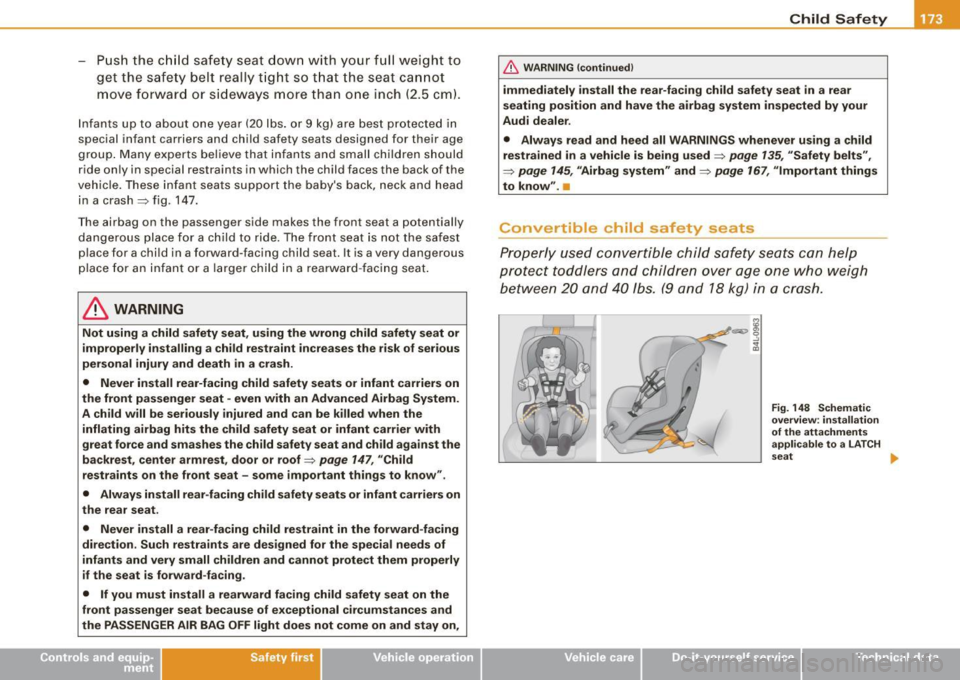
Convertible child safety seats
Properly used convertible child safety seats can help
protect toddlers and children over age one who weigh
between 20 and 40 lbs. (9 and 18 kg) in a crash.
Vehicle care I I
Fig. 148 Schematic
overview: installation
of the attachments
applicable to a LATCH
seat II-
irechnical data
Page 176 of 320
•---=C:...:.h.:.: i.:.:ld ::.....: S~ a::. f~ e~ t~ y~ ----------------------------------------------
Fig. 149 Schematic
overview: installation
of the seat using the
vehicle's safety belt
system
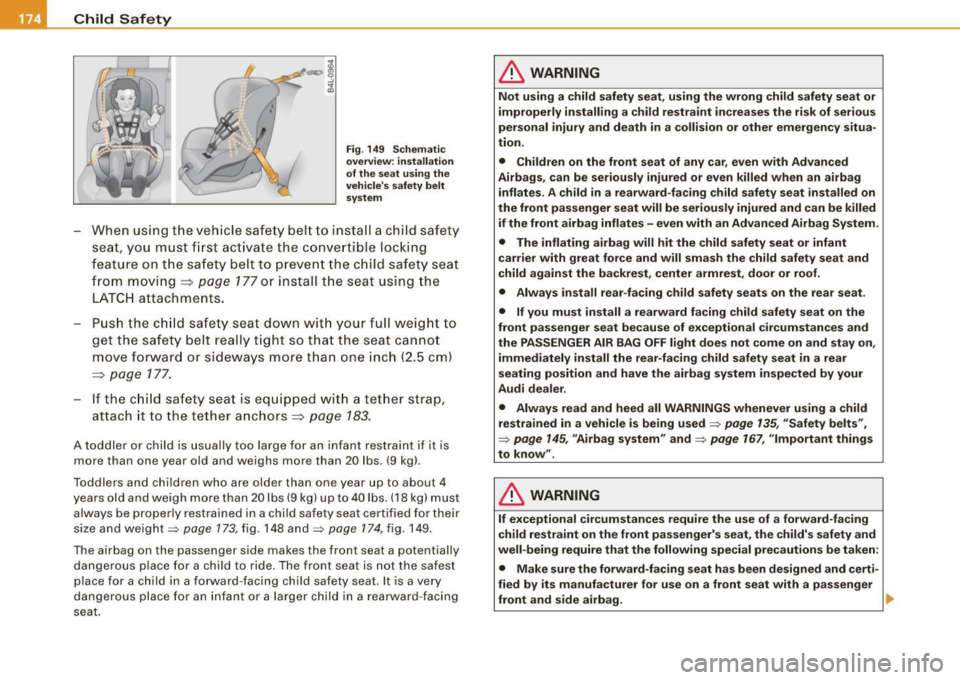
- When using the vehicle safety belt to install a child safety
seat, you must first activate the convertible locking
feature on the safety belt to prevent the child safety seat
from moving ==>
page 177 or install the seat using the
LATCH attachments.
- Push the child safety seat down with your full weight to
get the safety belt really tight so that the seat cannot
move forward or sideways more than one inch (2.5 cm)
==> page 177.
If the child safety seat is equipped with a tether strap,
attach it to the tether anchors ==>
page 183.
A toddler or child is usually too large for an infant restraint if it is
more than one year old and weighs more than 20 lbs. (9 kg) .
Toddlers and children who are older than one year up to about 4
years old and weigh more than 20 lbs (9 kg) up to 40 lbs. (18 kg) must always be properly restrained in a child safety seat certified for their
size and weight=>
page 173, fig. 148 and => page 174 , fig. 149.
The airbag on the passenger side makes the front seat a potentially dangerous place for a child to ride. The front seat is not the safest
place for a child in a forward-facing child safety seat . It is a very
dangerous place for an infant or a larger child in a rearward -facing
seat.
& WARNING
Not using a child safety seat, using the wrong child safety seat or
improperly installing a child restraint increases the risk of serious
personal injury and death in a collision or other emergency situa
tion.
• Children on the front seat of any car, even with Advanced
Airbags, can be seriously injured or even killed when an airbag
inflates. A child in a rearward-facing child safety seat installed on
the front passenger seat will be seriously injured and can be killed
if the front airbag inflates -even with an Advanced Airbag System.
• The inflating airbag will hit the child safety seat or infant
carrier with great force and will smash the child safety seat and
child against the backrest, center armrest, door or roof.
• Always install rear-facing child safety seats on the rear seat.
• If you must install a rearward facing child safety seat on the
front passenger seat because of exceptional circumstances and
the PASSENGER AIR BAG OFF light does not come on and stay on, immediately install the rear-facing child safety seat in a rear
seating position and have the airbag system inspected by your
Audi dealer.
• Always read and heed all WARNINGS whenever using a child
restrained in a vehicle is being used=>
page 135, "Safety belts",
=> page 145, "Airbag system" and=> page 167, "Important things
to know".
& WARNING
If exceptional circumstances require the use of a forward-facing
child restraint on the front passenger's seat, the child's safety and
well-being require that the following special precautions be taken:
• Make sure the forward-facing seat has been designed and certi
fied by its manufacturer for use on a front seat with a passenger
front and side airbag. ...
Page 177 of 320
& WARNING !continued)
• Always follow the manufacturer's instructions provided with
the child safety seat or infant carrier.
• Always move the front passenger seat into the rearmost posi
tion of the passenger seat's fore and aft adjustment range, and as
far away from the airbag as possible before installing the child
restraint.
• Always make sure that nothing prevents the front passenger's
seat from being moved to the rearmost position in its fore and aft
adjustment range .
• Always make sure the backrest is in an upright position .
• Make sure that the PASSENGER AIR BAG OFF light comes on
and stays on all the time whenever the ignition is switched on.
• If the light does not stay on, perform the checks~
page 156,
uMonitoring the Advanced Airbag System ".
• Take the child restraint off the front passenger seat and install
it properly at one of the rear seat positions if the PASSENGER AIR
BAG OFF light does not stay on whenever the ignition is switched
on. •
Safety first
Child Safety
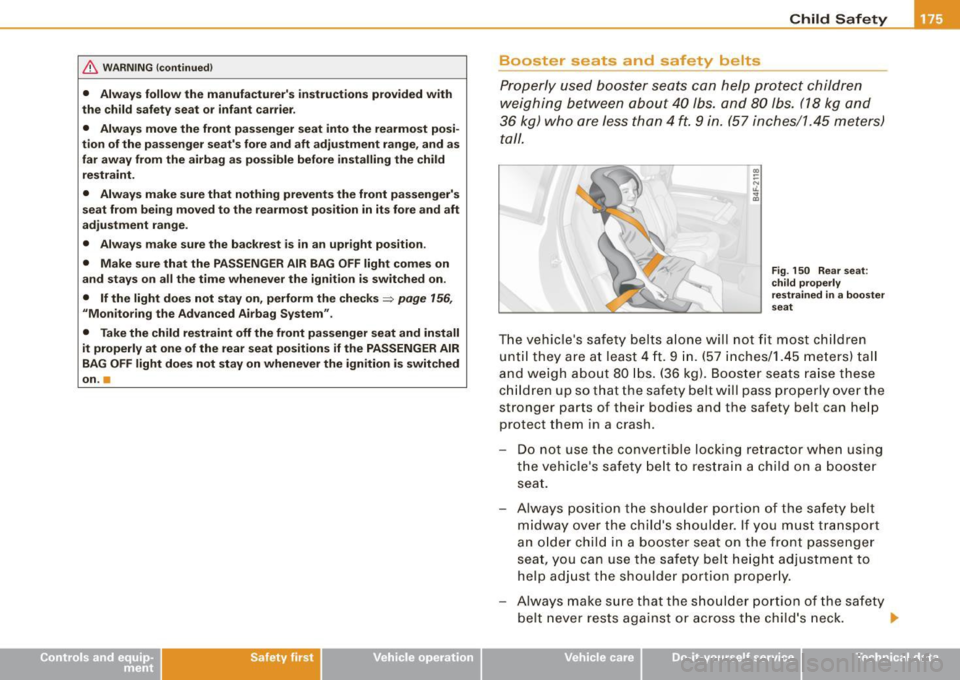
Booster seats and safety be lts
Properly used booster seats can help protect children
weighing between about 40 lbs. and 80 lbs. (18 kg and
36 kg) who are less than 4
ft. 9 in. (57 inches/1.45 meters)
tall.
Fig . 150 Rear seat:
child properly
restrained in a booster
seat
The vehicle's safety belts alone will not fit most children
until they are at least 4 ft. 9 in. (57 inches /1.45 meters) tall
and weigh about 80 lbs. (36 kg). Booster seats raise these
children up so that the safety belt will pass properly over the
stronger parts of their bodies and the safety belt can help
protect them in a crash.
- Do not use the convertible locking retractor when using
the vehicle's safety belt to restrain a child on a booster
seat.
- Always position the shoulder portion of the safety belt
midway over the child's shoulder. If you must transport
an older child in a booster seat on the front passenger
seat, you can use the safety belt height adjustment to
help adjust the shoulder portion properly.
- Always make sure that the shoulder portion of the safety
belt neve r rests against or across the child's neck.
9'>
Vehicle care I I irechnical data
Page 178 of 320
___ C_h_ i_ ld _ S_ a_ f_ e_ t_y ____________________________________________ _
-Always make sure that the chi ld can pr operly wear t he
lap por tion of the be lt low acr oss the thighs or pelvis and
never over the stomach or abdomen.
Children up to at least 8 years old (over 40 lbs or 18 kg) are best
protected in child safety seats designed for their age and weight.
Exper ts say that the ske le tal s tructure, particu lar ly the pe lvis, of
these children is not fully deve loped, and they must not use the
vehic le safety belts without a suitab le chi ld rest raint.
Children who are at least 4 ft. 9 in. (57 inches/1.45 meters) tall can
generally use the vehic le 's three point lap and shou lder belts . Never
use the lap belt portion of the vehic le's safety belt a lone to restrain
any chi ld, regardless of how big the child is. Always remember that
children do not have the pronounce d pelvic struc ture required for
the proper function of lap be lt portion of the vehicle's three point
lap and shou lder belts. The child' s safety abs olutely requires that a
lap belt portion of the safety belt be fastened snugly and as low as
possible aro und the pelv is. Never let the lap be lt portion of the
safety be lt pass over the child 's stomach or abdomen .
It is usua lly best to put thes e chi ldren in appropriate booster seats.
Be sure the booster seat me ets all app licable safety standards.
Booster seats raise the seating pos ition of the child and reposition
both the lap and s hou lder par ts of t he safety belt so that they pass
across the child's body in the right places. The routing of the belt
over the child's body is very important for the child 's protection,
whether or not a booster seat is used. Children age 12 and under must a lways ride in the rear seat.
In a crash, air bags must inflate wi th in a b link of an eye and with
considerab le force . In order to do its job, the airbag needs room to
inf la te so tha t it will be there to pr otec t the occ upant as the occu
pant moves forward into the airbag .
A vehicle occupant who is out of position and too close to the airbag ge ts in t he way of an inflating a irbag. When an occupant is too
close, he or she will be struck vio lent ly and will receive serious or
poss ibly even fatal inju ry. I
n order for the airbag to offer protection, it is important that all
v eh ic le occupan ts, espec ially any c hildren, who mus t be in the fron t
seat because of exceptiona l circumstances, be properly restrained
and as far away fro m the airbag as possible . By keepi ng room
between the child's body and the front of the passenger compart
ment, the ai rbag can inflate comp lete ly and provide s upplemental
p rotectio n in ce rtai n fr ontal collis ions .
& WARNING
Not u sing a booster seat , using the booster seat improperly , incor
rectly installing a boo ster seat or using the vehicle safety belt
improperly in creases the risk of serious personal injury and death
in a collision or other emergency situation . To help reduce the risk
of serious personal injury and /or death :
• Alway s make sure to position the shoulder portion of the three
point belt over the middle of child's shoulder .
• Never let the shoulder portion of the belt rest against or acro ss
the ne ck, fa ce , c hin , or throat of the child .
• Alway s make sure the lap belt portion of the three -point belt is
worn snug and pa sses as low a s po ssible across the child' s pel vis .
Never let the belt pass over the soft abdomen.
• Failure to properly route s afety belts over a ch ild's body will
cau se severe injurie s in an accident or other emergency situation
~ page 135 .
• Children on the front seat of any car , even with Advanced
Airb ags , c an be seriou sly injured or even killed when an airbag
inflates.
• Never let a child stand or knee l on any seat , fo r ex ample the
front seat .
• Never let a child ride in the cargo area of your vehicle .
• Always remembe r that a child leaning forward , sitting side
ways or out of po sition in any way during an accident can be
s truc k by a deploy ing airbag . Thi s will re sult in ser iou s per sonal
i njury or death .
~
Page 179 of 320
Child Safety -
--------------------''----
& WARNING (continued )
• If you must install a booster seat on the front passenger seat
because of exceptional c ircumstances the PASSENGER AIR BAG
OFF light must come on and stay on , whenever the ignition is
switched on.
• If the PASSENGER AIR BAG OFF light does not come on and stay
on , perform the checks described=>
page 156, "Monitoring the
Advanced A irbag System ".
• Take the ch ild restraint off the front passenger seat and install
it properly at one of the rear seat positions if the PASSENGER AIR
BAG OFF light does not stay on wheneve r the ignition is switched
on .
• Always read and heed all WARNINGS whenever using a child
restrained in a vehicle is being used=>
page 135, "Safety belts",
=> page 145, "Airbag system " and => page 167 , "Important things
to know ".•
Installing a child safety seat
Securing a child safety seat using a safety
belt
S a fety belt s for the rea r sea ts and the front passenger con
b e lo cked with t he conver tible lo ckin g retr actor to p rop
e rly sec ure c hild saf ety sea ts.
T he s afe ty bel ts e merge ncy lo cking re trac to rs fo r th e rea r sea ts
safety belts and for the front pass enger's seat safety belt have a
c o nve rtible loc king re tr ac tor fo r child r estrai nts. The sa fe ty b elt
must be loc ked so that be lt webbin g cannot unr eel. The re trac tor
c an be activa te d to lock the safety be lt and prevent the safet y belt
w ebbi ng fr om l oos en ing up dur in g n orm al dr ivi ng . A chi ld sa fety
seat can only be properly insta lled when t he safety be lt is locked so
th at th e child and chil d sa fet y seat will sta y in p lace .
Controls and equip ment Safety first Vehicle operation A
lways remember: Even though your vehic le is equipped with an
A dva nce d Airb ag sys tem, all chi ld re n, e sp ec ially those 12 yea rs a nd
youn ger, should a lways ride in the back seat prop erly restrained for
t hei r age a nd size .
& WARNING
Improperly installed child safety seats increase the risk of serious
personal injury and death in a collision .
• Always make sure that the safety belt retractor is locked when
installing a child safety seat . An unlocked safety belt retractor
cannot hold the child safety seat in place during normal driving or
in a crash .
• Always buckle the child safety seat firmly in place even if a
child is not sitting in it . A loose child safety seat can fly around
during a sudden stop or in a collision .
• Always make sure that the rear seat backrest to which the
center rear safety belt is attached is securely latched whenever
the rear center safety belt is being used to secure a child restraint.
• If the backrest is not securely latched , the child and the child
restraint will be thrown forward together with the backrest and
will strike parts of the vehicle interior. The child can be seriously injured or killed.
• Never install rear -facing child safety seats or infant carriers on
the front passenger seat . A child will be seriously injured and can
be killed when the passenger airbag inflates .
• The inflating airbag will hit the child safety seat or infant
carrier with great force and will smash the child safety seat and
child against the backrest , center armrest , door or roof .
• Always install rear-facing child safety seats or infant carriers on
the rear seat .
• Forward-facing child safety seats or infant carriers installed on
the front passenger's seat may interfere with the deployment of
the airbag and cause serious injury to the child . ..
Vehicle care Do-it-yourself service Technical data
Page 180 of 320
-Child Safety -------=---------------------------------------
& WARNING (continued )
• It is safer to install a forward-f acing child safety seat on the rear
seat.
• Always read and heed all WARNINGS whenever using a child
restrained in a vehicle is being used=>
page 167. Special precau
tions apply when installing a child safety seat on the front
passenger seat:::::,
page 147, "Child restraints on the front seat -
some important thing s to know ".
& WARNING
Always take special precautions if you must install a forward or
rearward-facing child restraint on the front passenger's seat in
exceptional situations :
• Whenever a forward or rearward -facing child restraint is
installed on the front passenger seat , the PASSENGER AIR BAG
OFF light must come on and stay on whenever the ignition is
switched on.
• If the PASSENGER AIR BAG OFF light does not come on and stay
on , perform the checks described=>
page 156, "Monitoring the
Advanced Airbag System ".
• Take the child restraint off the front passenger seat and install
it properly at one of the rear seat positions if the PASSENGER AIR
BAG OFF light does not stay on whenever the ignition is switched
on .
• Improper installation of child restraints can reduce their effec
tiveness or even prevent them from providing any prote ction .
• An improperly installed child restraint can interfere with the
airbag as it deploys and seriously injure or even kill the child .
• Always carefully follow the manufacturer's instructions
provided with the child safety seat or carrier .
• Never place additional items on the seat that can increase the
total weight registered by the weight-sensing mat and can cause
injury in a crash .
& WARNING
Forward-facing ch ild restraints :
• Always make sure the forward-facing seat has been designed
and certified by its manufa cturer for use on a front seat with a
passenger front and side airbag .
• Never put the forward-facing child restraint up , against or very
near the instrument panel.
• Always move the passenger seat into its rearmost position in
the seat's fore and aft adjustment range , as far away from the
airbag as possible before installing the forward-facing child
re straint. The backrest must be adjusted to an upright position.
• Make sure that the PASSENGER AIR BAG OFF light comes on
and stays on all the time whenever the ignition is switched on.
& WARNING
Re arward -facing child restraints :
• A child in a rearward -facing child safety seat installed on the
front passenger seat will be seriously injured and can be killed if
the front airbag inflates -even with an Advanced Airbag System.
• The inflating airbag will hit the child safety seat or infant
carrier with great force and will smash the child safety seat and
child against the backrest , center armrest , door or roof .
• Always be e specially careful if you must install a rearward
facing child safety seat on the front passenger seat in exceptional
circumstances .
• A tight tether strap on a rearward-facing child restraint
attached to the front pas senger seat can put too much pres sure
on the weight -m at in the seat and register a heavier weight in the
Advanced Airbag System. The heavier weight registered can make
the system work as though an adult were on the seat and deploy
the Advanced Airbag when it must be suppressed causing ser ious
or even fatal injury to the child.
Ill-
Page 181 of 320

_______________________________________________ C_h _ i_ld _ S_ a_ f_ e_ t..,:c y __ __
& WARNING (continued)
• Make sure that the PASSENGER AIR BAG OFF light comes on
and stays on all the time whenever the ignition is switched on.
• If the PASSENGER AIR BAG OFF light does not come on and stay
on, immediately install the rear-facing child safety seat in a rear
seating position and have the airbag system inspected by your
Audi dealer. •
Activating the convertible locking retractor
Use the convertible locking retractor to secure a child
restraint.
Always heed the child safety seat manufacturer 's instruc
tions when installing a child restraint in your vehicle. To
activate the convertible locking retractor:
- Place the child restraint on a seat, preferably on the rear
seat.
- Slowly pull the belt
all the way out.
- Route it around or through the child restraint belt path
=>& .
- Push the child safety seat down with your full weight to
get the safety belt really tight .
- Insert the belt tongue into the buckle for that seating
position.
- Gu ide the safety belt back into the retractor until the belt
lies flat and snug on the child safety seat.
Controls and equip
ment Safety first Vehicle operation
- You should
hear a "clicking" noise as the belt winds back
into the inertia reel. Test the convertible locking retractor
by pul ling on the belt. You should no longer be able to
pull the belt out of the retractor. The convertible locking
retractor is now activated .
- Make sure that the red release button is facing away from
the child restraint so that it can be unbuckled quickly.
- Pull on the belt to make sure the safety belt is properly
tight and fastened so that the seat cannot move forward
or sideways more than one inch (2.5 cm).
& WARNING
Using the wrong child restraint or an improperly installed child
restraint can cause serious personal injury or death in a crash.
• Always make sure that the safety belt retractor is locked when
installing a child safety seat. An unlocked safety belt retractor
cannot hold the child safety seat in place during normal driving or
in a crash.
• Always buckle the child safety seat firmly in place even if a
child is not sitting in it. A loose child safety seat can fly around
during a sudden stop or in a crash.
• Always make sure the seat backrest to which the child restraint
is installed is in an upright position and securely latched into place
and cannot fold forward. Otherwise, the seat back with the child
safety seat attached to it could fly forward in the event of an acci
dent or other emergency situation.
• Always read and heed all WARNINGS whenever using a child
restrained in a vehicle is being used=>
page 167 . Special precau
tions apply when installing a child safety seat on the front
passenger seat=>
page 147, "Child restraints on the front seat -
some important things to know". •
Vehicle care Do-it-yourself service Technical data
Page 186 of 320

___ C_h_ i_ld _ S_ a_ f_ e_ t-= y'------------------------------------------------
child head movement performance requirements . T hese new
per forma nce r equ ireme nts m ak e a tether ne cessary on m ost new
ch ild s afe ty s eats .
& WARNING
Improper installation of child restraints will increase the risk of
injury and death in a crash .
• Always follow the instructions provided by the manufacturer of
the child restraint you intend to install in your Audi.
• Improper use of child restraint anchors (including tether
anchors) can lead to injury in a collision . The anchors are designed
to withstand only those loads imposed by correctly fitted child
restraints.
• Never mount two child restraint systems on one LATCH lower
anchor point .
• Never attach two child restraint systems to one tether strap or
tether anchorage .
• Never attach a tether strap to a tie-down hook in the luggage
compartment.
• Never use child restraint tether anchorages to secure safety
belts or other kinds of occupant restraints .
• Never secure or attach any luggage or other items to the LATCH
lower anchorages or to the tether anchors .
• If a tether or other strap is used to attach a child restraint to the
front passenger seat , make sure that it is not so tight , that it
causes the weight -sensing mat to measure more weight than is
actually on the seat .
• The heavier weight registered can make the Advanced Airbag
System work as though an adult were on the seat and deploy the
Advanced Airbag when it must be suppres sed causing serious or
even fatal injury to the child.
• If you must install a rearward facing child safety seat on the
front passenger seat because of exceptional circumstances and
the PASSENGER AIR BAG OFF light does not come on and stay on ,
& WARNING (continued)
immediately install the rear-facing child safety seat in a rear
seating position and have the airbag system inspected by your
Audi dealer . •
Installing the upper tether strap on the
anchorage
Installing the tether strap
F ig . 156 Tether strap:
proper routing and
mounting
Fig . 157 T ether strap:
proper r outing and
mounting
R el ease or dep lo y the tethe r strap on the chil d restraint
acco rding to the c hild restraint man ufacturer 's instr uc-
ti on s.
11'-
Page 187 of 320

_______________________________________________ C_h _ i_ld _ S_ a_ f_ e_ t..,:c y __ _
-Guide the upper tether strap under the rear head
restraint and into the rear cargo area==> fig. 157 (raise the
head restraint if necessary).
- Slide the tether strap hook over the anchor bracket.
- Pull on the tether strap hook so that the spring catch of
the hook engages .
- Tighten the tether strap firmly following the child
restraint manufacturer's instructions.
Releasing the tether strap
- Loosen the tension following the child restraint manufac
turer's inst ructions.
- Depress the spring catch on the hook and release it from
the anchorage.
0 Note
If you leave the child restraint with the tether strap firmly installed
for several days, this could leave a mark on the upholstery on the
seat cushion and backrest in the area where the tether strap was
installed. The upholstery would also be permanently stretched
around the tether strap. This applies especially to leather seats. •
Using tether straps on rearward-facing child
restraints
Currently, few rear-facing child restraint systems come with a tether.
P lease read and heed the child restraint system manufacturer's
instructions carefully to determine how to properly install the
tether.
Controls and equip ment Safety first Vehicle operation
& WARNING
A
child in a rearward-facing child safety seat installed on the front
passenger seat will be seriously injured and can be killed if the
front airbag inflates -even with an Advanced Airbag System .
• The inflating airbag will hit the child safety seat or infant
carrier with great force and will smash the child safety seat and
child against the backrest, center armrest, or door.
• A tight tether or other strap on a rearward-facing child restraint
attached to the front passenger seat can put too much pressure
on the weight-mat in the seat and register a heavier weight in the
Advanced Airbag System. The heavier weight registered can make
the system work as though an adult were on the seat and deploy
the Advanced Airbag when it must be suppressed causing serious
or even fatal injury to the child.
• If you must install a rearward facing child safety seat on the
front passenger seat because of exceptional circumstances and
the PASSENGER AIR BAG OFF light does not come on and stay on,
immediately install the rear -facing child safety seat in a rear
seating position and have the airbag system inspected by your
Audi dealer. •
Additional Information
Sources of information about child restraints
and their use
There are a number of sources of additional information about child
restraint selection, installation and use:
NHTSA advises that the best child safety seat is the one that fits
your child and fits in your vehicle, and that you will use correctly and
consistently.
Try before you buy!
Vehicle care Do-it-yourself service Technical data
Page 190 of 320

_1--_l_ n _t _ e _ll _,ig ,_,_ e_n _t _ t_ e_ c_ h_n _o_ l_ o ~g""- y.e- __________________________________________ _
Intelligent technology
Notice about data recorded by
vehicle control modules
Your vehicle is not equipped with an Event Data Recorder (EDR),
installed by some manufacturers for the express purpose of
capturing data for retrieval after an accident or crash event . EDR's
are sometimes called "crash recorders".
Some state laws restrict the retrieval or downloading of data stored
by EDR's that were insta lled in a vehicle for the express purpose of
retrieving data after an accident or crash event without the owner's
consent .
Although your vehicle is not equipped with an EDR, it is equipped
with a number of electronic control modules for various vehicle systems such as, for example, eng ine function, emission control, as
well as for the airbags and safety belts.
These electronic control modules also record vehic le -related data
during norma l vehicle operation for diagnostic and repair purposes .
The recording capacity of the electronic cont rol modules is limited
to data (no sound is recorded) and only a small amount of data is
actually recorded over a very limited period of time and stored when
a system fault or other condition is sensed by a control unit . Some
of the data then stored may relate to vehic le speed, direction,
braking as we ll as restraint system use and performance in the
event of a crash or other condition. Stored data can only be read and
downloaded with special equip men t.
Electronic Stabilization Program (ESP)
General
The Electronic Stabili ty Program increases driving
stability.
co ::,
_1, _ __ J"u. __ 11 ... _ ,.....u.,___,lli u.. _ .x,u _ _, r-u ~~ ~!' js:..~&c:',I
I
'
1 J
F ig . 15 8 Cente r
cons ole with E SP
sw itch
With ESP, control over the veh ic le is increased in situations when
the vehicle is close to the limits of grip, such as during acce leration
and in curves. ESP reduces the risk of skidding a nd improves vehicle
stability under all road conditions . It operates at all speeds .
The Anti-Lock Brake System (ABS), E lec tronic Differentia l Lock (EDS)
and Anti-Slip Regulation System (ASR) are integrated in the Elec
tronic Stability Program .
How ESP work s
The ESP control unit processes the fo llowing data from high-sensi
tive sensors : the rotational speed of the vehicle about its vertica l
axis, fore -and -aft and lateral acceleration forces, brake pressure and
steering angle.
Using steering ang le and vehicle speed, the direction the driver
wishes to travel is determined and continuously compared with
t,.