oil capacity AUDI S3 2010 Owners Manual
[x] Cancel search | Manufacturer: AUDI, Model Year: 2010, Model line: S3, Model: AUDI S3 2010Pages: 320, PDF Size: 75.34 MB
Page 12 of 320
Instruments and warning/indicator lights
Engine cold
As long as the needle remains at the left end of the gauge, the
engine still has not reached its operating temperature . Avoid high
engine speeds, heavy engine loads and heavy throttle.
Normal temperature
When the engine has reached its operating temperature, the needle
will move into the middle of the gauge and remain there. If the engine is working hard at high outside temperatures, the needle
may turn further to the right. This is no cause for concern as long as
the
_ f_ warning light in the instrument cluster does not illuminate.
When the
-L warning light starts to flash, this can mean one of two
things: either the coolant
temperature is too high, or the coolant
level is too low=> page 30.
& WARNING
• Always observe the warning in=> page 215, "Engine compart
ment" before opening the engine hood and checking the engine
coolant level.
• Never open the engine hood if you see or hear steam, or if you
see engine coolant dripping from the engine compartment. You
could burn yourself. Let the engine cool off first so that you cannot
hear or see any steam or engine coolant.
0 Note
• Mounting additional lights or accessories in front of the air inlets
reduces the cooling effect of the radiator . At high outside tempera
tures or high engine load, the engine could overheat.
• The front spoiler has been designed to properly distribute the
cooling air when the vehicle is moving. If the spoiler is damaged,
this could reduce the cooling effect and the engine could then over
heat. Ask your authorized Audi dealer for assistance. •
Fuel gauge
The fuel gauge works only when the ignition is on.
When the needle reaches the red area, the warning light in the
instrument cluster will illuminate=>
page 32 I). This means you
have approximately 1.8 gallons (7 liters) of fuel left in the tank.
Time
to refuel!
The total tank capacity of your vehicle is listed in=> page 296,
"Data".
0 Note
Never run the tank completely dry! An irregular supply of fuel can
cause engine misfiring and fuel could enter into the exhaust
system. The catalytic converter could then overheat and be
damaged .•
Speedometer with odometer
The speedometer shows you the vehicle speed, and the
odometer shows you how many miles (kilometers) you
have driven.
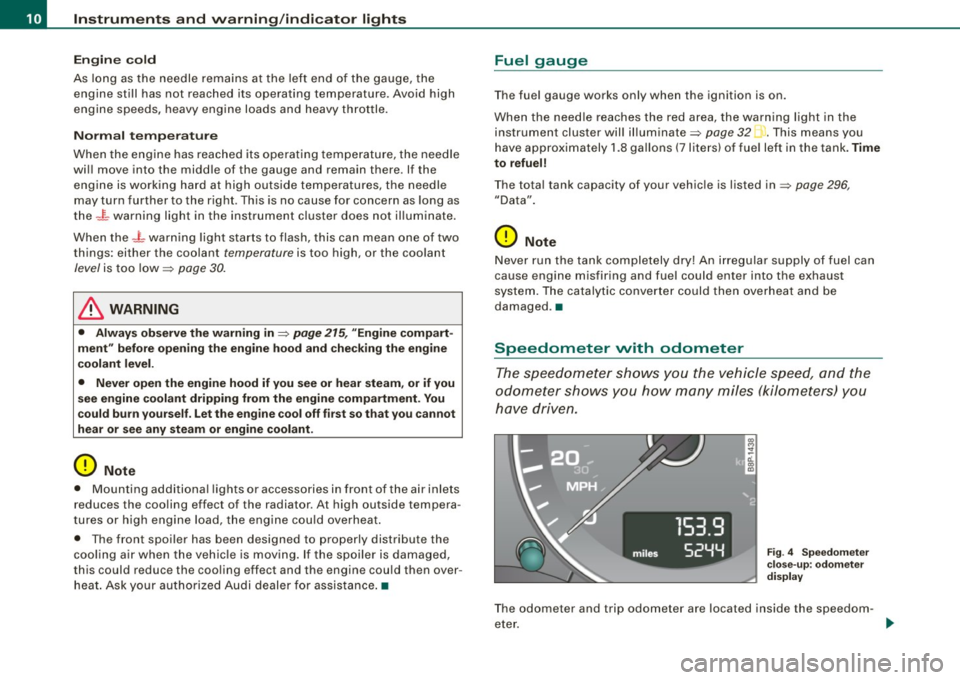
Fig. 4 Speedometer
close-up : odometer
display
The odometer and trip odometer are located inside the speedom
eter.
Page 253 of 320

Tires and wheels -
----------------
•
and is more difficult to stop. Overloading can not only lead to loss
of ve hicle control, but can a lso damage important parts of the
vehicle and can lead to sudden tire failure, inc luding a blowout and
sudden deflation that can cause the vehic le to crash.
Your safety and that of your passengers also depends on making
sure that load limits are not exceeded. Vehicle load includes every
body and everything in and on the veh icle . These load limits are
technically referred to as the vehicle's
Gross Vehicle Weight Rating
("GVWR"l.
The "GVWR" includes the weight of the basic vehicle, al l factory
insta lled accessories, a full tank of fuel, oil, coolant and other fluids
plus maximum load. The maximum load includes the number of
passengers that the vehicle is intended to carry ("seating capacity")
with an assumed weight of 150 lbs (68 kg) for each passenger at a
designated seating position and the total weight of any luggage in
the vehicle. If you tow a trailer, the weight of the trailer hitch and the
tongue weight of the loaded trai ler must be included as part of the
vehicle load .
The
Gross Axle Weight Rating ("GAWR") is the maximum load that
can be applied at each of the vehic le's two axles .
The Gross Vehicle Weight Rating and the Gross Axle Weight Rating
are listed on the safety compliance sticker label located either on
the driver's side B-pillar or on the inside of the fuel filler flap. Your
Audi has 5 seating positions, 2 in the front and 3 in the rear for total
seating capacity of 5. Each seating position has a safety belt
=> page 135, "Safety belts".
The fact that there is an upper limit to your vehicle's Gross Vehicle
Weight Rating means that the total weight of whatever is being
carried in the vehicle (including the weight of a trailer hitch and the
tongue weight of the loaded trailer) is limited. The more passengers
in the vehicle or passengers who are heavier than the standard
weights assumed mean that less weight can be carried as luggage .
T he tire pressure label on your Audi also lists the maximum
combined weight of all of the occupants and luggage or other cargo that the vehicle can carry.
For the location of the label
=> page 246,
fig. 173.
& WARNING
Overloading a vehicle can cause loss of vehicle control, a crash or
other accident, serious personal injury , and even death .
• Carrying more weight than your vehicle was designed to carry
will prevent the vehicle from handling properly and increase the
risk of the loss of vehicle control.
• The brakes on a vehicle that has been overloaded may not be
able to stop the vehicle within a safe distance.
• Tires on a vehicle that has been overloaded can fail suddenly,
including a blowout and sudden deflation, causing loss of control
and a crash.
• Always make sure that the total load being transported -
including the weight of a trailer hitch and the tongue weight of a
loaded trailer -does not make the vehicle heavier than the
vehicle's Gross Vehicle Weight Rating .•
Determining correct load limit
Use the example below to calculate the
total weight of the passengers and
luggage or other things that you plan to
transport so that you can make sure that
your vehicle will not be overloaded.
~
Vehicle care I t •
Page 293 of 320
________________________________________________ E_ m_ e_r .::g :...e_ n _ c_,y'-- s_ i_t _u _a_ t_ i_o _n_ s _---J_
Lifting the vehicle
Important safety precautions
Be aware of the following hazards before lifting the vehicle with a
workshop hoist or floor jack:
• The vehicle should never be lifted or jacked up from underneath
the engine oil pan, the transmission housing, the front or rear axle
or the body side members. This could lead to serious damage.
• Use lifting equipment with padded contact surfaces to avoid
damage to the underbody or chassis frame.
• Alternatively, cover the contact surfaces on workshop hoist or
floor jack with rubber pads before lifting .
• Before driving over a workshop hoist, check that the vehicle
weight does not exceed the permissible lifting capacity of the hoist .
• Before driving over a workshop hoist, ensure that there is suffi
cient clearance between the hoist and low parts of the vehicle .
& WARNING
To reduce the risk of serious injury and vehicle damage:
• Always lift the vehicle only at the special workshop hoist and
floor jack lift points illustrated
=> fig. 202 and => fig. 203 .
• Failure to lift the vehicle at these points could cause the vehicle
to tilt or fall from a lift if there is a change in vehicle weight distri
bution and balance. This might happen, for example, when heavy
components such as the engine block or transmission are
removed .
• When removing such heavy components, anchor vehicle to
hoist or add corresponding weights to maintain the center of
gravity . Otherwise , the vehicle might tilt or slip off the hoist,
causing serious personal injury. •
Lifting with workshop hoist and with floor
jack
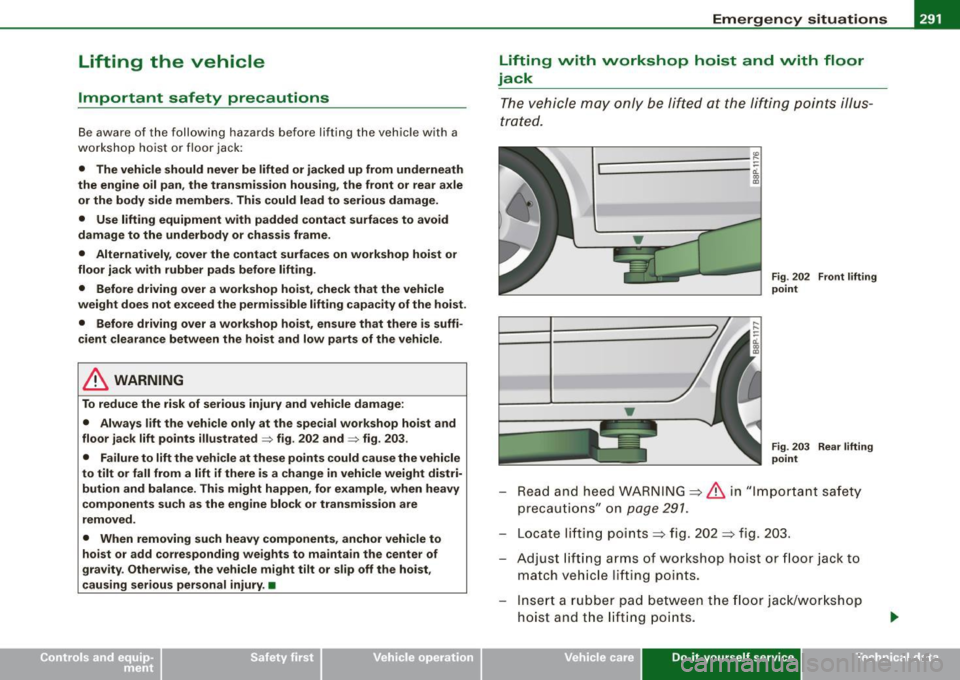
The vehicle may only be lifted at the lifting points illus
trated.
.... L===========::::==:: ~ 0:.
Fig . 202 Front lifting
point
Fig . 203 Rear lifting
point
Read and heed WARNING ~ & in "Important safety
precautions " on
page 291.
Locate lifting points~ fig. 202 ~ fig. 203.
Adjust lift ing arms of workshop hoist or floor jack to
match vehicle lifting points.
Inse rt a rubber pad between the floo r jack/workshop
hoist and the lifting poin ts.
Vehicle care Do-it-yourself service irechnical data
Page 294 of 320
lllffl.___E_ m _ e _r-==g :...e_ n_ c...:y _ s_ i_t _u _a _t_ i_o _n_ s _______________________________________________ _
If you mu st lift your veh icle with a floor jack to work underneath , be
sure the vehicle is safely supported on stands intended for this
purpose .
Front lifting point
T he lifting point is located on the floor pan reinforcement about at
t he same leve l as t he jac k mou nti ng poi nt=>
pag e 291, fig. 202 . Do
not lift the vehicle at the vertical sill reinforcement .
Rear lifting point
T he lifting point is located on the vertical reinforcement of the lower
sill for the o n board jack=>
page 291, fi g. 203 .
Lifting with vehicle jack
Refe r to=> page 274.
0 Note
• Be aware of the fo llo wi ng po ints before l ifting t he ve hicle :
- The vehicle should never be lifted or jacked up from under
neath the engine oil pan , the transmission housing , the front or
rear axle or the body side members . This could lead to serious
damage.
- To avoid damage to the underbody or chassis frame , a rubber
pad must be inserted between the floor jack and the lift points .
- Before driving over a workshop hoist, check that the vehi cle
weight does not exceed the permissible lifting capacity of the
hoist .
- Before driving over a workshop hoist , ensure that there is
sufficient clearance between the hoist and low parts of the
vehicle. •
Page 297 of 320
_________________________________________________ G_ e_ n_ e_r _a _l_ i_n _f_o _ r_ m_ a_ t _i _o _ n __ _
left door jamb. It shows the month and year of production and the
vehicle identification number of your vehicle (perforation) as well as
the Gross Vehicle Weight Rating (GVWR) and the Gross Axle Weight
Rating (GAWR).
The high voltage warning label
is located on the lock carrier.
The spark ignition system complies with the Canadian
standard ICES-002. •
Weights
Gross Vehicle Weight Rating
The Gross Vehicle Weight Rating (GVWR), and the Gross Axle Weight
Rating (GAWR) for front and rear are listed on a sticker on the left
door jamb.
The Gross Vehicle Weight Rating includes the weight of the basic
vehicle plus full fuel tank, oil and coolant, plus maximum load,
which includes passenger weight (150 lbs/68 kg per designated
seating position) and luggage weight.
Gross Axle Weight Rating
The Gross Axle Weight Rating is the maximum load that can be
applied at each axle of the vehicle ~& .
Vehicle capacity weight
The vehicle capacity weight (max. load) is listed either on the
driver's side B-pillar or inside the fuel filler flap .
Roof weight
The maximum permissible roof weight is 165 lb (75 kgl. The roof
weight is made up of the weight of the roof rack system and the
weight of the object being transported~
page 89, "Loading the
roof rack".
Controls and equip ment Safety first Vehicle operation
& WARNING
•
The actual Gross Axle Weight Rating at the front and rear axles
should not exceed the permissible weights, and their combination
must not exceed the Gross Vehicle Weight Rating.
• Exceeding permissible weight ratings can result in vehicle
damage, accidents and personal injury.
0 Note
• The vehicle capacity weight figures apply when the load is
distributed evenly in the vehicle (passengers and luggage). When
transporting a heavy load in the luggage compartment, carry the
load as near to the rear axle as possible so that the vehicle's
handling is not impaired.
• Do not exceed the maximum permissible axle loads or the
maximum gross vehicle weight. Always remember that the vehicle's
handling will be affected by the extra load. Therefore, adjust your
speed accordingly.
• Always observe local regulations.•
Dimensions
The specifications refer to the basic model. Differences may occur
depending on the model type and options ordered, for example, tire
sizes.
0 Note
When driving up steep ramps, on rough roads, over curbs, etc. it is
important to remember that some parts of your vehicle, such as
spoilers or exhaust system components, may be close to the
ground. Be careful not to damage them. •
Vehicle care Do-it-yourself service Tec hn ica l da ta
Page 298 of 320
___ D_ a_ ta ______________________________________________________ _
Data
Applies to vehi cles: with 2.0 lite r TFS I 4-cyl. g asoline eng ine ,
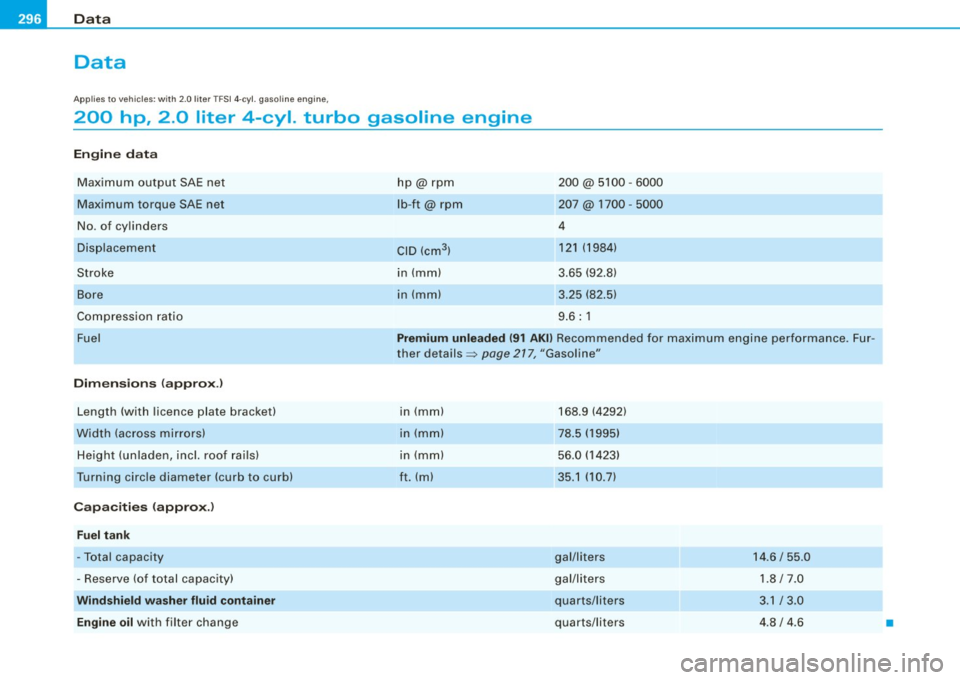
200 hp, 2.0 liter 4-cyl. turbo gasoline engine
Engin e data
Maximum output SAE net
Maximum torque SAE net
No. of cy linders
Disp lacement
Stroke
Bore
Compression ratio
Fuel
D im ensio ns (a pprox.)
Length (with licence plate bracket)
Width (across mirrors)
Height (unladen, incl. roof rails)
Turning circle diameter (curb to cu rb)
Ca pacitie s (a pprox.)
F u el t ank
-Total capacity
- Reserve (of total capacity)
W ind shi eld was her fluid cont ain er
Engine oil
with filter change hp@rpm
lb
-ft@ rpm
CID (cm
3 )
in (mm)
in (mm)
200@ 5100 -6000
207 @ 1700 -5000
4 121 (1984)
3.65 (92.8)
3 .25 (82 .5)
9 .6 : 1
Premium unleaded (91 AKI) Recommended for maximum engine performance . Fur
ther det ails =:>
page 277, "Gasol ine"
in (mm)
in (mm)
in (mm)
ft. (ml
168.9 (4292)
78 .5 (1995)
56.0 (1423)
35.1 (10.7)
gal/liters
gal/liters
quarts/liters
quarts/liters 14 .6 / 55.0
1 .8/7.0
3 .1 / 3 .0
4 .8 / 4.6
•
Page 299 of 320
___________________________________________________ D_a_ t_ a __ !II
A pp lies to veh ic les : w it h 2 .0 liter TDI 4 -cyl. c le an di esel e ngin e,
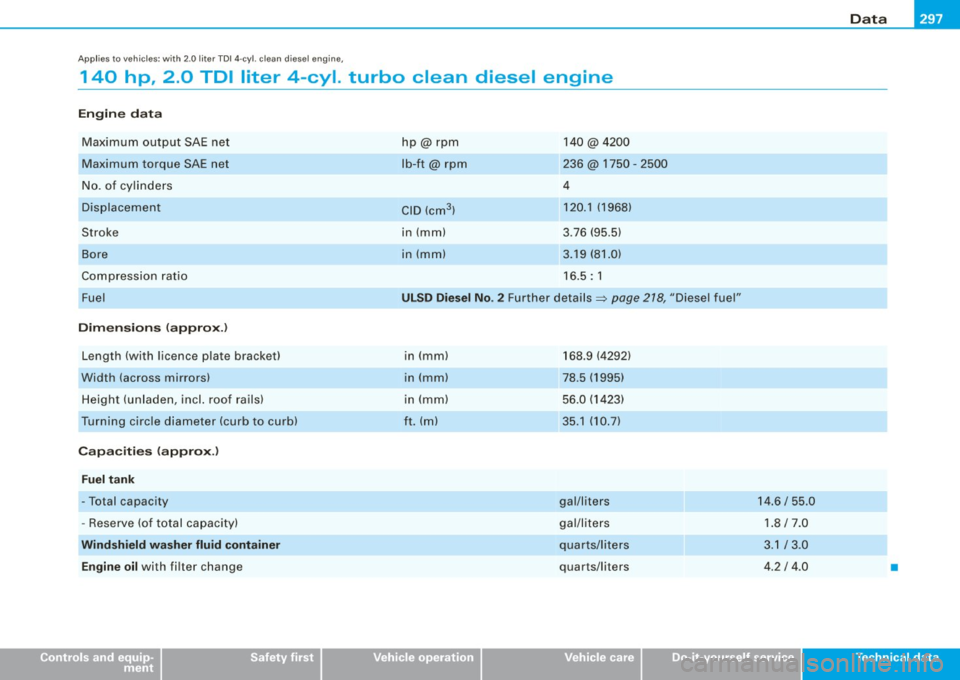
140 hp , 2 .0 TOI liter 4-cyl. turbo clean diesel engine
Engine data
Maximum output SAE net
Maximum torque SAE net
N o. o f cy linders
Displacement
Stroke
Bore
Co mpression ratio
Fuel
Dimensions (approx .)
Length (with licence p late bracket)
Width (across mirrors) H eight (unla den, incl. roof ra ils)
Turning circle diameter (curb to curb)
Capacities (approx .)
Fuel tank
-Total capacity
- Reserve (of t otal capacity)
Wind shield wa sher fluid container
Engine oil
with filter change
Controls and equip ment Safety first
hp@rpm
lb-ft@ rpm
CID (cm
3
)
in (mm)
in (mm)
14 0 @4200
236 @ 1750 · 2500
4
120.1 (1968)
3 .76 (95 .5)
3.19 (81 .0)
16. 5: 1
ULSD Diesel No . 2 Further details=> page 218, "Diesel fue l"
in (mm)
in (mm)
in ( mm)
ft. (ml
Vehicle operation
168.9 (4292)
78.5 (1995) 56.0 (14 23)
35.1 (10.7)
gal/liters
gal/li te rs
quarts/liters
quarts/liters
Vehicle care
14.6 / 55.0 1.8/7.0
3.1 / 3_0
4.2 I 4 .0
Do-it-yourself service
•
T ec hn ica l da ta