airbag AUDI S3 2011 User Guide
[x] Cancel search | Manufacturer: AUDI, Model Year: 2011, Model line: S3, Model: AUDI S3 2011Pages: 320, PDF Size: 75.79 MB
Page 79 of 320

& WARNING
• Never adjust the seatback while the vehicle is moving. If you
adjust your seatback while the vehicle is moving, you will be out
of position. Always adjust the seatback when the vehicle is not
moving.
• To reduce the risk of injury
in the case of sudden braking or
accident, front passengers must never ride in a moving vehicle
with the seatback reclined. Safety belts and the airbag system
only offer maximum protection when the seatback is upright and
the safety belts are properly positioned on the body. The more the seat back is reclined, the greater the risk of personal injury from an
incorrect seating position and improperly positioned safety
belts! •
App lies to vehicle s: w ith lumba r suppor t
Adjusting the lumbar support
The lumbar support can be adjusted to fit the natural
curvature of the occupant's spine.
~
--ct
L--------------- --,ll:
Adjusting the curvature
Fig. 73 Driver seat:
switch for lumbar
adjustment
- Push the front of the switch plate==> fig. 73 in order to
increase the curvature.
Con tro ls an d equip
m en t Vehicle OP-eration
Seats and storage
-Push the rear of the switch plate in order to decrease the
curvature.
Adjusting the height
- Push on the top of the switch plate in order to move the
support higher.
- Push on the bottom of the switch plate in order to move
the support lower.
& WARNING
Never adjust the lumbar support while the vehicle is moving. If
you adjust your seat while the vehicle is moving, you will be out of
position. Always adjust the lumbar support when the vehicle is
not moving. •
Head restraints
Front head restraints
The head restraints must be properly adjusted to the
occupants's height to provide optimal restraint in combi
nation with the seat restraints.
-
Vehicle care
Fig. 74 Driver's seat
head restra int:
adjusting the height ...
Do-it-yourselt service iTechnical data
Page 93 of 320
- Plug in appliance to be used.
The outlet may be used for 12-volt app liances w ith maxim um
cons umption of up to 100 watts, such as a flash light, small vacuum
cl eaner, e tc.
Before you purchase any accessor ies, always read and fo llow the
info rm ation in::::,
page 301, "Add it io na l acc essories and p arts
re placemen t".
& WARNING
The outlet plus any appliances plugged into it remain functional
even if the ignition is switched off or the ignition key is removed. Never leave children inside the vehicle without supervision .
0 Note
To avoid damaging the socket, only use plugs that fit properly.
(I) Tips
When the engine is off and accessor ies are st ill plugged in and are on,
the ve hicle battery can sti ll be drained .•
Storage
General overview
There are numerous pl aces to st ore items in your vehi cle .
Storage in t he center armrest
Storage in the rear armrest
::::, page 79
Glove com partment (Ai r ven tila tion in t he ::::, page 92
glove compartment*, CD changer*)
Controls and equip ·
ment Safety first
Seats and storage
Center console ::::,
page 92
Compartments in the door tr ims ::::, page 93
Storage in the footwell ::::, page 93
Compartments in luggage compartment ::::, page 94
Coat hooks
Some of the storage locations are only fo und o n specific vehicle
mode ls o r are op tio nal equ ipme nt.
& WARNING
• Always remove objects from the instrument panel. Any items
not put away could slide around inside the vehicle while dri ving or
when accelerating or when applying the brakes or when dri ving
around a corner.
• When you are driv ing make sure that anything you may have
placed in the center console or other stor age locations cannot fall
out into the footwells. In c ase of sudden braking you would not be
able to b rake, depres s the clutch or accelerate .
• Any pieces of clothing that you have hung up must not inter
fere with the driver's view. The co at hooks are designed onl y for
lightweight clothing . Never hang any clothing with hard, pointed
or hea vy objects in the pockets on the coat hooks. During sudden
braking or in an accident· especially if the airbag is deployed ·
the se objects could injure any passengers inside the vehicle. •
Vehicle care Technical data
Page 95 of 320

Compartments in the door trims
There are storage compartments in the door trims.
& WARNING
Fig. 96 Storage
compartment in the
door trim
Always read and heed all WARNINGS => page 163, "Important
safety instructions on the side airbag system". •
Applies to vehicles : with sto rage net in footwe ll
Storage net in footwell
There is a storage net in the passenger's footwell.
Con tro ls a nd e quip
m en t
Fig . 97 Storage net in
passenger's footwell
Vehicle OP-eration
Seats and storage
(I) Tips
Do not keep any sharp or pointed objects in the storage net -they are
a personal injury risk.•
Applies to vehicles: w ith storage net in the front seatbacks
Storage net in the seatbacks
There is a storage net behind both front seatbacks.
(I) Tips
Fig. 98 Storage net on
the driver's seatback
Do not keep any sharp or pointed objects in the storage net -th is
increases the risk of personal injury .•
Vehicle care Do-it-yourselt service iTechnical data
Page 96 of 320

Seats and storage
Applies to veh icles : with storage net in luggage compartment
Side storage in the luggage compartment
T here is a compartment with a n et on the right side of th e
luggage compartment .
•
Fig. 99 S id e c ompart ·
me nt in the lugg age
c om partm ent
The compa rtment is suitab le for holdi ng sma ll items. •
Coat hooks
There is a coat hook above each rear door.
Fig. 100 C oat h ook
The coat hooks a re located in the headliner above each rear door.
& WARNING
• Hang clothes in such a way that they do not impair the driver 's
vision.
• The coat hoo ks must only be used fo r light weight clothing. Do
not leave any heavy or sharp edged objects in the pockets whi ch
may interfere with the side curta in airbag deployment and can
cause personal injury in a cra sh.
• Do not use coat hangers fo r hanging clothing on the coat hooks
as this can interfere with proper deployment of the side curtain
airbags in an accident .
• Do not hang heavy objects on the coat hooks , as they could
cause personal injury in a sudden stop. •
Page 107 of 320
___________________________________________________ O_ n_ t_h _e_ r_o _a_ d __ _
On the road
Steering
Adjustable steering wheel
The height and reach of the steering wheel con be
adjusted .
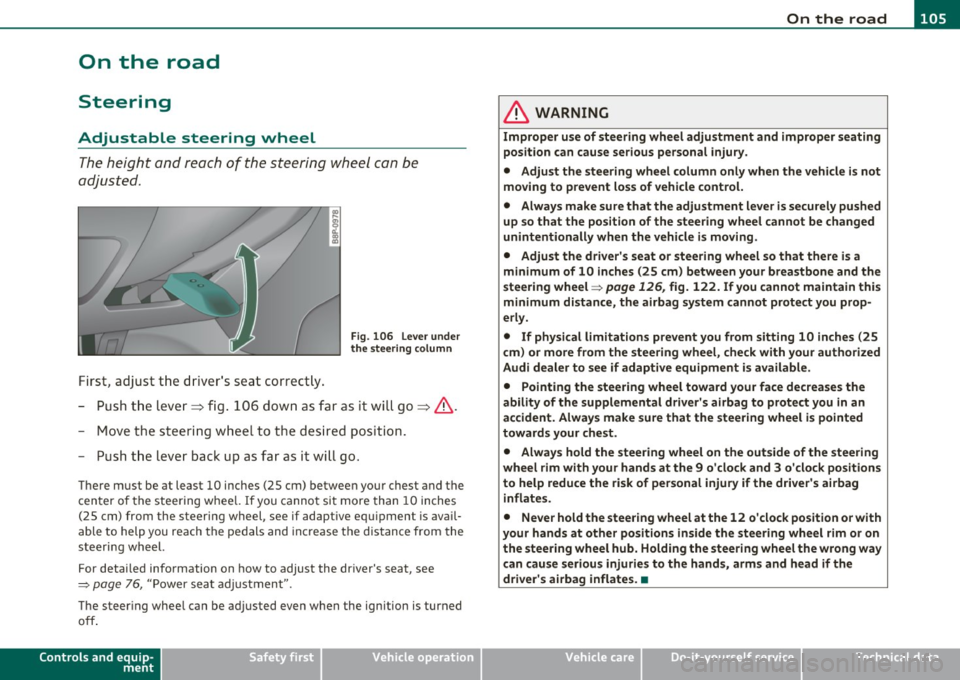
First, adjust t he dr iver's seat correct ly.
Fi g. 106 Leve r und er
the s tee ring column
-Pu sh t he lever~ fig. 106 down as far as it wi ll go~ &.
- Move th e st eeri ng wheel to t he desire d position.
- Push t he lever back up as fa r as it wi ll go.
There must be at least 10 inches (25 cm) between your chest and the
c en ter of the steer ing w hee l. If you cannot si t more than 10 inches
(25 cm) from the steering wheel, see if adaptive equ ipment is avai l
able to help you reach the pedals and increase the distance from the
steeri ng wheel.
For detai led info rmation on how to adjust the dr iver's seat, see
=> page 76, "Power se at adj ustment".
The steer ing whee l can be adjusted even when the ignition is turned
off .
Controls and equip
ment Safety first
& WARNING
Improper use of steering wheel adjustment and improper seating
position can cause serious personal
injury .
• Adjust the steer ing whe el column only when the vehicle is not
moving to prevent loss of vehicle control.
• Always make sure that the adjustment lever is securely pushed
up so that the position of the steering wheel cannot be changed
unintentionally when the vehicle is moving .
• Adjust the dr iver 's seat or steering wheel so that there is a
m inimum of 10 inches (25 cm) between your breastbone and the
steering wheel=>
page 126, fig. 122. If you cannot maintain this
minimum distance, the airbag system cannot protect you prop
erly.
• If physical limitations prevent you from sitting 10 inches (25
c m) or more from the steering wheel, check with your authorized
Audi dealer to see if adaptive equipment is available .
• Pointing the steering wheel toward your face decrea ses the
ability of the supplemental driver's a irbag to prote ct you in an
accident. Always make sure that the steer ing wheel is pointed
towards your che st .
• Always hold the steering wheel on the outside of the steering
wheel rim with your hands at the 9 o'clo ck and 3 o'clock position s
to help reduce the risk of personal injury if the driver's airbag
inflates .
• Never hold the steer ing wheel at the 12 o 'clock position or with
your hands at other positions inside the steering wheel rim or on
the steering wheel hub. Holding the steering wheel the wrong way
can cause serious injurie s to the hand s, arms and head if th e
driver 's airbag inflates. •
Vehicle care Technical data
Page 126 of 320
1111 ....... _D_ r_iv _i_ n .... g=-- S_ a_f _e _Ly :,.._ ______________________________________________ _
Driving Safely
General notes
Safe driving habits
Please remember -safety first!
Th is chapter contains important information, t ips, instructions and
warnings that you need to read an d observe fo r you r own safe ty, the
safety of you r passengers and others . We have summarized here
w hat you need to know about sa fety belts, airbags, child restra ints as
we ll as child safety . You r safety is for us
priority number 1. Always
observe the information and warnings in this section -for your own
safety as well as t hat of your passengers.
The informat ion in this section applies to all mode l versions of yo ur
veh icle . Some of the fe atures des cribed in this se ctions m ay be st an
dard equ ipment on some models, or may be optional eq uipment on
others. If you a re not sure, ask your a uth o rized Audi dealer.
& WARNING
• Always make sure that you follow the instructions and heed
the WARNINGS in th is Manual. It is in your interest and in the
intere st of your passengers.
• Always keep the complete Owner's Literatu re in your Audi
when you lend or sell your vehicle so that this important informa
tion will always be available to the driver and passengers .
• Always keep the Owner's literature handy so that you can find
it easily if you have questions . •
Safety equipment
The safety features are part of the occupant restraint
s y stem and wor k together to he lp reduce the ris k of injury
in a wide variety of accident situations.
Your sa fety and t he safety o f yo ur passenge rs shou ld no t be left to
chance . Adva nces in technology have made a variety of features avai l
a b le to help re duce the risk of injury in an a cc ident . The fo llow ing is a
list of jus t a few of the safety features in your Audi:
• sophisticated safety belts for driver and a ll passenger seating
p osi tion s,
• safety belt pretensioners,
• safety belt fo rce lim iters for the fro nt sea ts,
• safety belt he igh t adju stmen t sys tems for the fro nt sea ts,
• automatic safety be lt height adjustment for the rear seats,
• head restraints fo r eac h seating position,
• front airbags,
• side airbags in the fro nt seats a nd outer rear seats*,
• side curtain air bags,
• special LATCH anchorages for child restraints,
• head restraints fo r eac h seating position,
• adjus table stee ring co lumn.
Th ese ind ividual safety features, can work together as a system to
he lp protec t you and yo ur passengers in a wide range of accidents.
Th ese featu res ca nnot work as a syst em if they are not always
correct ly adjusted and cor rect ly used.
Safety is everybody' s re sponsibility! •
Page 128 of 320
• ....__D_ r_iv _i_ n_, g=-- S_ a _ f_e _,Ly _ ______________________________________________ _
Proper occupant seating positions
Proper seating position for the driver
The proper driver seating position is important for safe,
relaxed driving.
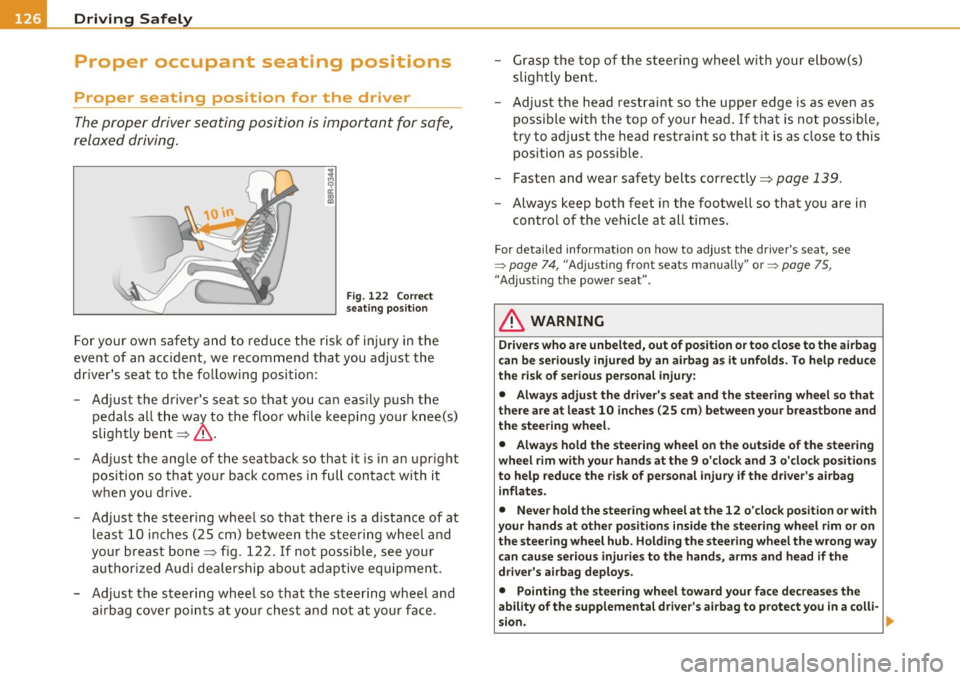
Fig. 122 Correct
seating position
For your own safety and to reduce the risk of injury in the
event of an accident, we recommend that you adjust the
driver's seat to the following position:
- Adjust the driver's seat so that you can easily push the
pedals all the way to the floor while keeping your knee(s)
slightly bent~& .
- Adjust the angle of the seatback so that it is in an upright
pos ition so that your back comes in full contact with it
when you drive.
- Adjust the steering wheel so that there is a distance of at least 10 inches (25 cm) between the steering wheel and
your breast bone~ fig . 122. If not possible, see your
authorized Audi dealership about adaptive equipment.
- Adjust the steering wheel so that the steering wheel and airbag cover points at your chest and not at your face. -
Grasp the top of the steering wheel with your elbow(s)
slightly bent.
- Adjust the head restraint so the upper edge is as even as
possible with the top of your head. If that is not possible,
try to adjust the head restraint so that it is as close to this
position as possible.
- Fasten and wear safety belts correctly~
page 139.
-Always keep both feet in the footwell so that you are in
control of the vehicle at all t imes.
F o r deta iled informat ion on how to adjust the d river 's seat, see
=>
page 74 , "Adjusting front seats manually " or => pag e 75,
"Adjus ting the power sea t".
& WARNING
Drivers who are unbelted, out of position or too close to the airbag
can be seriously injured by an airbag as it unfolds. To help reduce
the risk of serious personal injury:
• Always adjust the driver's seat and the steering wheel so that
there are at least 10 inches (25 cm) between your breastbone and
the steering wheel.
• Always hold the steering wheel on the outside of the steering
wheel rim with your hands at the 9 o'clock and 3 o'clock positions
to help reduce the risk of personal injury if the driver's airbag
inflates.
• Never hold the steering wheel at the 12 o'clock position or with
your hands at other positions inside the steering wheel rim or on
the steering wheel hub. Holding the steering wheel the wrong way
can cause serious injuries to the hands, arms and head if the
driver's airbag deploys.
• Pointing the steering wheel toward your face decreases the
ability of the supplemental driver's airbag to protect you in a colli·
sion. .,
Page 129 of 320

______________________________________________ D_ ri_v _ i_n _,,g ,c.._ S_a_ f_ e_ l..:: y __ lR
& WARNING (continued)
• Always sit in an upright position and never lean against or
place any part of your body too close to the area where the airbags
are located.
• Before driving, always adjust the front seats and head
restraints properly and make sure that all passengers are properly
restrained.
• Never adjust the seats while the vehicle is moving. Your seat
may move unexpectedly and you could lose control of the vehicle.
• Never drive with the backrest reclined or tilted far back! The
farther the backrests are tilted back, the greater the risk of injury
due to incorrect positioning of the safety belt and improper
seating position. • Children must always ride in child safety seats~
page 167.
Special precautions apply when installing a child safety seat on
the front passenger seat~
page 145. •
Proper seating position for the front
passenger
The proper front passenger seating position is important
for safe, relaxed driving .
For your own safety and to reduce the risk of injury in the
event of an accident, we recommend that you adjust the seat
for the front passenger to the following position:
- Adjust the angle of the seatback so that it is in an upright
position and your back comes in full contact with it when
ever the vehicle is moving.
- Adjust the head restraint so the upper edge is as even as
possible with the top of your head. If that is not possible,
try to adjust the head restraint so that it is as close to this
position as possible=>
page 128.
Controls and equip
ment Safety first Vehicle operation
-
Keep both feet flat on the floor in front of the front
passenger seat.
- Fasten and wear safety belts correctly::::>
page 139.
For detailed information on how to adjust the front passenger's seat,
see ~
page 73.
& WARNING
Front seat passengers who are unbelted, out of position or too
close to the airbag can be seriously injured or killed by the airbag
as it unfolds. To help reduce the risk of serious personal injury:
• Passengers must always sit in an upright position and never
lean against or place any part of their body too close to the area
where the airbags are located.
• Passengers who are unbelted, out of position or too close to
the airbag can be seriously injured by an airbag as it unfolds with
great force in the blink of an eye.
• Always make sure that there are at least 10 inches (25 cm)
between the front passenger's breastbone and the instrument
panel.
• Each passenger must always sit on a seat of their own and
properly fasten and wear the safety belt belonging to that seat.
• Before driving, always adjust the front passenger seat and
head restraint properly.
• Always keep your feet on the floor in front of the seat. Never rest them on the seat, instrument panel, out of the window, etc.
The airbag system and safety belt will not be able to protect you properly and can even increase the risk of injury in a crash.
• Never drive with the backrest reclined or tilted far back! The
farther the backrests are tilted back, the greater the risk of injury
due to incorrect positioning of the safety belt and improper
seating position.
II>
Vehicle care Do-it-yourself service Technical data
Page 139 of 320

Because the passengers of this vehicle are not using safety belts
=> page 136, fig. 126, they will keep moving at the same speed the
vehicle was moving just before the crash, until something stops them
- here, the wall =>
page 136, fig. 127.
The same principles apply to people sitting in a vehicle that is
involved in a frontal collision. Even at city speeds of 20 to 30 mph (30
to SO km/h), the forces acting on the body can reach one ton (2,000
lbs. or 1,000 kg) or more. At greater speeds, these forces are even
higher .
People who do not use safety belts are also not attached to their
vehicle. In a frontal collision they will also keep moving forward at
the speed their vehicle was travelling just before the crash . Of course,
the laws of physics don't just apply to frontal collisions, they deter
mine what happens in all kinds of accidents and collisions.•
What happens to occupants not wearing
safety belts?
In crashes unbelted occupants cannot stop themselves
from flying forward and being injured or killed. Always
wear your safety belts!
Safety first
Fig. 128 A driver not
wearing a safety belt is
violently thrown
forward
Vehicle OP-eration
Safety belts
Fig. 129 A rear
passenger not wearing
a safety belt will fly
forward and strike the driver
Unbelted occupants are not able to resist the tremendous forces of
impact by holding tight or bracing themselves. Without the benefit
of safety restraint systems, the unrestrained occupant will slam
violently into the steering wheel, instrument panel, windshield, or
whatever else is in the way=> fig. 128. This impact with the vehicle
interior has all the energy they had just before the crash.
Never rely on airbags alone for protection. Even when they deploy,
airbags provide only additional protection. Airbags are not supposed
to deploy in all kinds of accidents. Although your Audi is equipped
with airbags, all vehicle occupants, including the driver, must wear safety belts correctly in order to minimize the risk of severe injury or
death in a crash.
Remember too, that airbags will deploy only once and that your
safety belts are always there to offer protection in those accidents in
which airbags are not supposed to deploy or when they have already
deployed. Unbelted occupants can also be thrown out of the vehicle
where even more severe or fatal injuries can occur.
It is also important for the rear passengers to wear safety belts
correctly. Unbelted passengers in the rear seats endanger not only
themselves but also the driver and other passengers=> fig . 129. In a
frontal collision they will be thrown forward violently, where they can
hit and injure the driver and/or front seat passenger. •
Vehicle care Do-it-yourselt service iTechnical data
Page 140 of 320
•--=S~a ~f ~e ~t ,z.Y ...: b~ e~lt ~ s~ --------------------------------------------
Safety belts protect
People think it's possible to use the hands to brace the
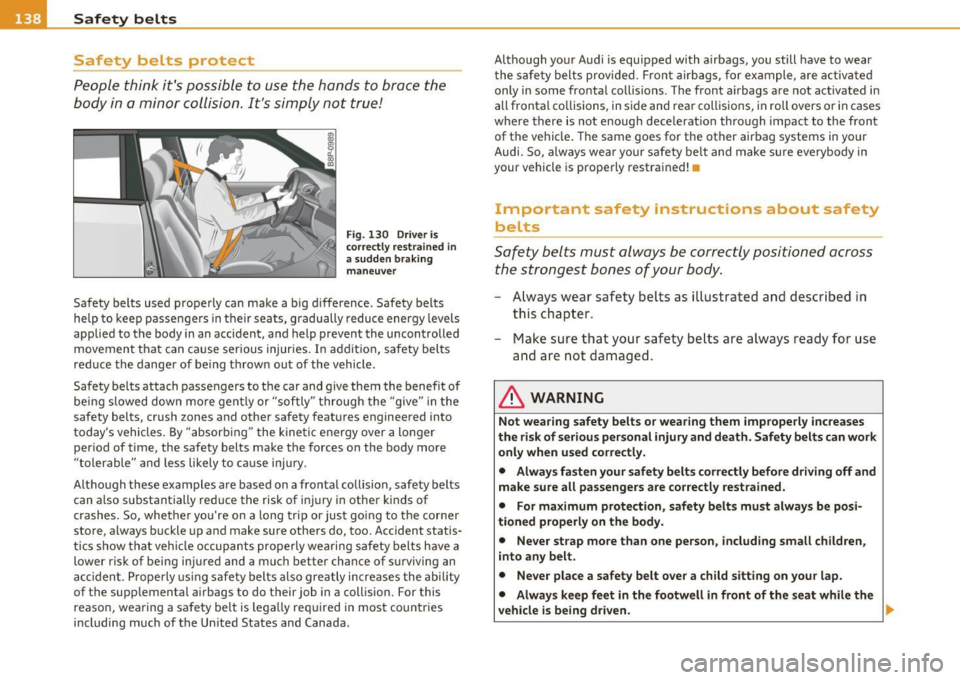
body in a minor collision . It's simply n ot true!
F ig . 1 30 Driv er is
c o rr ect ly res trai ned i n
a su dden bra kin g
m ane uver
Safety belts used prope rly can make a big difference. Safety belts
help to keep passengers in their sea ts, gradually reduce energy leve ls
applied to the body in an accident, and help prevent the uncontrolled
movement that can cause serious injuries . In add it io n, safety bel ts
red uce the danger of be ing t hrown out of the vehicle.
Sa fety be lts attach passengers to the car and give them the benefit of
being slowed down mo re gently or "softly" through the "give" i n the
safety belts, crush zones and other safety features engineered into
t oday 's vehicle s. By "absorb ing" the kine tic e nergy over a lo nger
period of time, the safety belts make the forces on the body more
"tolerable" and less likely to ca use inju ry.
Although these examples are based on a frontal collision, safety belts can a lso s ubstantially red uce the risk of i nju ry in other kinds of
cr ashes . So, whet he r you're on a long trip or just going to the corner
store, always b uckle up and make sure others do , too. Accident statis
t ic s show that vehi cle occupan ts properly wea ring safety belts have a
lower risk of being injured and a much better chance of surviv ing an
a cc iden t. Properly usi ng s afe ty belts also greatly in cre ases the ability
of the supp lemental airbags to do their job in a collision. For this
reaso n, wea ring a sa fety belt is lega lly req uired in mos t countries
including much of the Un ited States and Canada . Altho
ugh your Audi is equ ipped with a irbags, you still have to wear
t he s afe ty belts provided. Fron t air bags, for ex ample, are a ctiv ate d
only in some fronta l collisions . T he front a irbags a re not act ivated in
all frontal co llisions, in s ide and rear coll isio ns, in roll overs or in cases
where there is not enough decelerat ion thro ugh impact to the front
of the vehicle . The same goes for the other airbag systems in yo ur
Audi. So, always wea r you r safety be lt and make su re everybody in
your vehicle is proper ly restrained!
Important safety Instructions about safety
belts
Safety b elts must always be correctly positioned across
the strongest bones of your body.
- Always wear safety belts as illustrated and described in
this chapter.
- Make sure that your safety belts are always ready for use and are not damaged.
& WARNING
Not wea ring safety belts o r wearing them improperly inc reases
the risk of s eriou s personal injury and death . Safety belts can work
only when u sed correctl y.
• Alway s fasten your safety belts correctly bef ore driving off and
make sure all passengers are corre ctly restrained.
• For ma ximum protection , safety belts must alw ays be posi
ti oned properly on the body.
• Never strap more than one person , including small children ,
into any belt .
• Never place a safety belt o ver a ch ild sitting on your lap .
• Alway s keep feet in the footwell in front of the seat while the
vehicle is being driven.
~