height AUDI S3 2011 User Guide
[x] Cancel search | Manufacturer: AUDI, Model Year: 2011, Model line: S3, Model: AUDI S3 2011Pages: 320, PDF Size: 75.79 MB
Page 142 of 320
___ s_ a_ f_ e_ t_ y~ b_ e_ lt_s _____________________________________________ _
- Insert t he tongue into the correct buck le of your seat until
you hear it latch secure ly==> fig. 131 .
- Pull on the be lt to make sure tha t it is secure ly la tched in
the buck le.
Automatic safety belt retractors
Every safety be lt is equipped with an automatic be lt retractor on the
shoulder be lt. This feat ure locks the be lt whe n the belt is pulled out
fast, during hard braking and in an acc ident. The belt may also lock
w hen you dr ive up or dow n a steep hill or throug h a sharp curve.
Dur ing normal driv ing the belt lets you move freely.
Safety belt pretensioners
The safety belts are equipped w ith a belt pretensioner that helps to
t ighten the safety be lt and remove sla ck when the p re tensioner is
act ivated. The function of the pretensioner is monitored by a warn ing
light =>
page 15.
Switchable locking feature
Every sa fety be lt ex ce pt t he one on the driver sea t is eq uipped wi th a
switchab le locking feature that
must be used when the safety belt is
used to at tach a child safety seat. Be s ure to read t he importa nt info r
mation about this feature=>
page 177.
& WARNING
Imp roperly positioned safety belts can c au se se rious injury in a n
accident =>
page 140, "Safety b elt po sition ".
• Safety belts offer optimum protection only when the seatback
i s upr ight and belts are properly positioned on the body .
• Always make sure th at the rear seat backre st to which the
center rear safety belt is attached i s secur ely latched when ever the
rear cente r sa fety belt is be ing u sed . If the ba ckre st is not securely
latched, the pas senger will move forward with th e backre st during
sudde n braking, in a sudden maneuve r and especiall y in a crash .
& WARNING (continued )
• Never attach the safety belt to the buckle fo r another seat .
Attaching the belt to the wrong buckle will reduce safety belt
effectiveness and can cause ser ious personal injury.
• A pass enger who i s not properly restrained can be seriou sly
i njured by the safety belt itself when it mo ves from the stronger
part s of the body into critical area s like the abdomen.
• Alway s loc k the convertible locking retractor when you a re
securing a child safety seat in the vehicle=>
page 179. •
Safety belt position
Correct belt position is the key to getting maximum
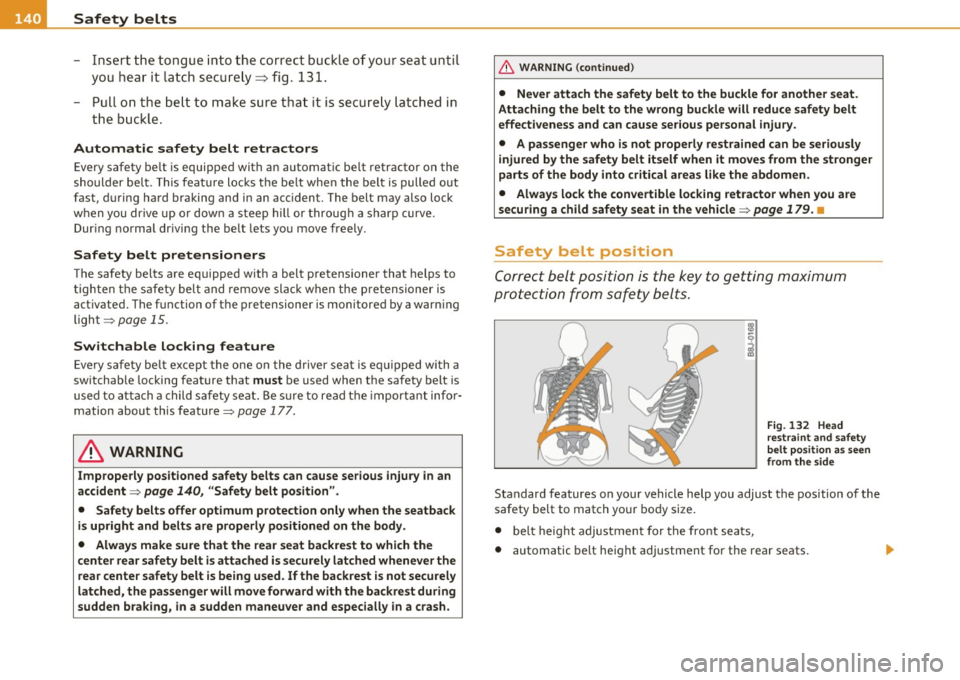
pro tection from safety belts .
Fig. 132 Hea d
r e str aint a nd safet y
belt po sit ion a s seen
from the side
Standard features on your vehicle help you adjust the position of the
safety belt to match your bo dy size.
• belt h eight adjustment for the fron t sea ts,
• automatic belt height adjustment for the rear seats .
Page 144 of 320
-Safety belts ----------------
& WARNING
Improperly positioned safety belts can cause
serious personal
injury in an accident.
• Expectant mothers must always wear the lap portion of the
safety belt as low as possible across the pelvis and below the
rounding of the abdomen.
• Always read and heed all WARNINGS and other important
information ~
& in "Fastening safety belts" on page 139. •
Unfastening safety belts
Unbuckle the safety belt with the red release button only
after the vehicle has stopped.
Fig. 134 Releasing
the tongue from the
buckle
- Push the red release button on the buckle ~ page 142 ,
fig. 134. The belt tongue will spr ing out of the buckle
~& -
- Let the belt wind up on the retractor as you guide the belt
tongue to its stowed position.
& WARNING
Never unfasten safety belt while the vehicle is moving. Doing so
will increase your risk of being injured or killed. •
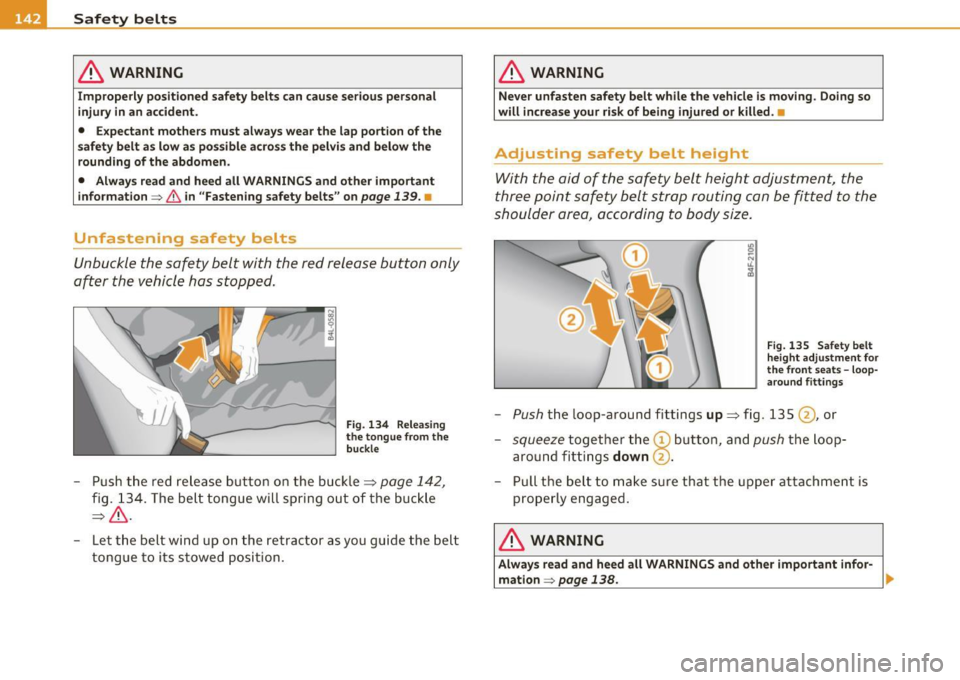
Adjusting safety belt height
With the aid of the safety belt height adjustment , the
three point safety belt strap routing can be fitted to the
shoulder area, according to body size.
Fig. 135 Safety belt
height adjustment for
the front seats -loop
around fittings
-Push the loop-around fittings up~ fig. 135 @, or
- squeeze together the (D button, and push the loop-
around fittings
down @.
- Pull the belt to make sure that the upper attachment is
properly engaged.
& WARNING
Always read and heed all WARNINGS and other important infor-
mation ~
page 138. .,
Page 145 of 320

_____________________________________________ S_a _f _e _t _y _b_ e_lt _ s __ _
[I) Tips
• T he shoulder belt part shou ld route approximate ly over the
middle of your shoulder -under no circumstances shou ld it route over
you r neck a nd throat area~ & in "Safety belt position" on
page 140 .
• With the front seats, the height adjustment of the seat can also
be used to adjust the position of the safety belts. •
Improperly worn safety belts
Incorrectly positioned safety belts can cause severe inju
nes.
Wearing safety belts improperly can cause serious injury or
death . Safety belts can only work when they are correctly
positioned on the body . Improper seating positions reduce
the effectiveness of safety belts and will even increase the
ris k of injury and death by moving the safety belt to critical
areas of the body . Improper seating positions also increase
the risk of serious injury and death when an airbag deploys
and str ikes an occupant who is not in the correct seating posi
tion. A driver is responsible for the safety of all vehicle occu pants and especially for chi ldren. T herefore:
- Never permit anyone to assume an incorrect sitting posi-
tion in the vehicle while traveling
~ & .
The fo llowing lists on ly some examples of imprope rly worn safety
belts th at will increase the risk of ser ious injury and death . O ur hope
is that these examples w ill make you more aware of seat ing pos itions
t ha t are dangero us.
Therefore, whenever the vehicle is moving :
• never wear the sho ulder belt unde r yo ur arm
• neve r let the shoulder be lt pass ove r you r neck
• neve r wear the safety belt loosely
Controls and equip
ment Safety first Vehicle operation
•
never place the lap belt portion of the safety belt across your
abdomen ~& -
& WARNING
Improperly worn safety belt s in cre ase th e risk of seriou s per sona l
injur y and death whene ver a vehicle is being used.
• Alway s make sur e that all vehicle occupants are correctly
re st ra ined and st ay in a c orrect se ating po sition whene ve r the
vehi cle i s bei ng used .
• Always re a d and heed all WARNINGS and other important
informat ion ~
page 13 8. •
Safety belt pretensioners
How safety belt pretensioners work
In front, side and rear end collisions above a particular
severity, safety belts are tensioned automatically .
The safety belts are eq uipped with safety belt p retensioners. The
system is activated by sensors in fron t, side and rear-end collisions of
great sever ity. Thi s tightens t he be lt and takes up belt slack~ & in
"Service and disposal of sa fety belt p retens ioner". Tak ing up the slack
helps to reduce forward occupan t movement during a collis ion .
0 Note
Never le t the bel t remain over a rear seatback that has been folded
forward.
[I) Tips
The safety belt pretensioners can only be act ivated once .
Vehicle care Do-it-yourself service Technical data
Page 177 of 320

& WARNING (continued)
• Make sure the forward-facing seat has been designed and certi·
fied by its manufacturer for use
on a front seat with a passenger
front and side airbag.
• Always follow the manufacturer's instructions provided with
the child safety seat or infant carrier.
• Always move the front passenger seat into the rearmost posi
tion of the passenger seat's fore and aft adjustment range, and as
far away from the airbag as possible before installing the child
restraint.
• Always make sure that nothing prevents the front passenger's
seat from being moved to the rearmost position in its fore and aft
adjustment range.
• Always make sure the backrest is in an
upright position.
• Make sure that the PASSENGER AIR BAG
OFF light comes on
and stays on all the time whenever the ignition is switched
on.
• If the light does not stay on, perform the checks => page 156,
"Monitoring the Advanced Airbag System".
• Take the child restraint off the front passenger seat and install
it properly at one of the rear seat positions if the PASSENGER AIR
BAG
OFF light does not stay on whenever the ignition is switched
on. a
Safety first Vehicle OP-eration
Child Safety
Booster seats and safety belts
Properly used booster seats can help protect children
weighing between about 40 lbs. and 80 lbs. (18 kg and
36 kg) who are less than 4 ft.
9 in.
(57 inches/1.45 meters) tall .
Fig. 147 Rear seat:
child properly
restrained in a booster
seat
The vehicle's safety belts alone will not fit most children until
they are at least 4 ft. 9 in. (57 inches/1.45 meters) tall and
weigh about 80 lbs. (36 kg). Booster seats raise these chil
dren up so that the safety belt will pass properly over the
stronger parts of their bodies and the safety belt can help
protect them in a crash.
- Do not use the convertible locking retractor when using
the vehicle's safety belt to restrain a child on a booster
seat.
- Always position the shoulder portion of the safety belt
midway over the child's shoulder. If you must transport an
older child in a booster seat on the front passenger seat,
you can use the safety belt height adjustment to help
adjust the shoulder portion properly.
- Always make sure that the shoulder portion of the safety
belt never rests against or across the child's neck.
9'>
Vehicle care Do-it-yourselt service iTechnical data
Page 260 of 320
lfflJ,.___T_ ir_e_ s _ a_ n _ d_ w_ h_e_ e_ ls _______________________________________________ _
(j)
®
®
U.S . DOT tire identification number
Audi Orig inal tire
Tire ply composition and materials used
Max imum load rating
Treadwear, traction and temperature grades
@ Maximum permissible inflation pressure
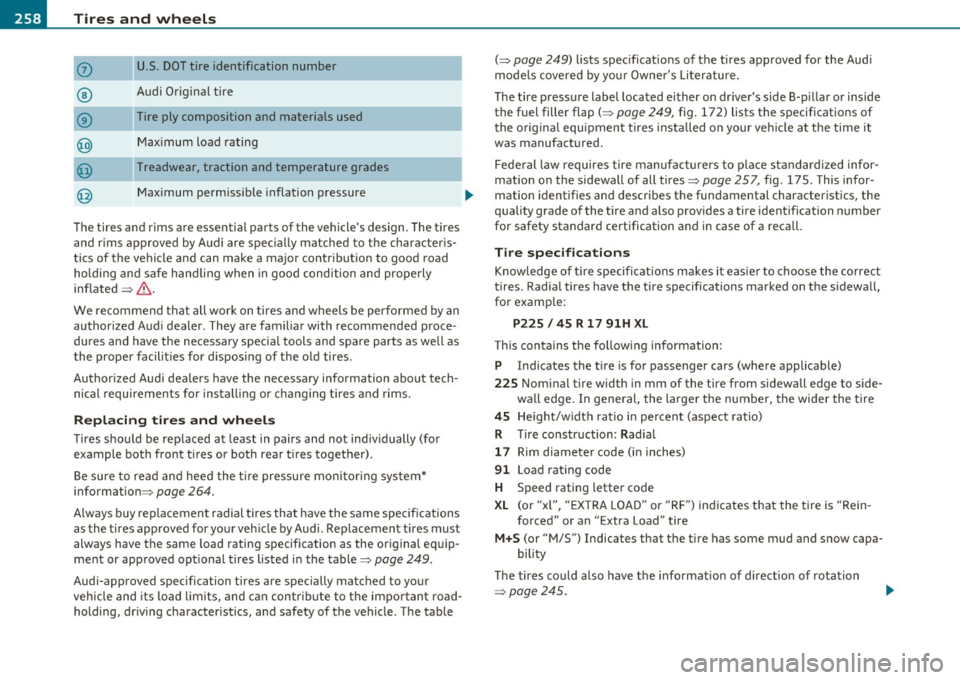
The tires and rims are essential parts of the vehicle's design. The tires
and r ims approved by Audi are spec ially matched to the characteris
tics of the vehicle and can make a major contribution to good road
holding and safe handling when in good condition and properly
inflated =>& .
We recommend that all work on tires and wheels be performed by an
authorized Audi dealer. They are familiar with recommended proce
dures and have the necessary special tools and spare parts as well as
the proper facilit ies for disposing of the old tires.
Authorized Audi dea lers have the necessary information about tech
nical requirements for installing or chang in g ti res and rims.
Replacing tires and wheels
Tires should be replaced at least in pairs and not ind ividually (for
example both front tires or both rear t ires together).
Be sure to read and heed the tir e pressure monitoring system*
information=>
page 264.
Always buy replacement radial tires that have the same specifications
as the tires approved for your veh icle by Audi . Replacement tires must
always have the same load rating specification as the original equip
ment or approved opt iona l tires listed in the table=>
page 249.
Audi-approved spec ification tires are specially matched to your
vehicle and its load limits, and can contribute to the important road
holding, driv ing characteristics, and safety of the vehicle. The table (=>
page
249) lists specifications of the tires approved for the Aud i
models covered by your Owner's Literature.
The tire pressure label located either on driver's side B-p illar or inside
the fuel filler flap(=>
page 249, fig. 172) lists the specifications of
the original equipment tires installed on your ve hicle at the time it
was manufactured.
Federal law requires tire manufact urers to place standardized infor
mation on the sidewall of all tires =>
page 2 5 7, fig. 17 5. This i nfor
mation identifies and describes the fundamental characteristics, the
quality grade of the tire and also provides a t ire identification number
for safety standard certification and in case of a reca ll.
Tire specifications
Knowledge of tire specificat ions makes it easie r to choose the correct
tires. Rad ial tires have the tire specifications marked on the s idewall,
for examp le:
P225 / 45 R 17 91H XL
This contains the following informat ion:
P I ndicates the tire is for passenger cars (where applicable)
225 Nominal tire width in mm of the tire from s idewall edge to side-
wa ll edge. In gene ral, the large r the number, the wider the tire
45 Height/width ratio in pe rcent (aspect ratio)
R Tire construction: Radial
17 Rim diameter code (in inches)
91 Load rating code
H Speed rating letter code
XL (or "xl", "EXTRA LOAD" or "RF") indicates that the tire is "Rein
forced" or an "Extra Load" tire
M+S (or "M/S") Indicates that the t ire has some mud and snow capa
bili ty
The tires could a lso have the information of direction of rotation
=>page 245.
Page 266 of 320
lffllL-_T.:..:..: ir:....:e~ s=---= a~ n:..:..: d:......: w..:....:.. h:....:e~ e= ls=--------------------------------------------------
Low aspect ratio tires
Your Audi is factory-equipped with low aspect ratio tires. These tires
have been thoroughly tested and been selected specifically for your
model for their superb performance, road feel and handling under a
variety of driving conditions. Ask your authorized Aud i dealer for
more details .
Th e low aspect ratio of these tires is indicated by a numeral of
55 or
less
in the tire's size designation . The numeral represents the ratio of
the tire's sidewall height in relation to its tread width expressed in
percentage. Conventional tires have a height/width ratio of 60 or
more.
The performance of low-aspect-ratio tires is particularly sensitive to
improper inflation pressure. It is therefore important that low
aspect ratio tires are inflated to the specified pressure and that the
inflation pressure is regularly checked and maintained. Tire pres
sures should be checked at least once a month and always before a
long trip~
page 252, "Checking t ire pressure" .
What you can do to avoid tire and rim damage
Low aspect ratio tires can be damaged more easily by impact w ith
potholes, curbs, gullies or ridges on the road, particularly if the tire is
unde rinflated.
In order to minimize the occurrence of impact damage to the tires of
your vehicle , we recomme nd that you observe the following precau
tions:
• Always maintain recommended inflation pressures. Check your
tire pressure every 2,000 miles (3,000 km) and add air if necessary.
• Drive ca refully on roads with potholes, deep gullies or ridges. The
impact from driving through or over such obstacles can damage your
tires. Impact with a curb may also cause damage to your tires .
• After any impact, immediately inspect your tires or have them
inspected by the nearest authorized Audi dealer. Replace a damaged
tire as soon as possible. •
Inspect your tires every 2,000 miles (3,000 km) for damage and
wear . Damage is not always easy to see. Damage can lead to loss of
air and underinflat ion, which could eventually cause tire fa ilure . If
you believe that a tire may have been damaged, replace the tire as
soon as poss ible .
• Th ese tires may wear more quickly than others.
• Please a lso remember that, while these tires deliver responsive
hand ling, they may rid e less comfortably and make more noise than
other choices .
Reduced performance in winter/cold season
conditions
All tires are designed for certain purposes. The low aspect ratio, ultra
high performance t ires originally installed on your vehicle are
intended for maximum dry and wet road perfo rmance and handling.
They are not su itable for cold, snowy or icy weather conditions . If you
drive under those circumstances, you should equip yo ur vehicle with
all-season or w inter tires, which offer better traction under those
conditions . We suggest yo u use the recommended snow or all-season
tires specified for your veh icle, or their equivalent .
Refer to =>
page 261 for more detailed information regard ing winter
tires. •
Tire pressure monitoring system
Applies to veh icles : w it h t ire press ure m onito ring syste m
General notes 1
Each tire, including the spare (if prov ided) , shou ld be checked
month ly when cold and inflated to the inflation pressure recom
mended by the vehicle manufacturer on the vehicle placard or t ire
inf lation pressure label. (If your vehicle has tires of a different size
than the siz e indicated on the vehicle placard or tire inflation pressure
label, you should determine the proper t ire inflation pressure for
those tires.)
~
Page 315 of 320
___________________________________________ A_ l!;:p ...:...h .:..: a:.:.. b.::....:: e..:t ..:..ic ::.. a:.:. l :....:..: in....:.-=: d..:e :.:.x..:.__ __
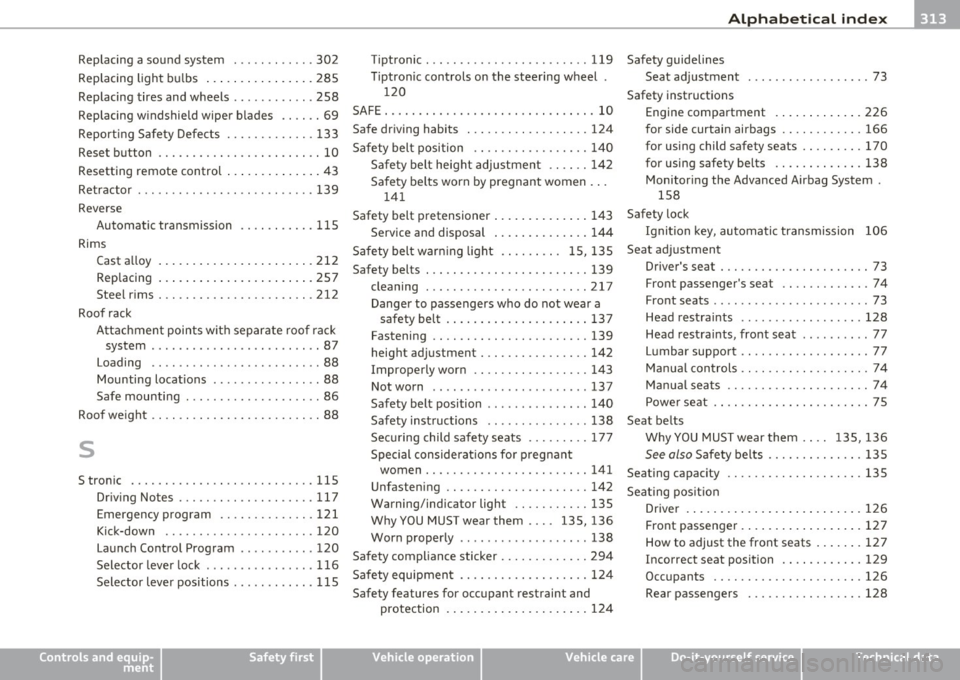
Replacing a sound system .... ... .. .. . 302
Replacing light bu lbs ... .. ... ... ..... 285
Replacing tires and wheels ............ 258
Replacing windshield wiper blades ...... 69
Reporting Safety Defects ......... .... 133
Reset button ........................ 10
Resetting remote control ....... .. ..... 43
Retractor ..... ...... .. .. .. .... ..... 139
Reverse
Automatic transmission .... .. .....
115
Rims
Cast alloy ...................... .
212
Replacing ....................... 257
Steel rims .................... .. . 212
Roof rack
Attachment points w ith separate roof rack
system ................ .........
87
Loading .. .. .. ... .... ... .. .. ..... 88
Mounting locations ........... .... . 88
Safe mounting ............... ..... 86
Roof weight .... .. .. ............. .... 88
s
S tronic ........ ...... .. ... ........ 115
Driving Notes .................... 117
Emergency program ........... ... 121
Kick-down .. ............ ........ 120
T i ptronic ... .. ... ... ...... ....... 119
Tipt ronic controls on the steering wheel .
120
SAFE ............................... 10
Safe driving habits ..... .. .. .. .. ..... 124
Safety belt position .... .... ......... 140
Safety belt height adjustment .. .. .. 142
Safety belts worn by pregnant women ...
141
Safety belt pretensioner ........... ... 143
Service and disposal .............. 144
Safety belt warning light ......... 15, 135
Safety belts . ...... .............. ... 139
cleaning ..................... ... 217
Danger to passengers who do not wear a
safety belt .................. ...
13 7
Fastening .. .. .......... ......... 139
height adjustment ....... ...... .. .
142
Improperly worn ................. 143
Not worn ....................... 137
Safety belt position ............... 140
Safety instructions .. .. ... ..... .. . 138
Securing child safety seats ......... 177
Spe cial considerat ions fo r pregnant
women ................ .... .. ..
141
Unfastening .. ................. .. 142
Warning/indicator light ........... 135
Why YOU MUST wear them .... 135, 136
Worn properly ................... 138
Launch Control Program .......... . 120 S f
S l
t l
l
k
11
a ety compliance sticker ............. 294
e ec or ever oc . . . . . . . . . . . . . . . . 6
Safety equipment .... ............. ..
124 Selector lever positions ........ ... . 115
Safety features for occupant restraint and
protection .................. ...
124
Safety guidelines
Seat adjustment ................. .
73
Safety instructions
Engine compartment ..... ..... .. .
226
for side curtain airbags ............ 166
for using child safety seats ......... 170
for using safety belts ............. 138
Monitoring the Advanced Airbag System .
158
Safety lock
Ignition key, automatic transmission
106
Seat adjustment
Driver's seat ................ .... ..
73
Front passenger's seat ............. 7 4
Front seats ... ..... ...... ...... ...
73
Head restraints .................. 128
Head restraints, front seat .......... 77
Lumbar support .. .. ............... 77
Manual controls .. .. .... ...... ..... 7 4
Manual seats ....... .......... .. ..
74
Power seat .. ..... ................ 75
Seat be lts
Why YOU MUST wear them . . . .
135, 136
See also Safety belts ...... .. ... .. . 135
Seating capacity ....... ...... ... . .. . 135
Seating pos it ion
Driver .............. ... .. .... ...
126
Front passenger ................ .. 127
How to adjust the front seats ....... 12 7
Incorrect seat position .. ..........
129
Occupants .. ................... . 126
Rear passengers ................ . 128
Controls and equip
ment Safety first Vehicle operation
Vehicle care Do-it-yourself service Technical data