ECO mode AUDI S3 2011 Owner's Manual
[x] Cancel search | Manufacturer: AUDI, Model Year: 2011, Model line: S3, Model: AUDI S3 2011Pages: 320, PDF Size: 75.79 MB
Page 101 of 320

Manual air recirculation mode c::%)
The recirculation mode preve nts polluted outside air
from entering the vehicle interior.
Switching on air recirculation
- Press the button l~l =:> page 97, fig. 101 =:> & .
Switching off air recirculation
- Press th e button l~ l aga in , or
- Press the
[ A UTO I button, or
- Press the
I®] button .
I n air recirculation mode, air is drawn from the ve hicle interior and
rec ircul ated. We recom mend that you use the man ual air r ecircula
tion mode under the following conditions:
W hen d riving throug h a t unnel o r in a traffic jam so t hat ex haust
fumes cannot enter the ve hicle inter ior .
& WARNING
Do not use thi s setting for e xtended periods of time. The windows
c ould fog up sin ce no fre sh air can enter the vehi cle. If the
windows fog up, press the air recirculation button again immedi·
atel y to switch off the air recirculation function or selec t defro st. •
Automatic air recirculation I~ ]
If outside air is polluted, an air quality sensor in the
vehicle will aut omatically switch on the air recirculation .
Switching on air recirculation
-Press l~]=:> page97, fig.101.
Controls and equip ·
ment Safety first
Warm and cold
Switching off air recirculation
- Press@again, or
- press
I A UT O], or
- press
I®] .
The au tomatic a ir recircu lation mode should no rma lly be left
sw itched on at all times.
Th e sys tem is ready to operate approximately 30 seconds a fter yo u
t u rn on t he ignit ion or start the ve hicle . Fres h air ente rs the vehicle
only during this in it ia lizat ion period .
T he air q ual ity senso r fo r de tect ing d ie se l and gasoline exhaust fumes
switches automat ically to air recirculation mode if the o uts ide a ir is
heavily po lluted. The supp ly of outside air is closed o ff.
As soon as the poll ution level d rops, fresh air is automat ically
supplied to the vehicle interior again.
Th e air re ci rculat ion ope ra tes fo r a m ax im um o f 12 mi nutes . If the
windows start to fog up w hile the air recirculation is on, press I@ ]
U nder certain operating condit ions (for examp le, if(@ ] or Ice:,] are
pressed) the a ir recircu lation a utomatically sw itches off. If the air
conditioner is switched off, or if the temperature is below 18 °F (-
8 °(), the a ir recirculation wi ll ope rate only for 12 seconds .•
Switching between Fahrenheit and
Centigrade
Y ou can change the tempera ture display from °F (Fahren
heit) to °C (Centigrade ) and vi ce ve rsa .
- Hold th e [¢.:>] butto n down =:> page 97, fig. 101.
- Tu rn the rotary switch ( driver's side)@for
3 seconds +.•
Vehicle care Technical data
Page 102 of 320
![AUDI S3 2011 Owners Manual llffl!l.___w __ a _r_ m __ a_n_ d_ c_ o _ l_d _______________________________________________ _
Air recirculation [a:i ]
The air recirculation prevents exhaust fumes or other
pollution fr](/img/6/57544/w960_57544-101.png "AUDI S3 2011 Owners Manual llffl!l.___w __ a _r_ m __ a_n_ d_ c_ o _ l_d _______________________________________________ _
Air recirculation [a:i ]
The air recirculation prevents exhaust fumes or other
pollution fr")
llffl!l.___w __ a _r_ m __ a_n_ d_ c_ o _ l_d _______________________________________________ _
Air recirculation [a:i ]
The air recirculation prevents exhaust fumes or other
pollution fr om entering the vehicle .
Switching air recirculation on
-Press lo;;, ]~ page 97, fig . 101 ~ &
Switching air recirculation off
- Press 0 agai n, or
- p ress [AUTO], or
- press[@] .
In the air recirculation mode, the air in the passenger compartment
is rec irculated to preven t exhaus t fu mes and othe r po llution from
enter ing the veh icle . We recommend that you use the manua l air
reci rcul atio n under the followi ng conditions:
• when driving through tunnels
• in a traffic jam.
& WARNING
Do not use thi s setting for extended periods of time . The window s
c ould fog up since no fresh air can enter the vehicle. If the
window s fog up, pre ss the air recir culation button again immedi
ately to swit ch off the air recirculation function or select defrost .•
Adjusting the fan speed G G
The automati cally selected fan speed can be increased or
de creased.
- Press the (:) or G butto ns in t he center o f the con tro l
panel ~
page 97, fig. 10 1 to adjus t the fa n sp ee d to your
comfort .
The air condit ion ing system a utomat ically regulates t he fan speed in
response to the interior temperature . However, you can also adjust
the fan speed manua lly . A line of small ba rs in the cen ter display
above the fan contro l buttons w ill retreat or extend to reflect your
adjustments to the fan speed. •
Air distribution
The automatically controlled air distribution can be
changed manually .
You can use the l~I. l~I or l~ I buttons separate ly or together in
combination . To switch back to the automatic air distribut ion setting,
either sw itc h off the butto ns you previo usly se lected, or press
[AUTO I.
Each of the three buttons has its own specific f unct ion (the re ference
numbers refer to the air outlets):::::,
page 101, fig. 102.
Air directed to the windows ik,,
All the air is directed to outlets (D,@ and @. Contrary to when [@ I
is pressed, the amo unt of air rem ain s the same.
Air di rected to the dri ver /front passenger[ ~]
All the air is directed to outlets @,@ and © in the i nstr ument
panel. Air also is directed throug h the center console in the rear.
Page 103 of 320

_________________________________________________ W_ a_ r_m _ a_ n_d_ c_ o_ ld _ ___._
Air directed to th e footw ells ~
All the air is directed to outlets ® and to the outlets under the front
seats. •
Air outlets
,
'''
Fig. 102 Instrument panel: air outlet locations and airflow directions
The air outlets (D and @on top of the instrument panel are
fixed. Outlets ® and © can be adjusted.
Adjusting air outlets ® and ©
-Turn the vertical thumbwheel beside the outlet to
increase, reduce or shut down the airflow from that
outlet.
- Move the small tab in the center of the outlet louver side
ways and up or down to adjust the level and direction of
airflow .
Contro ls a nd e quip
m en t Vehicle
OP-eration
The supply of a ir to the outlets is controlled either automat ically or
manually depend ing on the operation mode selected. The airflow
from all outlets can be heated, unheated or cooled .
The heater outlets for the rear footwells are located under the front
seats. When you select outlets@, air is also directed to the rear foot
wells.
[I) Tips
• When defrosting/defogging the windows, air flows from outlets
(D ,@ and @. To defrost or defog the windows as rapidly as poss ible,
air outlets ® should be opened
fully with the adjuster wheels.
• When the air conditioner is working, cooled air w ill flow primarily
from outlets @,® and @. To assure adequate cooling, outlets ®
and © should never be completely closed.•
Using the climate controls economically
Using the climate controls prudently can help save fuel .
When you use the air conditioner, engine power is reduced
and fuel consumption increases. To save fuel, you should use
the air conditioner only when necessary. Also please note the
following points:
- If you want to save fuel, switch off the air conditioner .
- If you are going to drive with the windows open, switch off
the air conditioner.
of polluta nts emitted into the air. •
Vehicle care Do-it-yourselt service iTechnical data
Page 122 of 320
1111..__T_ r _a_ n_s_ m_ i_ s _s_ i_ o _ n _________________________________________________ _
Applies to veh icles : with S tro nic® and with Tiptron ic controls on the stee ring whee l
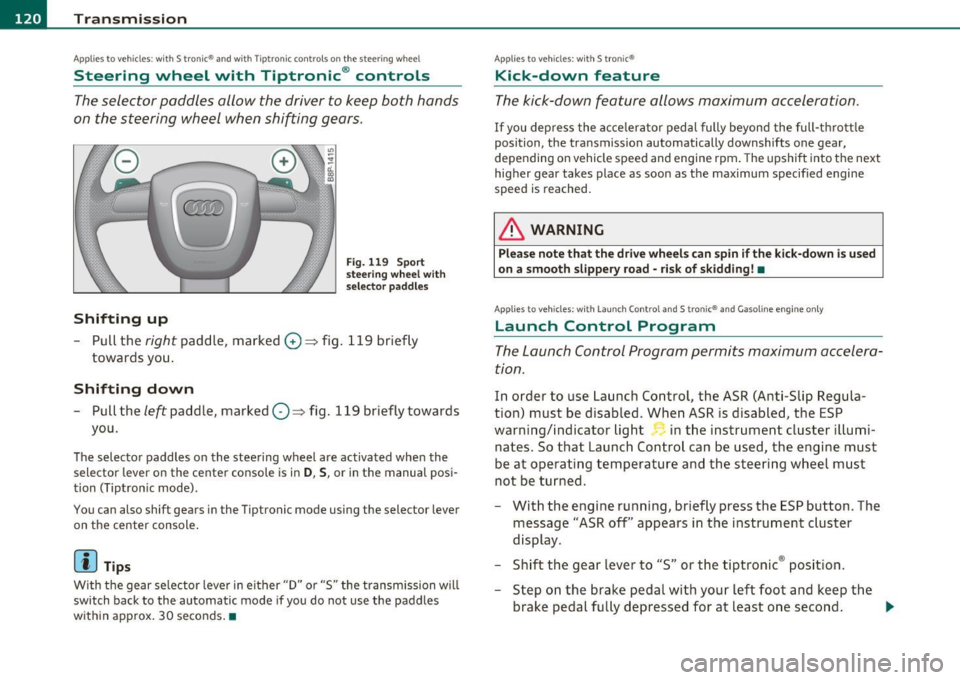
Steering wheel with Tiptronic ® controls
The selector paddles allow the driver to keep both hands
on the steering wheel when shifting gears.
Shifting up
Fig. 119 Sport
steering wheel with
selector paddles
-Pull the right paddle, marked G) => fig. 119 briefly
towards you .
Shifting down
-Pull the left paddle, marked O=> fig. 119 briefly towards
you.
The selector paddles on the steering wheel are activated when the
selector lever on the center console is in
D, S, or in the manual posi
tion (Tiptron ic mode).
You can also shift gears in the Tiptronic mode using the selector lever
on the center console.
[ i ] Tips
With the gear selector lever in either "D" or "S" the transmission will
switch back to the automatic mode if you do not use the paddles
within approx. 30 seconds .•
Applies to veh icles : with S tro nic®
Kick-down feature
The kick -down feature allows maximum acceleration.
If you depress the accelerator pedal fully beyond the full-thrott le
position, the transmission automatically downshifts one gear,
depending on vehicle speed and engine rpm. The upsh ift in to the next
higher gear takes place as soon as the maximum specified engine
speed is reached.
& WARNING
Please note that the drive wheel s can spin if the kick-down is u sed
on a smooth slippery road -risk of skidding! •
Applies to veh icles: w ith Lau nch Control an d S tron ic® and Gasoline engine only
Launch Control Program
The Launch Control Program permits maximum accelera
tion.
In order to use Launch Control, the ASR (Anti-Slip Regula
tion) must be disabled. When ASR is disabled, the ESP
warning/indicator light in the instrument cluster illumi
nates. So that Launch Control can be used, the engine must
be at operating temperature and the steering wheel must
not be turned.
- With the engine running, briefly press the ESP button. The
message "ASR off' appears in the instrument cluster
display.
- Shift the gear lever to "S" or the tiptronic ® posit ion.
- Step on the brake peda l with your left foot and keep the
brake pedal fully depressed for at least one second . _,,,
Page 123 of 320
Transmission -_____________ _.;..____;_~~
-With your ri ght foot, step on the accelerator to the wi de
open t hrottle positio n or Kickdown . The engine speed
settles at about
3,200 rpm.
- Take your left foot o ff the brake.
& WARNING
• Always adapt your driving to the traffic flow.
• Only use Launch Control when road and traffic condition s allow
it and other dri ver s will n ot be endangered or annoyed by your
driving and the acceleration of the vehicle.
• Make sure that ESP remains enabled . With the ESP disabled,
the vehicle could brake awa y, particula rly on a slick and slippery
road -risk of skidding!
• Once a cceleration i s fin ished , switch ASR on again by briefl y
pushing the ESP button. •
Applie s to v ehic le s: wit h S tron ic ®
Back-up program
In the event of a system malfunction, there is an back -up
program.
I n the even t of system ma lfunct ion, the automati c transmis sion
switches to the fail-safe mode. All of the se lector lever posit ion
displays fo r the automat ic transmiss ion are hi ghligh ted with a ligh t
background in the instrument cluster display . In some cases you
canno t drive in the reverse gear a ny mo re.
If the transmiss ion sw itc hes to fa il-safe mode, you should take the
vehicle to an authorized Aud i dealership as soon as possible to have
the cond itio n corrected. •
Contro ls a nd e quip
m en t Vehicle
OP-eration
Applies to veh icles : w ith S t ron ic ®
Emergency release for selector lever
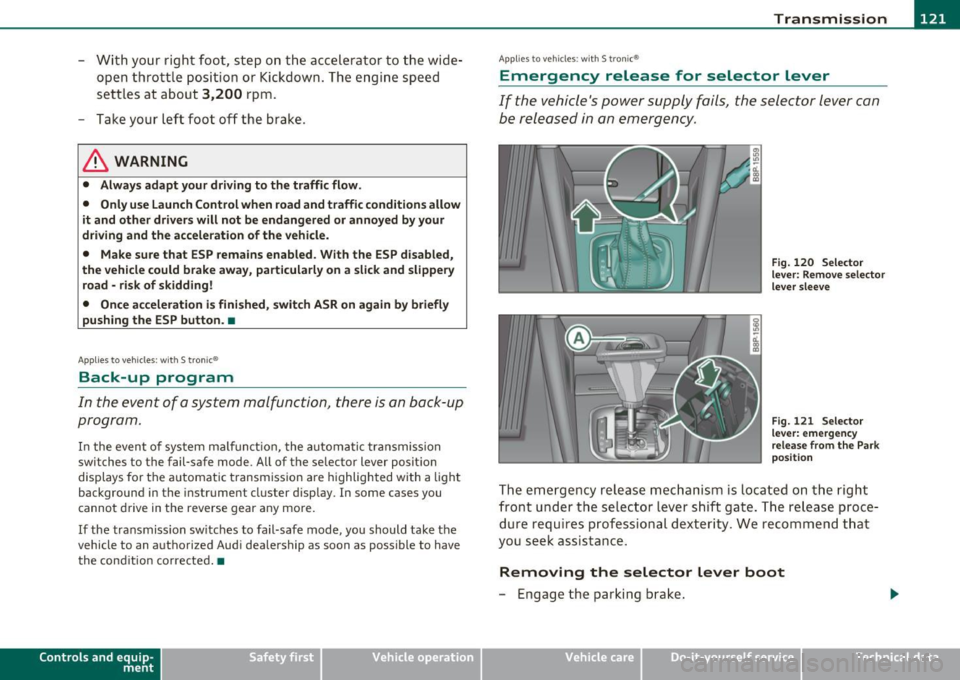
If the vehicle's power supply fails, the selector lever can
be released in an emergency .
Fig. 120 Selector
le ve r: R em ov e se le ct or
l e ve r sleev e
Fig. 12 1 Selector
l e ve r: em ergen cy
relea se fro m the P ark
p os iti on
The em ergency release m echanism is loca ted on th e right
front u nder the se lector lev er shift gate . The re lease p roc e
dure requ ires profess ional dext eri ty. We recommend t hat
you seek assis tance.
Removing the selector Lever boot
- Engage the par king bra ke.
Vehicle care Do-it-yourselt service iTechnical data
Page 162 of 320

........ _A_ i_rb _ a_,g,:;._ s_, y'- s_ t_e _m ________________________________________________ _
& WARNING (conti nued)
• Always make sure that the side a irbag can inflate without
interference :
- Never in stall seat covers or replacement uphol stery over the
front seatbacks that have not been specifically approved by
Audi .
- Never use addit ional se at cushions that cover the areas
where the side ai rbags inflate.
- Damage to the or iginal seat covers or to the seam in the area
of the side airbag module must always be repaired immedi
ately by an author ized Audi dealer.
• The airbag system can be activated only on ce. After an airbag
has inflated, it must be replaced by an authorized Audi dealer or
qualified technician who has the techni cal information, t raining
and special equipment necessary.
• The airbag sy stem can be deploy ed only once. After an airbag
has been dep loyed , it must be replaced with new replacement
parts designed and approved e specially for your Audi model
version. Replacement of complete airbag systems or a irbag
components must be performed by qualified workshops onl y.
Make sure that any airbag service action is entered in your Audi
Warranty
& Maintenance booklet under AIRBAG REPLACEMENT
RECORD .a
Other things that can affect Advanced
Airbag performance
Changing the ve hicle's suspension system can change the way that
t he A dvan ced Airbag Sys tem pe rfo rms in a crash . For examp le, using
tire -rim combinations not approved by Audi, lower ing t he veh icle,
c hang ing the st iffness o f th e suspens ion, including the sp rings,
suspension str uts , shoc k absorbers etc . ca n change the forces tha t
are meas ured by the a irbag sensors and sent to the electronic control
unit. Some suspension changes ca n, for examp le, increase the force levels measured by the senso
rs and make the airbag system deploy in
c ra shes in w hich i t wo uld not deploy if the ch an g es h ad not b een
made . Other ki nds of changes may reduce the force levels meas ured
by the sensors an d prevent the airbag from dep loying when it should .
Th e sensors in t he safety bel t buckle for the drive r and fro nt
passenger seat tell the e lectronic control mo dule if the sa fety belt is
la tch ed o r not. If the safety belt is being u sed, t he fron t airbag w ill
dep loy at a sl ightly h igher rate of vehicle deceleration than if the
s afety belt is not be ing use d. T herefo re, in a pa rticular collis io n, it is
possible that an a irbag w ill not deploy at a seati ng position where the
sa fety belt is being used but w ill inflate at the posit ion where the
safety belt is not be ing used . It is importa nt that nothi ng inte rfere
w ith the safety belt buck les so that t he sensors can send the co rrect
info rmation abou t safety b elt use to t he electron ic co ntro l unit .
& WARNING
Changing the vehicle 's suspension including use of unapproved
tire-rim combinations can change Advanced Airbag performance and increase the risk of serious personal injury in a crash .
• Never install suspension components that do not have the
same performance characteristics as the components originally
installed on your vehicle.
• Never use tire-rim combinations that have not been approved
by Audi.
& WARNING
Item s stored between the safety belt buckle and the center
console can cause the sensors in the buckle to send the wrong
information to the electroni c control module and prevent the
Advanced Airbag System from work ing properly.
• Always make sure that nothing can interfere with the safety
belt buckles and that they are not obstructed . ..,
Page 171 of 320

-----------------------------------------~C~ h~il ~d ~ S~a _!fe ~ t !;YL __
and for the different models of the same kind of child restraint
offered by child restraint manufacturers.
The weight ranges for the individual types, makes and models of ch ild
restraints that the NHTSA has specified in the Safety Standard
together with the weight ranges of typical infants and typical 1 year
old child have been stored in the control unit of the Advanced Airbag
System. When a child restraint is being used on the front passenger
seat with a typical 1 year-old chi ld, the Advanced Airbag System
compares the weight meas ured by the weight sensing mat with the
information stored in the electronic control unit .
The electronic contro l unit a lso registers the tension on the front
passenger safety belt. The tension on the safety belt for the front
passenger seat will be different for an adult who is properly using the
safety belt as compared to the tension on the belt when it is used to
attach a child restraint to the seat . The sensor below the latch for the
safety belt for the front seat passenger measures the tension on the
belt. The input from this sensor is then used with the weight to
"decide", whether there is a child restraint with a typical 1 year-old
child on the front passenger seat and whether or not the airbag must
be turned off .•
Child restraints and Advanced Airbags
Regardless of the child restraint that you use, ma ke sure that it has
been certified to meet United States Federal Motor Vehicle Safety
Standards and has been ce rtified by its manufacturer for use with an
airbag . Always be sure that the child restraint is properly installed at
one of the rear seating positions. If in exceptional circumstances you
must use it on the front passenger seat, carefully read all of the infor
mation on ch ild safety and Advanced Airbags and heed all of the
app licab le WARNINGS. Make certain that the child restra int is
correctly recognized by the weight-sensing mat inside the front
passenger seat, that the front passenger airbag is turned off and that
the airbag status is always correctly signaled by the
PASSENGER AIR
BAG OFF
light.
Controls and equip ment Safety first Vehicle operation
Many types and models of child restra
ints have been available over
t he years, new models are introduced reg ularly incorpo rating new
and improved designs and older models are taken out of product ion.
Chi ld restraints are not standardized. Child restraints of the same
type typ ically have d ifferent weights and sizes and differe nt 'foot
prints,' the size and shape of the bottom of the child restraint that
sits on the seat, when they are installed on a vehicle seat . These
differences make it virtually impossib le to certify compliance with
t he requirements for advanced airbags with each and every chil d
restra int that has ever been sold in the past or will be sold over the
course of the useful life of your vehicle.
For this reason, the United States Nationa l Highway Traffic Safety
Administration has published a list of specific type, makes and
mode ls of child restra ints that must be used to cert ify compliance of
the Advanced Airbag System in yo ur vehicle with the suppression
requirements of Federal Motor Veh icle Safety Standard 208. These
child restraints are:
A. Car beds, manufactured on or after September 1,
2004:
• Cosco Dream Ride 02-719
B. Rear facing child restraint systems,
manufactured on or after September 1, 2004:
(When the restraint system comes equipped with a removable base,
compliance has to be cert ified with or without the base) .
• Britax Handle with Care 191
• Century Assura 4553
• Century Smart Fit 4543
• Cosco Arriva 02727
• Evenflo Discovery Adjust Right 212
• Evenflo First Choice 204
• Graco Infant 8457
Vehicle care Do-it-yourself service Technical data
Page 202 of 320
Driving and environment
This is especially true for vehicles with low-slung chassis (sports
chassis) and fully loaded vehicles. •
Operate your vehicle economically
and minimize pollution
General
Your personal style of driving will determine the economy
of your vehicle, as well as exhaust and noise levels.
Fuel economy, env ironmental impact, and wear on your eng ine,
brakes and tires largely depend on three factors:
• your personal driving style
• operat ing conditions
• technical lim itations
If you anticipate what you need to do next and drive economically,
you can easily cut your fuel consumpt ion by 10-15 percent. This
sect ion wi ll g ive you some tips on how you can help the environment
and your pocketbook.
[I) Tips
The consumption estimates as published by ENVIRONMENTAL PROTECTION AGENCY (EPA) and Transport Canada may not co rre
spond to your actual consumption on the road, which will vary
depending upon vehicle load and speed, road and weather conditions,
trip length, etc. •
Drive smoothl} and keep a lookout ahead
Vehicles use the most fuel when they are accelerating.
Avoid unnecessary accelerating and braking .
Vehicles use the most fuel when they are accelerating. If you antici
pate what is go ing to happen next, you will need to brake less and,
thus, accelerate less. Let the vehicle coast whenever possible - for example when you see that the next traffic light is red.
Avoid full throttle
Driving at moderate speeds saves fuel and improves your
mileage.
- Try and keep well below your car's maximum speed.
Accelerating gently reduces fuel consumption, engine wear, and does
not d isturb the env ironment.
Fuel consumption, exhaust emissions and engine noise increase
disproportionately at high speeds. If you drive at approximately three
quarters of top speed, fuel consumption will be reduced by one half.
Never drive faster than the posted speed limit and weather condi
tions perm it. •
Reducing unnecessary idling
Even when your car is just idling it burns up fuel.
- Shut the engine off when you are not driving the vehicle .
- Do not warm up the vehicle by letting the engine run at idle .
It makes sense to shut off the engine in traffic jams, when waiting for
trains to pass at railroad crossings, or at traffic lights that have long
wa its on red. Turn ing the eng ine off for just 30-40 seconds saves
more fuel than is burned starting the engine again.
It takes a long time for the engine to warm up fully when it is running
at idle. However, wear and noxious emissions are espec ially high
when the engine is warming up . So you shou ld drive away as soon as .,_
Page 236 of 320
IJIII Checking and filling
-------=:---- =------------------------------------
Please be sure to consu lt with your aut horized Aud i dea ler for infor
m ation and availabili ty of the proper engine oil fo r yo ur vehicle's
diesel engine and fo r the latest technical informat ion .
Beca use t his spec ia l engine o il may not be avai lab le when need it, we
s tr ong ly recommend t hat yo u alw ays car ry with yo u extr a qu art (liter)
of oil that conforms to A ud i oil specificat ion VW 507 00, in case you
have to top off o il wh ile on the road.
& WARNING
Failure to use engine oil for your diesel engine that expressly
conforms to Audi oil specification VW 507 00 can cause engine
failure on the highway that can cau se a cra sh and serious per sonal
injury.
• Never use any amount of engine oil in the diesel engine that
does not conform to Audi oil specification VW 507 00 .
• Always carry with you an extra quart (liter ) of engine oil that
conforms to Audi oil specification VW 507 00
in case you must top
off the oil while on the road .
& WARNING
Improperly stored items can become airborne missiles, flying
through the vehicle causing serious personal injury in the event of
hard braking or an accident. To help reduce the risk of serious
personal injury:
• Always store extra quart (liter ) of engine oil for your diesel
engine in its original oil container that is securely closed in the
luggage compartment. Make sure the container is securely stored
and mounted.
0 Note
• If you use engine oil that does not express ly co nform to A udi o il
spe cifica tion VW 507 00, very ser ious and ve ry expens ive da mage to
your vehicle's eng ine will occ ur. Eng ine damage caused by using the wrong engine oil
is not covered by your New Vehicle Lim ited
W arran ty.
• Not all comme rcia lly available oils conform to t his very rigid Audi
oil qua lity stand ard eve n th ough they may be sy nth et ic -b as ed and
have the same v iscosity .•
Engine cooling system
Coolant
The engine coo lant per forms t wo functions: i t keeps the
engin e fro m ove rhea ting and i t pro tec ts th e engine from
f ree zin g in t he win ter .
The cooling system is sealed and genera lly requ ires little attention.
Th e cooling system has been filled at the factory wit h a permanent
coo lant which does not need to be c hanged. The coolant cons ists of a
mixt ure of water an d the manufacturer's glyco l-basedcoolant ad di
tive G12 ++ a ntifree ze with a nticorros ion addit ives (50% fo r USA
mode ls; 60% for Canadian models). This mixture both ass ures the
nece ssary frost protec tion and p rotects meta l components in the
eng ine's cooling system from corrosion and scaling. It also raises the
boiling poin t of the co olant.
Do not red uce the co ncent ration of the coolant in the summer by
add ing p la in water.
The proportion of coolant additive must be at
least 50 % but not more than 60%
to ma inta in an tifreeze protectio n
and coo ling efficiency. If the coolant frost protect ion is too low, t he
coo lant co uld free ze and damage t he veh icle h eating and eng ine
coo ling system.
F or ye ar-round drivi ng, an tifr ee ze is add ed at t he fa ctory for tempe r
atures dow n to:
• - 31°F( -35°C)USA
• -40 °F ( -40 °C) Canada .
Page 252 of 320
-~_T_ i_ re _ s_ a_n _ d_ w_ h _e_ e_ ls _________________________________________________ _
vehicle at its maximum capacity weight and tires that were on your
vehicle at the tim e it was manufactured.
If you wish to improve comfort when operating the vehicle at
normal load (up to 3 occupants) , you can adjust tire pressures to
those specified for normal vehicle load. Before operating the
vehicle at maximum load, you must increase the tire pressures to
those specified for maximum vehicle load
=> &.
Bear in mind that the tire pressure monitoring system* ca n only
monitor the tire pressures you have stored. The system does not
recogn ize the load condit ion of your vehicle.
The effectiveness of the tire pressure monitoring system* wi ll be
impaired if you store normal load pressures but then operate the
vehicle at its maximum load
=> &.
Tire designation
See the illustration => page 249, fig. 171 for the locat ion of the label
either on driver's side B-pillar or inside the fuel filler flap (color of the
actual label and exact location on the vehicle will vary slightly).
Note that the following tab le is accurate at the time of going to press
and is subject to change. In the event of discrepancies, the tire pres
sure label (on USA vehicles, the tire pressure label is located on
dr iver's side B-pillar ; on Canada vehicles, the tire pressure label is
located either on the driver's side B-p illar or inside the fuel filler flap.)
always takes precedence.
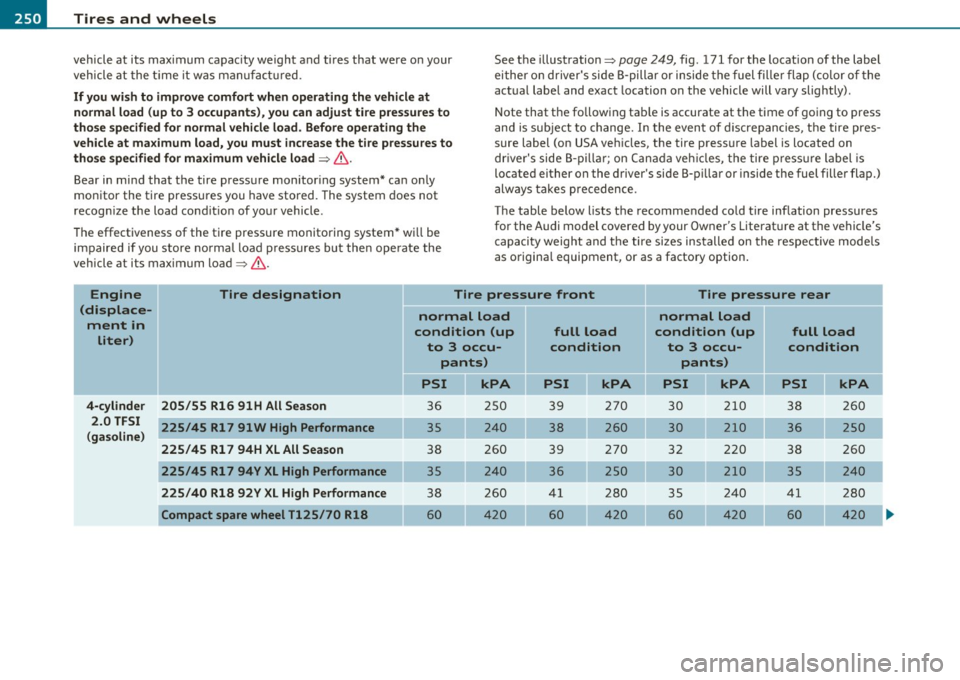
The table below lists the recommended cold tire inflation pressures
for the Audi model covered by your Owner's Literature at the vehicle's
capacity weight and the tire sizes installed on the respective models
as origina l equipment, or as a factory option.
Tire pressure front Tire pressure rear
Engine
(displace
ment in liter) normal Load
normal Load
condition (up full Load condition (up
full Load
to 3 occu- condition to 3 occu- condition pants) pants)
PSI kPA PSI kPA PSI kPA PSI II kPA
4-cylinder 205/55 R16 91H All Season 36 250 39 270 30 210 38 260
2.0 TFSI
225/45 R17 91W High Performance 35 240
38 260 30 210 36 250
(gasoline)
225/45 R17 94H XL All Season
38 260 39 270 32 220 38 260
225/45 Rl 7 94Y XL High Performance 35 240 36 250 30 210 35 240
225/40 R18 92Y XL High Performance
38 260 41 280
35 240 41
280
Compact spare wheel 1125/70 R18 60 420 60 60 420 60 420