air condition AUDI S3 2011 Owner's Manual
[x] Cancel search | Manufacturer: AUDI, Model Year: 2011, Model line: S3, Model: AUDI S3 2011Pages: 320, PDF Size: 75.79 MB
Page 206 of 320
Trailer towingL _____________________________________________ _
ment of the tow vehicle while observing tongue load requirements
and vehicle loading considerations.
Speed
The higher the speed, the more difficult it becomes for the driver to
control the rig. Do not drive at the maximum permissible speed. Reduce your speed even more under unfavorable load, weather or
wind conditions -particularly when going downhill.
Reduce vehicle speed
immediately if the trailer shows the slightest
sign of swaying .
Do not try to stop the swaying by accelerating.
Observe speed limits . In some areas speeds for vehicles towing
trailers are lower than for regular vehicles .
Always apply brakes early . When driving downhill, shift into lower
gear to use the engine braking effect to slow down the vehicle. Use of
the brakes alone can cause them to overheat and fail.
Coolant temperature
The coolant temperature gauge~ page 9 must be observed care
fully. If the needle moves close to the upper end of the scale, reduce
speed immediately and/or switch off the air conditioner .
If the coolant temperature warning light in the instrument cluster
starts flashing
-t-, pull off the road , stop and let the engine idle for
about two minutes to prevent heat build-up.
& WARNING
Anyone not properly restrained in a moving vehicle is at a much
greater risk in an accident. Never let anyone ride in your car who is
not properly wearing the restraints provided by Audi. •
Trailer towing tips
Important to know
-------------
Your vehicle handles differently when towing a trailer because of the
additional weight and weight distribution. Safety, performance and
economy will greatly depend on how carefully you load your trailer
and operate your rig.
Before you actually tow your trailer, practice turning, stopping and
backing up in an area away from traffic. Keep practicing until you have
completely become familiar with the way your vehicle-trailer combi
nation behaves and responds.
Backing up is difficult and requires practice. Backing up with a trailer
generally requires steering action opposite of that when backing up
your vehicle without a trailer.
Maintain a greater distance between your vehicle and the one in front
of you. You will need more room to stop.
To compensate for the trailer, you will need a larger than normal
turning radius .
When passing, remember that you cannot accelerate as fast as you normally would because of the added load. Make sure you have
enough room to pass. After passing, allow plenty of room for your
trailer before changing lanes again.
Avoid jerky starts, sharp turns or rapid lane changes.
[I] Tips
• Do not tow a trailer during the break-in period of your vehicle .
• If you tow a trailer, your Audi may require more frequent mainte
nance due to the extra load~
page 299. •
Page 208 of 320
___ C_ le_ a_n_ i _n_ g=- a_ n_d__, p_ ro_ t_e _c_ t_ i_ o _ n ___________________________________________ _
Cleaning and protection
General information
Regular care preserv es ve hicl e val ue.
Any automobile is exposed to industria l fumes, co rrosive road salt,
e tc. A well ca red for Audi c an look lik e new many ye ars after pur chase.
Regu lar and correct care w ill contribute to mai nta in ing t he beauty
a nd valu e of your Au di.
Furthermore, good care may be a condition for substantiating a
warranty claim should corrosion damage or paint defects occur.
Yo ur au thori zed Audi d eale r ha s a var iety of dedicated vehicle- care
products
and can advise w hich ones to use for clea ning the exterior
an d inter io r of your ve hicle.
W het her you use products recommended by Aud i or other comme r
cially availab le cleaning agents , please make sure yo u appl y them
co rrectly .
& WARNING
• Cleaning agents may be poisonous . Keep them out of the reach
of children.
• Heed all caution labels .
• Always read directions on the container before using any
product. Follow the directions carefully.
• Most chemical cleaners are concentrated and have to be
diluted .
• Use spot removing fluids only in well ventilated areas.
• Do not use gasoline, kero sene , diesel fuel , nail polish remover
or other volatile fluids . They may be toxic, flammable or
hazardous in other ways. Do not wash, wax or dry the vehicle with
the ign ition on or the engine running .
& WARNING (conti nued )
• Do not clean the under sides of chassi s, fenders , wheel cover s,
etc. without protecting your hands and arms. You may cut your
self on sharp-edged metal parts.
• Moisture and ice on brakes may impair braking efficiency
~ page 191, "General information ". Test the brakes carefully
each time you wash the vehicle .
'£> For the sake of the environment
Select only envir onmenta lly fr iendly clea ning produc ts . Leftover
cleaning pro ducts sho uld not dis posed of i n the household waste .•
Care of exterior
Washing
F re quent w ashin g protec ts th e vehicle.
T he best protection aga inst env ironmental influences is frequent
w ashi ng and w ax in g.
How often th is is required depends on:
• How much the vehicle is used
• Where the veh icle is parked (garage, in the open unde r trees, etc .)
• Th e season al and wea ther conditions
• Environmental influences
Th e longer bird droppings, insects, tree resin, road and indus tria l
gr ime, ta r, soot, road sa lt and ot he r materials remain on the veh icle
body, t he mo re lasting their destructive effects wi ll be. .,.
Page 223 of 320

__________________________________ F_ u_ e_l _s _ u...: p....:.. p ___ ly ~ a __ n _ d_ f _i_ l __ li _n _, g~ y __ o_ u _ r_f __ u_ e=.. l ::......:. t.:...a ..:...n :..:.k.::..._ __
Some states in the USA require permits to purchase diesel fuel. Check
with your State Motor Vehicle Department.
Diesel fuel may not be available outs ide the USA and Canada. Be sure
to check before traveling to other countries .
Winter operation
At temperatures below 20° F (- 7° C), Diesel fue l No. 2 loses its fluidity
due to wax separation, which may clog the fuel filter or tank filter and
keep the engine from running.
T o help the filter from being clogged by wax, the fuel fi lter in your
vehicle is automatically preheated. Preheating the fuel filter makes
operat ion of your vehicle possib le with Diesel fuel No. 2 down to -
10° F (-24° C).
If you expect temperatures below 5° F (-15° C) ask your fuel dealer
whether their Diesel fuel No. 2 is suffic iently w interized for the
prevailing and expected temperatures.
If not winte rized or insuffic iently winterized diesel fuel has already
thickened to the extent that the engine will not start, warm the
vehicle up by leaving it in a heated garage.
It is normal that the engine noise level (dieseling) is louder during the
warm-up period in winter.
It is also normal when whitish -blue smoke
comes out of the tailpipe after start ing and during warm-up. The
amount of smoke depends on the outside temperature.
Do not let your diese l engine id le unnecessari ly after a cold start.
Driving off slowly will shorten the warm-up period.
& WARNING
• Never use "starting assist fluids." They may be potentially
explosive or cause a "run-away" engine condition. This could
result in serious engine damage and personal injury.
• Never use fuel line anti-freeze offered for gasoline engines.
Safety first
0 Note
• Your diesel engine has been specifically designed to operate only
on Ultra Low Sulfur Diesel fue l. Therefore, never use home heating oil
or regu lar gaso line. The properties of these fuels may cause serious
damage to the fuel injection system and to the engine. Using these
fue ls can cause expens ive eng ine repairs and will also adversely affect
your New Vehicle Limited Warranty.
• If diesel fuel should get on any rubber hose, it must be wiped off
immediately. Then wash the contaminated hose portion with soap
and warm water. Do not allow diesel fuel to rema in on connecting
hoses. They may deve lop leaks and cause serious damage. •
Fuel tank
Fuel filler neck
The fuel filler neck is located on the right rear side panel behind the
fue l filler flap.
If the power locking system should fa il, you can still open the flap
manually - for detai led instructions see=>
page 224.
You ca n find the fuel tank capacity of your vehicle in Technical Data
=> page 296 .
The label on the inside of the fue l filler flap tells you the correct fuel
for your veh icle. For more information about fuel specifications, see
=> page 219.
Your vehicle fuel tank has an on-board refuelling vapor recovery
system . This feature helps to prevent fuel vapors from escaping from
the tank and polluting the environment while you refuel your vehicle.
In order to fill the tank properly while protect ing the environment,
please follow this refueling procedure carefully. .,,
Vehicle care Technical data
Page 231 of 320

___________________________________________ C_ h_e _c _k_ i_n ~g_ a_n_ d_ f_ i_ll _i_n _g __ _
prevent the formation of harmful deposits, sometimes called
"sludge," that
over time can lead to expensive repairs.
At the time of printing, engine o ils available in the U .S. and Canada
that meet the exacting specifications of Audi oil standard VW 502 00
(vehicles with gasoline eng ine) and VW 507 00 (vehicles w ith diesel
engine) are synthetic engine oils. This does not mean, however, that
every synthetic engine oil will meet Audi oil standard VW 502 00
(gasoline engines) and VW 507 00 (diesel engines). So always be sure
that you use an approved oil.
To help prevent the formation of harmful deposits use only oil with
the following specifications printed on the oil container:
• Gasoline engines: Audi oil standard VW 502 00
• Diesel engines: Audi oil standard VW 507 00
Oil containe r labels may carry the specification singly or in comb ina
tion with other des ignations and oi l quality standards.
Viscosity
Engine oils are graded according to their viscosity. The proper
viscosity grade oil for your engine depends on climactic or seasonal
conditions where you drive. You can use oil with a v iscosity grade of
SAE SW-40 across all temperature ranges for norma l dr iv in g cond i
tions.
However, if eng ine o il viscosity grade SAE SW-40 is not available, you
can also use viscosity grade SAE SW-30 or SAE OW-40 as long as it
meets Audi o il quality standard VW 502 00 (vehicles w ith gasoline
engine) or VW 507 00 (vehicles with diesel engine) specifications.
Because engine o il that meets the Audi oil standard may not be avail
able everywhere when you need it, we strongly recommend that you
always ca rry with you an extra quart (liter) of oil that express ly
conforms to the VW 502 00 (vehicles with gasoline eng ine) or VW
507 00 (vehicles with diesel engine) specification, in case you have to
top off the oil while on the road .
Applies to vehicles with gasoline engine only: Only if the leve l of the
oil is at or below the minimum mark on the oil dipstick - and no oil
Safety first
that expressly conforms to Aud i oil standard VW 502 00 specifica
tions is available -may you top off with a high quali ty engine oil, pref
erably synthetic-based, that meets ACEA A3, ACEA AS, ACEA BS or
API SL specifications, but even then, only in viscosity grades SAE SW-
40, SAE SW-30, or SAE OW-40. However, during the ent ire time
between oil change interva ls, never top off with more than a total of
0.5 qt/liter engine oil that does not conform to Audi oil specification
vw 502 00.
Applies to vehicles with diesel engine only : Only if the level of the
oil is at or below the minimum mark on the oil dipstick -and no oil
that expressly conforms to Audi oil standard VW 507 00 specifica
tions is ava ilable -may you top off with a high qua lity engine oil, that
meets ACEA C3 or API CF specifications, but even then, on ly in
viscos ity grades SAE SW-40, SAE SW-30, or SAE OW-40 . However,
during the entire time between oil change intervals, never top off
with more than a tota l of 0.5 qt/liter engine oil that does not
conform to Audi o il specification VW 507 00.
For more information about engine oil that has been approved fo r
your vehicle, please contact either your author ized Audi dealer or
Audi Customer Relations at 1 (800) 822-2834 or visit our web site at
www.audiusa.com or www .aud icanada.ca. Here you w ill also find a
current list of oils (manufact urers, brand names etc.) that conform to
Audi oil standard VW 502 00 (vehicles with gasoline eng ine) or VW
507 00 (vehicles with diesel engine).
Changing the engine oil
The engine oil and oil filter must be changed accord ing to the mileage
(kilometers) and time interva ls specified in your vehicle's Warranty
&
Maintenance booklet. Do not exceed these intervals -harmful
deposits from o ld engine oil can reduce engine performance and can
lead to expens ive engine repairs.
Chang ing the oil at the recommended intervals is so very important
because the lubricating p roperties of oil decrease g radua lly during
normal veh icle use. If you are not sure when you have your o il
changed, ask your authorized A udi Service Adv isor. ..,.
Vehicle care Technical data
Page 232 of 320
___ C_ h_ e_c _k _i _ n _g ~ a_n _d_ f_il _l_in _ g _________________________________________ _
Under some circumstances the engine oil should even be changed
more frequently. Change oil more often if you drive mostly short
distances, operate the vehicle in dusty areas or mostly under stop
and-go traff ic conditions, or when you use your vehicle where temper
atures stay below freezing point for long periods .
Detergent additives in the oil will make fresh oil look dark after the
engine has been run ning for a short time . This is normal and is not a
reason to change the oil more often than recommended .
Damage or malfunctions due to lack of maintenance
It is essentia l that you change your oi l at the recommended intervals
using only engine oil that complies with Audi oi l standard VW 502 00
(vehicles with gasoline engine) or VW 507 00 (vehicles with diesel
engine). Your Limited New Vehicle Warranty does not cover damage
or malfunctions due to failure to follow recommended maintenance
and use requirements as set forth in the Audi Owner's Manua l and
Warranty
& Maintenance booklet. Your dealer will have to deny
warranty coverage unless you present to the dealer proof in the form
of Service or Repair Orders that all scheduled maintenance was
performed in a timely manner .•
Engine oil consumption
The engine in your vehicle depends on an adequate
amount of oil to lubricate and cool all of its moving parts.
In order to provide effective lubrication and cooling of internal
engine components, all internal combustion engines consume a
certain amount of o il. Oil consumpt ion varies from engine to engine
and may change significant ly over the life of the eng ine. Typically,
engines with a specified break- in period (see~
page 197) consume
more oi l during the break-in period than they cons ume after oil
consumption has stabilized.
Under normal cond itions, the rate of oil consumpt ion depends on the
quality and vis cosity of the oil, the RPM (revol utions pe r minute) at
which the engine is operated, the ambient temperature and road
conditions. Further factors are the amount of oi l dilution from water condensation or fuel residue and the ox
idation level of the o il. As any
eng ine is subject to wear as mileage builds up, the oil consumption
may increase over time until replacement of worn components may
become necessary.
With all these variab les coming into play, no standard rate of oil
consumption can be established or specified. There is no alternative
to regular and frequent checking of the oil level , see
Note .
If the yellow engine oil level warning symbol in the instrument
cl uster .... lights up, you should check the oil level as soon as possible
with the oil dipstick~ page 231. Top off the o il at your earliest
convenience ~
page 232.
& WARNING
Before you check anything in the engine compartment, always
read and heed all WARNINGS~
& in "Work ing in the engine
compartment" on
page 226.
0 Note
Driving with an insufficient oil level is likely to cause severe damage
to the engine .
[ i ] Tips
• The oil pressure warning display 't::r. is not an indicator of the oil
level. Do not rely on it. Instead, check the oil level in your engine at
regular intervals, preferably each time you refuel, and alway s
before going on a long trip.
• If you have the impression your eng ine consumes excessive
amounts of oi l, we recommend that you consu lt your authorized Audi
dea ler to have the cause of your concern properly diagnosed. Keep in
mind that the accurate measurement of oil consumption requires
great care and may take some time . Your authorized Audi dea le r has
instructions about how to measure oil consumption accurately. •
Page 237 of 320

Checking and filling --------------------=------=:;______,.J VPII
You can mix the G12++ coolant additive with other additives G12+ or
Gl2. Always check with yo ur authorized Aud i dealer.
& WARNING
Before you check anything in the engine compartment, always
read and heed all WARNINGS =>
& in "W orking in the engine
co mpartment " on
page 226.
0 Note
• Before winter sets in, have the coolan t checked to see if the
coolant additive in your vehicle is sufficient to meet the clima te
conditions. This is especially important if you live in a region where
the winter is extremely cold . If necessary, increase the proportion of
coo lant additive to 60%.
• When adding coolant additive to your cooling system, remember :
- We recommend using only coolant additive
G12++ (check the
label) for your vehicle. This coolant additive is available at autho
rized Audi dealers. Other types of antifreeze can significantly
reduce corrosion protection . The resulting corrosion can cause a
loss of coolant and serious engine damage.
• Do not add any type of radiator leak sealant to your vehicle's
eng ine coolant. Adding radiator repair fluid may adversely affect the
function and performance of your cooling system and could result in
damage not covered by your New Vehicle Limited Warranty. •
Vehicle OP-eration
Checking the engine coolant level
The engine coolant level can be checked with a quick
glance.
Fig. 166 Engine
co mpartm ent: cool ant
expansion tank
Before you check anything in the engine compartment,
always read and heed all WARNINGS => & in "Working in
the engine compartment" on
page 226.
- Turn off the ignition.
- Read the engine coolant level from the coolant expansion
tank=> fig. 166 . With a cold engine, the coolant level
should be between the "min" and "max" markings. When
the engine is warm, the level may be slightly above the
"max" marking .
The location of the coolant expans ion tank can be seen in the engine
compartment illustration=>
page 227.
To obtain an accurate reading, the engine must be sw itched off.
The expans ion tank in your vehicle is equipped with an electric coolant
level sensor.
When the coolant level is too low, the warn ing light in the Auto-Check
System =>
page 32 will blink until you add coolant and the level has
been restored to normal. Even though there is an elect ric coolant
~
Vehicle care Do-it-yourselt service iTechnical data
Page 252 of 320
-~_T_ i_ re _ s_ a_n _ d_ w_ h _e_ e_ ls _________________________________________________ _
vehicle at its maximum capacity weight and tires that were on your
vehicle at the tim e it was manufactured.
If you wish to improve comfort when operating the vehicle at
normal load (up to 3 occupants) , you can adjust tire pressures to
those specified for normal vehicle load. Before operating the
vehicle at maximum load, you must increase the tire pressures to
those specified for maximum vehicle load
=> &.
Bear in mind that the tire pressure monitoring system* ca n only
monitor the tire pressures you have stored. The system does not
recogn ize the load condit ion of your vehicle.
The effectiveness of the tire pressure monitoring system* wi ll be
impaired if you store normal load pressures but then operate the
vehicle at its maximum load
=> &.
Tire designation
See the illustration => page 249, fig. 171 for the locat ion of the label
either on driver's side B-pillar or inside the fuel filler flap (color of the
actual label and exact location on the vehicle will vary slightly).
Note that the following tab le is accurate at the time of going to press
and is subject to change. In the event of discrepancies, the tire pres
sure label (on USA vehicles, the tire pressure label is located on
dr iver's side B-pillar ; on Canada vehicles, the tire pressure label is
located either on the driver's side B-p illar or inside the fuel filler flap.)
always takes precedence.
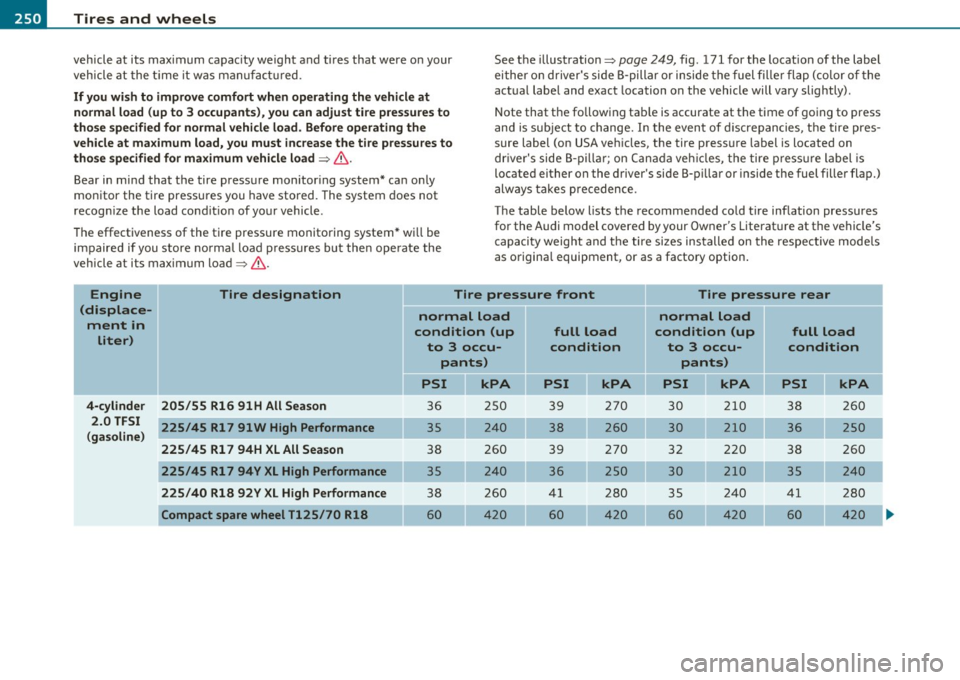
The table below lists the recommended cold tire inflation pressures
for the Audi model covered by your Owner's Literature at the vehicle's
capacity weight and the tire sizes installed on the respective models
as origina l equipment, or as a factory option.
Tire pressure front Tire pressure rear
Engine
(displace
ment in liter) normal Load
normal Load
condition (up full Load condition (up
full Load
to 3 occu- condition to 3 occu- condition pants) pants)
PSI kPA PSI kPA PSI kPA PSI II kPA
4-cylinder 205/55 R16 91H All Season 36 250 39 270 30 210 38 260
2.0 TFSI
225/45 R17 91W High Performance 35 240
38 260 30 210 36 250
(gasoline)
225/45 R17 94H XL All Season
38 260 39 270 32 220 38 260
225/45 Rl 7 94Y XL High Performance 35 240 36 250 30 210 35 240
225/40 R18 92Y XL High Performance
38 260 41 280
35 240 41
280
Compact spare wheel 1125/70 R18 60 420 60 60 420 60 420
Page 260 of 320
lfflJ,.___T_ ir_e_ s _ a_ n _ d_ w_ h_e_ e_ ls _______________________________________________ _
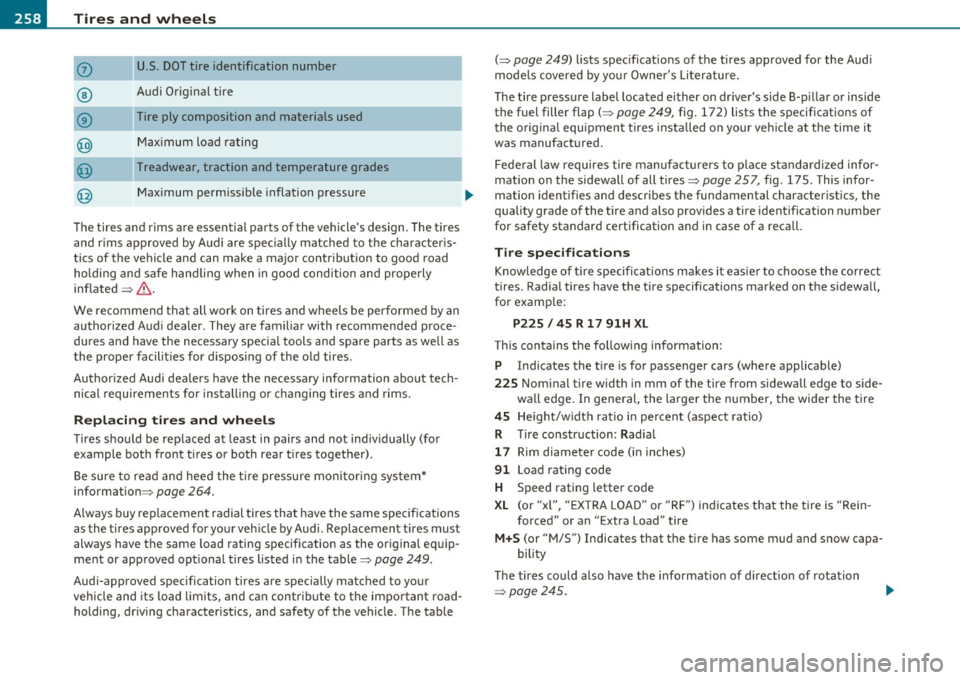
(j)
®
®
U.S . DOT tire identification number
Audi Orig inal tire
Tire ply composition and materials used
Max imum load rating
Treadwear, traction and temperature grades
@ Maximum permissible inflation pressure
The tires and rims are essential parts of the vehicle's design. The tires
and r ims approved by Audi are spec ially matched to the characteris
tics of the vehicle and can make a major contribution to good road
holding and safe handling when in good condition and properly
inflated =>& .
We recommend that all work on tires and wheels be performed by an
authorized Audi dealer. They are familiar with recommended proce
dures and have the necessary special tools and spare parts as well as
the proper facilit ies for disposing of the old tires.
Authorized Audi dea lers have the necessary information about tech
nical requirements for installing or chang in g ti res and rims.
Replacing tires and wheels
Tires should be replaced at least in pairs and not ind ividually (for
example both front tires or both rear t ires together).
Be sure to read and heed the tir e pressure monitoring system*
information=>
page 264.
Always buy replacement radial tires that have the same specifications
as the tires approved for your veh icle by Audi . Replacement tires must
always have the same load rating specification as the original equip
ment or approved opt iona l tires listed in the table=>
page 249.
Audi-approved spec ification tires are specially matched to your
vehicle and its load limits, and can contribute to the important road
holding, driv ing characteristics, and safety of the vehicle. The table (=>
page
249) lists specifications of the tires approved for the Aud i
models covered by your Owner's Literature.
The tire pressure label located either on driver's side B-p illar or inside
the fuel filler flap(=>
page 249, fig. 172) lists the specifications of
the original equipment tires installed on your ve hicle at the time it
was manufactured.
Federal law requires tire manufact urers to place standardized infor
mation on the sidewall of all tires =>
page 2 5 7, fig. 17 5. This i nfor
mation identifies and describes the fundamental characteristics, the
quality grade of the tire and also provides a t ire identification number
for safety standard certification and in case of a reca ll.
Tire specifications
Knowledge of tire specificat ions makes it easie r to choose the correct
tires. Rad ial tires have the tire specifications marked on the s idewall,
for examp le:
P225 / 45 R 17 91H XL
This contains the following informat ion:
P I ndicates the tire is for passenger cars (where applicable)
225 Nominal tire width in mm of the tire from s idewall edge to side-
wa ll edge. In gene ral, the large r the number, the wider the tire
45 Height/width ratio in pe rcent (aspect ratio)
R Tire construction: Radial
17 Rim diameter code (in inches)
91 Load rating code
H Speed rating letter code
XL (or "xl", "EXTRA LOAD" or "RF") indicates that the tire is "Rein
forced" or an "Extra Load" tire
M+S (or "M/S") Indicates that the t ire has some mud and snow capa
bili ty
The tires could a lso have the information of direction of rotation
=>page 245.
Page 263 of 320

__________________________________________________ T_i_ r _e _s_ a_ n_ d_ w_ h_e_ e _ l_s __ _
Tread wear
The tread wear grade is a compa ra tive ra ting based on the wear rate
of the tire when tested unde r co ntrolled conditions on a specified
government test co urse.
For examp le, a tire g rade d 150 would wea r o ne and one half (1 1/2)
times as well on the government course as a tire graded 100.
Th e relat ive performance o f tires depends upon t he ac tual con ditions
o f their use, however , and may de pa rt s ig ni ficantly from the norm
due to variations in driv ing ha bits, service prac tices an d differences in
roa d characterist ics and climate.
Traction
The traction grades, from highest to lowest, are AA, A, Band C. Those
grades represent the tire's ab ility to s to p on wet pavemen t as
meas ured under controlled condit ions o n spec ified governme nt test
s u rfaces of asphalt and conc rete. A tire mar ked C may have poo r trac
ti on perfo rma nce => & .
Temperature
The temperature grades are A (t he h ighest), B, a nd C, rep resenting
the t ire's resistance to the gene rat ion of heat and its ab ility to dissi
pate hea t when test ed unde r co ntro lled condi tions o n a spe cifi ed
indoor laboratory test wheel.
S ust ain ed high te m peratu re can cause t he mate rial of the tire to
degenerate and reduce tire life, and excessive temperatu re ca n lead
t o sudden tire fail ur e=> & .
Th e g rade C cor responds to a leve l of performance which all
passenger car tires m ust meet under the Fede ral Motor Vehicle
Safety Standa rd No. 109. G rades Band A rep resent higher levels of
per formance on the labo ratory test whee l than the minimum
req uired by law .
Safety first
& WARNING
The traction grade assigned to this tire is based on straight -ahead
braking traction tests, and does not include acceleration,
cornering, hydroplaning or peak traction characteristics.
& WARNING
The temperature grade for this tire is established for a tire that is
properly inflated and not overloaded. Excessive speed, underinfla
tion, or e xcessive loading, either separately or in combination, can
c ause heat buildup and po ssible tire failure .•
Winter tires
W inter tires can improve vehicl e handling on snow and
ic e. A t temper atures belo w 45 °F (7 °C) we recommen d
ch angin g to win ter tires .
In some heavy snow areas , loca l gover nments may requ ire true
wi nte r o r "snow" t ires, those with very deep ly c ut trea d. These tires
should only be use d in pairs and be i nstalled on all fo ur w heels . Mak e
sure you purchase snow tires that are the same size a nd constr uction
t ype as the ot her tir es o n your ve hicle.
If your veh icle is eq uipped with all-wheel drive*, th is will improve
t raction during w inte r drivin g, eve n with t he standard tires . However,
we st rongly recomme nd that you a lways equi p all four w hee ls on your
vehicle with correctly fitte d winter t ires or a ll-season ti res, w hen
wi nter road conditions a re expe cte d. Thi s also improves the vehicle 's
bra king pe rformance and re duces stop ping distances.
S u mme r tir es pro vide less g rip on ice and snow .
Winter tires (snow tires) must always be fi tted on all fo ur whee ls .
Ask yo ur autho rized Audi deale r or qu alified wor kshop for permitted
winter tire sizes . Use only ra dial w inte r tir es. ..
Vehicle care Technical data
Page 266 of 320
lffllL-_T.:..:..: ir:....:e~ s=---= a~ n:..:..: d:......: w..:....:.. h:....:e~ e= ls=--------------------------------------------------
Low aspect ratio tires
Your Audi is factory-equipped with low aspect ratio tires. These tires
have been thoroughly tested and been selected specifically for your
model for their superb performance, road feel and handling under a
variety of driving conditions. Ask your authorized Aud i dealer for
more details .
Th e low aspect ratio of these tires is indicated by a numeral of
55 or
less
in the tire's size designation . The numeral represents the ratio of
the tire's sidewall height in relation to its tread width expressed in
percentage. Conventional tires have a height/width ratio of 60 or
more.
The performance of low-aspect-ratio tires is particularly sensitive to
improper inflation pressure. It is therefore important that low
aspect ratio tires are inflated to the specified pressure and that the
inflation pressure is regularly checked and maintained. Tire pres
sures should be checked at least once a month and always before a
long trip~
page 252, "Checking t ire pressure" .
What you can do to avoid tire and rim damage
Low aspect ratio tires can be damaged more easily by impact w ith
potholes, curbs, gullies or ridges on the road, particularly if the tire is
unde rinflated.
In order to minimize the occurrence of impact damage to the tires of
your vehicle , we recomme nd that you observe the following precau
tions:
• Always maintain recommended inflation pressures. Check your
tire pressure every 2,000 miles (3,000 km) and add air if necessary.
• Drive ca refully on roads with potholes, deep gullies or ridges. The
impact from driving through or over such obstacles can damage your
tires. Impact with a curb may also cause damage to your tires .
• After any impact, immediately inspect your tires or have them
inspected by the nearest authorized Audi dealer. Replace a damaged
tire as soon as possible. •
Inspect your tires every 2,000 miles (3,000 km) for damage and
wear . Damage is not always easy to see. Damage can lead to loss of
air and underinflat ion, which could eventually cause tire fa ilure . If
you believe that a tire may have been damaged, replace the tire as
soon as poss ible .
• Th ese tires may wear more quickly than others.
• Please a lso remember that, while these tires deliver responsive
hand ling, they may rid e less comfortably and make more noise than
other choices .
Reduced performance in winter/cold season
conditions
All tires are designed for certain purposes. The low aspect ratio, ultra
high performance t ires originally installed on your vehicle are
intended for maximum dry and wet road perfo rmance and handling.
They are not su itable for cold, snowy or icy weather conditions . If you
drive under those circumstances, you should equip yo ur vehicle with
all-season or w inter tires, which offer better traction under those
conditions . We suggest yo u use the recommended snow or all-season
tires specified for your veh icle, or their equivalent .
Refer to =>
page 261 for more detailed information regard ing winter
tires. •
Tire pressure monitoring system
Applies to veh icles : w it h t ire press ure m onito ring syste m
General notes 1
Each tire, including the spare (if prov ided) , shou ld be checked
month ly when cold and inflated to the inflation pressure recom
mended by the vehicle manufacturer on the vehicle placard or t ire
inf lation pressure label. (If your vehicle has tires of a different size
than the siz e indicated on the vehicle placard or tire inflation pressure
label, you should determine the proper t ire inflation pressure for
those tires.)
~