seats AUDI S3 2011 Owner's Manual
[x] Cancel search | Manufacturer: AUDI, Model Year: 2011, Model line: S3, Model: AUDI S3 2011Pages: 320, PDF Size: 75.79 MB
Page 94 of 320

Seats and storage
Glove compartment
The glove compartment is illuminated and can be locked.
To open glove compartment
Fig. 94 Glove
compartment
- Pull the handle => fig. 94 in the direction of the arrow push
down lid to the fully open position.
To close glove compartment
-Push the glove compartment lid upward until the lock
engages.
The light will illuminate when the parking/headlights are turned on
and the glove compartment is open.
In the glove compartment lid, you will fi nd a place to store a pen and
a pad of paper.
& WARNING
To reduce the risk of personal injury in an accident or sudden stop,
always keep the glove compartment closed while driving. •
Applies to veh icles: with storage compartment in cente r con sole
Storage compartment for small objects Ca
Fig. 95 Center console
storage compartment
- To open the compartment, press th e cover Ce=> fig. 95.
- To close the compartment, push the drawer all the way in
until it clicks in place.
An additional storage compartment3> for relatively small objects is
located in the cente r console next to the brake lever. •
3
l Not available on vehicles wi th Aud i Naviga tion System .
Page 95 of 320

Compartments in the door trims
There are storage compartments in the door trims.
& WARNING
Fig. 96 Storage
compartment in the
door trim
Always read and heed all WARNINGS => page 163, "Important
safety instructions on the side airbag system". •
Applies to vehicles : with sto rage net in footwe ll
Storage net in footwell
There is a storage net in the passenger's footwell.
Con tro ls a nd e quip
m en t
Fig . 97 Storage net in
passenger's footwell
Vehicle OP-eration
Seats and storage
(I) Tips
Do not keep any sharp or pointed objects in the storage net -they are
a personal injury risk.•
Applies to vehicles: w ith storage net in the front seatbacks
Storage net in the seatbacks
There is a storage net behind both front seatbacks.
(I) Tips
Fig. 98 Storage net on
the driver's seatback
Do not keep any sharp or pointed objects in the storage net -th is
increases the risk of personal injury .•
Vehicle care Do-it-yourselt service iTechnical data
Page 96 of 320

Seats and storage
Applies to veh icles : with storage net in luggage compartment
Side storage in the luggage compartment
T here is a compartment with a n et on the right side of th e
luggage compartment .
•
Fig. 99 S id e c ompart ·
me nt in the lugg age
c om partm ent
The compa rtment is suitab le for holdi ng sma ll items. •
Coat hooks
There is a coat hook above each rear door.
Fig. 100 C oat h ook
The coat hooks a re located in the headliner above each rear door.
& WARNING
• Hang clothes in such a way that they do not impair the driver 's
vision.
• The coat hoo ks must only be used fo r light weight clothing. Do
not leave any heavy or sharp edged objects in the pockets whi ch
may interfere with the side curta in airbag deployment and can
cause personal injury in a cra sh.
• Do not use coat hangers fo r hanging clothing on the coat hooks
as this can interfere with proper deployment of the side curtain
airbags in an accident .
• Do not hang heavy objects on the coat hooks , as they could
cause personal injury in a sudden stop. •
Page 103 of 320

_________________________________________________ W_ a_ r_m _ a_ n_d_ c_ o_ ld _ ___._
Air directed to th e footw ells ~
All the air is directed to outlets ® and to the outlets under the front
seats. •
Air outlets
,
'''
Fig. 102 Instrument panel: air outlet locations and airflow directions
The air outlets (D and @on top of the instrument panel are
fixed. Outlets ® and © can be adjusted.
Adjusting air outlets ® and ©
-Turn the vertical thumbwheel beside the outlet to
increase, reduce or shut down the airflow from that
outlet.
- Move the small tab in the center of the outlet louver side
ways and up or down to adjust the level and direction of
airflow .
Contro ls a nd e quip
m en t Vehicle
OP-eration
The supply of a ir to the outlets is controlled either automat ically or
manually depend ing on the operation mode selected. The airflow
from all outlets can be heated, unheated or cooled .
The heater outlets for the rear footwells are located under the front
seats. When you select outlets@, air is also directed to the rear foot
wells.
[I) Tips
• When defrosting/defogging the windows, air flows from outlets
(D ,@ and @. To defrost or defog the windows as rapidly as poss ible,
air outlets ® should be opened
fully with the adjuster wheels.
• When the air conditioner is working, cooled air w ill flow primarily
from outlets @,® and @. To assure adequate cooling, outlets ®
and © should never be completely closed.•
Using the climate controls economically
Using the climate controls prudently can help save fuel .
When you use the air conditioner, engine power is reduced
and fuel consumption increases. To save fuel, you should use
the air conditioner only when necessary. Also please note the
following points:
- If you want to save fuel, switch off the air conditioner .
- If you are going to drive with the windows open, switch off
the air conditioner.
of polluta nts emitted into the air. •
Vehicle care Do-it-yourselt service iTechnical data
Page 105 of 320

_________________________________________________ W_ a_ r_m _ a_ n_d_ c_ o_ ld _ ___.lfll
Applies to vehicles : wi th electr ically heate d front se ats
Electrically heated front seats
With the ignition on, the seat cushion and backrest of the
front seats can be heated.
Fig. 10 4 Center
console: thumbw heels
f o r fr ont se at heating
Use the thumbwheels in the center console=> fig. 104 to
turn on and adjust front seat heating. An infinite range of
positions are possible .
- Roll the thumbwheel
© (driver's seat) or@ (front
passenger's seat) from position (0 ) upward in order to
activate the heating elements.
- Select the desired temperature setting from positions 1
through 6.
When the heating element is activated, the numbers on the thumb
wheel w ill illuminate .
0 Note
To prevent possible damage to the heating elements, do not kneel on
the seats or apply a heavy load to relatively small areas of the seat. •
Contro ls a nd e quip
m en t Vehicle
OP-eration
App lies to vehicles : with eng ine preheater
Engine preheater
Use of the engine preheater is recommended when the
ambient temperature is below -5 °F (-20 °C) .
Fig. 10 5 I n the le ft
fro nt b umper: engine
prehea ter connection
soc ket
T he engine preheater slow ly warms the engine coolant using a
heating element when the vehicle is parked. The included cable
4>
must be connected to a 120 Volt Ground Fault Circuit (GFI) protected
outlet that is protected from water (in your garage, for instance).
When the coo lant is preheated, the engine reaches its operating
temperature more qu ickly and will use less fuel and produce fewer
polluting emissions during the warm-up phase.
Preheat ing the engine can take up to 3 hours depending on the
temperature outside.
Conn ect ing th e engin e pr ehe ate r
• Only use the cable provided.
• All cables and connectors that are used must not be damaged
=> & .
• Open the cover=> fig. 105
G) .
• Plug the connecting cable into the socket@=>& .
4
) The cable is delivered with veh icles in Canada as standard equipment. The ca
ble can be obtained from an authorized Audi deale r for vehicles in the USA.
Vehicle care Do-it-yourselt service iTechnical data
Page 126 of 320
1111 ....... _D_ r_iv _i_ n .... g=-- S_ a_f _e _Ly :,.._ ______________________________________________ _
Driving Safely
General notes
Safe driving habits
Please remember -safety first!
Th is chapter contains important information, t ips, instructions and
warnings that you need to read an d observe fo r you r own safe ty, the
safety of you r passengers and others . We have summarized here
w hat you need to know about sa fety belts, airbags, child restra ints as
we ll as child safety . You r safety is for us
priority number 1. Always
observe the information and warnings in this section -for your own
safety as well as t hat of your passengers.
The informat ion in this section applies to all mode l versions of yo ur
veh icle . Some of the fe atures des cribed in this se ctions m ay be st an
dard equ ipment on some models, or may be optional eq uipment on
others. If you a re not sure, ask your a uth o rized Audi dealer.
& WARNING
• Always make sure that you follow the instructions and heed
the WARNINGS in th is Manual. It is in your interest and in the
intere st of your passengers.
• Always keep the complete Owner's Literatu re in your Audi
when you lend or sell your vehicle so that this important informa
tion will always be available to the driver and passengers .
• Always keep the Owner's literature handy so that you can find
it easily if you have questions . •
Safety equipment
The safety features are part of the occupant restraint
s y stem and wor k together to he lp reduce the ris k of injury
in a wide variety of accident situations.
Your sa fety and t he safety o f yo ur passenge rs shou ld no t be left to
chance . Adva nces in technology have made a variety of features avai l
a b le to help re duce the risk of injury in an a cc ident . The fo llow ing is a
list of jus t a few of the safety features in your Audi:
• sophisticated safety belts for driver and a ll passenger seating
p osi tion s,
• safety belt pretensioners,
• safety belt fo rce lim iters for the fro nt sea ts,
• safety belt he igh t adju stmen t sys tems for the fro nt sea ts,
• automatic safety be lt height adjustment for the rear seats,
• head restraints fo r eac h seating position,
• front airbags,
• side airbags in the fro nt seats a nd outer rear seats*,
• side curtain air bags,
• special LATCH anchorages for child restraints,
• head restraints fo r eac h seating position,
• adjus table stee ring co lumn.
Th ese ind ividual safety features, can work together as a system to
he lp protec t you and yo ur passengers in a wide range of accidents.
Th ese featu res ca nnot work as a syst em if they are not always
correct ly adjusted and cor rect ly used.
Safety is everybody' s re sponsibility! •
Page 128 of 320
• ....__D_ r_iv _i_ n_, g=-- S_ a _ f_e _,Ly _ ______________________________________________ _
Proper occupant seating positions
Proper seating position for the driver
The proper driver seating position is important for safe,
relaxed driving.
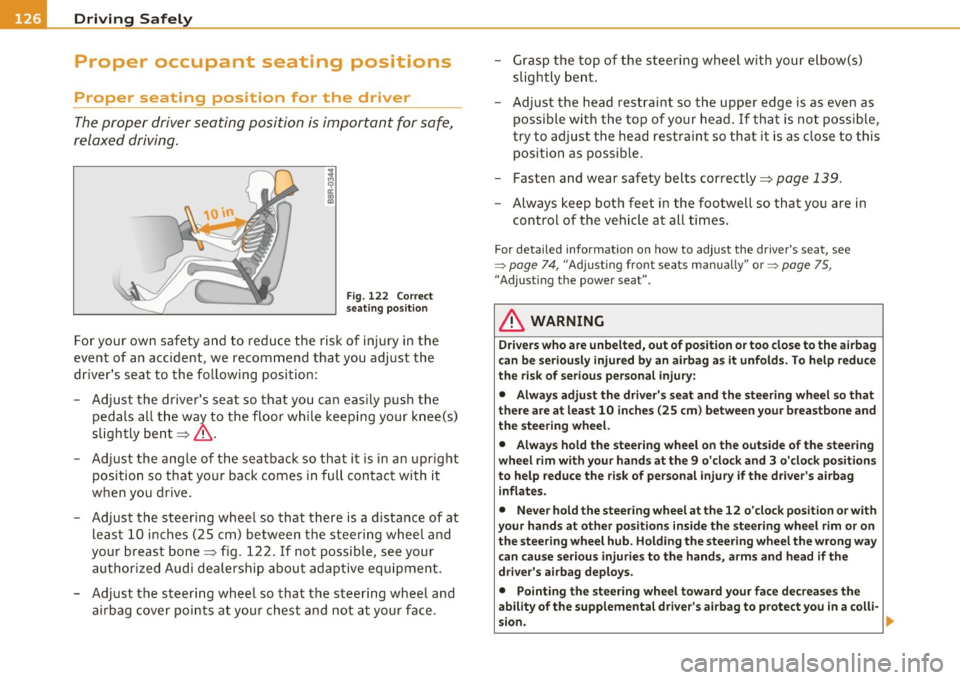
Fig. 122 Correct
seating position
For your own safety and to reduce the risk of injury in the
event of an accident, we recommend that you adjust the
driver's seat to the following position:
- Adjust the driver's seat so that you can easily push the
pedals all the way to the floor while keeping your knee(s)
slightly bent~& .
- Adjust the angle of the seatback so that it is in an upright
pos ition so that your back comes in full contact with it
when you drive.
- Adjust the steering wheel so that there is a distance of at least 10 inches (25 cm) between the steering wheel and
your breast bone~ fig . 122. If not possible, see your
authorized Audi dealership about adaptive equipment.
- Adjust the steering wheel so that the steering wheel and airbag cover points at your chest and not at your face. -
Grasp the top of the steering wheel with your elbow(s)
slightly bent.
- Adjust the head restraint so the upper edge is as even as
possible with the top of your head. If that is not possible,
try to adjust the head restraint so that it is as close to this
position as possible.
- Fasten and wear safety belts correctly~
page 139.
-Always keep both feet in the footwell so that you are in
control of the vehicle at all t imes.
F o r deta iled informat ion on how to adjust the d river 's seat, see
=>
page 74 , "Adjusting front seats manually " or => pag e 75,
"Adjus ting the power sea t".
& WARNING
Drivers who are unbelted, out of position or too close to the airbag
can be seriously injured by an airbag as it unfolds. To help reduce
the risk of serious personal injury:
• Always adjust the driver's seat and the steering wheel so that
there are at least 10 inches (25 cm) between your breastbone and
the steering wheel.
• Always hold the steering wheel on the outside of the steering
wheel rim with your hands at the 9 o'clock and 3 o'clock positions
to help reduce the risk of personal injury if the driver's airbag
inflates.
• Never hold the steering wheel at the 12 o'clock position or with
your hands at other positions inside the steering wheel rim or on
the steering wheel hub. Holding the steering wheel the wrong way
can cause serious injuries to the hands, arms and head if the
driver's airbag deploys.
• Pointing the steering wheel toward your face decreases the
ability of the supplemental driver's airbag to protect you in a colli·
sion. .,
Page 129 of 320

______________________________________________ D_ ri_v _ i_n _,,g ,c.._ S_a_ f_ e_ l..:: y __ lR
& WARNING (continued)
• Always sit in an upright position and never lean against or
place any part of your body too close to the area where the airbags
are located.
• Before driving, always adjust the front seats and head
restraints properly and make sure that all passengers are properly
restrained.
• Never adjust the seats while the vehicle is moving. Your seat
may move unexpectedly and you could lose control of the vehicle.
• Never drive with the backrest reclined or tilted far back! The
farther the backrests are tilted back, the greater the risk of injury
due to incorrect positioning of the safety belt and improper
seating position. • Children must always ride in child safety seats~
page 167.
Special precautions apply when installing a child safety seat on
the front passenger seat~
page 145. •
Proper seating position for the front
passenger
The proper front passenger seating position is important
for safe, relaxed driving .
For your own safety and to reduce the risk of injury in the
event of an accident, we recommend that you adjust the seat
for the front passenger to the following position:
- Adjust the angle of the seatback so that it is in an upright
position and your back comes in full contact with it when
ever the vehicle is moving.
- Adjust the head restraint so the upper edge is as even as
possible with the top of your head. If that is not possible,
try to adjust the head restraint so that it is as close to this
position as possible=>
page 128.
Controls and equip
ment Safety first Vehicle operation
-
Keep both feet flat on the floor in front of the front
passenger seat.
- Fasten and wear safety belts correctly::::>
page 139.
For detailed information on how to adjust the front passenger's seat,
see ~
page 73.
& WARNING
Front seat passengers who are unbelted, out of position or too
close to the airbag can be seriously injured or killed by the airbag
as it unfolds. To help reduce the risk of serious personal injury:
• Passengers must always sit in an upright position and never
lean against or place any part of their body too close to the area
where the airbags are located.
• Passengers who are unbelted, out of position or too close to
the airbag can be seriously injured by an airbag as it unfolds with
great force in the blink of an eye.
• Always make sure that there are at least 10 inches (25 cm)
between the front passenger's breastbone and the instrument
panel.
• Each passenger must always sit on a seat of their own and
properly fasten and wear the safety belt belonging to that seat.
• Before driving, always adjust the front passenger seat and
head restraint properly.
• Always keep your feet on the floor in front of the seat. Never rest them on the seat, instrument panel, out of the window, etc.
The airbag system and safety belt will not be able to protect you properly and can even increase the risk of injury in a crash.
• Never drive with the backrest reclined or tilted far back! The
farther the backrests are tilted back, the greater the risk of injury
due to incorrect positioning of the safety belt and improper
seating position.
II>
Vehicle care Do-it-yourself service Technical data
Page 130 of 320
• ....__D_ r_iv _i_ n_, g=-- S_ a _ f_e _,Ly _ ______________________________________________ _
& WARNING (continued)
• Children must always ride in child safety seats=> page 167.
Special precautions apply when installing a child safety seat on
the front passenger seat=>
page 145. •
Proper seating positions for passengers in
rear seats
Rear seat passengers must sit upright with both feet on
the floor consistent with their physical size and be prop
erly restrained whenever the vehicle is in use.
To reduce the risk of injury caused by an incorrect seating
position in the event of a sudden braking maneuver or an
accident, your passengers on the rear bench seat must
always observe the following :
- If there are passengers in the rear seat, slide the head
restraints upward at least to the next notch on the occu
pied seats =>
page 78.
-Make sure that the seatback is securely latched in the
upright position =>
page 81.
-Keep both feet flat in the footwell in front of the rear seat.
- Fasten and wear safety belts properly=>
page 139.
-Make sure that children are always properly restrained in a
child restraint that is appropriate for their size and age
=>
page 167.
& WARNING
Passengers who are improperly seated on the rear seat can be seri
ously injured in a crash.
& WARNING (continued)
• Each passenger must always sit on a seat of their own and
properly fasten and wear the safety belt belonging to that seat.
• Safety belts only offer maximum protection when the seatback
is securely latched in the upright position and the safety belts are
properly positioned on the body. By not sitting upright, a rear seat
passenger increases the risk of personal injury from improperly
positioned safety belts!
• Always adjust the head restraint properly so that it can give
maximum protection. •
Proper adjustment of head restraints
Correctly adjusted head restraints ore an important part
of your vehicle 's occupant restraint system and can help
to reduce the risk of injuries in accident situations .
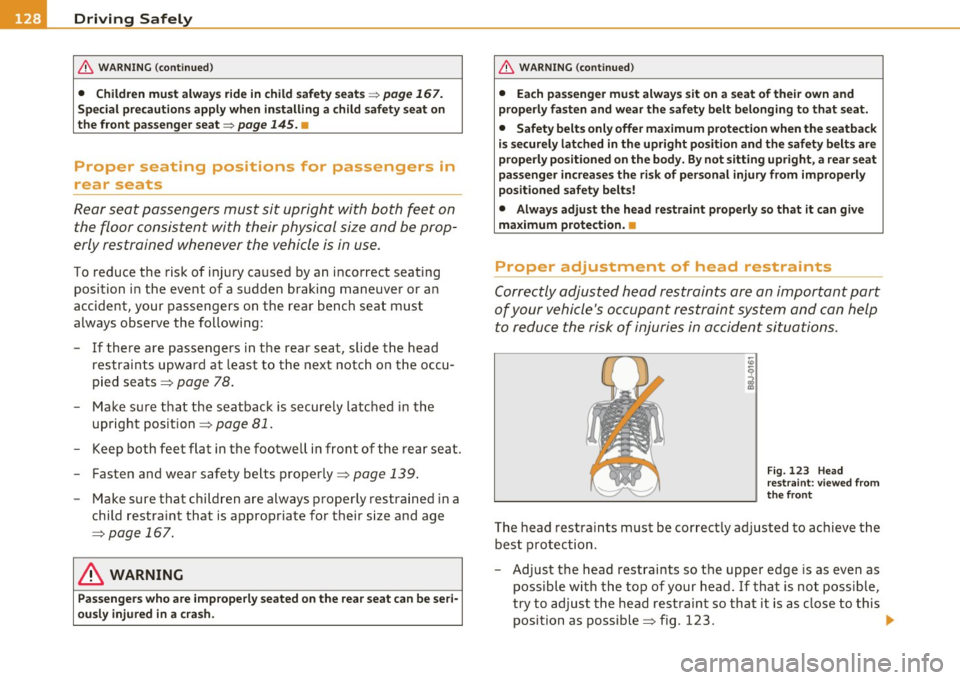
Fig. 123 Head
restraint: viewed from
the front
The head restraints must be correctly adjusted to achieve the
best protection.
- Adjust the head restraints so the upper edge is as even as
possible with the top of your head. If that is not possible,
try to adjust the head restraint so that it is as close to this
position as possible=> fig . 123. .,
Page 131 of 320

______________________________________________ D_ ri _v _ i_n _,,g ,c.._ S_a_ f_ e_ l..:: y __ _
- If there are passengers in the rear seat , slide the head
restra ints u pward at least to the next notch on the occu
p ied seats .
Adjusting head restraints ~ page 77.
& WARNING
Driving without head restraints or with head restraint s that are
not properly adjusted increases the risk of serious o r fatal neck
injury dramatic ally . To help reduce the ri sk of injury:
• Always drive with the head rest raints in place and prope rly
adju sted.
• Every person in the vehicle must have a prope rly adjusted head
restraint .
• Always make sure each per son in the vehicle properly adjusts
their head restraint. Adjust the head restraints so the upp er edge
is as even a s possible with the top of you r head . If that is not
possible, try to adjust the head re straint so that it is as close to
this position as possible.
• Never attempt to adjust head restraint while driving. If you
have driven off and mu st adjust the driver headrest for any reason,
first stop the vehicle safely before attempting to adjust th e head
restraint.
• Children must alway s be properly restrained in a child re straint
that is appropriate for their age and size~
page 167. •
Examples of improper seating positions
The occupant r estraint system con only reduce th e risk o f
injury if vehicle occupants ore properly seated.
Improper seat ing positio ns can cause se rious injury o r death.
Safety belts can only work w hen t hey are properly posi tione d
on t he body . Improper seating positio ns re duce the effective-
Controls and equip
ment Safety first Vehicle operation
ness of s
afe ty belts an d wi ll even increase the risk of injury
and deat h by moving the safety b elt to c rit ica l areas of t he
bo dy. Imp roper seating pos itions also i ncrease the risk of
serious inju ry and dea th w hen an ai rbag deploys a nd strikes
an occ upant who is not in t he proper seati ng pos ition . A
d river is respons ib le for t he safety o f all vehicle occupants
and especia lly for ch ildren. Therefore:
- Nev er a llow anyone to assume an incorrect seating pos i-
t io n whe n the vehic le is bei ng used=> &.
The follow ing b ulletins list only some samp le posi tions that will
increase the risk of se rious injury and death . O ur hope is that these
examples will ma ke you more aware o f seating positions t hat are
dange ro us.
Therefore , whenever the vehicle is moving:
• never stand up in the vehicle
• never stand on the seat s
• never knee l on t he seats
• never ride with the seatback reclined
• never lie down on the rear se at
• never lean up against the instrument panel
• never sit o n the edge of the seat
• never sit s ideways
• never lean out the w indow
• never p ut yo ur fee t out the window
• never p ut yo ur feet on the instrument panel
• never rest your feet on the seat c ush io n or back of the seat
• never ride in the footwe ll
• never ride in the cargo area
Vehicle care Do-it-yourself service Technical data