change wheel AUDI S3 2015 User Guide
[x] Cancel search | Manufacturer: AUDI, Model Year: 2015, Model line: S3, Model: AUDI S3 2015Pages: 310, PDF Size: 76.15 MB
Page 191 of 310
M N
0 > co ,...., \!) 1.1'1
M 1.1'1 ,....,
Smart Technology
Information about
data recorded by
vehicle control
modules
Your vehicle is not equipped with a crash data
recorder. This device is installed by some vehi
cle manufacturers to record data about crash
es so that it can be analy zed later . Crash data
recorders are also called "Event Data Record
ers ( EDR)" .
In some legal jurisdictions, it is not permitted
to access or download data recorded by pre
installed crash data recorders in order to eval
uate a crash without clear consent of the vehi
cle owner .
Your vehicle is not equipped with a crash data recorder. However it does contain a variety of
electronic control modules for various vehicle
systems such as engine function, exhaust
treatment or airbags and safety belts .
These electronic control modules record vehi cle data during normal driving for diagnosis
and repair purposes . The recording capability
of the electronic control modules is limited to
data only- no sound is recorded.
If the control
module detects a system ma lfunction or other
change in status, a very limited amount of da
ta is recorded for an extremely small period of
time . Data that is recorded in such a case may
include vehicle speed, d riving direction, the
load on the brakes and head restraints and
performance in the event of an acciden t or
other change in status . The stored data can
only be read or downloaded with special devi
ces.
Electronic stabilization
control (ESC)
Description
The Electronic Stabilization Control (ESC) con
tr ibutes to driver safety. It reduces the risk of
slipp ing and improves driving stability. ESC
Smart Technolog y 189
detects critical situations such as the vehicle
oversteering and understeering or the wheels
are spinning . The vehicle is stabilized by ap
plying the brakes or reducing engine torque.
Once the ESC is activated, the indicator light
m blinks in the instrument cluster .
The following systems are integrated in the
ESC:
Anti-lock braking system (ABS )
ABS prevents the whee ls from locking when
braking. The vehicle can still be steered even
during hard braking. Apply steady pressure to
the brake pedal. Do not pump the pedal. A
pulsing in the brake peda l indicates that the
system is acting to stabilize the vehicle.
Brake assi st sys tem
The brake assist system can decrease braking
distance. It increases braking power when the
driver presses the brake pedal quickly in emer
gency situations. You must press and hold the brake pedal until the dangerous situation is
over . In vehicles with adaptive cruise control*,
the brake assist system is more sensit ive if the
distance detected to the vehicle ahead is too
small.
Anti-slip regulation (ASR)
ASR reduces engine power when the drive
wheels begin spinning and adapts the force to
the road conditions . This makes it easier to
start , accelerate and dr ive up inclines .
Electronic differential lock (EDL)
The EDL brakes wheels that are spinning and
transfers the drive power to the other drive
wheel or wheels if the vehicle is equ ipped with
all wheel drive*). This function is not available
at higher speeds .
In extreme cases, EDL automatically switches
off to keep the brake on the braked wheel
from overheating . The vehicle is still working
correctly. EDL will switch on aga in automat i
cally when cond itions have returned to nor-
mal. .,..
•
•
•
Page 206 of 310
204 Trailer towing
different weight distribution. Safety, perform
ance and economy wi ll greatly depend on how
carefu lly you load your trailer and operate
your rig.
Before you actually tow your trailer, practice
turning, stopping and backing up in a n area
away from traffic. Keep practicing until you
have become comp letely fam iliar with the way
your veh icle-trailer comb ination behaves and
responds.
Backing up is d iff icult and requires practice.
Backing up with a tra iler genera lly requires
steering action opposite to that when back ing
up your veh icle without a trailer.
Maintain a greater distance between your ve
h icle and the one in front of you. You will need
more room to stop. To compensate for the
trailer, you will need a larger than normal
turning radius.
When passing, remember that yo u cannot ac
celerate as fast as you normally would be
cause of the added load. Make sure you have
enough room to pass. After passing, allow
p lenty of room for your tra iler before chang
ing lanes aga in.
Avoid jerky starts, sharp turns or rapid lane
changes.
(D Tips
- Do not tow a tra iler dur ing the break-in
period of you r vehicle.
- If you tow a trailer, your Audi may re
quire more frequent maintenance due to
the ext ra load
¢ page 289.
Parking on a slope
Do not park on a slope with a trailer. If it can
not be avoided, do so only after doing the fol
lowing:
Wh en park ing:
.. Apply the foot brake .
.. Have someone place chocks under both the
vehicle and the trailer wheels. ..
With chocks in place, slowly release the
brakes unti l the whee l chocks absorb the
load.
.. Turn the whee ls towards the curb.
.. App ly the parking brake.
.. Select the P selector lever posit ion.
When re starting afte r park ing :
.. App ly the foot brake.
.. Start the engine.
.. Select the D/S se lector lever position.
.. Release the parking brake and s lowly pull
out and away from the wheel chocks .
.. Stop and have someone retr ieve the wheel
chocks .
@ Tips
If you move the selector leve r of the auto
matic transmission to P befo re applying
the pa rking brake and before bloc king the
whee ls, you may h ave to use more force
la ter to move the lever out of the P posi
tion .
Page 240 of 310
238 Tires a nd whee ls
Recommended inflation
pressure
see c:::> page 236, Cold tire infla
tion pressure.
Reinforced tire
means a tire design to operate
at higher loads and at higher
inflation pressures than the
corresponding standard t ire .
Reinforced tires may be identi
fied as "XL", "xl", "EXTRA
LOAD", or "RF" on the sidewa ll.
Rim
means a meta l support for a
tire or a tire and tube assembly
upon which the tire beads are
seated .
Rim diameter
means nominal diameter of the
bead seat. If yo u change your
wheel size, you will have to pur
chase new t ires to ma tch the
new rim d iameter .
Rim size designation
means rim diameter and width.
Rim width
means nominal distance be
tween rim flanges.
Sidewall
means that por tion of a tire be
tween the tread and bead.
Speed rating (letter code)
means the speed at wh ich a tire
is designed to be driven for ex
tended periods of time . The rat
ings range from 93 mph
( 1 50 km/h) to 186 mph
( 2 98 km/h)
c:::> page 257 . You
may not find th is informat ion
on all tires because it is not re
quired by law.
The speed rating letter code,
where applicable, is molded on
the ti re sidewall and ind icates
the maximum permissible road
speeds
c:::> & in Winter tires on
page 261.
Tire pressure monitoring
system
means a system that detects
when one or more of a vehic le's
tires a re underinflated an d ill u
m inates a low tire press ure
warn ing telltale.
Tread
means that por tion of a tire
that comes into contact with
the road.
Page 244 of 310
242 Tires and wheel s
If you wish to improve comfort See the illustration c::;, fig. 168
when operating the vehicle at for the locati on of the labe l on
normal load (up to 3 occu -driver's side B-pillar (color of
pants), you can adjust tire the actual label and exact loca-
pressures to those specified tion on the vehic le will vary
for normal vehicle load. Before slight ly) .
operat ing the vehicle at maxi -Note that the following table is
mum load , you must increase accurate at the time of going to
the ti re pressu res to those press and is subject to change .
specified for maximum vehicle In the event of discrepancies,
load c::;, &. the tire pressure labe l is locat-
Bear in mind that the tire pres- ed on the driver's side 8-pi llar
sure monitoring system can on -always takes precedence .
ly monitor the tire pressures The table below lists the rec-
you have stored . The system
ommended cold tire inflation
does not recogn ize the load
pressures for the Audi model
condition of your vehic le.
covered by your Owner's Litera-
T he effectiveness of the tire ture at the vehicle's capacity
pressure monitoring system weight and the tire sizes instal -
will be impaired if you store led on the respective mode ls as
normal load pressures but then original equipment, or as a fac-
operate the vehicle at its maxi- tory option.
...
mum load c::;, & .
Page 246 of 310
244 Tires and wheels
The correct tire pressure for the
spare wheel is located on a la
bel on the driver's side 8-pillar .
Because technical changes may
be made to vehicle equipment
during the model year, always
compare the tire size designa
tion on the tire pressure label
on your vehicle with the tires on
your vehicle. Make sure that the
tire size information on the ve
hicle label is the same as the
size of the tires on the vehicle.
This is especially important if
the vehicle belongs to someone else or you bought the vehicle
with different rims/tires or you bought the vehicle as a previ
ously owned vehicle.
Remember, your safety and
that of your passengers also de
pends on making sure that load
limits are not exceeded. Vehicle
load includes everybody and ev
erything in and on the vehicle.
These load limits are technical
ly referred to as the vehicle's
Gross Vehicle Weight Rating
("GVWR"). The Gross Axle
Weight Rating ("GAWR") is the maximum load that can be ap
plied at each of the vehicle's
two axles. The Gross Vehicle Weight Rating and the Gross
Axle Weight Rating are listed
on the safety compliance stick
er label located on the driver's
side 8-pillar.
The tire pressure
label on your Audi lists the
maximum combined weight of
all of the occupants and lug gage or other cargo that the ve
hicle can carry. For the location
of the tire pressure label
~fig. 168.
A WARNING -
Overloading a vehicle can
cause loss of vehicle control,
a crash or other accident, se
rious personal injury, and
even death.
-Carrying more weight than your vehicle was designed to carry will prevent the ve
hicle from handling properly
and increase the risk of a
loss of vehicle control.
-The brakes on a vehicle that has been overloaded may not be able to stop the vehi
cle within a safe distance.
-Tires on a vehicle that has been overloaded can fail
suddenly causing loss of
control and a crash.
Page 250 of 310
248 Tires and wheels
also lead to sudden tire failure, including a blowout
and sudden deflation, caus ing loss of vehicle control.
-The driver is responsible for the correct tire pressures for
all tires on the vehicle. The
applicable pressure values
are located on a sticker on
the driver's side B-pillar.
-Only when all tires on the vehicle are filled to the cor
rect pressure, the tire pres
sure monitoring system can
work correctly.
-The use of incorrect tire
pressure values can lead to
accidents or other damage.
Therefore it is essential that
the driver observe the speci
fied tire pressure values for
the tires and the correct
pressures for the function of
the tire pressure monitoring
system.
-Always inflate tires to the recommended and correct
tire pressure before driving off.
- Driving with underinflated
tires bend more, letting
them get too hot resulting
in tread separation, sudden tire failure and loss of con
trol.
-Excessive speed and/over
loading can cause heat
build-up, sudden tire failure
and loss of control.
-If the tire pressure is too
low or too high, the tires
will wear prematurely and the vehicle will not handle
well.
-If the tire is not flat and you
do not have to change a
wheel immediately, drive at
reduced speed to the near
est service station to check
the tire pressure and add air
as required.
(D Note
Driving without valve stem
caps can cause damage to
the tire valves . To prevent
this, always make sure that
factory installed valve stem caps on all wheels are securely mounted on the valve.
@ For the sake of the environment
Underinflated tires will also
increase the fuel consump
tion .
Page 267 of 310
M N
0 > co ,...., \!) 1.1"1
M 1.1"1 ,....,
reached the level to trigger illumination of the
TPMS low tire pressure telltale.
Your veh icle has also been equ ipped with a
TPMS malfunction indicato r to indica te when
the system is not operating properly . The
TPMS malfunction indicator is combined with
the low tire pressure tellta le . When the sys
tem detects a malfunct ion, the telltale will
flash for approximately one minute and then
remain cont inuous ly illuminated. This se
quence will continue upon subsequent vehicle
start-ups as long as the ma lfunction ex ists .
When the malfunct ion indicator is illuminat
ed, the system may not be able to detect or
sig nal low t ire pressure as intended . TPMS
malfunct ions may occur for a variety of rea
sons, including the installa tio n of replace
ment or a lternate tires or whee ls on the veh i
cle that prevent the TPMS from funct ion ing
properly. Always check the TPMS malfunction
tellta le after replacing one or more tires or
wheels on your veh icle to ensure that the re
placement or alternate tires and wheels allow
the
TPMS to continue to function properly.
If the Tire Pressure Monitoring System
indicator appears
Applies to vehicles: with tire pressure monito ring system
The tire pressure indicator in the instrument
cluster informs you if the tire pressure is too
low or if there is a system malfunction .
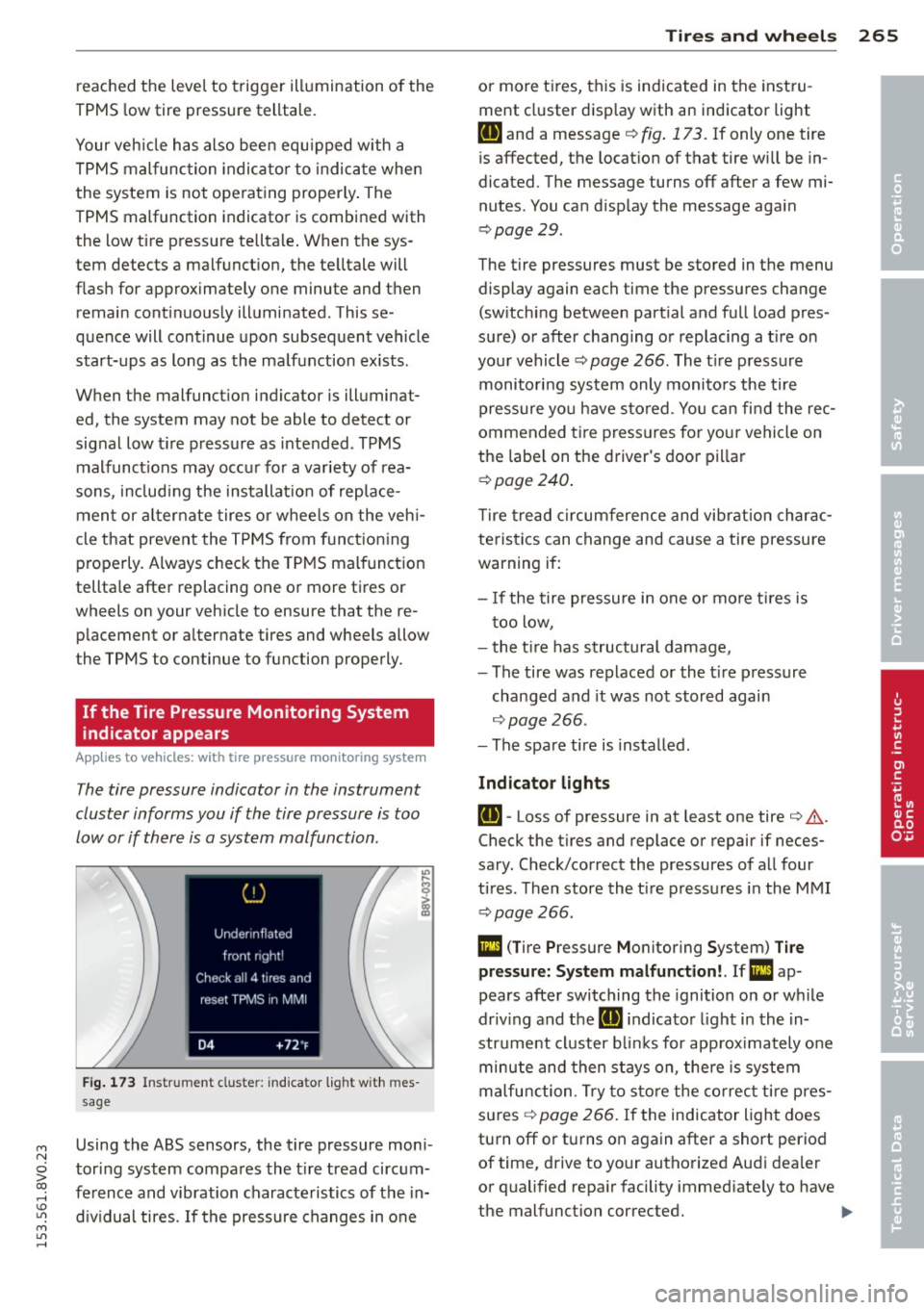
Fig . 173 In strum ent clus te r: indica tor l igh t w ith mes
sage
Using the ABS sensors, the tire pressure moni
toring system compares the t ire tread circum
ference and vibration characteristics of the in
d iv idual tires . If the pressure changes in one
Tire s an d wheel s 265
or more tires, this is indicated in the instru
ment cluster disp lay with an indicator light
ti] and a message c:::> fig . 17 3. If only one tire
is affected, the locat ion of that tire will be in
dicated. The message turns off after a few mi
nutes . You can d isplay the message aga in
c:::> page 2 9 .
The tire pressures must be stored in the menu
display again each time the pressures change
(sw itching between partial and full load pres
sure) or after chang ing or replacing a t ire on
your vehicle
c:::> page 266 . The t ire press ure
monitori ng system only monito rs the tire
pressure yo u have stored . Yo u can find the rec
ommended t ire press ures for your vehicle on
the labe l on the driver 's doo r pillar
c:::> page240 .
Tire t read circumference and vib rat ion charac
teristics can change and cause a tire pressu re
warning if :
- I f the tire pressure in one or mo re tires is
t oo low,
- the t ire has structural damage,
-The tire was replaced or the t ire p ressure
changed and it was not stored again
c:::> page 266 .
- The spare tire is installed .
Indicator light s
ti]-Loss of pressure in at least one tire c:::> &.
Check the tires and replace or repair if neces
sary. Check/correct the pressures of all four
tires . Then store the t ire pressures in the MMI
c:::> page 266 .
DI (T ire Pressure Monitoring System) T ir e
press ure: S ystem malfunct ion!. If Ill ap
pears afte r switching the ignition on or while
driv ing and the
ti] indicator l ight in the in
str ume nt cluster b links for app rox imately one
minute and then stays on , the re is system
malfunction. Try to s to re the co rrec t ti re pres
s u res
c:::> page 266. If the indicator ligh t does
turn off or tu rns on again after a short period
of time, drive to yo ur authorized Aud i dea ler
or qualified repa ir facility immed iate ly to have
the malfunction corrected. .,..
•
•
•
Page 268 of 310
![AUDI S3 2015 User Guide 266 Tire s and wheels
& WARNING
-If the tire pressure warning light ti] in
the instrument cluster turns on, the
pressure in one or more tires is too low.
Reduce the vehicle speed](/img/6/57541/w960_57541-267.png "AUDI S3 2015 User Guide 266 Tire s and wheels
& WARNING
-If the tire pressure warning light ti] in
the instrument cluster turns on, the
pressure in one or more tires is too low.
Reduce the vehicle speed")
266 Tire s and wheels
& WARNING
-If the tire pressure warning light ti] in
the instrument cluster turns on, the
pressure in one or more tires is too low.
Reduce the vehicle speed immediately
and avoid any hard steering or braking
maneuvers . Stop as soon as possible,
check the t ire and inflate the tire to the
correct pressure, which is specified on
the tire pressu re label on the veh icle
¢ page 240. Driving with a t ire with low
pressure causes the tire to overheat and
can result in failure of the tire . Low pres
sure can a lso have a negative effect on
the driving and braking behavior of the
vehicle.
- The driver is responsible for maintaining
the correct tire pressures. You must
check the t ire pressures regularly.
- Under certain conditions (such as a spor
ty driving style, winter conditions or un
paved roads), the pressure monitor ind i
cator may be delayed .
- Ask your author ized dealer if run-flat
t ires may be used on your vehicle.
- The tire pressure monitoring system can
also stop work ing when there is an ESC
malfunction.
- Using snow chains may result in a system
malfunction.
- The tires with the identification "AO" or
"RO" ¢ page 254 have been matched
with your Audi tire pressure monitoring
system. We recommend that you use
these tires.
- The tire pressure monitoring system can
only mon itor the t ire pressure of the
driving tires . Check the tire pressure of
the spare wheel in the luggage compart ment so that if necessary it is ready for
us e.
-
Storing tire pressures
Applies to vehicles: wit h tire press ure mo nitor ing system
A change in tire pressure or a change in tires
must be stored in the system.
The tire pressure is stored in the MMI.
.. Make sure before storing that the tire pres
sures of a ll four tires meet the specified va l
ues and are adapted to the load. Otherwise
the system could malfunction
¢ page 240.
.. Switch on the ignition.
.. Select: the
I MENU I button >Car > Systems*
control button > Service & control > Tire
pressure monitor > Store tire pre ssure >
Yes, store now.
(D Tips
Do not store the tire pressures if snow
chains are installed. Otherwise the system
could malfunction.
Page 272 of 310
2 70 What do I do now ?
other warning devices to alert other
motorists.
- Make sure that passengers wait in a safe
place away from the vehicle and well
away from the road and traff ic.
- To help prevent the ve hicle from mov ing
sudden ly and possibly slipping off the
jack, always fully set the parking brake and block the whee l diago na lly opposite
the whee l being changed . When one
front whee l is lifted off the gro und, plac
ing the A utomat ic Transm iss ion in P
( P ark) will
no t prevent t he ve hicl e from
movin g.
- B efore yo u change a w heel, be su re the
gr ound is leve l and fir m.
If necess ary,
use a s turdy board under the j ack.
- Alw ay s store the vehicle tool ki t, the j ack
and the repl aced t ire i n the l ugg age com
partment
¢ page 131.
Changing a wheel
When you change a wheel, follow these
quence described below step-by -step and in
exactly that order.
1. Remove the decorative wheel cover* . Fo r
mo re details see also¢
page 2 70, Deco
rative wheel covers
or ¢ page 2 71 ,
Wheels with wheel bolt caps .
2. Loosen the wheel bolts r::!> page 271.
3 . Locate the proper mo unting point for the
jack and align the jack below that point
¢ page 272.
4 .
Raise the car w ith the jack ¢ page 2 72.
5. Remove the wheel with the flat tire and
then install
the spare ¢ page 2 73.
6. Tighten all wheel bo lt s li ghtly.
7 .
Lower the ve hicle w ith the jack.
8. Use the wheel bolt wrench and
firmly
t ig hten all whee l bolts <:!> page 271.
9. Replace the decorative wheel cove r* .
A WARNING
A lways read and follow all WARNINGS and
informati on
r::!> &. in Raising the vehicle on
page
2 72 a nd r:!> page 274 .
After changing a wheel
A wheel change is not complete without the
doing the following .
"'Always store the vehicle toot kit, the jack*
and the replaced tire in the luggage com
pa rtment
¢ page 131.
"' Check the tire pr essure on the spare whee l
immed iate ly afte r mounting i t.
"' As soon as poss ib le, have the
tight ening
torques
on all whee l bolts chec ked with a
torque wre nch . The correc t tig hten ing tor
que is 90 ft l b (120 Nm).
"' Have the flat tire
replaced as soon as possi
ble.
@ Tips
- If you not ice that the wheel bo lts are
corroded and difficult to turn while
chang ing a tire, t hey should be rep laced
before you check the tig htening to rque.
- Dr ive at reduced speed until you have the
t ightening torques checked.
- After changing a whee l, the t ire p ress ure
in all four tires must be chec ked/co rrect
ed and the tire p ress ure monito ring ind i
cator must be s to red in the MMI
r::!> page 266.
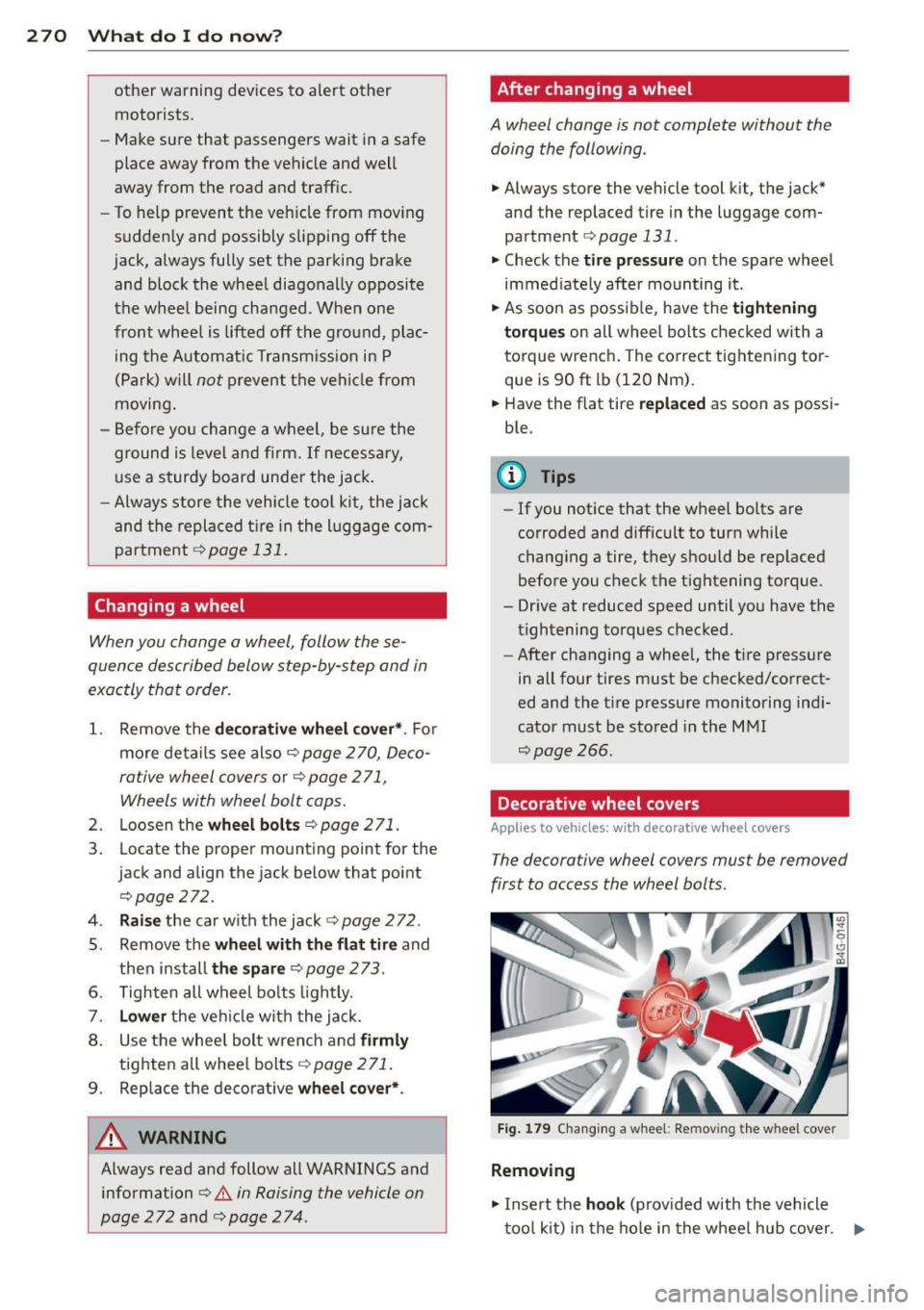
' Decorative wheel covers
Applies to vehicles: w ith decorative whee l covers
The decorative wheel covers mus t be removed
first to access the wheel bolts.
Fig. 1 79 Cha ngin g a w hee l: Re mov ing th e w heel cove r
Removing
"' Insert the hook (p rov ided with th e vehicle
t oo l ki t) in the ho le in the whee l hub cover . .,._
Page 274 of 310
272 What do I do now?
hold on to the car to keep your balance
and take care not to slip.
Raising the vehicle
Th e ve hicl e must b e lifted with the jack first
before the wheel can be removed.
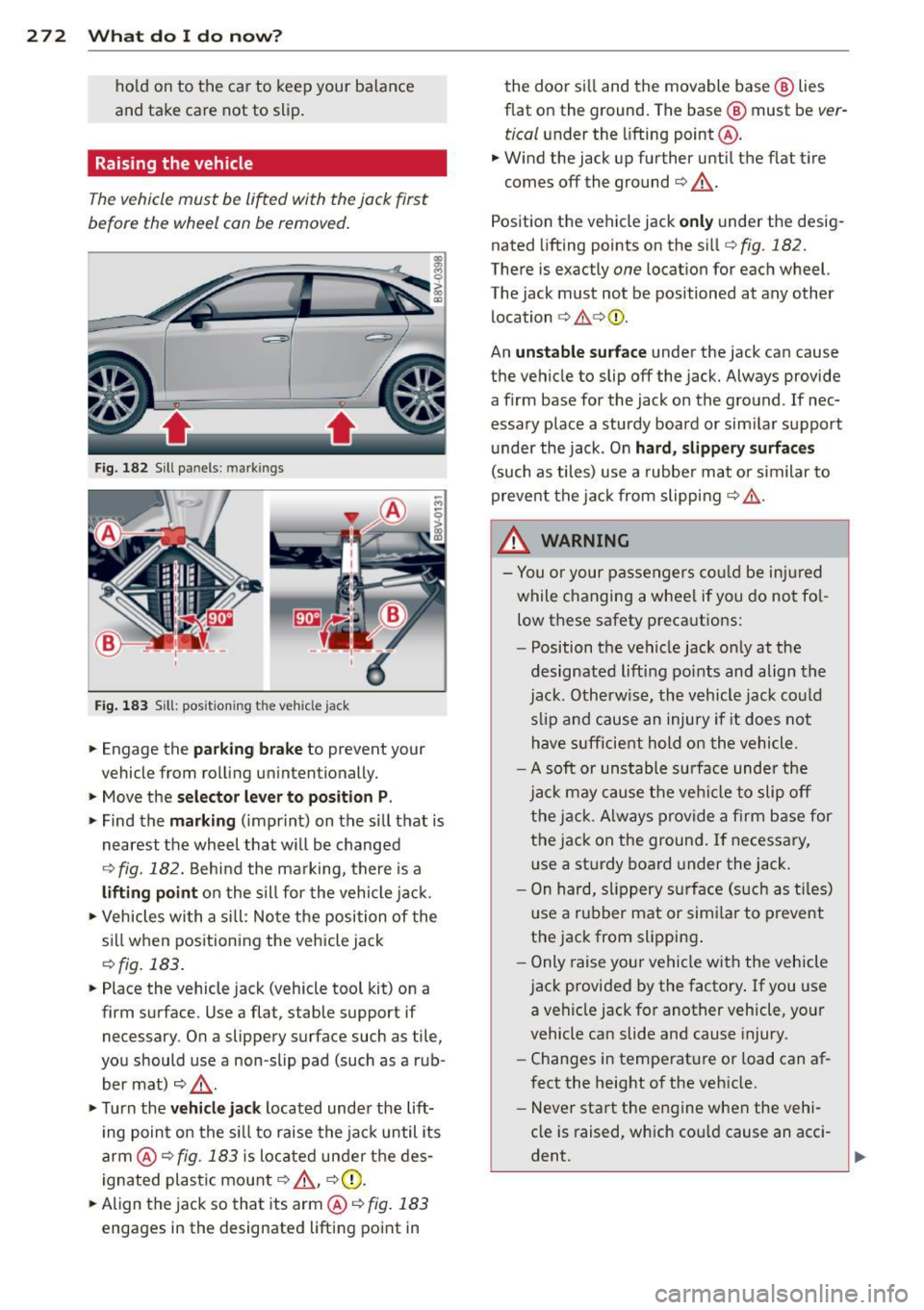
Fig. 182 Sill p anels : m arkin gs
Fig. 183 Sill: positio ning t he veh icle jack
.. Engage the parking brake to prevent your
vehicle from rolling unintentionally.
.. Move the
selector lever to position P .
.. Find the marking (imprint) on the sill that is
nearest the wheel that will be changed
~ fig . 182. Behind the marking, there is a
lifting point on the sill for the vehicle jack.
.. Vehicles with a sill : Note the position of the
sill when positioning the vehicle jack
r::!) fig. 183.
.. Place the vehicle jack (vehicle tool kit) on a
firm surface. Use a flat , stable support if
necessary . On a slippery surface such as tile,
you should use a non-slip pad (such as a rub
ber mat)
¢ _& .
.. Turn the vehicle jack located under the lift
ing point on the sill to raise the jack until its
arm @Q
fig. 183 is located under the des
ignated plastic mount Q
.&., Q (D .
.. Align the jack so that its arm @ Q
fig. 183
engages in the designated lifting point in the door sill and
the movable base @ lies
flat on the ground. The base @ must be
ver
tical
under the lifting point@ .
.. Wind the jack up further until the flat tire
comes off the ground Q
.&_.
Position the vehicle jack only under the desig
nated lifting points on the sill
Qfig . 182.
There is exactly one location for each wheel.
The jack must not be positioned at any other location Q
,&q(j) _
An unstable surface under the jack can cause
the vehicle to slip off the jack. Always provide a firm base for the jack on the ground . If nec
essary place a sturdy board or similar support
under the jack . On
hard, slippery surfaces
(such as tiles) use a rubber mat or similar to
prevent the jack from slipping Q
,&.
_& WARNING
- You or your passengers could be injured
while changing a wheel if you do not fol
low these safety precautions:
- Position the vehicle jack only at the
designated lifting points and align the
jack. Otherwise, the vehicle jack could
slip and cause an injury if it does not
have sufficient hold on the vehicle .
- A soft or unstable surface under the
jack may cause the vehicle to slip off
the jack . Always provide a firm base for
the jack on the ground. If necessary,
use a sturdy board under the jack.
- On hard, slippery surface (such as tiles)
use a rubber mat or similar to prevent
the jack from slipping.
- Only raise your vehicle with the vehicle
jack provided by the factory. If you use
a vehicle jack for another vehicle, your
vehicle can slide and cause injury.
- Changes in temperature or load can af
fect the height of the vehicle .
- Never start the engine when the vehi
cle is raised, which could cause an acci-
dent.
~