fuel AUDI S3 2015 User Guide
[x] Cancel search | Manufacturer: AUDI, Model Year: 2015, Model line: S3, Model: AUDI S3 2015Pages: 310, PDF Size: 76.15 MB
Page 43 of 310
....,
N
0 > co
rl I.O
"' ....,
"' rl
_& WARNING
Always take the key with you whenever you
leave your vehicle. The electronic immobil
izer can be deactivated w ith the key, so
this could make it possible for unauthor
ized persons to star t the engine and oper
ate vehicle systems such as the power win
dows or sunroo f. This can increase the risk
of serious injury.
(D Tips
-The vehicle cannot be started if an unau
thorized key is used .
It may not be poss i
ble to start the vehicle under certain cir
cumstances, for example if there is an
other radio module like the key from an
other vehicle or a transponder on the
same keychain.
- For an explanation on conformity with
the FCC regu lations in the United States
and the Industry Canada regulations, re
fer to
q page 292.
Safety central locking
App lies to vehicles: with safety central locking
Safety central locking provides the possibility,
to only unlock the driver's door and the fuel
filler door. The rest of the vehicle remains
l oc ked.
Unlocking the driver's door and the fuel
filler door
~ Press the remote control key or convenience
key~ button
once or turn the key onc e in
the opening direction.
Unlocking all doors , the luggage
compartment lid and the fuel filler door
~ Press the remote contro l key or convenience
key ~ button
twice within five seconds or
turn the key
twice within five seconds in the
opening direction.
When unlocking just the driver's door, the an
ti-theft alarm system* is also immediately de
activated.
Opening and closing 41
In vehicles with an MM I, you can directly ad
just the safety centra l locking
Q page 40.
Front passenger 's door and rear doors
emergency locking
All doors must be locked separately if the
power locking system fails.
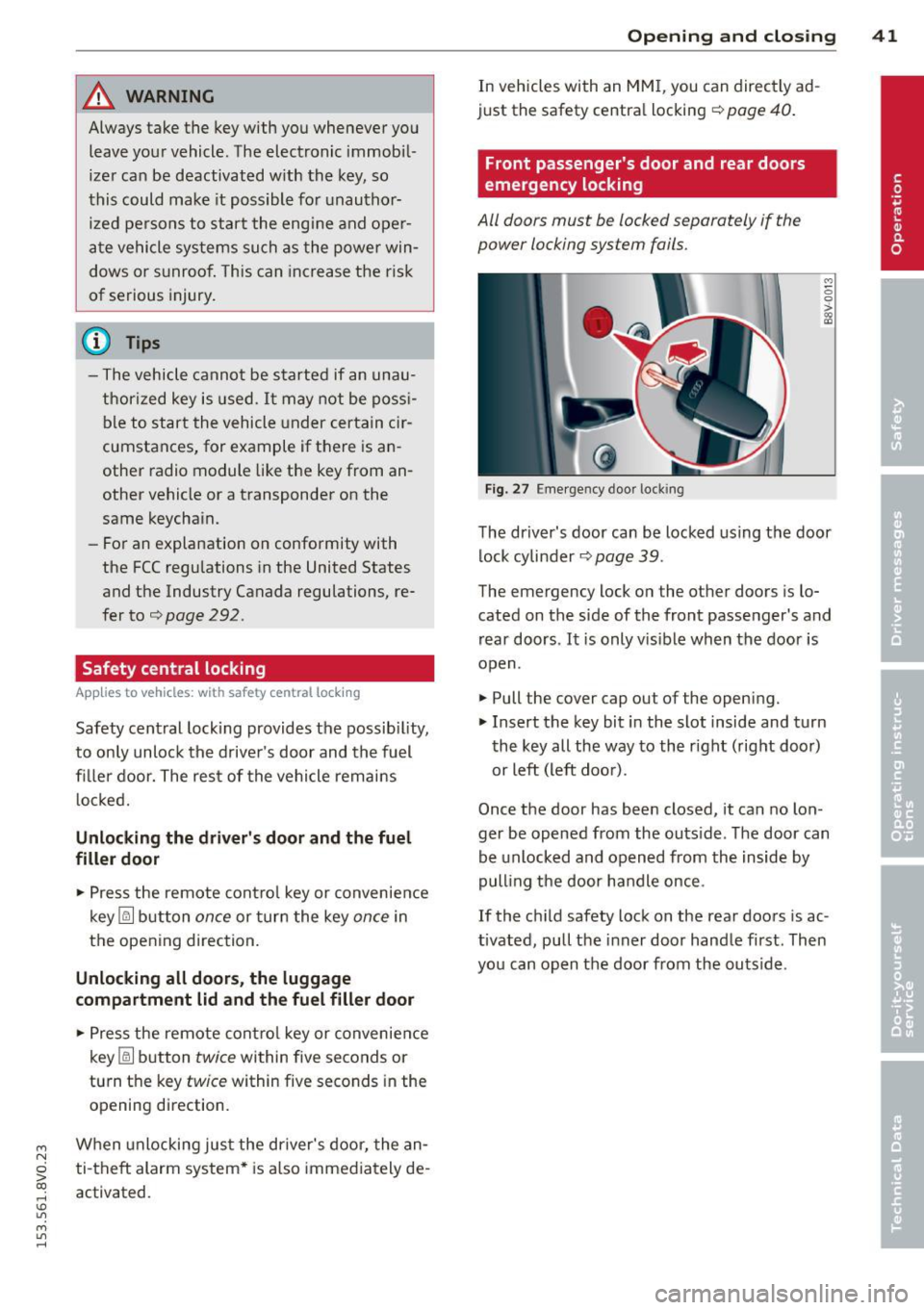
Fig. 2 7 Eme rgency door locking
M 0 0 > :ls
The driver's door can be locked using the door
lock cylinder
q page 39.
The emergency lock on the other doors is lo
cated on the side of the front passenger's and
rear doors.
It is only vis ible when the door is
open.
~ Pull the cover cap out of the opening.
~ Insert the key bit in the slot inside and turn
the key all the way to the right (right door)
or left (left doo r).
Once the door has been closed, it can no lon
ger be opened from the outs ide. The door can
be unlocked and opened from the inside by
pulling the door ha ndle once .
If the child safety lock on the rear doors is ac
tivated, pull the inner door handle first. Then
you can open the door from the outs ide .
Page 65 of 310
M N
0 > co ,...., \!) 1.1'1
M 1.1'1 ,....,
for a complete roof rack system. Additiona l
attachments or carrier systems are needed
to transport luggage and sports equipment.
We recommend using roof racks from the
Audi original accessories program.
- When installing the roof rack, make sure it
is only mounted on the designated locations
on the roof¢
fig. 57.
-We recommend that you keep the installa
tion instructions for your roof rack system
together with your Owner's literature in the
vehicle .
When should the roof rack be remo ved ?
-Before going through an automatic car wash
(it is best to ask the car wash operator for
advice).
- When not in use, to reduce fuel consump
t ion, w ind no ise and to guard against theft .
A WARNING
-Use of an unapproved roof rack or incor
rect mount ing of an approved roof rack
can cause the roof rack or the items at
tached to it to fa ll off the roof onto the
road.
- Objects fall ing from the roof of a veh icle
can cause a c rash and persona l injury.
- Only mount the roof rack on the desig
nated locations on the roof¢
fig. 57.
-The roof rack system must be installed
exactly according to the instructions pro
vided.
- When driving w ith a roof rack system,
changes to the center of g ravity and wind
resistance can change the veh icle han
dling and lead to a collision. A lways
adapt your driving and your speed to the
c u rrent conditions.
(D Note
- Your veh icle warranty does not cover any
damages to the veh icle caused by using
r oof racks or mo unting structures not
approved by Audi for your vehicle. The
same applies to damage resulting from i ncorrect roof rack installation.
S eat s an d sto rage 63
- Always check the roof rack mountings
and hardware before each trip and dur
ing a trip to make s ure everyth ing is se
curely tightened. If necessary, ret ighten
the mountings and check the entire sys
tem from time to time.
- After mount ing a roof rack system, or
when you transport objects on the roof
of your vehicle, the height of the veh icle
is naturally increased . Be careful when
dr iving unde r low bridges or in parki ng
garages for example. This cou ld cause
damage to the load and even the vehicle
itself .
- Make sure the open rear lid and the sun
roo f* do not come in to contact with the
roo f rac k.
Loading the roof rack
Always distribute loads evenly. Make sure
anything on the roof rack is securely tied
down .
.,. Always dis tribute the loads on the roof rack
even ly .
.,. Always attach items to the roof rack securely
before you drive off .
T he maxim um permissible roof we ight is
1 6 5 lb (75 kg ). The roof weight is the total of
the weight of the roof rack, the attachments
and the cargo you are carrying. You must a lso
not exceed the maximum load weight for the
roof rack you are using.
When using a roof rack system which has a
lower load carrying capacity, you must not use
up the tota l maximum permissible load carry
ing capacity specified above. Instead, you
should load the roof rack system only to the
max imum capacity specified by the manufac
ture r of the roof rack system .
A WARNING
Weak, damaged or imprope r straps used
to secure items to the roof rack can fail
during ha rd braking o r in a coll is ion and
cause ser ious persona l injury .
.
•
Page 66 of 310
64 Seats and storage
-Make sure the roof rack is installed exact
ly as specified above
r::;, page 62.
- Always use suitable mounting straps for
securing items to the roof rack to help
prevent items from shifting or flying for
ward.
- Items on the roof rack must always be
securely mounted.
- The use of a roof rack can negatively af
fect the way a vehicle handles. Cargo
that is large, heavy, bulky, long or flat
will have a greater negative influence on
the vehicle's aerodynamics, center of gravity and overall handling. Always
drive slowly, avoid sudden braking and
maneuvers when transporting cargo on
the roof of your vehicle.
- Never exceed the maximum permissible
load carrying capacity of the roof of your
vehicle, the permissible axle weights and
the permissible total weight of your veh i
cle
r::;, page 286, Weights.
@ For the sake of the environment
As a result of the increased wind resist
ance created by a roof rack, your vehicle is
using fuel unnecessarily. So remove the
roof rack after using it .
Luggage compartment
Loading luggage compartment
Luggage items must be stowed securely .
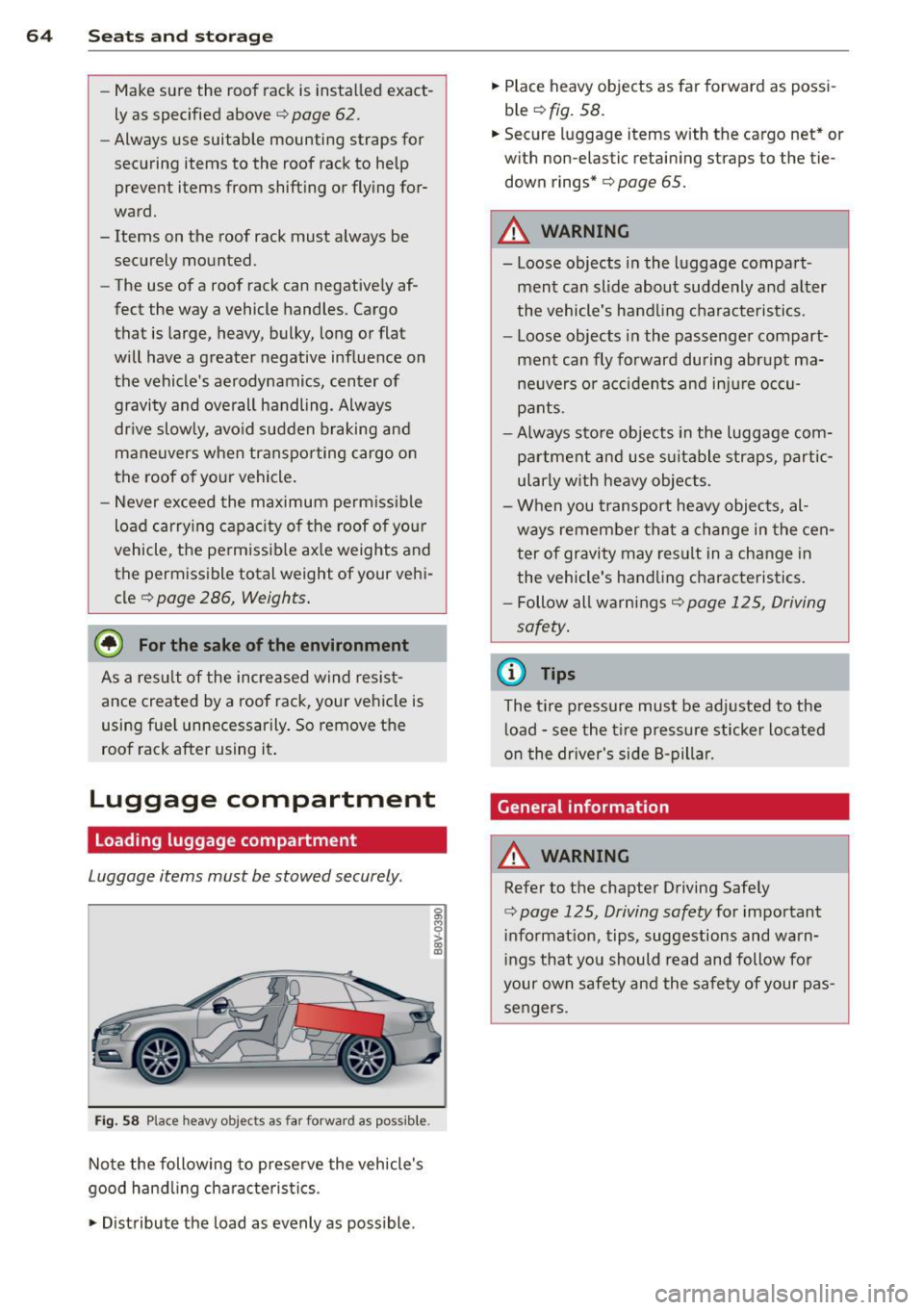
Fig. 58 Place heavy objects as far forward as possible.
Note the following to preserve the vehicle's
good handling characteristics .
.,. Distribute the load as evenly as possible .
0
s
> "' m
.,. Place heavy objects as far forward as possi
ble
r::;, fig. 58.
.,. Secure luggage items with the cargo net* or
with non-elastic retaining straps to the tie
down rings*
r::;, page 65.
A WARNING
- Loose objects in the luggage compart
ment can slide about suddenly and alter
the vehicle's handling characteristics.
- Loose objects in the passenger compart
ment can fly forward during abrupt ma
neuvers or accidents and injure occu
pants.
- Always store objects in the luggage com
partment and use suitable straps, partic
ularly w ith heavy objects.
- When you transport heavy objects, al
ways remember that a change in the cen
ter of gravity may result in a change in
the vehicle's handling characteristics.
- Follow all warnings
¢page 125, Driving
safety.
'
(D Tips
The tire pressure must be adjusted to the
load -see the tire pressure sticker located
on the driver's side B-pillar.
General information
A WARNING ,-
Refer to the chapter Driving Safely
r::;, page 125, Driving safety for important
information , tips, suggestions and warn
ings that you should read and follow for
your own safety and the safety of your pas
sengers .
Page 70 of 310
68 Warm and cold
Warm and cold Climate control system
Description
Different systems cou ld be installed.
- manual climate control system* or
- automatic climate control system*
The
climate control system* cools and re
moves humidity from the air in the vehicle in
terior. It is the most effective when the win
dows and panorama sunroof* are closed. If
there is a build-up of heat inside the vehicle,
ventilation can help to speed up the cooling
process . For this reason, the windows and
panorama sunroof can be opened from the
outside .
9 page 43, Convenience opening/
closing
Pollutant filter
T he pollutant filter removes pollutants such
as dust and pollen from the air .
Key recognition
You can store various settings for the manua l
and automatic
climate control system* and
assign them to the key being used .
A WARNING
Poor visibility can lead to accidents.
- For safer driving, keep all windows free
of ice, snow and fog .
- Become familiar as quickly as possible
with the correct use and function of the cl imate control system, especially with
the defrosting and defogg ing funct ion .
- When the temperature is below freezing,
only use the windsh ield washer system
after the w indshield has been warmed by the cl
imate control system . The washer
fluid could freeze on the windshield and
impair visibility.
(D Note
- If you suspect that the climate control
system is damaged, switch the system
off to prevent further damage and have
it checked by an authorized Audi dealer
or authorized Audi Service Facility.
- Repairs to the Audi climate control sys
tem require special technical knowledge
and special tools. See an authorized Audi
dealer or authorized Audi Serv ice Facility .
® For the sake of the environment
Reducing the amount of fuel used also re
duces the amount of pollutants that enter
the air.
(D Tips
- To prevent interference with the heating
and cooling output and to prevent the
w indows from fogging over, the air in
take in front of the windshield must be
free of ice, snow or leaves.
- Condensation from the cooling system*
can dr ip and form a puddle of water un
der the vehicle. This is normal and does
not mean there is a leak.
- T he energy management system may
switch the seat heating* or rear window
defroster off temporari Ly . These systems
are available again as soon as the energy
balance has been restored.
- The flows through the vents under the
rear window. Make sure the openings are
not covered when placing clothing on the
luggage compartment cover.
Page 73 of 310
M N
0 > co ,...., \!) ..,.,
activates the "eco" mode*1>. I n "eco" mode*,
a ll settings are lowered slightly to save fuel.
When in "eco" mode* ,
eco is shown in the dis
play. To ex it "eco" mode*, press the
!AU TO !
button again .
I• I • I Setting the temperature
The temperature can be adjusted individually
for the driver and front passenger using the
dials . Temperatu res between 60 °F (+16 °C)
and 84 °F (+28 °C) can be set . Outs ide of this
range,
Lo or Hi will appear in the climate con
trol system display. In both settings, the cli mate control runs with constantly at the max
i mum cooling or heating level. The tempera
ture is not regu lated.
Synchronization: By pressing the ! AU TO I but
ton for two seconds , the temperature setting
for the driver is transferred to the front pas
senger's side. This applies a temperature
change to the front passenger's side.
~ Adjusting the blower
To prevent the windows from fogging over,
the blower should always run at a low speed.
You can adj ust the volume of air generated by
the blower to you r preference. To have the
blower regulated automatically, press the
!AU TO! button.
Adjusting the air distribution
The air distribution is adjusted with the~, [Ml
and ~ buttons. To have the air distribution
r eg ulated automatically, press the
!AUTO ! but
ton .
The round air vents in the cockpit are adjusta
ble
~ page 72.
T o keep the w indows from fogging in damp
weather, we recommend opening the side air
vents and tilting them to the side
~ page 72, Adjusting the air vents.
Foot vents are located under the front seats
and adjustable vents on the end of the center
console to heat the rear of the vehicle.
M "' l) This func tio n is not available in all c oun tri es . ,....,
Warm and cold 71
~ Switching the defroster on and off
The w indshield and side windows are defrost
ed or cleared of condensation as quickly as
possible . The maximum amount of air flows
main ly from the vents below the windshield.
Recircu lation mode switches off. The tempera
ture is controlled automatically. In the
[i] set
ting, the
! AIC ! cooling mode sw itches on auto
matically, depending on the outside air tem
perature .
The
! AU TO ! button sw itches the defroster off.
l""'I Switching recirculation mode on and
off
The recircu lation mode can be turned on man
ually or automatically* .
- Switching manual recirculation mode on and
off: Press the~ button. The LED light up
when switched on.
- Automatic* recirculation mode: The recircu
lation mode must be activated in the MMI.
Select: the
I MENU I button >C ar> Systems*
con trol button> AC > Auto recirculation.
The a ir quality sensor that is des igned for
diesel and gasoline exhaust automatically
switches the recirculation mode on or off
depending on the leve l of pollutants in the
outside air .
In recirculation mode, the air inside the vehi
cle is circulated and filtered . This prevents the
unfiltered air outside the vehicle from enter
ing the vehicle interior. We recommend
switching recircu lation mode on when driving
th rough a tunne l or when sitting in traffic
~ .&. .
The 1- 1 button, IAU TO ! or the [i] button
switches rec irc ulation mode off.
The system switches to recirculation mode
whe n driving in reverse when the engine is
cold.
•
Page 111 of 310
M N
0 > co ,...., \!) 1.1"1
M 1.1"1 ,....,
Automatic
transmission S tronic-transmission
Introduction
Applies to vehicles: with S tronic transmiss ion
Your vehicle is equipped with an electronical
l y -controlled DSG transmission called S tronic.
T wo independent clutches transfer the power
between the engine and transmission. It al
lows the vehicle to accelerate without a no
ticeable interruption in traction .
T he transmission upshifts or downshifts auto
matically. The driving style continuously influ
ences the selection of the driving program .
When a
moderate driving style is used, the
transmission selects the most econom ica l
driving mode. The transmission upshifts at a
lower RPM and downshifts at a higher RPM to
improve fuel effic iency .
T he transmission switches to a sporty mode
after a kick-down or when the driver uses a
sporty driving style characterized by quick ac
celerator pedal movements, heavy accelera
tion, frequent changes in speed and traveling
at the maximum speed.
If desired, the driver can also select the gears
manually (tiptronic mode) r=> page 114,
Shifting manually (tiptronic mode) .
Selector lever positions
Applies to vehicles: with S tro nic transmission
Fig. 96 Instrument cluster: selector leve r positions
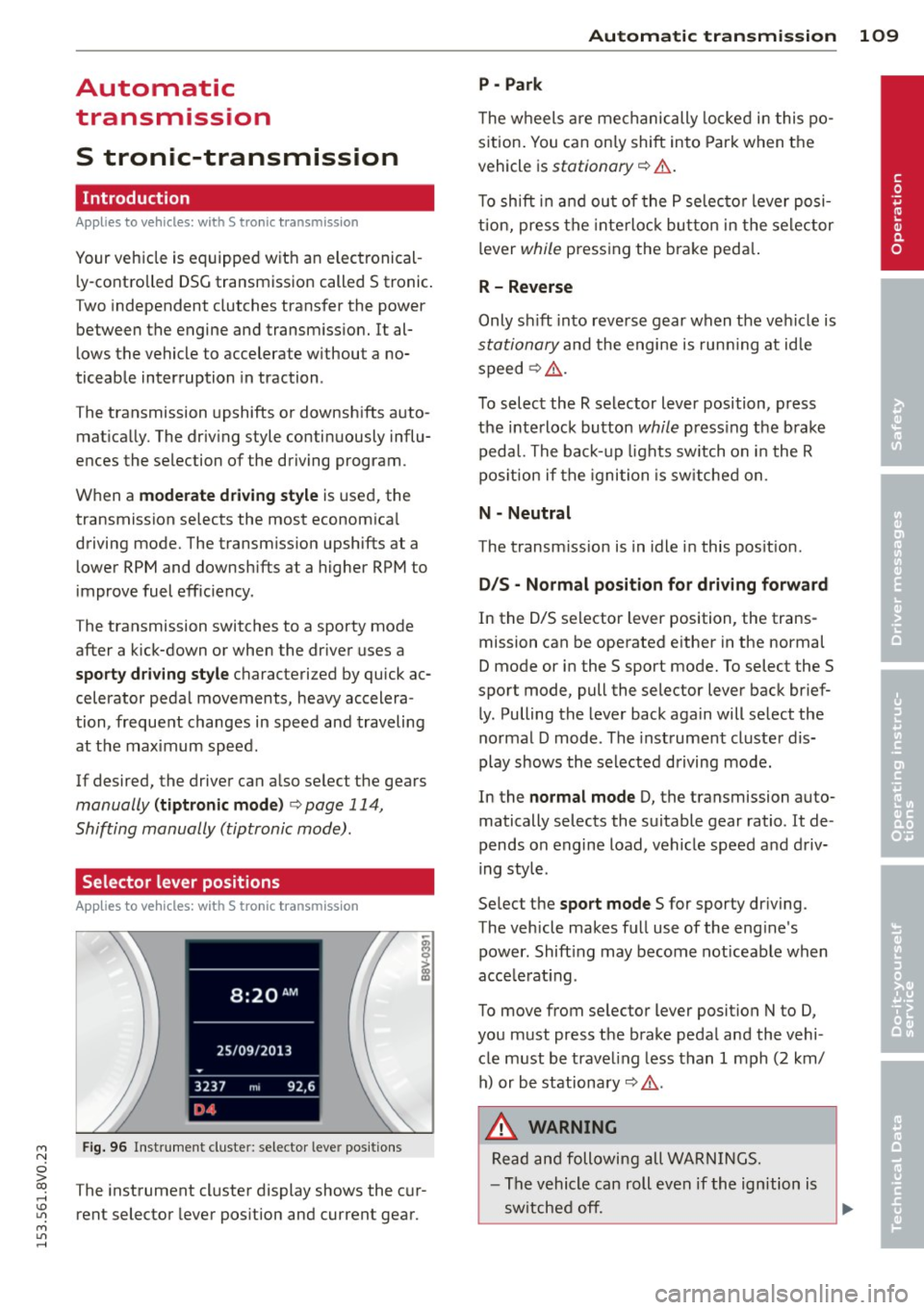
The instrument cluster display shows the cur
rent selector lever position and current gear.
Automatic transmission 109
P -Park
The wheels are mechanically locked in this po
sition. You can only shift into Park when the
vehicle is
stationary r=> &..
To shift in and out of the P selector lever posi
tion, press the interlock button in the selector
lever
while pressing the brake peda l.
R- Reverse
Only shift into reverse gear when the vehicle is
stationary and the engine is running at idle
speed
r=> &. .
To select the R selector lever position, press
the interlock button
while press ing the brake
pedal. The back-up lights sw itch on in the R
pos ition if the ignition is switched on .
N -Neutral
The transm iss ion is in idle in this position .
DIS -Normal position for driving forward
In the D/S selector lever position , the trans
mission can be operated either in the normal
D mode or in the S sport mode. To select the S
spor t mode, pull the selector lever back brief
ly. Pulling the lever back again will select the
normal D mode . The instrument cluster dis
play shows the selected driving mode.
In the
normal mode D, the transmission auto
matically selects the suitable gear ratio . It de
pends on engine load, vehicle speed and driv
ing style .
Select the
sport mode S for sporty driving .
The vehicle makes full use of the eng ine's
power. Shift ing may become noticeable when
acce lerat ing.
To move from selector lever position N to D,
you must press the brake pedal and the vehi cle must be traveling less than 1 mph (2 km/
h) or be stationary~ &.-
.&_ WARNING
Read and following all WARNINGS.
- The vehicle can roll even if the ignition is
switched off.
~
•
Page 200 of 310
198 Driving and the environment
Driving through water
on roads
Note the following to avoid vehicle damage
when driving through water, for example on
flooded roads:
- The water must not be any higher than the
bottom of the vehicle body.
- Do not drive faster than wa lking speed.
A WARNING
After driving through water or mud, the
braking effect can be reduced due to mois
ture on the brake discs and brake pads. A
few careful brake applications should dry off the brakes.
@) Note
Vehicle components such as the engine, transmiss ion, suspension or electrical sys
tem can be severely damaged by driving
through water.
- Determ ine the depth before driving
through water.
- Do not stop the vehicle, drive in reverse
or switch the engine off when driving
through water .
- Keep in mind that oncoming vehicles may create waves that raise the water
level and make it too deep for your vehi
cle to drive through safely.
- Avoid dr iving through salt water (corro
s ion).
Catalytic converter
App lies to vehicles: with gasoline engine
It is very important that your emission con
trol system (catalytic converter) is function
ing properly to ensure that your vehicle is run
ning in an environmentally sound manner.
> Always use lead-free gaso line r=;, page 210,
Fuel supply .
> Never run the tank down all the way to emp-
ty.
> Never put too much motor o il in your engine
r=;, page 223, Adding engine oil
The catalytic converter is an efficient "clean
up" device built into the exhaust system of
the vehicle . The cata lytic converter burns
many of the pollutants in the exhaust gas be
fore they are released into the atmosphere.
The exclusive use of unleaded fuel is critica lly
important for the life of the catalytic convert
er and proper functioning of the engine.
A WARNING
-
The temperature of the exhaust system is high, both when driv ing and after stopping
the eng ine .
- Never touch the exhaust tail pipes once
they have become hot . This could result
in burns.
- Do not park or operate the vehicle in
areas where the hot exhaust system may
come in contact with dry grass, brush,
fue l spill or other material wh ich can
cause a fire.
- Do not app ly additional undercoating or
rustproofing on or near the exhaust manifold, exhaust pipes, catalytic con
verter or heat shields . Dur ing driving, the
substance used for undercoating could
overheat and cause a fire.
(D Note
- Be aware that just one tank filling with
leaded fuel will already seriously de
grade the performance of the catalytic
converter.
- Do not exceed the correct engine oil level
r=;, page 223.
-Do not drive until the fuel tank becomes
completely empty. The engine could mis
fire . Unburned fuel could also get into
the exhaust system and this cou ld cause
the catalytic converter to overheat.
- Do not switch off the ignition while the
vehicle is moving.
- Do not continue to operate your vehicle
under these conditions, as otherwise fuel
IIJ,,
Page 201 of 310
M N
0 > co ,...., \!) 1.1"1
M 1.1"1 ,....,
can reach the catalytic converter . This
could result in overheating of the con
verter, requ iring its replacement.
- To assure efficient operation of the Emis
sion Control System :
- Have your veh icle ma inta ined properly
and in accordance with the service rec
ommendations in your Wa rranty
&
Ma intenance booklet.
- Lac k of proper maintenance as well as
improper use of the vehicle will impa ir
t he funct ion of the emission control
system and cou ld lead to damage.
@) For the sake of the environment
Even when the Emission Cont ro l System is
operating properly, t he exhaus t gas can
have a s ulfu r-like exhaust gas smell unde r
some operating states. This depends on
the s ulfur content of the fue l being used .
Using a different brand of fuel may help,
or filling the tank w ith lead-free super
grade gasoline.
Diesel particulate filter
Applies to vehicles: with d iesel eng ine
The diesel particulate filter fi lters nearly a ll of
the soot part icles out of the exhaust. The fil
ter cleans itse lf automatically under normal
driving conditions. If the filter cannot clea n it
self (for examp le, because you are only driving
short d istances) , the fil ter becomes clogged
with soot and the
II symbo l for the diesel
particulate f ilter illum inates ~ page 23.
A WARNING
- Do not park yo ur vehicle ove r flammable
materials such as g rass or leaves because
the high temperature of the diesel par
t icu late filter could start a fire .
- Do not apply an underbody protectant in
the exhaust system area or a fire could
start.
Dri ving and the en vironm ent 199
Placing your vehicle
out of service
If you would like to take your vehicle out of
se rv ice for a longer time, contact your author
ized Audi dealer or qualified repair fac ility .
They w ill advise yo u of impo rtant measures,
such as corrosion p rotection , maintenance
and storage p roced ures. Also follow the infor
ma tion about the battery ~ page 228 .
Operate your vehicle
economically and
minimize pollution
General
Your personal style of driving will determine
the economy of your vehicle, as well as ex
haust and noise levels .
Fuel economy, env ironme ntal impact, and
wea r on your eng ine, b rakes and tires la rgely
depend on three factors:
- your personal d riving s tyle
- operating conditions
- technical limitat ions
If you ant ic ipate what you need to do next and
drive economically, you can easily cut your
fuel consumpt ion by 10-15 percent. This sec
tion w ill give you some tips on how you can
help t he env ironment and your pocketbook.
@ Tips
The consumption estimates as published
by ENVIRONME NTAL PROTECTION AGENCY
(EPA) and Transpo rt Canada may not corre
spond to your actual consumption on the r oad, which will va ry depending upon vehi
cle load and speed, ro ad and weather con
ditions, trip leng th, etc.
Drive smoothly and keep a lookout
ahead
Vehicles use the most fuel when they are ac
celerating .
.,. Avo id unne cessary acceler ating and bra ki ng . .,..
•
•
•
Page 202 of 310
200 Driving and the environment
Vehicles use the most fuel when they are ac
celerati ng. If you anticipate what is going to
happen next, you will need to brake less and,
thus, accelerate less. let the vehicle coast
whenever poss ible -for example when you see
that the next traffic light is red.
Avoid full throttle
Driving at moderate speeds saves fuel and
improves your mileage.
.. Try and keep well be low your car's max imum
speed.
Accelerating gently reduces fuel consump
tion, engine wear, and does not disturb the
environment. F ue l consumption, exhaust emissions and en
gine noise increase disproportionately at hig h
speeds . If you drive at approximately three
quarters of top speed, fue l consumption will
be reduced by one half. Never dr ive faster
tha n the posted speed limit and weather con
d itions permit.
Reducing unnecessary idling
Even when your car is just idling it burns up
fuel.
.. Sh ut the engine off when you are not dr iving
the vehicle.
.. Do not warm up the vehicle by letting the
engine run at idle.
It is efficient to switc h off the engine when
stopped at railroad crossings and long red
lights. Turning the engine off for just 30-40
seconds saves mo re fuel than is burned by
start ing the eng in e again.
It takes a long time for the engine to warm up
fu lly when it is running at idle. However, wear
and nox ious em issions are especially high
when the engine is warming up. So you should
d rive away as soon as you sta rt the eng ine and
avoid ru nning a t high RPM wh ile the engine is
still warming up .
(D Note
Do not leave engine i dling unattended af
ter start ing. If wa rning lights sho uld come
on to indicate improper operation, they
would go unheeded. Extended idling also
produces heat , w hich could result in over
hea ting o r othe r damage to the veh icle or
othe r property.
Regular maintenance
A badly tuned engine unnecessarily wastes a
lot of fuel.
.. Have your ve hicle serviced at regu lar inter-
vals.
Having your veh icle regu larly serviced by an
authorized Aud i dealer helps to ensure that it
runs properly and econom ica lly. The cond it io n
of your veh icle not on ly affects its safety and
ability to ho ld its va lue, i t also affects
fuel
c onsumption .
Check your oil each t ime you fill your tank.
The amount of oi l used is re lated to engine
l oad and speed.
It is normal for the oil consump tion of a new
engine to reach its lowest value after a certain
mileage has been driven .
You m ust drive your ve hicle abou t 3,000 m iles
(5,000 kilometers) before you can properly
assess oil consumpt ion .
T his also ap plies to fue l consumption and en
gine o utp ut.
(D Note
- Have your veh icle ma inta in ed properly
and i n acco rdance with the service rec
ommendations in you r W arranty
& Main
t enance boo klet. l ack of proper ma inte
nance as well as im proper use of the ve
hicle will impair the function of the
em iss ion cont ro l system and cou ld lead
to damage.
Page 203 of 310
M N
0 > co ,...., \!) 1.1'1
M 1.1'1 ,....,
-Do not alter or remove any component of
the Emission Contro l System unless ap
proved by the manufacturer.
- Do not alter or remove any device, such
as heat shields, switches, ignition wires,
valves, wh ich are designed to protect
your vehicle's Emission Control System and other important veh icle compo
nents.
Fewer short trips
Fuel consumption will always be relatively
high on short trips .
~ Try to avoid driving short distances with a
cold eng ine.
The engine and catalytic converter have to
reach their optimal
operating temperature to
reduce fuel consumption and noxious emis
sions effectively.
Just after starting, a cold engine in a mid -size
car only achieves a fuel economy of 6-8 miles
per gallon (30-40 l/100 km). After about a
half a mile, fuel economy climbs to 12 mpg
(20 l/100 km). After about
2 .5 m iles (4 km),
the engine is at its proper operating tempera
ture and fue l economy has reached a normal
l eve l. So you can see that you should avoid
short trips wheneve r possible.
The
outside temperature is also critical in this
regard . Your car consumes more fuel in the
winter than in the summer.
Driving and the environment 201
•
•
•