flat tire AUDI S3 2015 Owner's Manual
[x] Cancel search | Manufacturer: AUDI, Model Year: 2015, Model line: S3, Model: AUDI S3 2015Pages: 310, PDF Size: 76.15 MB
Page 262 of 310
260 Tires and wheels
run flat tires. If run flat tires
are used, they must be in
stalled on all four wheels. Mixing tire types is not per
mitted.
@) Note
-For technical reasons, it is not generally possible to
use the wheel rims from
other vehicles. This can hold
true for wheels of the same
vehicle type.
- If the spare tire is different
from the tires that you have mounted on your vehicle
(for example winter tires or
wide prof ile tires), then use
the spare tire for a short pe
riod of time only and drive
with extra care. Replace the
flat tire with the tire match ing the others on your vehi
cle as soon as possible.
- Never drive without the
valve stem cap . The valves
could get damaged.
@) For the sake of the environment
Dispose of old tires in accord
ance w ith the local require
ments.
Uniform tire quality grading
- Tread wea r
- Traction AA A B C
- Temperature ABC
Quality g rades can be foun d where applicab le
on the t ire s ide wall between t read sho ulder
and maximum section width¢
page 254,
fig . 172 .
For example: Tread wear 200 , Traction AA,
Tempera ture A .
All passenge r ca r tir es must con fo rm to Feder
al Safety Req uirements in ad dition to these
grades.
Tread wear
T he tread we ar g rade is a c omparative r ati ng
b as ed on the wea r ra te of the tire when tes ted
u nder con tro lled cond itions o n a specifie d
government test course .
F o r ex am ple, a tire gr aded 1 S0 would wear
o n e and one h alf ( 11/ 2) times as well on the
government course as a ti re gr aded 10 0 .
T he re lative per forman ce of tires depen ds
up on the actu al cond itions of the ir use, h ow
ever, and m ay dep art s ignific antly from the
no rm due to va ria tions i n driving ha bits, se rv
ice p ractices and differe nces in road c haracter
ist ics and climate.
Traction
The tr actio n gr ad es, fro m hig hest to lowes t,
are AA, A, Ban d
C. Those grades represent t he
ti re 's ability to stop on wet pavement as
measured unde r cont rolled conditions on
specified g overnment test surfaces of aspha lt
and co ncrete. A t ire mar ked C may have poor
traction performance ¢
A.
Temperature
The temperature g rades are A (the highest),
B, an d C, represe nting the tire's resistance to
the generation of heat and its ab ility to dissi
pate heat when tested unde r controlled condi
t ions on a specif ied ind oor l abo rato ry test
whee l.
Page 263 of 310
M N
0 > co ,...., \!) 1.1"1
M 1.1"1 ,....,
Sustained high tem perature can cause the
materia l of the tire to degenerate and reduce
tire life, and excessive temperature can lead
to su dden ti re fa ilure <=>,& .
The grade C corresponds to a level of per form
a nce which a ll passenger car tires must meet
under the Federa l Motor Veh icle Safety Stand
ard No. 109. Grades Band A represent higher levels of performance on the laboratory test
wheel than the m inimum required by law.
_&. WARNING
The traction grade assigned to this t ire is
based on stra ight-ahead b raking t raction
tests, and does not include acceleration,
cornering, hydrop lan ing o r peak traction
character istics .
_&. WARNING
The temperature grade for this t ire is es
tablished for a ti re that is properly inflated
and not overloaded . Excessive speed, un
derinflation, or excessive loading, either
separately or in combination, can cause
heat buildup and possible tire fa ilure.
Winter tires
Winter tires can improve vehicle handling on
snow and ice. At temperatures below 45 °F
(7 °C) we recommend changing to winter
tires .
In some heavy snow areas, loca l governments
may require true winter or "snow" tires, those
with very deeply cut tread. These tires shou ld
only be used in pa irs and be installed on all
four wheels. Make sure you pu rchase snow
tires that are the same size and const ruct ion
type as t he other tires on your ve hicle.
If your vehicle is equipped with all-wheel
d rive*, this will improve tract ion during winte r
d riving, eve n w it h the standard t ires. Howev
e r, we strong ly recommend t hat you a lways
eq uip a ll four wheels on yo ur vehicle wi th cor
rectly fitted win ter t ires or a ll-season tires,
when winter road conditions are expected .
Tires an d wheel s 261
This also improves the veh icle's b rak ing per
formance and reduces stopping distances.
Summe r ti res prov ide les s gr ip on i ce and
snow.
Winter tires (snow tires) must always be fitted
o n all fo ur whee ls.
Ask your authorized Audi dealer or qualified
workshop for permitted winter tire sizes. Use
o nl y rad ial winter t ires.
Winter tires lose their effectiveness whe n the
tread is worn down to a depth of0 .157 inch
(4 mm) .
Only drive w ith w inter t ires under w inter con
dit ions. Summer t ires handle better when
there is no snow or ice on the roads and the
temperature is above 45 °F (7 °() .
If you have a flat tire, see notes on spare
whee l
r=;,page 254.
Please a lways remember that winter tires may
have a lower speed rating t han the tires o rigi
nally installed on your vehicle at the time it
was manufactured. P lease seer=;,
page 257,
Speed rating (letter code)
for a listing of the
speed rating le tter codes and the max imum
speed at which the tires can be d rive n.
The speed rating letter code(¢
page 238) is
o n the side wall of the t ire r=;,
page 254.
_&. WARNING
Winter t ires have maximum speed limits
that may b e lower than yo ur vehicle's max
imum speed. Always know the max imum
speed before dr iv ing off. Never dr ive faster
than the speed permitted for yo ur spe cific
win ter tires . This wi ll ca use damage to the
tires leading to an accident and ser ious
personal injury to you and your passen
gers.
_&. WARNING
Driving faster than the maximum speed
for which the winter tires on your ve hicle
were designed can cause t ire failure in
cluding a blowout and sudden d eflation,
-
•
•
•
Page 265 of 310
M N
0 > co ,...., \!) 1.1'1
M 1.1'1 ,....,
In certain circumstances, you may not use
wheel bo lts from a different vehicle -
even if it
i s the same mode l
Q page 291.
A WARNING
Improperly tightened or maintained wheel
bolts can become loose caus ing loss of
control, a collision and ser ious personal in
jury .
- Always keep the wheel bolts and the
threads in the wheel hubs clean so the
wheel bolts can turn easily and be prop
erly t ightened.
- Never grease or oil the wheel bolts and
the threads in the wheel hubs. They can
become loose w hile d riving if greased or
o iled,
even if tightened to the spec ified
torq ue.
- Only use wheel bo lts that belong to the
rim being ins talled.
- Never use different whee ls bolts on your
vehicle .
- Always maintain the correct tightening
torque fo r the wheel bolts to reduce the
risk of a wheel loss. If the tigh teni ng tor
que of the wheel bolts is too low, they
can loosen and come out when the vehi
cle is moving . If the tightening torque is
too high, the whee l bolts and threads
can be damaged and the wheel ca n be
come loose .
(D Note
The specified torque for the wheel bo lts is
90 ft lb (120 Nm) w ith a tolerance of
± 7,4 ft lb(± 10 Nm). Torque whee l bolts
diagonally. After changing a wheel, the
torque must be checked as soon as possi
b le with a torque wrench -prefe rably by an
author ized Audi dealer or qualified wo rk
shop.
Low aspect ratio tires
Your Audi is factory-equipped with low aspect
ratio tires . These tires have been thorough ly
tested and been selected spec ifically for your
model for the ir superb performance, road feel
Tire s an d wheel s 263
and handling under a variety o f driving condi
tions. Ask your authorized A udi dealer for
more details .
T he low aspec t ratio of these tires is ind icate d
by a numera l of
55 or le ss in the tire's size
designation. The numera l represents the ratio
of the t ire's sidewa ll height in relation to its
tread width expressed in percentage.
Conven
tiona l tires have a he ight/w idth rat io of 60 or
more .
The performance of low-a spect-ratio tire s is
particularl y sens it iv e to improper inflation
pressure. It is therefore important that low
a spect ratio tir es are inflated to the specified
pre ssure and that the inflation pr essure i s
regularly checked and ma intain ed . Tire pr es
s ure s should be checked at lea st on ce a
month and alway s bef ore a long trip
~ page 245 , Checking tire pressure .
A Word about Low Aspect Ratio and High
Performance Ti res
Hig h pe rformance tires are des igned for bet
ter performance and handling in warm cli
mates. When driving in cold, snowy or icy
weather, you sho uld equ ip your vehicle w it h
four all-season or winter tires, which
offer
better traction under those condit ions. We
suggest you use the Audi recommended win
te r or a ll-season tires specified for you r Audi.
High performance tires a lso have a lower as
pect ratio that aids performance and han
dling . Driving over rough or damaged road
surfaces, as well as debr is, cu rbs and other
obstacles can cause serious damage to
whee ls, tires, vehicle body, and suspens ion
parts . B e carefu l to avo id road hazards and re
du ce your speed , espec ia lly if your vehicle is
equipped wi th low prof ile tires .
Please a lso remember when making your se
lection that, wh ile these tires deliver respon
s ive handling, t hey m ay ride less comfo rtably
and make more noise than o thers . Finally,
these tires may wear more quickly than other
c h oices.
IJJ>
•
•
•
Page 266 of 310
264 Tire s and wheel s
It is important that the inflation pressu re is
regularly checked and maintained at recom
mended levels .
F or more informat ion p lease ask your A udi
deale r for more details .
What you can do to avoid tire and rim
damage
Low aspect ratio t ires can be damaged more
easi ly by impact with potho les, curbs, gu llies
or ridges on the road, part icularly if the t ire is
underinflated .
I n o rder to m inim ize the o ccu rrence of impact
damage to the tires of your vehicle, we recom
mend that you observe the following precau
tions:
- Always mainta in recommended inflat ion
pressures. Check your tire pressure every
2,000 miles (3,000 km) and add air if neces
sary .
- Drive carefu lly on roads with potholes, deep
gullies or ridges. The impact from driving
thro ugh or over such obstacles can damage
your t ires. Impact with a curb may also
cause damage to your tires.
- After any impact, immediately inspect your
t ires or have them inspected by the neares t
authorized Aud i dealer . Replace a damaged
t ire as soon as possible .
- Inspect your t ires every 2,000 miles (3,000
km) for damage and wear . Damage is not al
ways easy to see . Damage can lead to loss of
air and unde rinflat ion, wh ich could eventu
ally cause t ire fail ure.
If you be lieve that a
t ire may have been damaged, replace the
tire as soon as possible.
- T hese tires may wea r more quick ly than oth
ers.
- Please a lso remember that, whi le these t ires
deliver respons ive handling, they may ride
less comfortably and make mo re noise than
other c hoices.
Reduced performance in winter /cold
s eason condition s
All tires are designed for certain pu rposes .
The low aspect ratio, u ltra hig h performance t
ir es or iginally insta lled on yo ur vehicle a re in
tended for maximum dry and wet road per
formance and handling . They are not suitable
for cold, snowy or icy weather conditions. If
you drive under those c ircumstances, you
shou ld equ ip your vehicle w ith all -season or
winter tires, which offer bette r traction unde r
those conditions . We suggest you use the rec
ommended snow o r all-season t ires specified
for yo ur vehicle , or thei r equivalent .
Refer to~ page
261 for more detailed infor
mation regard ing winter tires .
Tire pressure
monitoring system
ill General notes
E ach tire, including the spare ( if provided),
shou ld be checked monthly wh en co ld and in
flated to t he inflat io n pressure recommended
by the veh icle man ufact urer on t he veh icle
placard or tire inf lation pressure labe l. (If your
vehicle has tires of a different size than the
size indicated on the vehicle placard or tire in
flat ion pressure labe l, you should determine
the proper t ire inflation press ure for those
t i res).
As an added safety feature, your ve hicle has
been equipped with a tire pressure monitoring
system (TPMS) that illum inates a low tire
pressure tell tale when one or more of your
t ires is s ignificantly under-inflated . According
ly, when the low tire pressure telltale illumi
nates, you shou ld stop and check you r tires as
soon as possib le, and inflate them to the
proper p ress ure. Driving on a sig nifican tly u n
der -inflated t ire causes the tire to overhea t
and can lead to tire fa ilure . Under-inflation al
so reduces fuel eff iciency and tire tread life,
and may affect the vehicle's hand ling and
stopp ing ability.
Please note that the TPMS is not a substit ute
for proper tire maintenance, and it is the driv
er 's respons ibility to maintain correct tire
pressure, even if under-inflation has not
Page 268 of 310
![AUDI S3 2015 Owners Manual 266 Tire s and wheels
& WARNING
-If the tire pressure warning light ti] in
the instrument cluster turns on, the
pressure in one or more tires is too low.
Reduce the vehicle speed](/img/6/57541/w960_57541-267.png "AUDI S3 2015 Owners Manual 266 Tire s and wheels
& WARNING
-If the tire pressure warning light ti] in
the instrument cluster turns on, the
pressure in one or more tires is too low.
Reduce the vehicle speed")
266 Tire s and wheels
& WARNING
-If the tire pressure warning light ti] in
the instrument cluster turns on, the
pressure in one or more tires is too low.
Reduce the vehicle speed immediately
and avoid any hard steering or braking
maneuvers . Stop as soon as possible,
check the t ire and inflate the tire to the
correct pressure, which is specified on
the tire pressu re label on the veh icle
¢ page 240. Driving with a t ire with low
pressure causes the tire to overheat and
can result in failure of the tire . Low pres
sure can a lso have a negative effect on
the driving and braking behavior of the
vehicle.
- The driver is responsible for maintaining
the correct tire pressures. You must
check the t ire pressures regularly.
- Under certain conditions (such as a spor
ty driving style, winter conditions or un
paved roads), the pressure monitor ind i
cator may be delayed .
- Ask your author ized dealer if run-flat
t ires may be used on your vehicle.
- The tire pressure monitoring system can
also stop work ing when there is an ESC
malfunction.
- Using snow chains may result in a system
malfunction.
- The tires with the identification "AO" or
"RO" ¢ page 254 have been matched
with your Audi tire pressure monitoring
system. We recommend that you use
these tires.
- The tire pressure monitoring system can
only mon itor the t ire pressure of the
driving tires . Check the tire pressure of
the spare wheel in the luggage compart ment so that if necessary it is ready for
us e.
-
Storing tire pressures
Applies to vehicles: wit h tire press ure mo nitor ing system
A change in tire pressure or a change in tires
must be stored in the system.
The tire pressure is stored in the MMI.
.. Make sure before storing that the tire pres
sures of a ll four tires meet the specified va l
ues and are adapted to the load. Otherwise
the system could malfunction
¢ page 240.
.. Switch on the ignition.
.. Select: the
I MENU I button >Car > Systems*
control button > Service & control > Tire
pressure monitor > Store tire pre ssure >
Yes, store now.
(D Tips
Do not store the tire pressures if snow
chains are installed. Otherwise the system
could malfunction.
Page 269 of 310
....,
N
0 > co
rl I.O
"' ....,
"' rl
What do I do now? Luggage compartment
lid emergency release
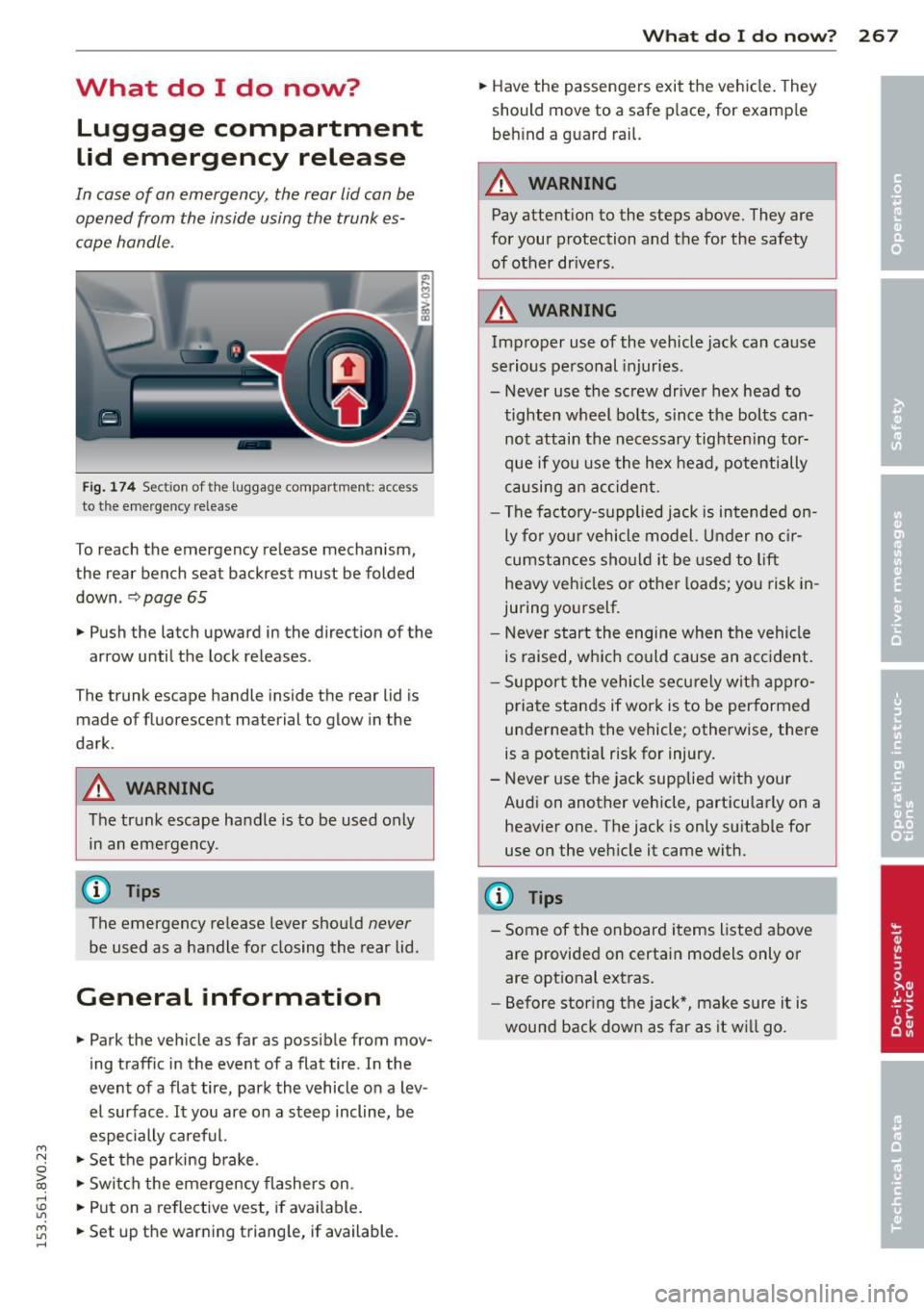
In case of an emergency, the rear lid can be
opened from the inside using the trunk es
cape handle .
Fig. 174 Section of the luggage compartm en t: access
to the emergency release
To reach the emergency release mechanism,
the rear bench seat backrest must be folded
down .
~ page 65
.,. Push the latch upward in the direction of the
arrow until the lock releases .
The trunk escape handle inside the rear lid is
made of fluorescent material to glow in the
dark.
A WARNING
The trunk escape handle is to be used only in an emergency .
@ Tips
The emergency release lever should never
be used as a handle for closing the rear lid .
General information
.,. Park the vehicle as far as possible from mov
ing traff ic in the event of a flat tire. In the
event of a flat tire, park the vehicle on a lev
el surface .
It you are on a steep incline, be
especially careful.
.,. Set the parking b rake.
.,. Swi tch the emergency flashers on .
.,. Put on a reflective vest, if avai lable .
.,. Set up the warning triangle, if available .
What do I d o now ? 267
.,. Have the passengers exit the vehicle . They
should move to a safe place, for examp le
beh ind a guard rail.
A WARNING
Pay attention to the steps above. They are
for your p rotection and t he for the safety
of other dr ivers.
A WARNING ...
Imp roper use of the vehicle jack can cause
se rious pe rsonal injuries .
- Never use the screw driver hex head to
tighten w heel bolts, s ince the bolts can
not attain the necessary tighten ing tor
que if you use the hex head, potentially
causing an ac cident .
- The fac tory-supplied jack is intended on
ly fo r yo ur vehicle model. U nder no c ir
cumstances sho uld it be used to
li ft
heavy vehicles o r other loads; you risk in
juring yo urself .
- Never s tart the engine when the vehicle
is raised, w hich co uld cause an acc ident.
- Support the vehicle secu rely wit h appro
priate stands if wor k is to be performed
underneath the vehicle ; otherwise, there
is a pote ntia l risk for injury.
- Never use the jac k supplied wit h your
Aud i on another vehicle, particularly on a
heav ier one. The jack is only su itable for
use on the vehicle it came with.
@ Tips
- Some of the on board items listed above
are provided on certain mo dels only or
are opt ional extras.
- Before stor ing the jack*, make sure it is
wound back down as far as it w ill go .
Page 271 of 310
....,
N
0 > co
rl I.O
"' ....,
"' rl
-Do not drive faster than 50 mph (80 km/
h). You r isk having an accident.
- Avoid full-throttle acceleratio n, heavy
braking, and fast cornering . You risk hav
ing an acc ident.
- Never drive us ing more than one spare
wheel and tire. You risk having an acci
dent.
- Normal summer or winter tires must not
be mounted on the compact spare whee l
rim.
- For technical reasons, the use of tire
chains on the spare tire is not permitted.
If it is necessary to dr ive with tire chains,
the spare wheel must be mounted on the
front axle in the event of a flat in a rear
t ir e. The newly ava ilable front wheel
must then be i nstalled in pla ce of the
re ar wheel with the f lat tir e. Ins tall ing
the tire chai n befo re mo unting the wheel
and tire is recommended .
- Loose items in the passenger compart
ment can cause serio us personal inj ury
dur ing hard braking or in an accident.
Never store the inf latable spare tire or
jack and tools in the passenger compart ment.
- Norma l summer or winter tires m ust not
be mounted on the compact spare wheel
rim .
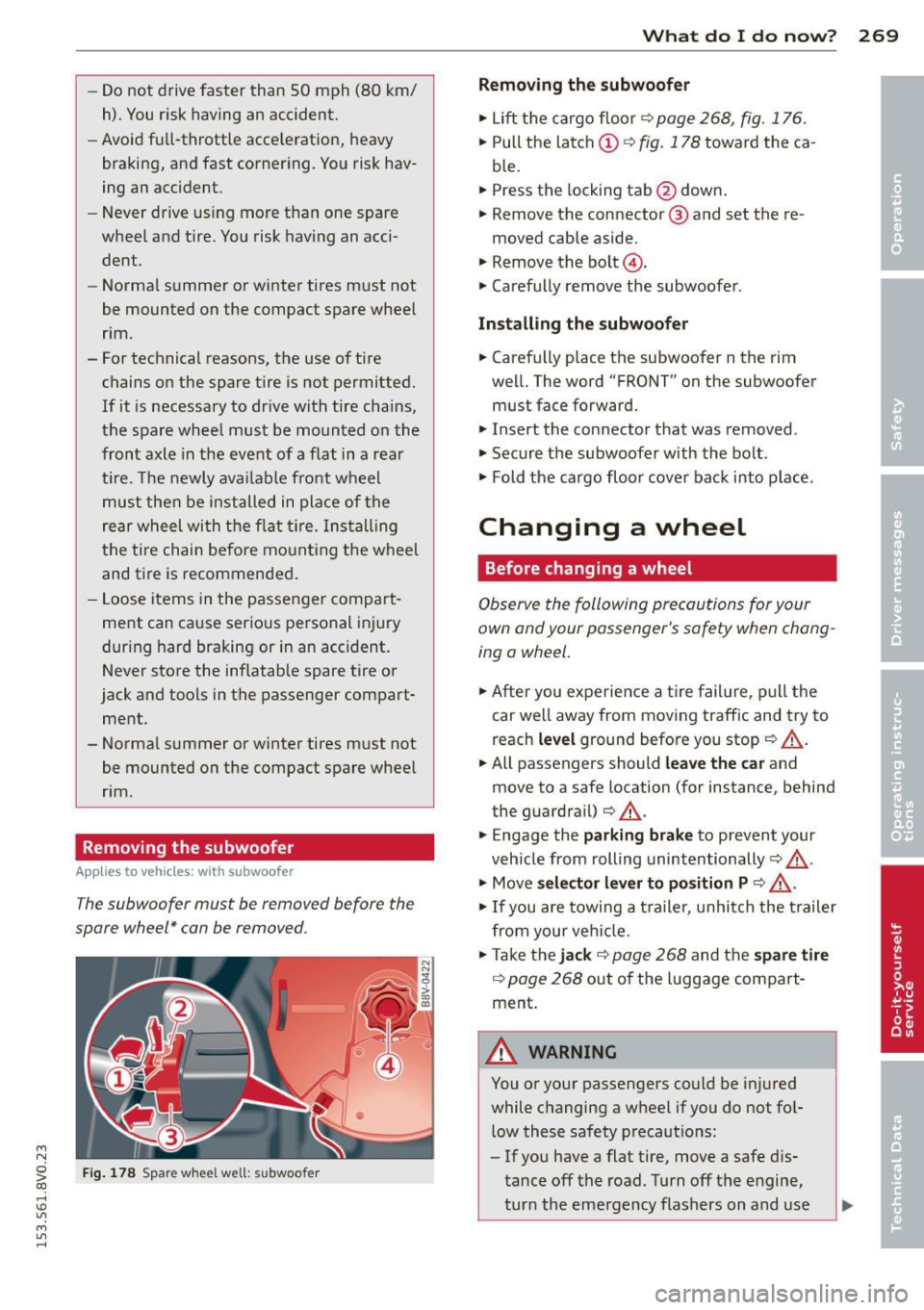
Removing the subwoofer
App lies to vehicles : with subwoofer
The subwoofer must be removed before the
spare wheel* can be removed .
Fig. 178 Spa re whee l w ell : subwoo fer
What do I do now ? 269
Removing the subwoofer
.,. Lift the cargo floor¢ page 268, fig . 176.
.,. Pull the latch (D ¢ fig. 178 toward the ca -
ble.
.,. Press the locking tab @down .
.,. Remove the connector ® and set the re-
moved cable as ide .
.,. Remove the bolt @ .
.,. Carefully remove the subwoofer .
Installing the subwoofer
.,. Carefully place the subwoof er n the rim
wel l. The word "FRONT" on the subwoofer
must face forward.
.,. Insert the connector that was removed.
.,. Secure the subwoofer with the bolt .
.,. Fold the cargo floo r cover back into place.
Changing a wheel
Before changing a wheel
Observe the following precautions for your
own and your passenger 's safety when chang
ing a wheel .
.,. Aft er you experience a tire failure, pull the
car we ll away from mov ing traffic and try to
reac h
level ground before you stop ¢ &_ .
.,. All passenge rs should
leave the car and
move to a safe location (for instance, behind
the guardrail)¢ &_ .
.,. Engage the
parking brake to prevent your
veh icle from rolling unintentionally¢&_ .
.,. Move
sel ector lever to po sition P ¢ ,&. .
.,. If you are towing a t ra iler, unhi tch the trailer
from your ve hicle .
.,. Take t he
jack ¢ page 268 and the sp a re tire
¢ page 268 out of the luggage com part
ment .
A WARNING
You or your passengers could be inj ured
while changing a w heel if you do not fo l
l ow these safety p recaut io ns:
- If you have a flat tire, move a safe d is
tance off the road. Turn off the engine,
turn the emergency flashers on and use
Page 272 of 310
2 70 What do I do now ?
other warning devices to alert other
motorists.
- Make sure that passengers wait in a safe
place away from the vehicle and well
away from the road and traff ic.
- To help prevent the ve hicle from mov ing
sudden ly and possibly slipping off the
jack, always fully set the parking brake and block the whee l diago na lly opposite
the whee l being changed . When one
front whee l is lifted off the gro und, plac
ing the A utomat ic Transm iss ion in P
( P ark) will
no t prevent t he ve hicl e from
movin g.
- B efore yo u change a w heel, be su re the
gr ound is leve l and fir m.
If necess ary,
use a s turdy board under the j ack.
- Alw ay s store the vehicle tool ki t, the j ack
and the repl aced t ire i n the l ugg age com
partment
¢ page 131.
Changing a wheel
When you change a wheel, follow these
quence described below step-by -step and in
exactly that order.
1. Remove the decorative wheel cover* . Fo r
mo re details see also¢
page 2 70, Deco
rative wheel covers
or ¢ page 2 71 ,
Wheels with wheel bolt caps .
2. Loosen the wheel bolts r::!> page 271.
3 . Locate the proper mo unting point for the
jack and align the jack below that point
¢ page 272.
4 .
Raise the car w ith the jack ¢ page 2 72.
5. Remove the wheel with the flat tire and
then install
the spare ¢ page 2 73.
6. Tighten all wheel bo lt s li ghtly.
7 .
Lower the ve hicle w ith the jack.
8. Use the wheel bolt wrench and
firmly
t ig hten all whee l bolts <:!> page 271.
9. Replace the decorative wheel cove r* .
A WARNING
A lways read and follow all WARNINGS and
informati on
r::!> &. in Raising the vehicle on
page
2 72 a nd r:!> page 274 .
After changing a wheel
A wheel change is not complete without the
doing the following .
"'Always store the vehicle toot kit, the jack*
and the replaced tire in the luggage com
pa rtment
¢ page 131.
"' Check the tire pr essure on the spare whee l
immed iate ly afte r mounting i t.
"' As soon as poss ib le, have the
tight ening
torques
on all whee l bolts chec ked with a
torque wre nch . The correc t tig hten ing tor
que is 90 ft l b (120 Nm).
"' Have the flat tire
replaced as soon as possi
ble.
@ Tips
- If you not ice that the wheel bo lts are
corroded and difficult to turn while
chang ing a tire, t hey should be rep laced
before you check the tig htening to rque.
- Dr ive at reduced speed until you have the
t ightening torques checked.
- After changing a whee l, the t ire p ress ure
in all four tires must be chec ked/co rrect
ed and the tire p ress ure monito ring ind i
cator must be s to red in the MMI
r::!> page 266.
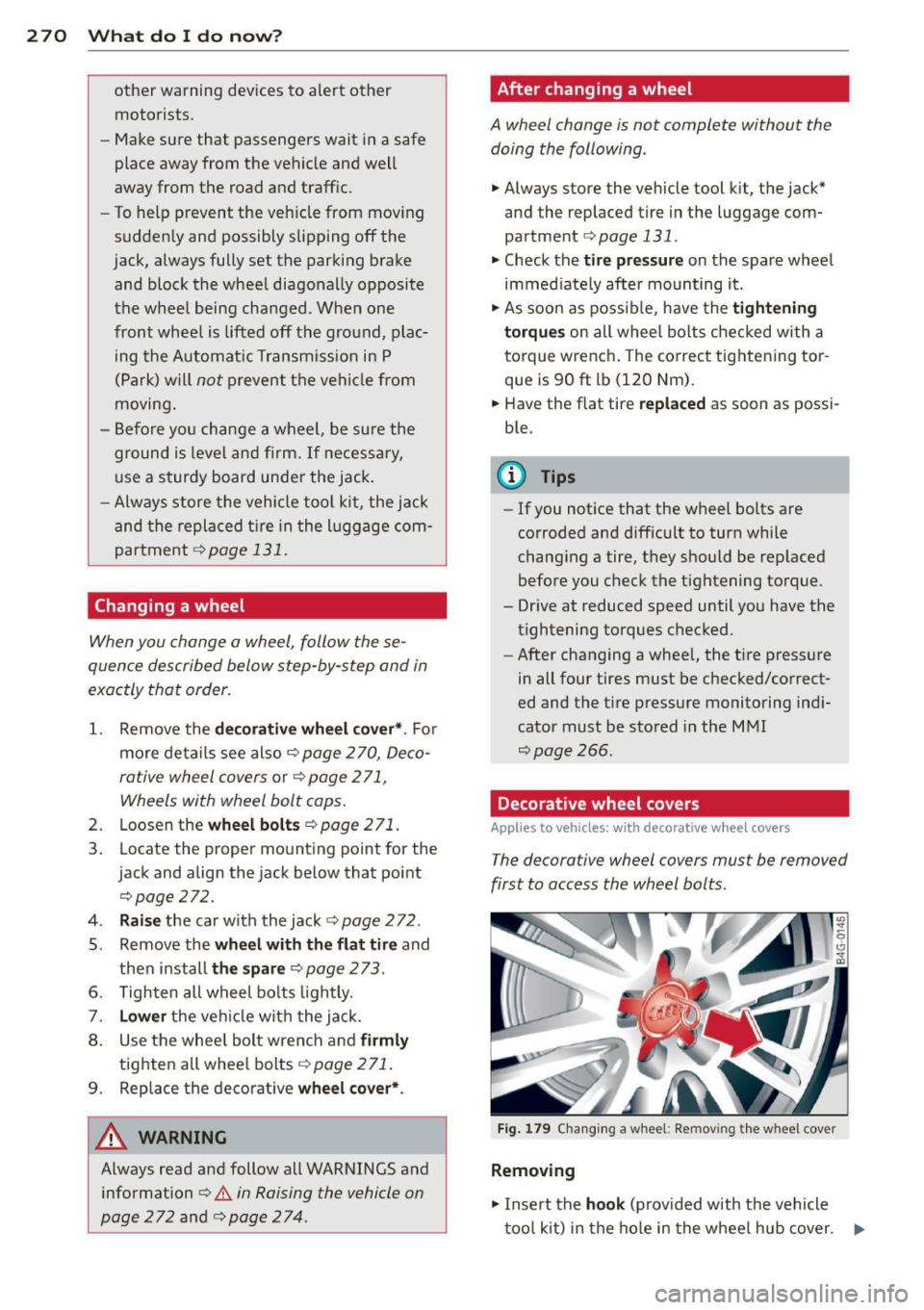
' Decorative wheel covers
Applies to vehicles: w ith decorative whee l covers
The decorative wheel covers mus t be removed
first to access the wheel bolts.
Fig. 1 79 Cha ngin g a w hee l: Re mov ing th e w heel cove r
Removing
"' Insert the hook (p rov ided with th e vehicle
t oo l ki t) in the ho le in the whee l hub cover . .,._
Page 274 of 310
272 What do I do now?
hold on to the car to keep your balance
and take care not to slip.
Raising the vehicle
Th e ve hicl e must b e lifted with the jack first
before the wheel can be removed.
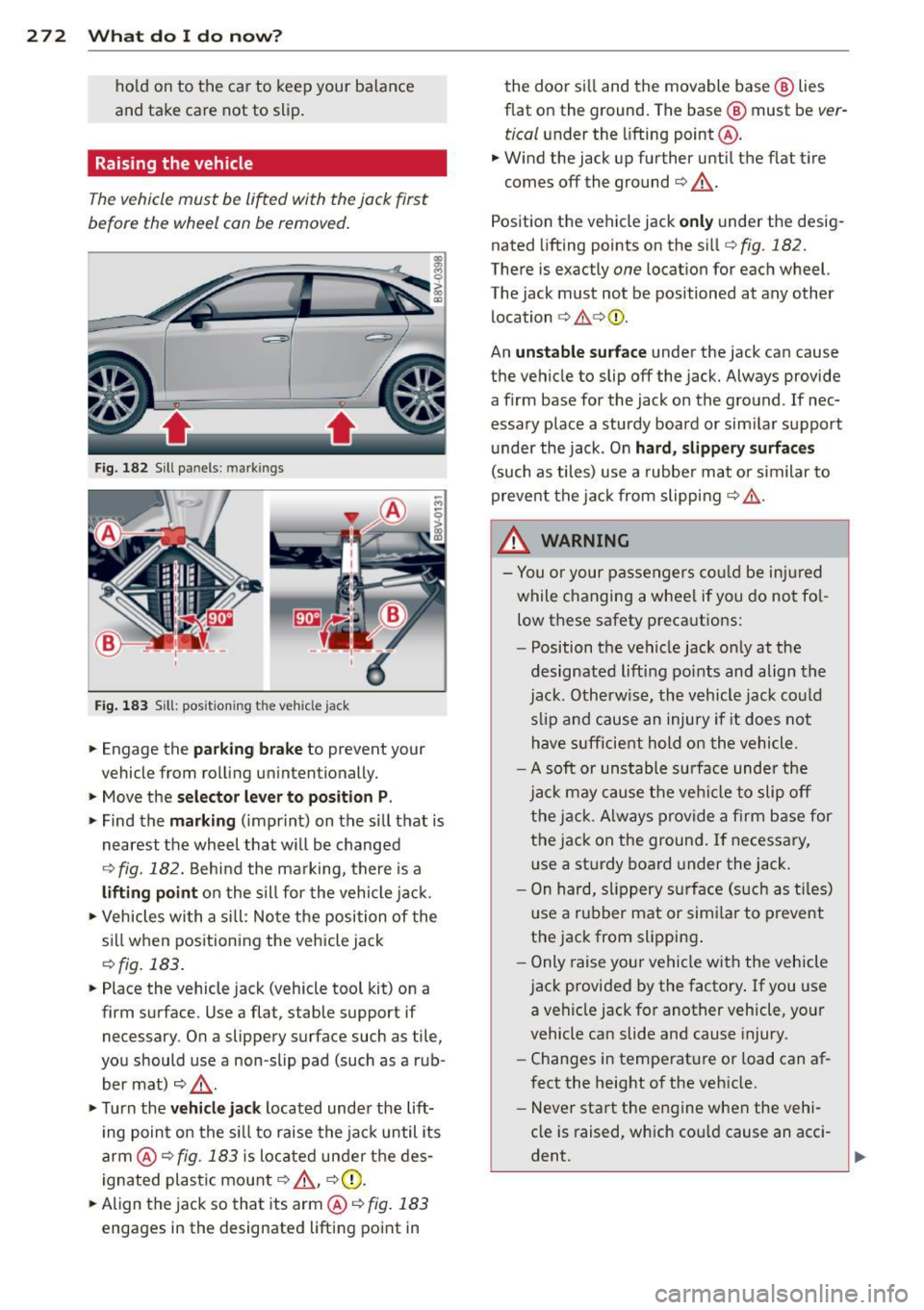
Fig. 182 Sill p anels : m arkin gs
Fig. 183 Sill: positio ning t he veh icle jack
.. Engage the parking brake to prevent your
vehicle from rolling unintentionally.
.. Move the
selector lever to position P .
.. Find the marking (imprint) on the sill that is
nearest the wheel that will be changed
~ fig . 182. Behind the marking, there is a
lifting point on the sill for the vehicle jack.
.. Vehicles with a sill : Note the position of the
sill when positioning the vehicle jack
r::!) fig. 183.
.. Place the vehicle jack (vehicle tool kit) on a
firm surface. Use a flat , stable support if
necessary . On a slippery surface such as tile,
you should use a non-slip pad (such as a rub
ber mat)
¢ _& .
.. Turn the vehicle jack located under the lift
ing point on the sill to raise the jack until its
arm @Q
fig. 183 is located under the des
ignated plastic mount Q
.&., Q (D .
.. Align the jack so that its arm @ Q
fig. 183
engages in the designated lifting point in the door sill and
the movable base @ lies
flat on the ground. The base @ must be
ver
tical
under the lifting point@ .
.. Wind the jack up further until the flat tire
comes off the ground Q
.&_.
Position the vehicle jack only under the desig
nated lifting points on the sill
Qfig . 182.
There is exactly one location for each wheel.
The jack must not be positioned at any other location Q
,&q(j) _
An unstable surface under the jack can cause
the vehicle to slip off the jack. Always provide a firm base for the jack on the ground . If nec
essary place a sturdy board or similar support
under the jack . On
hard, slippery surfaces
(such as tiles) use a rubber mat or similar to
prevent the jack from slipping Q
,&.
_& WARNING
- You or your passengers could be injured
while changing a wheel if you do not fol
low these safety precautions:
- Position the vehicle jack only at the
designated lifting points and align the
jack. Otherwise, the vehicle jack could
slip and cause an injury if it does not
have sufficient hold on the vehicle .
- A soft or unstable surface under the
jack may cause the vehicle to slip off
the jack . Always provide a firm base for
the jack on the ground. If necessary,
use a sturdy board under the jack.
- On hard, slippery surface (such as tiles)
use a rubber mat or similar to prevent
the jack from slipping.
- Only raise your vehicle with the vehicle
jack provided by the factory. If you use
a vehicle jack for another vehicle, your
vehicle can slide and cause injury.
- Changes in temperature or load can af
fect the height of the vehicle .
- Never start the engine when the vehi
cle is raised, which could cause an acci-
dent.
~
Page 276 of 310
274 What do I do no w?
When removing or installing the wheel,
the rim could hit the brake rotor and dam
age the rotor. Work carefully and have a
second person help you.
Never use the hexagonal socket in the han
dle of the screwdriver to loosen or t ighten
the wheel bolts.
- Pull the reversible b lade from the screw
driver before yo u use the hexagonal
socket in the handle to turn the whee l
bo lts.
- When mounting tires with
unid irectional
tread design
make sure the tread pat
tern is pointed the r ight way
¢page 274.
- The wheel bolts should be clea n and easy
to tu rn . Check for d irt and corrosion on
the mat ing su rfaces of both the whee l
and the h ub. Remove a ll dirt from these
su rfaces before remo unti ng the wheel.
Tires with unidirectional tread design
Tires with unidirectional tread design must be
mounted with their tread pattern p ointed in
the right direction.
Using a spare tire with a tread pattern
intended for use in a specific direction
When using a sp are tire w ith a tread pa tte rn
i nten ded for use in a specific direc tion, p lease
note t he following:
- T he direction of rotation is marked by an a r
row on the side of the tire.
- If the spare t ire has to be installed in the in
c orrec t direction, use the spa re tire only
tempor arily si nce the t ire will no t be able to
achieve its op timum performance character
istics with regard to aquaplaning, noise and
wear .
- We recommend tha t you pay particular a t
tention to this fact during wet weather and
that you adjust your speed to matc h road
condit ions. -
Replace the flat ti re with a new one and
have it insta lled on your vehicle as soo n as
possible to resto re the hand ling advantages
of a unidirectional tire.
Notes on wheel changing
Please read t he information ¢ page 254, New
tires and replacing tires and wheels
if you a re
going to use a spa re tire which is different
from the t ires on you r vehicle.
After you change a tire:
- Check the tire pre ssure on the spare imme
diately after installation .
- Have the wheel bolt tightening torque
c hecked with a torque wrench as soon as
possible by your author ized Audi dealer or
a qualified service stat ion.
- With steel and alloy wheel r ims, the wheel
bolts a re co rrectly tightened at a torque of
90 ft lb (120 Nm ).
- If you notice that the wheel bolts are cor
roded and difficult to turn while changing
a tire , they should be replaced before you
check the t ightening torque .
- Replace the flat tire w ith a new one and
have it installed on your vehicle as soon as
po ssible . Remount the wh eel cover.
Until then , dr ive with e xtra care and at re
duced speeds.
A WARNING
= -
- If you are going to equ ip your vehicle
with tires o r rims which differ from those
which were facto ry installed, then be
s ure to read the information¢
page 25 4,
New tires and repla cing tires and
wheels.
- Always m ake s ure the dam age d wheel o r
even a flat tire a nd the jack and tool ki t
are properly secu red in the luggage com
pa rtment and are not loose in the pas
senger compartment.
- In an accident or sudden maneuver they
could fly forwa rd, injuring anyone in the
veh icle.