steering wheel AUDI S3 2015 Owner's Guide
[x] Cancel search | Manufacturer: AUDI, Model Year: 2015, Model line: S3, Model: AUDI S3 2015Pages: 310, PDF Size: 76.15 MB
Page 163 of 310
....,
N
0 > co
rl I.O
"' ....,
"' rl
www.dtsc.ca.gov/hazardouswaste/perchlorate. When the vehicle or parts of the
restraint system includ ing airbag modules
and safety belts with pretensioners are
scrapped, all applicable laws and regula
tions must be observed. Your authorized
Audi dealer is familiar with these require
ments and we recommend that you have
your dealer perform this serv ice for you.
Other things that can affect Advanced
Airbag performance
Changing the vehicle's suspension system can
change the way that the Advanced Airbag Sys
tem performs in a crash. For example, using
tire-r im combinations not approved by Audi,
lowering the vehicle, changing the stiffness of
the suspension, including the springs, suspen
sion struts, shock absorbers etc. can change
the forces that are measured by the airbag sensors and sent to the electron ic control
unit. Some suspension changes can, for exam
ple, increase the force levels measured by the
sensors and make the airbag system deploy in
crashes in which it would not deploy if the
changes had not been made. Other kinds of
changes may reduce the force levels meas
ured by the sensors and prevent the airbag
from deploying when it should .
A WARNING
Changing the vehicle's suspension includ
ing use of unapproved tire-rim combina
tions can change Advanced Airbag per
formance and increase the risk of serious
personal injury in a crash.
- Never install suspension components
that do not have the same performance characteristics as the components origi
nally insta lled on your vehicle.
- Never use tire-rim combinations that
have not been approved by Audi.
Airbag system 161
Knee airbags
Description of knee airbags
Applies to vehicles: wi th knee airbags
The knee airbag system can provide supple
mental protection to properly restrained
front seat occupants.
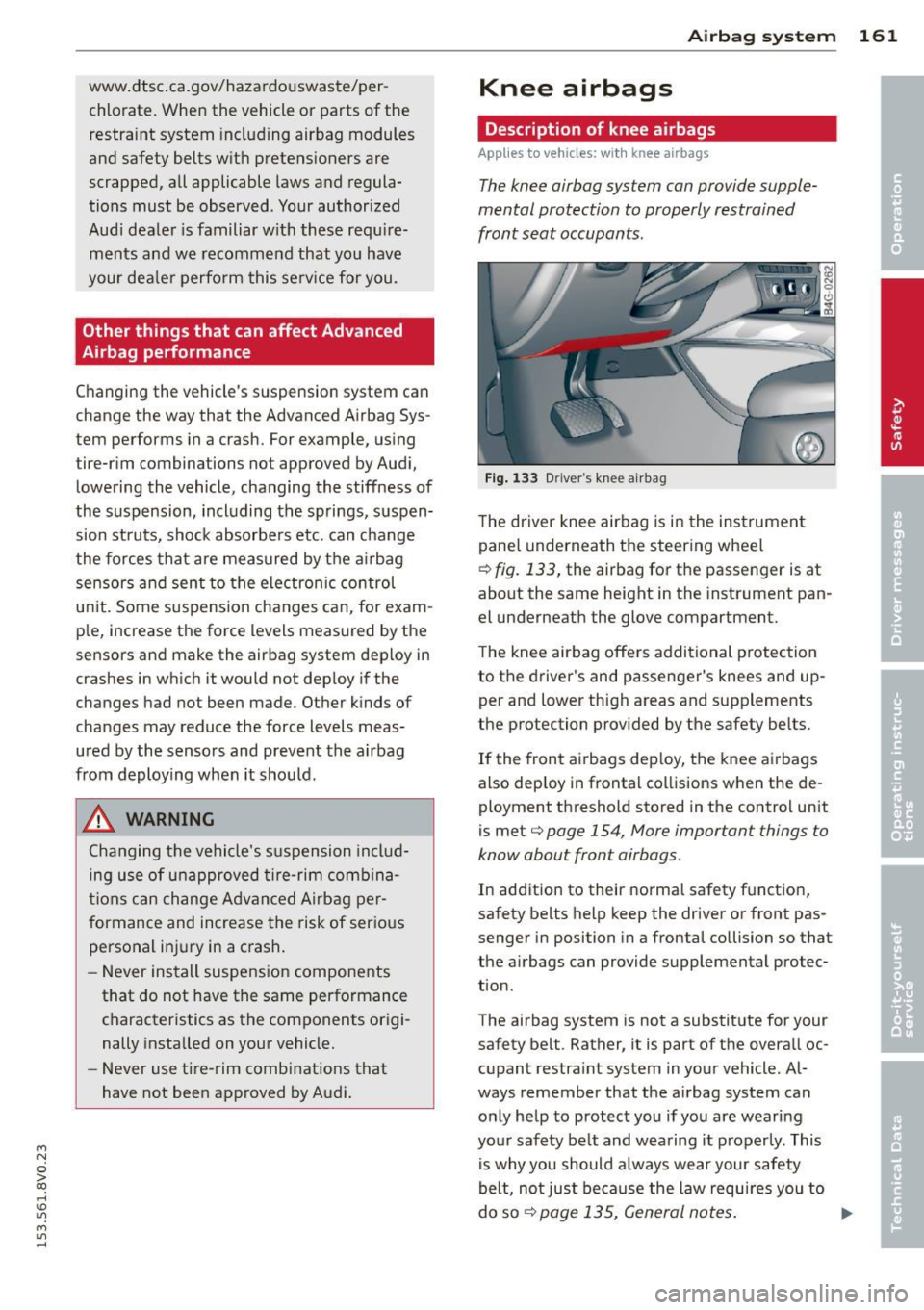
Fig. 133 Driver's kn ee airbag
The dr iver knee airbag is in the instrument
panel underneath the steering wheel
¢
fig. 133, the airbag for the passenger is at
about the same height in the instrument pan
el underneath the glove compartment.
The knee airbag offers additional protection
to the driver's and passenger's knees and up
per and lower thigh areas and supplements
the protection provided by the safety belts.
If the front airbags deploy, the knee airbags
also dep loy in frontal collisions when the de
ployment threshold stored in the control unit
is met¢
page 154, More important things to
know about front airbags.
In addition to their normal safety function,
safety belts help keep the driver or front pas
senger in position in a frontal collision so that
the airbags can provide supplemental protec
tion.
The airbag system is not a substitute for your
safety belt. Rather, it is part of the overall oc
cupant restraint system in your vehicle. Al
ways remember that the airbag system can
only help to protect you if you are wearing
your safety be lt and wearing it properly. This
is why you should always wear your safety
belt, not just because the law requires you to
do so¢
page 135, General notes. ..,_
Page 165 of 310
....,
N
0 > co
rl I.O
"' ....,
"' rl
Fully inflated airbags in combination with
properly worn safety belts slow down and lim
it the occupant's forward movement and help
to reduce the risk of injury.
Important safety instructions on the
knee airbag system
A ppl ies to vehicles: with Knee airbags
Airbags are only supplemen tal restraints. Al
ways wear safety belts correctly and ride in a
proper seating position.
There is a lot that you and your passengers
must know and do to help the safety belts and
airbags to provide supplemental protection .
A WARNING
An inflating knee airbag can cause serious
injury. Wearing safety belts incorrectly and
improper seating positions increase the
risk of serious personal injury and death
whenever a vehicle is being used.
- The knee airbag system cannot protect
you properly if you are seated too close
to any of the airbag locations. When ad
justing their seat positions, it is impor
tant that both the driver and the front passenger keep their upper bodies and
knees at the following minimum safe
distances:
- at least 10 inches (25 cm) between the
chest and the steering wheel/instru
ment panel.
- 4 inches (10 cm) between the knees
and the lower part of the instrument
panel.
- The risk of personal injury increases if
you lean forward or to the side, or if the
seat is improperly positioned and you are
not wearing your safety belt. The risk in
creases even more should the airbag de ploy.
- Always make sure that the knee airbag can inflate without interference. Objects
between you and the airbag can increase
the risk of injury in an accident by inter
fering with the way the airbag deploys or
Airbag system 163
by being pushed into you as the airbag
deploys.
- Never let anybody, especially children
or animals ride in the footwell in front
of the passenger seat.
If the airbag de
ploys, this can result in serious or fatal
injuries.
- Never carry objects of any kind in the
footwell area in front of the driver's or
passenger's seat. Bulky objects (shop
ping bags, for example) can interfere
with or prevent proper deployment of
the airbag. Small objects can be
thrown through the vehicle if the air bag deploys and injure you or your pas
sengers .
- Make sure there are no cracks, deep scratches or other damage in the area of
the instrument panel where the knee air
bags are located.
- If children are incorrectly seated, their
risk of injury increases in a collision
~ page 170, Child Safety .
Side airbags
Description of side airbags
The airbag system can provide supplemental
protection to properly restrained occupants.
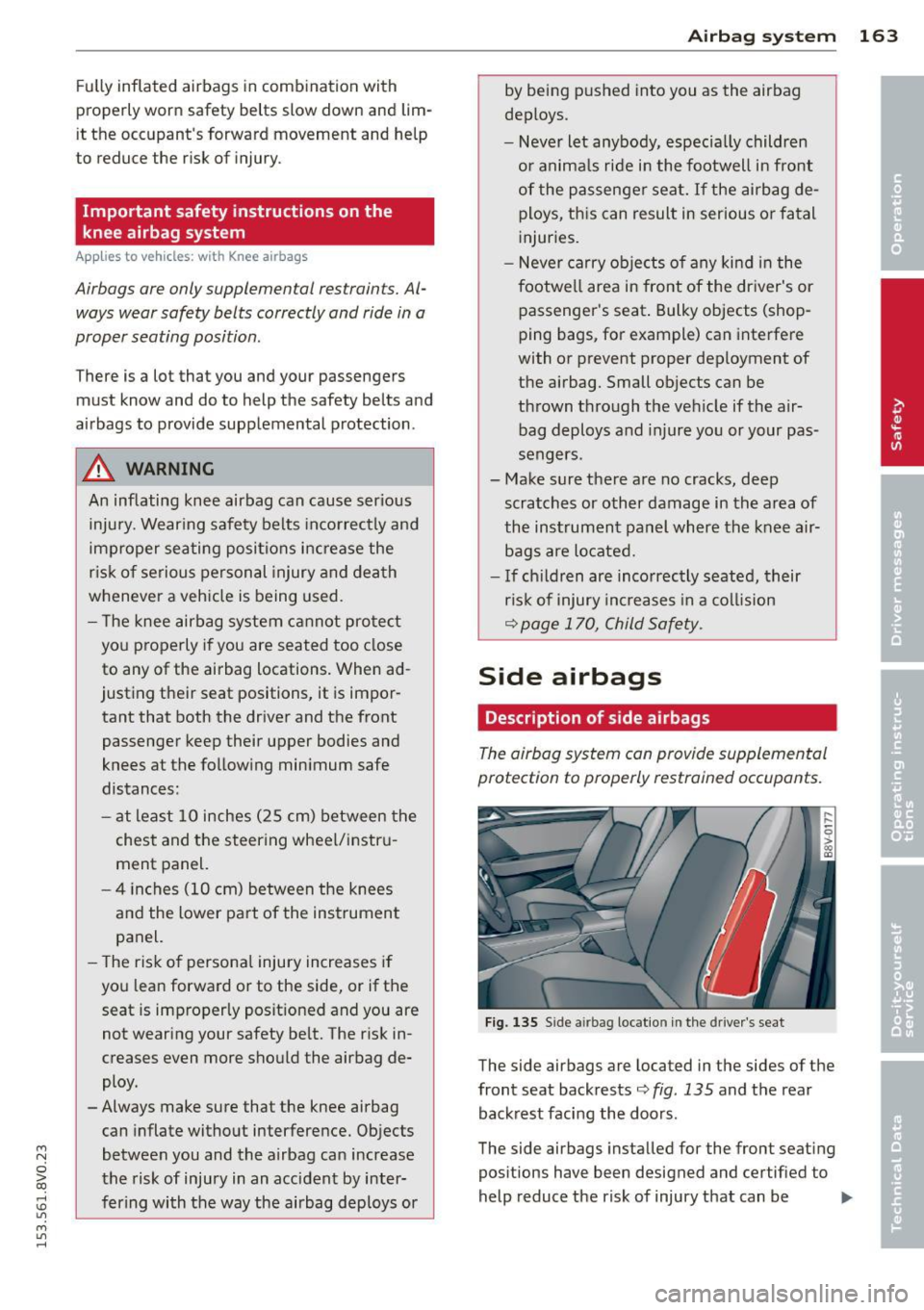
Fig. 135 S ide a irbag locatio n in the driver's seat
The side airbags are located in the sides of the
front seat backrests~
fig. 135 and the rear
backrest facing the doors.
The side airbags installed for the front seating
positions have been designed and certified to
help reduce the risk of injury that can be
IJJJ,
Page 174 of 310
172 Child Saf ety
c::> page 144, Airbag system and
c::> page 170 , Important things to
know.
Always rep lace child restraints that were
installed in a vehicle during a crash . Dam
age to a child restraint that is not visible
could cause it to fail in another collision
situation.
Advanced front airbag system and children
Your veh icle is eq uipped with a front "Ad
vanced Airbag System" in compliance with
United States Federal Motor Vehicle Safety
Standard ( FMVSS) 208 as applicab le at the
time your vehicle was manufactured.
The Advanced Airbag system in your vehicle has been certified to meet the " low -risk" re
quirements for 3 and 6 year-o ld children on
the passenger side and small adults on the
driver side. The low risk deployment criter ia
are intended to reduce the risk of injury
through interaction with the a irbag that can
occur, for example, by be ing too close to the
steering wheel and instrument panel when
the airbag inflates. In addi tion, the system
h as been certified to comply w ith the "sup
pression" requirements of the Sa fety Stand
ard, to turn
off the front airbag for infants up
to 12 months who a re restrained on the front
passenger seat in chi ld restraints that are list
ed in the Standard.
Even though yo ur vehicle is equipped with an
Advanced Airbag system, all chi ldren, espe
cially those 12 years and younger, shou ld al
ways ride in the back seat properly restrained
for the ir age and s ize . The a irbag on the pas
senger side makes the front seat a potentially
dangerous place for a child to ride. The front
seat is not the safest place fo r a ch ild in a fo r
ward-facing child safety seat. It can be a ve ry
dangerous place for an infan t or a large r ch ild
in a rearward- facing seat. The vehicle's Advanced Airbag System has a
capacitive passenger detection system i n the
front passenger seat cush ion that can detect
the presence of a baby or a ch ild in a child re
stra int system on this seat.
The capacitive passenger detection system registers the changes that result in an electri
ca l fie ld when a chi ld, a child restra int, and a
baby blanket are on the front passenger seat.
The change in the measured capac itance due
to the p resence of a child, a ch ild restraint,
and a baby blanket on the front passenge r
seat is related to the chi ld restraint system
rest ing o n the seat. The meas ured capa cit an ce
of a child restrain t system varies depend ing
on the type of system and specific make and
model.
T he electrical c apa citan ce of the various
types, makes, and models of child restraints
specified by the U .S . Nationa l Highway Traffic
Safety Administration (NH TSA) in the re levant
safety standard are stored in the Advanced
Airbag System contro l unit together with the
capacitances typical of infants and a 1-year
o ld child . When a child restraint is used on the
front passenger seat with a typical 1 year-old
infa nt, the Advanced Airbag System compa res
the capacitance measu red by the capacitive
passenge r de tection system wi th the data
stored in the electron ic cont ro l unit . Child restraints and Advanced front
airbag system
Regardless of the c hild restra int that you use,
make sure that it has been cert ified to meet
U nited States Federal Motor Vehicle Safety
Standards and has been ce rtified by its manu
factu rer for use with an airbag. A lways be sure
t h at the c hild restr aint is properly installed at
one of the rear seating posi tions. If in excep
t iona l circumstances yo u must use it on the
front passenger seat, carefully read a ll of the
information on child sa fety and Advanced Air
bags and heed all of the applicable WARN
INGS . Make certain that the c hild and chi ld re
stra int are correctly recognized by the capac i
t ive passenger detection system in the front .,.
Page 191 of 310
M N
0 > co ,...., \!) 1.1'1
M 1.1'1 ,....,
Smart Technology
Information about
data recorded by
vehicle control
modules
Your vehicle is not equipped with a crash data
recorder. This device is installed by some vehi
cle manufacturers to record data about crash
es so that it can be analy zed later . Crash data
recorders are also called "Event Data Record
ers ( EDR)" .
In some legal jurisdictions, it is not permitted
to access or download data recorded by pre
installed crash data recorders in order to eval
uate a crash without clear consent of the vehi
cle owner .
Your vehicle is not equipped with a crash data recorder. However it does contain a variety of
electronic control modules for various vehicle
systems such as engine function, exhaust
treatment or airbags and safety belts .
These electronic control modules record vehi cle data during normal driving for diagnosis
and repair purposes . The recording capability
of the electronic control modules is limited to
data only- no sound is recorded.
If the control
module detects a system ma lfunction or other
change in status, a very limited amount of da
ta is recorded for an extremely small period of
time . Data that is recorded in such a case may
include vehicle speed, d riving direction, the
load on the brakes and head restraints and
performance in the event of an acciden t or
other change in status . The stored data can
only be read or downloaded with special devi
ces.
Electronic stabilization
control (ESC)
Description
The Electronic Stabilization Control (ESC) con
tr ibutes to driver safety. It reduces the risk of
slipp ing and improves driving stability. ESC
Smart Technolog y 189
detects critical situations such as the vehicle
oversteering and understeering or the wheels
are spinning . The vehicle is stabilized by ap
plying the brakes or reducing engine torque.
Once the ESC is activated, the indicator light
m blinks in the instrument cluster .
The following systems are integrated in the
ESC:
Anti-lock braking system (ABS )
ABS prevents the whee ls from locking when
braking. The vehicle can still be steered even
during hard braking. Apply steady pressure to
the brake pedal. Do not pump the pedal. A
pulsing in the brake peda l indicates that the
system is acting to stabilize the vehicle.
Brake assi st sys tem
The brake assist system can decrease braking
distance. It increases braking power when the
driver presses the brake pedal quickly in emer
gency situations. You must press and hold the brake pedal until the dangerous situation is
over . In vehicles with adaptive cruise control*,
the brake assist system is more sensit ive if the
distance detected to the vehicle ahead is too
small.
Anti-slip regulation (ASR)
ASR reduces engine power when the drive
wheels begin spinning and adapts the force to
the road conditions . This makes it easier to
start , accelerate and dr ive up inclines .
Electronic differential lock (EDL)
The EDL brakes wheels that are spinning and
transfers the drive power to the other drive
wheel or wheels if the vehicle is equ ipped with
all wheel drive*). This function is not available
at higher speeds .
In extreme cases, EDL automatically switches
off to keep the brake on the braked wheel
from overheating . The vehicle is still working
correctly. EDL will switch on aga in automat i
cally when cond itions have returned to nor-
mal. .,..
•
•
•
Page 192 of 310
190 Smart Technology
Steering r ecommendat ion
The ESC helps to stabilize the vehi cle by
changing the steering torque.
Select ive wh eel torqu e co ntrol
Select ive wheel torque control is used when
driving on curves . The front wheel on the in
side of the curve or both wheels on the inside
of the curve are braked selective ly as needed.
Th is a llows more precise driv ing in c urves.
Automatic post -collision braking system
The "Automatic post-collision braking system"
can he lp to reduce the risk of sliding and of
other coll is ions after an acc ident. If the airbag
control mod ule detects a collision above acer
tain vehicle speed, the vehicle is braked by the
ESC.
The vehicle does not brake automatically if:
- the driver presses the accelerator pedal , or
- the braking fo rce genera ted by the pressed
brake pedal is greater than the braking force
that would be initiated by the system, or
- the ESC, the brake system or the vehicle
electrical system are not functioning .
A WARNING ,.
- The ESC and its integrated systems can
not overcome the lim its posed by natural
physical laws. This is especia lly impor
tant on s lippery or wet roads. If the sys-
Switching on /off
terns begin acting to stabilize your vehi
cle, you should immediately a lter your
speed to match the road and traffic con
ditions . Do not let the increased safety
provided tempt you into taking r isks .
This could increase your risk of a co lli
sion .
- Please note the r isk of a coll is ion increas
es when driving fast, especially through
curves and o n slippe ry or wet roads, and
when dr iv ing too close to objects ahead.
The ESC and i ts integrated systems can
not a lways p revent collisions -there is
still a risk of accidents!
- Press the acce lerator pedal caref ully
when acce lerating on even, slippery sur
faces such as ice and snow. The drive wheels can spin even when these control
systems are installed and this can affect
driving stability and increase the risk of a
coll is io n.
(D Tips
- ABS and ASR only function correctly
when all four wheels are equ ipped w ith
identical t ires . Different t ire sizes can
lead to a reduction in engine power.
- You may hear noises when the systems
descr ibed are working .
- If the
DJ or [IJ indicator light appears,
there may be a malfunction¢
page 22.
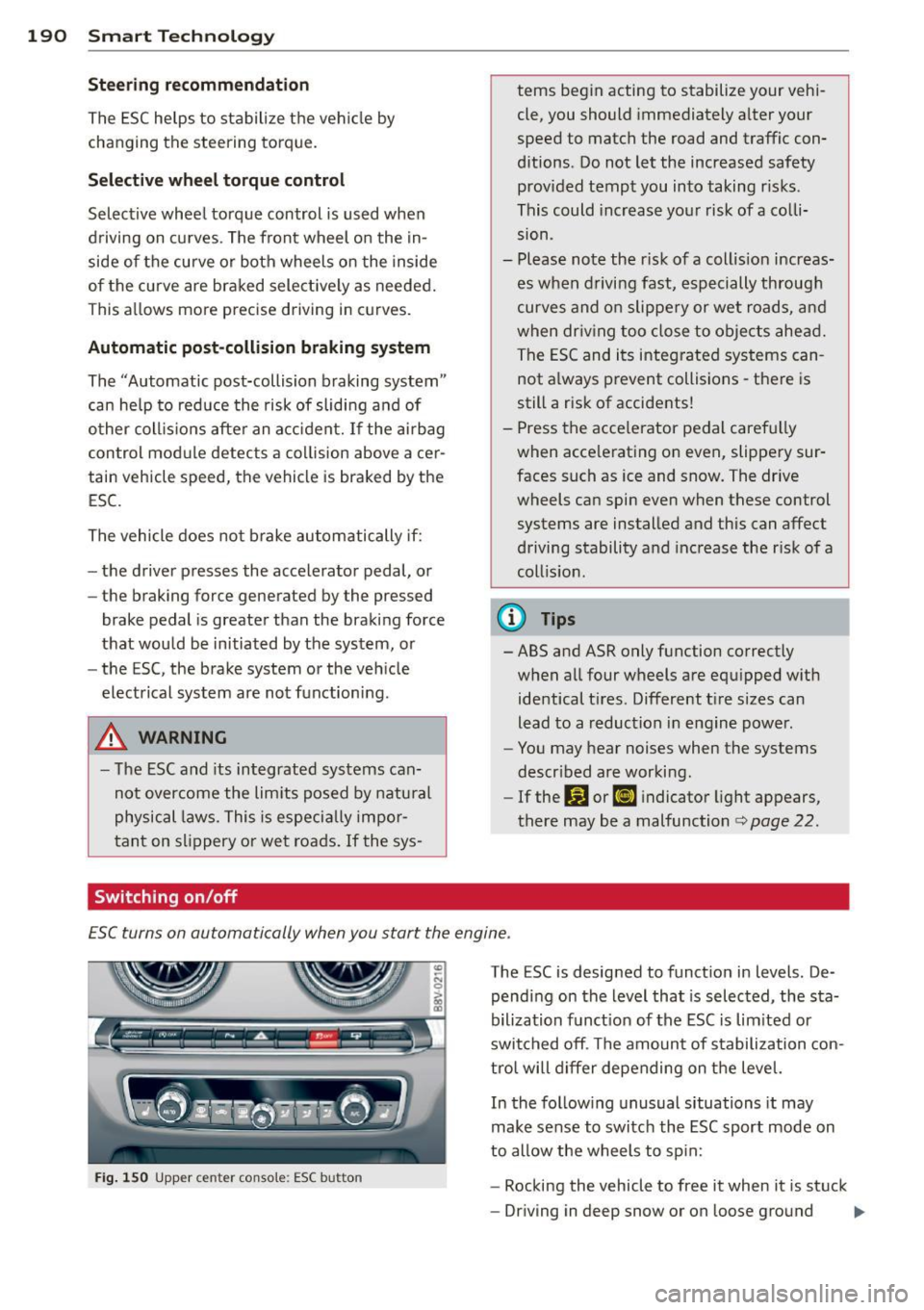
E SC turns on automatically when you start the engine .
Fig. 1 50 Upper c ente r conso le : ESC but to n
The ESC is designed to funct ion in levels . De
pending on the level that is selected, the sta
bilization funct io n of the ESC is lim ited or
swit ched off . The amoun t of stabilization con
tro l will differ depending on t he level.
In the follow ing unusual situations it may
make sense to switch the ESC sport mode on
to allow the wheels to sp in:
- Rocking the vehicle to free it when it is stuck
- Driving in deep snow or on loose ground
ll>
Page 195 of 310
M N
0 > co ,...., \!) 1.1'1
M 1.1'1 ,....,
the brakes. If you need to brake addit ion
ally, bra ke in intervals and not continu
ously.
(D Tips
- If the brake boos ter is not wor king, you
must p ress the brake pedal with much
more force t hen no rma l.
- If yo u retrof it your vehicle with a front
s po ile r, wheel covers or similar items,
make sure that the air f low to the front
whee ls is not interrupted. Otherwise the
brake system can become too hot.
Electromechanical
steering
The elec tromechanical steering suppor ts the
driver's s teering movements .
Powe r stee ring adapts electronically based o n
the veh icle speed.
The vehicle still has full stee ring fu nctionality
if the powe r steering fails o r whe n the eng ine
i s stopped (towi ng). To s teer, yo u must app ly
m uc h mo re fo rce than usual.
Indicator lights and messages
• Do not drive vehicle: steering defective
If th is in dicator lig ht tu rns on and stays on
and this message appears, the power steering may have fa iled.
Do
not co ntin u e dr iving . See an autho rize d
Aud i dea ler o r autho rized Aud i Service Fac ility
for assistance.
• Do not drive vehicle: steering defective
There is a malf unct io n in the electro nic steer
in g lo ck. You canno t turn the ign ition on.
Do
not tow your vehicle beca use it ca nnot be
steered. See an autho rized Aud i dea le r or au
thor ized Audi Se rv ice Facility for ass istance.
Ei:-Y Steering malfunction : you can continue
driving
I f the indicator light turns on, the steering
wheel may be more difficult to move or more
Smart Technolog y 193
sensit ive tha n usua l. The stee ring wheel may
also be at a n angle when dr iv ing stra ight .
D rive slowly to you r auth ori zed Audi de aler o r
qualifie d wo rkshop to have the ma lf u ncti on
correc ted.
II Steering lock : sy stem fault! Pl ease con
tact Service
T he re is a malfunction in the elec tronic steer
ing lock .
D rive to an author ized Audi dealer or author
ized Audi Serv ice Facility immediately to have
the malfunc tion corrected.
A WARNING
Have the sys tem ma lf u nction co rrec ted as
soon as po ssible by an aut horiz ed Aud i
d e aler or au thoriz e d Au di Service Fa cili ty,
a s this incr eases the r is k of an acciden t.
(D Tips
If th e . or l~ij indi cator ligh t only s tays
o n for a short t ime , you may con tinue dr iv
i ng.
ALL wheel drive
(quattro)
App lies to vehicles: wi th all wheel drive
In all wheel drive, all four wheels are pow
ered.
General information
In all whee l dr ive, the dr iv ing power is divi ded
between all fo ur whee ls. Thi s happens auto
matically depending on yo ur driv ing behavior
as well as the current road conditions. Refer
to
¢ page 189, Electronic stabilization con
trol (ESC) .
The all wheel drive concept is designed for
high eng ine power. Your veh icle is except ion
a lly powerfu l and has excellent driving charac
te ristics both under normal driv ing cond itions
and on snow a nd ice. Always read and follow
safety precaut ions¢ .&.. ..,.
•
•
•
Page 206 of 310
204 Trailer towing
different weight distribution. Safety, perform
ance and economy wi ll greatly depend on how
carefu lly you load your trailer and operate
your rig.
Before you actually tow your trailer, practice
turning, stopping and backing up in a n area
away from traffic. Keep practicing until you
have become comp letely fam iliar with the way
your veh icle-trailer comb ination behaves and
responds.
Backing up is d iff icult and requires practice.
Backing up with a tra iler genera lly requires
steering action opposite to that when back ing
up your veh icle without a trailer.
Maintain a greater distance between your ve
h icle and the one in front of you. You will need
more room to stop. To compensate for the
trailer, you will need a larger than normal
turning radius.
When passing, remember that yo u cannot ac
celerate as fast as you normally would be
cause of the added load. Make sure you have
enough room to pass. After passing, allow
p lenty of room for your tra iler before chang
ing lanes aga in.
Avoid jerky starts, sharp turns or rapid lane
changes.
(D Tips
- Do not tow a tra iler dur ing the break-in
period of you r vehicle.
- If you tow a trailer, your Audi may re
quire more frequent maintenance due to
the ext ra load
¢ page 289.
Parking on a slope
Do not park on a slope with a trailer. If it can
not be avoided, do so only after doing the fol
lowing:
Wh en park ing:
.. Apply the foot brake .
.. Have someone place chocks under both the
vehicle and the trailer wheels. ..
With chocks in place, slowly release the
brakes unti l the whee l chocks absorb the
load.
.. Turn the whee ls towards the curb.
.. App ly the parking brake.
.. Select the P selector lever posit ion.
When re starting afte r park ing :
.. App ly the foot brake.
.. Start the engine.
.. Select the D/S se lector lever position.
.. Release the parking brake and s lowly pull
out and away from the wheel chocks .
.. Stop and have someone retr ieve the wheel
chocks .
@ Tips
If you move the selector leve r of the auto
matic transmission to P befo re applying
the pa rking brake and before bloc king the
whee ls, you may h ave to use more force
la ter to move the lever out of the P posi
tion .
Page 237 of 310
M N
0 > co ...... \!) 1.1'1
M 1.1'1 ......
-If you notice unusual vibration or if the vehicle pulls to one side when driving, al
ways stop as soon as it is safe to do so and check the
wheels and tires for dam age.
(D Note
-Please note that summer and winter tires are de
signed for the conditions
that are typical in those sea
sons. Audi recommends using winter tires during the
winter months. Low tem peratures significantly de
crease the elasticity of
summer tires, which affects
traction and braking ability.
Tires and wheels 235
If summer tires are used in
very cold temperatures, cracks can form on the tread bars, resulting in perma
nent tire damage that can
cause loud driving noise and unbalanced tires. Audi is not
responsible for this type of
damage.
-Burnished, polished or chromed rims must not be used in winter road condi
tions. The surface of the
rims does not have suffi
cient corrosion protection
for this and could be perma
nently damaged by road salt
or similar substances.
' •
•
Glossary of tire and loading terminology
Accessory weight
means the combined weight (in
excess of those standard items
which may be replaced) of auto matic transmission, power
steering, power brakes, power
windows, power seats, radio, and heater, to the extent that
these items are available as fac
tory-installed equipment (whether installed or not).
Aspect ratio
means the ratio of the height to
the width of the tire in percent. Numbers of 55 or lower indi
cate a low sidewall for im proved steering response and
better overall handling on dry
pavement.
' •
Page 255 of 310
-The longer one tire is used in one location on the vehicle,
the more it wears at certain points; therefore, we recom
mend that you follow the tire
manufacturer's suggested tire
rotation intervals.
-Vehicles with front-wheel drive experience more tread
wear on the front wheels com pared to all-wheel drive (quat
tro).
-Please rotate tires as shown
¢ fig. 171.
-Extra care must be taken when
rotating direction-specific
tires
Q page 2 74.
Wheel balancing
The wheels on new vehicles are balanced. However, various sit
uations during everyday driving
can cause them to become un
balanced, resulting in vibra
tions you can usually feel
through the steering wheel.
Unbalanced wheels must be re
balanced to avoid excessive
wear on steering, suspension
and tires. A wheel must also be
rebalanced when a new tire is
M N
~ installed. co ,...., \!) 1.1"1
M 1.1"1 ,....,
Tires and wheels 253
Incorrect wheel alignment
Incorrect wheel alignment can
cause excessive tire wear, impairing the safety of the vehi
cle. If tires show excessive
wear, have the wheel alignment checked by an authorized Audi
dealer or qualified workshop.
All-wheel drive
Vehicles with quattro must al
ways have tires of the same size, construction and tread
type. For details see
¢ page 193 .
.8, WARNING
Sudden tire failure can lead
to loss of control, a crash and serious personal injury!
-Never drive a vehicle when the tread on any tire is worn down to the wear indica
tors.
-Worn tires are a safety haz ard, they do not grip well on
wet roads and increase your risk of "hydroplaning" and
loss of control.
-Always keep chemicals that can cause tire damage, such
-
as grease, oil, gasoline and
brake fluid away from tires.
~
' •
•
' •
Page 268 of 310
![AUDI S3 2015 Owners Guide 266 Tire s and wheels
& WARNING
-If the tire pressure warning light ti] in
the instrument cluster turns on, the
pressure in one or more tires is too low.
Reduce the vehicle speed](/img/6/57541/w960_57541-267.png "AUDI S3 2015 Owners Guide 266 Tire s and wheels
& WARNING
-If the tire pressure warning light ti] in
the instrument cluster turns on, the
pressure in one or more tires is too low.
Reduce the vehicle speed")
266 Tire s and wheels
& WARNING
-If the tire pressure warning light ti] in
the instrument cluster turns on, the
pressure in one or more tires is too low.
Reduce the vehicle speed immediately
and avoid any hard steering or braking
maneuvers . Stop as soon as possible,
check the t ire and inflate the tire to the
correct pressure, which is specified on
the tire pressu re label on the veh icle
¢ page 240. Driving with a t ire with low
pressure causes the tire to overheat and
can result in failure of the tire . Low pres
sure can a lso have a negative effect on
the driving and braking behavior of the
vehicle.
- The driver is responsible for maintaining
the correct tire pressures. You must
check the t ire pressures regularly.
- Under certain conditions (such as a spor
ty driving style, winter conditions or un
paved roads), the pressure monitor ind i
cator may be delayed .
- Ask your author ized dealer if run-flat
t ires may be used on your vehicle.
- The tire pressure monitoring system can
also stop work ing when there is an ESC
malfunction.
- Using snow chains may result in a system
malfunction.
- The tires with the identification "AO" or
"RO" ¢ page 254 have been matched
with your Audi tire pressure monitoring
system. We recommend that you use
these tires.
- The tire pressure monitoring system can
only mon itor the t ire pressure of the
driving tires . Check the tire pressure of
the spare wheel in the luggage compart ment so that if necessary it is ready for
us e.
-
Storing tire pressures
Applies to vehicles: wit h tire press ure mo nitor ing system
A change in tire pressure or a change in tires
must be stored in the system.
The tire pressure is stored in the MMI.
.. Make sure before storing that the tire pres
sures of a ll four tires meet the specified va l
ues and are adapted to the load. Otherwise
the system could malfunction
¢ page 240.
.. Switch on the ignition.
.. Select: the
I MENU I button >Car > Systems*
control button > Service & control > Tire
pressure monitor > Store tire pre ssure >
Yes, store now.
(D Tips
Do not store the tire pressures if snow
chains are installed. Otherwise the system
could malfunction.