warning AUDI S3 2016 Owners Manual
[x] Cancel search | Manufacturer: AUDI, Model Year: 2016, Model line: S3, Model: AUDI S3 2016Pages: 328, PDF Size: 81.78 MB
Page 249 of 328

,....,
N
0 > co ,....,
you.
A WARNING
- Brake fluid is poisonous. It must be stored
only in the closed original container out of
the reach of chi ldren!
- Brake failure can resu lt from old or inappro
priate brake fluid. Observe these precau
t ions:
- Use only brake flu id that meets SA E speci
fication
J 1703 and conforms to Federal
Motor Vehicle Standard 116. Always check
with your authorized Audi dealer to make
sure you are using the correct brake fluid.
The correct type of brake fluid is also indi
cated on the brake flu id reservoir.
- The brake fluid must be new. Heavy use of
the brakes can cause a vapor lock if the
brake fluid is left in the system too long.
This can ser iously affect the efficiency of
the brakes as well as your safety. This
could result in an acc ident.
(D Note
Brake fluid w ill damage the pa int of your vehi
cle.
For the sake of the environment
Because of the prob lem of proper disposal of
brake flu id as well as the special tools re
quired and the necessary expertise, we rec
ommend that you have the brake fluid
changed by your author ized Audi dealer.
Battery
General information
All work on the battery requires expert knowl
edge.
Read and foll ow t he WARNING S before check
ing anything in the engine compartment
¢ page 236, Working in the engine comport
ment.
Ch eck ing and Filling
Plug -in hybrid drive* : you can find important in
formation about the high -vo ltage battery under
¢ page 98.
The battery in yo ur Audi does not need any ma in
tenance under
normal operating conditions . Audi
recommends having the electrolyte level check
by an authorized Audi dealer or author ized Audi
Service Facility when there are
high outside tem
peratures or when dr iving all day. The e lectrolyte
level should also be checked each time the bat
tery is charged¢
page 249.
Have the battery checked when you bring your ve
hicle in for an inspection. It is a good idea to re
place the battery if it is more than 5 years old.
D uring certa in types of a irbag deployments, the
battery is d isconnected from the veh icle electri
cal system for safety reasons¢
& in Repair, core
and disposal of the airbags on page 199.
Di sco nnecting the battery te rminal s
The battery should not be disconnected. Several
vehicle functions (power windows, for example)
will be lost when the battery is disconnected. The
funct ions must be reprogrammed after connect
ing the battery. To avoid this, the battery should
only be disconnected from the vehicle electrical
system when it is absolutely necessary.
To reprogram the functions, proceed as follows:
Function Reprogramming
Power window one-¢ page 44, Correcting
touch up/down func-power window molfunc-
tion tions
Remote control key or
If the vehicle does not
Convenience key react to the key, it must
be synchronized
¢page 37
Dig ita l clock ¢page 10
ESC indicator light The indicator light goes
out after driving a few
meters
247
Page 250 of 328
Check ing and F illing
Not running th e vehicle for long p eriod s of
t im e
If you do not drive your vehicle for several days or
weeks, electrical components are gradually re duced or sw itched off. Th is reduces energy con
sumpt io n and maintains the vehicle's ability to
start over a long period of time
c:::, page 164 .
Some convenience functions, such as interior
lighting or power seats* may not work . These
convenience functions will be available again
once yo u sw itch the ignition on and start the en
gine.
Winter operation
During the winter months, it is common for the
battery capacity to decrease as the temperatures
become lowe r. This is because mo re power is
needed to sta rt the veh icle and components s uch
as the headlights and the rear window defogger
are used more frequently .
Avoid using power unnecessar ily, especially in
ci ty driving or on sho rt trips. Have yo ur author
ized Audi dealer or authorized Audi Service Facili
ty check the battery capacity before the start of
winter c:::, page 249. A well-charged battery will
not on ly reduce starting problems in cold weath
er, but it will also last longer .
A WARNING
-Work on the battery requires expert knowl
edge. Contact an authorized Audi dealer or
autho rized Aud i Service Facility for informa
t ion regarding the vehicle battery. There is a
risk for chemical burns or explosions.
- Never open the vehicle battery. Do not t ry to
c hange the batte ry electro lyte level. Othe r
wise explosive gas wi ll escape from the bat
te ry and increase the risk of an explos ion .
(D Tips
If your vehicle is not driven for several weeks
in very cold temperatu res, remove the batte ry
and sto re it in a pla ce where it wi ll not freeze.
This prevents the battery from being dam
aged and needing to be replaced.
248
· Working on the battery
Be especially careful when working on or near
the battery.
Plug- in hybrid drive*: For important informat ion
about the high-voltage battery, refer to
c:::, page 98 .
The battery is located in the engine compart
ment . Before you check anything in the engine
compartment,
r e ad and heed all WARNING S
¢,&. .
Always heed the safe ty wa rnings , when working
on the vehicle battery or the veh icle electrical
system to prevent injury .
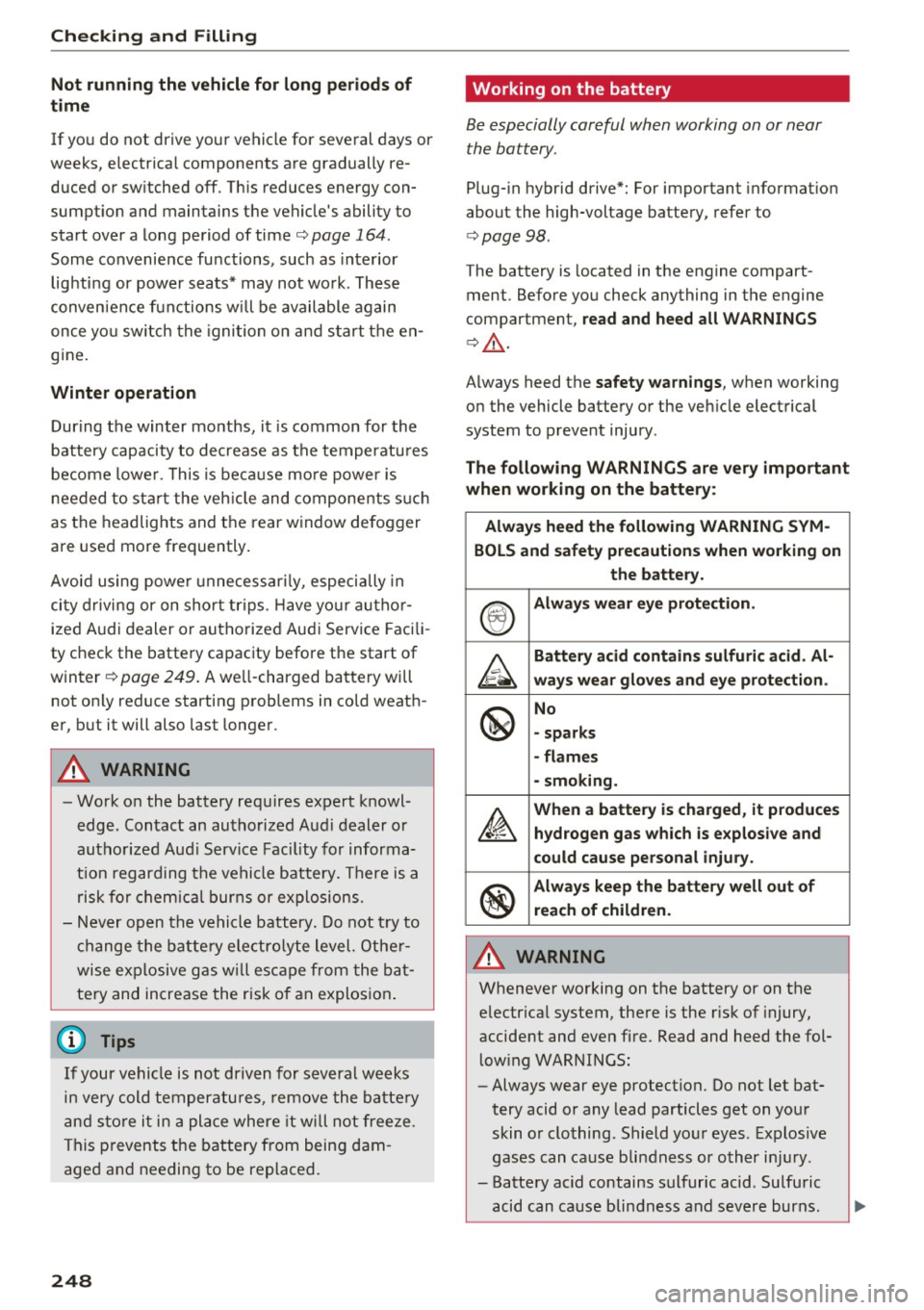
The following WARNINGS are very important
w hen wor king on the batter y:
Alwa ys heed the following WARNING S YM-
BOLS and safet y precaut ions when wo rking on
the batte ry.
®
Alwa ys wear e ye protection .
&
Batt ery ad d co ntains sulfu ric acid . Al-
way s w ear glove s and ey e prot ect ion .
@
No
-spark s
- flame s
- smoking .
~
When a battery is cha rged , it p roduce s
h yd rog en gas which is e xplo siv e and
could cause personal in jur y.
®
Alway s kee p the ba tter y w ell out of
r each of children.
A WARNING
Whenever working on the battery or on the
e lectr ical system, there is the r isk of injury,
accident and even fire. Read and heed the fol low ing WARNINGS:
- Always wear eye protection. Do not let bat
tery acid or any lead particles get on your
skin or clothing . Shield your eyes. Explosive
gases can cause blindness or other in ju ry .
- Battery acid contains sulfuric acid . Sulfuric
acid can cause blindness and severe burns .
Page 251 of 328
.... N
0 > CX)
.... I.Cl U"I
.... I.Cl ....
-Always wear gloves and eye protection. Do
not tilt the battery because acid could leak
out of the ventilation openings.
- If you get battery acid in your eyes or on
your skin, immediately rinse with cold wa
ter for several minutes and get medical at
tention .
- If you should ingest any battery acid, seek
medical attention immediately.
- Do not expose the battery to an open flame,
electric sparks or an open light.
- Do not smoke.
- Do not interchange the positive and nega-
tive cab les.
- When working on the battery, be sure not to
short-circuit the terminals with tools or oth
er metal objects. This wou ld cause the bat
tery to heat up very quickly, which could
lead to damage or explosion and personal
injury.
- When a battery is charged, it produces hy
drogen gas which is explosive and could
cause personal injury.
- Always keep the battery well out of the
reach of children.
- Before work is done on the electrical sys
tem, disconnect the negative ground cable.
- Before performing any work on the electri
cal system, switch off the engine and igni
tion as well as any electrical equipment . The
negative cable on the battery must be dis
connected. If you are just going to replace a
light bulb, then it is enough to switch off
the lights.
- Before disconnecting the battery, switch off
the anti-theft alarm system! Otherwise you
will set off the a larm.
- When disconnecting the battery, first dis
connect the negative cable and then the
posit ive cab le.
- Before reconnecting the battery, make sure
all electrical consumers are switched off.
Reconnect the positive cab le first and then
the negative cable . Never interchange the
cables - th is could start a fire!
- Never charge a frozen o r a thawed-out bat
tery. It could explode! If a battery has fro-
Checking and Filling
zen, then it must be replaced. A discharged
battery can freeze over at 32 °F (0 °C).
- Make sure the vent hose is always attached
to the opening on the side of the battery.
- Never use batteries which are damaged.
There is the danger of an exp losion! Always
replace a damaged battery.
_8 WARNING ~
California Proposition 65 Warning:
- Battery posts, term inals and related acces
sories contain lead and lead compounds,
chemicals known to the State of California
to cause cancer and reproductive problems.
Wash hands after handling.
(D Note
-Do not disconnect the vehicle battery when
the ignition is on or when the engine is run
ning, otherwise, you will damage electronic
components in the electrical system.
- If your vehicle is going to stand for a long
period of time without being driven, protect
the battery from "freezing", otherwise it
w ill be damaged and will then have to be re
placed .
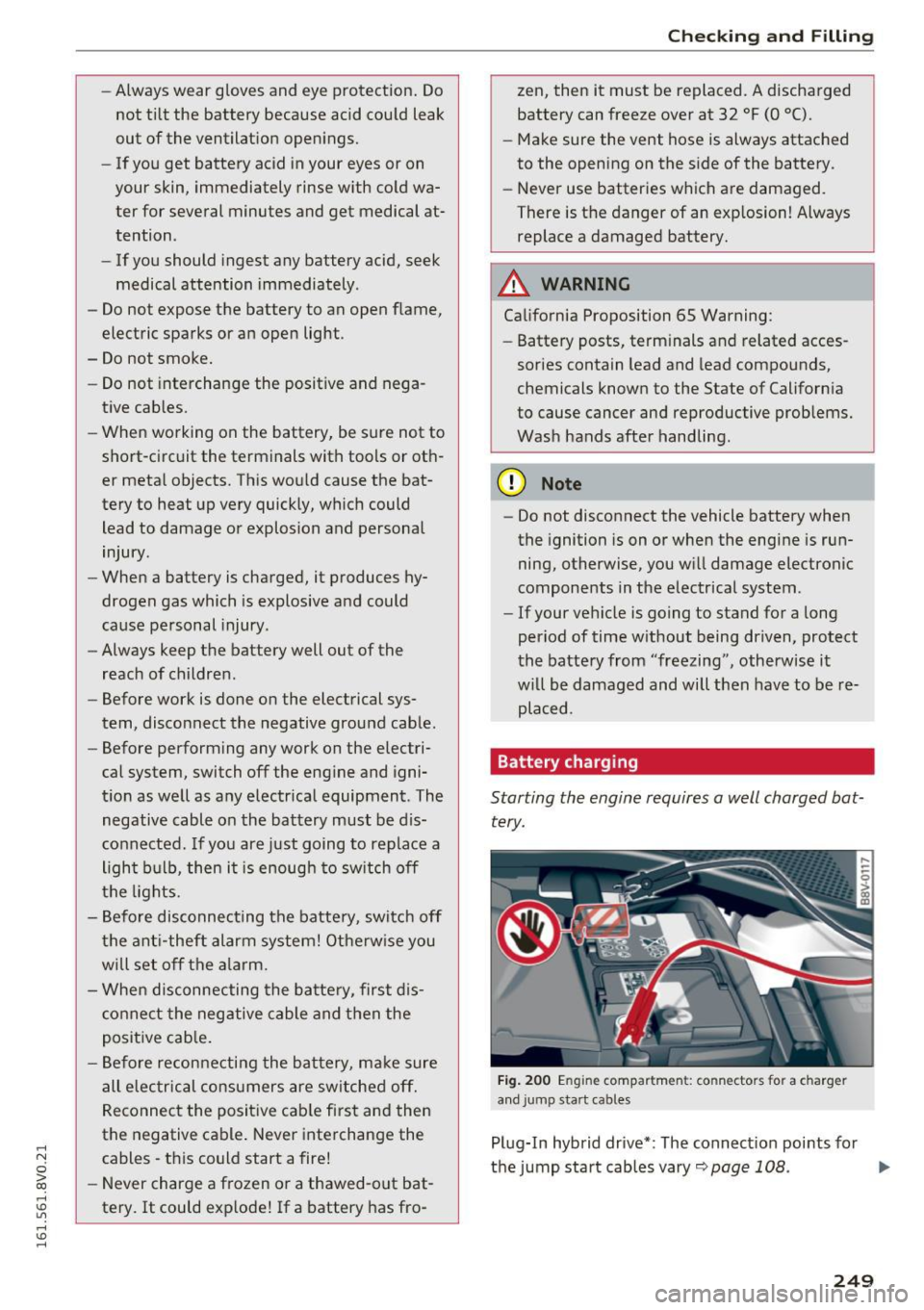
Battery charging
Starting the engine requires a well charged bat
tery.
Fig. 200 Eng ine compartmen t: co nnectors fo r a charger
a n d jump start cab les
Plug-In hybrid drive* : The connect ion points for
the jump start cables vary~
page 108. .,.
249
Page 252 of 328
Check ing and F illing
Al ways read and heed all WARNING S below
¢
A and ¢ A in Working on the battery on
page 248.
... Swi tch off the ignition and all electrical con
sumers .
... Make sure the area is well ventilated when you
charge the battery.
... Open the engine hood ¢
page 23 7.
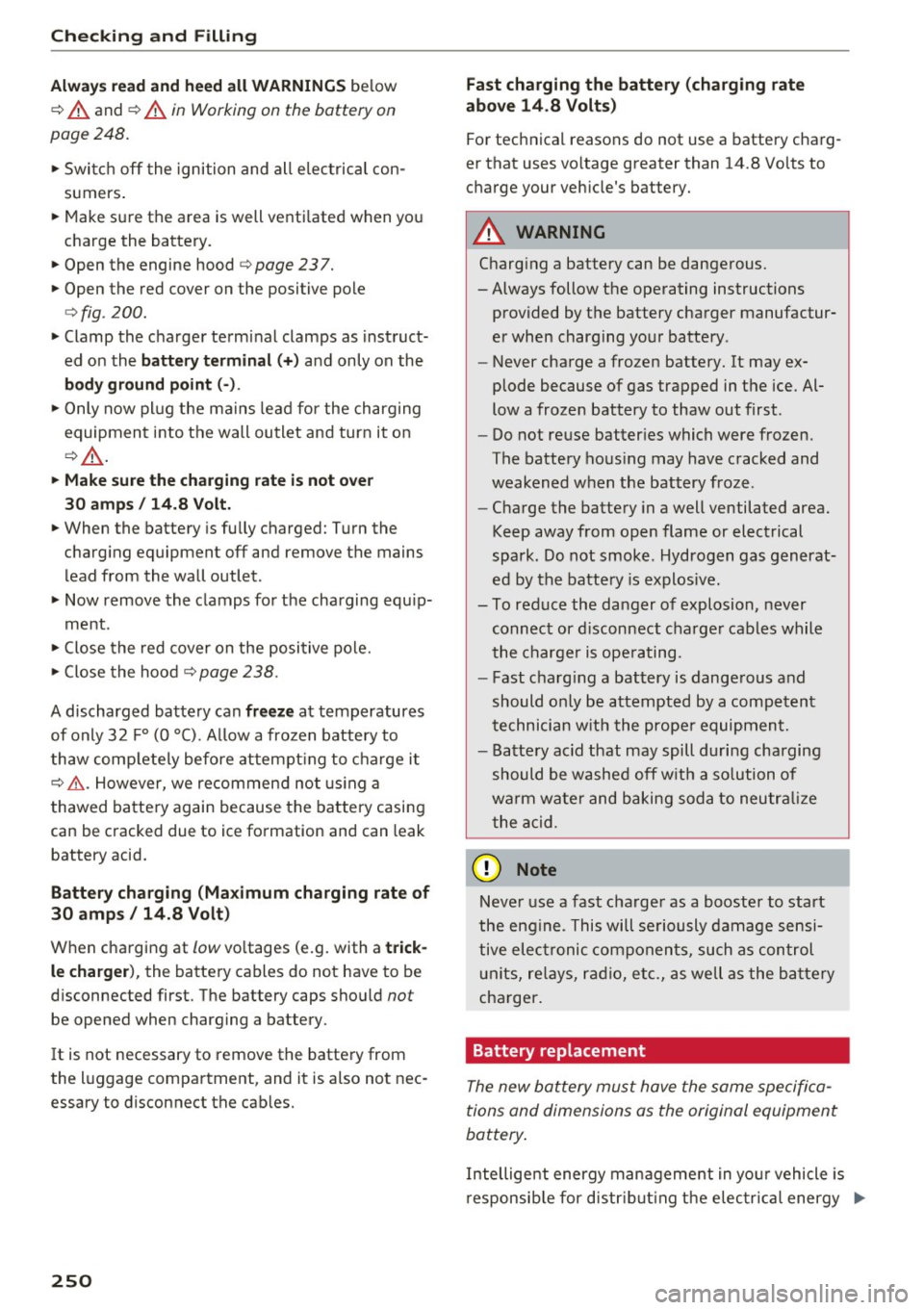
... Open the red cover on the positive pole
¢fig . 200.
... Clamp the cha rge r terminal clamps as instruct
ed on the
batt ery terminal (+ ) and only on the
bo dy ground poin t(·).
... Only now pl ug the mains lead for the charging
equipment into the wall outlet and turn it on
¢£ .
... Make su re the ch arg ing rate is not o ver
3 0 a mp s/ 1 4.8 Volt.
... When the battery is fully charged: Turn the
charg ing equipment off and remove the mains
lead from the wall outlet.
... Now remove the clamps fo r the charging equ ip-
ment .
... Close the red cover on the positive pole.
... Close the hood ¢
page 238.
A discharged battery can freeze at temperatures
of only 32 F
0 (0 °C). A llow a frozen battery to
thaw comp letely before attempt ing to c harge it
¢
.&. . However, we recommend not us ing a
thawed batte ry again because the battery casing
can be cracked due to ice formation and can leak
battery acid.
Battery charging (Ma ximum charging rate of
30 amp s/ 14.8 Volt )
When charging at low voltages (e.g. with a trick
le charger ),
the battery cables do not have to be
d isconnected first. The battery caps should
not
be opened when charging a battery.
It is not necessary to remove the battery from
the lu ggage compartment, and it is also not nec
essary to disconnect the cables.
250
Fast charging the battery (charg ing rat e
abov e 14.8 Volts )
For technical reasons do not use a battery charg
er that uses voltage greater than 14.8 Volts to
charge your veh icle's battery.
A WARNING
Charg ing a battery can be dangerous .
-Always follow the operating instructions
provided by the battery charger manufactur
er when charging your battery .
- Never charge a frozen battery.
It may ex
plode because of gas trapped in the ice. Al
low a frozen battery to thaw out first.
- Do not reuse batteries which were frozen.
The battery hous ing may have cracked and
weakened when the battery froze.
- Charge the battery in a well ventilated area .
Keep away from open flame or electrical
spark. Do not smoke . Hydrogen gas generat
ed by the batte ry is explosive .
- To reduce the danger of explosion, never
connect or d isconnect charger cables while
the charger is ope rating .
- Fast charg ing a battery is dangerous and
should only be attempted by a competent
technician w ith the prope r equipment.
- Batte ry acid that may spill during charging
should be washed off w ith a so lution of
warm water and baking soda to neutra lize
the ac id.
{[) Note
Never use a fast cha rge r as a booster to start
the eng ine. This will se riously damage sensi
tive elec tronic components, such as control
u nits, re lays, ra dio, e tc., as well as the ba ttery
charger.
Battery replacement
The new battery must hove the some specifica
tions and dimensions as the original equipment
battery .
Intelligent energy man agement in yo ur vehicle is
r esponsib le for d istr ib uting the elec trica l energy ..,.
Page 253 of 328
,....,
N
0 > co ,....,
gent energy management system wi ll keep the
engine battery charged better than veh icles w ith
out this system . To make sure the additional
e lectrical energy is avai lab le once again after you
have changed the battery, we recommend that
you install batteries of the same type and manu
facture on ly (the same as those installed at the
time your veh icle was de livered). Specifications
are listed on the battery housing. Your author
ized dealer must code the battery in the energy
management system to enable you to use the en
ergy management functions correctly after re p lacing the battery.
The new battery must have the same capacity,
voltage (12 -volts), amperage, construction and
p lug sealing .
When insta lling the battery, ma ke sure the igni
tion and all e lectrical consumers are switched
off .
(D Note
Ma ke sure the ventilation hose on the side of
the battery is connected, otherw ise fumes o r
battery acid can leak out .
@ For the sake of the environment
Because of the prob lem of proper disposal of
a ba ttery, we recommend your author ized
Audi dea ler change the battery for you . Bat
teries contain su lf u ric acid and lead and must
always be disposed of properly in compliance
w ith all environmental regulations. D isposing
of vehicle batteries improperly is very danger
ous to the env ironment.
Ch eck ing and Filling
Windshield washer
system
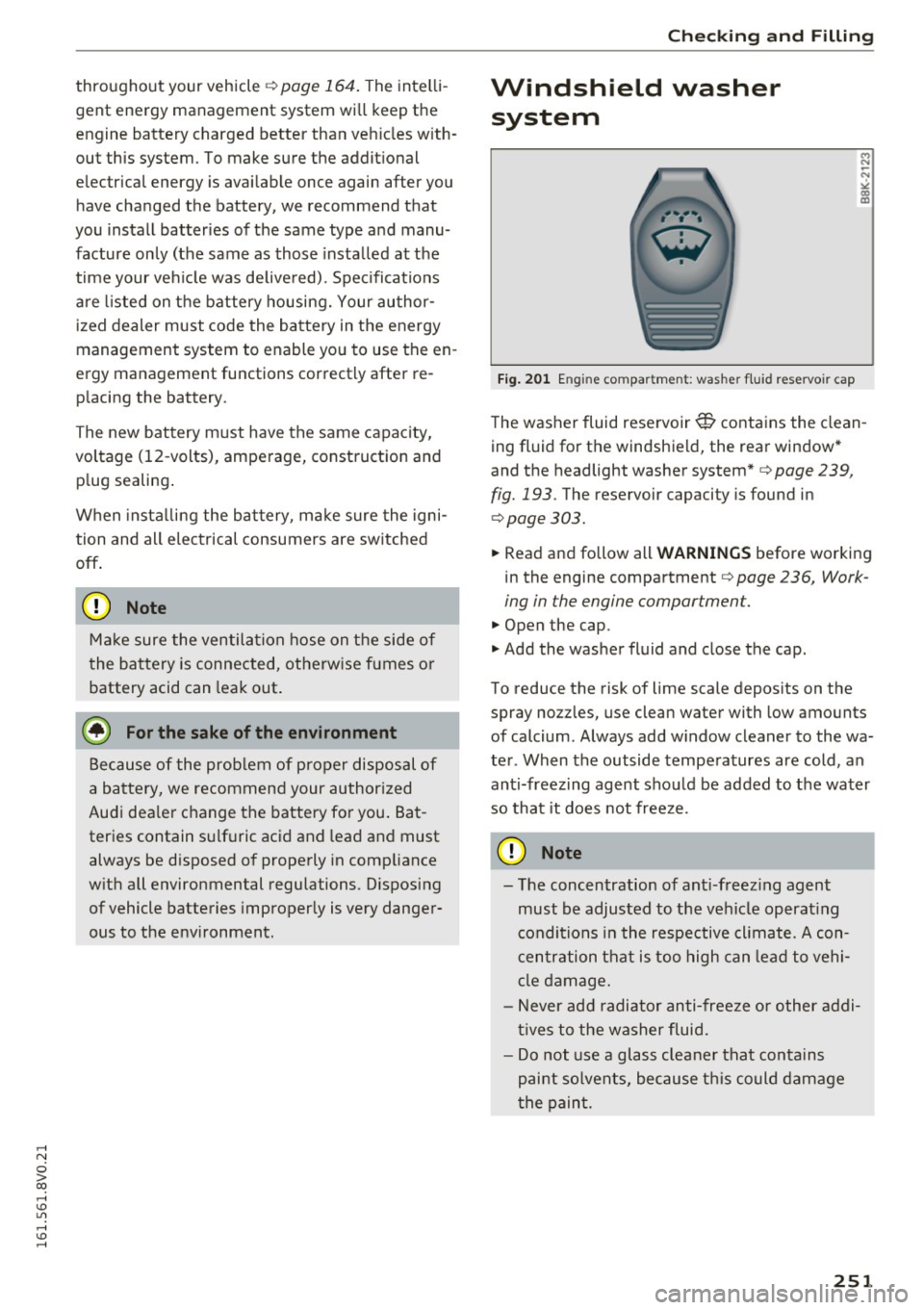
F ig . 201 E ngin e compar tmen t: was her flui d reservo ir cap
M N
-N ~
"' m
The washer fluid reservoir W contains the clean
ing fluid for the windshield, the rear window *
and the headlight washer system*¢
page 239,
fig. 193 .
The reservoir capacity is found in
¢ page 303.
.,. Read and follow all WARNING S before working
in the engine compartment <=>
page 236, Work
ing in the engine compartment .
.,. Open the cap.
.,. Add the washer fluid and close the cap .
To reduce the risk of lime scale deposits on the
spray nozzles, use clean water with low amounts
of calcium. Always add w indow cleaner to the wa
ter . When the outside temperatures are cold, an
anti-freez ing agent should be added to the water
so that it does not free ze.
(D Note
- The concentration of ant i-freez ing agent
must be adjusted to the vehicle operat ing
conditions in the respective cl imate. A con
c entration that is too high can lead to vehi
cle damage.
- Never add radiator an ti-free ze or other addi
tives to the washer fluid.
- Do not use a glass cleane r that contains
pai nt solvents, because t his could damage
t he paint.
251
Page 260 of 328

Tires and wheels
"XL" "xl" "EXTRA LOAD" or "RF" I I I
on the sidewall.
Rim
means a metal support for a tire
or a tire and tube assembly upon
which the tire beads are seated.
Rim diameter
means nominal diameter of the
bead seat . If you change your
wheel size, you will have to pur
chase new tires to match the new rim diameter .
Rim size designation
means rim diameter and width.
Rim width
means nominal distance between
rim flanges.
Sidewall
means that portion of a tire be
tween the tread and bead .
Speed rating (letter code)
means the speed at which a tire is
designed to be driven for extend
ed periods of time. The ratings range from 93 mph (150 km/h)
to 186 mph (298 km/h)
c::> table
on page 254.
You may not find
this information on all tires be
cause it is not required by law.
25 8
The speed rating letter code,
where applicable, is molded on
the tire sidewall and indicates the maximum permissible road
speeds
c::> .&. in Winter tires on
page 269 .
Tire pressure monitoring
system*
means a system that detects
when one or mo re of a vehicle's
tires are underinflated and illum i
na tes a low tire pressure warning
telltale .
Tread
means that portion of a tire that
comes into contact w ith the road .
Tread separation
means pulling away of the tread
from the t ire carcass .
Treadwear indicators (TWI)
means the projections within the
principal grooves designed to give
a visua l indication of the degrees
of wear of the tread. See
c::> page 262, Treadwear indicator
for mo re information on measur-
ing tire wear. .,.
Page 263 of 328
different tire speeds. For this reason, in case of emergency, only
use a spare tire* that is the same
circumference as the regular
tires.
&_ WARNING -
-Only use tire/rim combina tions and suitable wheel bolts
that have been approved by
Audi. Otherwise, damage to
the vehicle and an accident could result.
-For technical reasons, it is not possible to use tires from oth
er vehicles - in some cases,
you cannot even use tires from
the same vehicle model.
-Make sure that the tires you
select have enough clearance
to the vehicle . Replacement
tires should not be chosen
simply based on the nominal
size, because tires with a dif
ferent construction can differ
greatly even if they are the
same size. If there is not
enough clearance, the tires or
the vehicle can be damaged and this can reduce driving
safety and increase the risk of
an accident.
Tires and wheels
-Only use tires that are more
than 6 years old when abso lutely necessary and drive
carefully when doing so.
-Do not use run-flat tires on
your vehicle. Using them when
not permitted can lead to ve
hicle damage or accidents.
-If you install wheel covers on the vehicle, make sure they allow enough air circulation to
cool the brake system. If they
do not, this could increase the
risk of an accident.
Tire wear/damage
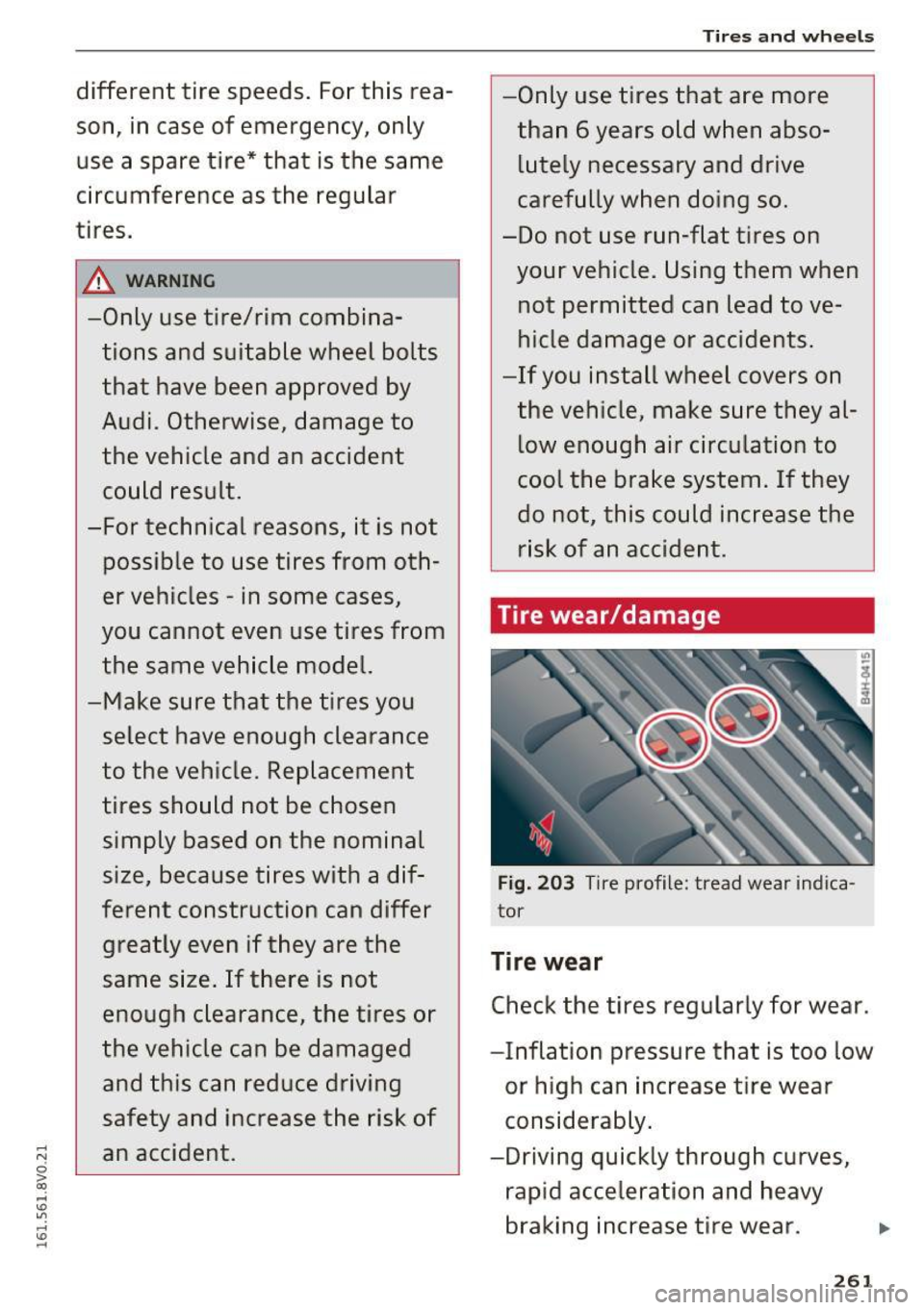
Fig. 203 Tire profile: tread wear indica
tor
Tire wear
Check the tires regularly for wear .
- Inflation pressure that is too low
or high can increase tire wear
considerably.
-Driving quickly through curves, rapid acceleration and heavy
braking increase tire wear. ..
261
Page 264 of 328
Tires and wheels
-Have an authorized Audi dealer or authorized Audi Service Facili
ty check the wheel alignment if
there is unusual wear .
-Have the wheels rebalanced if an imbalance is causing noticeable
vibration in the steering wheel. If you do not, the tires and other
vehicle components could wear more quickly.
Treadwear indicator
Original equipment tires contain
treadwear indicators in the tread pattern, which are bars that are 1/16 in. (1.6 mm) high and are
spaced evenly around the tire per
pendicular to the running direc
tion
¢ fig . 203 . The letters "TWI"
or triangles on the tire sidewall indicate the location of the tread
wear indicators.
The tires have reached the mini mum tread depth
l) when they
have worn down to the tread wear
indicators. Replace the tires with
new ones
¢ ..&. .
Wheel rotation
Rotating the wheels regularly is
recommended to ensure the tires
1> Obey any applicable regulations in your
country.
262
wear evenly. To rotate wheels, in
stall the wheels from the rear
axle on the front axle and vice
versa . This will allow the tires to
have approximately the same
length of service life.
For unidirectional tires, make
sure the tires are installed accord
ing to the running direction indi
cated on the tire sidewall
¢page 288.
Hidden damage
Damage to tires and rims can of
ten occur in locations that are hidden . Unusual vibrations in the
vehicle or pulling to one side may indicate that there is tire damage.
Reduce your speed immediately.
Check the tires for damage . If no
damage is visible from the out
side, drive slowly and carefully to
the nearest authorized Audi deal
er or authorized Audi Service Fa
cility to have the vehicle inspect
ed .
.&_ WARNING
Tread that has worn too low or
different tread depths on the
tires can reduce driving safety. ,..
Page 266 of 328
Tires and wheels
A WARNING
Always adapt the tire pressure
to your driving style and vehicle load.
-Overloading can lead to loss of vehicle control and increase
the risk of an accident. Read and follow the important safe
ty precautions inc:::> page 266,
Tires and vehicle load limits.
-The tire must flex more if the
tire pressure is too low or if
the vehicle speed or load are
too high. This heats the tire up
too much. This increases the
risk of an accident because it
can cause the tire to burst and
result in loss of vehicle con
trol.
-Incorrect tire pressure in creases tire wear and has a
Tire pressure table
Please note that the information
contained in the following table
was correct at the time of print ing, and the information is sub
ject to change . If there are differ
ences between this information
and the tire pressures specified
on the label on the driver's side 8- pillar, always follow the specifica-
264
negative effect on driving and
braking behavior, which in
creases the risk of an accident.
(D Note
Replace lost valve caps to re
duce the risk of damage to the
tire valves.
@ For the sake of the environment
Tire pressure that is too low in
creases fuel consumption.
(D Tips
Audi recommends using the
tire pressure specified for a normal load c:::>
table on
page 265
or for a full load
when the vehicle is partially
loaded.
tion on the 8-pillar label c:::>
page 263, fig. 204.
Make sure that the tire designa
tion on your tire matches the des ignation on the tire pressure label
and the tire pressure table.
The following table lists recom- mended tire pressures in cold ..
Page 268 of 328
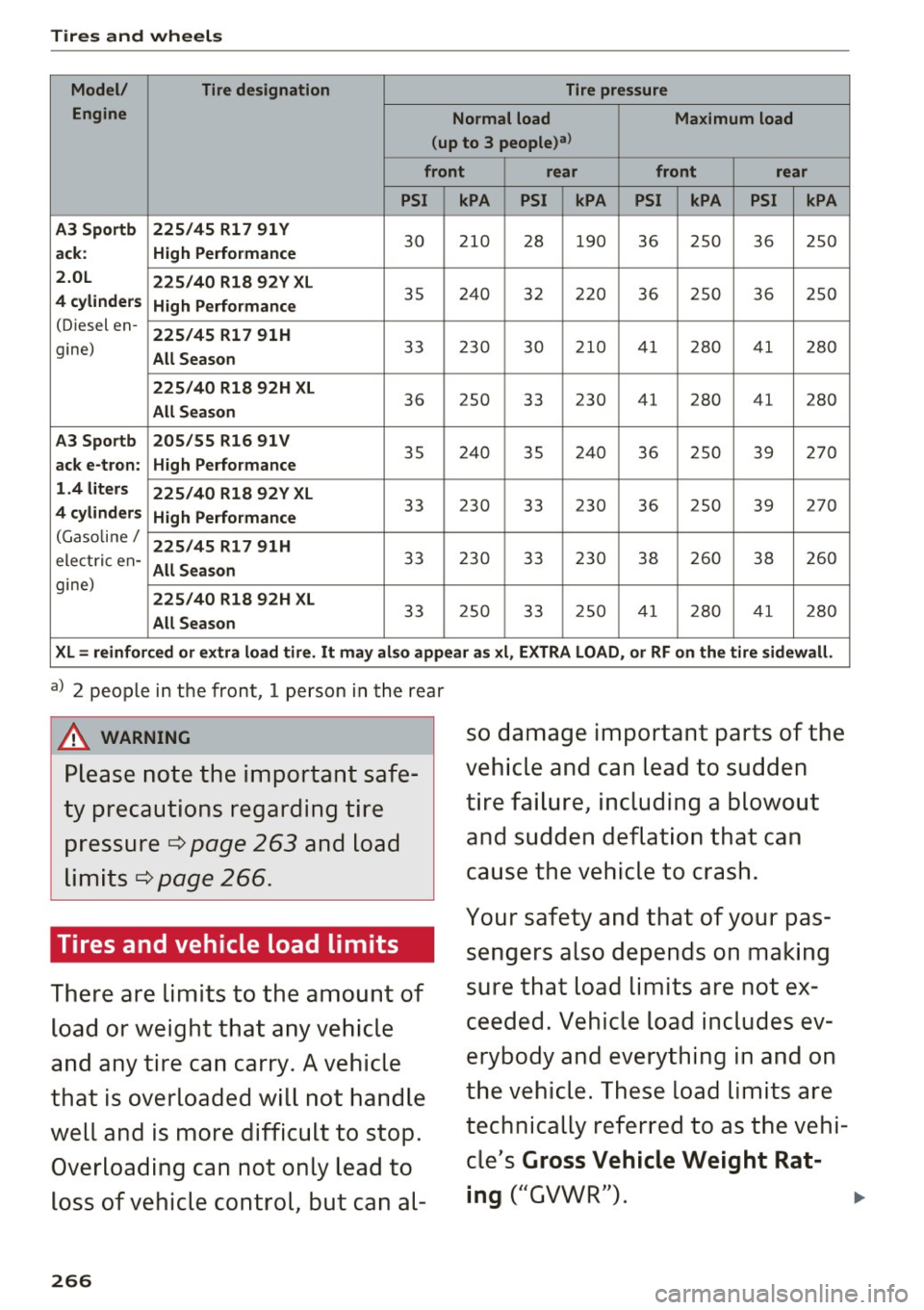
Tires and wheels Model/ Tire designation
Tire pressure
Engine Normal load
Maximum load
(up to 3 people)a>
front rear front rear
PSI kPA PSI kPA PSI kPA PSI kPA
A3 Sportb 225/45 Rl 7 91 Y ack: High Performance
30 210 28 190 36 250 36 250
2.0L
225/40 Rl8 92Y XL
4 cylinders High Performance
35 240 32 220 36 250 36 250
(Diesel en-
225/45 Rl7 91H
gine) All Season
33 230 30
210 41 280 41 280
225/40 Rl8 92H XL
All Season
36 250 33 230 41
280 41
280
A3 Sportb 205/55 Rl6 91 V
ack e-tron: High Performance
35 240 35 240 36 250 39 270
1.4 liters
225/40 Rl8 92Y XL
4 cylinders High Performance
33 230
33 230
36 250 39 270
(Gasoline/
225/45 Rl 7 91H
electric en- All Season
33 230 33 230 38 260 38 260
gine)
225/40 Rl8 92H XL
All Season
33 250 33 250 41 280 41 280
XL= reinforced or extra load tire. It may also appear as xi, EXTRA LOAD, or RF on the tire sidewall.
a) 2 people in the front, 1 person in the rear
A WARNING
Please note the important safe
ty precautions regarding tire pressure ¢
page 263 and load
limits ¢
page 266.
Tires and vehicle load limits
There are limits to the amount of
load or weight that any vehicle
and any tire can carry. A vehicle
that is overloaded will not handle
well and is more difficult to stop. Overloading can not only lead to
loss of vehicle control, but can al-
266
so damage important parts of the
vehicle and can lead to sudden
tire failure, including a blowout
and sudden deflation that can
cause the vehicle to crash.
Your safety and that of your pas sengers also depends on making
sure that load limits are not ex
ceeded. Vehicle load includes ev
erybody and everything in and on
the vehicle. These load limits are
technically referred to as the vehi cle's
Gross Vehicle Weight Rat-
ing
("GVWR"). ..,