change wheel AUDI S3 2016 User Guide
[x] Cancel search | Manufacturer: AUDI, Model Year: 2016, Model line: S3, Model: AUDI S3 2016Pages: 328, PDF Size: 81.78 MB
Page 213 of 328
,....,
N
0 > co ,....,
Your vehicle is equipped with a front "Advanced
Airbag System" in compliance w ith United States
F edera l Motor Vehicle Safety Standard ( FMVSS)
208, as well as Canada Motor Vehicle Safety
Standard (CMVSS) 208 as applicable at the time
your veh icle was manufactured.
The Advanced Airbag system in your vehicle has been certified to meet the "low-risk" require
ments for 3- and 6-year old children on the pas
senger side and small adults on the driver side.
The low risk deployment criteria are intended to
reduce the risk of injury through interaction with
the airbag that can occur, for example, by being
too close to the steering wheel and instrument panel when the airbag inflates. In addition, the
system has been certified to comply with the
"s uppress ion " req uirements of the Safety Stand
a rd, to turn off the front ai rbag for infants up to
12 months who are restrained on the front pas
senger seat in child restraints that are listed in
the Standard.
E ven though your vehicle is equipped with an Ad ·
vanced Airbag system, all children, especially
those 12 years and younger, should always ride
in the back seat properly restra ined for their age
and si ze. The airbag on the passenger side makes
the front seat a potentially dangerous place for a
child to r ide . The front seat is not the safest place
for a child in a forward-facing child safety seat .
It
can be a very dangerous place for an infant or a
l arger child in a rearward -facing seat.
The vehicle's Advanced A irbag System has a ca
pac itive passenger detect io n system in the front
passenger seat cush ion that can detect the pres
ence of a baby or a child in a ch ild restraint sys
tem on this seat .
The capacit ive passenger detection system regis
ters the changes that result in an electrical fie ld
when a ch ild, a child restra int, and a baby blanket
are on the front passenge r seat. The change in
the measured capacitance due to the presence of
a child, a child restraint, and a baby b lanket on
the front passenger seat is related to the child restraint system resting on the seat. The meas
ured capacitance of a child restraint system var-
Ch ild safety
ies depending on the type of system and specific
make and mode l.
T he elect rical capac itance of the va rious types,
makes, and models of chi ld restra ints specified
by the U.S .National Highway Traff ic Safety Ad
ministration (NHTSA) in the relevant safety
standard are stored in the Advanced Airbag Sys
tem control unit together with the capacitances
typ ical of infants and a 1-year old child. When a
child restraint is used on the front passenger
seat w it h a typical 1 year-old infant, the Ad
vanced Airbag System compares the capacitance measured by the capacitive passenge r detection
system with the data stored in the electronic co n
t rol unit.
Child restraints and Advanced front airbag
system
Regardless of the ch ild restraint that you use,
make sure that it has been certified to meet Safe
ty Standards and has been cert ified by its manu
facturer for use w ith an airbag . Always be sure
that the c hild rest raint is p roperly installed at
one of the rear seating positions . If in exception
al circumstances you must use it on the front
passenge r seat, carefu lly read a ll of the informa
tion on child safety and Advanced Airbags and heed all of the applicable WARNINGS . Make cer
tain that the chi ld and child restraint are correct
ly recognized by the capac itive passenger detec
t ion system in the front passenger seat, that the
front passenger a irbag is turned off, and that the
airbag status is always correctly s ignaled by the
PASSENGER AIR BAG OFF light .
Many types and models of child restra ints have
been available over the years, new models are in
troduced regu larly incorporating new and im
proved designs and older models a re take n out of
production. Child restra ints are no t standa rdized.
Child res tra ints of the same type typically have
different weights and sizes and different "foot
prints", the size and shape of the bottom of the
chi ld restraint that sits on th e seat, when they
are installed on a vehicle seat. These d ifferences
make it virtually impossib le to certify compliance
with the requirements for advanced a irbags w ith
each and every child restra int that has ever been ..,.
21 1
Page 260 of 328

Tires and wheels
"XL" "xl" "EXTRA LOAD" or "RF" I I I
on the sidewall.
Rim
means a metal support for a tire
or a tire and tube assembly upon
which the tire beads are seated.
Rim diameter
means nominal diameter of the
bead seat . If you change your
wheel size, you will have to pur
chase new tires to match the new rim diameter .
Rim size designation
means rim diameter and width.
Rim width
means nominal distance between
rim flanges.
Sidewall
means that portion of a tire be
tween the tread and bead .
Speed rating (letter code)
means the speed at which a tire is
designed to be driven for extend
ed periods of time. The ratings range from 93 mph (150 km/h)
to 186 mph (298 km/h)
c::> table
on page 254.
You may not find
this information on all tires be
cause it is not required by law.
25 8
The speed rating letter code,
where applicable, is molded on
the tire sidewall and indicates the maximum permissible road
speeds
c::> .&. in Winter tires on
page 269 .
Tire pressure monitoring
system*
means a system that detects
when one or mo re of a vehicle's
tires are underinflated and illum i
na tes a low tire pressure warning
telltale .
Tread
means that portion of a tire that
comes into contact w ith the road .
Tread separation
means pulling away of the tread
from the t ire carcass .
Treadwear indicators (TWI)
means the projections within the
principal grooves designed to give
a visua l indication of the degrees
of wear of the tread. See
c::> page 262, Treadwear indicator
for mo re information on measur-
ing tire wear. .,.
Page 266 of 328
Tires and wheels
A WARNING
Always adapt the tire pressure
to your driving style and vehicle load.
-Overloading can lead to loss of vehicle control and increase
the risk of an accident. Read and follow the important safe
ty precautions inc:::> page 266,
Tires and vehicle load limits.
-The tire must flex more if the
tire pressure is too low or if
the vehicle speed or load are
too high. This heats the tire up
too much. This increases the
risk of an accident because it
can cause the tire to burst and
result in loss of vehicle con
trol.
-Incorrect tire pressure in creases tire wear and has a
Tire pressure table
Please note that the information
contained in the following table
was correct at the time of print ing, and the information is sub
ject to change . If there are differ
ences between this information
and the tire pressures specified
on the label on the driver's side 8- pillar, always follow the specifica-
264
negative effect on driving and
braking behavior, which in
creases the risk of an accident.
(D Note
Replace lost valve caps to re
duce the risk of damage to the
tire valves.
@ For the sake of the environment
Tire pressure that is too low in
creases fuel consumption.
(D Tips
Audi recommends using the
tire pressure specified for a normal load c:::>
table on
page 265
or for a full load
when the vehicle is partially
loaded.
tion on the 8-pillar label c:::>
page 263, fig. 204.
Make sure that the tire designa
tion on your tire matches the des ignation on the tire pressure label
and the tire pressure table.
The following table lists recom- mended tire pressures in cold ..
Page 274 of 328
Tires and wheels
the vehicle placard or tire inflation pressure la
bel, you should determine the proper tire
inflation pressure for those tires).
As an added safety feature, your vehicle has been
equipped with a tire pressure monitoring system
(TPMS) that illuminates a low tire pressure tell
tale when one or more of your tires is significant ly under-inflated. Accordingly, when the low tire
pressure telltale illuminates, you should stop and
check your tires as soon as possible, and inflate
them to the proper pressure . Driving on a signifi
cantly under-inflated tire causes the tire to over
heat and can lead to tire failure. Under-inflation
also reduces fuel efficiency and tire tread life,
and may affect the vehicle's handling and stop
ping ability.
Please note that the TPMS is not a substitute for
proper tire maintenance, and it is the driver's re
sponsibility to maintain correct tire pressure,
even if under-inflation has not reached the level
to trigger illumination of the TPMS low tire pres
sure telltale.
Your vehicle has also been equipped with a TPMS
malfunction indicator to indicate when the sys
tem is not operating properly. The TPMS mal
function indicator is combined with the low tire
pressure telltale. When the system detects a
malfunction, the telltale will flash for approxi
mately one minute and then remain continuously
illuminated. This sequence will continue upon
subsequent vehicle start-ups as long as the mal
function exists .
When the malfunction indicator is illuminated,
the system may not be able to detect or signal
low tire pressure as intended. TPMS malfunctions
may occur for a variety of reasons, including the
installation of replacement or alternate tires or
wheels on the vehicle that prevent the TPMS
from functioning properly. Always check the
TPMS malfunction telltale after replacing one or
more tires or wheels on your vehicle to ensure
that the replacement or alternate tires and
wheels allow the TPMS to continue to function
properly .
272
· If the Tire Pressure Monitoring System
indicator appears
Applies to vehicles: with tire pressure monitoring system
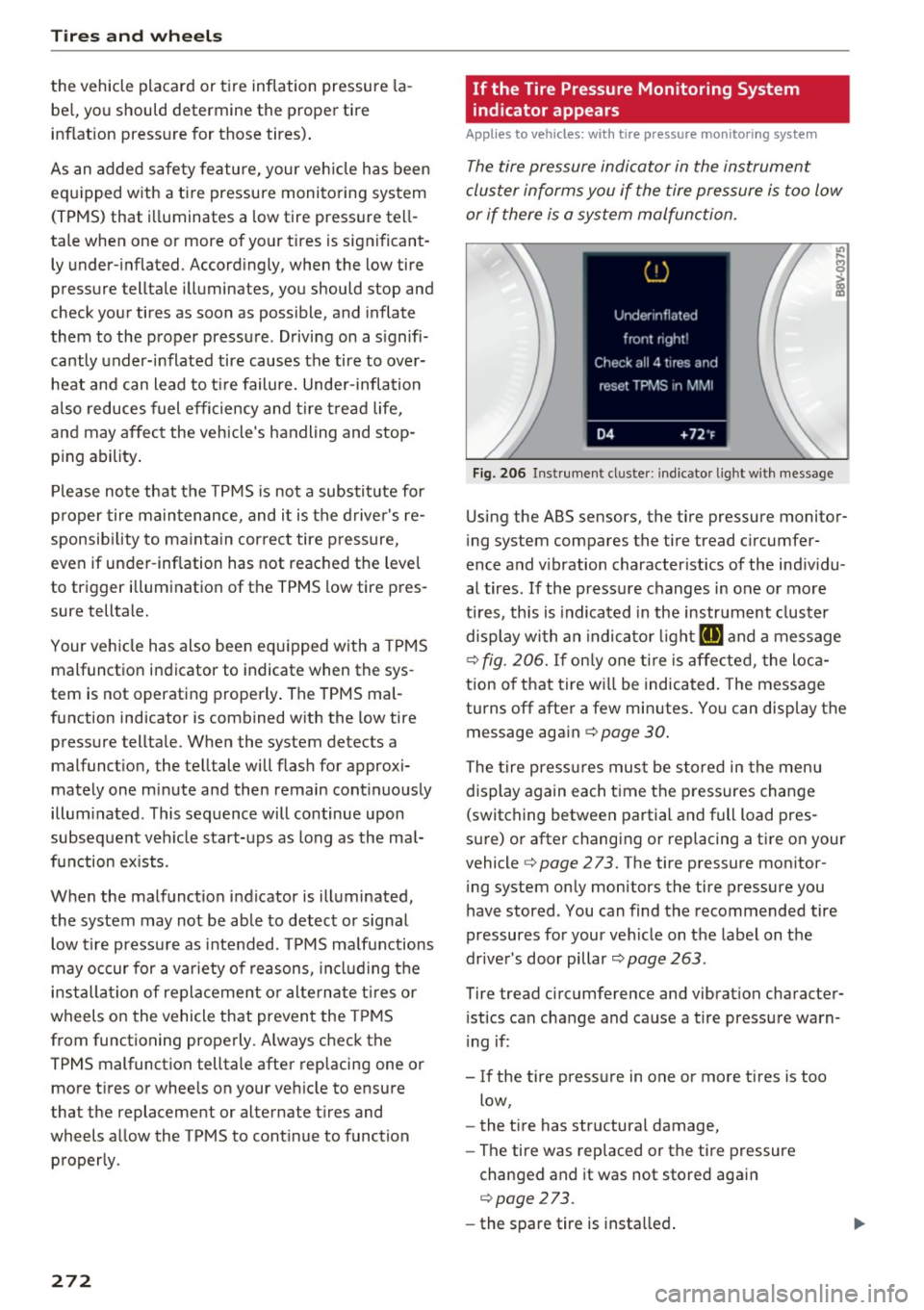
The tire pressure indicator in the instrument
cluster informs you if the tire pressure is too low
or if there is a system malfunction.
Fig. 206 Instrument cl uster: i ndic ator lig ht with message
Using the ABS sensors, the tire pressure monitor
ing system compares the tire tread circumfer
ence and vibration characteristics of the individu
al tires . If the pressure changes in one or more
tires , this is indicated in the instrument cluster
display with an indicator light
Rt] and a message
¢fig. 206. If only one tire is affected, the loca
tion of that tire will be indicated. The message
turns off after a few minutes. You can display the
message again¢
page 30.
The tire pressures must be stored in the menu
display again each time the pressures change
(switching between partial and full load pres
sure) or after changing or replacing a tire on your
vehicle
¢ page 273. The tire pressure monitor
ing system only monitors the tire pressure you
have stored . You can find the recommended tire
pressures for your vehicle on the label on the
driver's door pillar¢
page 263.
Tire tread circumference and vibration character
istics can change and cause a tire pressure warn
ing if:
- If the tire pressure in one or more tires is too
low,
- the tire has structural damage,
- The tire was replaced or the tire pressure
changed and it was not stored again
¢page 273.
-the spare tire is installed.
Page 275 of 328
,....,
N
0 > co ,....,
IE-Loss of pressure in at least one tire c::> ,&.
Check the tires and replace or repair if necessary.
Check/correct the pressures of all four tires. Then
store the tire pressures in the MMI
c::> page 2 73 .
mm (Tire Pressure Monitoring System) Tire
pressure: System malfunction!.
If m appears
after switching the ignition on or whi le driving
and the
IE indicator light in the instrument clus
ter blinks for approximately one minute and then
stays on, there is system malfunction. Try to
store the correct tire pressures
c::> page 2 73. If
the indicator light does not turn off or turns on
again after a short period of time, drive to an au
thor ized Audi dealer or authorized Audi Service
Facility immediately to have the malfunction cor
rected.
A WARNING
- If the tire pressure warning light IE in the
instrument cluster turns on, the pressure in
one or more tires is too low . Reduce the ve
hicle speed immediately and avoid any hard
steering or braking maneuvers. Stop as soon
as possible, check the tire and inflate the
t ir e to the correct pressure, which is speci
fied on the tire pressure label on the veh icle
c::> page 263. Driving with a ti re with low
pressure causes the tire to overheat and can
result in failure of the tire. Low pressure can
also have a negative effect on the driving
and braking behavior of the vehicle .
- Th e driver is responsible for maintaining the
correct tire pressures. You must check the
tire pressures regularly.
- Under certain conditions (such as a sporty
driv ing style, winter conditions or unpaved
roads), the pressure monitor indicator may
be delayed.
- Do not use run-flat tires on your vehicle . Us
ing them when not permitted can lead to
vehicle damage or accidents.
(D Tips
- The tire pressure monitoring system can al
so stop working when there is an ESC mal
function.
Tires and wheels
-Using snow chains may result in a system
ma lfunction.
- The tires with the identification "AO" or
"RO"
c::> page 260 have been matched with
your Audi tire pressure monitoring system .
We recommend that you use these tires.
- The tire pressure monitoring system can on
ly monitor the tire pressure of the driving
tires. Check the tire pressure of the spare
wheel in the luggage compartment so that if necessary it is ready for use.
Storing tire pressures
Applies to vehicles: with tire pressure mon itor ing system
A change in tire pressure or a change in tires
must be stored in the system.
The tire pressure is stored in the MMI.
.,. Make sure befo re storing that the tire pressures
of all four tires meet the specified va lues and
are adapted to the load. Otherwise the system
could malfunction
c::> page 263.
.. Switch on the ign ition.
.,.. Select: the I MENU I button> Car> Systems "
control button > Service & control > Tire pres
sure monitor > Store tire pressure > Yes, store
now .
(D Tips
Do not store the tire pressures if snow chains
a re installed . Otherwise the system could
malfunction.
273
Page 283 of 328
.... N
0 > CX)
.... I.Cl U"I
.... I.Cl ....
both tabs on the side panels ¢ fig. 209 (top im
age).
.. A3 Sedan: clip the plastic hook@ into the lug
gage compartment seal¢
fig. 209 (bottom im
age) .
Side panel
.. Open the twist lock and remove the cover @* I
@ ¢fig. 208 .
.&_ WARNING
Improper use of the vehicle jack can cause se
rious personal injuries.
- Never use the screw driver hex head to
tighten wheel bolts, since the bolts cannot
atta in the necessary tightening torque if you
use the hex head, potentially caus ing an ac
c ident.
- The factory-supplied jack is intended only
for your vehicle model. Under no circum
stances should it be used to
lift heavy
vehicles o r other loads; you r is k inju ring
yo urself.
- Never start the engine when the vehicle is
ra ised, whi ch could cause an accide nt.
- Support the veh icle secure ly with app ropr i
ate stands if wor k is to be perfo rmed under
neath t he vehicle; otherwise, the re is a po
tent ial risk for in jury.
- Never use the jack s upplied with your Audi
on another vehicle, par tic ularly on a heav ier
one. The jack is only suitab le for use on the
vehicle it came with .
(D Tips
The vehicle jack* in your vehicle is mainte
na nee-free.
Tire mobility kit
Preparation
A ppl ies to vehicles: W ith t ire re pair set
.. Read and fo llow th e import ant saf ety pr ecau
tion s¢
page 280, General information .
.. Check if a repair w ith the t ire mobility k it is pos
s ible
¢ page 281.
Emergen cy a ssis tanc e
Using the tire mobility kit
App lies to vehic les : With tire r epair set
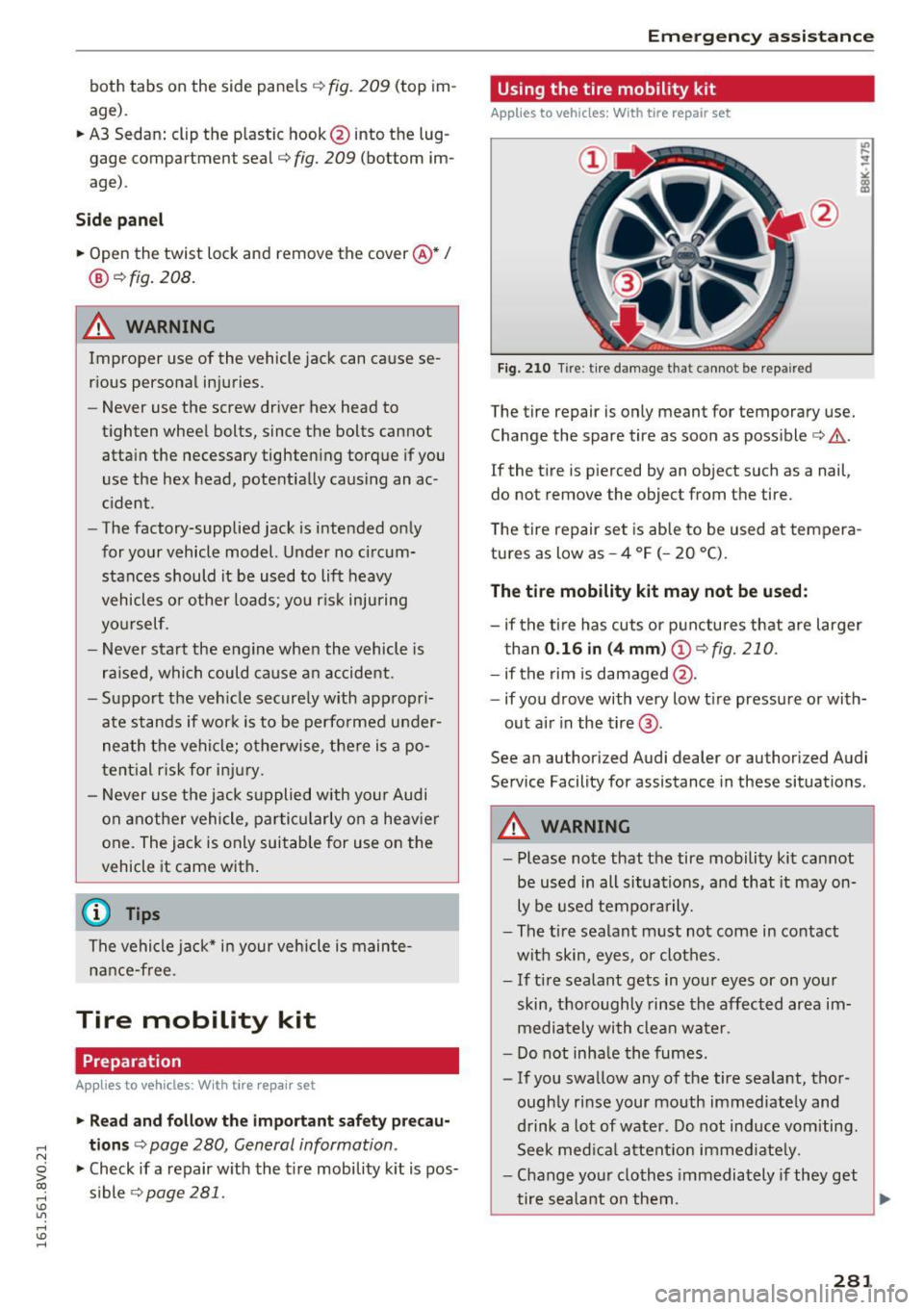
F ig. 210 T ire: t ire damage t hat cannot be repaired
The tire repair is only meant for temporary use.
Change the spare tire as soon as possible <=>,&. .
If the t ire is p ierced by an object such as a nail,
do not remove the object from the tire.
The tire repair set is ab le to be used at tempera
tures as low as - 4 °F (- 20 °C).
The t ire mobility kit may not be us ed:
- if the ti re has cuts or punctures that are larger
than
0 .1 6 in (4 mm)@ ¢ fig. 210.
-if the rim is damaged @.
- if you drove with very low t ire pressure or with-
out air in the tire @.
See an authorized Audi dealer or authorized Audi
Service Facility for assistance in these situations .
.&_ WARNING
>=
-Please note that the tire mobility kit cannot
be used in all situations, and that it may on
ly be used temporarily.
- The tire sealant must not come in contact
wit h skin, eyes, o r clothes.
- If ti re sealant gets in you r eyes or on yo ur
skin, tho ro ughly rinse the affected area im
mediately wi th clea n wate r.
- Do not inha le the fumes.
- If you swallow any of the tire sealant, thor-
ough ly rinse your mouth immediately and
drink a lot of water . Do not ind uce vomiting.
Seek med ica l attent io n immed iate ly .
- Change yo ur clothes immediately if they get
tire seala nt on them.
~
281
Page 285 of 328
,....,
N
0 > co ,....,
Appl ies to vehicles: W ith t ire repa ir set
.,. Adhe re the sticke r that says "max. SO mph
(max. 80 km/h)" that is p rovided w ith the t ire
mobility k it within the driver's fie ld of vision .
.,. Stop the vehicle after driving for about 10 mi
nutes and check the tire pressure .
.,. lfthe tire pressure is lower than 19 psi (130
kPA), then the tire is too severely damaged. Do
not cont inue driving. See an authorized Audi
dealer or authorized Audi Service Facil ity for as
s istance .
.,. If the t ire pressure is at least 19 psi (130 kPA),
adjus t the tire pressu re to the spec ified value
~ page 263, Tire pressure . Store the tire pres
sures
~page 273, Storing tire pressures . Drive
to the nearest authorized Audi dealer or au
thorized Audi Serv ice Facility to have the tire re
placed.
A WARNING
If the tire pressure is less than 19 psi
(130 kPA) after 10 minutes of d riving, then
the tire is too severely damaged. Do not con
tinue dr iv ing . See an authorized Audi dealer
or autho rized Audi Service Fac ility for assis
t ance.
A WARNING
Pay a ttent ion to the following after repair ing
the tire:
- Do not drive faster than 50 mph (80 km/h).
- Avoid hard acceleration, brak ing sharp ly,
and fast corner ing.
- The veh icle may become mo re difficu lt to
co ntro l.
-If the t ire is too severely damaged, see an
authorized Audi dealer o r autho rized Aud i
Service Facility for assistance .
@ For the sake of the environment
You can give the used t ire sealant bottle to an
author ized Audi dealer or authorized A udi
Serv ice Facility fo r disposal.
Em ergenc y ass is tanc e
{!) Tips
Remember to obtain a new bott le of sealant
from an authorized A udi dealer or authorized
Audi Service Fac ility after repairing a tire.
Replacing wheels
Before changing a wheel
Observe the following precautions for your own
and your passenger's safety when changing a wheel.
.,. After you experience a t ire failure, pull the car
well away from moving traffic and try to reach
le vel grou nd before you stop~,& .
.,. All passengers should
leave the car and move
t o a safe location (for ins tance, behind the
gua rdrail) ~,& .
.,. Engage the
pa rking brake to prevent your vehi
cle from rolling unintentionally ~ .,& .
.,. Move
sele ctor le ver to po sition P ~ .,& .
.,. If you are tow ing a trai ler, unhitch the trailer
from yo ur vehicle .
.,. Take the jack Q page 280 and the spare tire
~ page 289 out of the luggage compartment.
A WARNING
You o r you r passengers could be injured while
changing a whee l if yo u do not follow these
safety precaut ions :
- If you have a fla t tire, move a safe dis tance
off the road. Turn off the eng ine, turn the
emergency f lashers on and use other warn
ing devices to alert other motorists.
- Make sure that passenge rs wai t in a safe
p lace away from the vehicle and well away
from the road and t raffic.
- To help prevent the vehicle from moving suddenly and possib ly slipping off the jack,
always fu lly set the park ing brake and block
the wheel d iagonally opposite the wheel be
ing changed . When one front whee l is lifted
off the ground, placing the Automatic
Transmission i n P (Park) w ill
not prevent the
veh icle from moving.
~
283
Page 286 of 328
Emergency assistance
-Before you change a wheel, be sure the
ground is level and firm. If necessary, use a
sturdy board under the jack.
- Always store the vehicle tool kit, the jack
and the replaced tire in the luggage com
partment
c:> page 172.
Changing a wheel
When you change a wheel, follow the sequence
described below step-by-step and in exactly that
order.
1. Remove the decorative wheel cover*. For
more details see also
c:> page 284, Decora
tive wheel covers
or c:> page 285, Wheels
with wheel bolt caps.
2 . Loosen the wheel bolts c:> page 285 .
3. Locate the proper mounting point for the
jack and align the jack below that point
c:> page 286 .
4. Raise the car with the jack c:> page 286 .
5. Remove the wheel with the flat tire and then
install
the spare c:>page 287.
6. Tighten all wheel bolts lightly.
7 .
Lower the vehicle with the jack.
8. Use the wheel bolt wrench and firmly tighten
all wheel bolts
c:> page 285.
9. Replace the decorative wheel cover* .
_&. WARNING
Always read and follow all WARNINGS and in
forma tion
c:> .& in Raising the vehicle on
page 286
and c:> page 288.
After changing a wheel
A wheel change is not complete without the do
ing the following .
.,. Always store the vehicle tool kit, the jack* and
the replaced tir e in the luggage compartment
c:> page 172 .
.,. Check the tire pressure on the spare wheel im
mediate ly after mounting it .
.,. As soon as possible, have the
tightening tor
ques
on all wheel bolts checked with a torque
wrench. The correct tightening torque is 90 ft
lb
(120 Nm).
284
.,. Have the flat tire replaced as soon as possible .
@ Tips
- If
you notice that the wheel bolts are cor
roded and difficult to turn while changing a
tire, they shou ld be replaced before you
check the tightening torque .
- Drive at reduced speed until you have the
tightening torques checked.
- After chang ing a wheel, the tire pressure in
all four tires must be checked/corrected and
the tire pressure monitoring indicator m ust
be stored in the MMI
c:>page 273.
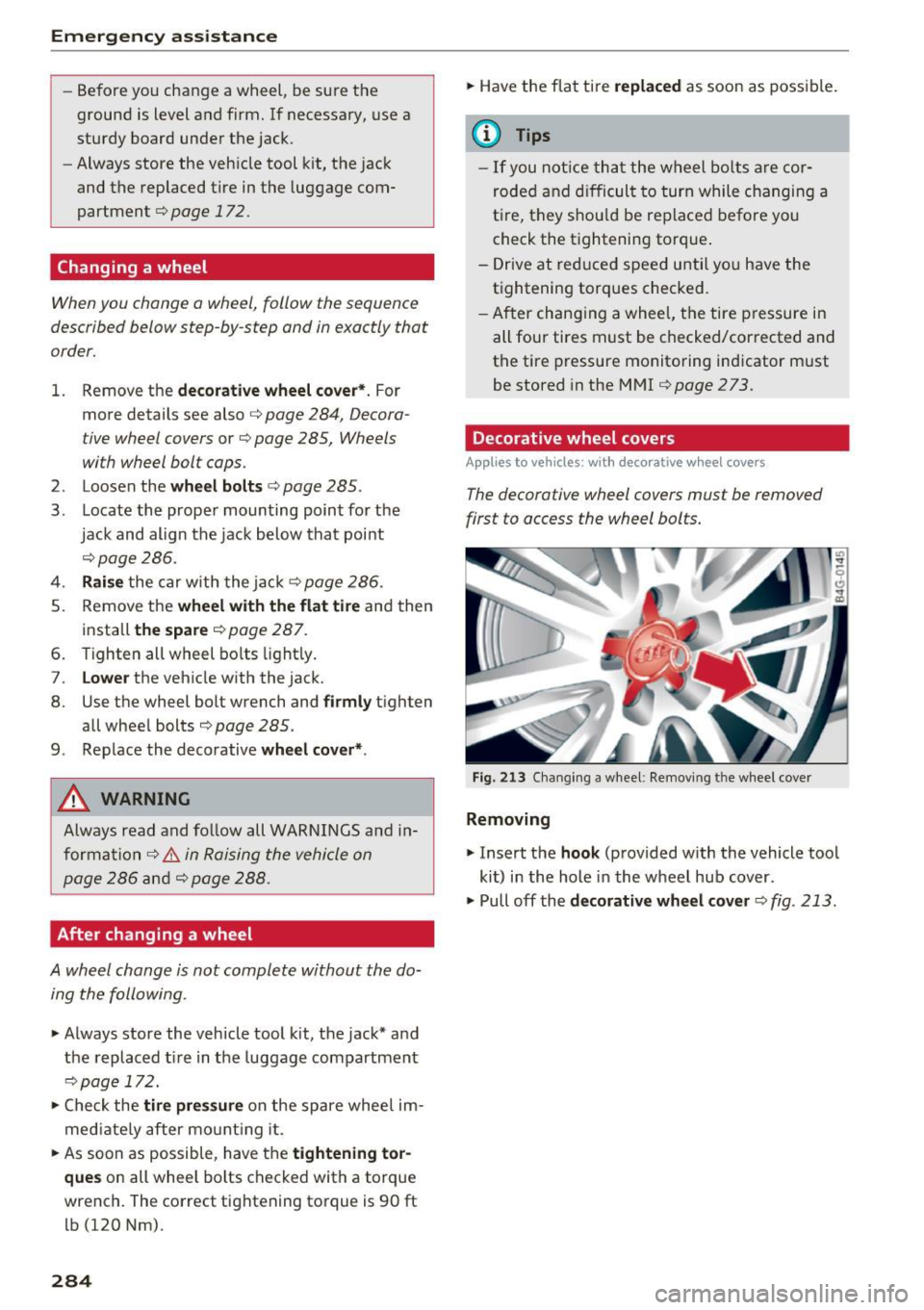
Decorative wheel covers
Applies to vehicles: wit h decorative wheel covers
The decorative wheel covers must be removed
first to access the wheel bolts .
Fig. 213 Chang ing a w heel : Remov ing t he wheel cover
Removing
.,. Insert the hook (provided with the vehicle tool
kit) in the hole in the wheel hub cover.
.,. Pull off the
decorative wheel cover c:> fig. 213 .
Page 288 of 328
Emerg ency assis ta nce
Raising the vehicle
The vehicle must be li~ed with the jack first be
fore the wheel can be removed .
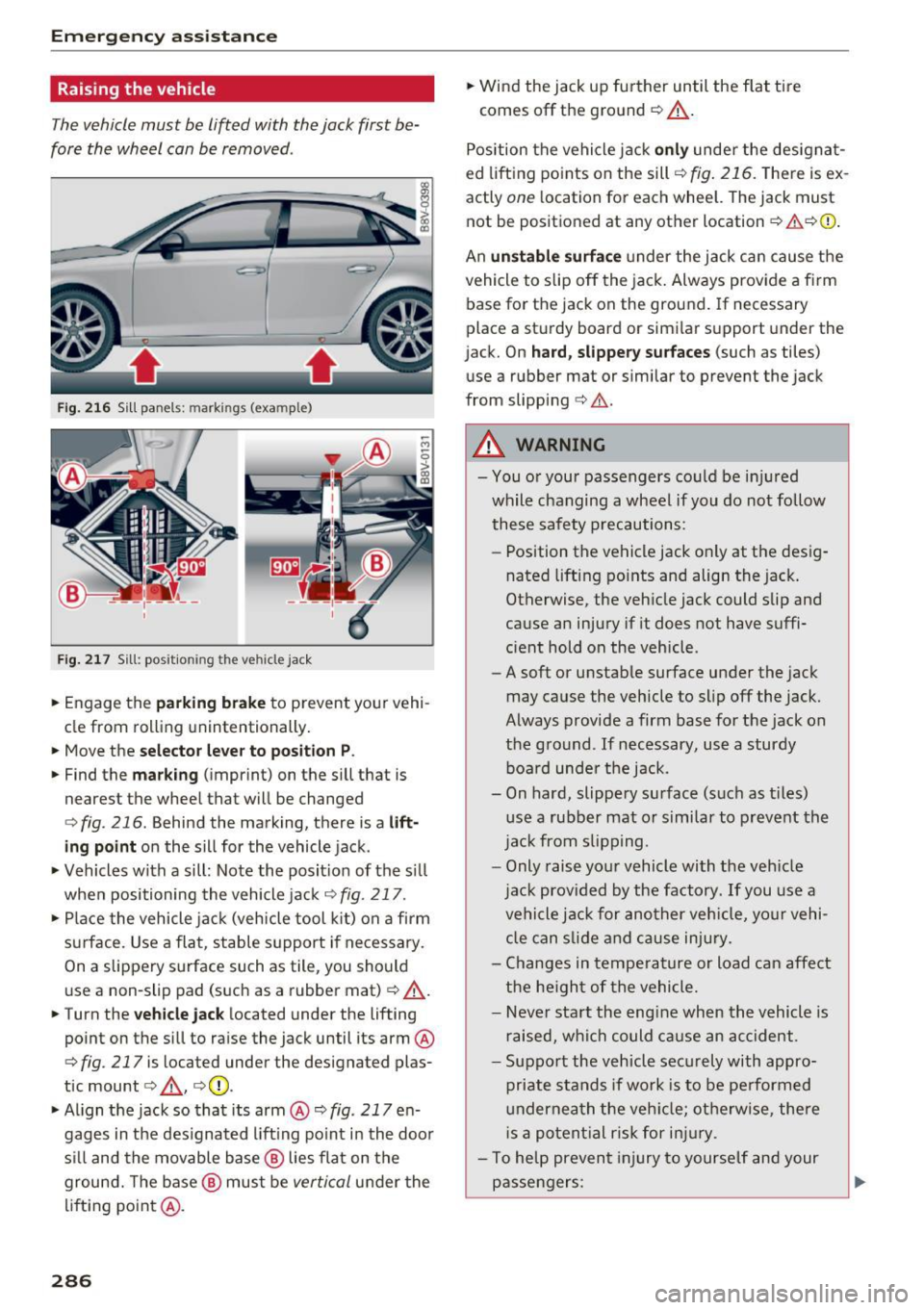
Fig. 216 Sill panels : markin gs (example)
Fig . 217 S ill : pos itio ning the vehicle jack
• Engage the park ing b rake to prevent you r vehi
cle from rolling unintentionally.
• Move the
sel ec tor lev er to position P.
• Find the ma rk ing ( impr int) on the sill that is
nearest the wheel that will be changed
¢ fig. 216 . Behind the marking, there is a lift
ing point on the sill for the vehicle jack .
• Vehicles with a sill: Note the posit io n of the s ill
when positioning the vehicle jack ¢
fig. 217 .
• Place the vehicle jack (veh icle tool kit) on a firm
s u rface. Use a flat, stable s upport if necessary.
On a slippery surface such as tile, you should
use a non-slip pad (such as a rubber mat)
¢ .&_ .
• Turn the vehicle j ack located under the lifting
point on the sill to ra ise the jack until its arm @
¢fig . 217 is located under the designated plas
tic mount ¢
_A, ¢(D.
• Al ign the jack so that its arm @
q fig. 217 en
gages in the des ignated lift ing po int i n the doo r
s ill and the movable base @ lies flat on the
ground. The base @ must be
vertical under the
li ft ing point @.
286
• Wind the jack up further until the flat tire
comes off the ground ¢
_A.
Position the vehicle jack only under the designat
ed lifting points on the sill ¢
fig. 216. There is ex
actly
one l ocation fo r each wheel. The jack must
not be positioned at any other location ¢
,1.¢(D .
An un stab le surf ace under the jack can cause the
vehicle to slip off the jack. Always provide a firm
base for the jack on the ground. If necessary
place a st urdy board or similar s upport under the
jack. On
ha rd, slipper y sur fac es (such as tiles)
use a rubber mat or similar to prevent the jack
from slipping ¢& .
A WARNING
-You or your passengers could be inj ured
while changing a wheel if you do not follow
these safety precautions:
- Position the vehicle jack only at the desig
nated lifting po ints and align the jack .
Otherwise, the veh icle jack could slip and
cause an injury if it does not have suffi
cient hold on the vehicle .
- A soft or unstab le surface under the jack
may cause the vehicle to slip off the jack.
Always provide a firm base for the jack on
the gro und . If necessary, use a sturdy
boa rd unde r the jack.
- On hard, slippery surface (such as t iles)
u se a rubber mat o r similar to p revent the
ja ck from s lipp ing.
- Only raise your vehicle with the veh icle
j ack prov ided by the factory . If you use a
vehicle jack for another veh icle, yo ur vehi
cle can s lide and cause injury.
- Changes in tempe rature or load can affect
the he ight of the vehicle.
- Never start the eng ine when the vehicle is
r aised, w hich could cause an accident.
- Suppo rt the vehicle sec urely with appro
priate stands if work is to be pe rformed
u ndernea th the ve hicle; ot herwise, there
i s a potent ial risk for in jury.
- To he lp prevent injury to yourse lf and your
p assengers: .,.
Page 289 of 328
.... N
0 > CX)
.... I.Cl U"I ,....,
I.Cl ....
-Do not raise the vehicle until you are sure
the jack is securely engaged.
- Passengers must not remain in the vehicle
when it is jacked up.
- Make sure that passengers wait in a safe
p lace away from the vehicle and well away
from the road and traff ic.
- Make sure jack position is correct, adjust
as necessary and then cont inue to raise
the jack.
- Changes in temperature or load can affect
the height of the vehicle.
CD Note
Do not lift the vehicle by the sill. Position the
veh icle jack on ly at the designated lifting
points on the sil l. Otherwise, your vehicle will
be damaged.
Taking the wheel off/installing the spare
Follow these instructions step-by-step for chang
ing the wheel .
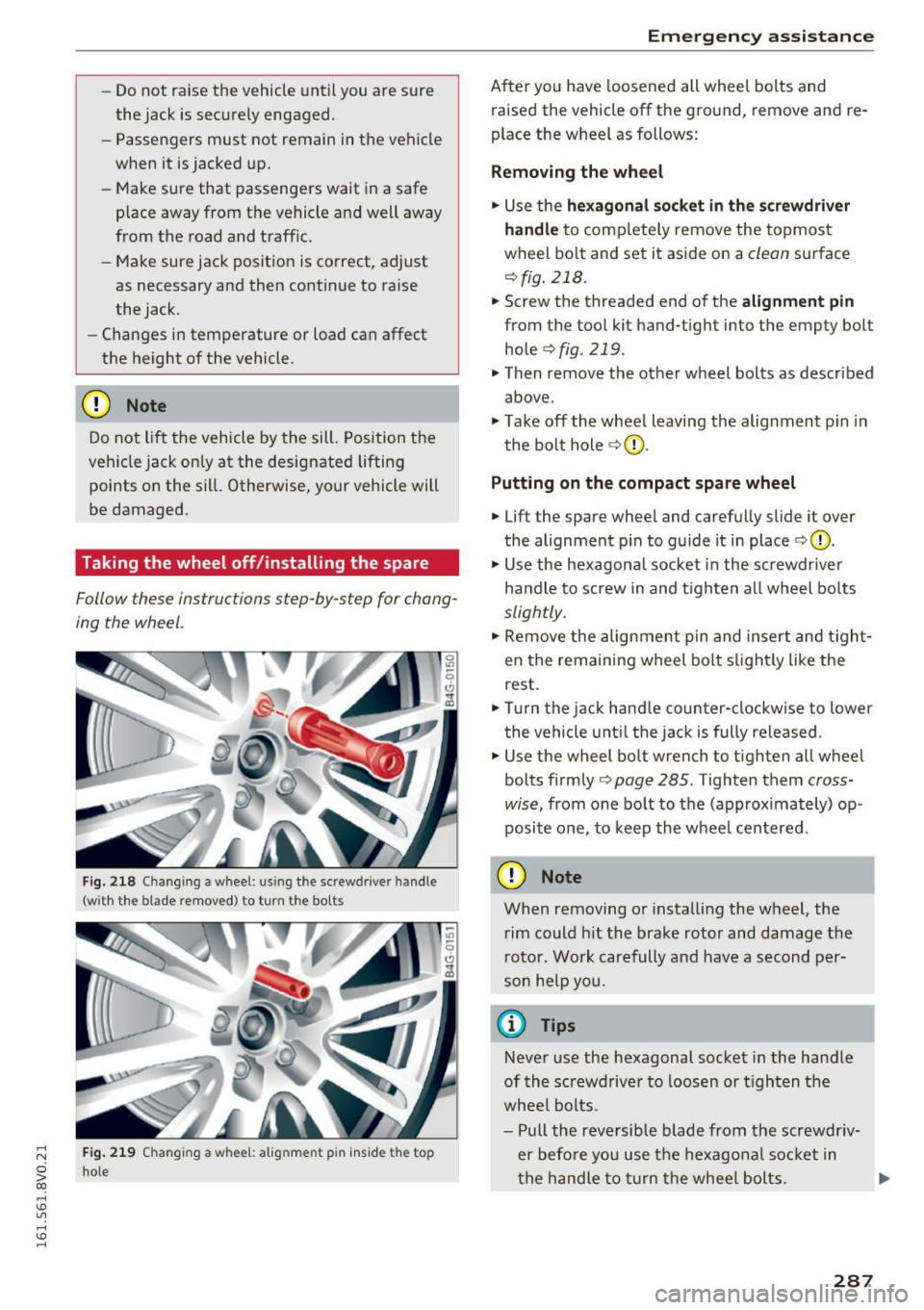
Fig. 2 18 Ch anging a whee l: using the screwd river handle
(with the blade removed) to turn the bolts
F ig . 2 19 Ch ang ing a whee l: alig nmen t pin inside the top
hole
Em ergen cy a ssis tanc e
After you have loosened all wheel bolts and
raised the vehicle off the ground, remove and re
place the wheel as follows:
Removing the wheel
.,.. Use the hexagonal socket in the screwdri ver
handle
to comp letely remove the topmost
wheel bo lt and set it aside on a
clean su rface
c!>fig. 218.
.,.. Screw the threaded end of the alig nment pin
from the tool kit hand-tight into the empty bo lt
hole
r::!> fig . 219.
.,.. Then remove the other wheel bolts as descr ibed
above .
.,.. Take off the wheel leaving the alignment p in in
the bolt hole
~ 0-
Putting on the comp act spare wheel
.,.. Lift the spare wheel and carefully slide it over
the alignment p in to guide it in place
r::!> (0 .
.,.. Use the hexagonal socket in the screwdr iver
handle to screw in and tighten a ll wheel bolts
slightly .
.,.. Remove the alignment pin and insert and t igh t
en the remaining wheel bo lt s light ly like the
rest .
.,.. Turn the jack hand le counter -clockwise to lower
the vehicle until the jack is fully released .
.,.. Use the wheel bolt wrench to tighten a ll wheel
bolts firmly
r::!> page 285 . Tighten them cross
wise,
from one bo lt to the (approx imately) op
posite one, to keep the wheel centered .
CD Note
When removing or installing the wheel, the
rim co uld h it the brake rotor and damage the
r otor. Work carefully and have a second per
son help you.
0) Tips
Never use the hexagonal socket in the handle
of the sc rewdrive r to loosen or t ighten the
whee l bolts.
- Pull the reversible blade from the screwdr iv
er before yo u use the hexagona l soc ket in
t he handle to tu rn the whee l bolts.
287