child restraint AUDI S3 2016 User Guide
[x] Cancel search | Manufacturer: AUDI, Model Year: 2016, Model line: S3, Model: AUDI S3 2016Pages: 328, PDF Size: 81.78 MB
Page 187 of 328
,....,
N
0 > co ,....,
ro ll-overs.
A lwa ys rememb er: Airbags will deploy only o nce,
and on ly in certain kinds of coll is ions. Your safety
be lts are always there to offer protection in those
situations in which airbags are not supposed to
deploy, or when they have a lready deployed; for
examp le, when your vehicle str ikes or is struck by
another vehicle after the first collis ion.
This is just one of the reasons why an airbag is a
supp lementary restraint and is not a substitute
for a safety belt. The airbag system works most effect ively when used with the safety belts.
Therefore, always properly wear your safety belts
c::>page 176.
A WARNING
Sitting too close to the steer ing whee l or in
st rument panel will decrease the effect ive
ness of the airbags and will inc rease the risk
o f persona l injury in a co llision.
- Never sit closer than 10 inches (25 cm) to
the steering wheel or instrument panel.
- If you cannot sit mo re than 10 inches
( 2 5 cm) from the steering wheel, inves ti
gate whethe r adaptive equipment may be
available to help you reach the pedals and
increase your seating distance from the
steering wheel.
- All veh icle occupants and especially children
must be restrained properly whenever riding
in a vehicle. An unrestrained or improperly
restra ined child could be injured by stri king
the inte rior or by being ejected from the ve
hicle d uring a sudden maneuver or impact.
An unrestrained or imp roperly restrained
child is also at greate r risk of inju ry or death
through contact with an inflating airbag .
-If you are unrest rained, leaning fo rwa rd, s it
t ing s ideways or o ut of pos ition in any way,
yo ur risk of in jury is mu ch h igher.
- Yo u will also receive serious injur ies and
c ou ld even be killed if you are up ag ainst the
airbag or too close to it w hen it inf lates -
even with an Advanced Ai rbag.
-
Airb ag sys tem
-To reduce the r is k of injury when an airbag
inflates, always wear sa fety belts prope rly
c::> page 179, Safety belts.
- Always make certain that children age 12 or
younger always ride in the rear seat. If chil
dren are not properly restrained, they may be severely injured or killed when an airbag
inflates.
- Never let children r ide unrestrained or im
p roperly restrained in the vehicle. Ad just the
front seats properly.
- Never ride with the back rest recl ined .
- Always sit as far as possible from the steer-
ing wheel or the instrument panel
c::> page 167.
- Always sit upright with your back against
the backrest of your seat .
- Never p lace your feet on the instrument
panel or on t he seat. Always keep both feet
on the floor in front of the seat to help pre
vent ser ious injuries to the legs and hips if
the airbag inflates.
- Never recl ine the front passenger's seat to
transpo rt objects , Items can also mo ve in to
the area of the s ide a irbag or the front air
b ag d uring braking o r in a sudden maneu
ver. Obje cts ne ar the airbags can be come
p roject iles and cause injury when an airbag
inflates .
A WARNING ,.___ -
Airbags that have deployed in a crash m ust be
replaced.
- Use on ly original equipment airbags ap
proved by A udi and installed by a t rained
technician who has the necessary tools and
d iagnostic equipment to properly replace
any airbag in yo ur vehicle and assure system
effect iveness in a crash .
- Never permit salvaged or recycled airbags to
be installed in your vehicle.
Child restraints on the front seat - some
important things to know
.,. Be s ure to read the impo rtan t in format ion and
heed the WARN INGS for important deta ils
185
Page 188 of 328
Airbag syste m
about children and Advanced Airbags
¢page 209 .
Even tho ugh your vehicle is equipped with an Ad
vanced Airbag System, make certain that all chi l
dren, especially those 12 years and younger, al
ways ride in the back seat proper ly restrained for
their age and size. The airbag on the passenger
side makes the front seat a potentially dangerous place for a child to ride. The front seat is not the
safest place for a child in a forward-facing child
seat . It ca n be a very dangerous place for an in
fant or a c hild in a rearward-fac ing seat.
The Advanced Airbag System in your veh icle has
been cert ified to comply with the requirements
of United States Federal Motor Vehicle Safety
Standard ( FMVSS) 208, as well as Canada Motor
Veh icle Safety Standa rd (CMVSS) 208 as applica
b le at the time your vehicle was man ufa ct ur ed.
According to requi rements, the front Advanced
Airbag System on the passenger side has been
certified for "suppression" for infants of about 12 month old and younger and for "low risk de
ployment" for children aged 3 to 6 years o ld (as
defined in the standard) .
The
PAS SENGER AIR BAG O FF light in the instru
ment panel tells you when the front Advanced
Airbag on the passenger side has been turned off by the electronic control unit.
Each time you switch on the ignition, the
PAS
S ENGER AIR BAG OFF
light will come on for a
few seconds and:
- will stay on if the front passenger seat is not
occupied,
- will stay on if the electrical capacitance meas
ured by the capacitive passenger detection sys
tem for the front passenger seat equals the
combined capacitance of an infant up to about one year of age and one of the rearward-facing
or forward-facing child restraints listed in Fed
eral Motor Vehicle Safety Standard 208 w ith
which the Advanced Airbag System in your veh i
cle was certified. Fo r a listing of the child re
straints that were used to cert ify your vehicle's
compliance with the U.S. Safety Standard
¢ page 211 .
186
- will stay on if there is a sma ll child o r chi ld re
straint on the front passenger seat,
- wi ll go off if the front passenger seat is occu
pied by an adult as registered by the capacitive
passenger detectio n system ~
page 196, Mon
itoring the Advanced Airbag System.
The PAS SENGER AIR BAG OFF lig ht comes on
when electrical capacitance registered on the
front passenger seat is equal to or less than the
combined capacitance of a typical 1 year-old in
fant and one of the rearward-facing or forward
facing child restraints listed in Federal Motor Ve hicle Safety Standard 208 w ith which the Ad
vanced Airbag System in your vehicle was certi
fied .
If the total electr ical capacitance registered o n
the front passenger seat is more than that of a
typ ical 1 year-old chi ld but less than the weight
of a sma ll adult, the front airbag on the passen
ger side can deploy (the
PAS SENGER AIR BAG
OFF
light does not come on).
If the
PASSENGER AIR BAG OFF light does not
come on, the front airbag on the passenger side
has not been t urned off by the electron ic con trol
u nit and can dep loy if the con trol uni t senses an
impact t hat meets the conditions stored in its
memo ry.
For exampl e, the airbag ma y depl oy if:
- a small ch ild that is heav ier than a typ ical 1
year-old child is on the front passenger seat (regard less of whethe r the child is in one of the
child seats listed ¢
page 211), or
- a child who has outgrown ch ild restraints is on
the front passenge r seat.
If the front passenger a irbag is turned off, the
PA SSENGER AIR BAG OFF light comes on in the
i nst rument cluster and stays on .
If the front passenger airbag deploys, the Feder
al Standard requires the airbag to meet the "low
risk" dep loyment criteria to reduce the r isk of in
ju ry through interaction w ith the airbag . "Low
r isk" dep loyment occurs in those crashes that
take place at lower decelerations as defined in
the e lectronic contro l unit ¢
page 196, PASSEN-
GER AIR BAG OFF light. .,_
Page 189 of 328
,....,
N
0 > co ,....,
installed on the front seat may be struck and
knocked out of position by t he rapidly inflating
passenger's airbag in a frontal co llision . The air
bag could greatly reduce the effectiveness of the
chi ld restraint a nd even seriously i njure the ch ild
during inflation .
For this reason, and because the back seat is the
safest place for ch ildren -when properly restra in
ed according to the ir age and size -we strongly
recommend that children always sit in the back
seat
Q page 209, Child safety.
.8, WARNING
A child in a rearward-facing chi ld seat insta l
led on the front passenger seat will be ser i
ously injured and can be k illed if the front air
bag inf lates -even with an Advanced Airbag
System.
- The inflating a irbag w ill hit the child seat or
infant carrier with great fo rce and will
smash the ch ild seat and child against the
backrest, center arm rest, door or roof.
- Always ins tall rear-facing child seats on the
rear seat.
-If you must install a rearward fac ing child
seat on the front passenger seat because of
exceptiona l circumstances and the
PASSEN·
GER AIR BAG OFF
light does not come on
and stay on, immediately insta ll the rear
facing child seat in a rea r seat ing position
and have the airbag system inspected by
yo ur Audi dealer.
- Forward-fac ing ch ild seats insta lled on the
front passenge r's seat may interfe re with
the deployment of the airbag and ca use se
rious person al injury to the child.
.8, WARNING
If, in except io nal circumst ances, you mus t in
stall a forward-f acing chi ld restraint on the
front passenger's seat:
- Always ma ke sure the forwar d-fa cing se at
has been designed and ce rtified by its man
ufact urer for use on a front seat with a pas
senger front and s ide a irbag .
.
Airb ag sys tem
-Never put the fo rward-facing child restraint
up aga inst or very near the instrument pan
el.
- Always move the passenger seat into its
rearmost posit ion in the seat's fore and aft
adjustment range, as far away from the a ir
bag as possible before installing the for
ward-facing chi ld restraint. The backrest
must be adjusted to an upr ight position .
- Make sure that the
PASSENGER AIR BAG
OFF
li ght comes on and stays on a ll the time
wheneve r th e ignit ion is switched on.
.8, WARNING
To reduce t he ris k of serious injury, ma ke sure
that the
PASSENGER AIR BAG OFF li gh t will
be d isplayed whenever a child res traint is in
stalled on the front passenger seat and the ignition is switched on.
- If th e
PASSENGER AIR BAG OFF li ght does
not stay on, perform the checks described
¢ page 196, Monitoring the Advanced Air
bag System.
- Take the child restra int off t he front passen
ger seat and install it prope rly at one of the
rear seat positions if the
PASSENGER AIR
BAG OFF
light does not stay on.
- Have the ai rbag system inspected by your
Aud i deale r immediately.
- Always care fully follow instructions from
child restraint manufacture rs when instal
ling child restra ints.
.8, WARNING
--
If, in exceptional c ircumstances, you must in
stall a forward or rearward-facing child re
stra int on the fron t passenger's seat :
- Improper installat io n of child restraints can
reduce the ir effectiveness or even prevent
them from providing any pro tect ion.
- An improperly installed child restra int can
interfere wi th the airbag as it deploys and
serio usly injure or even kill th e chi ld -even
with a n Advan ced A irbag System.
- Always carefully follow the manufacturer's
i n str uctions provided with the child seat or
car rie r.
187
Page 192 of 328
Airbag syste m
restrained, not just because the law requires you
to be.
The Advanced Airbag System in your veh icle has
been cert ified to meet the "low r isk" require
ments for 3 and 6 year-o ld children on the pas
senger side and very sma ll adults on the driver
side . The low risk dep loyment cr iteria are intend
ed to he lp reduce the risk of injury through inter
action with the front airbag that can occur, for
example, by being too close to the steering wheel
a nd instrument panel when the airbag inflates .
In addition, the system has been certified to
comply w ith the "suppression" requirements of
the Safety Standard, to turn off the front a irbag
for i nfants 12 months old and younger who a re
restrained on the front passenger seat in ch ild re
stra ints that are listed in the Standa rd
¢ page 211, Child restraints and Advanced front
airbag system.
" Suppression" requ ires the front a irbag on the
passenger side to be tu rned off if:
- a child up to about one year of age is restra ined
o n the fro nt passenger seat in one of the rear
facing or forward-facing infant restraints listed
in Federal Motor Vehicle Safety Standard 208
with wh ich the Advanced Airbag System in your
vehicle was certified. For a listing of the ch ild
restraints that were used to certify your vehi
cle's compliance with the US Safety Standard
¢ page 211,
-When a person is detected on the front passen
ger seat that has an electrica l capacitance t hat
is more than the tota l electrical capacitance of
a chi ld that is about 1 year old restrained in one
of the rear-facing or forward-fac ing infant re
straints (listed in Federal Motor Vehicle Safety
Standard 208 w ith w hich the Advanced A irbag
System in your veh icle was certified), the front
airbag on the passenge r side may or may not
deploy.
The
P ASS ENGER AIR BAG OFF light comes on
when the e lectron ic cont rol un it detects a total
e lectr ica l capacitance on the front passenger seat
that requires the front a irbag to be turned off. If
the
PAS SENGER AIR BAG OFF light does not
come on, the front airbag on the passenger side
190
has not been turned off by the contro l uni t and
can deploy if the contro l unit senses an impact
that meets the cond itions stored in its memory.
If the total e lectr ica l capacitance registered o n
the front passenger seat is more than that of a
typica l 1 year-old, but less than the weight of a
small adu lt, t he front a irbag on the passenger
s ide may deploy (the
PA SS ENGER AIR BAG OFF
light does not come on).
For e xample , the ai rbag ma y deplo y if:
- a small ch ild that is heav ier than a typica l 1
year-old child is on the front passenger seat
(regard less o f whether the child is in one o f the
child seats listed
¢ page 211),
-a child who has outgrown child restraints is on
the front passenger seat.
If the front passenger a irbag is t urned off, the
PA SSENGER AIR BAG O FF light in the center of
the instr ument pane l will come on and stay on .
If the front passenger a irbag deploys, the Feder
al Standard requ ires the airbag to meet the "low
r isk" dep loyment criteria to he lp reduce the r isk
of inju ry through interaction with the airbag .
"Low risk" deployment occurs in those crashes
that take p lace at lower decelerations as defined
in the electronic contro l unit ¢
page 196.
Alwa ys remembe r: Even though your vehicle is
equipped with Advanced Airbags, the safest place
for children is properly restrained on the back
seat. Please be sure to read the important infor
mation in the sections that fo llow and be sure to
heed all of the WARNINGS.
A WARNING
To reduce the risk of injury when an airbag in
flates, always wea r safety belts prope rly.
- If you are unrestrained, leaning forward, sit
ting sideways or out of position in any way,
your r isk of injury is much highe r.
- You will also receive ser ious injuries and
could even be killed if you are up against the
airbag or too close to it when i t inflates -
even with an Advanced Airbag
¢page 184.
Page 193 of 328
,....,
N
0 > co ,....,
A child in a rearward-facing child seat instal
led on the front passenger seat will be seri
ously injured and can be killed if the front air
bag inflates - even with an Advanced Airbag
System.
-Although the Advanced Airbag System in
your vehicle is designed to turn off the front
airbag when a rearward-facing child re
straint has been installed on the front pas
senger seat, nobody can absolutely guaran
tee that deployment is impossible in all con ceivable situations that may happen during
the useful life of your vehicle.
- The inflating airbag will hit the child seat or
infant carrier with great force and will
smash the child seat and child against the backrest, center armrest, door, or roof.
-Always install rearward-facing child re straints on the rear seat.
- If you must install a rearward facing child
seat on the front passenger seat because of
exceptional circumstances and the
PASSEN
GER AIR BAG OFF light does not come on
and stay on, immediately install the rear
facing child seat in a rear seating position and have the airbag system inspected by
your Audi dealer.
A WARNING
If, in exceptional circumstances, you must in
stall a forward-facing child restraint on the
front passenger's seat:
- Always make sure the forward-facing seat
has been designed and certified by its man
ufacturer for use on a front seat with a pas
senger front and side airbag.
- Never put the forward-facing child restraint
up against or very near the instrument pan
el.
- Always move the passenger seat into its
rearmost position in the seat's fore and aft
adjustment range, as far away from the air
bag as possible, before installing the for
ward-facing child restraint. The backrest must be adjusted to an upright position.
Airbag system
-Always make sure that there is nothing on
the front passenger seat that will cause the
capacitive passenger detection system in
the seat to signal to the Airbag System that
the seat is occupied by a person when it is
not, or to signal that it is occupied by some
one who is heavier than the person actually
sitting on the seat. The presence of addi
tional objects could cause the passenger
front airbag to be turned on when it should
be off, or could cause the airbag to work in a
way that is different from the way it would have worked without the object on the seat.
- Make sure that the
PASSENGER AIR BAG
OFF light comes on and stays on all the time
whenever the ignition is switched on.
Advanced Airbag System components
The front passenger seat in your vehicle has a lot
of very important parts of the Advanced Airbag
System in it . These parts include the capacitive
passenger detection system, wiring, brackets,
and more. The control unit monitors the system
on the front passenger seat when the ignition is
switched on and turns the airbag indicator light
on when a malfunction in the one of the system
components is detected
¢ page 196. Because
the front passenger seat contains important
parts of the Advanced Airbag System, you must
take care to prevent it from being damaged.
Damage to the seat may prevent the Advanced
Airbag System for the front passenger seat from
doing its job in a crash.
The front Advanced Airbag System consists
of the following:
-Crash sensors in the front of the vehicle that
measure vehicle acceleration/deceleration to
provide information to the Advanced Airbag
System about the severity of the crash.
- An electronic control unit, with integrated
crash sensors for front and side impacts. The
control unit "decides" whether to fire the front
airbags based on the information received from
the crash sensors. The control unit also "de
cides" whether the safety belt pretensioners
should be activated.
111-
191
Page 195 of 328
,....,
N
0 > co ,....,
passenger seat an d the child restraint man
ufacturer's instructions require the use of a
towel, foam cushion or something else to
properly pos ition the ch ild rest raint, make
certain that the
PASSENGER AIR BAG OFF
light comes on and stays on whenever the
child res trai nt is insta lled on the fron t pas
senger seat.
- If the
PASSENGER AIR BAG OFF light does
not come on and stay on, immedia tely in
sta ll child res traint in a rear se ating position
and have the airbag system inspected by
yo ur Audi dealer .
,&_ WARNING
If the front passenger seat gets wet, dry it im
mediately.
- If liqu id soaks into the front passenger seat,
this can keep the airbag system from work ing properly and may, for instance, deact i
vate the passenger frontal airbag. If this happens, the
PASSENGER AIR BAG OFF
light will come on and stay on togethe r with
the a irbag ind icator light
fl (USA mod els)/
fll (Ca nada models) i n the ins trument clus
t er.
- If liquid is poo led on t he seat, but has not
soa ked in, this may also keep the a irbag sys
tem from wo rking properly and ca use the
passenger frontal ai rbag to be enabled
(turned on), even though the re is a properly
installed ch ild restraint system on the seat.
Wet towe ls or other wet t hings on the seat
cushion can have the same effect. If the
fro nt passenger frontal airbag is t urned on,
the
PASSENGER AIR BAG OFF l ight will go
o ut.
How the Advanced Airbag System
components work together
The front Advanced Airbag System an d the side
ai rbags s upplement the protection offered by the
front three -point safety be lts with p retensioners
and load limiters and the adjustable head re
stra ints* to help reduce the risk of injury in a
wide range of accident and crash situat ions. Be
Airb ag sys tem
su re to read the important in format ion about
safety and heed the WARNINGS in this chapter.
D eployment of the Adv anced A irbag System and
the ac tivation of the safety belt pretensioners de
pend on the dece le ration measured by the crash
sensors and registered by the electronic contro l
u nit . Crash severity depends on speed and dece l
eration as well as the mass and stiffness of the
vehicle or object involved in the crash.
On the passenger side, regard less of safety be lt
u se, the front passenge r frontal airbag will be
turned off if the e lectr ica l capacitance measured
by the capacitive passenger detection system on
the front passenger seat is less than the amou nt
programmed in t he e lectron ic co ntrol unit. The
front passenge r frontal a irbag w ill also be turned
off if the capaci tance measu red by the sys tem for
the fron t passenger se at equals th at of a n in fan t
of about one year of age in one of t he ch ild seats
that was used to certify the Advanced Airbag Sys
tem under Fe d era l Motor Vehicle Safety Standard
208. The
PASSENGER AIR BAG OFF light comes
on and stays on to tell you when the front Ad
vanced Airbag System on the passenger side has been turned off
r=:> page 196 .
,&_ WARNING
-To reduce the risk of injury when an airbag in-
flates, always wea r safe ty be lts prope rly.
- If you are u nrestra ined, leaning forward, si t
ting sideways or ou t of posi tion in a ny way,
your r is k of injury is much hig he r.
- You will a lso receive ser ious injuries and
could even be killed if you a re up against the
a ir bag or too close to it when i t in flates -
even with an Advan ced Airb ag
<=:>page 184.
193
Page 196 of 328
Airbag system
More important things to know about front
airbags
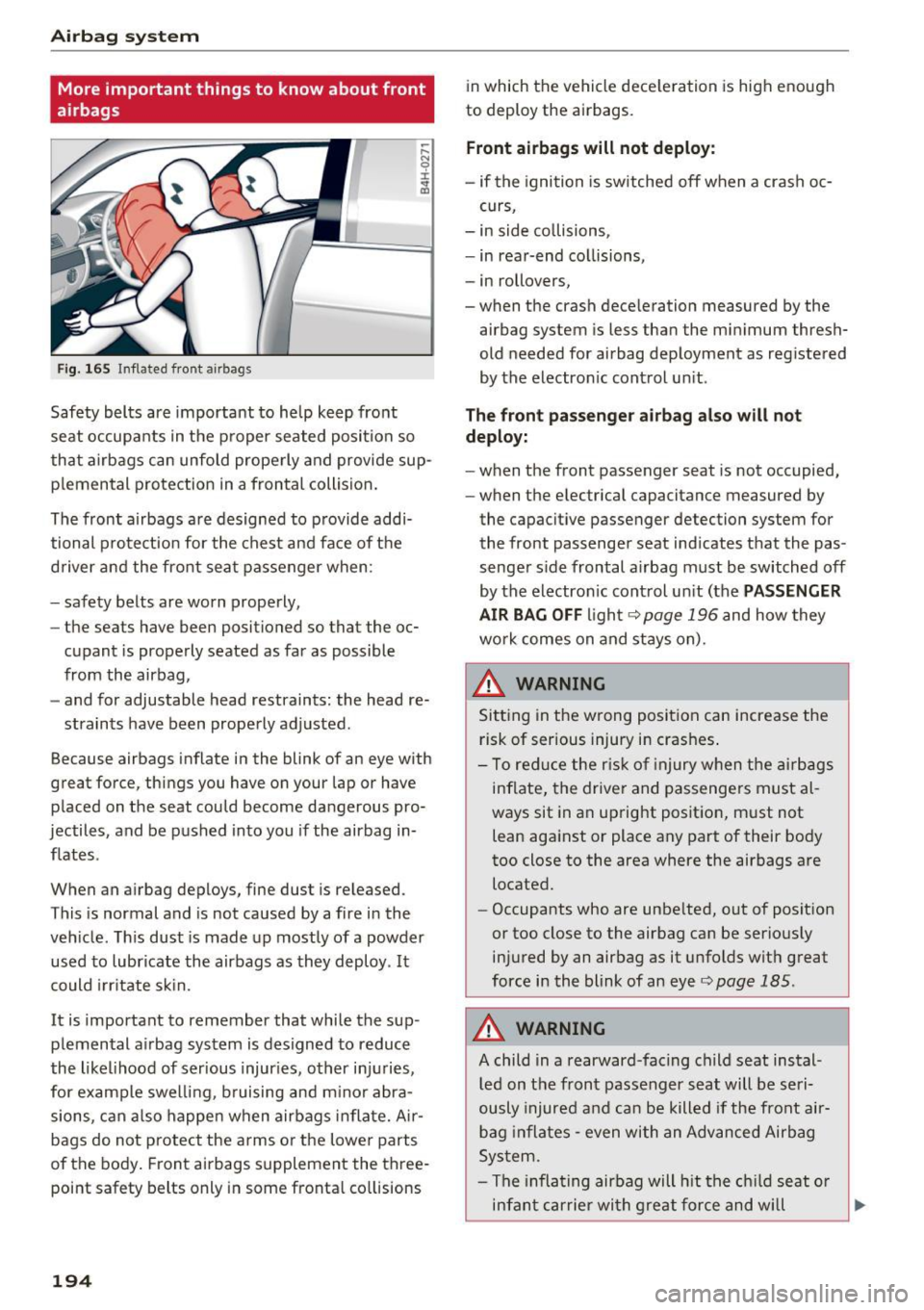
Fig. 165 In fla ted fro nt airb ags
Safety belts are important to help keep front
seat occupants in the proper seated position so
that airbags can unfold properly and provide sup p lemental protection in a frontal collision.
The front airbags are designed to provide addi
tional protection for the chest and face of the
driver and the front seat passenger when:
- safety belts are worn properly ,
- the seats have been positioned so that the oc-
cupant is properly seated as far as possible
from the airbag,
- and for adjustable head restraints: the head re-
straints have been properly adjusted .
Because airbags inflate in the blink of an eye with
great force, thing s you have on your lap or have
placed on the seat could become dangerous pro
jectiles , and be pushed into you if the airbag in
flates .
When an airbag deploys, fine dust is released.
This is normal and is not caused by a fire in the
veh icle. This dust is made up mostly of a powder
used to lubricate the airbags as they deploy . It
could irritate sk in .
It is important to remember that while the sup
plemental a irbag system is designed to reduce
the likel ihood of serious injur ies , other injuries,
for example swel ling , bruising and m inor abra
sions, can a lso happen when airbags inflate. Air
bags do not protect the arms or the lower parts
of the body. Front airbags supplement the three
point safety belts only in some fronta l co llisions
194
in which the vehicle decele ration is high enough
to deploy the airbags.
Front airbags will not deploy:
- if the igni tion is sw itched off when a crash oc-
curs,
- in side collisions ,
- in rear-end co llisions,
- in rollovers,
- when the crash deceleration measured by the
airbag system is less than the minimum thresh
old needed for airbag deployment as registered
by the electronic control un it .
The front passenger airbag also will not
deploy:
- when the front passenger seat is not occupied,
- when the electrical capacitance measured by
the capacit ive passenger detection system for
the front passenger seat ind icates that the pas
senger s ide frontal a irbag must be switched off
by the electronic control un it (the
PASSENGER
AIR BAG OFF
light ~ page 196 and how they
work comes on and stays on).
.&, WARNING
Sitting in the wrong position can increase the
risk of serious injury in cras hes .
- To reduce the risk of in jury w hen the airbags
inflate, the driver and passengers must al
ways sit in an upright position, must not
lean against or place any part of their body
too close to the area where the airbags are
located.
- Occupants who are unbe lted, out of posit ion
or too close to the airbag can be seriously injured by an airbag as it unfolds with great
force in the blink of an eye
c?) page 185 .
A WARNING
A child in a rearward-facing child seat instal
led on the front passenger seat will be seri
ously injured and can be killed if the front air
bag inflates -
even with an Advanced Airbag
System.
- The inflating airbag will hit the child seat or
infant carrier with great force and will
Page 199 of 328
,....,
N
0 > co ,....,
the front passenger seat . Always make sure that
the safety belt for the front passenger seat is
properly fastened.
Th e PASSENGER AIR BAG OFF light will show
the status of the front seat p assenger' s fr ontal
Ad vanced Airbag a few se cond s after the igni·
tion i s swit ched on and the ai rbag in d icator
light goes off . The PA SSEN GER AIR BA G OFF
light :
-will stay on if the front passenger seat is not
occupied;
- wi ll stay on if the electrical ca pacita nee meas
ured by the capacit ive passenger detection sys
tem for the front passenger seat equals the combined capacitance of an infant up to about
one year of age and one of the rearward-facing
o r fo rwa rd-facing ch ild restraints listed in Fed
era l Moto r Vehicle Safety Standard 208 w it h
wh ich the Advanced Airbag System in your veh i
cl e was certified; Fo r a listing of the child re
straints that were used to certify you r vehicle 's
compliance with the U.S. Safety Standard
¢ page 211 .
-will go out if the front passenger seat is occu
pied by an adult as registered by the capacitive
passenger detection system .
- The
PASSENGER AIR BAG OFF light must come
on and stay on if the ignition is on and ...
- a car bed has been insta lled on the front pas
senger seat, or
- a rearward-facing child restrai nt has been in
sta lled on the front passenger seat, or
- a forwa rd-facing child restra int has bee n instal
l ed on the front passenge r seat,
- and if the e lectr ic al capaci tance registered on
the front passenger seat is equal to or less than
the combined capacitance of a typical 1 year o ld infant and one of the rearward-facing or
forward -facing chi ld restraints listed in Federal
Motor Vehicle Safety Standard 208 w ith which
the Advanced Airbag System in your vehicle was
certified.
If the front passenger seat is not occupied, the
front airbag w ill not deploy, and the
PA SSENGER
AIR BAG OFF
light will stay on. Never install a
rearward -fac ing ch ild restraint on the front pas-
Airb ag sys tem
senger seat, the safest place for a chi ld in any
kind of child restraint is at one of the seating po
s itions on the rear seat¢
page 185, Child re
straints on the front seat -some important
things to know
and ¢ page 209, Child safety .
If the PASSENGER AIR BAG light comes
on ...
If the PA SSEN GER AIR BAG OFF light comes on
when one of the conditions listed above is met,
be sure to check the light regu larly to make cer
ta in that the
PASSENGER AIR BAG OFF l ight
stays on continuously whenever the ignition is
on. If the
PASSENGER AIR BAG OFF li ght does
not appear on and does no t stay on a ll the time,
stop as soon as it is safe to do so and
- react ivate the system by turning the ignit ion
off for more than 4 seconds a nd then turn ing it
on again;
- remove and re insta ll the chi ld restraint. Make
sure that the chi ld restraint is properly insta l
led and that the safety belt for the front pas
senger seat has been correct ly routed through
the child restraint as described in the c hild re
straint manufacturer's instructions;
- make sure that the convertible locking retrac
tor on the safety belt for the front passenge r
seat has been activated and that the safety belt has been pulled tight.
- make sure that no e lectr ica l device (such as a
laptop, CD player, e lectron ic games device,
power inverter or seat heater for ch ild seats) is
placed or used on the fro nt passenger seat if
the device is connected to the 12-volt socket or
the c igarette lighter socket;
- make sure that no seat heater has been retro
fitted or othe rw ise added to the front passen
ger seat;
- make sure that not hing can inte rfere with the
safety belt buckles and that they are not ob
structed;
- make sure that there are no wet objects (such
as a wet towe l) and no water or other liquids on
the front passenge r seat cushion. .,..
197
Page 200 of 328
Airbag system
If the PASSENGER AIR BAG light still does
not come on ...
If the PASSENGER AIR BAG OFF light still does
not come on and does not stay on continuously
(when the ignition is switched on),
- take the child restraint off the front passenger
seat and install it properly at one of the rear
seat positions. Have the airbag system inspect
ed by your Audi dealer immediately .
- move the chi ld to a rear seat position and make
sure that the child is properly restrained in a
child restraint that is appropriate for its size
and age .
The PASSENGER AIR BAG light should NOT
come on ...
The PASSENGER AIR BAG OFF light should NOT
come on when the ignition is on and an adult is
sitting in a proper seating position on the front
passenger seat. If the
PASSENGER AIR BAG OFF
light comes on and stays on or flashes for about
S seconds while driving, under these circumstan
ces, make s ure that:
- the adult on the front passenger seat is proper
ly seated on the center of the seat cushion with
his or her back up against the backrest and the
backres t is not recl ined,
- the adu lt is not taking weight off the seat by
holding on to the passenger assist handle
above the front passenger door or supporting
their weight on the armrest,
- the safety belt is being properly worn and that
there is not a lot of slack in the safety belt web
bing,
- there are no aftermarket seat covers or cush
ions or other things (such as blankets) on the
front passenger seat that might cause the ca
pacitive passenger detection system to miscal
culate electrical capacitance.
Important safety instructions on
monitoring the Advanced Airbag System
A WARNING
- If the status of the Adv a need Airbag System
has changed while the vehicle is moving, the
PASSENGER AIR BAG OFF light blinks for
198
about S seconds to catch the driver's atten
tion. If this happens, always stop as soon as
it is safe to do so and check the steps descri
bed above .
- If the
PASSENGER AIR BAG OFF light does
not go off when an adult who is not very
small is sitting on the front passenger seat
after taking the steps described above, make sure the adult is properly seated and
restrained at one of the rear seating posi
tions. Have the airbag system inspected by
your authorized Audi dealer befo re trans
porting anyone on the front passenger seat.
A WARNING
An airbag system that is not functioning prop
erly cannot provide supplemental protection in a fronta l crash.
- If the airbag indicator light~
page 21
comes when the vehicle is being used, have
the system inspected immediately by your
authorized Audi dealer.
It is possible that
the airbag will inflate when it is not sup
posed to, or wi ll not inflate when it should.
A WARNING
If the front airbag inflates, a ch ild without a
chi ld restraint, or in a rearward-facing child
safety seat, or in a forward-fac ing ch ild re
straint that has not been properly insta lled
will be seriously injured and can be killed.
- Even though you r vehicle is equipped with
an Advanced A irbag System, make certain
that a ll children, especially 12 years and
younger, always ride on the back seat prop
erly restrained for their age and size.
-Always install forward or rear-facing child seats on the rear seat -even with an Ad
vanced Airbag System.
- If you must install a rearward-facing child
seat on the front passenger seat because of
except ional circumstances and the
PASSEN·
GER AIR BAG OFF
light does not appear and
stay on, immediately install the rear-facing
child seat in a rear seat ing position and have
the airbag system inspected by your Audi
dea le r.
~
Page 204 of 328
Airbag syste m
Although they are not a soft pillow, they can
"cushion" the impact and in this way they can
he lp to reduce the risk of injury to the lower ex
tremities .
All of this takes place in the blink of an eye, so
fast that many people don't even realize that the airbags have deployed. The a irbags also inflate
with a great deal of force and it is important for
occupant safety that nothing should be in their
way when they deploy .
Fully inflated airbags in comb ination with proper
ly worn safety belts slow down and limit the oc
cupant's forward movement and help to reduce
the risk of inju ry.
Important safety instructions on the knee
airbag system
App lies to veh icles : with knee a irbags
Airbags are only supplemental restraints . Always
wear safety belts correctly and ride in a proper
seating position.
There is a lot that you and your passengers must
know and do to help the safety belts and airbags
to provide supplemental protection .
,&. WARNING
An inflating knee airbag can cause ser ious in
jury. Wearing safety bel ts incorrectly and im
proper seating positions increase the r isk of
serious personal injury and death whenever a
vehicle is being used.
- The knee airbag system cannot protect you properly if you are seated too close to any of
the airbag locat ions. When adjusting their
seat positions, it is important that both the driver and the front passenger keep their
upper bodies and knees at the following
min imum safe distances:
- at least 10 inches (25 cm) between the
chest and the steering wheel/instrument panel.
- at least 4 inches (10 cm) between the
knees and the lower part of the instru ment panel.
- The risk of persona l injury increases if you
lean forward or to the s ide, or if the seat is
202
improperly positioned and you are not wear
ing your safety belt. The risk increases even
more should the airbag deploy.
- Always make sure that the knee a irbag can
inflate w ithout interference. Objects be
tween you and the airbag can increase the
r isk of injury in an accident by interfering
w ith the way the airbag deploys or by being
pushed i nto you as the a irbag deploys.
- Never let anybody, especia lly children or
anima ls ride in the footwell in front of the
passenger seat. If the airbag deploys, this
can result in serious or fatal injuries .
- Never carry objects of any kind in the foot
well area in front of the driver's or pas senger's seat. Bulky objects (shopp ing
bags, for example) can interfere with or
prevent proper dep loyment of the a irbag.
Small objects can be thrown through the
vehicle if the airbag deploys and injure you
or your passengers.
- Ma ke sure there are no crac ks, deep scratch
es o r other damage in the area of the i nst ru
ment panel where the knee airbags are lo
cated .
- If children are incorrec tly seated, their risk
of injury increases in a coll is ion
c:::> page 209, Child safety.
Side airbags
Description of side airbags
The airbag system can provide supplemental
protection to properly restrained occupants .
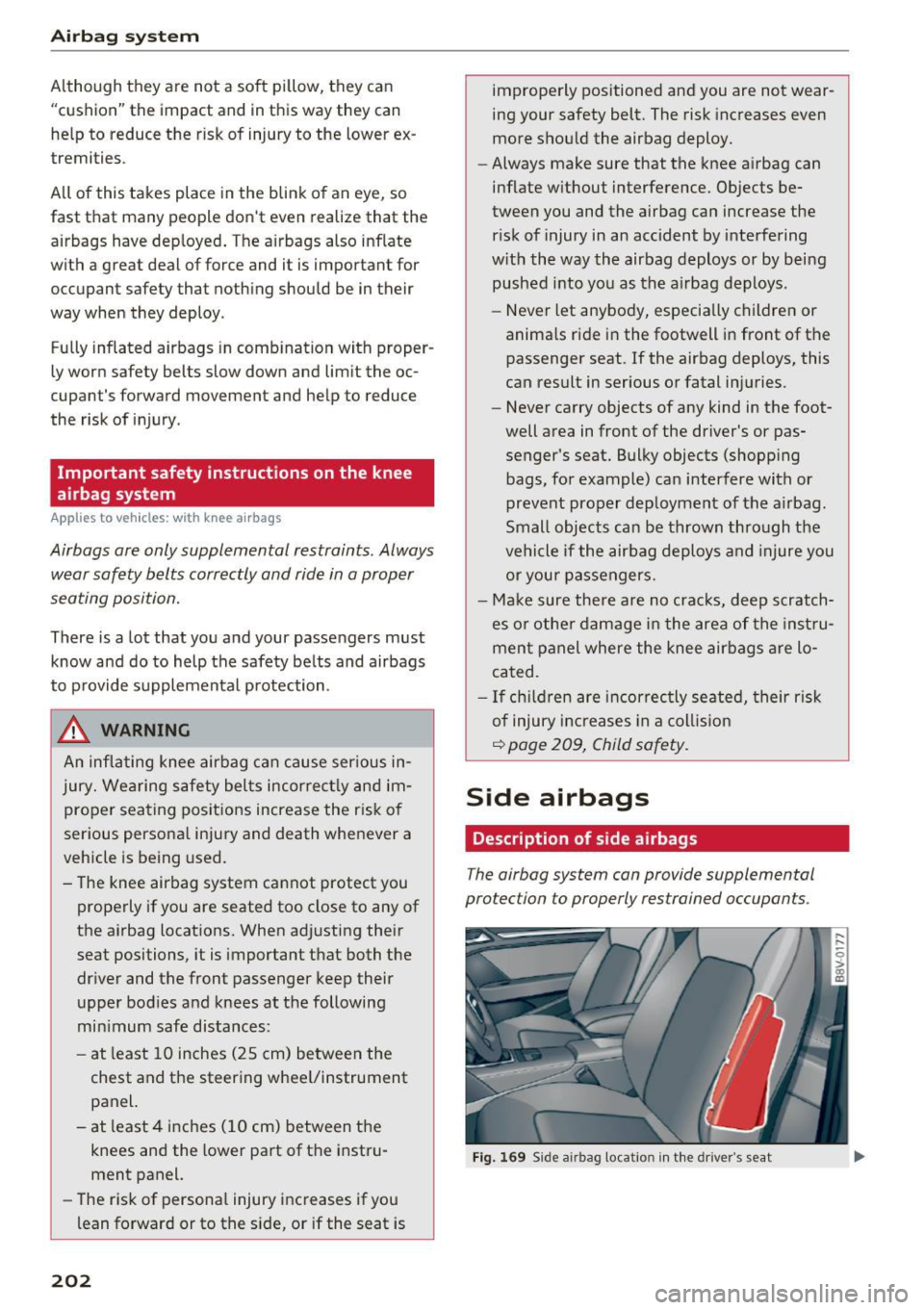
Fig. 169 S ide a irbag locatio n in the driver 's seat