flat tire AUDI S3 2016 User Guide
[x] Cancel search | Manufacturer: AUDI, Model Year: 2016, Model line: S3, Model: AUDI S3 2016Pages: 328, PDF Size: 81.78 MB
Page 268 of 328
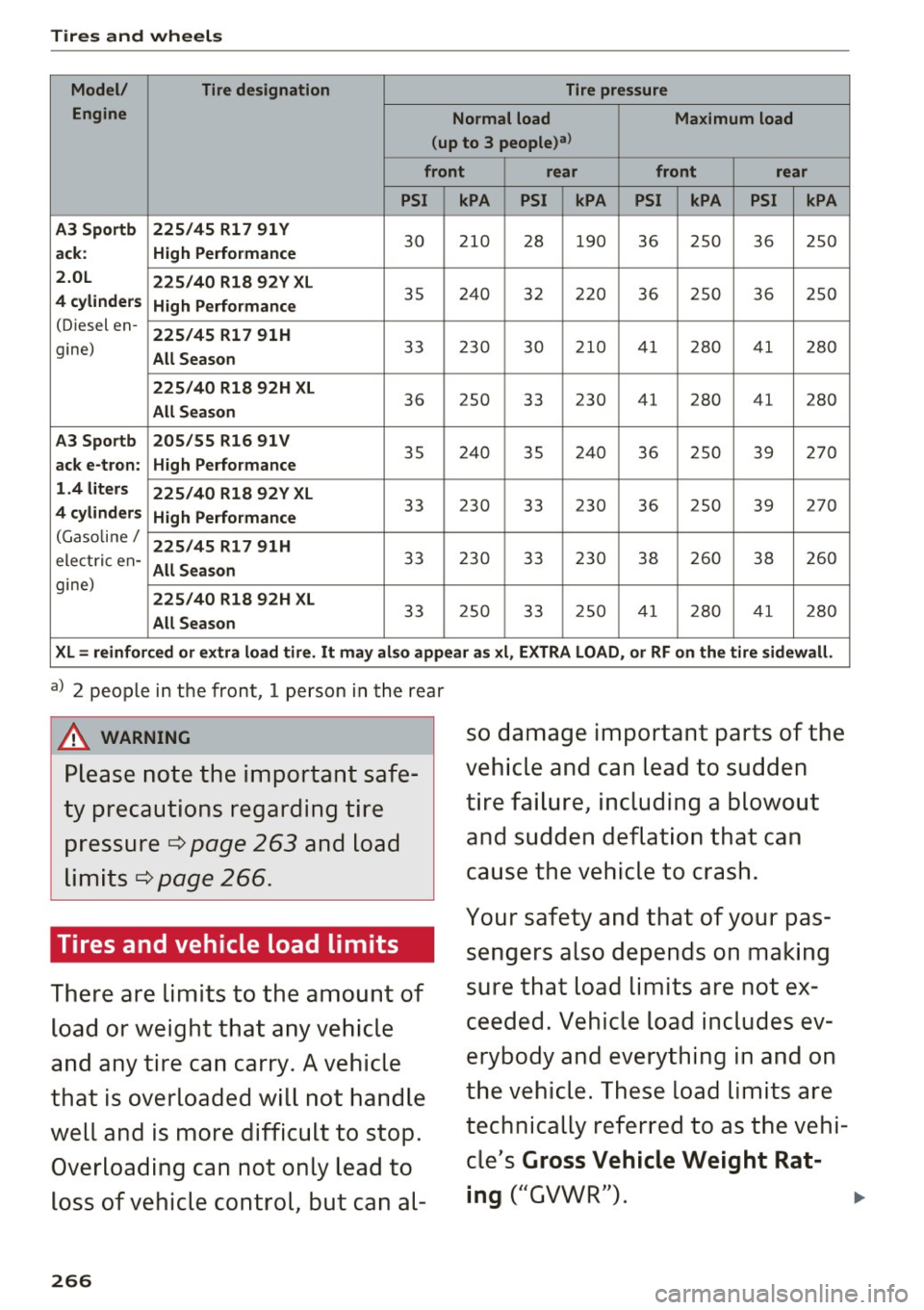
Tires and wheels Model/ Tire designation
Tire pressure
Engine Normal load
Maximum load
(up to 3 people)a>
front rear front rear
PSI kPA PSI kPA PSI kPA PSI kPA
A3 Sportb 225/45 Rl 7 91 Y ack: High Performance
30 210 28 190 36 250 36 250
2.0L
225/40 Rl8 92Y XL
4 cylinders High Performance
35 240 32 220 36 250 36 250
(Diesel en-
225/45 Rl7 91H
gine) All Season
33 230 30
210 41 280 41 280
225/40 Rl8 92H XL
All Season
36 250 33 230 41
280 41
280
A3 Sportb 205/55 Rl6 91 V
ack e-tron: High Performance
35 240 35 240 36 250 39 270
1.4 liters
225/40 Rl8 92Y XL
4 cylinders High Performance
33 230
33 230
36 250 39 270
(Gasoline/
225/45 Rl 7 91H
electric en- All Season
33 230 33 230 38 260 38 260
gine)
225/40 Rl8 92H XL
All Season
33 250 33 250 41 280 41 280
XL= reinforced or extra load tire. It may also appear as xi, EXTRA LOAD, or RF on the tire sidewall.
a) 2 people in the front, 1 person in the rear
A WARNING
Please note the important safe
ty precautions regarding tire pressure ¢
page 263 and load
limits ¢
page 266.
Tires and vehicle load limits
There are limits to the amount of
load or weight that any vehicle
and any tire can carry. A vehicle
that is overloaded will not handle
well and is more difficult to stop. Overloading can not only lead to
loss of vehicle control, but can al-
266
so damage important parts of the
vehicle and can lead to sudden
tire failure, including a blowout
and sudden deflation that can
cause the vehicle to crash.
Your safety and that of your pas sengers also depends on making
sure that load limits are not ex
ceeded. Vehicle load includes ev
erybody and everything in and on
the vehicle. These load limits are
technically referred to as the vehi cle's
Gross Vehicle Weight Rat-
ing
("GVWR"). ..,
Page 269 of 328
The "GVWR" includes the weight
of the basic vehicle, all factory installed accessories, a full tank of
fuel, oil, coolant and other fluids plus maximum load. The maxi
mum load includes the number of
passengers that the vehicle is in
tended to carry ("seating capaci
ty") with an assumed weight of 150 lbs. (68 kg) for each passen
ger at a designated seating posi
tion and the total weight of any luggage in the vehicle . If you tow
a trailer, the weight of the trailer
hitch and the tongue weight of
the loaded trailer must be includ
ed as part of the vehicle load.
The
Gross Axle Weight Rating
("GAWR") is the maximum load
that can be applied at each of the
vehicle's two axles.
The fact that there is an upper limit to your vehicle's Gross Vehi
cle Weight Rating means that the
total weight of whatever is being carried in the vehicle (including
the weight of a trailer hitch and
the tongue weight of the loaded
trailer) is limited. The more pas sengers in the vehicle or passen
gers who are heavier than the
standard weights assumed mean
Tires and wheels
that less weight can be carried as luggage.
The Gross Vehicle Weight Rating
and the Gross Axle Weight Rating
are listed on the safety compli
ance sticker label located on the driver's side B-pillar
¢ page 263,
fig. 204.
A WARNING
Overloading a vehicle can cause
loss of vehicle control, a crash
or other accident, serious per
sonal injury, and even death.
-Carrying more weight than your vehicle was designed to
carry will prevent the vehicle
from handling properly and increase the risk of the loss of
vehicle control.
-The brakes on a vehicle that
has been overloaded may not
be able to stop the vehicle
within a safe distance.
-Tires on a vehicle that has been overloaded can fail sud
denly, including a blowout and
sudden deflation, causing loss
of control and a crash.
-Always make sure that the to- tal load being transported -,..
267
Page 270 of 328
Tires and wheels
including the weight of a trail
er hitch and the tongue
weight of a loaded trailer does not make the vehicle
heavier than the vehicle's
Gross Vehicle Weight Rating.
Determining correct load
limit
Use the example below to calcu
late the total weight of the pas
sengers and luggage or other
things that you plan to transport
so that you can make sure that
your vehicle will not be overload ed.
Steps for Determining Correct Load Limit
1. Locate the statement "THE
COMBINED WEIGHT OF OCCU
PANTS AND CARGO SHOULD
NEVER EXCEED XXX KG OR XXX
LBS"on your vehicle's placard
(tire inflation pressure label)
¢ page 263, fig. 204.
2. Determine the combined
weight of the driver and pas
sengers that will be riding in
your vehicle.
3 . Subtract the combined weight
of the driver and passengers
from
"XXX" kilograms or "XXX"
268
pounds shown on the sticker
¢ page 263, fig. 204.
4 . The resulting figure equals the
available amount of cargo and
luggage load capacity. For ex
ample, if the
"XXX" amount
equals
1400 lbs . and there will
be five
150 lbs. passengers in
your vehicle, the amount of available cargo and luggage
load capacity is
650 lbs .
(1400-750 (5 X 150) = 650
lbs.)
5. Determine the combined
weight of luggage and cargo
being loaded on the vehicle.
Tha t weight may not safely ex
ceed the available cargo and luggage load capacity calculat
ed in Step 4.
6. If your vehicle will be towing a
trailer, load from your trailer
will be transferred to your ve hicle . Consult this manual to
determine how this reduces
the available cargo and lug
gage load capacity of your vehi
cle.
~check the tire sidewall
(¢ page 253, fig. 202) to deter
mine the designated load rating
for a specific tire.
Page 272 of 328
Tires and wheels
Use of snow chains is o nly pe rmitted with certain
rim/t ire combinations due to tec hnical reasons .
Chec k with an autho rize d Aud i dealer or autho r
i z ed A ud i Service Fac ility to see if yo u may use
snow chains.
Use
fine-mesh snow chains . They must not add
mo re t han 0 .53 inc h (13 .5 mm) in height, i nclud
i n g the chain loc k.
You mus t remove the chains when d riving on
roads that are
free of snow . W hen roads a re free
of snow, snow c hains ca n impair handlin g and
damage the t ires, and the chains w ill quickly be
destroyed.
A WARNING
Us ing inco rrect sno w ch ains or insta lling snow
chains in co rrectly can result in loss o f vehicle
c o ntrol, w hich i ncreas es th e risk of an a cci
de nt.
(D Note
- Snow cha ins can damage t he rims/whee l
covers* if the chains com e into d ir e ct con
tact wi th th em. R emov e th e wh eel covers*
fir st. U se coat ed s now chai ns.
Low aspect ratio tires
Your Aud i is fa cto ry-equippe d wi th low aspec t ra
tio tires . These ti res have been tho roughly teste d
an d been se lected specifically for yo ur model for
their superb per fo rmance, road f eel and handling
under a variety of d riving conditions . As k yo ur au
thor ized Audi dealer for mo re details .
The low aspect ratio of these t ires is indicated by
a nume ra l of
55 or less in the tire's size designa
tion . The nume ra l r ep resents the rat io o f th e
tire's sidewall he ight i n relat ion to its tread width
expressed in percentage . Conventional tires have
a height/w idt h ratio o f 60 o r more .
The performance of low-aspect-ratio tires is par
ticularly sensitive to improper inflation pres
sure. It is therefore important that low aspect
ratio tires are inflated to the specified pressure
and that the inflation pressure is regularly
c hecked and maintained . Tire pre ssures should
270
be checked at least once a month and always
before a long trip
~ page 263.
What you can do to avoid tire and rim
damage
Low aspect ra tio tires can be damaged more eas i
l y by impact with potho les, curbs, gullies or
r idges on t he road , particularly if t he tire is un
der i n flated.
I n order to min imize the occurrence o f impact
dama ge to the tires o f your veh icle, we recom
men d that you observe the following preca u
tions:
- Always main tain recommende d inf la tion pres
sures . Check yo ur tir e pressure eve ry 2,000
m iles (3,000 km) and add a ir if necessary .
- Dr ive ca refully on roa ds w ith potholes, deep
gullies o r ridges . The impact from dr iving
throug h or over such obstacles can damage
your t ires. Impact wit h a curb may a lso cause
damage to your tires.
-After a ny impact, immed iate ly inspect you r
tires or have them inspected by the nearest au
thorized Aud i dealer. Replace a damaged tire as
soon as poss ible .
- Inspect your tires every 2,000 m iles (3,000 km)
for damage and wear . Damage is no t always
easy to s ee . Damage ca n lead to loss o f air and
unde rin flation, w hich co uld even tually cause
t ire f ailure . If yo u beli eve th at a ti re may have
bee n da mage d, re place the tire as soon as p os
sible.
- These tires may we ar m ore quick ly th an oth ers.
- Please also rem emb er tha t, whil e the se tires
delive r responsive h andli ng, they may ride less
c omf ortabl y and ma ke m ore noi se th an o ther
choi ces .
Reduced performance in winter/cold season
conditions
A ll ti res are des igned for cert ain pur poses . T he
l ow aspect r atio , ul tra hig h perform ance tires
o rigina lly installed on your vehicle are inten ded
for maximum dry and wet road performance and
handling . T hey a re not suitable fo r co ld, snowy o r
i cy weather conditions. If yo u drive under th ose
c ircumstances, you should equip yo ur vehicle
with all -season o r winter tires, which offer better
11>-
Page 273 of 328
traction under those conditions. We suggest you
use the recommended snow or all-season tires
specified for your vehicle, or their equivalent.
Refer to
q page 269 for more detai led info rma
tion regarding winter tires.
Uniform tire quality grading
- Tr ead wear
- Traction AA A B C
- Temperature ABC
Quality grades can be found where applicable on
the tire side wa ll between tread shoulder and
maximum sect ion w idth
q page 253, fig. 202.
For exampl e: T read wear 2 00 , Traction AA , Tem
perature
A .
All passenger car tires must conform to Federal
Safety Requirements in addition to these grades.
Trea d we ar
The tread wear grade is a comparative rating
based on the wear rate of the tire when tested
under contro lled conditions on a specified gov
ernment test course.
For examp le, a tire graded
150 would wear one
and one ha lf
(11/2) times as well on the govern
ment course as a tire graded
100.
The relative performance of tires depends upon
the actual conditions of their use, however, and may d epart significant ly from the norm due to
variations in driving habits, service practices and d ifferences in road characteris tics and climate.
Tracti on
The traction grades, from highest to lowest, are
AA, A, B and
C. T hose grades represent the tire's
ability to stop on wet pavement as measured un
der controlled conditions on specified govern
ment test surfaces of asphalt and concrete . A tire
marked C may have poor traction performance
q .&. .
,...., Temp eratur e N
0
ii; The temperature grades are A (the h ighest), B,
and C, representing the tire's resistance to the
generation of heat and its ability to diss ipate
Tir es and wheel s
heat when tested under controlled conditions on
a specified indoor laboratory test wheel.
Sustained h igh temperatu re can cause the mate
ria l of the t ire to degenerate and reduce ti re life ,
and excessive temperature can lead to s udden
tire failure
q .& .
The grade C corresponds to a level of perfo rm
ance which all passenger car tires must meet un
der the Federal Motor Vehicle Safety Standa rd
No.
109. Grades Band A represent higher levels
of performance on the laboratory test wheel than
the minim um requ ired by law.
A WARNING
-
The tract ion grade assigned to this t ire is
based on straight -ahead braking traction
tests, and does not include acceleration, cor nering, hyd roplaning or pea k traction cha rac
terist ics.
A WARNING
The temperature grade for this tire is estab
lished for a tire that is properly infl,;1ted and
not overloaded . Excessive speed, underinfla
tion, or excessive loading, either separately or i n combination, can cause heat bui ldup and
possib le tire fai lure .
A WARNING
-
-Temperature grades apply to tires that are
p roperly inf lated and not over or under inflat
ed.
Tire pressure monitoring system
(l) General notes
App lies to vehicles: wi th tir e pressure mo nito rin g syste m
Each tire, including the spare (if provided),
shou ld be checked monthly when cold and inflat-
ed to the inflat io n pressure recommended by the
vehicle manufacturer on the veh icle placard or
t ir e inflation pressure label. (If your ve hicle has
t ir es of a different size than the si ze ind icated on .,..
271
Page 274 of 328
Tires and wheels
the vehicle placard or tire inflation pressure la
bel, you should determine the proper tire
inflation pressure for those tires).
As an added safety feature, your vehicle has been
equipped with a tire pressure monitoring system
(TPMS) that illuminates a low tire pressure tell
tale when one or more of your tires is significant ly under-inflated. Accordingly, when the low tire
pressure telltale illuminates, you should stop and
check your tires as soon as possible, and inflate
them to the proper pressure . Driving on a signifi
cantly under-inflated tire causes the tire to over
heat and can lead to tire failure. Under-inflation
also reduces fuel efficiency and tire tread life,
and may affect the vehicle's handling and stop
ping ability.
Please note that the TPMS is not a substitute for
proper tire maintenance, and it is the driver's re
sponsibility to maintain correct tire pressure,
even if under-inflation has not reached the level
to trigger illumination of the TPMS low tire pres
sure telltale.
Your vehicle has also been equipped with a TPMS
malfunction indicator to indicate when the sys
tem is not operating properly. The TPMS mal
function indicator is combined with the low tire
pressure telltale. When the system detects a
malfunction, the telltale will flash for approxi
mately one minute and then remain continuously
illuminated. This sequence will continue upon
subsequent vehicle start-ups as long as the mal
function exists .
When the malfunction indicator is illuminated,
the system may not be able to detect or signal
low tire pressure as intended. TPMS malfunctions
may occur for a variety of reasons, including the
installation of replacement or alternate tires or
wheels on the vehicle that prevent the TPMS
from functioning properly. Always check the
TPMS malfunction telltale after replacing one or
more tires or wheels on your vehicle to ensure
that the replacement or alternate tires and
wheels allow the TPMS to continue to function
properly .
272
· If the Tire Pressure Monitoring System
indicator appears
Applies to vehicles: with tire pressure monitoring system
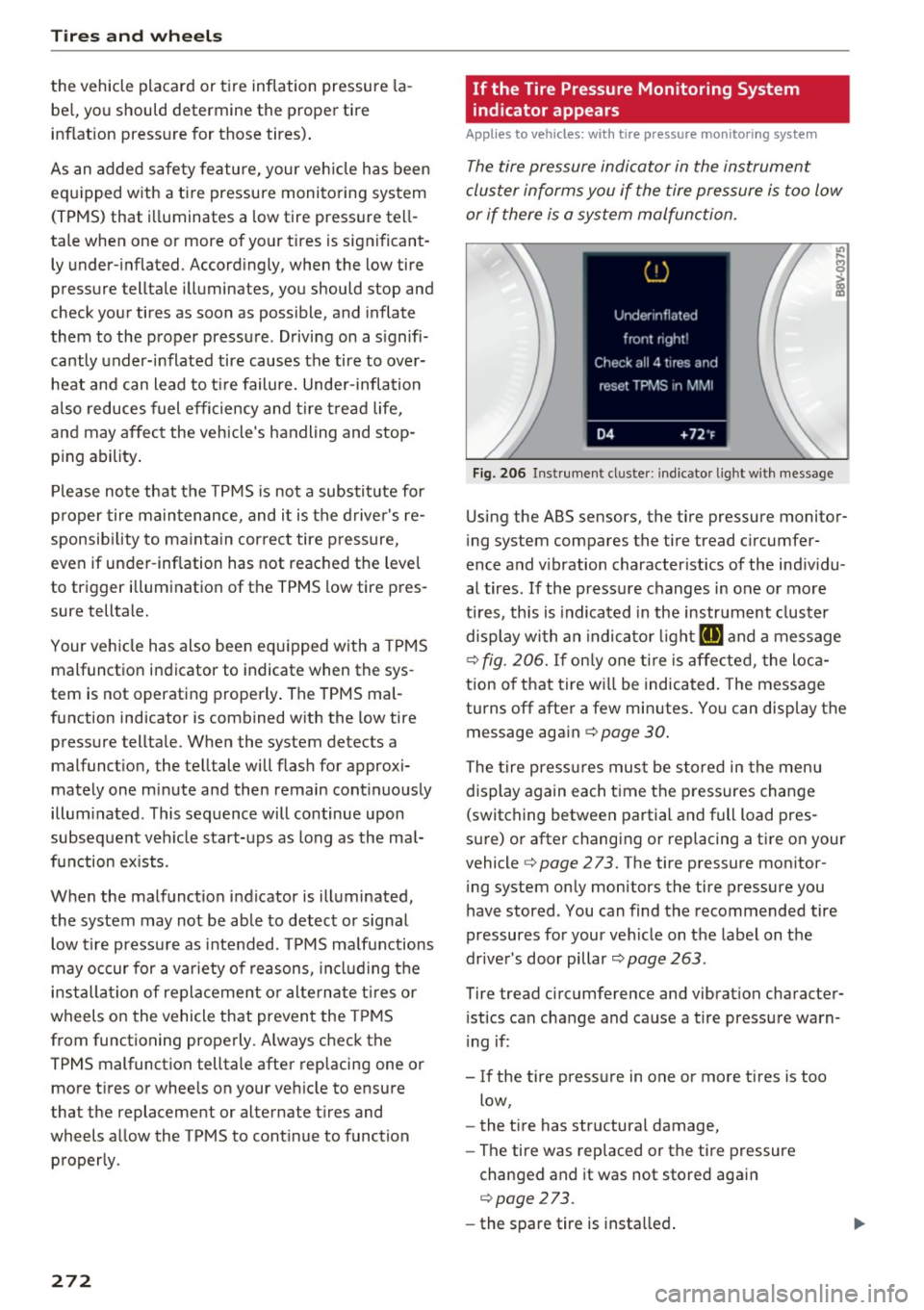
The tire pressure indicator in the instrument
cluster informs you if the tire pressure is too low
or if there is a system malfunction.
Fig. 206 Instrument cl uster: i ndic ator lig ht with message
Using the ABS sensors, the tire pressure monitor
ing system compares the tire tread circumfer
ence and vibration characteristics of the individu
al tires . If the pressure changes in one or more
tires , this is indicated in the instrument cluster
display with an indicator light
Rt] and a message
¢fig. 206. If only one tire is affected, the loca
tion of that tire will be indicated. The message
turns off after a few minutes. You can display the
message again¢
page 30.
The tire pressures must be stored in the menu
display again each time the pressures change
(switching between partial and full load pres
sure) or after changing or replacing a tire on your
vehicle
¢ page 273. The tire pressure monitor
ing system only monitors the tire pressure you
have stored . You can find the recommended tire
pressures for your vehicle on the label on the
driver's door pillar¢
page 263.
Tire tread circumference and vibration character
istics can change and cause a tire pressure warn
ing if:
- If the tire pressure in one or more tires is too
low,
- the tire has structural damage,
- The tire was replaced or the tire pressure
changed and it was not stored again
¢page 273.
-the spare tire is installed.
Page 275 of 328
,....,
N
0 > co ,....,
IE-Loss of pressure in at least one tire c::> ,&.
Check the tires and replace or repair if necessary.
Check/correct the pressures of all four tires. Then
store the tire pressures in the MMI
c::> page 2 73 .
mm (Tire Pressure Monitoring System) Tire
pressure: System malfunction!.
If m appears
after switching the ignition on or whi le driving
and the
IE indicator light in the instrument clus
ter blinks for approximately one minute and then
stays on, there is system malfunction. Try to
store the correct tire pressures
c::> page 2 73. If
the indicator light does not turn off or turns on
again after a short period of time, drive to an au
thor ized Audi dealer or authorized Audi Service
Facility immediately to have the malfunction cor
rected.
A WARNING
- If the tire pressure warning light IE in the
instrument cluster turns on, the pressure in
one or more tires is too low . Reduce the ve
hicle speed immediately and avoid any hard
steering or braking maneuvers. Stop as soon
as possible, check the tire and inflate the
t ir e to the correct pressure, which is speci
fied on the tire pressure label on the veh icle
c::> page 263. Driving with a ti re with low
pressure causes the tire to overheat and can
result in failure of the tire. Low pressure can
also have a negative effect on the driving
and braking behavior of the vehicle .
- Th e driver is responsible for maintaining the
correct tire pressures. You must check the
tire pressures regularly.
- Under certain conditions (such as a sporty
driv ing style, winter conditions or unpaved
roads), the pressure monitor indicator may
be delayed.
- Do not use run-flat tires on your vehicle . Us
ing them when not permitted can lead to
vehicle damage or accidents.
(D Tips
- The tire pressure monitoring system can al
so stop working when there is an ESC mal
function.
Tires and wheels
-Using snow chains may result in a system
ma lfunction.
- The tires with the identification "AO" or
"RO"
c::> page 260 have been matched with
your Audi tire pressure monitoring system .
We recommend that you use these tires.
- The tire pressure monitoring system can on
ly monitor the tire pressure of the driving
tires. Check the tire pressure of the spare
wheel in the luggage compartment so that if necessary it is ready for use.
Storing tire pressures
Applies to vehicles: with tire pressure mon itor ing system
A change in tire pressure or a change in tires
must be stored in the system.
The tire pressure is stored in the MMI.
.,. Make sure befo re storing that the tire pressures
of all four tires meet the specified va lues and
are adapted to the load. Otherwise the system
could malfunction
c::> page 263.
.. Switch on the ign ition.
.,.. Select: the I MENU I button> Car> Systems "
control button > Service & control > Tire pres
sure monitor > Store tire pressure > Yes, store
now .
(D Tips
Do not store the tire pressures if snow chains
a re installed . Otherwise the system could
malfunction.
273
Page 282 of 328
Emerg ency assis ta nce
Emergency assistance
Trunk escape latch
Applies to veh icles: with trunk escape latch
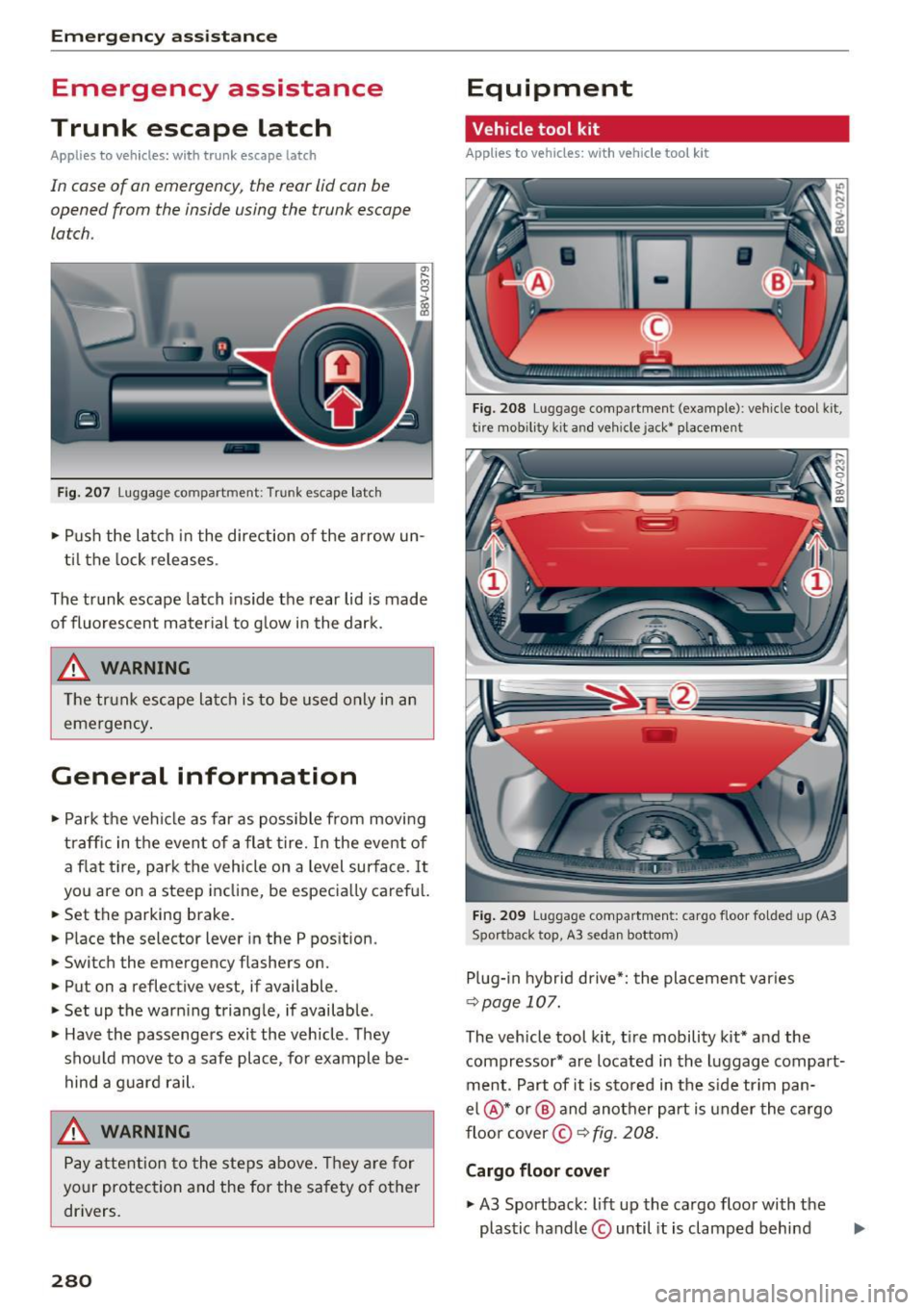
In case of an emergency, the rear lid can be
opened from the inside using the trunk escape
latch.
Fig. 207 luggage compartment: Trunk escape latch
.,. Push the latch in the direction of the arrow un
ti l the lock releases.
The trunk escape latch inside the rear lid is made
of fluo rescent mater ial to g low in the dark.
_& WARNING
The trunk escape latch is to be used only in an
emergency .
General information
.,. Park the vehicle as far as poss ible from moving
t raff ic in the event of a flat tire. In the event of
a f lat t ire, park the vehicle on a level surface. It
you are on a steep incline, be especia lly careful.
.,. Set the parking brake.
.,. Place the selector lever in the P pos ition .
.,. Switch the emergency flashers on.
.,. Put on a reflective vest, if available .
.,. Set up the warn ing triangle, if available .
.,. Have the passengers exit the vehicle. They
should move to a safe place, for example be
hind a guard rail.
_& WARNING
Pay attention to the steps above. They a re for
your protection and the for the safety of other
drivers.
280
Equipment
Vehicle tool kit
Applies to vehicles: with vehicle tool kit
Fig. 208 luggage compartment (example): vehicle tool kit,
t ire mobility kit and vehicle jack* placement
Fig. 209 luggage compartment: cargo floor fo lded up (A3
Spo rtback top, A3 sedan bottom)
Plug-in hybrid drive*: the placement var ies
<>page 107 .
The vehicle tool kit, tire mobility kit* and the
compressor* are located in the luggage compart
ment. Part of it is sto red in the s ide tr im pan
el @ * or @ and another part is under the cargo
floor cover ©¢
fig. 208.
C argo floor cove r
.,. A3 Sportback: lift up the cargo floor with the
plastic handle © until it is clamped behind
Page 284 of 328
Emergency assistance
-If an allergic reaction occurs, seek immedi
ate medical attention .
- Keep the tire sealant away from children .
- In vehicles with a tire pressure monitoring
system*, using tire sealant can results in an
incorrect display or a system malfunct ion.
Drive carefully to the nearest author ized
Audi dealer or authorized Audi Service Facili
ty.
@ Tips
- If sealant leaks, allow it to dry in place. You
can then pee l it off like a sticker.
- Note the expiration date on the sealant bot
tle . Replace the tire sealant at an author
i zed Audi dealer or authorized Audi Service
Facility.
- Radio reception can be interrupted when operating the compressor*.
- Obey all laws.
Repairing tires
App lies to veh icles: W it h tir e re p air set
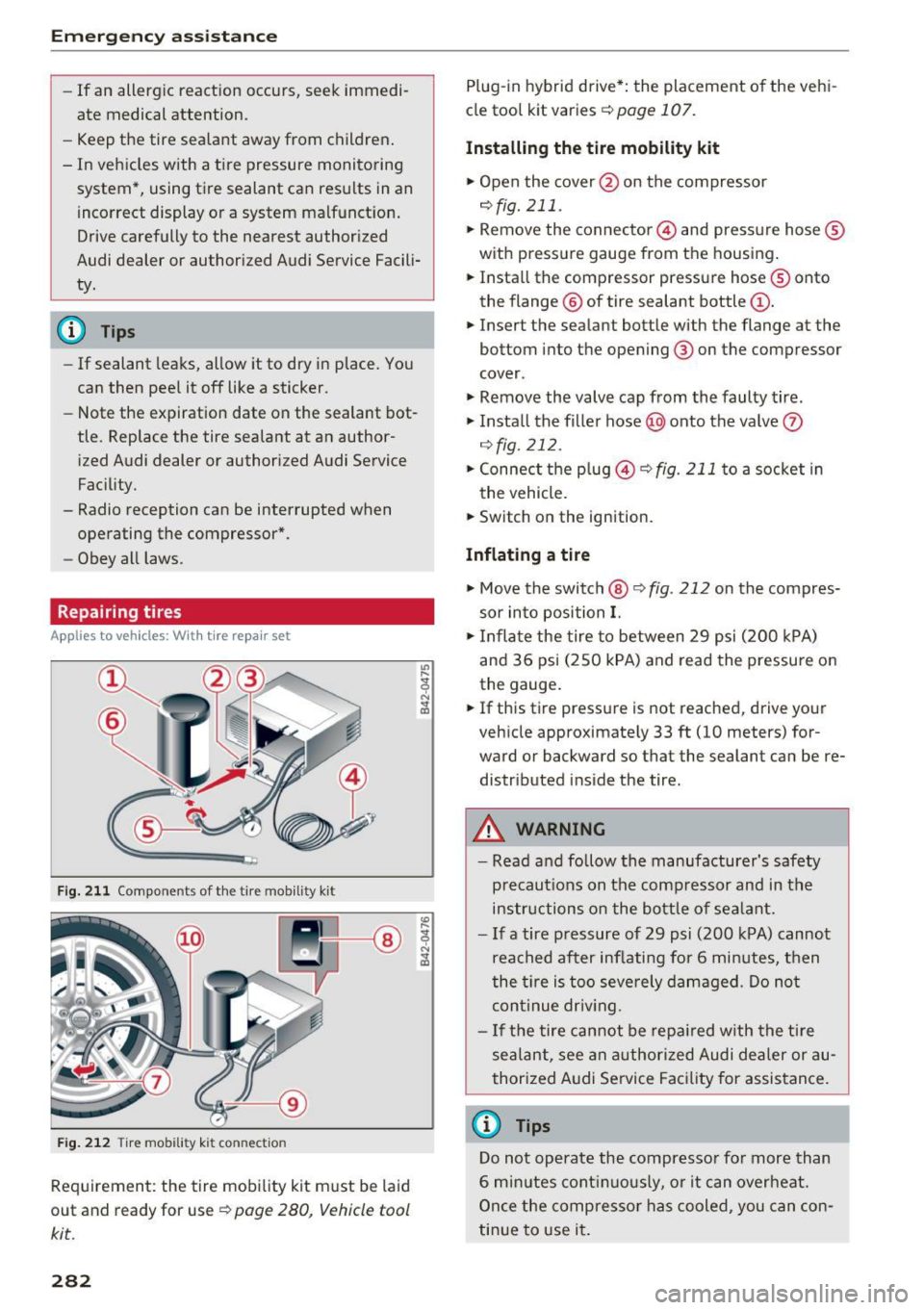
F ig . 211 Compo nents of the tire mobili ty k it
F ig. 212 Tire mob ilit y kit co nn ectio n
Requirement: the tire mobility kit must be laid
out and ready for use
9 page 280, Vehicle tool
kit.
282
Plug-in hybrid drive*: the placement of the vehi
cle tool kit varies
9 page 107.
Installing the tire mobility kit
.,. Open the cover @on the compressor
<=)fig. 211 .
.,. Remove the connector@and press ure hose ®
with press ure gauge from the housing .
.,. Insta ll the compressor pressure hose ® onto
the flange ® of tire sealant bottle ©-
.,. Insert the sealant bottle with the flange at the
bottom into the opening ® on the compressor
cover .
.,. Remove the valve cap from the faulty tire.
.,. Insta ll the filler hose@onto the valve (!)
<=)fig. 212 .
.,. Connect the plug @~ fig. 211 to a socket in
the vehicle.
.,. Switch on the ignition.
Inflating a tire
.,. Move the switch@ 9 fig. 212 on the compres
sor into position
I.
.,. Inflate the tire to between 29 psi (200 kPA)
and 36 psi (250 kPA) and read the pressure on
the gauge .
.,. If this tire pressure is not reached, drive your
veh icle approximately 33
ft (10 meters) for
ward or backward so that the sealant can be re
distr ibuted inside the tire.
_& WARNING
-Read and follow the manufacturer's safety
precaut ions on the compressor and in the
instructions on the bottle of sealant.
- If a tire pressure of 29 psi (200 kPA) cannot
reached after inflating for 6 minutes, then
the tire is too severely damaged. Do not
continue driving.
- If the tire cannot be repaired with the tire
sealant, see an authorized Audi dealer or au
thorized Audi Service Facility for assistance.
(D Tips
Do not operate the compressor for more than
6 minutes continuously, or it can over heat.
Once the compressor has cooled, you can con
tinue to use it.
Page 286 of 328
Emergency assistance
-Before you change a wheel, be sure the
ground is level and firm. If necessary, use a
sturdy board under the jack.
- Always store the vehicle tool kit, the jack
and the replaced tire in the luggage com
partment
c:> page 172.
Changing a wheel
When you change a wheel, follow the sequence
described below step-by-step and in exactly that
order.
1. Remove the decorative wheel cover*. For
more details see also
c:> page 284, Decora
tive wheel covers
or c:> page 285, Wheels
with wheel bolt caps.
2 . Loosen the wheel bolts c:> page 285 .
3. Locate the proper mounting point for the
jack and align the jack below that point
c:> page 286 .
4. Raise the car with the jack c:> page 286 .
5. Remove the wheel with the flat tire and then
install
the spare c:>page 287.
6. Tighten all wheel bolts lightly.
7 .
Lower the vehicle with the jack.
8. Use the wheel bolt wrench and firmly tighten
all wheel bolts
c:> page 285.
9. Replace the decorative wheel cover* .
_&. WARNING
Always read and follow all WARNINGS and in
forma tion
c:> .& in Raising the vehicle on
page 286
and c:> page 288.
After changing a wheel
A wheel change is not complete without the do
ing the following .
.,. Always store the vehicle tool kit, the jack* and
the replaced tir e in the luggage compartment
c:> page 172 .
.,. Check the tire pressure on the spare wheel im
mediate ly after mounting it .
.,. As soon as possible, have the
tightening tor
ques
on all wheel bolts checked with a torque
wrench. The correct tightening torque is 90 ft
lb
(120 Nm).
284
.,. Have the flat tire replaced as soon as possible .
@ Tips
- If
you notice that the wheel bolts are cor
roded and difficult to turn while changing a
tire, they shou ld be replaced before you
check the tightening torque .
- Drive at reduced speed until you have the
tightening torques checked.
- After chang ing a wheel, the tire pressure in
all four tires must be checked/corrected and
the tire pressure monitoring indicator m ust
be stored in the MMI
c:>page 273.
Decorative wheel covers
Applies to vehicles: wit h decorative wheel covers
The decorative wheel covers must be removed
first to access the wheel bolts .
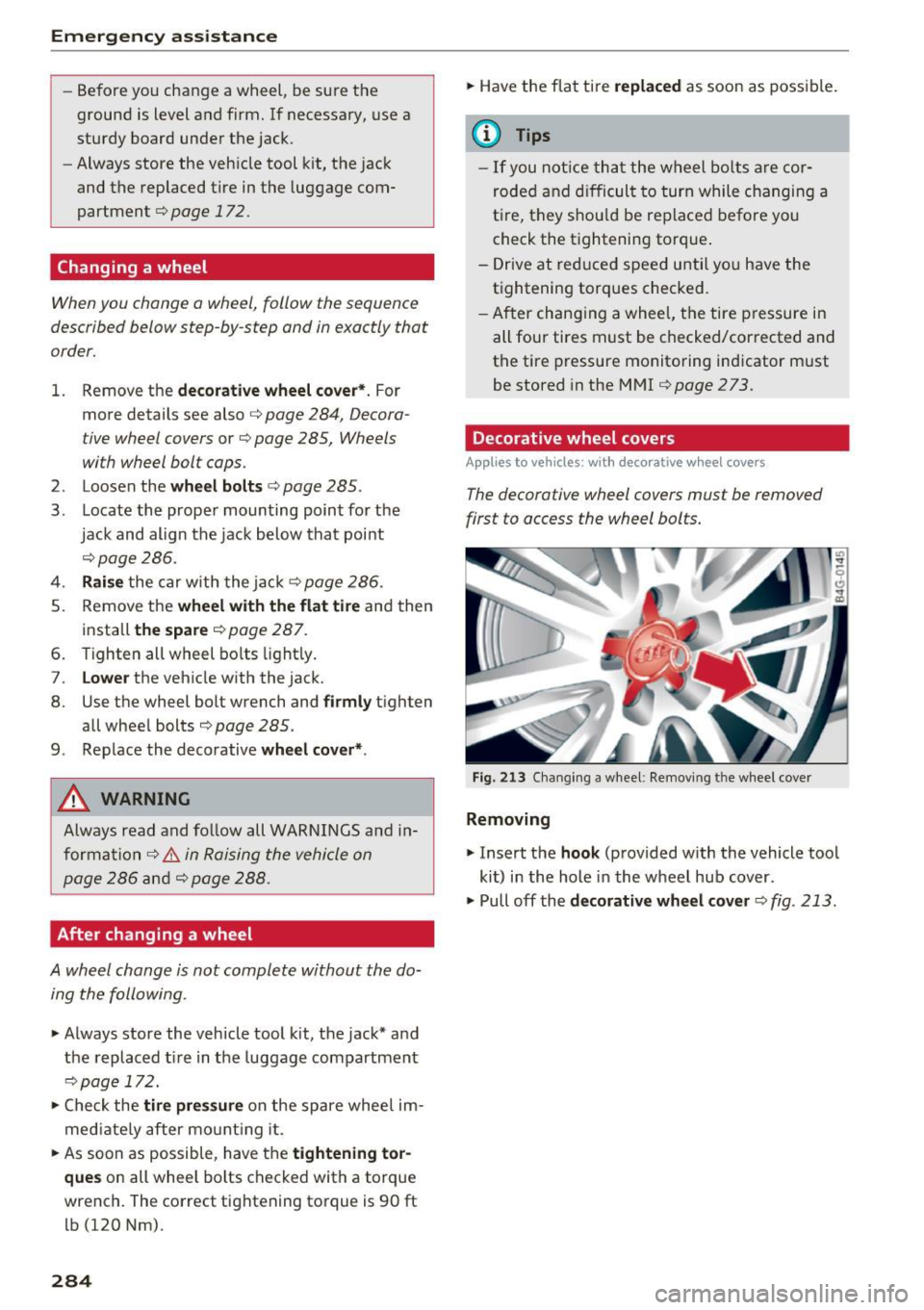
Fig. 213 Chang ing a w heel : Remov ing t he wheel cover
Removing
.,. Insert the hook (provided with the vehicle tool
kit) in the hole in the wheel hub cover.
.,. Pull off the
decorative wheel cover c:> fig. 213 .