oil AUDI S3 2016 Owner's Manual
[x] Cancel search | Manufacturer: AUDI, Model Year: 2016, Model line: S3, Model: AUDI S3 2016Pages: 328, PDF Size: 81.78 MB
Page 246 of 328

Checking and Filling
-To reduce the risk of burns from hot engine
oil, let the engine cool down to the touch.
- When removing the oil drain plug with your
fingers, stay as far away as possible. Always
keep your forearm parallel to the ground to
help prevent hot oil from running down your
arm.
- Drain the oil into a container designed for
this purpose, one large enough to hold at least the total amount of oil in your engine .
- Engine oil is poisonous. Keep it well out of
the reach of children .
- Continuous contact with used engine oil is
harmful to your skin. Always protect your
skin by washing oil off thoroughly with soap
and water .
CD Note
Never mix oil additives with your engine oil.
These additives can damage your engine and
adversely affect your Audi Limited New Vehi
cle Warranty.
@ For the sake of the environment
-Before changing your oil, first make sure
you know where you can properly dispose of
the used oil.
- Always dispose of used engine oil properly.
Do not dump it on garden soil, wooded
areas, into open streams or down sewage
drains.
- Recycle used engine oil by taking it to a used
engine oil collection facility in your area, or
contact a service station.
Cooling system
Coolant
The engine coolant performs two functions: it
keeps the engine from overheating and it pro tects the engine from freezing in the winter.
The cooling system is sealed and generally re
quires little attention.
The cooling system has been filled at the factory
with a permanent coolant which does not need to
be changed. The coolant consists of a mixture of
244
specially conditioned water and the manufactur
er's glycol-based coolant additive Gl3 antifreeze
with anticorrosion additives (50% for USA mod els; 60% for Canadian models). This mixture
both assures the necessary frost protection and
protects metal components in the engine's cool
ing system from corrosion and scaling. It also
raises the boiling point of the coolant.
Do not reduce the concentration of the coolant in
the summer by adding plain water.
The propor
tion of coolant additive must be at least 50%
but not more than 60%
to maintain antifreeze
protection and cooling efficiency. If the coolant
frost protection is too low, the coolant could
freeze and damage the vehicle heating and en
gine cooling system.
For year-round driving, antifreeze is added at the
factory for temperatures down to:
--31°F(-35°C)USA
- - 40 °F ( - 40 °C) Canada.
If you must add coolant, use a mixture of water
and coolant additive. Mixing the coolant additive
with distilled water is recommended.
A WARNING
Before you check anything in the engine com
partment, always read and heed all WARN
INGS
~ page 236.
CD Note
- Before winter sets in, have the coolant
checked to see if the coolant additive in your
vehicle is sufficient to meet the climate con ditions. This is especially important if you
live in a region where the winter is extreme
ly cold.
If necessary, increase the proportion
of coolant additive to 60%.
- When adding coolant additive to your cool
ing system, remember:
- We recommend using only coolant addi
tive Gl2++ or G13 (check the label) for
your vehicle. This coolant additive is avail
able at authorized Audi dealers. Other
types of antifreeze can significantly re
duce corrosion protection. The resulting
Page 247 of 328
.... N
0 > CX)
.... I.Cl U"I
.... I.Cl ....
corrosion can cause a loss of coolant and
serious engine damage .
- Do not add any type of radiator leak sealant
to your vehicle's engine coolant . Adding ra
diator repair fluid may adversely affect the
function and performance of your cooling
system and could result in damage not cov
ered by your New Vehicle Limited Warranty.
Adding coolant
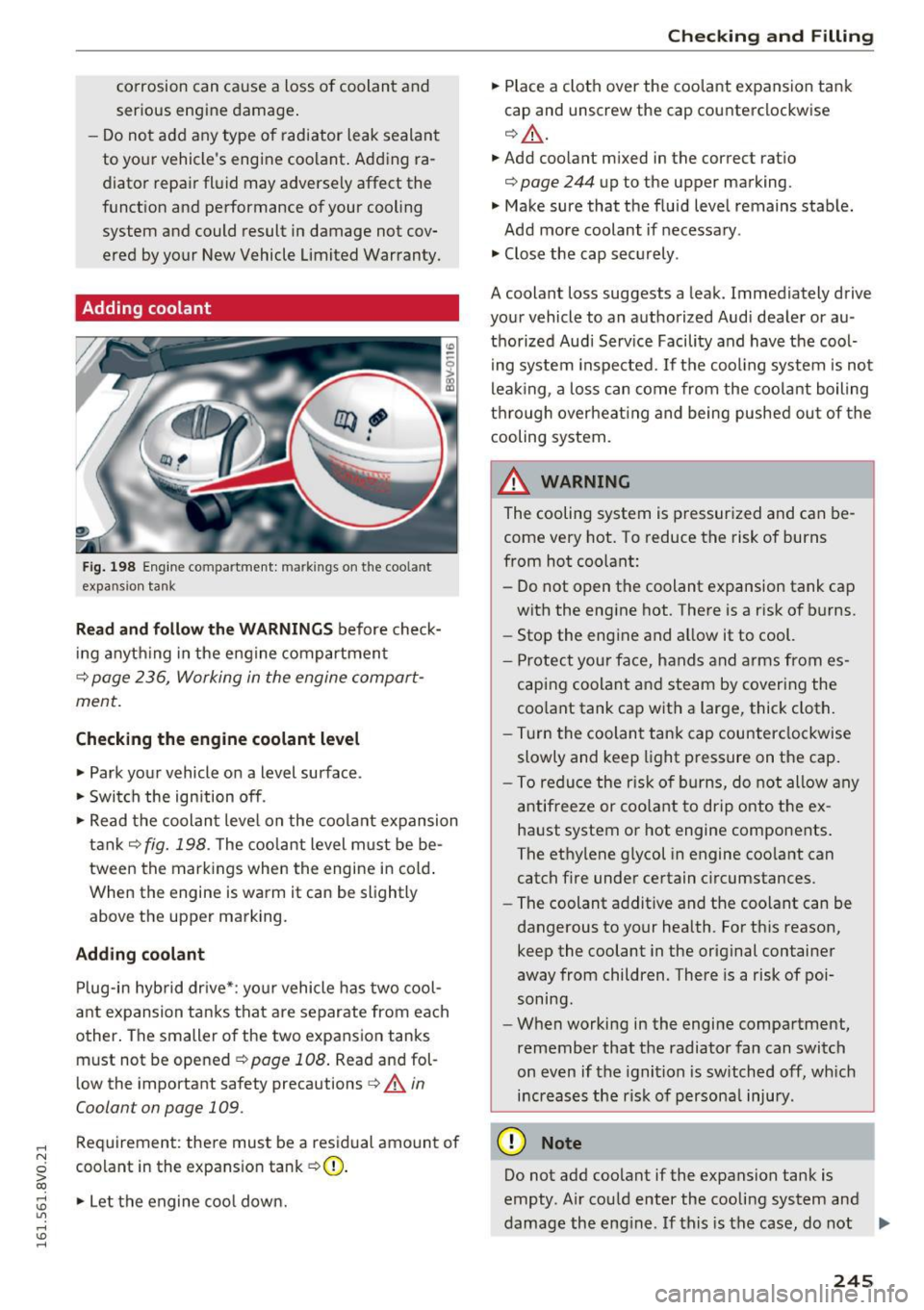
F ig . 198 Engine compa rtment: mark in gs on t he coo lant
expa nsion tank
Read and follow the WARNINGS before check
ing anything in the engine compartment
¢ page 236, Working in the engine compart
ment.
Checking the engine coolant level
• Park your vehicle on a level surface .
• Switch the ignition off .
• Read the coolant level on the coolant expansion
tank
¢ fig. 198 . The coolant level must be be
tween the markings when the engine in cold .
When the engine is warm it can be slightly above the upper marking.
Adding coolant
Plug-in hybrid drive*: your vehicle has two cool
ant expansion tanks that are separate from each
other. The smaller of the two expansion tanks
must not be opened
¢ page 108. Read and fol
low the important safety precautions ¢
A in
Coolant on page 109.
Requirement: there must be a residual amount of
coolant in the expansion tank ¢(D .
• Let the engine cool down .
Checking and Filling
• Place a cloth over the coolant expansion tank
cap and unscrew the cap counterclockwise
¢ A .
• Add coolant mixed in the correct ratio
¢
page 244 up to the upper marking.
• Make sure that the fluid level remains stable.
Add more coolant if necessary.
• Close the cap securely .
A coolant loss suggests a leak. Immediately drive
your vehicle to an authorized Audi dealer or au
thorized Audi Service Facility and have the cool
i ng system inspected. If the cooling system is not
leak ing, a loss can come from the coolant boiling
through overheat ing and being pushed out of the
cooling system .
,&_ WARNING
-= -The cooling system is pressurized and can be
come very hot. To reduce the risk of burns
from hot coolant:
- Do not open the coolant expansion tank cap
with the engine hot. There is a risk of burns.
- Stop the engine and allow it to cool.
- Protect your face, hands and arms from es-
caping coolant and steam by covering the
coo lant tank cap with a large, thick cloth.
- Turn the coolant tank cap counterclockwise
slowly and keep light pressure on the cap.
- To reduce the risk of burns, do not allow any
antifreeze or coolant to drip onto the ex
haust system or hot engine components.
The ethylene glycol in engine coo lant can
catch fire under certain circumstances .
- The coolant additive and the coolant can be
dangerous to your health . For th is reason,
keep the coolant in the original container
away from children. There is a risk of poi
soning .
- When working in the engine compartment,
remember that the radiator fan can switch
on even if the ignition is switched off, wh ich
increases the risk of persona l injury.
(J) Note
Do not add coolant if the expansion tank is
empty . Air could enter the cooling system and
damage the eng ine.
If this is the case, do not ..,_
245
Page 248 of 328
Checking and Filling
cont inue driving. See an authorized Audi deal
er or authorized Audi Service Facility for assis
tance .
Radiator fan
The radiator fan switches on outomotico/ly by it
self.
An auxiliary elect ric radiator fan sw itches on and
off depend ing on coolant temperature and other
vehicle operating conditions.
After you switch the engine off, the auxiliary fa n
can cont inue runn ing fo r up to 10 minutes -even
with the ignition off . It ca n even switch on again
later by itself¢.&. , if
- the temperature of the engine coolant r ises due
to the heat bu ild -up from the engine in the e n
gine compartment, or
- the engine compartment heats up because the
vehicle is parked in intense sunlight .
A WARNING
-To reduce the risk of pe rsonal injury never
touch the radiator fan .
- The auxiliary electric fan is temperature
controlled and can switch on suddenly even
when the eng ine is not running.
- The auxiliary radiator fan switches on auto
matically when the engine coo lant reaches a
certain tempe rature and w ill cont inue to run
until the coolant temperature drops.
Brake fluid
Checking brake fluid level
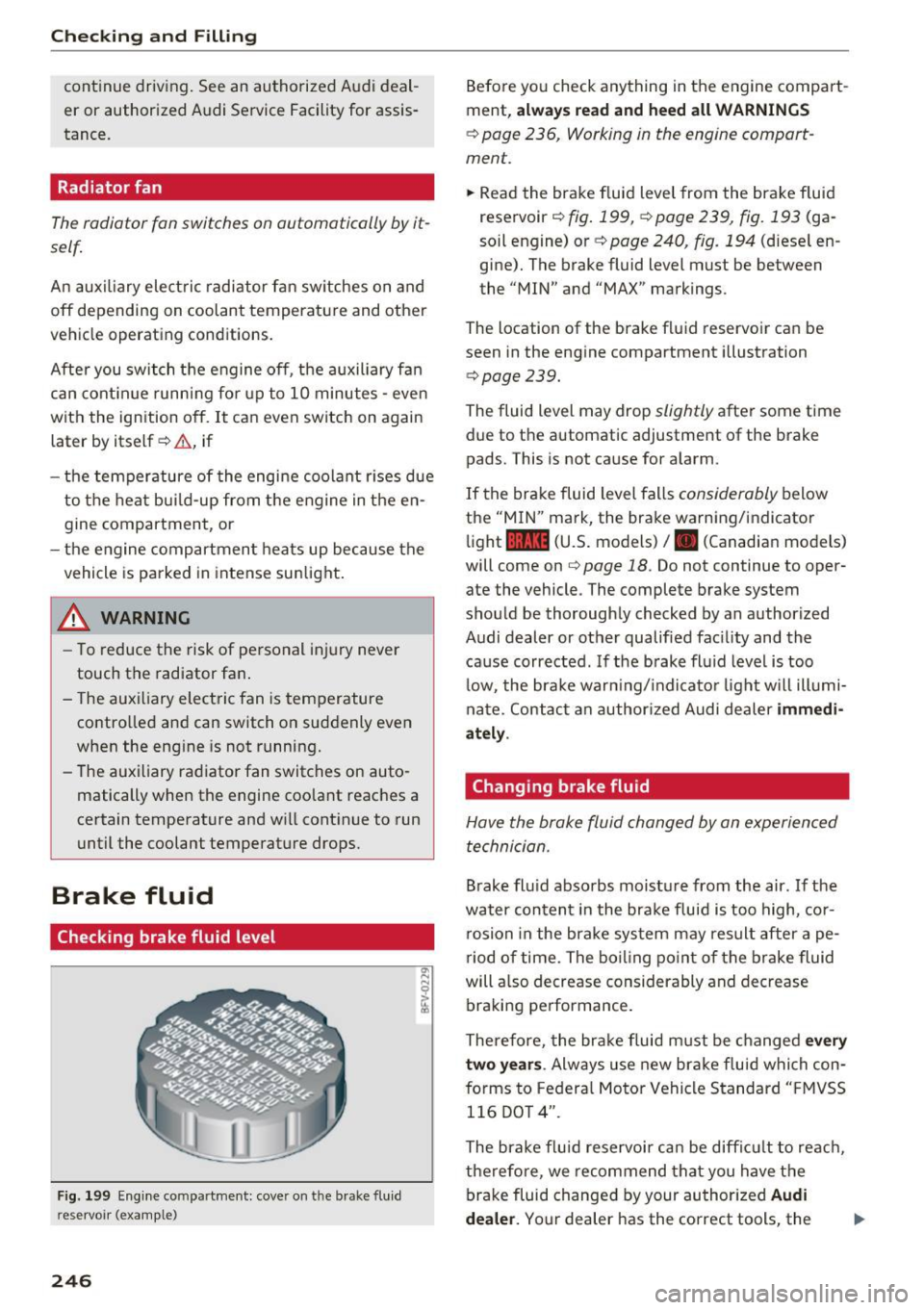
F ig . 19 9 Engine co mpar tment: cove r o n t he b rake fluid
r e servo ir (example)
246
-
Before yo u check any thing in the engine compart
ment,
always read and heed all WARNINGS
¢ page 236, Working in the engine comport
ment .
.,. Read the brake fluid level from the brake f luid
reservoir ¢
fig. 199, ¢ page 239, fig. 193 (ga
soil engine) or ¢
page 240, fig. 194 (diesel en
gine). The brake fluid level must be between
the "MIN" and "MAX" markings .
The location of the brake fl u id reservoir can be
seen in the engine compartment i llustration
q page239.
The fluid level may drop slightly after some time
due to t he automatic adjustment of the brake
pads. This is not ca use for a larm.
If t he brake fluid level falls considerably below
the "M IN" mark, the brake warning/indicator
li ght ~ (U.S. models)
I. (Canadian models)
will come on
q page 18 . Do not continue to oper
ate the vehicle . The complete brake system
shou ld be thorough ly checked by an authorized
Audi dealer or other qualified fac ility and the
cause corrected .
If the brake fl uid level is too
l ow, the bra ke war ning/ indicato r light w ill illumi
na te. Cont act an a uthor ized Audi dealer
immedi
atel y.
Changing brake fluid
Have the brake fluid changed by an experienced
technician.
B rake fl uid abso rbs moistu re from the air. If the
wa ter con ten t in the brake fluid is too high, cor
r osion in the bra ke system may res ult after ape
riod of time. The boi ling po int of the brake fluid
will a lso decrease considerably and decrease
bra king performance.
Therefore, the bra ke fluid m ust be changed
every
two year s. Always use new brake f luid which con
forms to Federa l Motor Vehicle Standard " FMVSS
116 DO T 4" .
The brake fluid reservoir can be diffic ult to reac h,
the refore, we recommend that you have t he
brake fluid changed by your author ized
Audi
dealer .
Your dealer has the correct tools, the
Page 254 of 328
Checking and Filling
Service interval display
The service interval display detects when your ve
hicle is due for service.
The service interval display works in two stages:
-Inspection or oil change reminder: after a cer-
tain distance driven, a message appears in the
instrument cluster display each time the igni
tion is switched on or off . The remaining dis
tance or time is displayed briefly.
- Inspection or oil change due: if yo ur vehicle
has reached an inspection or oi l change interval
or both intervals at the same time, the mes
sage
Inspection due! or Oil change due! or Oil
change and inspection due!
appears briefly af
ter switching the ignition on/off .
Checking service intervals
You can check the remaining distance or time un
til the next oil change or next inspection in the
MMI. Select the
I MENU I button> Car> Systems *
control button > Service & control > Service in
tervals .
Resetting the indicator
Your authorized Audi dealer or authorized Audi
Serv ice Facility will reset the serv ice interval dis
p lay after performing service.
If you perform an oil change yourself to the Audi
specifications, you must reset the service interval
d isp lay.
To reset the display, select the
I MENU ! button >
Car > Systems * control button > Service & con
trol
> Service intervals > Reset oil change inter
val.
([) Note
-Only reset the oil change indicator if the oil
was changed.
- Following the service intervals is critical to
maintain ing the service life and va lue of
your vehicle, especially the engine. Even if
the m ileage on the vehicle is low, do not ex
ceed the time for the next service.
- Calculating the time to the next oil change
i s interrupted when the ve hicle battery is
disconnected. If the vehicle is not driven for
252
a long period of time, check the mainte
nance schedule so that you can fo llow the
maintenance intervals.
Page 255 of 328
,..., N 0 > 00 ,..., \D Ln ,..., \D ....
Tires and wheels
Wheels
General information
... Check your tires regularly for
damage (punctures, cuts, cracks
and bulges). Remove foreign ob
jects from the tire tread.
.,. If driving over c urbs or similar
obstacles, drive slowly and ap
proach the curb at an angle.
.,.Have faulty tires or rims re
placed immediately.
... Protect your tires from oil,
grease and fuel.
.,.Mark tires before removing
them so that the same running direction can be maintained if
they are reinstalled .
... Lay tires flat when storing and
store them in a cool, dry location
with as little exposure to light as possible.
(D Note
-Please note that summer and winter tires are designed for
the conditions that are typical in those seasons. Audi recom
mends using winter tires dur
ing the winter months. Low
temperatures significantly de
crease the elasticity of summ
er tires, which affects traction
Tires and wheels
and braking ab ility. If summer
tires are used in very cold
temperatures, cracks can form on the tread bars, result ing in
permanent tire damage that
can cause loud driving noise
and unbalanced tires.
-Burnished, polished or chromed rims must not be
used in winter driving condi
tions. The surface of the rims does not have sufficient corro
sion protection for this and
could be permanently dam
aged by road salt or sim ilar
substances.
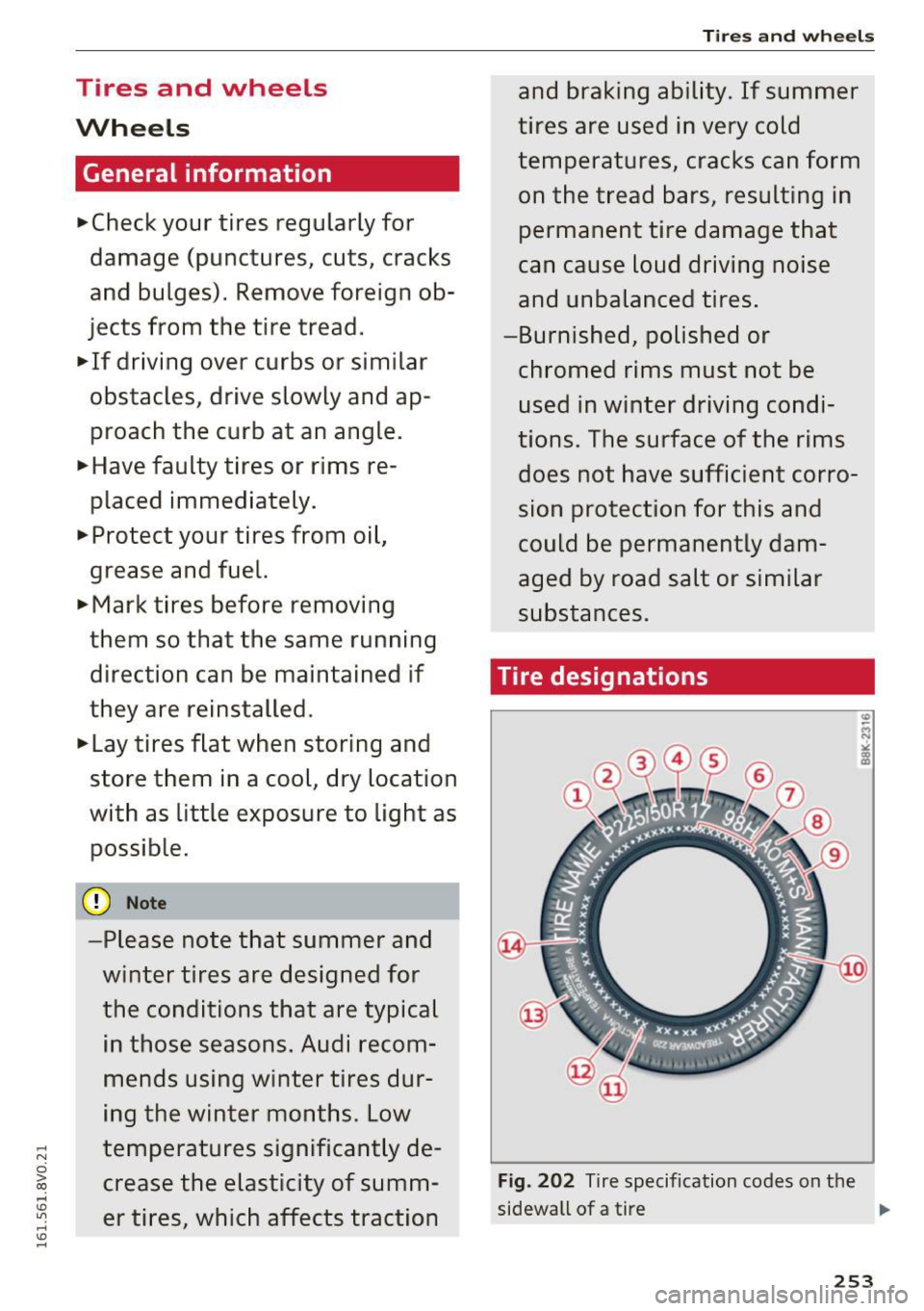
Ti re designations
Fig. 202 Tire specification codes on the
sidewall of a tire .,.
253
Page 258 of 328

Tires and wheels
Bead
means the part of the tire that is
made of steel wires, wrapped or
reinforced by ply cords and that is
shaped to fit the rim .
Bead separation
means a breakdown of the bond
between components in the bead.
Cord
means the strands forming the
plies in the tire.
Cold tire inflation pressure
means the tire pressure recom
mended by the vehic le manufac
turer for a tire of a designated
size that has not been driven for more than a couple of miles (kilo
meters) at low speeds in the
three hour period before the tire pressure is measured or adjusted.
Curb weight
means the weight of a motor ve
hicle with standard equipment in
cluding the maximum capacity of
fuel, oil, and coolant, air condi
tioning and additiona l weight of
op tional equipment.
E x tra load tire
means a tire designed to operate
at higher loads and at h igher in-
2 56
flation pressures than t he corre
sponding standard tire. Extra load
tires may be identified as "XL",
"xl" , "EXTRA LOAD" , or "RF" on
the sidewall.
Gross A xle Weight Rating
("GAWR" )
means the load-carrying capacity
of a single axle system , measured
at the tire-ground interfaces.
Gross Vehicle Weight Rating ("GVWR")
means the max im um total loaded
weight of the vehicle .
Groove
means the space between two ad
jacent tread ribs .
Load rating (code)
means the maximum load tha t a
tire is rated to carry for a given in
flation pressure. You may not find
this informat ion on all tires be
cause it is not required by law .
Maximum load rating
means the load rating for a tire at
t he maximum permissible infla
tion p ressure for that tire .
Maximum loaded vehicle
weight
means the sum of:
Page 269 of 328
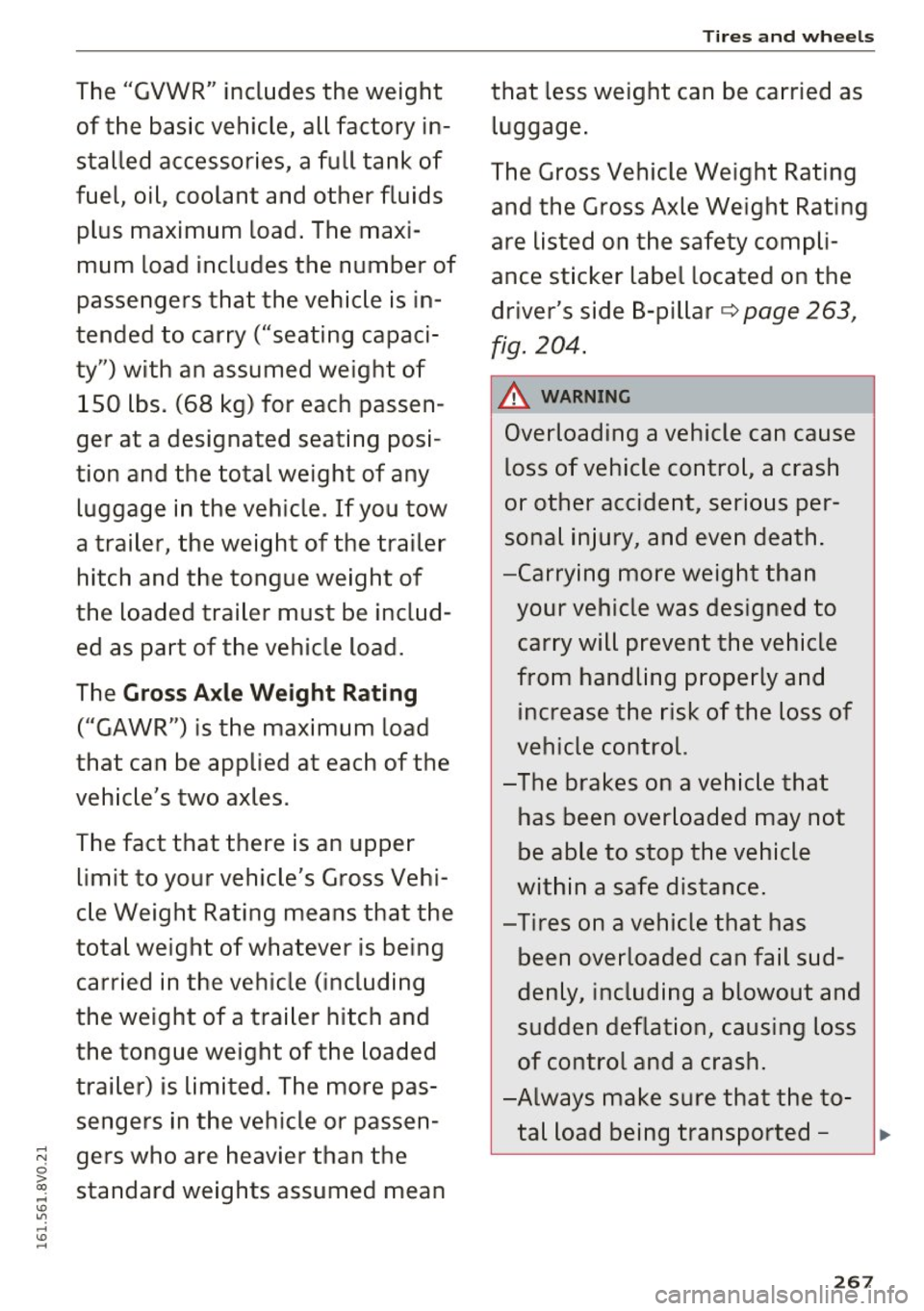
The "GVWR" includes the weight
of the basic vehicle, all factory installed accessories, a full tank of
fuel, oil, coolant and other fluids plus maximum load. The maxi
mum load includes the number of
passengers that the vehicle is in
tended to carry ("seating capaci
ty") with an assumed weight of 150 lbs. (68 kg) for each passen
ger at a designated seating posi
tion and the total weight of any luggage in the vehicle . If you tow
a trailer, the weight of the trailer
hitch and the tongue weight of
the loaded trailer must be includ
ed as part of the vehicle load.
The
Gross Axle Weight Rating
("GAWR") is the maximum load
that can be applied at each of the
vehicle's two axles.
The fact that there is an upper limit to your vehicle's Gross Vehi
cle Weight Rating means that the
total weight of whatever is being carried in the vehicle (including
the weight of a trailer hitch and
the tongue weight of the loaded
trailer) is limited. The more pas sengers in the vehicle or passen
gers who are heavier than the
standard weights assumed mean
Tires and wheels
that less weight can be carried as luggage.
The Gross Vehicle Weight Rating
and the Gross Axle Weight Rating
are listed on the safety compli
ance sticker label located on the driver's side B-pillar
¢ page 263,
fig. 204.
A WARNING
Overloading a vehicle can cause
loss of vehicle control, a crash
or other accident, serious per
sonal injury, and even death.
-Carrying more weight than your vehicle was designed to
carry will prevent the vehicle
from handling properly and increase the risk of the loss of
vehicle control.
-The brakes on a vehicle that
has been overloaded may not
be able to stop the vehicle
within a safe distance.
-Tires on a vehicle that has been overloaded can fail sud
denly, including a blowout and
sudden deflation, causing loss
of control and a crash.
-Always make sure that the to- tal load being transported -,..
267
Page 279 of 328
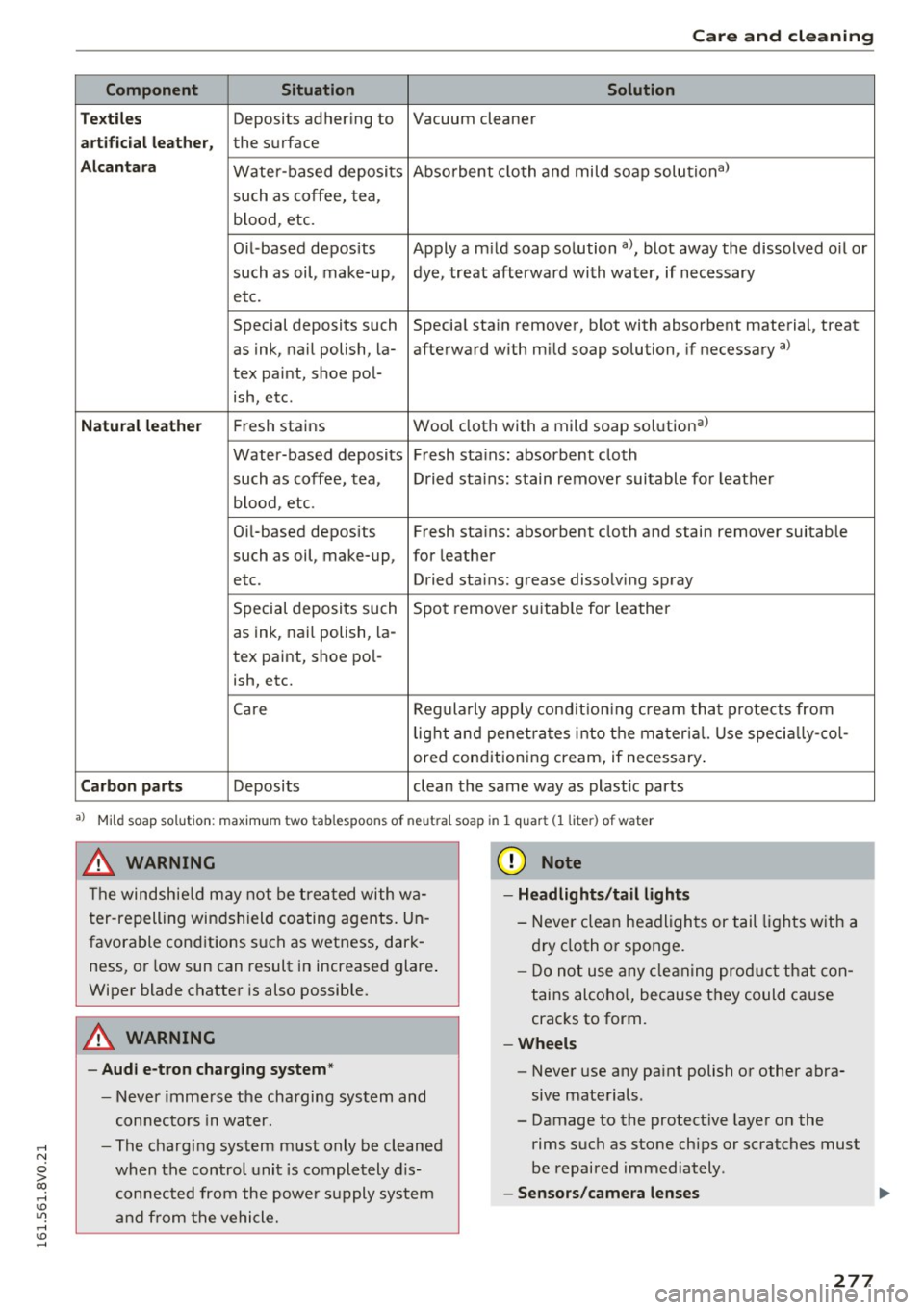
,..,
N
0 > co ,..,
Component Situation Solution
T ex til es
Deposits adhering to Vacuum cleaner
art ificial l eather, the surface
A lcan tara Water-based deposits Absorbent
cloth and mild soap solutiona>
such as coffee, tea,
b lood, etc.
Oil -based deposits Apply a m ild soap solution
a), blot away the dissolved o il or
such as oil, make-up, dye, treat afterward with water, if necessary
etc.
Special deposits such Special stain
remover, blot with absorbent material, treat
as ink, nail polish, la- afterward with mild soap solution, if necessary
a)
tex paint, shoe pol-
ish, etc.
Natu ral le ath er Fresh stains Wool cloth with a mild soap solution a)
Water-based deposits Fresh stains: absorbent cloth
such as coffee, tea, Dried stains : stain
remover suitable fo r leather
b lood , etc.
Oi [-based deposits Fresh stains: absorbent cloth and stain
remover suitable
such as oil, make-up, for leather
etc. Dried stains : grease dissolving spray
Special deposits such Spot remove r suitab le for leather
as ink, nai l polish, la-
tex paint, shoe pol-
ish, etc.
Care Regularly apply condit ion ing c ream that protects from
lig ht and penet rates into the material. Use specia lly-co l-
ored conditioning cream, if necessary .
Carbon part s Deposits clean the same way as plast ic parts
a) Mi ld soap solution: maximum two tablespoons of neutral soap in 1 q uart (1 liter) of water
.8, WARNING
The windshield may not be trea ted with wa
ter-repelling windshield coating agents. Un
favorable cond itions such as wetness, dark
ness, or low sun can result in increased glare.
Wiper blade chatter is also possible.
A WARNING
- Audi e -tron charg ing sy stem *
- Never immerse the charging system and
connectors in water.
- The charging system m ust only be cleaned
when the control unit is completely d is
connected from the powe r su pply system
and from the vehicle.
-
({I) Note
- Hea dlight s/tail lights
- Never clean headlights or tail lights w ith a
d ry cloth or sponge.
- Do not use any cle aning product that con
tains alcoho l, because they could ca use
cracks to form.
-Whe els
- Never use any pa int polish or other abra-
sive materials.
- Damage to the protect ive layer on the
rims such as stone chips or scratches must
be repaired immediately .
-Sensor s/came ra le nses Ill-
277
Page 294 of 328
Fuses and bulbs
-Some of the equipment listed in the follow
ing tables applies only to certain mode l ver
sions or certain optional equ ipment.
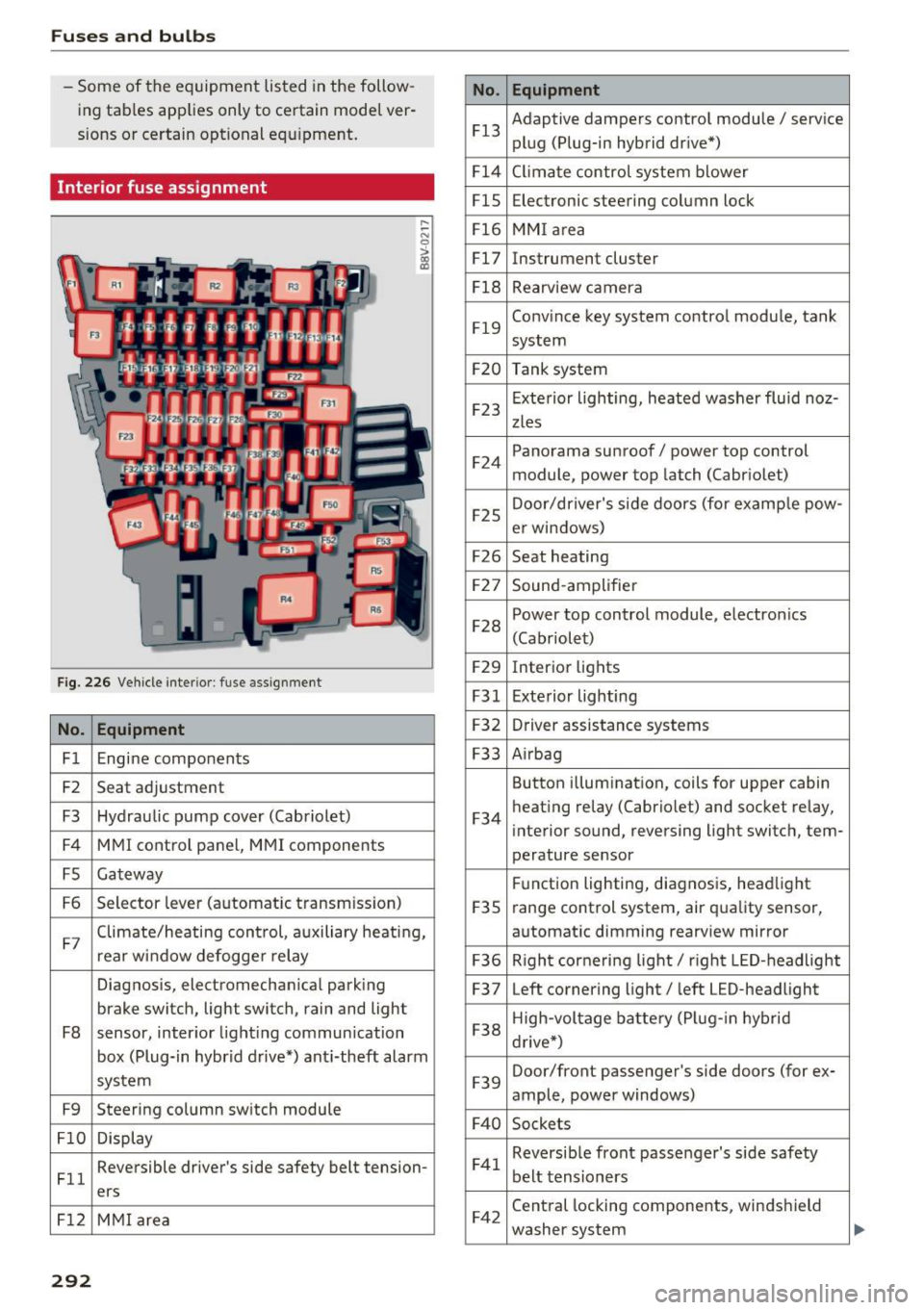
Interior fuse assignment
F ig. 226 Vehicle interior: fuse assignment
No. Equipment
Fl Engine components
F2 Seat adjustment
F3 Hydraulic pump
cover (Cabriolet)
F4 MMI control panel, MMI components
FS Gateway
F6 Selector lever (automatic transmiss
ion)
.... ~ N 0
> a) cc
F7 Climate/heating cont
rol, auxiliary heating,
rear window defogger relay
Diagnosis, electromechanical parking
brake switch, light switch , rain and light
F8 sensor, interior lighting commun ication
box (Plug-in hybrid drive*) ant i-theft alarm
system
F9 Steering column switch module
FlO Display
Fll Reversible driver's side safety belt tension-
ers
Fl2 MMI area
292
No.
Fl3
Fl4
FlS
Fl6
Fl7
Fl8
Fl9
F20
F23
F24
F25
F26
F27
F28
F29 F31
F32
F33
F34
F35
F36
F37
F38
F39
F40
F41
F42
Equipment
Adaptive dampers control module/ service plug (Plug-in hybrid dr ive")
Climate control system blower Electronic steering column lock
MMI area
Instrument cluster
Rearview camera
Convince key system control module, tank
system
Tank system Exterior lighting, heated washer fluid noz-
zles
Panorama sunroof/ power top control
module, power top latch (Cabriolet)
Door/dr iver's side doors (for example pow-
er windows)
Seat heating
Sound-amplifier
Power top control module, electro nics
(Cabriolet)
Interior lights
Exterior lighting
Driver assistance systems
A irbag
Button illumination, coils for upper cabin
heating relay (Cabriolet) and socket relay,
interior sound, reversing light switch, tern-
perature sensor
Function lighting, diagnosis, headlight
range control system, air quality sensor,
automat ic dimming rearv iew mirror
Right corneri ng light/ r ight LED-headlight
Left cornering light/ left LED-headlight
High-voltage battery (Plug- in hybrid
drive*)
Door/front passenger's side doors (for ex-
ample, power windows)
Sockets
Reversib le front passenger's side safety
belt tensioners
Central locking components, windshield
washer system
Page 295 of 328
.... N
0 > CX)
rl I.Cl U"I
rl I.Cl ....
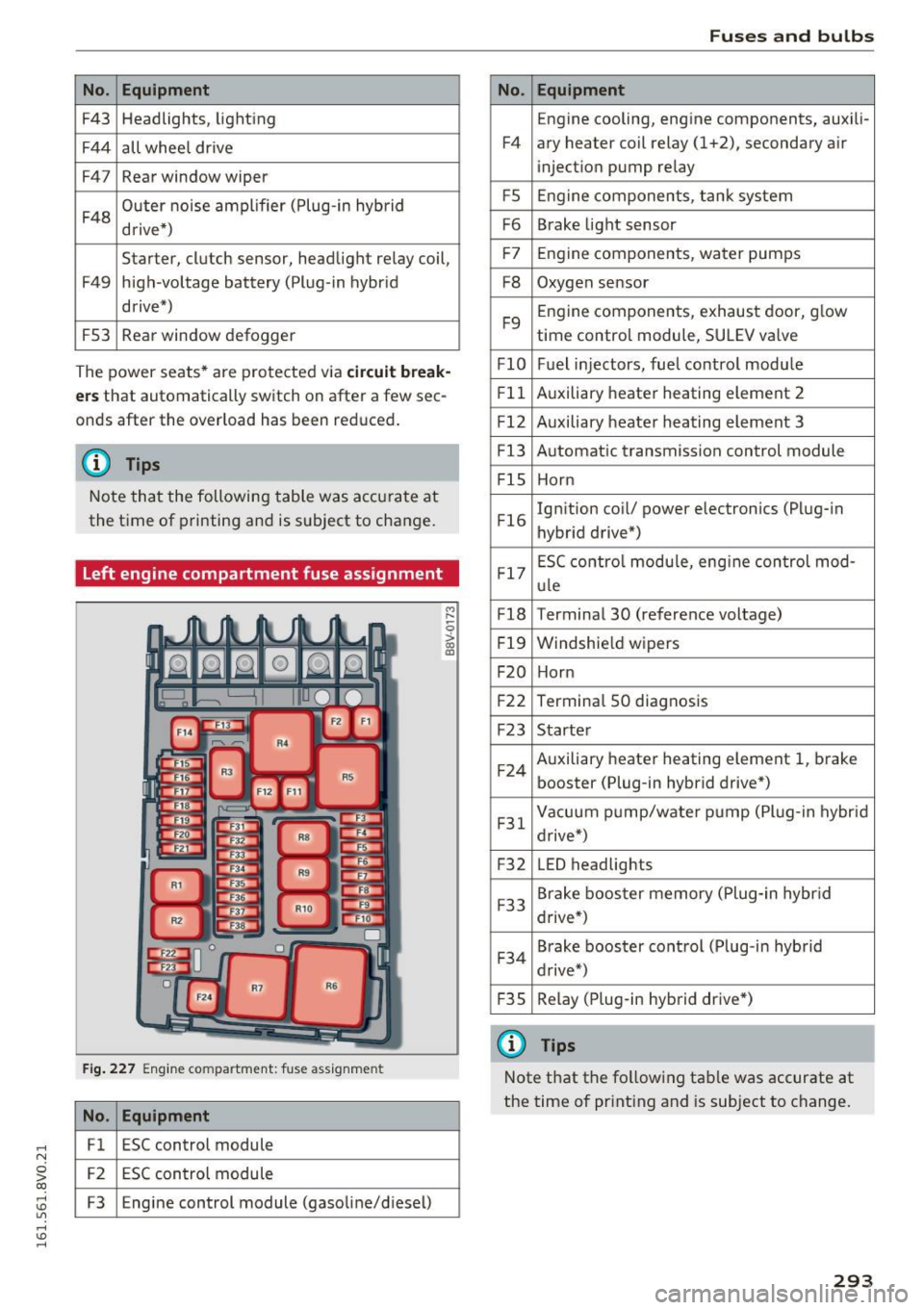
No. Equipment
F43 Headlights, lighting
F44 all whee l drive
F47 Rear window wiper
F48 Outer noise amplifier
(Plug-in hybrid
drive*)
Starter, clutch sensor, headlight relay coil,
F49 high-voltage battery (Plug-in hybr id
drive*)
F53 Rear window
defogger
The power seats* are protected via
circuit break
ers
that automatically switch on after a few sec
onds after the overload has been reduced.
(D Tips
Note that the following table was accurate at
the time of printing and is subject to change.
Left engine compartment fuse assignment
Fig. 227 Engine compartment: fuse assignment
No. Equipment
Fl ESC control module
F2 ESC control module
F3 Engine control module (gasoline/d iesel)
M ,-..
0
> co ID
Fuses and bulbs
No. Equipment
Engine cooling, engine components, auxili-
F4 ary heater coil relay (1+2), secondary a ir
injection pump relay
FS Engine components, tank system
F6 Brake light sensor
F7 Engine components,
water pumps
F8 Oxygen sensor
F9 Engine
components, exhaust door, glow
time control module, SULEV va lve
FlO Fuel injectors, fuel control modu le
Fll Auxiliary heater heating element 2
F l2 Auxiliary heater heating element 3
Fl3 Automatic transmission control module
FlS Horn
Fl6 Ignition coil/
power electronics (Plug-in
hybrid drive*)
Fl7 ESC control
module, eng ine control mod -
ule
Fl8 Terminal 30 (reference voltage)
F l9 Windshield wipers
F20 Horn
F22 Termina l 50 diagnosis
F23 Starter
F 24 Auxiliary heater heating element 1,
brake
booster (Plug-in hybrid drive*)
F31 Vacuum
pump/water pump (Plug-in hybrid
drive*)
F32 LED
headlights
F33 Brake booster
memory (Plug-in hybrid
drive*)
F 34 Brake
booster control (Plug -in hybrid
drive*)
F 35 Relay (Plug-in hybrid drive*)
@ Tips
Note
that the fo llowing tab le was accurate at
the time of printing and is subject to change.
293