tow AUDI S3 2016 Owner's Guide
[x] Cancel search | Manufacturer: AUDI, Model Year: 2016, Model line: S3, Model: AUDI S3 2016Pages: 328, PDF Size: 81.78 MB
Page 199 of 328
,....,
N
0 > co ,....,
the front passenger seat . Always make sure that
the safety belt for the front passenger seat is
properly fastened.
Th e PASSENGER AIR BAG OFF light will show
the status of the front seat p assenger' s fr ontal
Ad vanced Airbag a few se cond s after the igni·
tion i s swit ched on and the ai rbag in d icator
light goes off . The PA SSEN GER AIR BA G OFF
light :
-will stay on if the front passenger seat is not
occupied;
- wi ll stay on if the electrical ca pacita nee meas
ured by the capacit ive passenger detection sys
tem for the front passenger seat equals the combined capacitance of an infant up to about
one year of age and one of the rearward-facing
o r fo rwa rd-facing ch ild restraints listed in Fed
era l Moto r Vehicle Safety Standard 208 w it h
wh ich the Advanced Airbag System in your veh i
cl e was certified; Fo r a listing of the child re
straints that were used to certify you r vehicle 's
compliance with the U.S. Safety Standard
¢ page 211 .
-will go out if the front passenger seat is occu
pied by an adult as registered by the capacitive
passenger detection system .
- The
PASSENGER AIR BAG OFF light must come
on and stay on if the ignition is on and ...
- a car bed has been insta lled on the front pas
senger seat, or
- a rearward-facing child restrai nt has been in
sta lled on the front passenger seat, or
- a forwa rd-facing child restra int has bee n instal
l ed on the front passenge r seat,
- and if the e lectr ic al capaci tance registered on
the front passenger seat is equal to or less than
the combined capacitance of a typical 1 year o ld infant and one of the rearward-facing or
forward -facing chi ld restraints listed in Federal
Motor Vehicle Safety Standard 208 w ith which
the Advanced Airbag System in your vehicle was
certified.
If the front passenger seat is not occupied, the
front airbag w ill not deploy, and the
PA SSENGER
AIR BAG OFF
light will stay on. Never install a
rearward -fac ing ch ild restraint on the front pas-
Airb ag sys tem
senger seat, the safest place for a chi ld in any
kind of child restraint is at one of the seating po
s itions on the rear seat¢
page 185, Child re
straints on the front seat -some important
things to know
and ¢ page 209, Child safety .
If the PASSENGER AIR BAG light comes
on ...
If the PA SSEN GER AIR BAG OFF light comes on
when one of the conditions listed above is met,
be sure to check the light regu larly to make cer
ta in that the
PASSENGER AIR BAG OFF l ight
stays on continuously whenever the ignition is
on. If the
PASSENGER AIR BAG OFF li ght does
not appear on and does no t stay on a ll the time,
stop as soon as it is safe to do so and
- react ivate the system by turning the ignit ion
off for more than 4 seconds a nd then turn ing it
on again;
- remove and re insta ll the chi ld restraint. Make
sure that the chi ld restraint is properly insta l
led and that the safety belt for the front pas
senger seat has been correct ly routed through
the child restraint as described in the c hild re
straint manufacturer's instructions;
- make sure that the convertible locking retrac
tor on the safety belt for the front passenge r
seat has been activated and that the safety belt has been pulled tight.
- make sure that no e lectr ica l device (such as a
laptop, CD player, e lectron ic games device,
power inverter or seat heater for ch ild seats) is
placed or used on the fro nt passenger seat if
the device is connected to the 12-volt socket or
the c igarette lighter socket;
- make sure that no seat heater has been retro
fitted or othe rw ise added to the front passen
ger seat;
- make sure that not hing can inte rfere with the
safety belt buckles and that they are not ob
structed;
- make sure that there are no wet objects (such
as a wet towe l) and no water or other liquids on
the front passenge r seat cushion. .,..
197
Page 212 of 328
Child safety
exceptional circumstances and the
PASSENGER AIR BAG OFF light does not
come on and stay on, immediately install
the rear-facing child safety seat in a rear
seating position and have the airbag system inspected immediately by your Audi dealer .
A WARNING
-Forward-facing child seats installed on the
front passenger seat may interfere with the deployment of the airbag and cause serious
personal injury to the child.
- If exceptional circumstances require the use
of a forward-facing child restraint on the
front passenger's seat, the child's safety
and well-being require the following special
precautions to be taken:
- Always make sure that the forward-facing seat has been designed and certified by its
manufacturer for use on a front passenger
seat with a front and side airbag.
- Always carefully follow the manufacturer's
instructions provided with the child seat
or infant carrier.
- Never install a child restraint without a
properly attached top tether strap if the
child restraint manufacturer's instructions require the top tether strap to be used.
- Never put the forward-facing child re
straint up against or very near the instru
ment panel.
-Always set the safety belt upper anchor
age to the adjustment position that per
mits proper installation in accordance
with the child restraint manufacturer's in
structions.
- Always move the passenger seat into its
rearmost position in the seat's fore and
aft adjustment range, as far away from
the airbag as possible before installing the
child restraint. The backrest must be ad
justed to an upright position .
- Always make sure that nothing prevents
the front passenger's seat from being moved to the rearmost position in its fore
and aft adjustment range .
210
-Never place objects on the seat (such as a
laptop, CD player, electronic games de
vice, power inverter or seat heater for
child seats) . These may influence the elec
trical capacitance measured by the capaci
tive passenger detection system and can
also fly around in an accident and cause
serious personal injury.
- Never place or use any electrical device
(such as a laptop, CD player, electronic
games device, power inverter or seat heat
er for child seats) on the front passenger
seat if the device is connected to the 12-
volt socket or the cigarette lighter socket.
- If a seat heater has been retrofitted or
otherwise added to the front passenger seat, never install any child restraint sys
tem on this seat.
- Make sure that there are no wet objects
(such as a wet towel) and no water or oth
er liquids on the front passenger seat
cushion.
- Always make sure that the
PASSENGER
AIR BAG OFF
light comes on and stays on
all the time whenever the ignition is
switched on.
- If the
PASSENGER AIR BAG OFF light
does not come on and stay on, immediate ly install the forward-facing child seat in a
rear seating position and have the airbag
system inspected by your authorized Audi
dealer.
- Always buckle the child seat firmly in
place even if a child is not sitting in it. A
loose child seat can fly around during a
sudden stop or in a collision.
- Always read and heed all WARNINGS
whenever using a child restraint in a vehi
cle ¢
page 176, Safety belts, ¢ page 184,
Airbag system
and ¢ page 209, Impor
tant information.
(D Tips
Always replace child restraints that were in
stalled in a vehicle during a crash. Damage to
a child restraint that is not visible could cause
it to fail in another collision situation.
Page 216 of 328
Child safety
-Make sure the forward-facing seat has
been designed and certified by its manu
facturer for use on a front seat with a
passenger front and side airbag .
- Always carefully follow the manufacturer's
instructions provided with the child safety
seat o r carrier .
- Always move the front passenger seat into
the rearmost position of the passenger
seat's fore a nd aft adjustment range, and
as far away from the airbag as possible be
fore insta lling the child restraint.
- Always make sure that nothing prevents
the front passenge r's seat from be ing
moved to the rearmost posit ion in its fore
and aft adjustment range.
- Always make sure that the back rest is in
the upr ight position.
- Never place or use any e lectr ica l device
(such as a laptop, CD player, e lectron ic
g ames device, power inve rter or sea t heat
er for ch ild seats) on the front passenger
seat if the device is connected to the 12 -
volt socket or the cigarette lighter socket.
- If a seat heater has been retrofitted or
otherwise added to the front passenger
seat, never install any chi ld restraint sys
tem on th is seat.
- Make sure that there are no wet objects
(such as a wet towel) and no water or oth
er liqu ids on the front passenger seat
cushion.
- Never place objects on the seat (such as a
laptop, CD p layer, electron ic games de
vice, power inverter or seat heater for
child seats). These may influence the elec
trical capacitance measured by the capaci tive passenge r detection system and can
a lso fly around in an accident and cause
serio us personal in jury.
- Always bu ckle the child safety seat firmly in
place even if a child is not s itting in it. A
loose child safety seat can fly around during
a sudden stop or in a collisio n.
- Always re ad a nd heed all WARN INGS when
ever using a child restrained in a vehicle is
being used
¢ page 176, Safety belts,
214
c::> page 184, Airbag system and
c::> page 209 , Child safety.
A WARNING
To reduce the risk of serious injury, make sure
that the
PASSENGER AIR BAG OFF light
comes on and stays on whenever a ch ild re
stra int is installed on the front passenger seat
and the ign ition is switched on.
- Take the child restra int off the front passen
ge r seat and install it prope rly at one of the
rear seat positions if the
PASSENGER AIR
BAG OFF
light does no t stay on.
- Have the airbag system inspected by your
author ized Audi dealer immed iate ly.
Secure unused safety belts on the rear seat
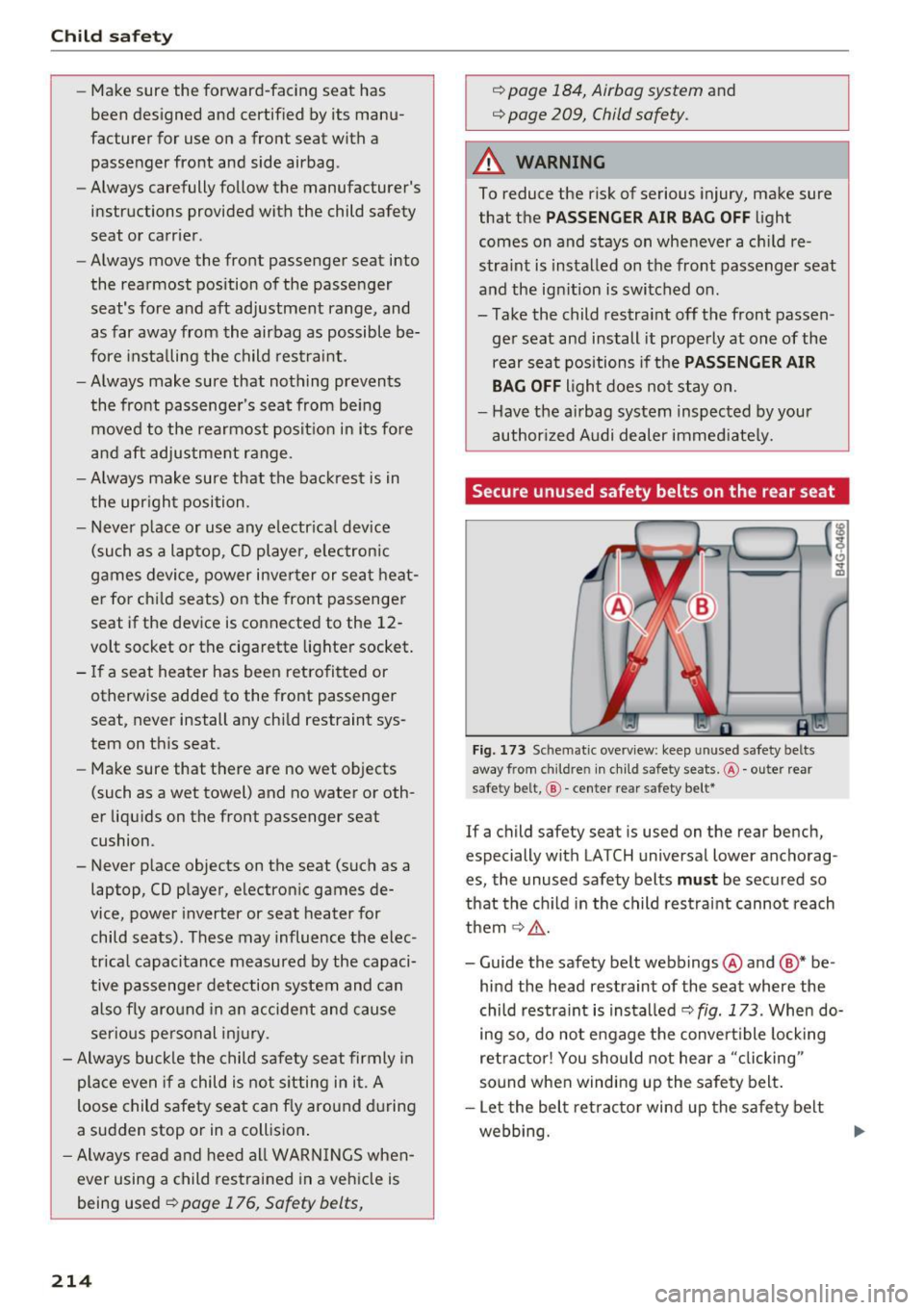
Fi g. 173 Schema tic overv iew: keep unused safety belts
away from children in c hild safety seats.@· outer rear
safety belt,@· ce nter rear safety belt*
If a child safety seat is used on the rear bench,
especially with LATCH universal lower anchorag
es, the unused safety belts
must be sec ured so
that the c hild in the child rest raint cannot reach
them
c::> _&. .
- Guide the safety belt webbings @and @* be
hind the head restraint of the seat where the
child restra int is installed
c::> fig. 173. When do
ing so, do not engage the convert ible locking
ret ra ctor! You should not hear a "cl icking"
sound when winding up the sa fe ty belt.
- Let the belt ret racto r wind up the safety belt
webbing.
Page 218 of 328
Child safety
the rear-fac ing ch ild safety seat in a rear
seat ing pos ition and have the airbag system
inspected by your Audi dealer.
- Never place or use any electrical device
(such as a laptop, CO player, electronic
games dev ice, power inverte r or s eat heater
for child seats) on the front passenger seat if the device is connected to the 12-volt
socket or the cigarette lighter socket.
- If a seat heater has been retrofitted or oth erwise added to the front passenger seat,
never install any ch ild rest raint system on
this seat .
- Make s ure that there are no wet objects
(s uch as a wet towel) and no water or other
liquids on the front passenger seat cushion.
- Never place objects on the seat (such as a
laptop, CD player, electronic games dev ice,
power inverter or seat hea ter for child
seats) . These may influence the e lectr ica l
capacitance measured by the capacitive pas
senger detection system and can also fly
around in an accident and ca use serio us per
sonal injury .
- Always read and heed all WARNINGS when
ever using a child restrained in a veh icle is
being used
¢ page 176, Safety belts,
i::> page 184 , Airbag system and
c:::;, page 209, Important information .
Convertible child safety seats
Properly used convertible child safe ty sea ts con
help protect toddlers and children over age one
who weigh between 20 and 40 lbs . (9 and 18 kg)
in a crash.
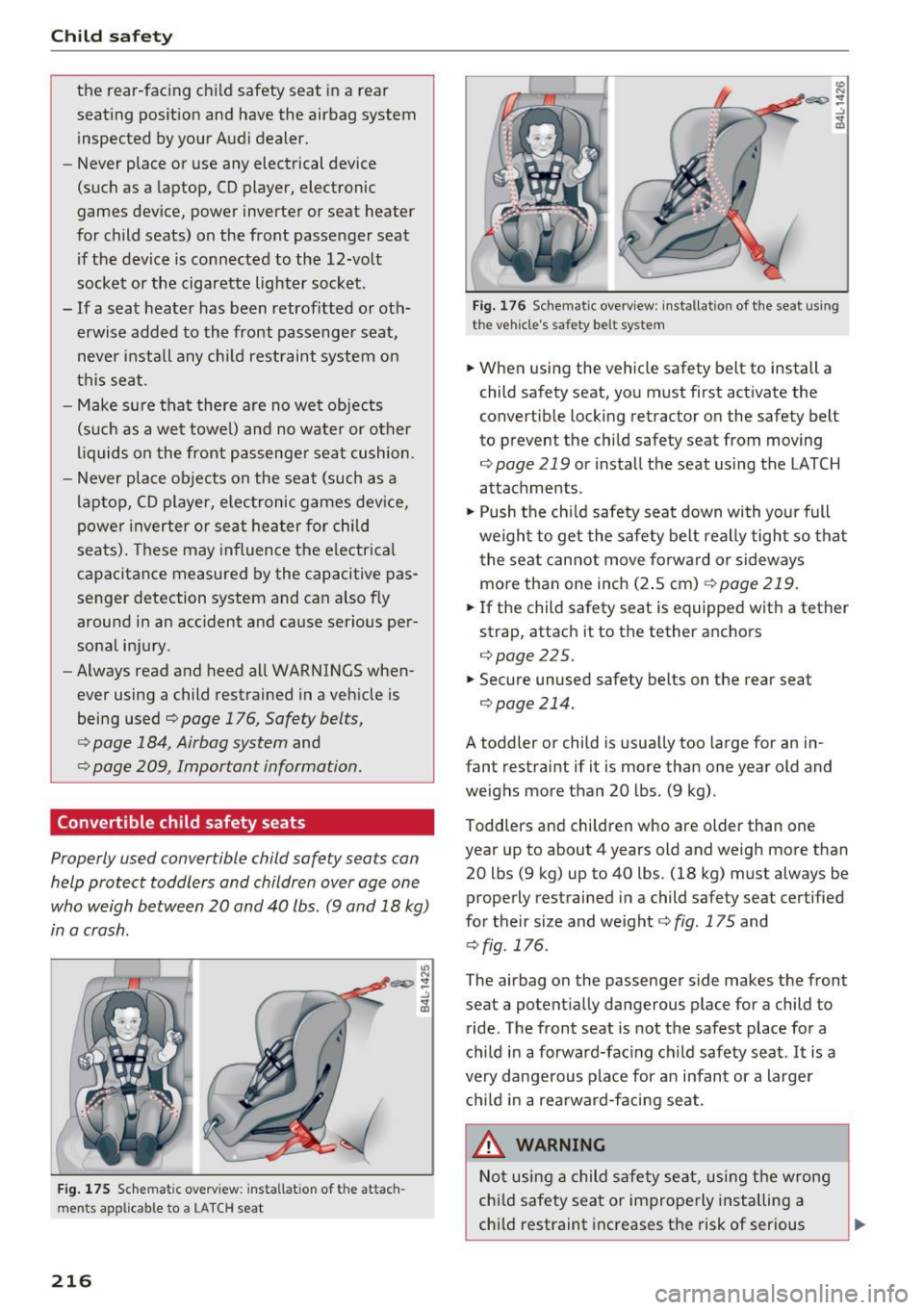
F ig. 1 75 Schema tic overv iew : in stallat io n of the a ttac h
m ents app lica ble to a LATCH seat
216
F ig. 17 6 Schem at ic ove rv iew: in stallat ion of t he seat usin g
t he vehicle's sa fety bel t system
.,. When using the vehicle safety belt to install a
child safety seat, you must first activate the
convertib le locking retractor on the safety belt
to prevent the child safety seat from moving
c:::;, poge 219 or install the seat using the LATCH
attachments .
.,. Push the chi ld safety sea t down with you r full
weigh t to get the safety belt really tight so that
the seat cannot move fo rward or sideways
more than one inch (2 .5 cm)
¢ page 219.
.,. If the child safety seat is equipped with a tether
strap, attach it to the tether ancho rs
c:::;, poge225 .
.,. Secure unused safety belts on the rear seat
c:::;, poge 214.
A toddler o r child is usually too large for an in
fant restraint if it is more than one year old and
weighs more than 20 lbs. (9 kg).
Toddlers and children who are older than one
year up to about 4 years old and weigh more than
20 lbs (9 kg) up to 40 lbs. (18 kg) must always be
properly restrained in a child safety seat certified
for their size and we ight
c:::;, fig . 175 and
¢ fig. 176.
The airbag on the passenger side makes the front
seat a potent ially dangerous place for a child to
ride . The front seat is not the safest place for a
ch ild in a forward-fac ing ch ild safety seat .
It is a
very dangerous place for an infant or a large r
ch ild in a rea rward-faci ng seat .
& WARNING
Not using a child safe ty se at, us ing t he wrong
chi ld safety seat or improperly insta lling a
chi ld restraint increases the risk of serious
Page 219 of 328
,....,
N
0 > co ,....,
er emergency situation.
- Children on the front seat of any car, even
with Advanced Airbags, can be seriously in
jured or even killed when an airbag inflates. A child in a rearward-facing child safety seat installed on the front passenger seat will be
seriously injured and can be killed if the
front airbag inflates -even with an Ad
vanced Airbag System.
- The inflating a irbag will hit the child safety
seat or infant carrier with great force and
will smash the ch ild safety seat and chi ld
against the bac krest, center arm rest, door
or roo f.
- Always install rear-facing child safety seats
on the rear seat.
- If you must install a rearward fac ing ch ild
safety seat on the front passenger seat be
cause of exceptiona l circumstances and the
PASSENGE R AIR B AG OFF light does not
come on and stay on, immediate ly install
the rear-fac ing ch ild safety seat in a rear
seating pos ition and have the airbag system
inspected by your Audi dealer.
- The rear side of the child safety seat should
be pos it ioned as close as poss ible to the
backrest on the vehicle seat.
- For adjustable head restraints: adjust or re
move the rear seat head restraint if it is d if
ficult to install the child seat with the head restra int in place ¢
page 60. Install the
head restraint again immediately once the
child seat is removed. Driving w ithout head
restra ints or w ith head restraints that are
not properly adjusted increases the risk of
serious or fatal neck injury dramatically.
- Always read and heed all WARN INGS when
ever using a child restrained in a vehicle is being used ¢
page 176, Safety belts,
¢ page 184, Airbag system
and
¢ page 209, Important information.
A WARNING
If exceptional circumstances require the use
of a forward-facing child restra int on the
front passenger's seat, the child's safety and
Ch ild safety
well-being req uire that the following special
precautions be taken:
- Make sure the forward-facing seat has been
des igned and certified by its manufacturer
for use on a front seat with a passenger
front and side airbag.
- Always follow the manufacturer's instruc
tions provided with the child safety seat or
infant carrier .
- Always move the front passenger seat into
the rearmost pos ition of the passenger
seat's fore and aft adjustment range, and as
far away from the airbag as possible before
installing the ch ild rest raint .
- Always make sure that nothing prevents the front passenger's seat from being moved to the rea rmost pos ition in its fore and aft ad
justment range .
- Always make sure the backrest is in an up
right position .
- Never p lace or use any electr ica l device
(such as a laptop , CD player, e lectron ic
games device , power inve rter or sea t heater
for child sea ts) on the front passenger seat
if the device is connected to the 12 -volt
socket or the cigarette lighter socket.
- I f a seat heater has been retrofi tted or o th
erwise added to the front passenger seat, never install any child restra int system on
this seat.
- Make sure that there are no wet objects
(such as a wet towel) and no water or other
liquids on the front passenger seat cush ion.
- Never p lace objects on the seat (such as a
laptop, CD p layer, electronic games device,
power inverter o r seat heater for ch ild
seats). These may influence the electrical
capacitance measured by the capacitive pas
senger detect ion system and can also fly
aro und in an accident and cause serious per
sonal injury.
- Make sure that the
PASSENGER AIR BAG
OFF
li ght comes on and stays on a ll the time
wheneve r the ignit ion is swit ched on.
- I f the
PASSENGER AIR BAG OFF light does
no t come on and stay on, immediately in
s tall the forward-fac ing ch ild seat at a sea t-
ing position on the rear seat and have the ...,
217
Page 224 of 328
Child safety
-Always make sure the seat backrest to which
the child restraint is installed is in an up
right position and securely latched into
place and cannot fold forward. Otherwise,
the seatback with the child safety seat at
tached to it could fly forward in the event of
an accident or other emergency situation.
- Always read and heed all WARNINGS when
ever using a child restrained in a vehicle is
being used
¢ page 209 . Special precautions
apply when installing a child safety seat on
the front passenger seat¢
page 185, Child
restraints on the front seat -some impor
tant things to know.
Deactivating the convertible locking
retractor
The convertible Locking retractor for child re
straints will be deactivated automatically when
the belt is wound all the way bock into the re
tractor .
~ Press the red button on the safety belt buckle.
Th@ belt tongue will pop out of the buckle.
~ Guide the safety belt all the way back into its
stowed position .
Always let the safety belt retract completely into
its stowed position . The safety belt can now be
used as an ordinary safety belt without the con
vertible locking retractor for child restraints .
If the convertible locking retractor should be ac
tivated inadvertently, the safety belt must be un
fastened and guided completely back into its
stowed position to deactivate this feature. If the
convertible lock ing retractor is not deactivated,
the safety belt will gradually become tighter and
uncomfortable to wear.
A WARNING
-
Improperly installed child safety seats in
crease the risk of serious personal injury and
death in a collision.
- Never unfasten the safety belt to deactivate
the convertible locking retractor for child re straints while the vehicle is moving . You
222
would not be restrained and could be seri
ously injured in an accident.
- Always read and heed all WARNINGS when
ever using a child restrained in a vehicle is
being used¢
page 209. Special precautions
apply when installing a child safety seat on
the front passenger seat
<=:> page 185, Child
restraints on the front seat -some impor
tant things to know.
LATCH system (Lower
anchorages and tethers
for children)
' Child Restraint System anchors and how
are they related to child safety
To provide a simpler and more practicable way to
attach the child restraint on the vehicle seat, Federal regulations require special lower ancho
rages in vehicles and devices on new child re
straints to attach to the vehicle anchorages .
In the United States, the combination of the
tether anchorages and the lower anchorages is
now generally called the LATCH system for
"Lower Anchorages and Tethers for Children" . In
Canada, the terms "top tether" with "lower uni
versal anchorages" (or "lower universal anchor
age bars") are used to describe the system .
In other countries the term "ISOFIX" is used to
describe the lower anchorages .
Forward-facing child restraints manufactured af
ter September 1, 1999, are required by U.S. fed
eral regulations to comply with new child head
movement performance requirements . These
new performance requirements make a tether
necessary on most new child seats.
Installing a child restraint that requires a top
tether without one can seriously impair the per
formance of the child restraint and its ab ility to
protect the child in a collision. Installing a child
restraint that requires a top tether without the
top tether may be a violation of state law.
Child restraint manufacturers offer LATCH lower
anchorages on their child seats with hook-on or ...
Page 235 of 328
,....,
N
0 > co ,....,
¢ page 242, Adding engine oil
The cata lytic converter is an efficient "clean -up"
device bui lt into the exhaust system of the vehi
cle. The catalytic converter burns many of the
pollutants in the exhaust gas before they are re
leased into the atmosphere.
The exclusive use of unleaded fue l is critica lly im
portant for the life of the catalytic converter and
proper functioning of the engine.
A WARNING
The temperature of the exhaust system is
high, both when driving and after stopping
the engine.
- Never touch the exhaust tail pipes once they
have become hot. This could result i n burns .
- Do not park or operate the vehicle in areas
where the hot exhaust system may come in
contact with dry grass, brush, fuel spill or
other material which can cause a fire .
-Do not apply additional undercoating or
rustproofing o n or near the exhaust mani
fold, exhaust pipes, catalytic converte r o r
heat s hields. During dr iving, t he substance
used for under coati ng could ove rheat and
c ause a fire.
(D Note
- Be aware that just one tank filling with
leaded fue l wi ll al ready ser iously degrade
the pe rformance of the ca talytic converter.
- Do not ex ceed the correct eng ine o il level
~page 242.
- Do not d rive until the fuel tank becomes
complete ly empty. The engine co uld m is
fire. Unburned fuel could also get in to the
exhaust system and this co uld cause t he
cata lytic converter to overheat .
- Do no t sw itch off t he igni tion while t he vehi
cle is moving.
- Do no t continue to operate your vehicle un
der these cond it ions, as othe rwise fue l can
reach the catalytic converter. This cou ld re
su lt in overheating of the converter, req uir
i ng its replacement.
Ch eck ing and Filling
-To ass ure eff icient operat ion of the Emis
sion Contro l System:
- Have yo ur vehicle maintained p roperly and
i n accordance with the serv ice recommen
dat ions in yo ur War ranty
& Ma intenance
booklet.
- L ack of proper ma intenance as well as im
p roper use of the ve hicle will impa ir the
f u nction of t he emission control system
a nd could lead to damage.
~ For the sake of the environment
Eve n when the Em iss ion Control System is op
era ting properly, t he exhaus t gas can have a
su lf ur -li ke exhaus t gas sme ll under some op
erating s tates . This depends on the sul fur
content of the fuel being used. Using a differ
ent brand of fuel may help, or fi lling the tank
with lead-free super grade gasoline.
Diesel particulate filter
Appl ies to vehicles: wit h diesel eng ine
The diese l particu late filter filte rs nearly all of
the soot part icles out of the exhaust. The filter
cleans itself automatically under norma l driving
condit ions. If the filter cannot clean itself (for ex
amp le, because yo u are o nly dr iving short distan
ces), the filte r becomes clogged with soot and
the
II symbol fo r the diese l par ticu late filter il
l u minates
¢page 23.
A WARNING
-Do not park your veh icle over flammab le
materia ls such as grass or leaves because
the high temperature of the diesel particu
late filte r cou ld start a fi re.
-
- Do not app ly an underbody protectant in the
exhaust system area or a fire could start .
233
Page 269 of 328
The "GVWR" includes the weight
of the basic vehicle, all factory installed accessories, a full tank of
fuel, oil, coolant and other fluids plus maximum load. The maxi
mum load includes the number of
passengers that the vehicle is in
tended to carry ("seating capaci
ty") with an assumed weight of 150 lbs. (68 kg) for each passen
ger at a designated seating posi
tion and the total weight of any luggage in the vehicle . If you tow
a trailer, the weight of the trailer
hitch and the tongue weight of
the loaded trailer must be includ
ed as part of the vehicle load.
The
Gross Axle Weight Rating
("GAWR") is the maximum load
that can be applied at each of the
vehicle's two axles.
The fact that there is an upper limit to your vehicle's Gross Vehi
cle Weight Rating means that the
total weight of whatever is being carried in the vehicle (including
the weight of a trailer hitch and
the tongue weight of the loaded
trailer) is limited. The more pas sengers in the vehicle or passen
gers who are heavier than the
standard weights assumed mean
Tires and wheels
that less weight can be carried as luggage.
The Gross Vehicle Weight Rating
and the Gross Axle Weight Rating
are listed on the safety compli
ance sticker label located on the driver's side B-pillar
¢ page 263,
fig. 204.
A WARNING
Overloading a vehicle can cause
loss of vehicle control, a crash
or other accident, serious per
sonal injury, and even death.
-Carrying more weight than your vehicle was designed to
carry will prevent the vehicle
from handling properly and increase the risk of the loss of
vehicle control.
-The brakes on a vehicle that
has been overloaded may not
be able to stop the vehicle
within a safe distance.
-Tires on a vehicle that has been overloaded can fail sud
denly, including a blowout and
sudden deflation, causing loss
of control and a crash.
-Always make sure that the to- tal load being transported -,..
267
Page 270 of 328
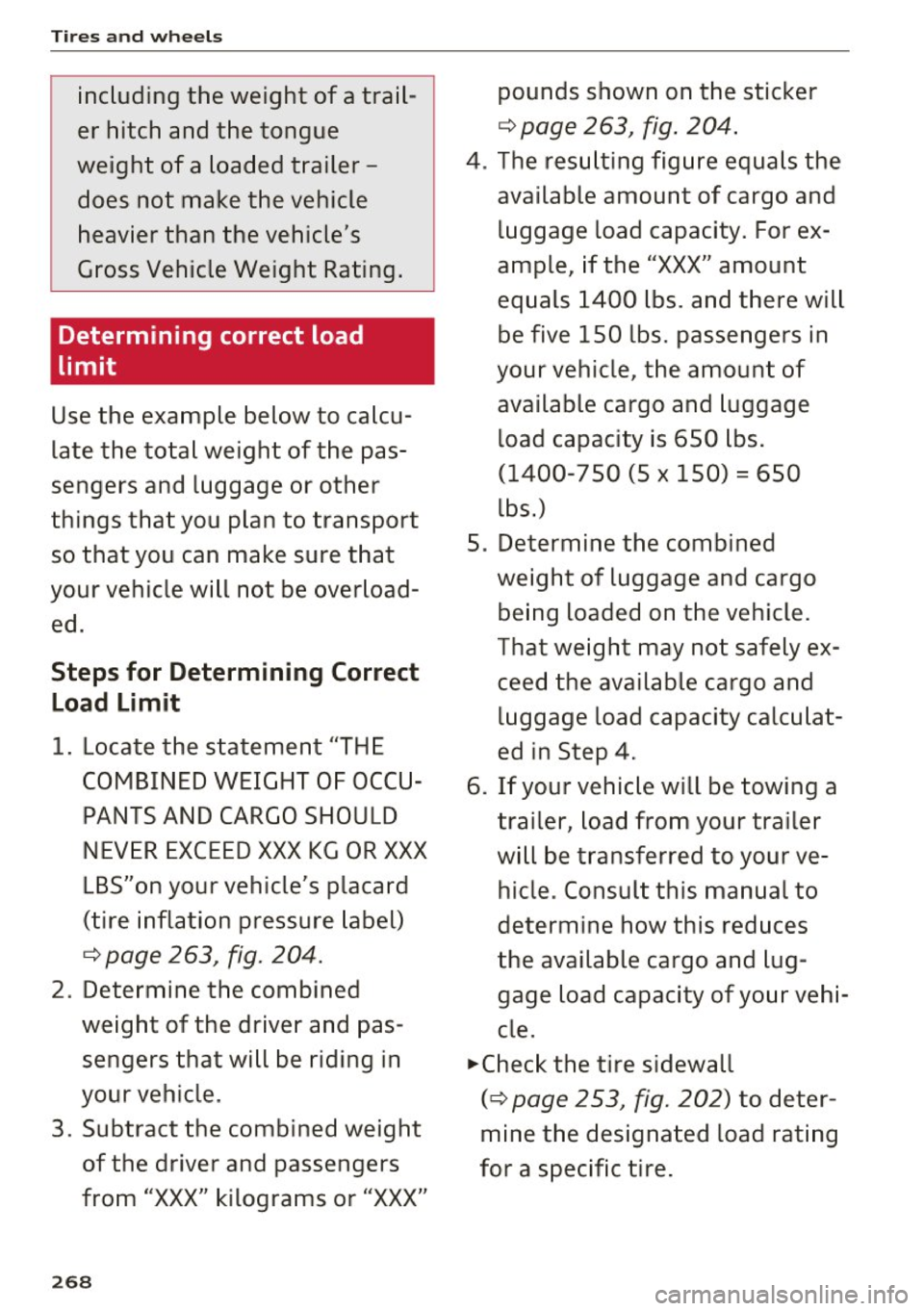
Tires and wheels
including the weight of a trail
er hitch and the tongue
weight of a loaded trailer does not make the vehicle
heavier than the vehicle's
Gross Vehicle Weight Rating.
Determining correct load
limit
Use the example below to calcu
late the total weight of the pas
sengers and luggage or other
things that you plan to transport
so that you can make sure that
your vehicle will not be overload ed.
Steps for Determining Correct Load Limit
1. Locate the statement "THE
COMBINED WEIGHT OF OCCU
PANTS AND CARGO SHOULD
NEVER EXCEED XXX KG OR XXX
LBS"on your vehicle's placard
(tire inflation pressure label)
¢ page 263, fig. 204.
2. Determine the combined
weight of the driver and pas
sengers that will be riding in
your vehicle.
3 . Subtract the combined weight
of the driver and passengers
from
"XXX" kilograms or "XXX"
268
pounds shown on the sticker
¢ page 263, fig. 204.
4 . The resulting figure equals the
available amount of cargo and
luggage load capacity. For ex
ample, if the
"XXX" amount
equals
1400 lbs . and there will
be five
150 lbs. passengers in
your vehicle, the amount of available cargo and luggage
load capacity is
650 lbs .
(1400-750 (5 X 150) = 650
lbs.)
5. Determine the combined
weight of luggage and cargo
being loaded on the vehicle.
Tha t weight may not safely ex
ceed the available cargo and luggage load capacity calculat
ed in Step 4.
6. If your vehicle will be towing a
trailer, load from your trailer
will be transferred to your ve hicle . Consult this manual to
determine how this reduces
the available cargo and lug
gage load capacity of your vehi
cle.
~check the tire sidewall
(¢ page 253, fig. 202) to deter
mine the designated load rating
for a specific tire.
Page 278 of 328
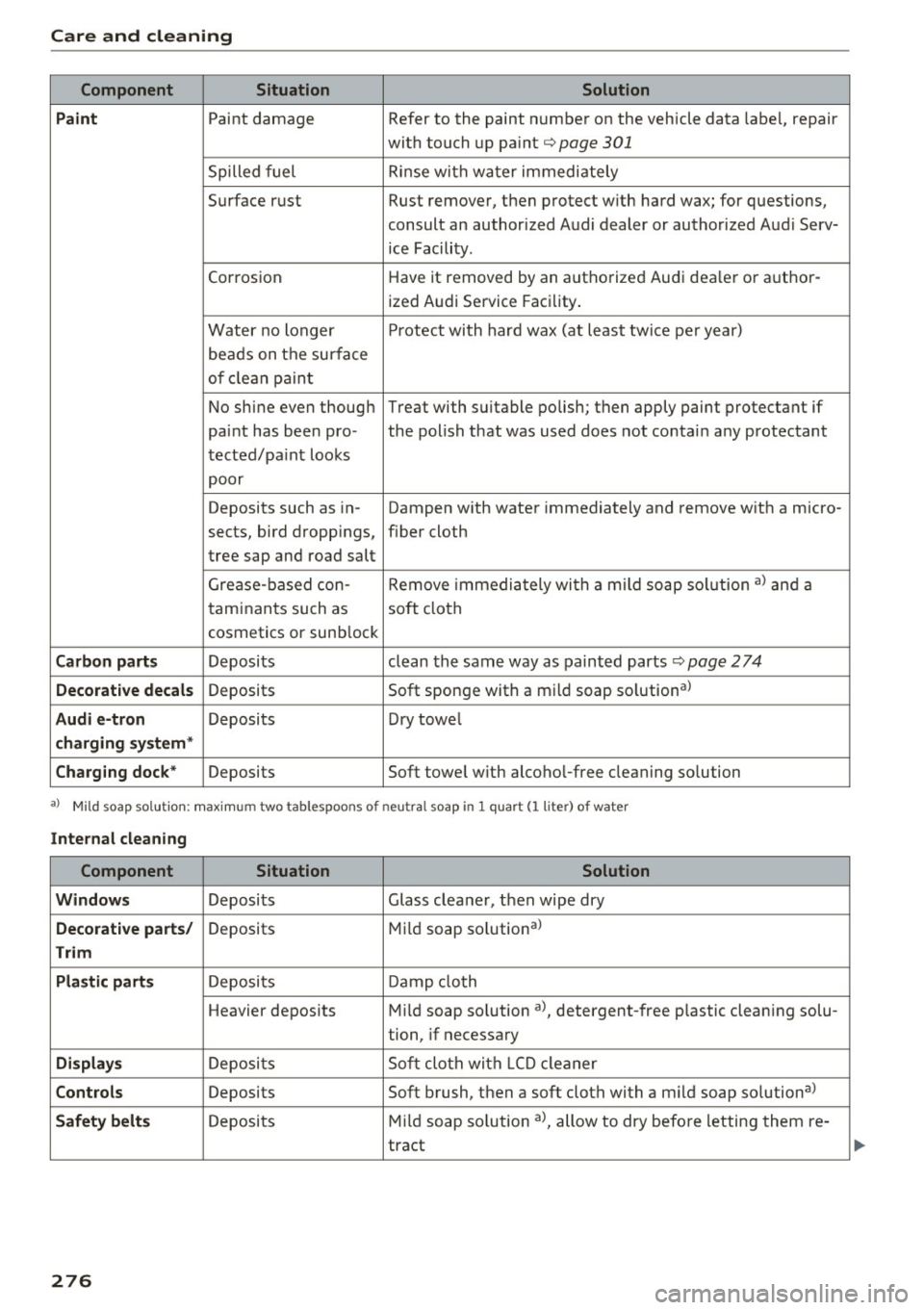
Care and cleaning
Component Situation Solution
Paint
Paint damage Refer to the paint number on the vehicle data label, repair
with touch up paint¢
page 301
Spilled fuel Rinse with water immediately
Surface rust Rust remover, then protect with hard wax; for questions,
consult an authorized Audi dealer or authorized Audi Serv-
ice Facility.
Corrosion Have
it removed by an authorized Audi dea ler or a uthor-
ized A udi Service Facility.
Water no longer Protect with hard wax (at least twice per year)
beads on the surface
of clean paint
No shine even though Treat with suitable polish; then apply paint protectant if
paint has been pro- the polish that was used does not contain any protectant
tected/paint looks
poor
Deposits such as in- Dampen w ith water immediately and remove with a micro-
sects, bird dropp ings, f iber cloth
tree sap and road salt
Grease-based con- Remove immediately wi th a mild soap solution al and a
taminants such as
soft cloth
cosmetics or sunblock
Carbon parts Deposits clean the same way as painted parts¢ page 2 74
Decorative decals Deposits Soft sponge with a mild soap solutional
Audi e-tron Deposits Dry towe l
charging system *
Charging dock*
Deposits Soft towel with alcoho l-free cleaning so lution
a} Mild soa p sol ution: maxim um two tablespoons of neutral soap in 1 quart (I liter) of water
Internal cleaning
Component Situation Solution
Windows
Deposits Glass cleaner, then wipe dry
Decorative parts/ Deposits Mild soap solutional
Trim
Plastic parts
Deposits Damp cloth
Heavier deposits Mild soap so lution al, detergent-free p lastic clean ing solu-
tion, if necessary
Displays Deposits Soft cloth with LCD cleaner
Controls Deposits Soft brush, then a soft cloth with a mild soap solutional
Safety belts Deposi ts Mild soap solution al, allow to dry before letting them re-
tract
276