ABS AUDI S3 SEDAN 2015 User Guide
[x] Cancel search | Manufacturer: AUDI, Model Year: 2015, Model line: S3 SEDAN, Model: AUDI S3 SEDAN 2015Pages: 282, PDF Size: 71.14 MB
Page 126 of 282
Intelligent Technology
road and traffic conditions . Do not let the in
c reased sa fety prov ided tempt you into tak
ing risks. Th is cou ld increase your r isk of a
collision .
- Please note the risk of a co llision increases
when d riving fast, especially through curves
and on slippery or wet roads, and whe n dr iv
i ng too close to obj ects ahead . T he ESC and
i t s integr ated sy ste ms cann ot a lways pre
ven t colli sion s -the re is s till a risk of acci
dent s!
- Press the ac celerator ped al carefully whe n
acc ele ratin g on eve n, slippe ry su rfac es su ch
Switching on /off
as ice a nd snow . T he d rive wheels can spin
even wh en t hese control systems are instal
led and this ca n affect d riving stability and
increase the risk of a collis ion .
{!) Tips
-ABS an d ASR o nly fu nction co rrec tly when
all four wheels are equipped with identica l
t ir es . Differe nt tire s izes ca n lead to a reduc
t ion in e ngine powe r.
- Yo u may hear noises when t he systems de
sc rib ed ar e wo rking.
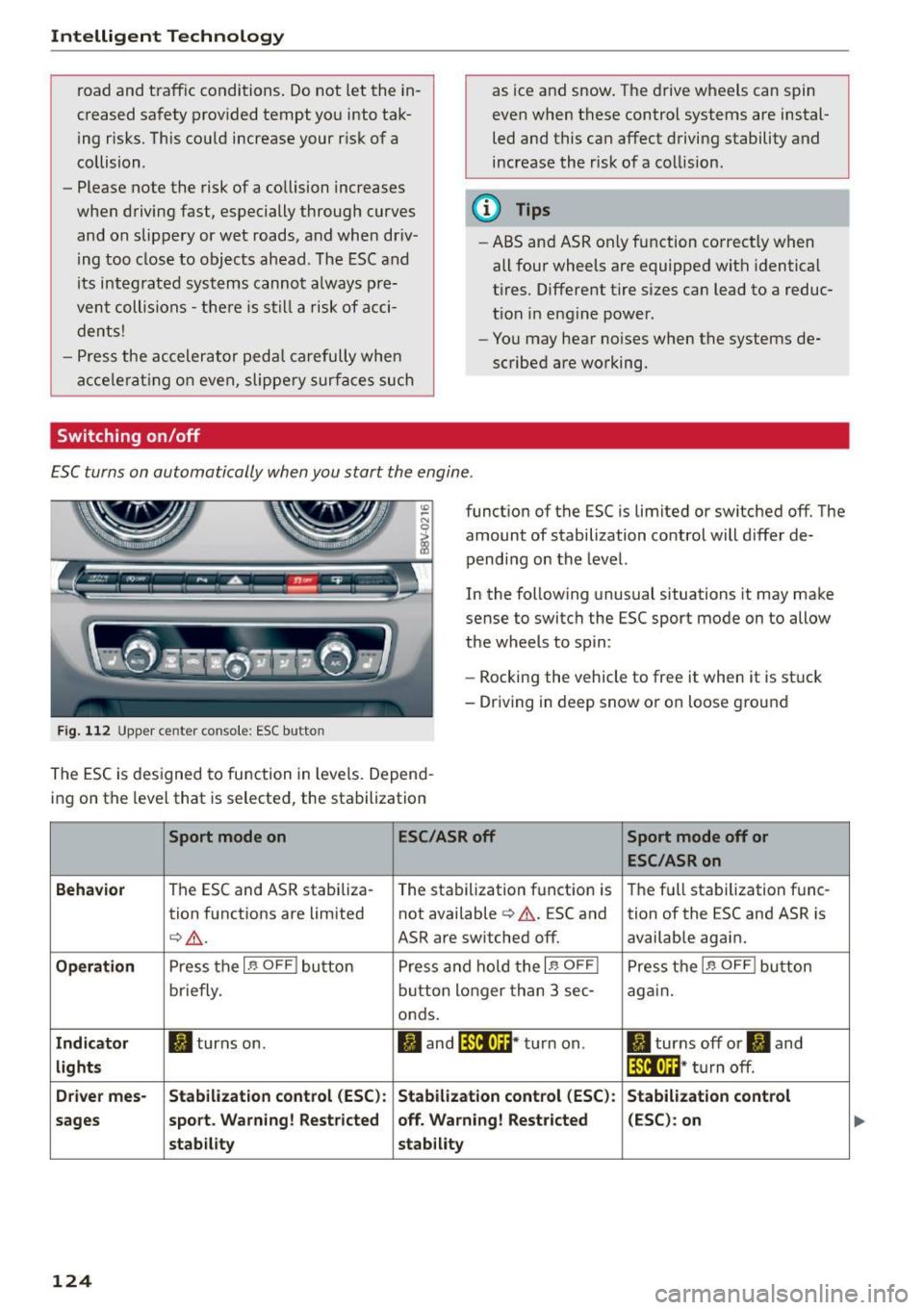
E SC turns on automatically when you start the engine .
Fig. 112 Upper ce nte r con so le : ESC butto n
functio n of the ESC is limited or switched off. The
amount of stabilization control will d iffer de
pend ing on the level.
In the fo llow ing unusual situations it may ma ke
sense to switch the ESC sport mode on to allow
t h e wheels to sp in:
- Rocking the vehicle to free it when it is st uck
- Driving in deep snow or o n loose g ro und
The E SC is d esigned to fu nction in levels . Depen d
i ng on the level that is se lected, the sta bilization
Sport mode on ESC/ASR off Sport mode off or
ESC/ASRon
Behavior
T he ESC and ASR stabiliza- The sta bilization f unct ion is T he f ull sta bilization f unc -
tion f unct ions a re lim ited not available¢& . ESC and
tion of the ESC and ASR is
¢ _& .
ASR are switched off. available again.
Operation Press t he I~ OFF ! bu tton P ress and hold t he I~ OFF I Pre ss th e I~ OFF ! bu tton
briefly. bu
tto n lon ger than 3 sec-
again.
onds.
Indicator II tur ns on. ltl and lf'tl•U~ * tu rn on . II turns off or II and
lights lf'tl•lH* turn off .
Driver mes- Stabilization control (ESC): Stabilization control (ESC) : Stabilization control
sages sport
. Warning! Restricted off . Warning! Restricted (ESC) : on
stab ility stability
124
Page 139 of 282
M N
0 > co ..... \!) 1.1"1
1.1"1
1.1"1
.....
-Please observe information on safe driving
~page 130.
A WARNING
To help prevent poisonous exhaust gas from
being drawn into the vehicle, always keep the
rear lid closed while driving .
- Never transport objects larger than those
fitting completely into the luggage area be
cause the rear lid cannot be fully closed.
- If you absolutely must drive with the rear lid
open, observe the following notes to reduce
the risk of poisoning:
- Close all windows,
- Close the power roof*,
- Open all air outlets in the instrument pan-
el,
- Switch off the air recirculation,
- Set the fresh air fan to the highest speed.
A WARNING
Always make sure that the doors, all windows,
the power roof* and the rear lid are securely
closed and locked to reduce the risk of injury
when the vehicle is not being used.
-After closing the rear lid, always make sure
that it is properly closed and locked.
- Never leave your vehicle unattended espe
cially with the rear lid left open . A child
could crawl into the vehicle through the lug
gage compartment and close the rear lid be
coming trapped and unable to get out. Be
ing trapped in a vehicle can lead to serious
personal injury.
- Never let children play in or around the vehi
cle.
- Never let passengers ride in the luggage
compartment. Vehicle occupants must al
ways be properly restrained in one of the ve hicle's seating positions.
(D Tips
- Air circulation helps to reduce window fog
ging. Stale air escapes to the outside
through vents in the trim panel. Be sure to keep these slots free and open.
Driving safety
-The tire pressure must correspond to the
load. The tire pressure is shown on the tire
pressure label. The tire pressure label is lo
cated on the driver's side B-pillar. The tire
pressure label lists the recommended cold
tire inflation pressures for the vehicle at its
maximum capacity weight and the tires that
were on your vehicle at the time it was man ufactured. For recommended tire pressures
for normal load conditions, please see chap
ter ~
page 224.
' Tie-downs
The luggage compartment is equipped with four
tie-downs to secure luggage and other items.
Use the tie-downs to secure your cargo properly
~page 136, Loading the luggage compartment.
In a collision, the laws of physics mean that even
smaller items that are loose in the vehicle will
become heavy missiles that can cause serious in
jury. Items in the vehicle possess energy which
vary with vehicle speed and the weight of the
item. Vehicle speed is the most significant factor.
For example, in a frontal collision at a speed of
30 mph (48 km/h) , the forces acting on a 10-lb
(4.5 kg) object are about 20 times the normal
weight of the item. This means that the weight
of the item would suddenly be about
200 lbs. (90 kg). You can imagine the injuries
that a 200 lbs. (90 kg) item flying freely through
the passenger compartment could cause in a col
lision like this.
A WARNING
-Weak, damaged or improper straps used to
secure items to tie-downs can fail during hard
braking or in a collision and cause serious per
sonal injury .
- Always use suitable mounting straps and
properly secure items to the tie-downs in
the luggage compartment to help prevent
items from shifting or flying forward as dan
gerous missiles.
- When the rear seat backrest is folded down,
always use suitable mounting straps and
properly secure items to the tie-downs in
137
Page 143 of 282
....,
N
0 > co
rl I.O
"'
"'
"'
rl
Why use safety belts?
Frontal collisions and the law of physics
Frontal crashes create very strong forces for peo
ple riding in vehicles .
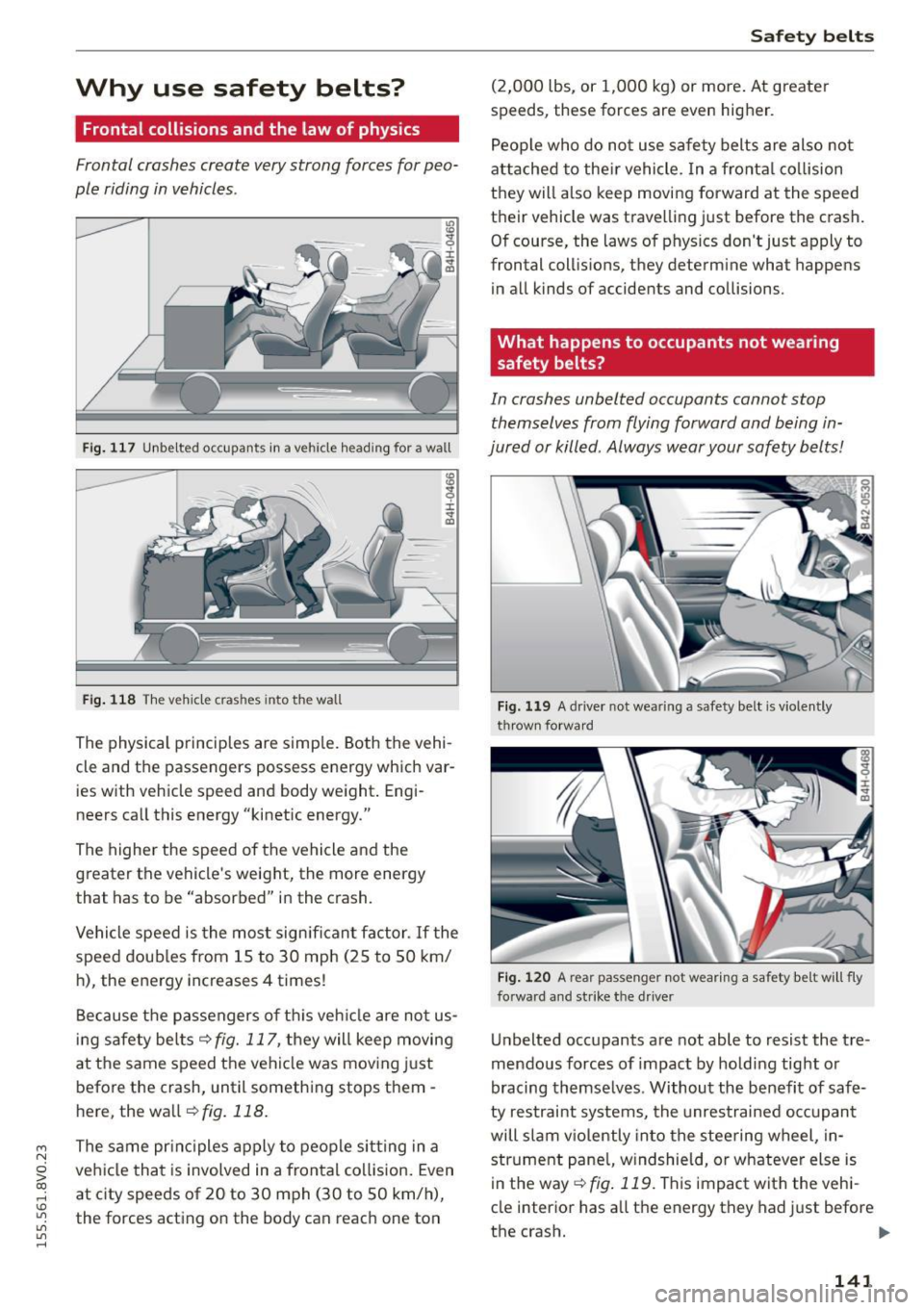
Fig. 117 Unbelted occupants in a ve hicle heading for a wall
Fig . 118 The vehicle cras hes into th e wall
CD
~ ±
cle and the passengers possess energy which var ies with vehicle speed and body weight . Engi
neers call this energy "kinetic energy."
The higher the speed of the vehicle and the
greater the vehicle's weight, the more energy
that has to be "absorbed" in the crash.
Vehicle speed is the most significant factor. If the
speed doubles from 15 to 30 mph (25 to 50 km/
h) , the energy increases 4 times!
Because the passengers of this vehicle are not us
ing safety belts
q fig. 117, they will keep moving
at the same speed the vehicle was moving just
before the crash, until something stops them -
here, the wall
qfig. 118 .
The same principles apply to people sitting in a
vehicle that is involved in a frontal collision. Even
at city speeds of 20 to 30 mph (30 to 50 km/h),
the forces acting on the body can reach one ton
Safety belts
(2,000 lbs, or 1,000 kg) or more . At greater
speeds, these forces are even higher .
People who do not use safety belts are also not
attached to their vehicle. In a frontal collision
they will also keep moving forward at the speed
their vehicle was travelling just before the crash.
Of course, the laws of physics don't just apply to
frontal collisions, they determ ine what happens
in all kinds of accidents and collisions.
What happens to occupants not wearing
safety belts?
In crashes unbelted occupants cannot stop themselves from flying forward and being in
jured or killed . Always wear your safety belts!
Fig. 119 A dr iver not wea ring a safety belt is vio lently
thrown forward
Fig. 120 A rear passenger not wearing a sa fety belt w ill fly
fo rward and strike t he drive r
Unbelted occupants are not able to resist the tre
mendous forces of impact by holding tight or
bracing themselves . Without the benefit of safe
ty restraint systems, the unrestrained occupant
will slam v iolently into the steering wheel, in
strument panel, windshie ld, or whatever else is
in the way
q fig . 119 . This impact with the vehi
cle interior has all the energy they had just before
the crash. ..,_
141
Page 144 of 282
Safety belts
Never rely on airbags a lone for protection . Even
when they deploy, airbags provide only additional
protection . A irbags are not supposed to deploy in
all kinds of accidents. Although your Audi is
equipped w ith airbags, all vehicle occupants, in
cluding the driver, must wear safety belts cor
rectly in orde r to min imize the risk of seve re in
jury o r death in a crash .
Remember too, that airbags will deploy only once
and that your safety be lts are a lways there to of
fer protection in t hose accidents in which airbags
are not supposed to deploy or when they have a l
ready deployed . Unbelted o ccupan ts can also be
thrown ou t of the vehicle where even mo re severe
or fata l injur ies can occur .
It is also important fo r the rea r passenge rs to
wear safety belts co rrectly. Unbe lted passenge rs
i n t he rear se ats endanger not only themselves
but also the driver and other passengers
~ fig . 120. In a frontal coll ision they wi ll be
thrown forward violent ly, where they can hit and
in ju re the driver and/or front seat passenger.
Safety belts protect
People think it's possible to use the hands to
brace the body in a minor collision . It 's simply
not true!
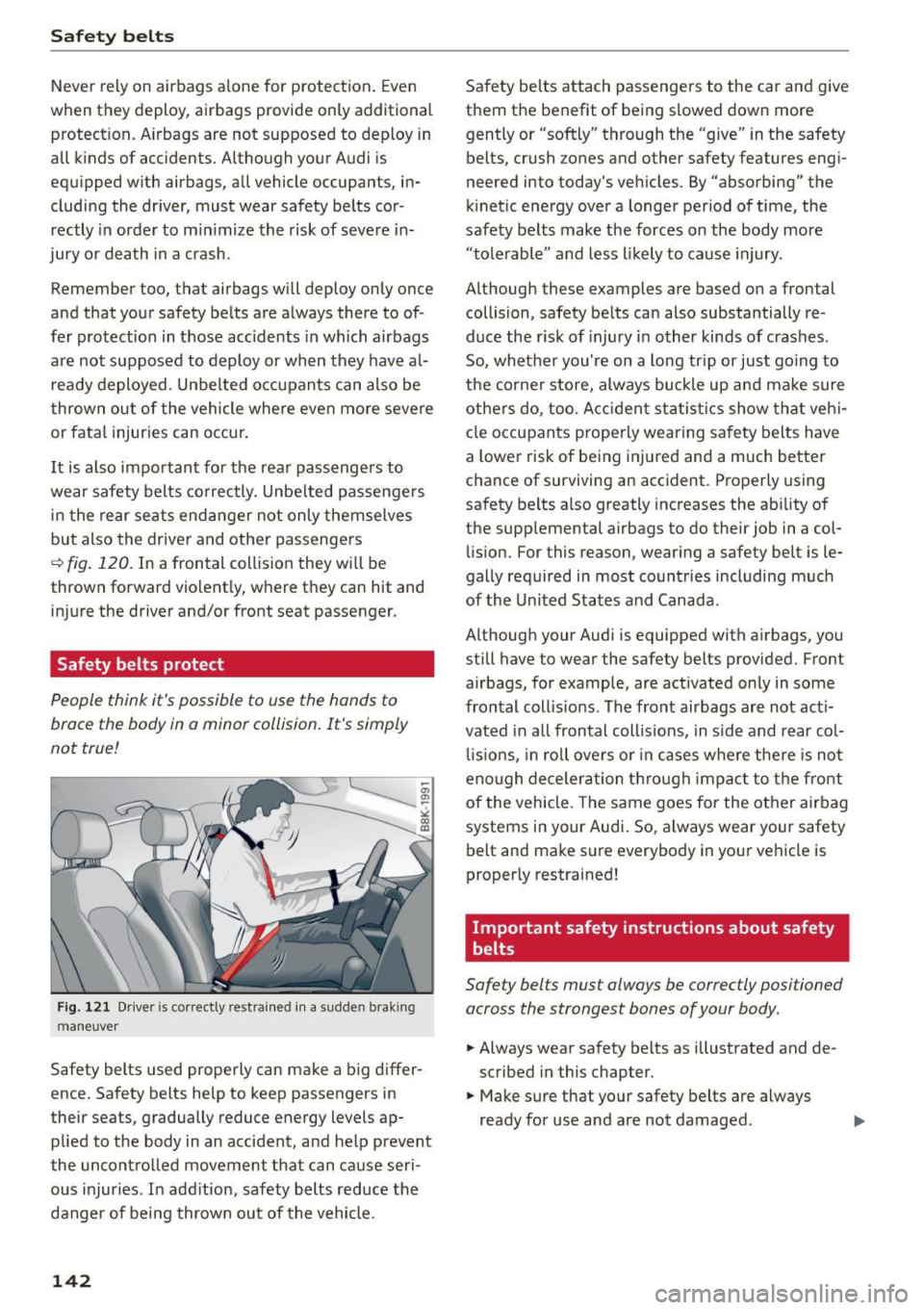
F ig . 121 Driver is correct ly restra ined i n a sudden b rak ing
m aneuver
Safety belts used properly can make a big differ
ence. Safety belts help to keep passengers in
their seats , gradually reduce energy levels ap
plied to the body in an accident, and he lp prevent
the uncont ro lled movement that can cause seri
ous injur ies. In add it ion, safety belts reduce the
danger of being throw n ou t of the vehicle.
142
Safety be lts attach passengers to the car and give
them the benefit of being s lowed down more
gently or "softly" through the "give" in the safety
belts, crush zones and other safety features eng i
neered into today's veh icles. By "absorbing" the
ki net ic ene rgy over a longer period of time, the
safety be lts make the forces on the body more
"tole rable" and less li kely to cause injury .
Although these examples are based o n a frontal
collision, safety be lts can also substantially re
duce the r isk o f injury in other kinds o f crashes.
So, whether you're on a long tr ip or just go ing to
t he cor ne r store, always bu ckle up and ma ke sure
o thers do, too. Ac ciden t sta tis tics show that ve hi
cle occupants properly wearing sa fe ty belts have
a lowe r risk of be ing injured and a much better
chance of surviving an accident. Pro perly using
safety belts a lso greatly increases the ab ility of
the supp lemental airbags to do their job in a col
li sion. For this reason, wear ing a safety be lt is le
gally required in most countries including much
of the United States and Canada .
Although your Audi is equipped with a irbags, you
still have to wear the safety belts provided. Front airbags, for example, are act ivated only in some
fron tal coll is io ns . The front airbags are not act i
vated in a ll frontal col lisions, in s ide and rear co l
li sio ns, in ro ll overs o r in cases whe re the re is not
eno ugh deceler ation th rough impac t to the front
of the vehicle . T he same goes for the other airbag
systems in your Audi. So, always wear your safety
belt and make sure everybody in your vehicle is
proper ly restrained!
Important safety instructions about safety
belts
Safety belts must always be correctly positioned
across the strongest bones of your body .
.,. Always wear safety belts as illustrated and de
scribed in this chapter .
.,. Make s ure that your safety belts are always
ready fo r use and are not damaged .
Page 155 of 282
M N
0 > co ...... \!) 1.1'1
1.1'1
1.1'1
......
_& WARNING
Objects between you and the airbag will in
crease the risk of injury in a crash by interfer
ing with the way the airbag unfolds and/or by
being pushed into you as the airbag inflates.
- Always make sure nothing is in the front air-
bag deployment zone that could be struck
by the airbag when it inflates.
- Objects in the zone of a deploying airbag
can become projectiles when the airbag de
ploys and cause serious personal injury.
- Never hold things in your hands or on your
lap when the vehicle is in use.
- Never place accessories or other objects
(such as cup holders, telephone brackets,
note pads, navigation systems, or things
that are large, heavy, or bulky) on the doors; never attach then to the doors or the wind
shield; never place them over or near or at
tach them to the area marked ,,AIRBAG" on
the steering wheel, instrument panel or the
seat backrests; never place them between
these areas and you or any other person in
the vehicle.
- Never attach objects to the windshield
above the passenger front airbag, such as
accessory GPS navigation units or music
players. Such objects could cause serious in
jury in a collision, especially when the air
bags inflate.
- Never recline the front passenger seat to
transport objects. Items can also move into
the deployment area of the side airbags or
the front airbag during breaking or in a sud den maneuver. Objects near the airbags can
fly dangerously through the passenger com
partment and cause injury, particularly
when the seat is reclined and the airbags in
flate.
_& WARNING
A person on the front passenger seat, espe cially infants and small children, will receive
serious injuries and can even be killed by be
ing too close to the airbag when it inflates.
- Although the Advanced Airbag System in
your vehicle is designed to turn off the front
-
Airbag system
passenger airbag if an infant or a small child
is on the front passenger seat, nobody can
absolutely guarantee that deployment un
der these special conditions is impossible in
all conceivable situations that may happen
during the useful life of your vehicle.
- The Advanced Airbag System can deploy in
accordance with the ,,low risk" option for 3-
and 6-year-old children under the U.S. Fed
eral Standard if a child with electrical capac
itance greater than the combined capaci
tance of a typical one-year old infant re
strained in one of the forward facing or rear
ward-facing child seats with which your ve
hicle was certified is on the front passenger
seat and the other conditions for airbag de
ployment are met.
- Accident statistics have shown that children
are generally safer in the rear seat area than
in the front seating position .
- For their own safety, all children, especially
12 years and younger, should always ride in
the back properly restrained for their age
and size.
Advanced front airbag system
Your vehicle is equipped with a front Advanced
Airbag System in compliance with United States
Federal Motor Vehicle Safety Standard 208 asap
plicable at the time your vehicle was manufac
tured.
The front Advanced Airbag System supplements
the safety belts to provide additional protection
for the driver's and front passenger's heads and
upper bodies in frontal crashes. The airbags in
flate only in frontal impacts when the vehicle de
celeration is high enough.
The front Advanced Airbag System for the front
seat occupants is not a substitute for your safety
belts. Rather, it is part of the overall occupant re
straint system in your vehicle. Always remember
that the airbag system can only help to protect
you, if you are sitting upright, wearing your safe-
ty belt and wearing it properly . This is why you ..,.
153
Page 157 of 282
M N
0 > co ,...., \!) 1.1'1
1.1'1
1.1'1
,....,
A WARNING
A child in a rearward-facing child seat instal
led on the front passenger seat wi ll be seri
ously injured and can be killed if the front air
bag inflates -even with an Advanced Airbag
System.
-Although the Advanced Airbag System in
your vehicle is designed to turn off the front
airbag when a rearward-facing child re
straint has been installed on the front pas senger seat, nobody can absolutely guaran
tee that deployment is impossible in all con
c eivable s ituations that may happen dur ing
the useful life o f you r vehicle.
- The inflating a irbag w ill hit the child seat or
infant carrier w ith great force an d will
smash the ch ild seat and child agains t the
backrest, center armrest, doo r, or roo f.
- Alw ays install rearward- facing child re
straints on the rear seat .
- If you must i nst all a rearw ard facing child
sea t on the front passenger sea t beca use of
excep tional circ umstances and the
PASSEN
GER AIR BAG OFF light does not come on
and stay on, immediately install the rear
facing child seat in a rear seating position
and have the a irbag system inspected by
your Audi dealer.
A WARNING
If, in exceptional c ircumstances, you must in
stall a forward-facing ch ild restraint on the
front passenge r's seat:
-Always make sure the forward-fac ing seat
has be en designed and certified by its man
ufact urer for use on a fro nt seat wit h a pas
senger front and side airbag.
- Never put the forwa rd-facing child rest raint
up against or ve ry nea r the i nstr ument pan
el.
-Always move t he passenger seat into its
rearmost position in the seat 's fore and aft
adjus tment range, as far away from the air
bag as possib le, before installing the fo r
ward-facing c hild restraint . The backrest
must be adjusted to an up right position .
-
Airbag syste m
- Always make sure that there is nothing on
the front passenger seat that w ill cause the
capacitive passenger detection system in
the seat to signal to the Airbag System that
the seat is occup ied by a person when it is
not, or to signal that it is occupied by some
one who is heavier than the person actually
sitt ing on the se at. T he presen ce of add i
tion al ob jects could cause t he passenger
front airbag to be tu rned on when it shou ld
be off, or co uld cause the ai rbag to wo rk in a
way that is different from the way it would
have worked without the ob ject on the seat.
- Make sure that the
PASSENGER AIR BAG
OF F light comes on and stays on all the time
wheneve r the ignit ion is switched on.
Advanced Airbag System components
The front passenger seat in yo ur vehicle has a lot
of very impo rtant parts of the Advanced A irbag
System in it . T hese pa rts include the capacitive
passenge r detection system, wir ing, brackets,
and more. The con trol unit mon itors the syste m
o n the front passenge r se at when the ig nition is
swi tched on and turns the airbag indicator ligh t
on when a malfunction in the one of the system
components is detected
¢ page 160 . Because
the front passenger seat contains important
parts of the Advanced A irbag System, yo u m ust
take care to prevent it from being damaged.
Damage to the seat may prevent the Advanced
Airbag System for the front passenger seat from
doing its job in a crash.
The front Advanced Airbag System consi sts
of the following:
- Crash sensors in the front of the vehicle that
measure vehicle acceleration/deceleration to
p rov ide i nfo rmat ion to the Advanced Airbag
System abo ut the sever ity o f the cr ash.
- An elect ron ic cont ro l unit, with integrated
cr ash senso rs for front and s ide imp acts. The
cont ro l uni t "dec ides" whet her to fire the fron t
airbags based on the info rmation received from
the crash sensors . The control unit a lso "de
cides" whether the safety belt pretens ione rs
should be activated. ..,.
155
Page 166 of 282
Airb ag syst em
entered in your Audi Warranty & Mainte
nance booklet under
AIRBAG REPLACEMENT
RECORD.
- For safety reasons in severe accidents, the
alternator and starter are separated from
the vehicle battery with a pyrotechnic circuit interrupter .
- Work on the pyrotechnic circ uit inter rupt
er must only be performed by a qualified
technicians w ho have the experience, in
formation and special tools necessary to perform the work safely.
- If the veh icle or the circuit interrupter is
scrapped, a ll applicable safety precautions
must be followed.
@ For the sake of the environment
Undep loyed airbag modu les and pretension
ers might be classified as Perchlorate Materia l
- specia l hand ling may apply, see
www.dtsc.ca.gov/hazardouswaste/perchlo rate. W hen the veh icle or parts of the re
straint system including a irbag modules and
safety belts with prete nsioners are scrapped ,
all applicable laws and regulat ions must be
observed. Your authorized A udi dealer is fa
m iliar with the se requirements a nd we recom
mend that you have your dealer perform this
service for yo u.
Other things that can affect Advanced
Airbag performance
Changing the vehicle's suspension system ca n
change the way that the Advanced A irbag System
performs in a crash. For example, using t ire- rim
combinat ions not approved by Audi, lower ing the
ve hicl e, chang ing the stiffness of the suspension,
includ ing the spr ings, suspension s truts, shoc k
absorbers etc. can change the forces that are
measured by the a irbag sensors and sent to the
e lectronic control unit. Some suspension changes
can, for example, increase the force levels meas
ured by the sensors and make the a irbag system
deploy in c rashes in which it wou ld not deploy if
the changes had not been made. Other ki nds of
changes may reduce the force levels measured by
164
the sensors and p revent the airbag from dep loy
ing when it shou ld .
A WARNING
Changing the vehicle's suspension including
use of unapproved tire-rim combinations can
change Advanced Airbag performance and in
crease the risk of serious personal injury in a
crash.
- Never install suspension components that
do not have the same performance charac
ter istics as the components origina lly instal
led on you r vehicle.
- Never use tire-rim combinations that have
not been approved by Audi.
Knee airbags
Description of knee airbag s
Applies to vehicles: with knee airbags
The knee airbag system can provide supplemen
tal protection to properly restrained front seat
occupants .
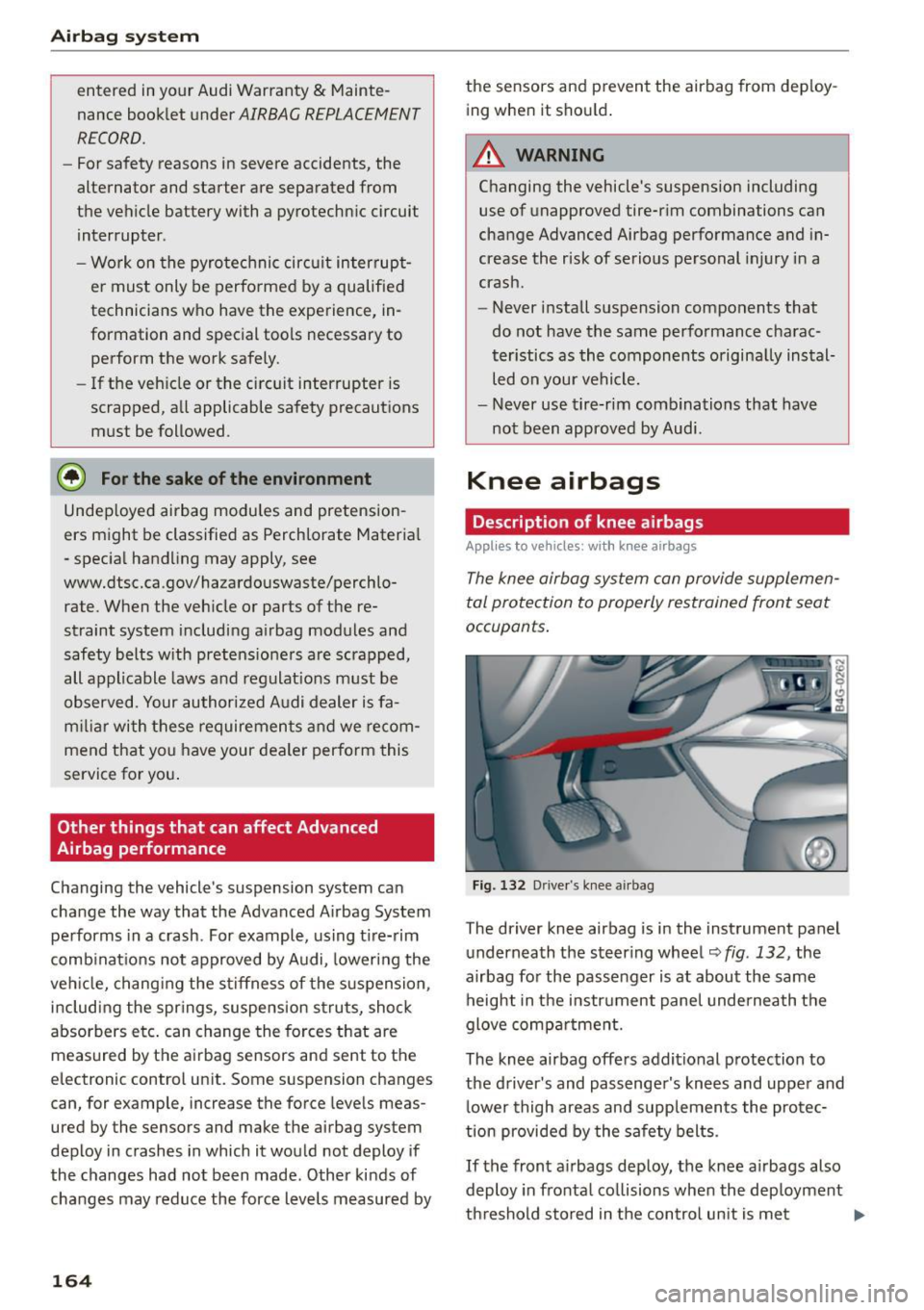
Fig. 132 Driver 's knee a irbag
The driver knee airbag is i n the instrument panel
u nderneath the steer ing wheel ~
fig. 132 , the
airbag fo r the passenger is at abou t the same
height in the i nstr ument panel underneath the
glove comp artment.
The knee airbag offers additional protection to
the d river's and passenge r's kn ees and uppe r and
lower thigh areas and supplements the protec
tion provided by the safety belts.
If the front a irbags deploy, the knee a irbags also
deploy in fronta l co llisions when the dep loyment
th reshold stored in the con trol un it is met
II>-
Page 183 of 282
....,
N
0 > co
rl I.O
"'
"'
"'
rl
airbag system inspected by your authorized
Audi dealer.
- Take the child restraint off the front passen
ger seat and install it properly at one of the
rear seat pos it ions if the
PASSENGER AIR
BAG OFF
light does not stay on whenever
the ignition is switched on .
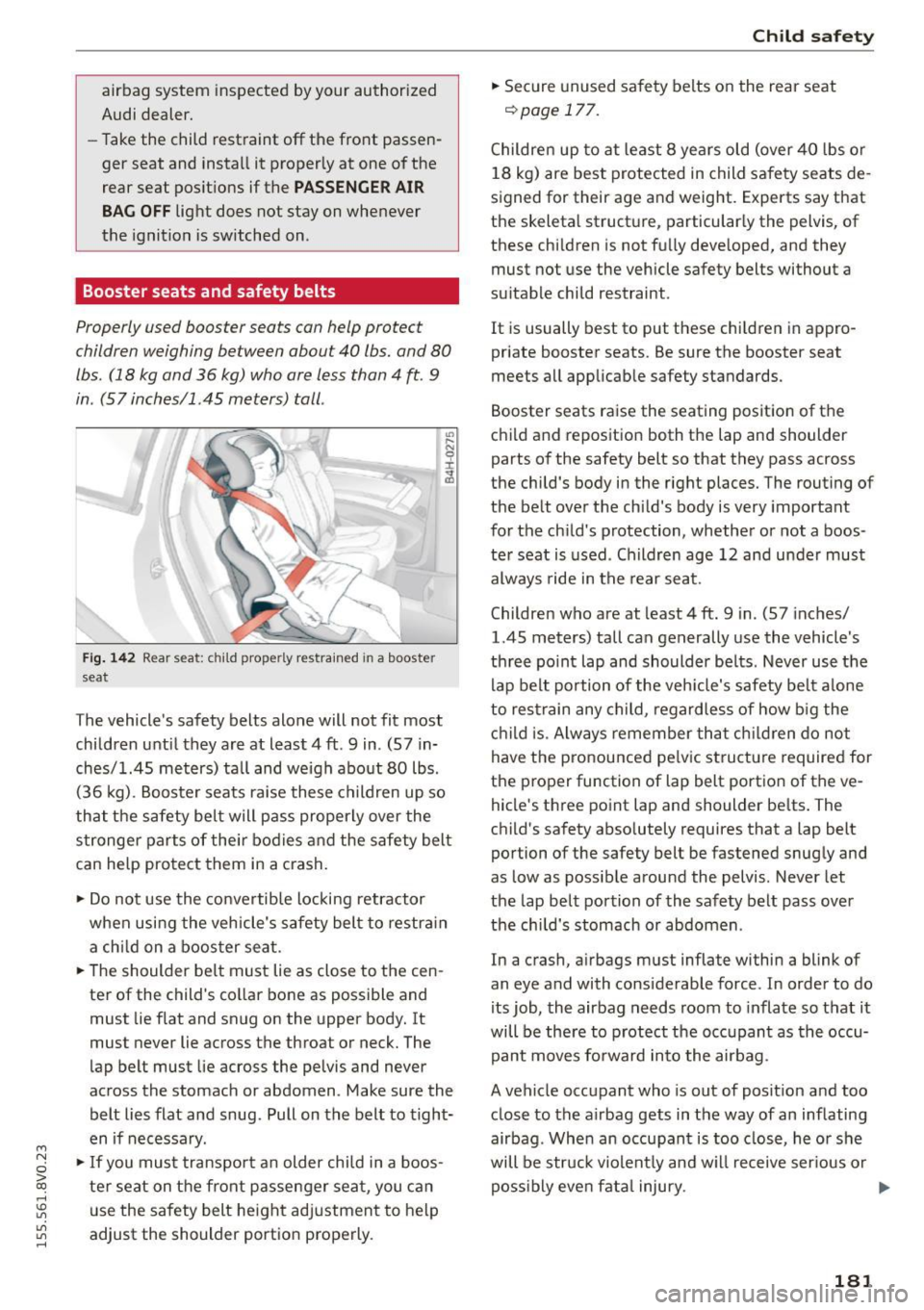
Booster seats and safety belts
Properly used booster seats can help protect
children weighing be tween about 40 lbs. and 80
lbs . (18 kg and 36 kg) who are less than 4
ft. 9
in . (57 inches/1 .45 meters) tall .
Fig. 14 2 Re ar seat: child pro perl y restrain ed in a booster
seat
T he vehicle's safety belts alone will not fit most
children unti l they are at least 4
ft . 9 in . (57 in
ches/1.45 meters) tall and we igh about 80 lbs .
(36 kg) . Booster seats raise these children up so
that the safety bel t will pass properly over the
stronger parts of their bodies and the safety belt
can help protect them in a c rash.
.,. Do not use the co nvertib le locking retractor
when using the vehicle's safety bel t to restra in
a ch ild on a boos ter sea t.
.. The shoulder be lt must lie as close to the cen
te r of the child's co llar bone as possible and
must lie flat and snug on the upper body. It
must never lie across the throat or neck. The
lap belt must lie across the pelvis and never
ac ross the stomach or abdomen . Make sure the
belt lies flat and snug . Pull on the belt to tight
en if necessary .
.,. If you must transpo rt an older chi ld in a boos
ter seat on the front passenger sea t, you can
use the safety belt height adj ustmen t to help
adjust the shoulder port ion properly .
Child sa fe ty
.. Secure unused sa fety belts on the rear seat
i=> page 177.
Childre n up to at least 8 yea rs old (over 40 lbs or
18 kg) are best protected in child safety seats de
s igned for their age and weight . Experts say that
the skeleta l structure, particularly the pelvis, of
these chi ldren is not f ully deve loped, and they
must not use the vehicle safety belts without a
su itable child restraint .
It is usually best to put these child ren in appro
priate booster seats . Be sure the booster seat
meets all applicab le safety standards.
Booster seats ra ise the seating position of the
child and reposit ion both the lap and shoulder
parts of the safety belt so that they pass across
the chi ld's body in the right places. The routing of
the be lt over the chi ld 's body is very important
for the ch ild's protection, whether or not a boos
te r seat is used . Children age 12 and under must
always ride in the rear seat.
Children who are at least 4
ft. 9 in . (57 inches/
1.45 meters) tall can generally use the vehicle's
th ree po int lap and shoulder be lts . N ever use the
lap belt portion of the veh icle's safety belt a lone
to re strain any child , regardles s of how b ig the
c hi ld i s. A lways remember that c hildren do no t
have the pronounced pe lv ic struct ure required for
the p roper function of lap belt port ion of the ve
hicle 's t hree point lap and shoulder be lts . The
c h ild 's safety abso lutely requires that a lap belt
portion of the safety belt be fastened snug ly and
as low as possible around the pelvis . Never let
the lap belt portion of the safety belt pass over
the ch ild's stomach or abdomen .
In a crash, a irbags must inflate within a blink of
an eye and with considerable force . In order to do
its job, the airbag needs room to inflate so that it
will be the re to p rotect the occ upant as th e occu
pant moves fo rward into the airbag .
A vehicle occupant who is out of posit ion and too
close to the a irbag gets in the way of an inflating
airbag . When an occupan t is too close, he o r she
will be struck violent ly and w ill receive ser ious or
poss ibly eve n fa ta l injury. .,,.
181
Page 209 of 282
with the ignition off. It can even switch on again
l ater by itself~.& , if
- the temperature of the engine coolant rises due to the heat bui ld-up from the eng ine in the en
gine compartment, or
- the engine compar tment heats up because the
vehicle is parked in intense sunlight.
A WARNING , --
- To reduce the risk of personal injury never
touch the radiator fan.
- The auxiliary e lectric fan is temperature con
trolled and can switch on suddenly even
when the engine is not running.
- The aux iliary radiator fan switches on auto
matically when the engine coo lant reaches a
certain temperature and will continue to run
until the coolant temperature drops.
Brake fluid
Checking brake fluid level
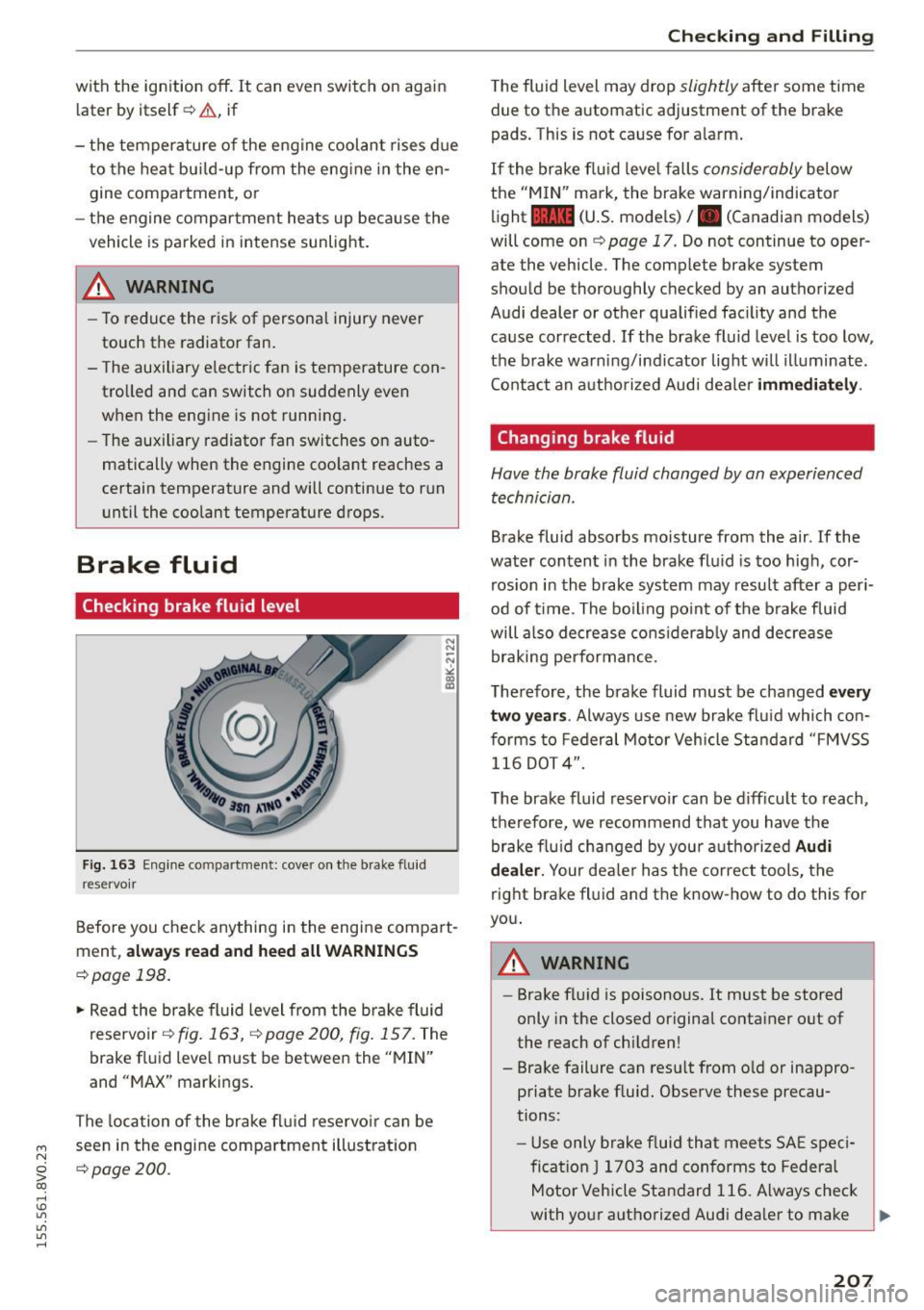
Fig. 163 Engine compa rt m ent: cove r on the brake fluid
reservo ir
N N -N
"' :ll
Before you check anything i n the engine compa rt
ment,
al ways re ad and h eed all W ARN INGS
~page 198.
... Read the brake fluid level from the b ra ke fluid
reservoir
r¢ fig. 163, r:¢ page 200, fig. 157. The
brake f luid leve l must be between the "MIN"
and "MAX" markings.
The location of the brake fl uid reservo ir can be
...., seen in the engine compartment illustration
N
~ r¢ page 200.
co
rl I.O
"'
"'
"'
rl
Check in g and Fillin g
The fluid level may drop slightly after some time
due to the automatic adjustment of the brake
pads . This is not cause for a larm.
If the brake f luid leve l falls considerably below
the "MIN" mark, the brake warning/indicator
light
1111 (U.S. mode ls) I. (Canadian models)
will come on
~ page 17. Do not continue to oper
ate the vehicle . The comp lete brake system
should be thoroughly checked by an authorized
Audi dealer or other qualified fac ility and the
cause corrected . If the brake flu id level is too low,
the brake warning/indicator light wi ll illuminate .
Contact an a uthorized Audi dea ler
immedi ate ly .
Changing brake fluid
Have the brake fluid changed by an experienced
technician.
Brake fluid absorbs moisture from the air. If the
water content in the brake flu id is too hig h, cor
ros ion in the brake system may result after a per i
od of t ime. The bo iling po int of the brake fluid
will a lso decrease cons iderab ly and decrease
braking performance.
Therefore, the brake fluid must be changed
e ve ry
tw o years .
Always use new brake flu id which co n
forms to Federal Motor Vehicle Standard "FMVSS
116 DOT 4".
The brake fluid reservoir can be diff icu lt to reach,
therefore, we recommend tha t you have the
brake flu id changed by you r authorized
Audi
de aler.
Your dea le r has the correct tools, the
right brake fluid and the know-how to do this for
you .
A WARNING
- -
-Brake flu id is poisonous. It must be stored
only in the closed original conta iner out of
the reach of children !
- Brake failure can resu lt from o ld or inappro
priate brake fluid. Observe these precau
tions:
- Use only brake fluid that meets SA E spe ci
ficat ion
J 1703 and conforms to Federa l
Motor Vehicle Standard 116. Always check
with your a uthorized Audi dea ler to make
~
207
Page 224 of 282
Tires and wheels
different tire speeds. For this rea
son, in case of emergency, only
use a spare tire* that is the same
circumference as the regular tires.
.&,. WARNING -
-Only use tire/rim combina
tions and suitable wheel bolts
that have been approved by
Audi. Otherwise, damage to
the vehicle and an accident could result.
-For technical reasons, it is not
possible to use tires from oth
er vehicles - in some cases,
you cannot even use tires from
the same vehicle model.
-Make sure that the tires you select have enough clearance
to the vehicle. Replacement
tires should not be chosen
simply based on the nominal size, because tires with a dif
ferent construction can differ greatly even if they are the
same size . If there is not
enough clearance, the tires or
the vehicle can be damaged
and this can reduce driving
safety and increase the risk of
an accident.
-Only use tires that are more
than 6 years old when abso-
222
lutely necessary and drive
carefully when doing so.
-Do not use run-flat tires on
your vehicle. Using them when not permitted can lead to ve
hicle damage or accidents.
-If you install wheel covers on
the vehicle, make sure they al
low enough air circulation to
cool the brake system. If they
do not, this could increase the
risk of an accident.
Tire wear/damage
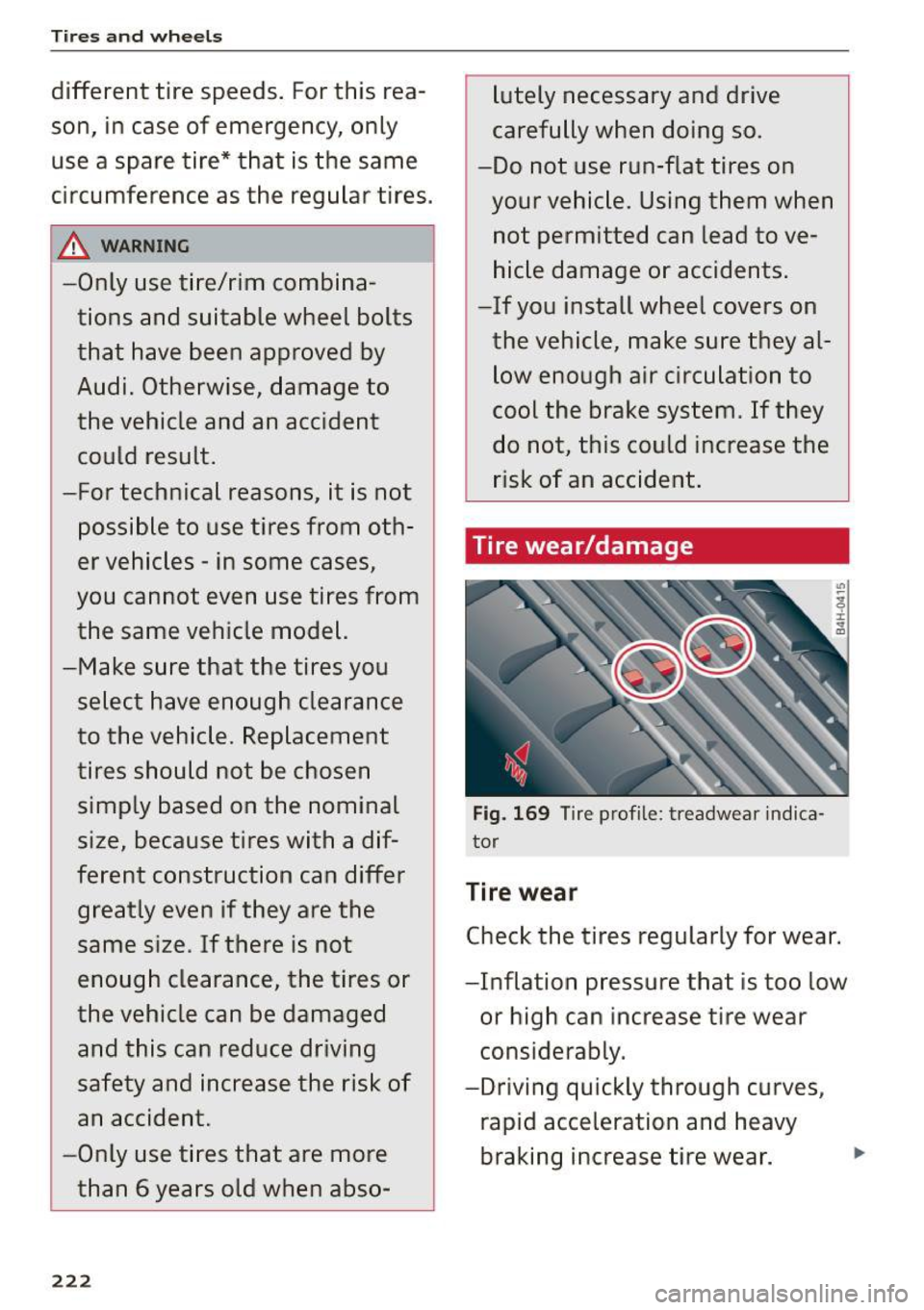
Fig. 169 Tire profil e: treadwear indica
tor
Tire wear
Check the tires regularly for wear.
-Inflation pressure that is too low
or high can increase tire wear
considerably.
-Driving quickly through curves, rapid acceleration and heavy
braking increase tire wear.
..