battery AUDI S3 SEDAN 2015 Owner's Manual
[x] Cancel search | Manufacturer: AUDI, Model Year: 2015, Model line: S3 SEDAN, Model: AUDI S3 SEDAN 2015Pages: 282, PDF Size: 71.14 MB
Page 201 of 282
....,
N
0 > co
rl I.O
"'
"'
"'
rl
-Always proceed with extreme caution so
that clothing, jewelry or long hair do not
become caught in the radia tor fan, fan
belt or other moving components or do not come into contact with hot compo
nents . T ie back long hair before beg inning
work and do no t wear cloth ing that can
hang down into the eng ine.
- limit your exposure to exhaust and chemi
cals to as short a time as possible
q ,& .
..&, WARNING
California Propos ition 65 Warning:
- Engine exhaust, some of its constituents,
and certai n veh icle components conta in or
em it chemicals known to the State of Cali
forn ia to cause cancer and birth defec ts and
reproductive harm. In addition, certai n flu
ids contained in vehicles and certain prod
ucts of component wear contain or emit
chemicals known to the State of California
t o cause cancer and birth defects or other
reproductive harm .
- Battery posts , terminals and related acces
sories contain lead and lead compounds,
chem icals known to the State of California
to cause cancer and reproductive harms .
Wash hands after hand ling.
(D Note
When filli ng flu ids, be sure not to m ix the flu
ids up . Otherwise seve re malfunctions and en
gine damage w ill occur .
@ For the sake of the environment
You should regu larly check the grou nd under
your veh icle in order to detect leaks quickly . If
there are visible spots from oil or other f luids,
b ring yo ur vehicle to an autho rized Aud i dea l
er or authori zed Audi Se rv ice F acili ty to be
checked.
Ch eck in g and Fillin g
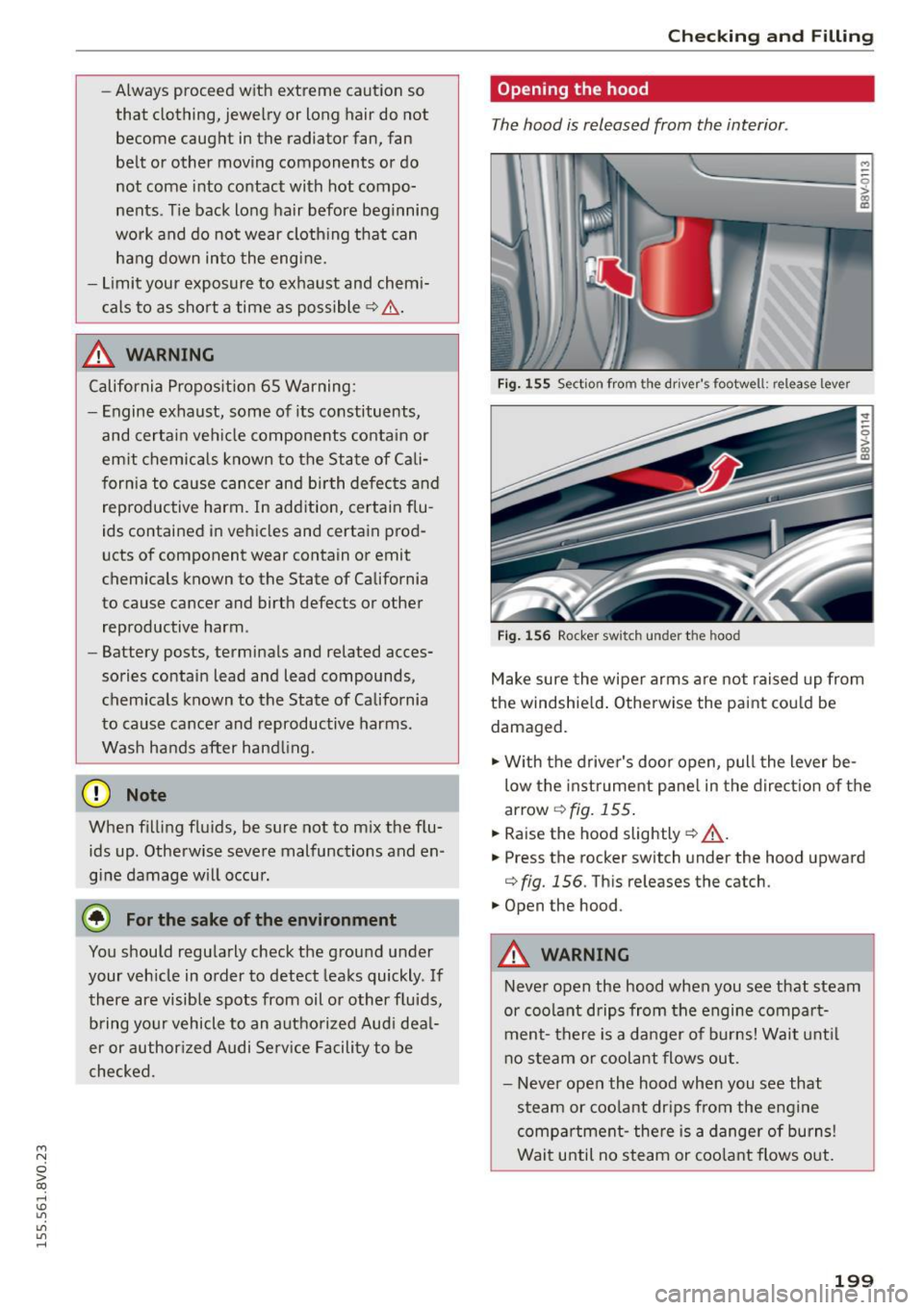
Opening the hood
The hood is released from the in terior .
Fig . 155 Se ctio n from t he dr iver' s footwe ll: re le a se le ve r
Fig . 156 Ro cke r swit c h un der t he hoo d
Make sure the wiper arms a re not raised up from
the windsh ie ld . Oth erwise the paint cou ld be
damaged.
.,. W ith the driver's door open, pull the lever be
low the instr ument pane l in the d irect ion of the
arrow
<=> fig. 155.
.,. Raise the hood slightly r:!> ff::.. .
.,. Press the rocker switch unde r the hood upward
q fig. 156 . This re leases the catch .
.,. Open the hood .
..&, WARNING
-=
Never open the hood when you see that steam
or coolant drips from the engine compart
ment- there is a da nger of bu rns! Wait unt il
n o steam or coolant flows out .
- Never open the hood when you see that
s team or coo lant dr ips from the e ngine
comp artment- the re is a dange r of burns !
Wait until no steam or coo lant flows o ut .
199
Page 203 of 282
....,
N
0 > co
rl I.O
"'
"'
"'
rl
Checking and Filling
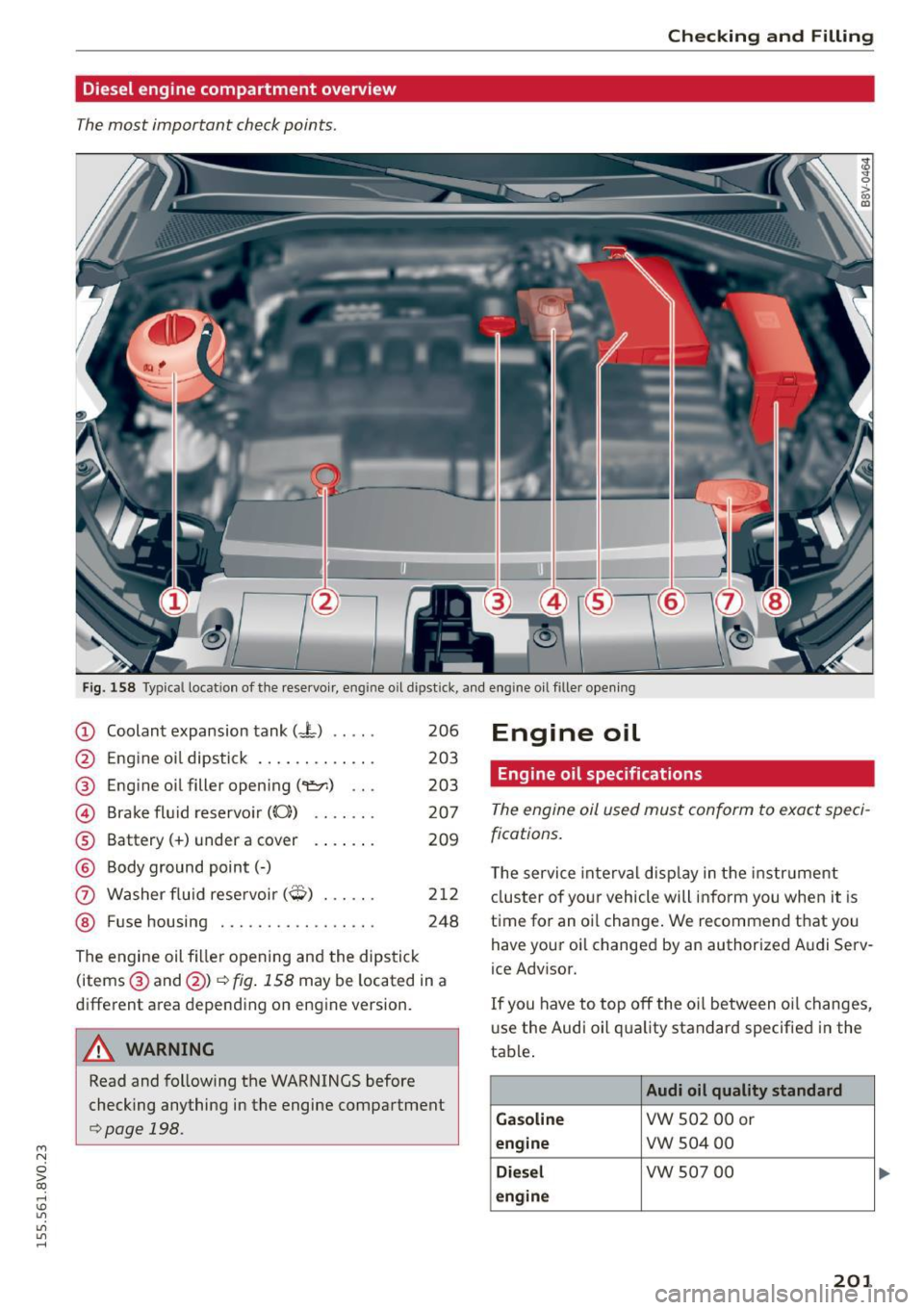
Diesel engine compartment overview
The most important check points .
Fig. 158 Typical locat ion of the reservoi r, eng ine oil dipstick, and engine o il filler opening
CD Coolant expansion tank (-L) .....
@
®
©
®
®
(J)
®
Engine oil dipstick ... ...... ... .
Engine oil filler opening (~) .. .
Brake fluid reservoir
(0))
Battery(+) under a cover
Body ground point(-)
Washer fluid reservoir
(O) ..... .
Fuse housing .......... ...... .
206
203
203 207
209
212
248
The engine oil filler opening and the dipstick
(items ® and @)¢
fig . 158 may be located in a
d ifferent area depending on engine version.
A WARNING
-
Read and following the WARNINGS before
checking anything in the engine compartment
¢page 198.
Engine oil
Engine oil specifications
The engine oil used must conform to exact speci
fications.
T he service interval display in the instrument
cluster of your vehicle will inform you when it is
time for an oi l change. We recommend that you
have your oil changed by an authorized Audi Serv
ice Advisor.
If you have to top off the oil between o il changes,
use the Audi oil qua lity standard specified in the
table .
Audi oil quality standard
Gasoline
VW 502 00 or
engine vw 504 00
Diesel VW 507 00
engine
201
Page 210 of 282
Checking and F ill in g
sure you are using the correct brake f luid .
The correct type of brake fluid is also indi
cated on the brake fluid reservoir .
- The brake fluid must be new. Heavy use of
the brakes can cause a vapor lock if the
brake fluid is left in the system too long.
This can ser iously affect the effic iency of
the brakes as well as your safety . This
could res ult in an accident.
(D Note
Brake flu id will damage the paint of your vehi
cle .
@ For the sake of the environment
Because of the problem of proper d isposa l of
brake fluid as well as the spec ia l tools re-
quired and the necessary expertise, we rec
ommend tha t you have the b rake fluid
changed by your author ized Audi dealer.
Battery
General information
The battery in yo ur Audi does not need any ma in
tenance under normal operating conditions. Aud i
recommends having the electro lyte level check by
an author ized Audi dealer or author ized Audi
Service Fac ility when the re a re
high outside tem
pe ratu res or when dr iv ing a ll day. The electroly te
leve l sho uld also be checked ea ch t ime the bat
t ery is charged
9 page 210 .
Have the battery checked when you br ing you r ve
hicle in fo r an inspec tio n. It is a good idea to re
p la ce the batte ry if i t is more than 5 ye ars old .
During certai n types of a irbag dep loyments, the
battery is disconnect ed from the vehicle electr i
cal system fo r safety reasons
9 .&. in Repair, care
and disposal of the airbags on page 163.
Disconnecting the battery terminals
Some veh icle functions (such as power windows)
are not ava ilable when the batte ry is disco nnect
ed. These functions must be programmed after
the ba ttery is reconnec ted. To avoid havi ng to do
t his , on ly disconnect the b attery from the veh icle
208
electrica l sys tem when that is necessa ry to pe r
form repairs.
To reprogram the func tion s, proceed as fo llows:
Function Reprogramming
P owe r window one-
9 page 41, Correcting
to uch up/down f unc-power window malfunc-
tion tions
Remote control key o r If the vehicle does not
Conve nience key reac t to the key , it must
be synchronized
9 page 35
Digita l clock 9 page 10
ESC indi cato r light The ind icator lig ht goes
o ut afte r driving a few
meters
Not running the vehicle for long periods of
time
If you do not d rive yo ur vehicle for several days or
weeks, e lectr ica l components are gradua lly re
duced or switched off. Th is red uces energy con
s u mption and maintains the vehicle's ability to
start over a long per iod of t ime ¢
page 128.
Some conven ience functions , such as inter ior
li ght ing or power seats* may not wo rk . These
convenienc e functions w ill be availabl e agai n
o nce you swi tch the ig nition on and sta rt the en
gine.
Winter operation Du ring the winter months , it is common for the
batte ry capaci ty to dec rease as the tempe rat ur es
become lower . This is because more powe r is
needed to start the vehicle and componen ts such
as the he ad lights and the rear window defogger
are used more frequent ly.
Avoid using powe r unnecessar ily, especially in
c ity dr iv ing o r o n short trips . H ave yo ur au thor
iz ed Audi de aler or author ized A udi Se rv ice Facili
ty check the ba ttery capacity before the start of
winter ¢
page 210. A well-charged battery will
not only reduce starting problems in co ld weath
er, but it will a lso last longer .
Page 211 of 282
M N
0 > co ,...., \!) er,
er,
er,
,....,
A WARNING ,~
- Work on the battery requires expert knowl
edge. Contact an authorized Aud i dealer or
authorized Audi Service Fac ility for informa
t ion regarding the v ehicl e batte ry. There is a
risk for chemical burns or e xplosions.
- Never open the vehicle battery . Do no t try to
change the batte ry elect ro lyte level. Other
wise ex plosive gas will e scape from the bat
tery and increase the r is k of an explosion.
@ Tips
If your vehicle is not driven for severa l wee ks
in very cold tempe ratu res, remove the battery
and store it in a pla ce where i t will no t freeze.
This preven ts the bat tery from being d am
aged and needing to be replaced .
Working on the battery
Be especially careful when working on or near
the battery.
The bat te ry is loc ated in t he luggage compart
men t under the floor. Before yo u check any thing
i n the l uggage comp artme nt,
read and heed all
WARNINGS
q ,&. .
Always heed the sa fety warning s, when working
on the vehicle battery o r th e veh icle elec trical
sys tem to preven t inju ry.
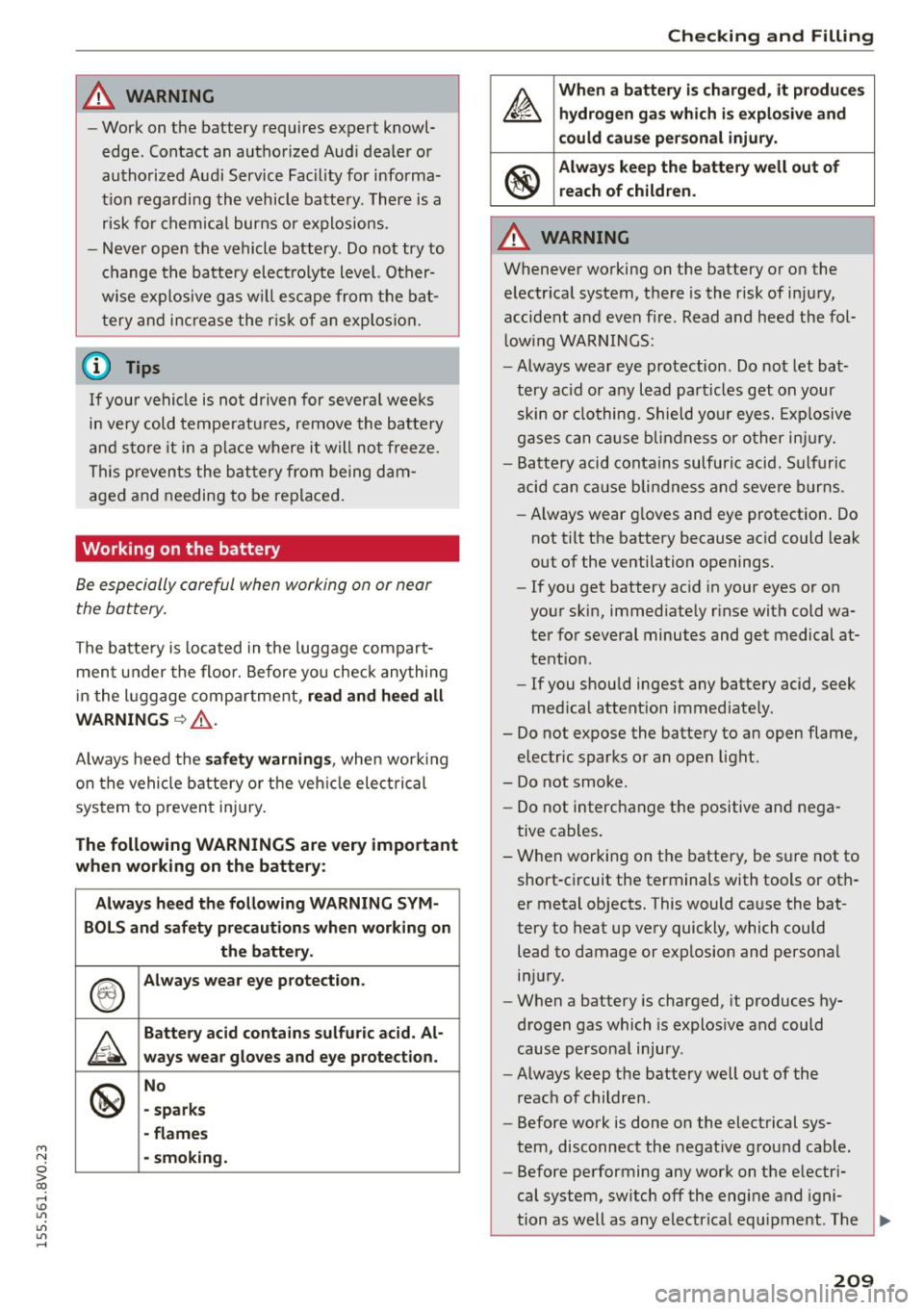
The following WARNINGS are very important
when work ing on the battery:
Always he ed the following WARNING SYM-
BOLS and safety pre caution s wh en working on
the battery .
®
Always wear eye protect ion.
A
Battery acid contains sulfuric acid. Al ·
ways wear gloves and eye protection.
@
No
• sparks
- flame s
- smok ing.
Checking and Fillin g
&
When a battery is charged, it produce s
-hydrog en gas which i s explo siv e a nd
c ould cau se p ers onal injury.
®
Always keep the battery well out of
reach of children .
A WARNING ..,__ -
Whenever working on the battery or on the
electr ica l system, the re is the risk of in jury,
accident and even fi re. Read and heed the fol
l ow ing WARNI NGS:
- Always wear eye protection. Do not let bat
tery ac id or a ny lead particles get on your
skin o r clothing. Shield yo ur eyes. Exp losive
gases can ca use blindness or o ther in jury.
- Battery acid conta ins sulfuric acid. Sulfuric
acid can ca use b lindness and severe burns.
- Always wear g loves and eye protection. Do
not tilt the battery because ac id could leak
out of the ventilation openings.
- If you get battery ac id in your eyes or on
your s kin, immed iate ly r inse with cold wa
ter fo r several minutes and get medical at
tent ion.
- If you shou ld ingest any battery acid , seek
med ica l attent io n immed iate ly.
- Do not expose the batte ry to an open flame,
electric sparks or an open light.
- Do not smoke.
- Do not interchange the positive and nega-
tive cables .
- When working on the battery , be s ure not to
short-c ircuit the terminals with tools or oth
er metal objects . This would ca use the bat
tery to heat up very quickly , which could
lead to damage or exp losion and perso nal
in jur y.
- When a battery is charged, it produces hy
drogen gas which is e xplos ive and could
cause persona l injury .
- Always keep the battery well out of the
reach of children.
- Before work is done on the electrical sys
tem, disconnect the negat ive g round cab le.
- Before performing any work on t he e lectr i
cal system, sw itch
off the engine and igni-
tion as well as any electrical equ ipme nt. The .,..
209
Page 212 of 282
Checking and Fill in g
negative cable on the battery must be dis·
connected. If you are just going to replace a
light bulb, then it is enough to switch off
the lights .
- Before disconnecting the battery, switch off
the anti-theft alarm system! Otherwise you
will set off the alarm .
- When disconnecting the battery, first dis
connect the negative cable and then the
posit ive cab le.
- Before reconnect ing the battery, make sure
all electrical consumers are switched off . Re
connect the pos itive cable first and then the
negative cable . Never intercha nge the ca
bles -th is could star t a fire!
- Never charge a froze n or a thawed-out bat
te ry.
It co uld explode! If a batte ry has fro
zen, then it m ust be repl aced. A d isc harged
b at tery can free ze over at 3 2 °F (0 °C).
- Make sure the vent hose is always attached
to the opening on the side of the battery .
- Never use batte ries which are damaged.
T he re is the danger of an explos ion! Always
replace a damaged battery.
_& WARNING
California P ropos ition 65 Warning:
- Battery posts , termina ls and re lated acces
sories contain lead and lead compounds ,
chemicals known to the Sta te of C alifornia
to cause ca nce r and reproductive problems.
Wash hands after hand ling.
(D Note
- Do not d isconnect t he ve hicle battery when
the ignition is o n or when the engine is run
ning, othe rwise , you w ill damage electronic
components in the electrical system .
- If your vehicle is going to stand for a long
period of time without be ing driven, p rotect
the battery from "freezing", otherwise it
will be damaged and will then have to be re
placed.
210
Battery charging
Starting the engine requires a well charged bat
tery .
Fig. 16 4 En g in e compa rtmen t: connecto rs fo r a c harg er
and jump start c ables
Always read and heed all WARNINGS below
c> .& and q .& in Working on the battery on
page 209 .
.,.. Switch off the ignition and all elec trical con
sumers.
.,.. Make s ure the area is we ll ventilated when you
charge the battery .
.,.. Open the eng ine hood
q page 199 .
.,.. Open the red cover on the positive pole
q fig. 164 .
.,.. Clamp the charge r te rm inal clamps as inst ruct
ed on the
battery terminal (+ ) and o nly on the
body ground point (· ).
.,.. On ly now plug the mains lead for the charging
equ ipmen t in to the wall outlet and turn it on
~ .& -
... Make sure the charging rate is not ov er
30 amps / 14 .8 Volt .
.,.. When the bat tery is fully cha rged : Tur n the
charg ing equipment off and remove the mains
lead from the wall outlet.
.,.. Now remove the clamps fo r the charging equip -
ment .
.,.. Close the red cover on the positive pole.
.,.. Close the hood
c> page 200.
A d ischarged battery can freeze at temperatures
of only 32 F
0 (0 °C) . Allow a frozen battery to
thaw complete ly before attempting to charge it
~ .&. . However, we recommend not using a
thawed battery aga in because the battery casing ..,_
Page 213 of 282
M N
0 > co ,...., \!) 1.1'1
1.1'1
1.1'1
,....,
can be cracked due to ice formation and can leak battery acid.
Battery charging (Maximum charging rate of
30 amps / 14.8 Volt)
When charging at
low voltages (e.g . with a trickl e
charger ), the battery cab les do not have to be
d isconnected first. The battery caps shou ld
not
be opened when charg ing a battery .
It is not necessary to remove the battery from
the luggage compartment, and it is also not nec
essary to disconnect the cables .
Fast charging the battery (charg ing rate
a bo ve 14.8 Volt s)
F or technical reasons do not use a battery charg
er that us es voltage greater than 14 .8 Volts to
charge your vehicle's battery.
A WARNING
Charging a battery can be dangerous.
- Always fo llow the operating instructions
provided by the battery charger manufactur
er when charging y our battery.
- Never charge a frozen battery. It may ex
plode because of gas trapped in the ice. Al
low a frozen battery to thaw o ut first.
- Do not reuse batteries which were frozen .
The battery hous ing may have cracked and
weakened when the battery froze.
- Charge the battery in a well ventilated area .
Keep away from open flame or electrical
spark . Do not smoke. Hyd rogen gas generat
ed by the battery is explos ive .
- To reduce the danger of explosion, never co nnect or disconnect cha rger cables while
the cha rger is operating .
- Fast charg ing a battery is dangerous and
should only be attempted by a competent
tec hnician with the p roper equipment .
- Battery acid that may spill during charg ing
should be washed off w ith a so lution of
wa rm water and baking so da t o n eutrali ze
t he a cid .
Checking and Fillin g
(D Note
Never use a fast charger as a booster to start
the engine . This will ser iously damage sensi
tive electronic components, s uch as control
units, relays, radio, etc., as well as the battery
charger .
Battery replacement
The new bat tery mus t hove the some specifica
tions and dimensions as the original equipmen t
battery.
Intelligent energy management in your vehicle is
responsible for distributing the electrical energy
t h roughout your vehicle
Q page 128 . The intelli
gent energy management system w ill keep the
engine batt ery charged better than vehicles with
out this system. To ma ke s ure t he add it iona l elec
t rical energy is av ailabl e once again afte r yo u
have changed the battery, we recommend tha t
yo u install batteries of the same type and man u
facture on ly (the same as those insta lled at the
t ime yo ur vehicle was delivered). Specifications
are listed on the battery hous ing . Your author
ized dealer must code the battery in the energy
manageme nt system to enab le you to use the en
ergy ma nagement fu nctions cor rectly afte r re
plac ing the battery .
The new battery mus t have the same capacity ,
vo ltage (12 -volts), amperage, construction and
plug seal ing.
When install ing the battery, make sure the ign i
t ion and all electr ica l consumers are switched off.
(D Note
Make sure the ventilat ion hose on the side of
the battery is connected, otherwise f umes or
battery acid can lea k out.
~ For the sake of the environment
Because o f the prob lem of proper disposal of
a battery, we recommend you r authorized
A udi dealer change the battery for you. Bat
teries contain sulfur ic acid and lead and must
always be dispose d of properly in complia nce
with a ll envi ronm ental regulations. Disposing ..,.
211
Page 215 of 282
M N
0 > co ,...., \!) 1.1'1
1.1'1
1.1'1
,....,
Resetting the indicator
Your authorized Audi dealer or authorized Audi
Service Facility will reset the service interval dis
play after performing service.
If you perform an oil change yourself to the Audi
specifications, you must reset the service interval
display.
To reset the display, select the
I MENU I button>
Car > Systems* control button > Service & con
trol
> Service intervals > Reset oil change inter
val.
(1) Note
- Only reset the oil change indicator if the oil
was changed.
- Following the service intervals is critical to
maintaining the service life and value of
your vehicle, especially the engine. Even if
the mileage on the vehicle is low, do not ex
ceed the time for the next service.
- Calculating the time to the next oil change
is interrupted when the vehicle battery is
disconnected. If the vehicle is not driven for
a long period of time, check the mainte
nance schedule so that you can follow the
maintenance intervals.
Checking and Filling
213
Page 220 of 282
Tires and wheels
(a) Curb weight
(b) Accessory weight
(c) Vehicle capacity weight, and
(d) Production options weight
Ma ximum (permissible )
inflation pres su re
means the max imum cold infla
tion pressure to which a tire may be inflated. Also called "maxi
mum inflation pressure."
Normal occupant weight
means 150 lbs. (68 kilograms)
times the number of occupants
seated in the vehicle up to the to
tal seating capacity of your vehi
cle .
Occupant d istribution
means distribution of occupan ts
in a vehicle .
Outer diameter
means the overall diameter of an
inflated new tire.
Overall width
means the l inear distance be
tween the exteriors of the side
walls of an infla ted tire, including
elevations due to labeling , deco
rations, or protective bands or
ribs.
2 18
Ply
means a layer of rubber -coated
parallel cords.
Production options weight
means the comb ined weight of
those installed regular production
options weighing over 5 lbs. (2.3 kg) in excess of those standard
items which they rep lace, not pre
viously considered in cu rb weight
or accessory weight, including heavy duty brakes, ride levelers,
roof rack, heavy duty battery, and
special trim.
Radial ply tire
means a pneumatic tire in which
the ply co rds that extend to the
beads are laid at substantially 90
deg rees to the centerline of the
tread.
Recommended inflation
pressure
see ~ page 217 , Cold tire infla
tion pressure.
Reinforced tire
means a tire designed to operate
at higher loads and at higher in
flation pressures than the corre sponding standard tire. Rein
forced tires may be identified as
Page 254 of 282
Emerg enc y s it uat ion s
Emergency situations
General
T his c hapt er is inte nded fo r tra ined e merg ency
c rews a nd worki ng p ers onn el w ho h ave the nec
e ssa ry tool s and equipm ent t o perf orm the se
op era tion s.
Starting by pushing or
towing
CD Note
Veh icles w ith an automatic transmission can
not be started by push ing or tow ing.
Starting with jumper
cables
If necessary, the engine con be started by con
necting it to the battery of another vehicle .
If the engine should fail to start because of a d is
charged or weak battery, the battery can be con
nected to the battery of
another vehicle, using a
p air o f jump er ca bles to start the engine.
Jump er c able s
Use only jumper cables of sufficiently large cr oss
se ction
to carry the starter current safely. Refer
to the manufacturer's specifications.
Use on ly jumper cables with
insulated term inal
clamps which are d istinctly mar ked:
pl us( +) cabl e in most cases co lored re d
minu s(-) cable
in most cases colored black .
A WARNING
Batteries contain electricity, ac id, and gas.
Any of these can cause very ser ious or fatal in
jury . Follow the inst ruct ions be low for safe
hand ling of your veh icle's battery.
- Always shield your eyes and avoid leaning
over the battery w henever possible.
- A discharged battery can freeze at tempera
tures just below 32
°F (0 °C). Before con
nect ing a jumper cab le, you must thaw the
25 2
frozen battery completely, otherwise it
could explode.
- Do not allow battery acid to contact eyes or
skin. Flush any contacted area with water immediately.
- Improper use of a booster battery to start a
veh icle may cause an explosion.
- Vehicle batteries generate explosive gases .
Keep sparks, flame and lighted cigarettes
away from batteries.
- Do not try to jump start any vehicle with a
low acid level in the battery.
- The voltage of the booster battery must al
so have a 12-volt rating. The capacity (Ah) of
the booster battery should not be lower
than that of the discharged battery. Use of
batter ies of different voltage or substantial
ly different "Ah" rating may cause an explo
sion and personal injury.
- Never charge a frozen battery. Gas trapped in the ice may cause an explosion .
- Never charge or use a battery that has been
frozen. The battery case may have be weak
ened .
- Use of batter ies of different voltage or sub
stantially d ifferent capacity (Ah) rating may
cause an explosion and injury. The capacity
(Ah) of the booster battery should not be
lowe r than that of the discharged battery.
- Before you check anything in the engine
compartment, always read and heed a ll
WARNINGS
qpoge 198.
CD Note
-App lying a higher voltage booster battery
wi ll cause expensive damage to sensitive
elec tronic components, such as control
units, re lays, radio, etc.
- T here must be no electrical contact between
the vehicles as otherwise cu rrent cou ld al
ready start to flow as soon as the positive
(+) termina ls are connected.
@ Tips
The discharged battery must be properly con-
nected to the vehicle's electrical system. .,.
Page 255 of 282
....,
N
0 > co
rl I.O
"'
"'
"'
rl
When jump starting or charging the battery,
never connect the negative ground cable to
the battery negat ive post because the battery
manager system must be able to detect the
battery's state of charge. Always connect the
negative g round cab le to the negative ground
post of the battery manager control unit.
Using jump start cables
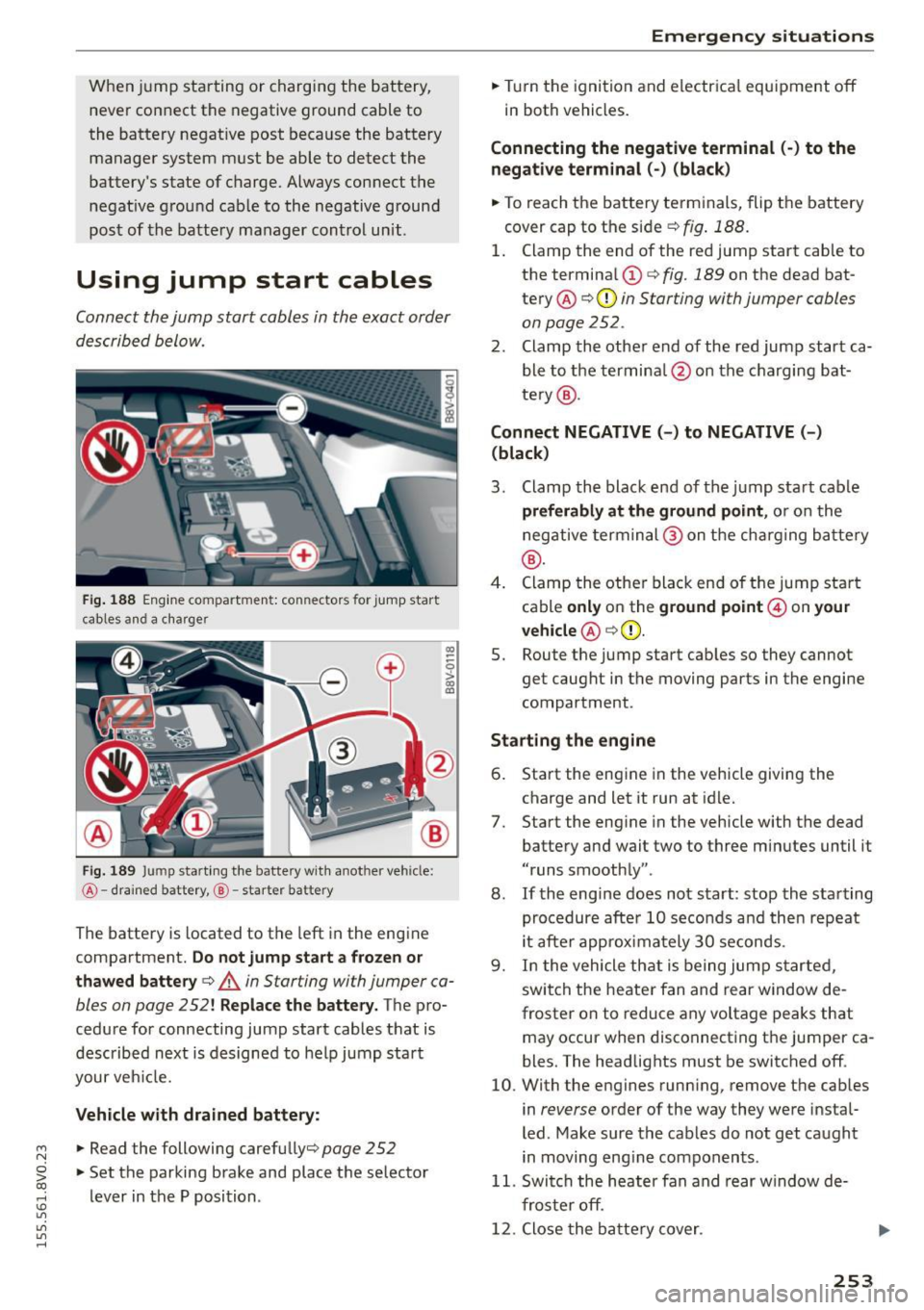
Connect the jump start cables in the exact order
described below.
Fig. 188 Engine compa rtment: connectors for jump start
cables and a charger
Fig. 189 Ju m p sta rting the battery with anot her veh icle:
@ -drained battery, @-starter battery
The battery is located to the left in the eng ine
compartment.
Do not jump start a frozen or
thawed battery
c> A in Starting with jumper ca
bles on page
252! Replace the battery. The pro
cedure for connecting jump start cables that is
described next is designed to help jump start
your veh icle.
Vehicle with drained battery: .. Read the following carefullyc>
page 252
.. Set the parking brake and place the selector
lever in the P position .
Emergency situations
.. Turn the ignition and electrica l equipment off
in both vehicles.
Connecting the negative terminal(-) to the
negative terminal(-) (black)
.. To reach the battery terminals, flip the battery
cover cap to the side
c> fig . 188 .
1. Clamp the end of the red jump start cable to
the terminal © c>
fig. 189 on the dead bat
tery ®
¢0) in Starting with jumper cables
on page 252 .
2. Clamp the other end of the red jump start ca
ble to the terminal@on the charging bat
tery @.
Connect NEGATIVE (-) to NEGATIVE (-)
(black)
3 . Clamp the black end of the jump start cable
preferably at the ground point , or on the
negative term inal @ on the charg ing battery
® ·
4. Clamp the other black end of the jump start
cable
only on the ground point@) on your
vehicle ®
¢(D.
5. Route the jump start cab les so they cannot
get caught in the moving parts in the engine
compartment .
Starting the engine
6. Start the engine in the vehicle giving the
charge and let it run at idle.
7. Start the engine in the vehicle with the dead
battery and wait two to three minutes until it
"runs smoothly" .
8. If the engine does not start: stop the starting
procedure after
10 seconds and then repeat
it after approximately
30 seconds .
9. In the vehicle that is being jump started,
switch the heater fan and rear window de
froster on to reduce any voltage peaks that
may occur when disconnecting the jumper ca
bles. The headlights must be switched off .
10. With the engines running, remove the cables
in
reverse orde r of the way they were instal
led . Make sure the cables do not get caught
in moving eng ine components .
11. Switch the heater fan and rear w indow de
froster off .
12 . Close the battery cover .
253