tow AUDI S3 SEDAN 2015 Owner's Manual
[x] Cancel search | Manufacturer: AUDI, Model Year: 2015, Model line: S3 SEDAN, Model: AUDI S3 SEDAN 2015Pages: 282, PDF Size: 71.14 MB
Page 120 of 282
Parking syste m s
General information
App lies to vehicles: with parking system p lus with rearview
camera
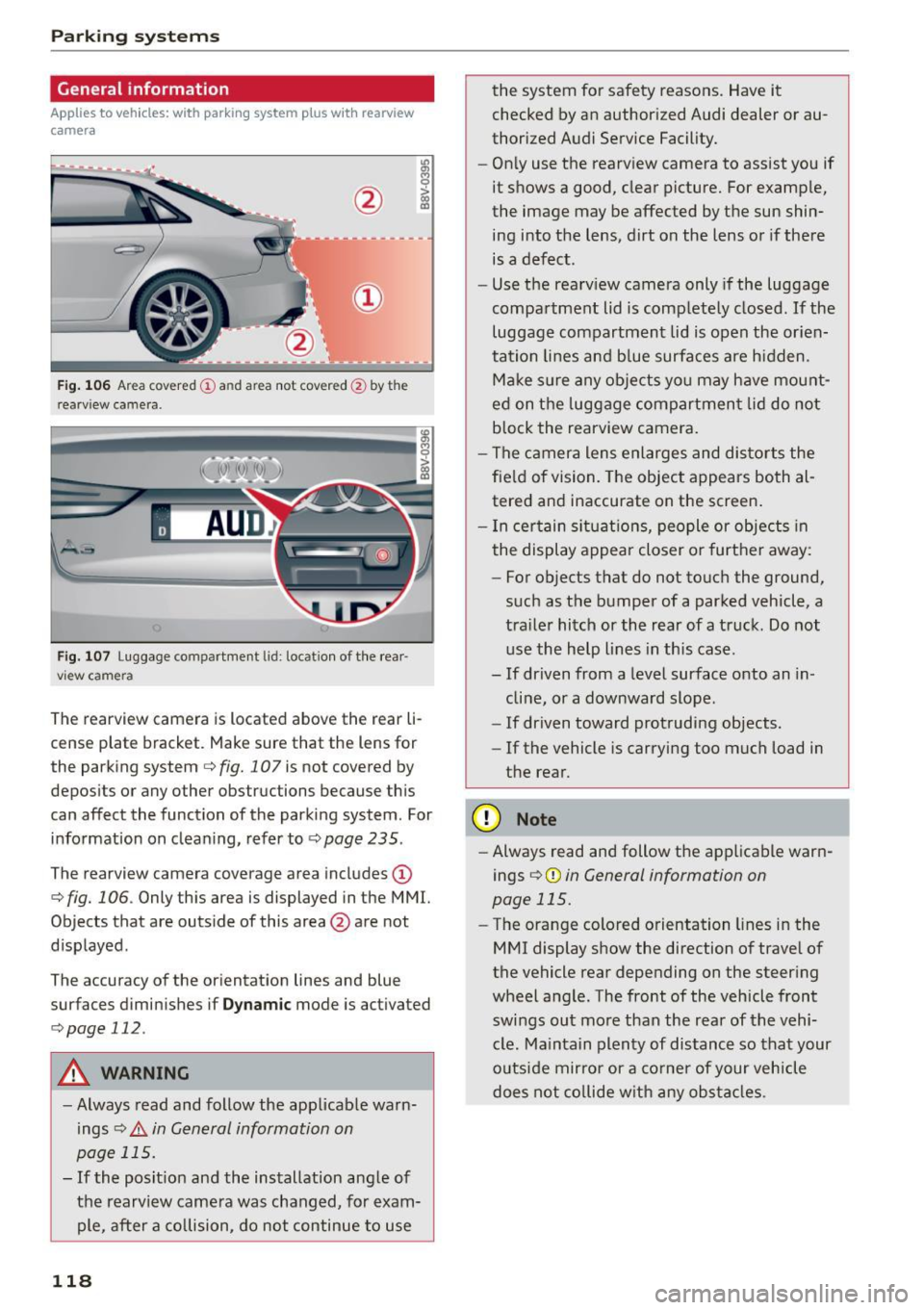
F ig . 106 Ar ea covered (!) an d area not cove red@ by th e
r earv iew ca mera .
Fig. 107 Luggage compartment lid : locat ion of the rear
vi ew came ra
The rearview camera is located above the rear li
cense plate bracket . Make sure that the lens for
the parking system
c::> fig. 107 is not covered by
deposits or any other obstructions because th is
can affect the function of the parking system . For
information on cleaning, refer to
c::> page 235 .
The rearview camera coverage area includes (D
c::> fig. 106. Only this area is displayed in the MMI.
Objects that are outside of this area @are not
displayed .
The accuracy of the or ientation lines and blue
surfaces diminishes if
D yn am ic mode is activated
c::> page 112.
A WARNING
-Always read and follow the app licable warn
ings
c::> .&. in General information on
page 115.
- If the posit ion and the installation ang le of
the rearview camera was changed, for exam ple, after a co llision, do not continue to use
118
the system for safety reasons. Have it
checked by an author ized Audi dealer or au
thorized Audi Service Facility.
- On ly use the rearview camera to assist you if
it shows a good, clear picture. For examp le,
the image may be affected by the sun shin
ing into the lens, dirt on the lens or if there
is a defect.
- Use the rearv iew camera only if the luggage
compartment lid is completely closed.
If the
luggage compartment lid is open the or ien
tation lines and b lue surfaces are h idden.
Make s ure any objects yo u may have mount
ed on t he luggage compartmen t lid do not
block the rearview camera.
- The camera lens enlarges and distorts the
fie ld of vision. The object appears both al
tered and inaccurate on the screen .
- I n ce rtain si tuat ions, people or objects in
the display appea r closer or further away:
- For objects that do not to uch the ground,
such as the bumper of a parked vehicle, a
tra ile r hitch or the rear of a truck. Do not
use the help lines in this case.
- If driven from a level surface onto an in
cline, or a downward slope .
- If driven toward protruding objects.
- If the vehicle is carrying too much load in
the rear.
(D Note
- Always read and follow the applicable warn
ings
c::> (D in General information on
page 115.
- The orange colored o rientation lines in the
MMI display show the direction of trave l of
the vehicle rear depending on the steer ing
wheel a ngle . The front of the vehicle front
swings out more than the rear of the vehi
cle. Ma intain plenty of distance so that your
o utside mirror or a co rne r of your vehicle
does not co llide w ith any ob stacl es .
Page 128 of 282
Intelligent Technology
& WARNING
-New brake pads do not achieve their full
braking effect during the first 250 mi
(400 km). They must be "broken in" first .
However, you can compensate for the slight·
ly reduced braking force by pressing firmly
on the brake pedal. Avoid heavy braking dur·
ing the break-in period.
- Alway apply the brakes for the purpose of
cleaning the brake system when road and
traffic conditions permit. You must not en·
danger other road users. This increases the
risk of an accident.
- On steep slopes , reduce the speed and se
lect a lower gear or lower selector lever po·
sition. Drive as little as possible while press· ing the brake pedal and avoid putting your
left foot on the brake pedal while driving.
This could cause the brakes to overheat and impair the efficiency of the brakes .
- Do not let the brakes "grind" by always
keeping your foot on the brake pedal. This
can cause the brakes to overheat, increase
wear and increase braking distance unneces·
sarily.
- Certain weather and operating conditions
such as driving through water, driving in
heavy rain or driving after washing your
ve·
hide can impair the effectiveness of the
brakes. In the winter, ice may build up on
the brake pads, rotors and drums. Check
these components by braking carefully. Ap·
plying the brakes carefully several times
dries the brakes and removes ice build-up .
- The efficiency of the brakes can also be im·
paired by driving for long stretches on roads
covered with salt without using the brakes.
You can
remove salt deposits from the brake
rotors and pads by carefully applying the
brakes several times.
- If the front spoiler is damaged or you install
another spoiler, make sure the front wheel
brakes are ventilated properly . Otherwise,
the brake system could overheat, which re·
duces their effectiveness.
- Failure of a brake circuit impairs braking
performance, which increases braking dis·
126
tance. Avoid driving the vehicle and have it
towed it to the nearest authorized Audi
dealer or authorized Audi Service Facility .
- Never let the vehicle roll while the engine is
stopped because this increases the risk of an
accident .
-If the brake booster is not working, you will
have to press much harder on the brake ped·
al to compensate for the lack of the booster .
(D Note
-Never let the brakes "rub" by pressing the
pedal lightly when braking is not really nee·
essary. This causes the brakes to overheat
and increases braking distance and causes
wear .
- Before driving on a long stretch with steep
slopes, reduce your speed and shift to the
next lower gear This makes use of the en·
gine braking effect and relieves the brakes .
If you need to brake additionally, brake in
intervals and not continuously.
(D Tips
-If the brake booster is not working, you
must press the brake pedal with much more
force then normal.
- If you retrofit your vehicle with a front spoil·
er, wheel covers or similar items, make sure
that the air flow to the front wheels is not
interrupted. Otherwise the brake system
can become too hot.
Electromechanical
steering
The electromechanical steering supports the
driver's steering movements .
Power steering adapts electronically based on
the vehicle speed.
T he vehicle still has full steering functionality if
the power steering fails or when the engine is
stopped (towing). To steer, you must apply much
more force than usual.
Indicator lights and messages
• Do not drive vehicle: steering defective
Page 129 of 282
M N
0 > co ,...., \!) 1.1'1
1.1'1
1.1'1
,....,
If th is indicator light turns on and stays on and
this message appears, the power steering may have failed .
Do
not continue driving. See an authorized Aud i
dea ler or autho rized Audi Service Facility for as
sistance.
• Do not drive vehicle: steering defective
There is a malfunction in the electron ic steering
l ock. You cannot turn the ignition on .
Do
not tow your vehicle because it cannot be
steered. See an authorized Aud i dealer or author
ized Audi Service Fac ility for assistance .
'-:r,ij Steering malfunction: you can continue driv
ing
If the indicator light turns on, the steering whee l
may be more difficult to move or more sensitive
than usual. The steering wheel may also be at an
angle when dr iving straight.
Drive slow ly to an authorized Audi dealer or au
thor ized Audi Se rvice Facility to have the ma l
function corrected.
!II Steering lock: system fault! Please contact
Service
There is a malfunct ion in the electron ic steering
l oc k.
Drive to an authorized Aud i dealer or authorized
Aud i Service Facility immediately to have the
malfunction corrected.
_& WARNING
-
Have the system malfunction corrected as
soon as possible by an authorized Audi dealer
or authorized Audi Service Faci lity, as th is in
creases the risk of an accident .
(D Tips
If
the . or ,-:r-n indicator light only stays on
for a short time, you may continue driving.
Intelligent Technology
All wheel drive (quattro)
Applies to vehicles: with all w heel drive
In all wheel drive, all four wheels are powered.
General information
In all wheel dr ive, the dr iv in g power is divided be
tween all four whee ls . T his happens automatical
ly depending on your driving behavior as well as
the current road conditions . Refer to¢
page 123,
Electronic stabilization control (ESC).
The all wheel drive concept is designed for high
engine power. Your vehicle is exceptionally pow
erfu l and has excellent driving characteristics
both under normal driving conditions and on
snow and ice. Always read and follow safety pre cautions
q ,& .
Winter tires
By using all wheel drive, your vehicle has good
forward motion with standard tires in winter con
ditions. However, in winter we recommend using
winter or all season tires on
all four wheels, be
cause this will improve the
braking effect .
Snow chains
If
there are snow chain laws, snow chains must
also be used on vehicles with all wheel drive
q page 230, Snow chains.
Replacing tires
For vehicles with all wheel d rive, only wheels wi th
the same rolling circumference should be used.
Avoid wheels with different tread depths
qpage 221.
Offroad vehicle?
Your Audi is not an offroad vehicle -there is not
enough ground clearance. For this reason, avoid
difficult terra in. Refer to¢
page 259.
_& WARNING ~
-Also, in vehicles with a ll wheel drive, adapt
your driving style to the current road and
traffic cond itions . Do not let the increased
safety provided tempt you into taking risks.
- The braking ability of your veh icle is limited
to the tract ion of the wheels. In th is way, it
127
Page 134 of 282
Driving safety
is as close to this position as possible. Move the
head restraint so that it is as close to the back
of the head as possible.
.. Fa sten and wear safety belt s correctly
<=> page 143.
.. Always keep both feet in the footwell so that
you are in control of the veh icle at all times.
For detailed information on how to adjust the
driver's seat, see
<=> page 55 .
A WARNING
Drivers who are unbelted, out of position or
too close to the airbag can be seriously in
jured by an airbag as it unfolds. To help re
duce the risk of serious personal injury:
- Always adjust the dr iver's seat and the
steering wheel so that there are at least
10 inches (25 cm) between your breastbone
and the steering wheel.
- Always adjust the driver's seat and the
steering wheel so that there are at least
4 inches (10 cm) between the knees and the
lower part of the instrument panel.
- Always hold the steering wheel on the out
side of the steering wheel rim with your
hands at the 9 o'clock and 3 o'clock posi
tions to help reduce the risk of personal in
jury if the driver's airbag inflates .
- Never hold the steering wheel at the
12 o'clock position or with your hands at
other positions inside the steering wheel
rim or on the steering wheel hub . Holding
the steering wheel the wrong way can cause
serious injuries to the hands, arms and head
if the driver's airbag inflates.
- Pointing the steering wheel toward your
face decreases the ability of the supplemen
tal driver's airbag to protect you in a colli
sion.
- Always sit in an upright position and never
lean against or place any part of your body
too close to the area where the airbags are
located.
- Before driving, always adjust the front seats
properly and make sure that all passengers
are properly restrained.
132
- For adjustable head restraints: before driv
ing, always also adjust the head restraints
properly .
- Never adjust the seats while the vehicle is
moving. Your seat may move unexpectedly
and you could lose control of the vehicle.
- Never drive with the backrest reclined or tilted far back! The farther the backrests are
tilted back, the greater the risk of injury due
to incorrect positioning of the safety belt
and improper seating position .
- Children must always ride in child seats
<=> page 172 . Special precautions apply
when installing a child seat on the front pas senger seat<=>
page 148.
· Proper seating position for the front
passenger
The proper front passenger seating position is
important for safe , relaxed driving.
For your own safety and to reduce the risk of in
jury in the event of an accident, we recommend
that you adjust the seat for the front passenger
to the following position :
.. Adjust the angle of the seatback so that it is in
an upright position and your back comes in full
contact with it whenever the vehicle is moving .
.. For adjustab le head restraints: adjust the head
restraint so the upper edge is as even as possi
ble with the top of your head. If that is not pos
sible, try to adjust the head restraint so that it
is as close to this position as possible
<=> page 134 . Move the head restraint so that it
is as close to the back of the head as possible.
.. Keep both feet flat on the floor in front of the
front passenger seat .
.. Fasten and wear safety belts correctly
<=> page 143.
For detailed information on how to adjust the
front passenger's seat, see
c> page 54.
A WARNING
Front seat passengers who are unbelted, out
of position or too close to the airbag can be
Page 138 of 282
Driving safet y
mats wi ll prevent them from sliding into posi
tions that cou ld interfere with the peda ls or im
pa ir safe operation of your vehicle in other ways .
A WARNING
Pedals that cannot move freely can result in a
loss of vehicle control and increase the risk of
serious persona l injury .
- Always make sure that floor mats are prop
erly secured .
- Never place or insta ll floor mats or other
floor coverings in t he veh icle that cannot be
properly secured in place to prevent them
from slipping and inte rfering w ith the ped
als or the ability to control the veh icle .
- Never place or insta ll floor mats or other
floor coverings on top of already installed
floor mats. Additiona l floo r mats and other
c overings w ill reduce the si ze of the pedal
area and interfere w ith the pedal s.
- Always proper ly reinstall and secu re floor
mats that have been take n ou t for clean ing .
- Always make sure that objects cannot fa ll
in to the dr iver footwell while the veh icle i s
moving. Obje cts can be come trapped unde r
the brake pedal an d accelerator peda l caus
ing a loss of vehicle cont ro l.
Storing cargo correctly
Loading the luggage compartment
All luggage and other objects must be properly
s towed and secured in the luggage compart
ment.
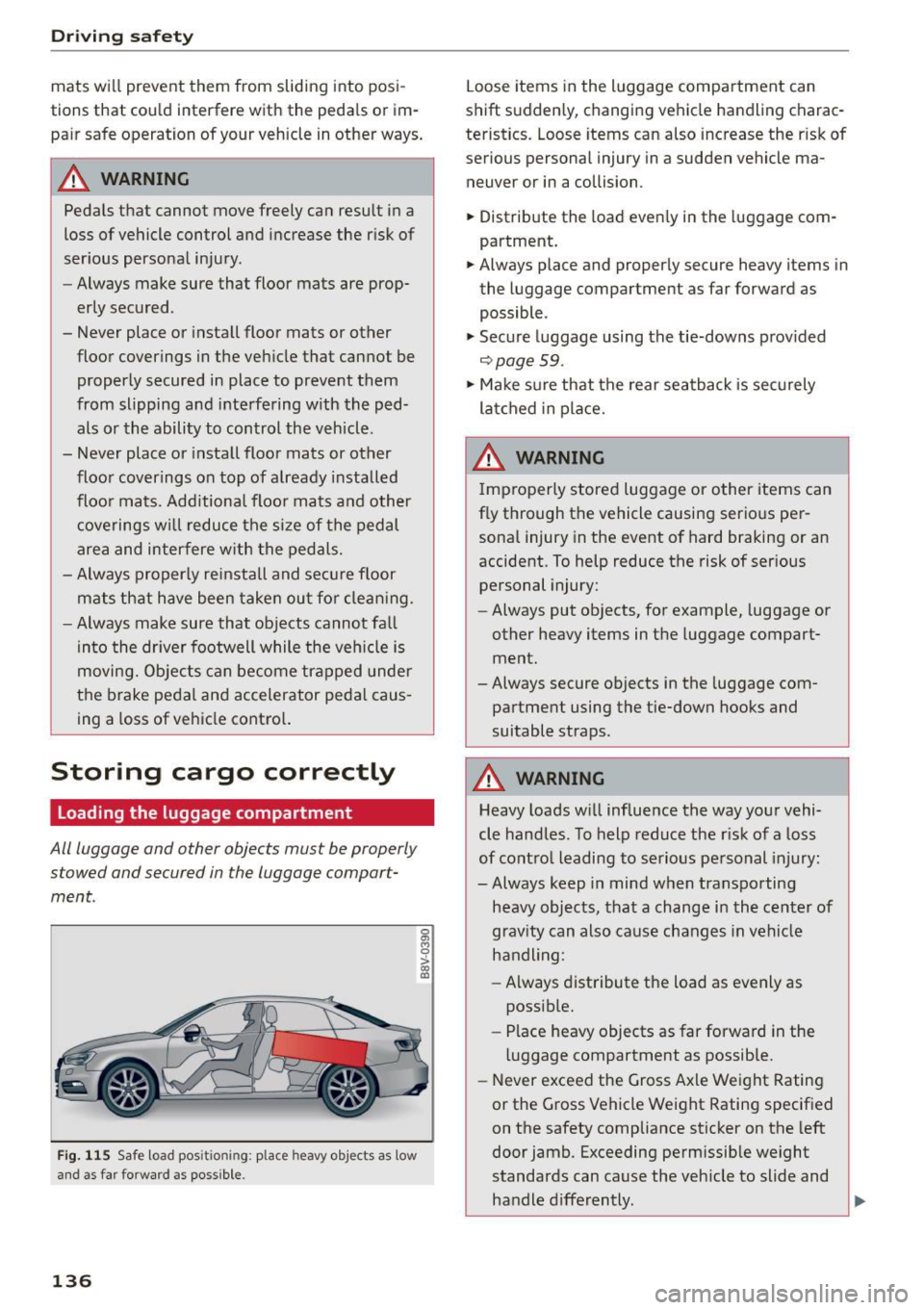
F ig . 11 5 Safe load pos it io nin g: place heavy objects as low
an d a s far for ward as possib le .
136
Loose items in the luggage compa rtment can
shift suddenly, changing vehicle handling charac
teristics. Loose items can also increase the r isk o f
serious persona l injury in a sudden vehicle ma
neuver or in a collision.
.,. Distribute the load even ly in the luggage com
partment.
.,. Always place and properly secure heavy items in
the luggage compartment as far forward as
possible .
.,. Secure luggage using the tie-downs prov ided
~ page 59.
.,. Ma ke s ure that the rear seatback is securely
la tc hed in place.
A WARNING
I mproperly stored luggage or other items can
fly through the vehicle causing serio us per
sona l injury in the event o f hard braking or an
accident. To help reduce the risk of ser ious
personal injury:
- Always put objects, for example, luggage or
other heavy items in the luggage compart
ment.
- Always secure objects in the luggage com
partment using the tie-down hooks and
suitable straps.
A WARNING
H eavy loads wi ll influence the way your vehi
cle handles . To help reduce the r isk of a loss
of contro l leading to se rio us pe rsonal injury:
-Always keep in mind when transpo rting
heavy objects, tha t a change i n the center of
grav ity can also cause changes in vehi cle
h a ndli ng:
- Always distribute the load as evenly as
possib le.
- Place heavy objects as far forward in the
luggage compartment as possib le.
- Never exceed the Gross Axle Weight Rating
or the Gross Vehicle Weight Rating specif ied
on the safety compliance sticker on the left
door jamb. Exceeding permissib le weight
standards can cause the veh icle to slide and
handle d ifferently. ,...
Page 147 of 282
....,
N
0 > co
rl I.O
"'
"'
"'
rl
-A loose-fitting safety belt can cause serious
injuries by shifting its position on your body
from the strong bones to more vulnerable,
soft tissue and cause serious injury.
- Always read and heed all WARNINGS and
other important information ¢
page 142.
Pregnant women must also be correctly
restrained
The best way to protect the fetus is to make sure
that expectant mothers always wear safety belts
correctly -throughout the pregnancy .
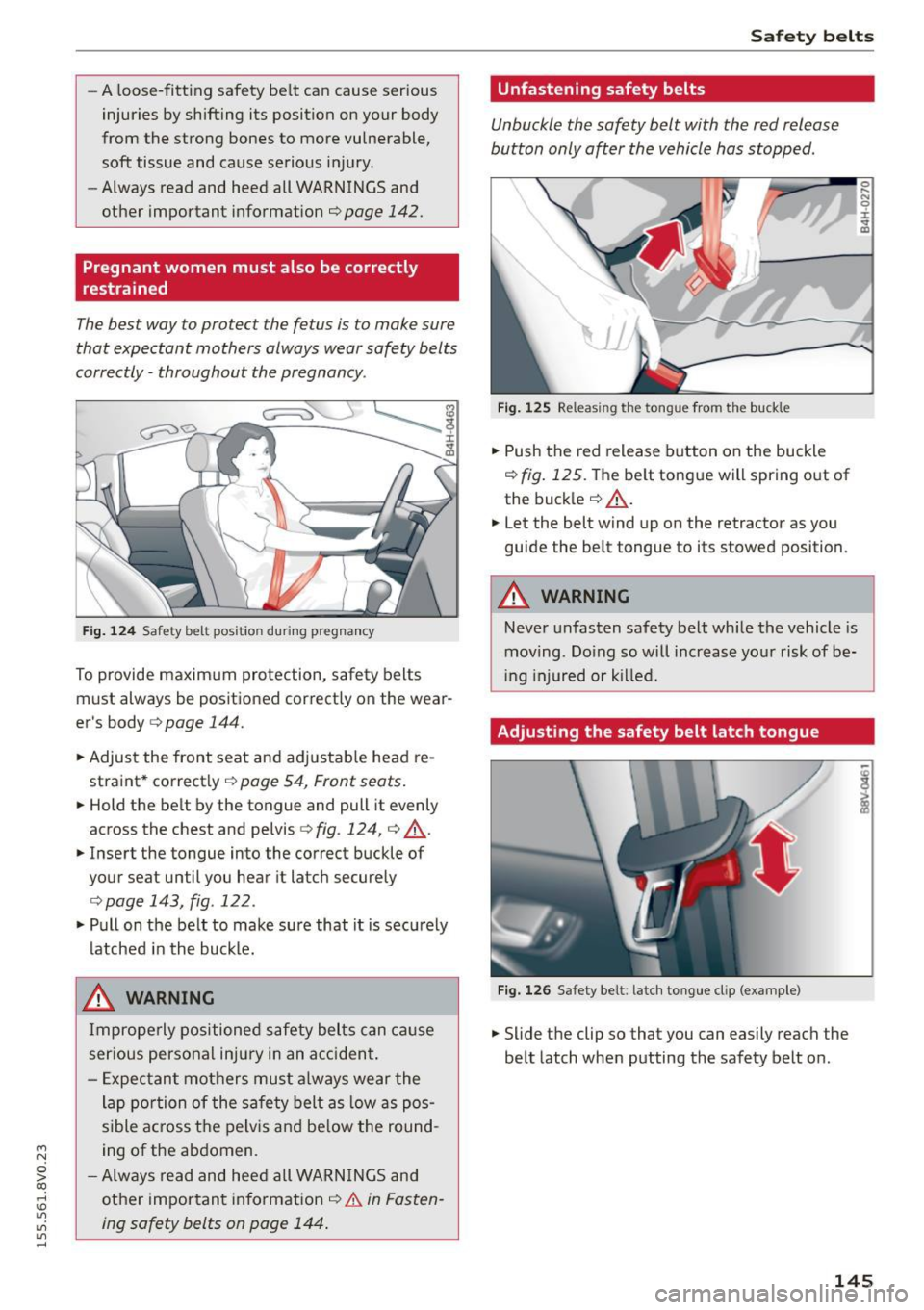
Fig. 124 Safety belt position during pregnancy
To provide maximum protection, safety belts
must always be positioned correctly on the wear
er's body
c:> page 144.
• Adjust the front seat and adjustable head re
straint* correctly¢
page 54, Front seats.
• Hold the belt by the tongue and pull it evenly
across the chest and pelvis ¢
fig. 124, c:> .&_.
• Insert the tongue into the correct buckle of
your seat until you hear it latch securely
¢page 143, fig. 122 .
•Pullon the belt to make sure that it is securely
latched in the buckle.
_& WARNING
Improperly positioned safety belts can cause
serious personal injury in an accident.
- Expectant mothers must always wear the
lap portion of the safety belt as low as pos
sible across t he pelvis and below the round
ing of the abdomen .
- Always read and heed all WARNINGS and
other important information
¢ .&. in Fasten
ing safety belts on page 144.
Safety belts
Unfastening safety belts
Unbuckle the safety belt with the red release
button only a~er the vehicle has stopped .
J-L
Fig. 125 Releasing the tongue from the buckle
• Push the red release button on the buckle
¢
fig. 125. The belt tongue will spring out of
the buckle
c:> .&_ .
• Let the belt wind up on the retractor as you
guide the belt tongue to its stowed position .
_& WARNING
-Never unfasten safety belt while the vehicle is
moving. Doing so will increase your risk of be
ing injured or killed.
Adjusting the safety belt latch tongue
Fig. 126 Safety belt: la tch tongue cl ip (example)
.,.. Slide the clip so that you can easily reach the
belt latch when putting the safety belt on .
0 ..... N 0 :i:
"' CD
145
Page 159 of 282
M N
0 > co ,...., \!) 1.1'1
1.1'1
1.1'1
,....,
-If you must use a child restraint on the front
passenger seat and the child restraint man
ufacturer's instructions requ ire the use of a
towel, foam cushion or someth ing else to
properly position the child restraint, make
certain that the
P A SSENG ER AIR BAG OFF
light comes on and stays on whenever the
child restrain t is ins talled on the fron t pas
senger seat.
- If the
PASSENGER AIR BAG OFF light does
not come on and stay on, immed iately in
sta ll child restra int in a rear seating position
and have the airbag system inspected by
yo ur Audi dealer .
&_ WARNING
If the front passenger seat gets wet, dry it im
mediately.
-If liquid soaks into the front passenger seat,
this can keep the airbag system from work ing properly and may, for instance, deacti
vate the passenger frontal a irbag. If th is
happens, the
PASSENGER AIR BAG OFF
light will come on and stay on together with
the a irbag indicator light
II in the inst ru
me nt cluster.
- If liquid is poo led on the seat, but has not
soa ked in, this may a lso keep the airbag sys
tem from wor king proper ly and cause the
passenger fron tal ai rbag to be ena bled
(turned on), even tho ugh there is a properly
installed chi ld restraint system on the seat .
Wet towels or other wet things on the seat c u shion can have the same effect. If the
front passenger fronta l airbag is turned on,
the
PASSENGER AIR BAG OFF light will go
o ut.
How the Advanced Airbag System
components work together
The fron t Advanced A irbag Sys tem and the s ide
ai rbags supplement the pro tect ion offered by the
front three-point safety be lts with pretensioners
and load limiters and the adjustable head re
straints* to he lp red uce the risk of in jury in a
wide range of acc ident and cras h situations. Be
Airbag syste m
su re to read the important information about
safety and heed the WARNINGS in this chapter .
Deployment o f the Adv anced A irbag System and
the ac tivation of the sa fety belt pretensione rs de
pend on the dece lerat ion meas ured by the crash
sensors and registered by the e lectronic control
u nit . Cras h seve rity depends on speed and decel
eration as we ll as the mass and stiffness of the
vehicle or object involved in the crash .
On t he passenger side, regardless of safety belt
u se, the front passenger fronta l airbag will be
turned off if the electrical capacitance meas ured
by the capacitive passenger detection system on
the front passenger seat is less than the amount programmed in the electronic control unit . T he
front passeng er fronta l airbag will a lso be turned
off if the capac itance meas ured by t he system for
the front passenger sea t eq uals tha t of an inf ant
of about one year o f age in one of t he chi ld seats
that was used to certify the Advanced Airbag Sys
tem under Federal Motor Vehicle Safety Standard
208. The
PASSENGER AIR BAG OFF light comes
on and stays on to tell you when the front Ad
vanced Airbag System on the passenger side has been turned
off c::>page 160 .
&_ WARNING
-To reduce the risk of in jury w hen an a irbag in-
flates, always wear safety belts prope rly .
- If you are unrestra ined, leaning forward, sit
ting sideways or out of posit ion i n any way,
your r is k of injury is m uch higher.
- You will a lso receive se rious injur ies an d
could even be killed if you a re up aga inst th e
ai rbag or too close to i t when i t in flates -
even with an A dvan ced Airb ag
<=:> page 14 8.
157
Page 163 of 282
M N
0 > co ,...., \!) 1.1'1
1.1'1
1.1'1
,....,
The PASSENGER AIR BAG OFF light will show
the status of the front seat passenger's frontal
Advanced Airbag a few seconds after the igni·
tion is switched on and the airbag indicator
light goes off. The PASSENGER AIR BAG OFF
light:
- will stay on if the front passenger seat is not
occupied;
- will stay on if the electrical capacitance meas
ured by the capacitive passenger detection sys
tem for the front passenger seat equals the combined capacitance of an infant up to about
one year of age and one of the rearward-fac ing
or forward-facing child restraints listed in Fed
eral Motor Vehicle Safety Standard 208 wit h
wh ich the Advanced Airbag System in your vehi
cle was certified; For a listing of the child re
stra ints that were used to certify your vehicle's
compliance with the U.S. Safety Standard
¢page 174.
-will go out if the front passenger seat is occu
pied by an adult as registered by the capacitive
passenger detection system.
-The PASSENGER AIR BAG OFF light must come
on and stay on if the ignition is on and ...
- a car bed has been installed on the front pas
senger seat, or
- a rearward-facing chi ld restraint has been in
stalled on the front passenger seat, or
- a forward-facing child restraint has been insta l
led on the front passenger seat,
- and if the electr ical capacitance regis tered on
the front passenger seat is equa l to or less than
the combined capacitance of a typical 1 year
o ld infant and one of the rearward -facing or
forward-facing child restraints listed in Federal
Motor Vehicle Safety Standard 208 with which
the Advanced Airbag System in your vehicle was certified .
If the front passenger seat is not occupied, the
front airbag will not deploy, and the
PASSENGER
AIR BAG OFF
light will stay on. Never install a
rearward -facing child restraint on the front pas ·
senger seat , the safest place for a child in any
kind of child restra int is at one of the seating po
sitions on the rear seat ¢
page 149, Child re-
Airbag system
straints on the front seat -some important
things to know
and ¢ page 172 , Child safety.
If the PASSENGER AIR BAG light comes
on ...
If the PASSENGER AIR BAG OFF light comes on
when one of the conditions listed above is met,
be sure to check the light regularly to make cer
ta in that the
PASSENGER AIR BAG OFF li ght
stays on continuously whenever the ignition is
on . If the
PASSENGER AIR BAG OFF light does
not appea r on and does not stay on all the time,
stop as soon as it is safe to do so and
- reactivate the system by turning the ign ition
off
for more than 4 seconds and then turning it on
aga in;
- remove and reinstall the child restraint. Make
sure that the child restraint is properly installed
and that the safety belt for the front passenger
seat has been correctly routed through the
child restraint as described in the chi ld restraint
manufacturer's instru ction s;
- make sure that the convertible locking retractor
on the s,;1fety belt fo r the front passenger seat
has been activated and that the sa fe ty belt has
been pu lled tight.
- make sure that no electrical device (such as a
laptop, CD player, electronic games device,
power inverter or seat heater fo r child seats) is
placed or used on the front passenger seat if
the device is connected to the 12-volt socket or
the ci garette lighter socket;
- make sure that no seat heater has been retrofit
ted or otherwise added to the front passenger
seat;
- make sure that nothing can interfere with the
safety belt buckles and that they are not ob
structed;
- make sure that there are no wet objects (such as a wet towel) and no water or other liquids on
the front passenger seat cush ion.
If the PASSENGER AIR BAG light still does
not come on ...
If the PASSENGER AIR BAG OFF light still does
not come on and does not stay on continuously
(when the ignition is sw itched on),
111-
161
Page 175 of 282
M N
0 > co ,...., \!) 1.1'1
1.1'1
1.1'1
,....,
exceptional circumstances and the
PASSENGER AIR BAG OFF light does not
come on and stay on, immediately install
the rear-facing child safety seat in a rear
seating position and have the airbag system
inspected immediately by your Audi dealer .
A WARNING
-Forward-facing child seats installed on the
front passenger seat may interfere with the deployment of the airbag and cause serious
personal injury to the child.
-If exceptional circumstances require the use
of a forward-facing child restraint on the
front passenger's seat, the child's safety
and well-being require the following special
precautions to be taken:
-Always make sure that the forward-facing seat has been designed and certified by its manufacturer for use on a front passenger
seat with a front and side airbag.
-Always carefully follow the manufacturer's
instructions provided with the child seat
or infant carrier.
- Never install a child restraint without a
properly attached top tether strap if the
child restraint manufacturer's instructions require the top tether strap to be used.
- Never put the forward-facing child re
straint up against or very near the instru
ment panel.
- Always set the safety belt upper anchor
age to the adjustment position that per
mits proper installation in accordance with
the child restraint manufacturer's instruc
tions.
- Always move the passenger seat into its
rearmost position in the seat's fore and aft
adjustment range, as far away from the
airbag as possible before installing the
child restraint . The backrest must be ad
justed to an upright position .
- Always make sure that nothing prevents
the front passenger's seat from being moved to the rearmost position in its fore
and aft adjustment range.
Child safety
-Never place objects on the seat (such as a
laptop, CD player, electronic games device,
power inverter or seat heater for child
seats) . These may influence the electrical
capacitance measured by the capacitive
passenger detection system and can also
fly around in an accident and cause serious
personal injury.
- Never place or use any electrical device
(such as a laptop, CD player, electronic
games device, power inverter or seat heat
er for child seats) on the front passenger
seat if the device is connected to the 12-
volt socket or the cigarette lighter socket.
- If a seat heater has been retrofitted or
otherwise added to the front passenger
seat, never install any child restraint sys
tem on this seat.
- Make sure that there are no wet objects
(such as a wet towel) and no water or oth
er liquids on the front passenger seat
cushion.
- Always make sure that the
PASSENGER
AIR BAG OFF
light comes on and stays on
all the time whenever the ignition is
switched on.
- If the
PASSENGER AIR BAG OFF light
does not come on and stay on, immediate
ly install the forward-facing child seat in a
rear seating position and have the airbag
system inspected by your authorized Audi
dealer.
- Always buckle the child seat firmly in
place even if a child is not sitting in it. A
loose child seat can fly around during a
sudden stop or in a collision.
- Always read and heed all WARNINGS
whenever using a child restraint in a vehi
cle
¢ page 140, Safety belts, ¢ page 148,
Airbag system
and ¢ page 172, Impor
tant information.
(D Tips
Always replace child restraints that were in
stalled in a vehicle during a crash. Damage to
a child restraint that is not visible could cause
it to fail in another collision situation.
173
Page 179 of 282
....,
N
0 > co
rl I.O
"'
"'
"'
rl
-Make sure the forward-facing seat has
been designed and certified by its manu
facturer for use on a front seat with a pas
senger front and side airbag.
- Always carefully follow the manufacturer's
instructions provided with the child safety
seat or carrier.
- Always move the front passenger seat into
the rearmost position of the passenger
seat's fore and aft adjustment range, and
as far away from the airbag as possible be
fore installing the child restraint.
- Always make sure that nothing prevents
the front passenger's seat from being
moved to the rearmost position in its fore
and aft adjustment range .
- Always make sure that the backrest is in
the upright position.
- Never place or use any electrical device
(such as a laptop, CD player, electronic
games device, power inverter or seat heat
er for child seats) on the front passenger
seat if the device is connected to the 12-
volt socket or the cigarette lighter socket.
- If a seat heater has been retrofitted or
otherwise added to the front passenger
seat, never install any child restraint sys
tem on this seat.
- Make sure that there are no wet objects
(such as a wet towel) and no water or oth
er liquids on the front passenger seat
cushion.
- Never place objects on the seat (such as a
laptop, CD player, electronic games device,
power inverter or seat heater for child
seats). These may influence the electrical
capacitance measured by the capacitive
passenger detection system and can also
fly around in an accident and cause serious
personal injury.
- Always buckle the child safety seat firmly in
place even if a child is not sitting in it. A
loose child safety seat can fly around during
a sudden stop or in a collision .
- Always read and heed all WARNINGS when
ever using a child restrained in a vehicle is
being used
¢ page 140, Safety belts,
Child safety
¢ page 148, Airbag system and
¢ page 172, Child safety.
A WARNING
-
To reduce the risk of serious injury, make sure
that the
PASSENGER AIR BAG OFF light
comes on and stays on whenever a child re
straint is installed on the front passenger seat
and the ignition is switched on.
- Take the child restraint off the front passen ger seat and install it properly at one of the
rear seat positions if the
PASSENGER AIR
BAG OFF
light does not stay on.
- Have the airbag system inspected by your
authorized Audi dealer immediately.
Secure unused safety belts on the rear seat
Fig. 138 Schematic overview: keep unused safety belts
away from children in c hild safety seats. @-outer rear
safety belt, @ -ce nter rear safety belt*
If a child safety seat is used on the rear bench,
especially with LATCH universal lower anchorag
es, the unused safety belts
must be secured so
that the child in the child restraint cannot reach
them ¢_& .
- Guide the safety belt webbings @and
®* be
hind the head restraint of the seat where the
child restraint is installed
¢ fig. 138. When do
ing so, do not engage the convertible locking
retractor! You should not hear a "clicking "
sound when winding up the safety belt.
- Let the belt retractor wind up the safety belt
webbing.
177