ignition AUDI S3 SEDAN 2015 Repair Manual
[x] Cancel search | Manufacturer: AUDI, Model Year: 2015, Model line: S3 SEDAN, Model: AUDI S3 SEDAN 2015Pages: 282, PDF Size: 71.14 MB
Page 200 of 282
Checking and F ill in g
damp cloth and plenty of cold water. If the
AdB lue has already crysta llized, use warm
water and a sponge. AdBl ue res idue that is
not removed will crysta lli ze and can damage
the affected s urface.
- Do not store the ref ill bottle in the vehicle.
If it leaks, the escaping Ad Blue cou ld dam
age the veh icle inter ior.
- Do not allow Ad Blue to come into contact
with clothing. If there is contact with the
flu id, flush immed iate ly w ith plenty of wa
ter .
@ Tips
-You can obtain refill bott les from an author
i zed Audi dealer or authorized Audi Service
Facility .
- Follow the Ad Blue manufacturer 's instruc
tions for use and storage .
Engine compartment
Working in the engine compartment
Special care is required if you are working in the
engine compartment
For work in the engine compartment such as
c h ecking and filling fluid s, there i s a risk of in
jury, scalding , accid ents, and burns. F or thi s
rea son, follow all the following li sted warning s
and general safety precautions. The engine
c ompartment is a dangerous area!
~ &
A WARNING
To reduce the risk of injur ies, complete the
following steps before opening the hood :
- Turn the eng ine off.
- switch the ignit ion off .
- Set the parking b rake.
- Pla ce the sele ctor leve r in the P pos ition.
- Let the engine coo l down .
- Never open the hood when you see that
steam o r coolan t drips from the engine
compartment- there is a da nger of burns!
Wait un til no steam o r coolant flows ou t.
- Keep children away from the engine com
partm ent.
198
-
- Never sp ill fluids on a hot engine . These fl u
ids (such as the freeze protection conta ined
in the coolant) can catch fire.
- Avoid short circ uits in the e lectrica l system,
especially the battery.
- When working in the engine compa rtment,
remember that the radiator fan can switch
on even if the ignition is switched off, wh ich
increases the risk of pe rsonal injury.
- Never open the cap on the coolant expan
si on tank when the engine is warm . The
cooli ng system is under p ress ure .
- To protect yo ur face, hands, and a rms from
hot steam or coolant, cover the cap with a large cloth when o pening.
- Do not remove the engine c over under any
circumstances . T his i ncreases the r isk of
burns.
- If tests need to be per formed with t he en
gine running, there is additional danger due
to mov ing components (such as the rib bed
be lt , a lternator a nd radiator fan) a nd from
the high v olt age ignit io n sy stem.
-Never reac h into the radiato r fan . The e lec
tric aux iliar y fan i s controlled by tempera
ture and can swi tch on sudden ly.
- Pay attention to t he fo llow ing warnings list
ed when w ork on the fue l system o r on the
elec tric al equipmen t is requ ired .
- Always d isconnect the vehicle battery
from the vehicle electrical system
- Do not smo ke
- Never work near open flames
- Always have a work ing fire exting uis her
near by
- To reduce t he risk of e le ct ric shock and in
jury, never touch the following components
when t he engine is running or is bein g start
e d :
- Ign ition cable
- Other components in the electronic h igh
vo ltage ignition system
- If you must check or perform work o n the
e ngine whi le it is running:
- S et t he parki ng bra ke and pla ce the selec
t or lever in the P (park) posi tion first .
Page 208 of 282
Checking and Fill in g
system and could result in damage not cov
ered by your New Vehicle Limited Warranty.
Adding coolant
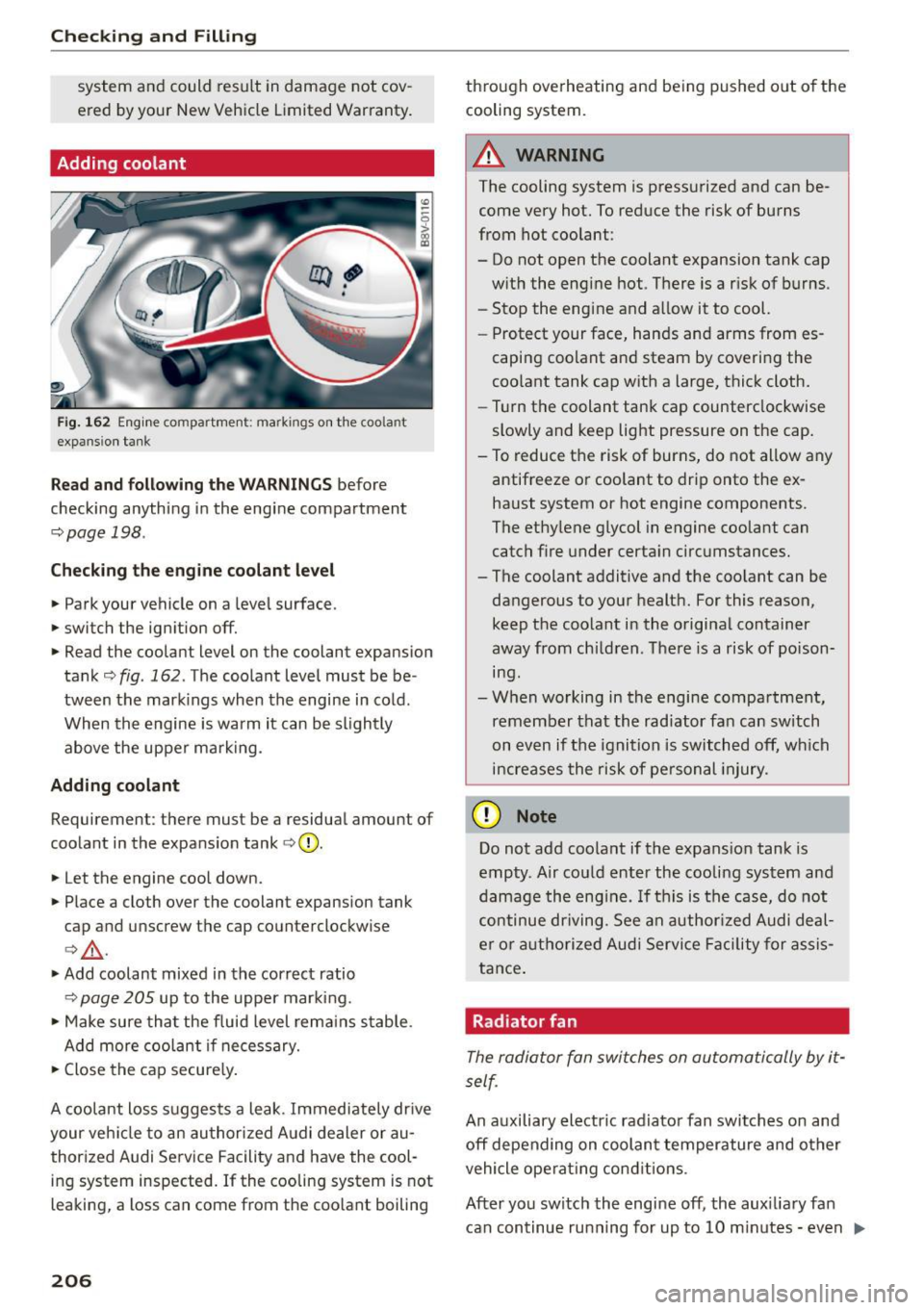
Fig. 162 Eng ine compartment: ma rkings on the coola nt
expans ion tank
Read an d follo wing the WARNINGS before
checking anything in the engine compartment
r::;,page 198.
Checking the engine coolant level
.. Park your vehicle on a level surface.
.. switch the ignition off.
.. Read the coolant level on the coolant expansion
tank
r::;, fig . 162 . The coolant level must be be
tween the mark ings when the engine in cold .
When the engine is warm it can be slightly
above the upper marking .
Adding coolant
Requirement: there must be a residual amount of
coolant in the expans ion tank
c> Q).
.. Let the engine cool down.
.. Place a cloth over the coolant expansion tank
cap and unscrew the cap counterclockwise
<=>& .
.,. Add coolant mixed in the correct ratio
r::;, page 205 up to the upper marking .
.. Make sure that the fluid level rema ins stable.
Add more coolant if necessary.
.. Close the cap secure ly.
A coolant loss s uggests a leak. Immediate ly drive
your veh icle to an authorized A udi dealer or au
thor ized Audi Service Facility and have the cool
ing system inspected.
If the cooling system is not
leaking, a loss can come from the coolant boiling
206
thro ugh ove rheating and being pushed out o f the
cooling system.
A WARNING
The cooling system is pressurized and can be
come very hot. To reduce the risk of burns
from hot coolant:
- Do not open the coolant expansion tank cap
w ith the engine hot. There is a risk of burns .
- Stop the eng ine and a llow it to cool.
- Protect your face, hands and arms from es-
caping coolant and steam by covering the
coo lant tank cap with a large, thick cloth.
- Turn the coolant tank cap counterclockwise
slowly and keep light pressure on the cap.
- To reduce the risk of burns, do not allow any
antifreeze or coolant to drip onto the e x
haust system or hot engine components.
The ethy lene glycol in engine coola nt can
catch fire under certa in circumstances.
- The coolant additive and the coolant can be
dangerous to your health. For this reason,
keep the coolant in the o riginal container
away from ch ildren . The re is a risk of poison
ing .
- W hen working in the engine compartment,
remember that the rad iator fa n can switch
on ev en if the ignition is switched off, wh ich
increases the risk of pe rsonal injury.
@ Note
Do not add coolant if the expans ion tank is
empty . Air cou ld enter the cooling system and
damage the eng ine. If this is the case, do not
continue driving. See an author ized Audi deal
er or a uth ori zed Audi Service Facility for a ssis
ta nce .
. Radiator fan
The radiator fan switches on automatically by it
self
An a uxiliary electric radiato r fan switches on and
off depending on coolan t temperature and other
vehicle ope rat ing cond itions .
After yo u sw itch the engine off, the aux ilia ry fan
can continue running for up to 10 m inutes -even .,,.
Page 209 of 282
with the ignition off. It can even switch on again
l ater by itself~.& , if
- the temperature of the engine coolant rises due to the heat bui ld-up from the eng ine in the en
gine compartment, or
- the engine compar tment heats up because the
vehicle is parked in intense sunlight.
A WARNING , --
- To reduce the risk of personal injury never
touch the radiator fan.
- The auxiliary e lectric fan is temperature con
trolled and can switch on suddenly even
when the engine is not running.
- The aux iliary radiator fan switches on auto
matically when the engine coo lant reaches a
certain temperature and will continue to run
until the coolant temperature drops.
Brake fluid
Checking brake fluid level
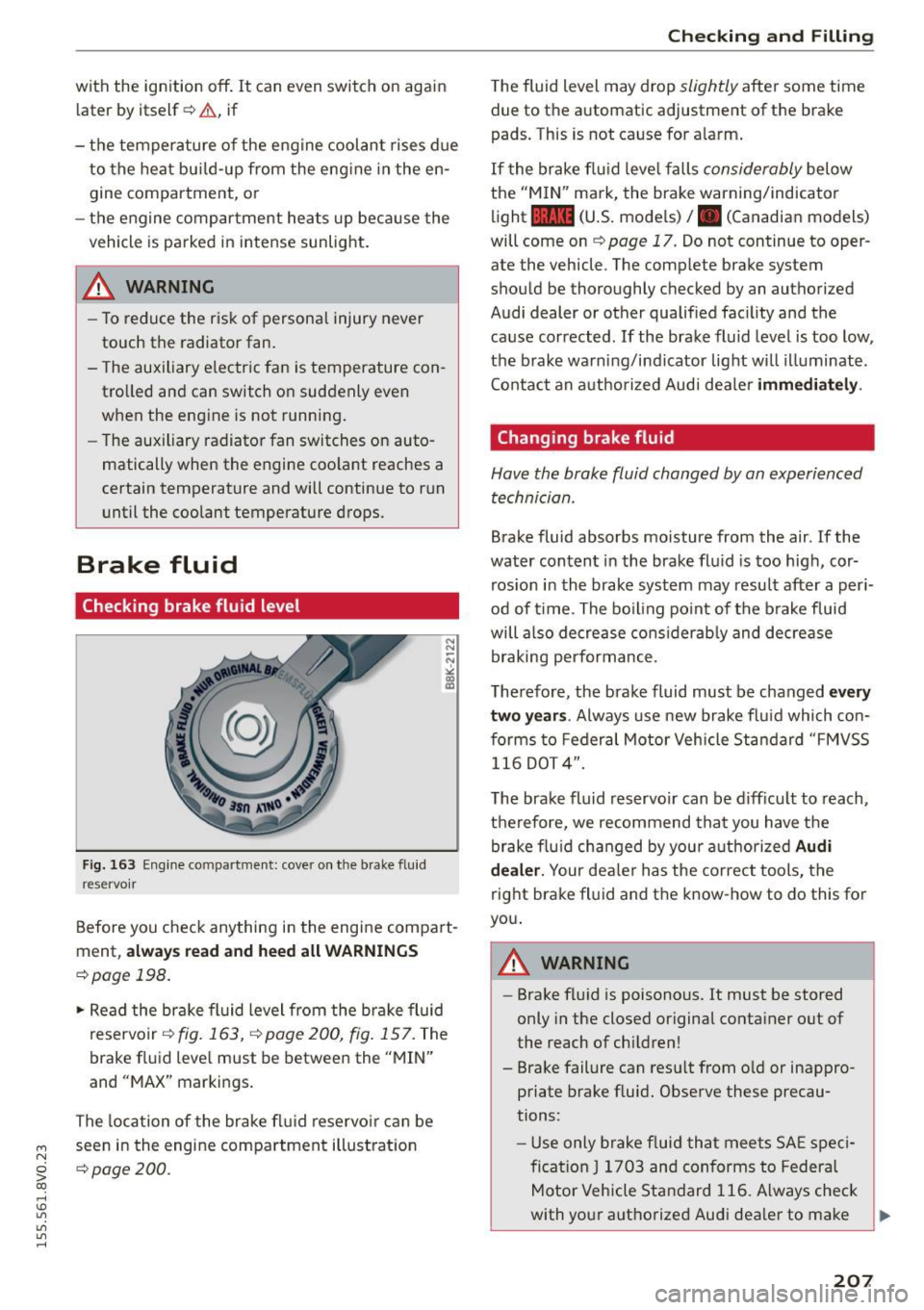
Fig. 163 Engine compa rt m ent: cove r on the brake fluid
reservo ir
N N -N
"' :ll
Before you check anything i n the engine compa rt
ment,
al ways re ad and h eed all W ARN INGS
~page 198.
... Read the brake fluid level from the b ra ke fluid
reservoir
r¢ fig. 163, r:¢ page 200, fig. 157. The
brake f luid leve l must be between the "MIN"
and "MAX" markings.
The location of the brake fl uid reservo ir can be
...., seen in the engine compartment illustration
N
~ r¢ page 200.
co
rl I.O
"'
"'
"'
rl
Check in g and Fillin g
The fluid level may drop slightly after some time
due to the automatic adjustment of the brake
pads . This is not cause for a larm.
If the brake f luid leve l falls considerably below
the "MIN" mark, the brake warning/indicator
light
1111 (U.S. mode ls) I. (Canadian models)
will come on
~ page 17. Do not continue to oper
ate the vehicle . The comp lete brake system
should be thoroughly checked by an authorized
Audi dealer or other qualified fac ility and the
cause corrected . If the brake flu id level is too low,
the brake warning/indicator light wi ll illuminate .
Contact an a uthorized Audi dea ler
immedi ate ly .
Changing brake fluid
Have the brake fluid changed by an experienced
technician.
Brake fluid absorbs moisture from the air. If the
water content in the brake flu id is too hig h, cor
ros ion in the brake system may result after a per i
od of t ime. The bo iling po int of the brake fluid
will a lso decrease cons iderab ly and decrease
braking performance.
Therefore, the brake fluid must be changed
e ve ry
tw o years .
Always use new brake flu id which co n
forms to Federal Motor Vehicle Standard "FMVSS
116 DOT 4".
The brake fluid reservoir can be diff icu lt to reach,
therefore, we recommend tha t you have the
brake flu id changed by you r authorized
Audi
de aler.
Your dea le r has the correct tools, the
right brake fluid and the know-how to do this for
you .
A WARNING
- -
-Brake flu id is poisonous. It must be stored
only in the closed original conta iner out of
the reach of children !
- Brake failure can resu lt from o ld or inappro
priate brake fluid. Observe these precau
tions:
- Use only brake fluid that meets SA E spe ci
ficat ion
J 1703 and conforms to Federa l
Motor Vehicle Standard 116. Always check
with your a uthorized Audi dea ler to make
~
207
Page 212 of 282
Checking and Fill in g
negative cable on the battery must be dis·
connected. If you are just going to replace a
light bulb, then it is enough to switch off
the lights .
- Before disconnecting the battery, switch off
the anti-theft alarm system! Otherwise you
will set off the alarm .
- When disconnecting the battery, first dis
connect the negative cable and then the
posit ive cab le.
- Before reconnect ing the battery, make sure
all electrical consumers are switched off . Re
connect the pos itive cable first and then the
negative cable . Never intercha nge the ca
bles -th is could star t a fire!
- Never charge a froze n or a thawed-out bat
te ry.
It co uld explode! If a batte ry has fro
zen, then it m ust be repl aced. A d isc harged
b at tery can free ze over at 3 2 °F (0 °C).
- Make sure the vent hose is always attached
to the opening on the side of the battery .
- Never use batte ries which are damaged.
T he re is the danger of an explos ion! Always
replace a damaged battery.
_& WARNING
California P ropos ition 65 Warning:
- Battery posts , termina ls and re lated acces
sories contain lead and lead compounds ,
chemicals known to the Sta te of C alifornia
to cause ca nce r and reproductive problems.
Wash hands after hand ling.
(D Note
- Do not d isconnect t he ve hicle battery when
the ignition is o n or when the engine is run
ning, othe rwise , you w ill damage electronic
components in the electrical system .
- If your vehicle is going to stand for a long
period of time without be ing driven, p rotect
the battery from "freezing", otherwise it
will be damaged and will then have to be re
placed.
210
Battery charging
Starting the engine requires a well charged bat
tery .
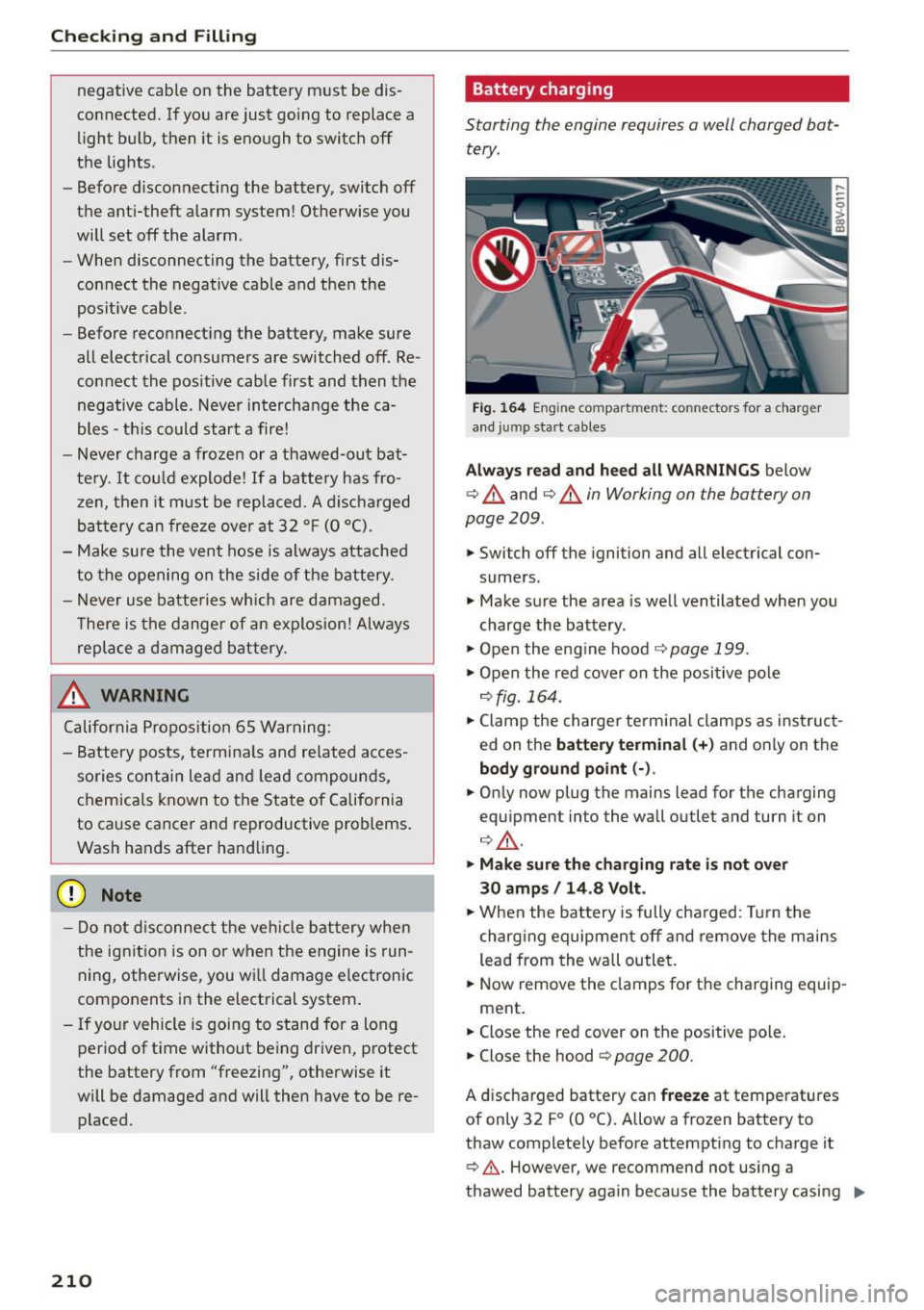
Fig. 16 4 En g in e compa rtmen t: connecto rs fo r a c harg er
and jump start c ables
Always read and heed all WARNINGS below
c> .& and q .& in Working on the battery on
page 209 .
.,.. Switch off the ignition and all elec trical con
sumers.
.,.. Make s ure the area is we ll ventilated when you
charge the battery .
.,.. Open the eng ine hood
q page 199 .
.,.. Open the red cover on the positive pole
q fig. 164 .
.,.. Clamp the charge r te rm inal clamps as inst ruct
ed on the
battery terminal (+ ) and o nly on the
body ground point (· ).
.,.. On ly now plug the mains lead for the charging
equ ipmen t in to the wall outlet and turn it on
~ .& -
... Make sure the charging rate is not ov er
30 amps / 14 .8 Volt .
.,.. When the bat tery is fully cha rged : Tur n the
charg ing equipment off and remove the mains
lead from the wall outlet.
.,.. Now remove the clamps fo r the charging equip -
ment .
.,.. Close the red cover on the positive pole.
.,.. Close the hood
c> page 200.
A d ischarged battery can freeze at temperatures
of only 32 F
0 (0 °C) . Allow a frozen battery to
thaw complete ly before attempting to charge it
~ .&. . However, we recommend not using a
thawed battery aga in because the battery casing ..,_
Page 214 of 282
Checking and Filling
of vehicle batteries improperly is very danger
ous to the environment.
Windshield washer system
F ig . 165 Eng ine compartment: washer fluid reservoir cap
M
"' -')'
"" 00 a,
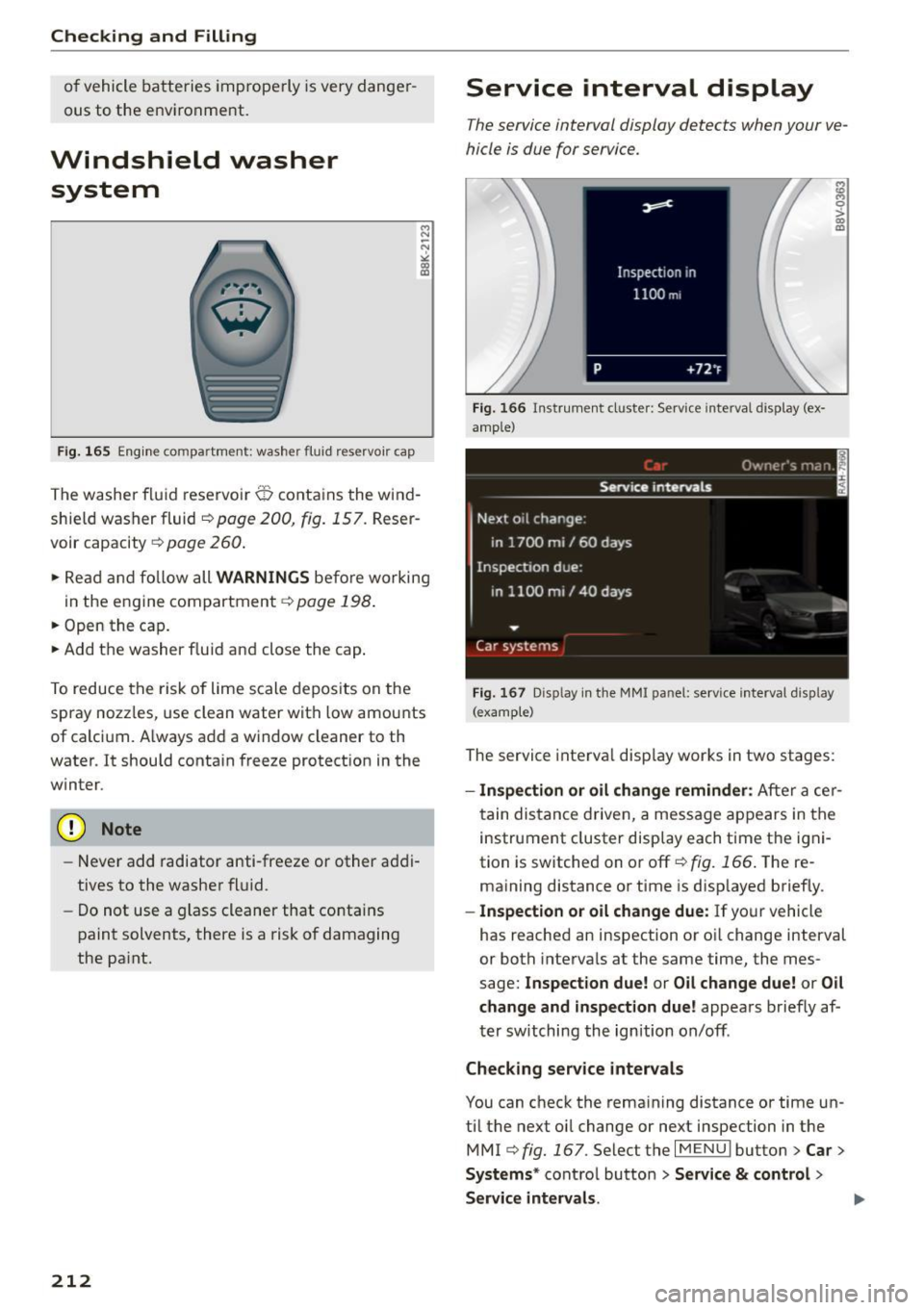
The washer fluid reservoir O contains the wind
shield washer fluid¢ page 200, fig. 157. Reser
voir capacity¢ page 260.
"' Read and follo w all
WARNINGS before working
in the engine compartment ¢page
198 .
... Open the cap .
... Add the washer f luid and close the cap .
To reduce the risk of lime scale depos its on the
spray nozzles, use clean water with low amounts
of calcium. Always add a window cleaner to th
water. It should contain freeze protection in the
winter.
(D Note
- Never add radiator anti-freeze or other addi
tives to the washer fluid.
- Do not use a glass cleaner that contains
paint solvents, there is a risk of damaging
the pa int.
212
Service interval display
The service interval display detects when your ve
hicle is due for service.
Fig. 166 Instrument cluster: Service interval display (ex·
amp le)
Fig. 167 Display in the MMI panel: service interval display
(example)
l6 M 0 ;:;. co m
The service interval display works in two stages:
-Inspection or oil change reminder: After a cer
tain distance driven, a message appears in the
instrument cluster display each time the igni
tion is switched on or off¢ fig. 166. The re
maining distance or time is disp layed briefly.
- Inspection or oil change due: If your vehicle
has reached an inspection or oi l change interval
or both intervals at the same time, the mes
sage:
Inspection due! or Oil change due! or Oil
change and inspection due!
appears briefly af
ter switching the ignition on/off.
Checking service intervals
You can check the rema ining distance or time un
til the next oil change or next inspection in the
MMI
¢ fig. 167. Select the I MENU I button> Car>
Systems*
control button > Service & control >
Service intervals.
Page 235 of 282
....,
N
0 > co
rl I.O
"'
"'
"'
rl
If the Tire Pressure Monitoring System
indicator appears
Applies to vehicles: with t ire p ressure monitoring syste m
The tire pressure indicator in the instrument
cluster informs you if the tire pressure is too low
or if there is a system malfunction.
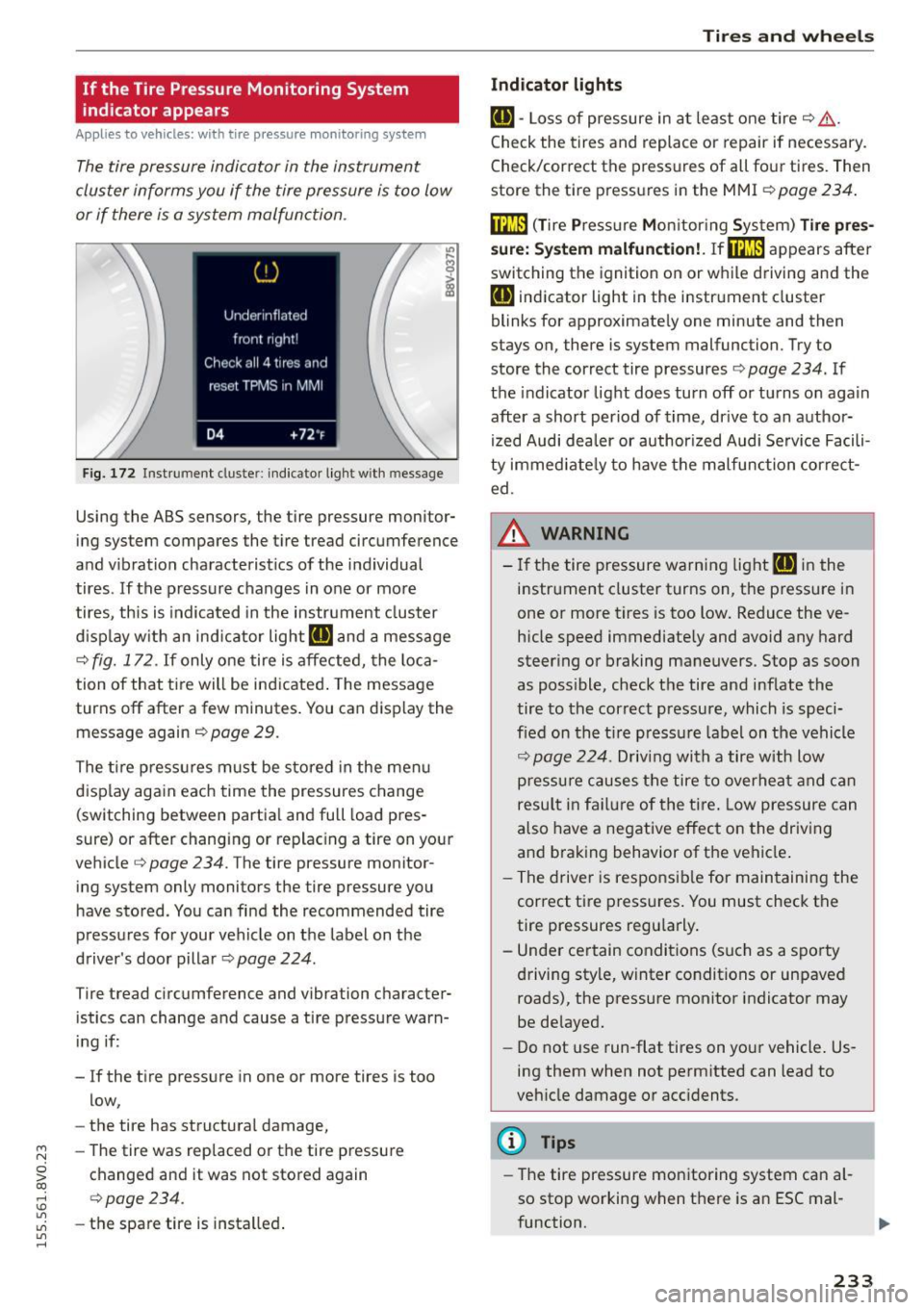
F ig. 172 Instrument cluster: in dicator light w ith message
Using the ABS sensors, the tire pressure monitor
ing system compares the tire tread circumference
and v ibration characterist ics of the ind ividual
tires.
If the pressure changes in one or mo re
tires, th is is indicated in the instrument cluster
d isp lay w ith an ind icator light
RE and a message
¢
fig. 172. If only o ne tire is affected, the loca
tion of that ti re will be indicated . The message
turns off after a few minutes . You can display the
message again
r::;,page 29.
The tire p ressu res m ust be stored in the menu
disp lay aga in each time the pressures change
(switching between partia l and full load pres
sure) or after changing or replac ing a tire on your
ve hicle¢
page 234. The tire pressure monitor
ing system only monitors the tire pressure you
have stored. You can find the recommended tire
pressures for your vehicle on the label on the
driver's door pillar¢
page 224.
Tire tread circumference and vibration character
istics can change and cause a tire pressure warn
in g if:
- If the tire pressure in one or more tires is too
low,
- the tire has structural damage,
- The tire was replaced or the tire pressure
changed and it was not stored again
¢ page 234.
-the spare tire is insta lled .
Tires and wheels
Indicator lights
RE -Loss of pressure in a t least one tire ¢ ,&.
Check the tires and replace or repair if necessary.
Check/correct the pressures of all four t ires. Then
store the tire p ressu res in the MMI ¢
page 234.
film (T ire Pressure Mon itor ing Sys tem) Tire pres
s ure: Sy stem malfunction!. If@m
appears after
switching the ignition on or while driving and the
RE ind icator light in the instr ument cluster
blinks for approximate ly one minute and then
stays on, there is system malfunction. Try to
store the correct tire pressures ¢
page 234. If
the indicator light does turn off or turns on aga in
after a short period of time, dr ive to an author
i zed Audi dea ler or author ized Audi Serv ice Facili
ty immed iate ly to have the malfunction corre ct
ed.
,&. WARNING
- If the tire pressure warning light RE in the
i n str ument cluster turns on, the pressure in
one or more tires is too low . Reduce the ve
h icle speed immediate ly and avoid any hard
steer ing or braking maneuvers. Stop as soon
as poss ible, check the tire and inf late the
tire to the correct pressure, which is speci
fied on the t ire p ress ure label on the vehicle
r::;, page 224. Driv ing with a tire with Low
p ressu re causes the tire to overhea t and c an
resul t in fa il ur e of the tire . Low pressure can
a lso have a negative effect on the driving
and b rak ing behavior of t he vehicle .
- T he drive r is respons ib le for main taining the
correct ti re press ures . You must check the
tire pressures regu larly .
- Under certain conditions (such as a sporty
driving style, winter conditions or unpaved
roads), the pressure monitor indicator may
be de layed.
- Do not use run-flat tires on yo ur vehicle . Us
ing them when not permitted can lead to
veh icle damage or acc idents.
(D Tips
- The tire pressure monitoring system can al
so stop working when t here is an ESC mal-
function. ..,.
233
Page 236 of 282
Tires and wheel s
-Using snow chains may result in a system
malfunction.
- The t ires wi th the ident ificat ion "AO" or
"RO"¢
page 221 have been matche d with
your A udi tire pressure monitoring system.
We recommend that you use these t ires.
- The tire pressure monitoring system can on
l y mon itor the ti re p ress ure of the dr iv ing
tires. Check the tire pressure of the spare
whee l in the luggage compartment so that
i f necessary it is ready for use.
Storing tire pressures
Applies to vehicles: w ith tire pressure monitoring system
A change in tire pressure or a change in tires
must be stored in the system .
The tire p ressu re is stored in the MMI.
.., Make sure befo re stori ng th at t he tire pressures
of all fo ur t ires meet the specified va lues and
are adapted to the load . Otherwise the system
cou ld ma lf u nction
¢ page 224 .
.., Switc h on the ignition .
.,. Se lect : the IMENU! button> Car> Systems *
control button > Service & control > Tire pres
sure monitor > Stor e tire pressure > Yes, store
now .
(]} Tips
Do not store the t ire press ures if snow cha ins
are i nstalled . Otherwise the system could
malf unct io n.
234
Page 238 of 282
Care and cleaning
& WARNING
- Only wash the vehicle when the ignition is
off an d follow the i nstructions fr om the car
wash operator to r educe the r isk of acci
dents.
- To reduce the r isk of cuts, protect yourself
from sharp metal components when wash ing the underbody or the inside of the wheel
hous ings.
- After washing the vehicle, the braking effect
may be delayed due to moisture o n the
brake rotors or i ce in the winte r. T he bra kes
mus t be d ried first w ith a few caref ul bra ke
applications .
@ Note
-If you wash the ve hicle in an au tomatic car
wash, you m ust fold the e xterior m irrors in
to reduce the ris k of damage to the mirrors .
Power folding exterior mirrors* must only
be fo lded i n and out using the power folding
funct ion. -
To prevent paint damage, do not wash the
vehicle in direct sunlight.
- T o reduce the r is k of damage to the sur face,
do not use insect remov ing sponges, kitchen
sponges or similar items.
- Mat te finish painted vehicle components:
- To reduce the risk of damage to the sur-
face, do not use po lishi ng agents or hard
wax.
- Never use protective wax.
It can destroy
the matte finish effect.
- Do not place any stickers or magnet ic
signs on vehicle parts painted w ith matte
finish paint. The pa int co uld be damaged
when the sticke rs o r mag nets are re
moved.
@ For the sake of the environment
Only wash the ve hicle in facilities spec ially de
s igned fo r that purpose. This w ill reduce the
r isk of dir ty wa ter co ntaminated w ith oil from
entering the sewe r system.
Cleaning and care information
When cleaning and caring for individua l vehicle
components, refer to the following tables. The
information contained there is simply recommen
dations. For quest ions or for components that are not listed,
consult an authorized A udi dealer
or authorized Audi Service Facility . Also follow
the information found in
¢ _6.
Exterio r cleaning
Component Situation Solution
Windshield wiper
Deposits ¢ page 50, Cleaning windshield wiper blades
blades
Headlights /
Deposits Soft sponge with a mild soap
solutiona)
Tail lights
Sensors /
Deposits Sensors: soft cloth with solvent-free cleaning so lution
camera len se s Camera le ·nses : soft clot h w ith a lcohol-free clea ning so lu-
tion
Snow/ ice Hand brush/solvent-free de- icing spray
Wheel s Road sa lt Water
Brake dust Acid-free specia l cleaning solution
E xhau st tail pipe s Road salt Water, clean
ing solution su itab le for stain less stee l, if nee -
essary
D ecorative parts / Deposits Mild soap solution al, a clean ing solution suitable for stain-
trim l ess stee l, if necessary
236
Page 250 of 282
Fuses and bulbs
Fuses and bulbs
Electrical fuses
Replacing fuses
A fuse that has blown will have metal strips that
have burned through.
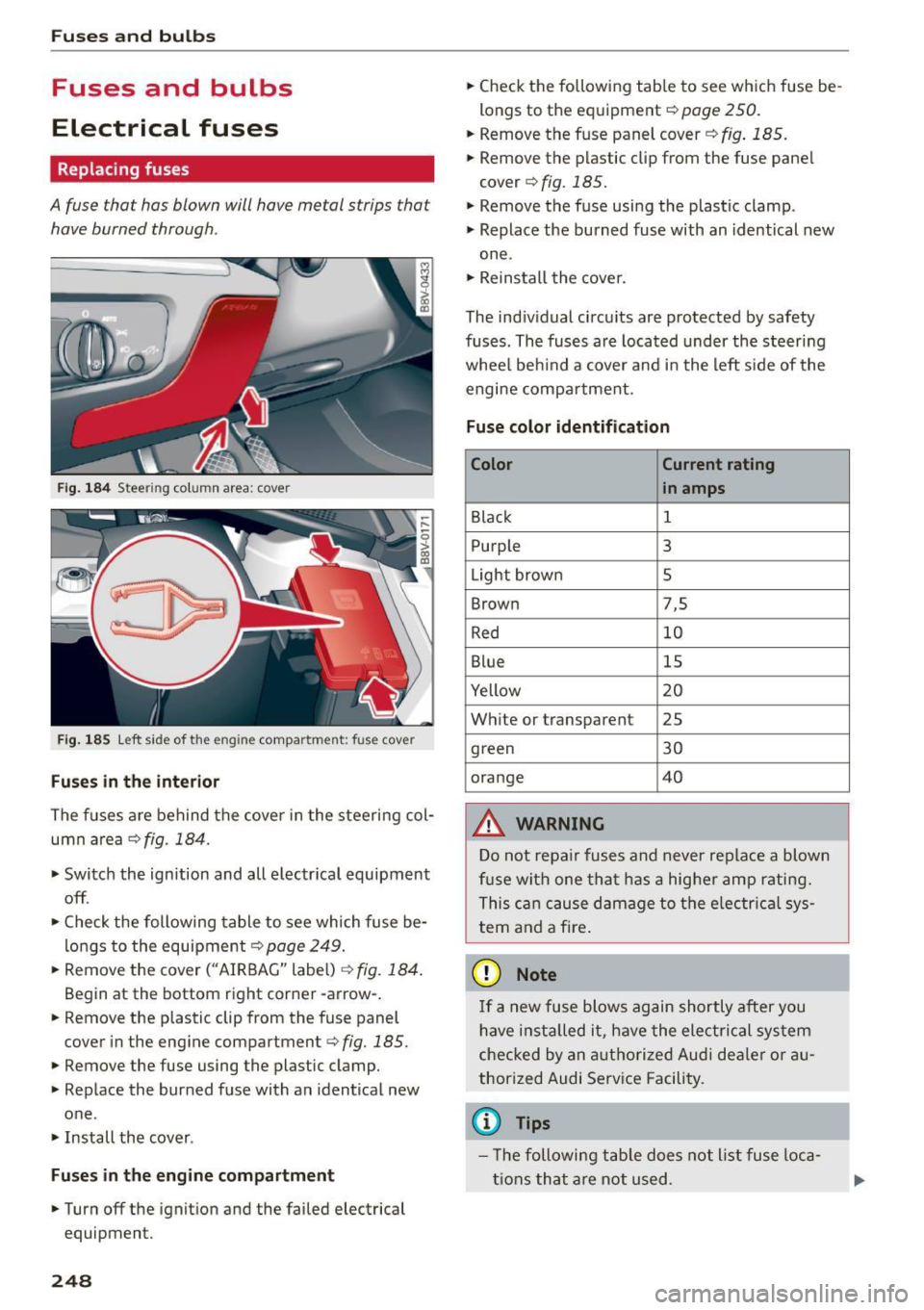
Fig. 184 Steering column area: cover
Fig. 1 85 Left side of the engine compartment: fuse cover
Fuses in the interior
The fuses are behind the cover in the steering col
umn a rea
r::;,fig. 184.
" Switc h the ignition and all e lectr ica l equipment
off .
" Check the following table to see which fuse be
l o ngs to the equipment
r::;, page 249.
"Remove the cover ("AIRBAG" label) r::;,fig. 184 .
Begin at the bottom right corner -arrow-.
" Remove the plastic clip from the fuse panel
cover in the engine compartment<=>
fig. 185.
"Remove the fuse using the plastic clamp.
" Rep lace the bur ned fuse with an identical new
one .
" Install the cover .
Fuses in the engine compartment
"Turn off the ignit ion and the failed electrical
equipment.
248
" Check the following tab le to see wh ich fuse be
longs to the equipment¢
page 250.
" Remove the fuse panel cover ¢fig . 185.
" Remove the plastic clip from the fuse pane l
cover
r::;, fig. 185 .
.. Remove the fuse using the plastic clamp .
" Replace the burned fuse with an identical new
one .
.. Reins tall the cover.
The ind iv idual circuits are protected by safety
fuses . The fuses a re located under the steering
whee l beh ind a cover and in the left s ide of the
engine compa rtment.
Fuse color identification
Color Current rating
in amps
Bla ck 1
Purple 3
Light brown 5
Brown 7,5
Red 10
Blue 15
Yellow 20
Wh ite or transparent 25
green 30
orange 40
&, WARNING
Do not repa ir fuse s and never replace a blown
f u se w ith one that has a hig her amp rating.
T his c an c ause damage to t he e lectr ica l sys
tem and a fi re .
(D Note
If a new fuse blows again shortly after you
h ave installed i t, have the ele ct ric al sys tem
checked by an a uth orized Audi deale r o r au
thorized Audi Service Facili ty.
{!) Tips
- Th e followi ng table does not l ist fuse loca
t ions tha t are not u sed.
Page 255 of 282
....,
N
0 > co
rl I.O
"'
"'
"'
rl
When jump starting or charging the battery,
never connect the negative ground cable to
the battery negat ive post because the battery
manager system must be able to detect the
battery's state of charge. Always connect the
negative g round cab le to the negative ground
post of the battery manager control unit.
Using jump start cables
Connect the jump start cables in the exact order
described below.
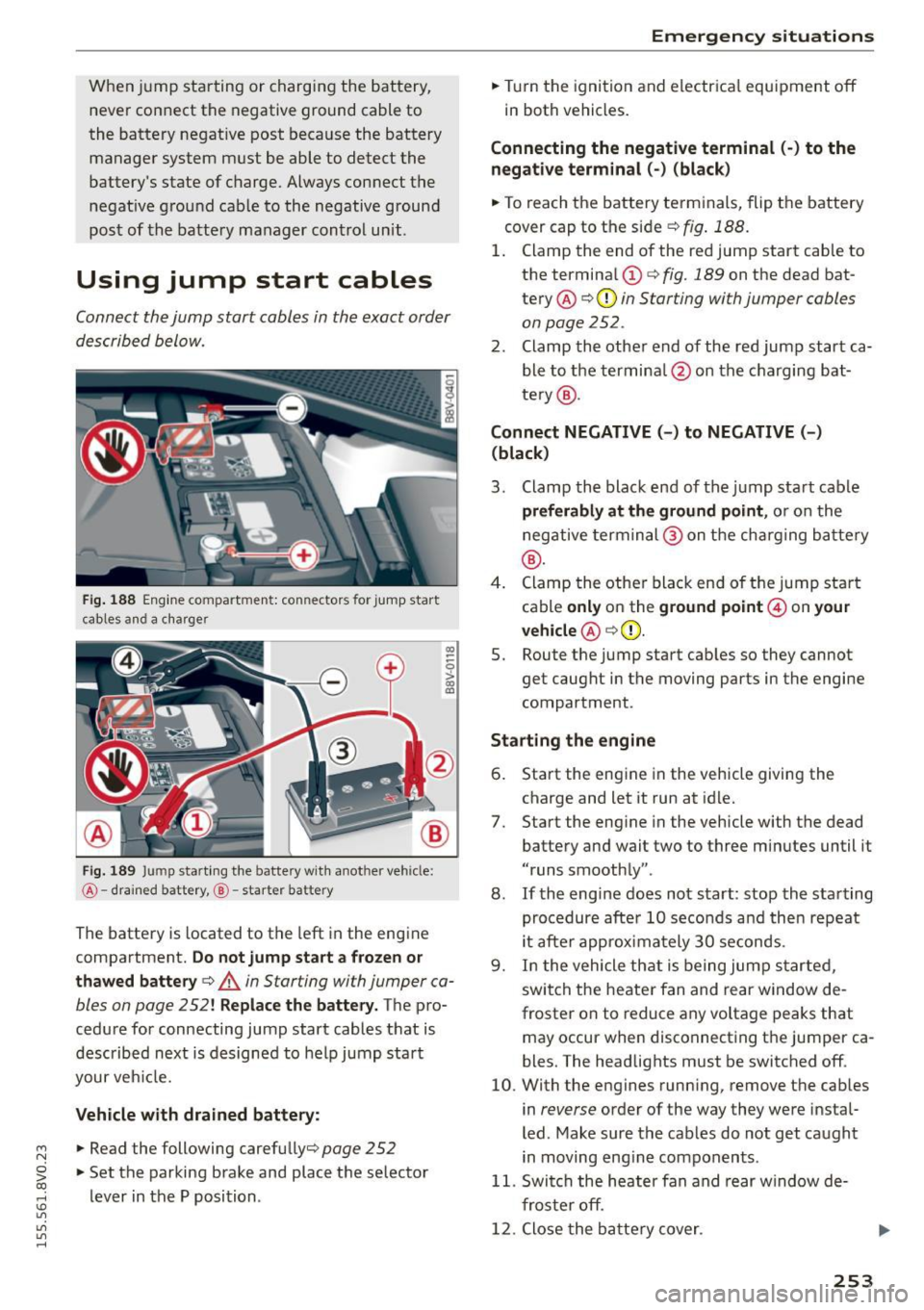
Fig. 188 Engine compa rtment: connectors for jump start
cables and a charger
Fig. 189 Ju m p sta rting the battery with anot her veh icle:
@ -drained battery, @-starter battery
The battery is located to the left in the eng ine
compartment.
Do not jump start a frozen or
thawed battery
c> A in Starting with jumper ca
bles on page
252! Replace the battery. The pro
cedure for connecting jump start cables that is
described next is designed to help jump start
your veh icle.
Vehicle with drained battery: .. Read the following carefullyc>
page 252
.. Set the parking brake and place the selector
lever in the P position .
Emergency situations
.. Turn the ignition and electrica l equipment off
in both vehicles.
Connecting the negative terminal(-) to the
negative terminal(-) (black)
.. To reach the battery terminals, flip the battery
cover cap to the side
c> fig . 188 .
1. Clamp the end of the red jump start cable to
the terminal © c>
fig. 189 on the dead bat
tery ®
¢0) in Starting with jumper cables
on page 252 .
2. Clamp the other end of the red jump start ca
ble to the terminal@on the charging bat
tery @.
Connect NEGATIVE (-) to NEGATIVE (-)
(black)
3 . Clamp the black end of the jump start cable
preferably at the ground point , or on the
negative term inal @ on the charg ing battery
® ·
4. Clamp the other black end of the jump start
cable
only on the ground point@) on your
vehicle ®
¢(D.
5. Route the jump start cab les so they cannot
get caught in the moving parts in the engine
compartment .
Starting the engine
6. Start the engine in the vehicle giving the
charge and let it run at idle.
7. Start the engine in the vehicle with the dead
battery and wait two to three minutes until it
"runs smoothly" .
8. If the engine does not start: stop the starting
procedure after
10 seconds and then repeat
it after approximately
30 seconds .
9. In the vehicle that is being jump started,
switch the heater fan and rear window de
froster on to reduce any voltage peaks that
may occur when disconnecting the jumper ca
bles. The headlights must be switched off .
10. With the engines running, remove the cables
in
reverse orde r of the way they were instal
led . Make sure the cables do not get caught
in moving eng ine components .
11. Switch the heater fan and rear w indow de
froster off .
12 . Close the battery cover .
253