instrument panel AUDI S3 SEDAN 2018 User Guide
[x] Cancel search | Manufacturer: AUDI, Model Year: 2018, Model line: S3 SEDAN, Model: AUDI S3 SEDAN 2018Pages: 404, PDF Size: 62.3 MB
Page 287 of 404
LL co .... N
" N .... 0 N > co
action is entered in your Audi Warranty &
Maintenance booklet under
AIRBAG RE
PLACEMENT RECORD.
- Applies to plug-in hybrid* vehicles: In the
event of a collision where the airbags de
ploy, the electrical connection to the high
voltage battery is automatically disconnect
ed. This prevents a short c ircuit.
@) For the sake of the environment
Undeployed airbag modules and pretension
ers might be classified as Perchlorate Materi
al - special handling may apply, see
www.dtsc.ca.gov/hazardouswaste/perchlo
rate. When the vehicle or parts of the re
straint system including airbag modules and
safety belts with pretensioners are scrapped,
all applicable laws and regulations must be
observed. Your authorized Audi dealer is fa
miliar with these requirements and we recom
mend that you have your dealer perform this
service for you.
Other things that can affect Advanced
Airbag performance
Changing the vehicle's suspension system can
change the way that the Advanced Airbag System
performs in a crash. For example, using tire-rim
combinations not approved by Audi, lowering the
vehicle, changing the stiffness of the suspension, including the springs , suspension struts, shock
absorbers etc. can change the forces that are
measured by the airbag sensors and sent to the
electronic control unit . Some suspension changes
can, for example, increase the force levels meas
ured by the sensors and make the airbag system
deploy in crashes in which it would not deploy if
the changes had not been made. Other kinds of
changes may reduce the force levels measured by
the sensors and prevent the airbag from deploy
ing when it should.
A WARNING
Changing the vehicle's suspension including
use of unapproved tire-rim combinations can
change Advanced Airbag performance and in-
.
Airbag system
crease the risk of serious personal injury in a
crash.
- Never install suspension components that
do not have the same performance charac
teristics as the components originally instal led on your vehicle.
- Never use tire-rim combinations that have
not been approved by Audi.
Knee airbags
Description of knee airbags
Applies to: vehicles with knee airbags
The knee airbag system can provide supplemen
tal protection to properly restrained front seat
occupants.
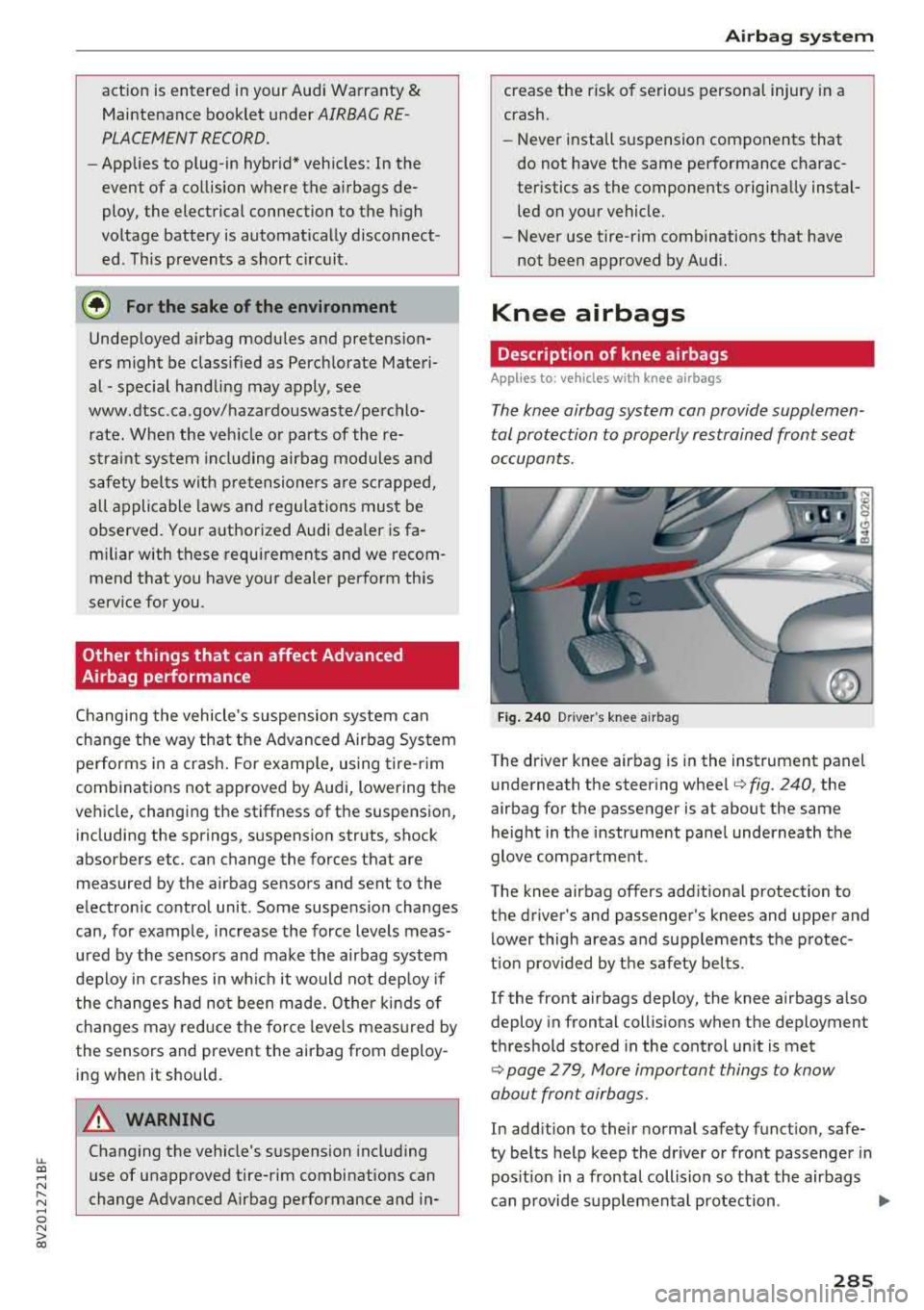
Fig. 240 Driver 's knee airbag
The driver knee airbag is in the instrument panel
underneath the steering
wheel¢ fig. 240, the
airbag for the passenger is at about the same
height in the instrument panel underneath the
glove compartment.
The knee airbag offers additional protection to
the driver's and passenger's knees and upper and
lower thigh areas and supplements the protec
t ion provided by the safety belts.
If the front airbags deploy, the knee airbags also
deploy in frontal collisions when the deployment
threshold stored in the control unit is met
¢ page 2 79, More important things to know
about front airbags .
In addition to their normal safety function, safe
ty belts help keep the driver or front passenger in
posit ion in a frontal collision so that the airbags
can provide supplemental protection .
..,.
285
Page 288 of 404
Airbag system
The airbag system is not a substitute for yo ur
safety belt. Rather, it is part of the overa ll occu
pant restraint system in your vehicle. Always re member that the airbag system can only help to
protect you if you are wearing your safety belt
and wear ing it properly . This is why you should
always wear your safety belt, not just because
the law req uires you to do so
q page 260, Gener
al notes.
Remember too, airbags will deploy only once and
only in ce rtain k inds of accidents
-yo ur safety
be lts are always there to offer protect ion in those
accidents in wh ich airbags a re not suppose d to
deploy or w hen they h ave already deployed, fo r
examp le when your vehicle str ikes or is str uck by
another after the firs t collision .
T his is jus t one of the reasons why an airbag is
not a subs titut e for the safety belt. The airbag
sys tem works most effec tively when used with
the safety belts. Therefore, a lways wear your
safety belts correct ly.
It is important to remember th at whi le the sup
p lemen tal knee a irbag system is des igned to re
duce the like lih ood of se rious injuries, other inju
ries, for example, swe lling, b ruising an d minor
ab rasions and friction burns can also occur when
an airbag inf lates .
The knee airbag system basically consists of :
- The elec tronic control module
- T wo infl atab le airbags (airbag a nd gas genera-
t or), one for the driver an d one fo r the fron t
passenger
- T he airbag indic ato r ligh t in the ins trumen t
pane l
The knee airbag system will not deploy:
-whe n the ignition is switched off
- in frontal collisions when the decele ration
measured by the control u nit is too low
- in s ide collisions
- in rear -end collisions
- in rollove rs
- in the eve nt o f a sys tem ma lf u nct ion (wa rning/
indicator light is on)
q page 26 .
286
A WARNING
,-
- Safety belts and the airbag system can only
provide protect io n when occupa nts ar e in
the prope r seat ing pos ition
~ page 2 79 .
-If the a irbag ind icator light ¢ page 26
comes when the veh icle is being used, have
t he system inspected immedia tely by your
author ized A udi de aler.
It is possib le th at
the air bag will i nfl at e w hen i t is no t sup
po sed to , or w ill no t in fla te w hen it sho uld .
How knee airbags work
Applies to: vehicles wi th knee airbags
The risk of injury to the leg area can be reduced
by fully inflated knee airbags.
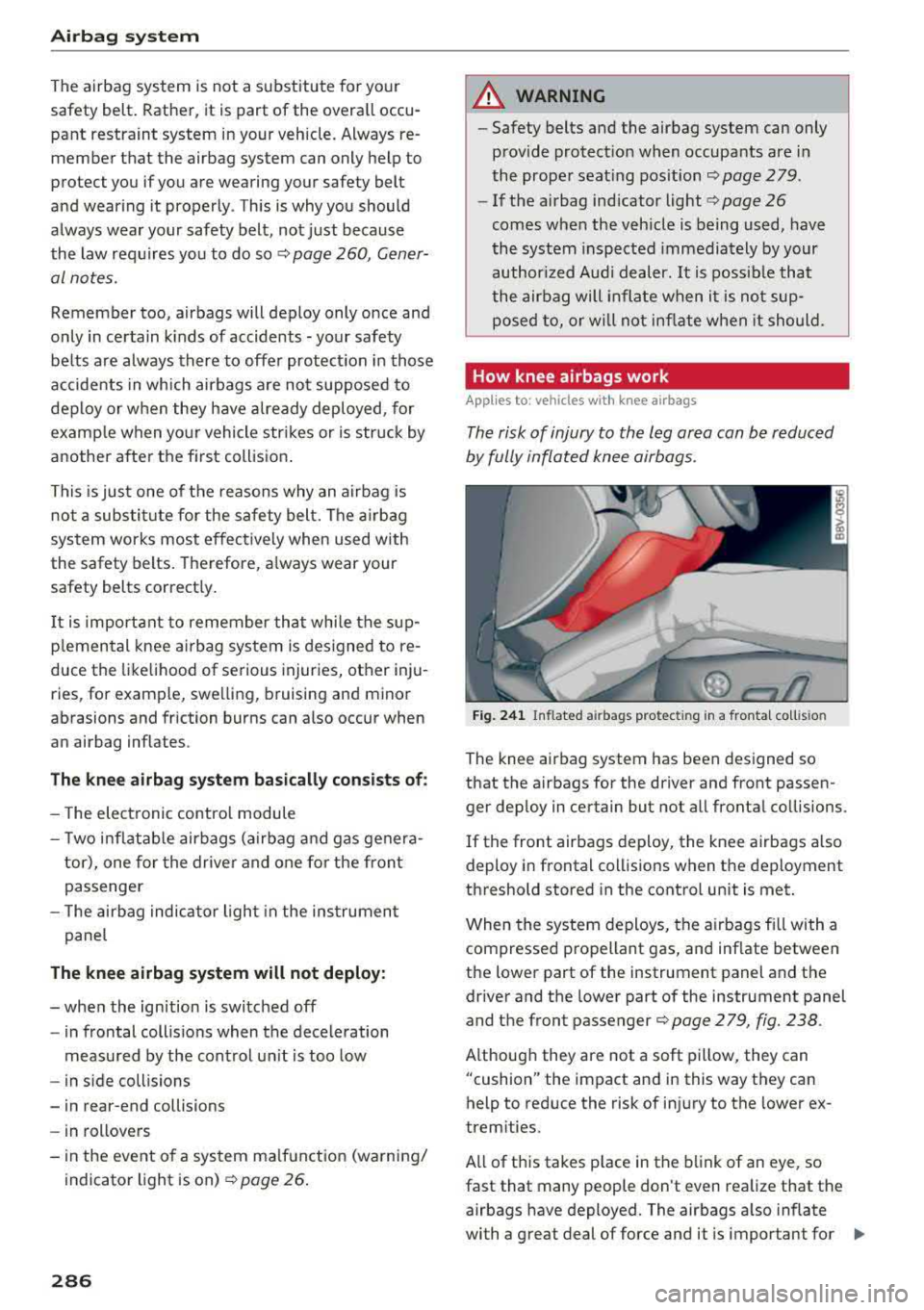
Fig. 241 Inflated a irbags protec ting in a fro nta l co llis io n
The knee airbag system has been designed so
that the airbags for the driver and front passen
ger dep loy in ce rtain but not all fronta l collisions .
If the front airbags deploy, the knee airbags also
deploy i n frontal col lisions when the dep loyment
th reshold stored in the cont rol unit is met.
When the system deploys , the a irbags f ill with a
compressed pro pellant gas, and inflate between
the lowe r part of the instrument panel and the
driver and the lower part of the instrument panel
and t he front
passenger¢ page 2 79, fig. 238 .
Althoug h they are not a soft pillow, they can
"cushion" the impact and in this way they ca n
help to red uce the risk of in jury to the lower ex
trem ities.
A ll of th is takes p lace in the b link of an eye, so
fast that many people don 't even rea lize that the
airbags have deployed. The airbags a lso inflate
with a g reat deal of force and it is important fo r
Ill-
Page 289 of 404
LL co .... N
" N .... 0 N > co
occupant safety that nothing should be in their
way when they deploy.
Fully inflated airbags in combination with proper
ly worn safety belts slow down and limit the oc
cupant's forward movement and help to reduce
the risk of injury.
Important safety instructions on the knee
airbag system
A ppl ies to: ve hicles with knee a ir b ags
Airbags are only supplemental restraints. Always
wear safety belts correctly and ride in a proper
seating position.
There is a lot that you and your passengers must
know and do to help the safety belts and airbags
to provide supplemental protection .
A WARNING
An inflating knee airbag can cause serious in
jury . Wearing safety belts incorrectly and im
proper seating posit ions increase the r isk of
serious personal injury and death whenever a
vehicle is being used .
- The knee airbag system cannot protect you
properly if you are seated too close to any of
the airbag locations. When adjusting their
seat positions, it is important that both the
driver and the front passenger keep their
upper bodies and knees at the following
minimum safe distances :
- at least 10 inches (25 cm) between the
chest and the steering wheel/instrument
panel.
- at least 4 inches (10 cm) between the
knees and the lower part of the instru
ment panel.
- The risk of persona l injury increases if you
lean forward or to the side, or if the seat is
improperly positioned and you are not wear
ing your safety belt. The risk increases even
more should the airbag deploy.
- Always make sure that the knee airbag can
inflate without interference. Objects be
tween you and the airbag can increase the risk of injury in an accident by interfering
-
Airbag system
with the way the airbag deploys or by being
pushed into you as the airbag deploys.
- Never let anybody, especially children or
animals ride in the footwell in front of the
passenger seat. If the airbag deploys, this
can result in serious or fatal injuries.
- Never carry objects of any kind in the foot
well area in front of the driver's or pas
senger's seat . Bulky objects (shopping
bags, for example) can interfere with or
prevent proper deployment of the airbag.
Small objects can be thrown through the
vehicle if the airbag deploys and injure you
or your passengers.
- Make sure there are no cracks, deep scratch
es or other damage in the area of the instru
ment panel where the knee airbags are lo
cated.
- If children are incorrectly seated, their risk
of injury increases in a collision
<=> page 294, Child safety .
Side airbags
Description of side airbags
The airbag system can provide supplemental
protection to properly restrained occupants .
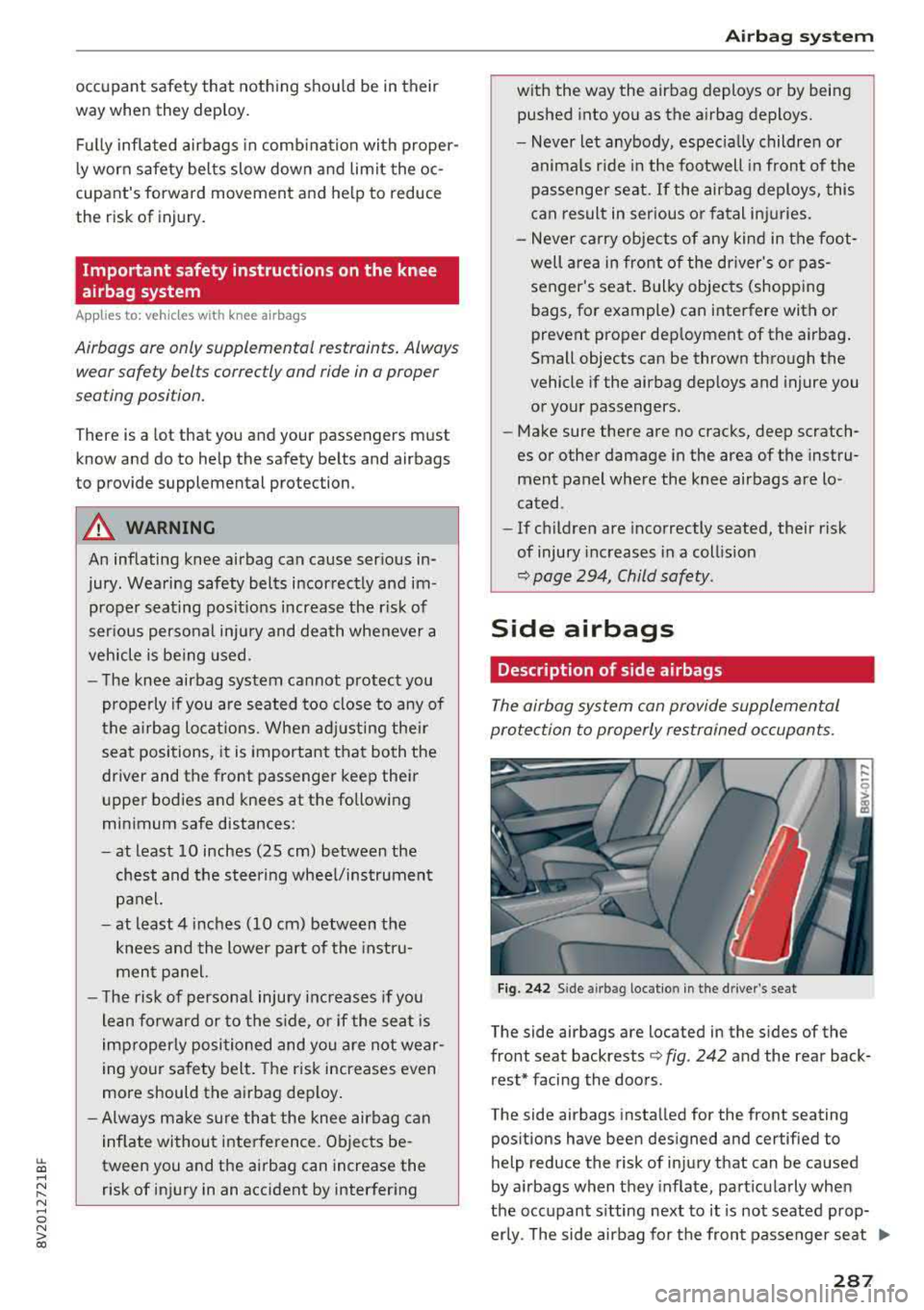
Fig. 242 Side airbag loc atio n in the driver's se at
The side airbags are located in the sides of the
front seat backrests
<=> fig . 242 and the rear back
rest* facing the doors.
The side airbags installed for the front seating
positions have been designed and certified to
help reduce the risk of injury that can be caused
by airbags when they inflate, particularly when
the occupant sitting next to it is not seated prop
erly . The side airbag for the front passenger seat
.,.
287
Page 298 of 404
Child safety
-Always make sure that the PASSENGER
AIR BAG OFF
light comes on and stays on
all the time whenever the ignit ion is
sw itched on.
- If the
PASSENGER AIR BAG OFF light
does not come on and stay on, immediate
ly install the forward-facing child seat in a
rear seating posit ion and have the airbag
system inspected by your authorized Aud i
dea le r.
- Always buckle the child seat firmly in
place even if a child is not sitt ing in it. A
loose child seat can fly around during a
sudden stop o r in a collision.
- Always read and heed all WARNINGS
wheneve r using a child restraint in a vehi
cle ~ page 260, Safety belts, ~ page 269,
Airbag system
and ~ page 294, Impor
tant information .
(D Tips
Always replace child restraints that were in
stalled in a vehicle during a crash . Damage to
a child restraint that is not visib le could cause
it to fail in another collision situation .
Advanced front airbag system and children
Your veh icle is equipped with a front "Advanced
Airbag System" in compliance w ith United States
Federal Motor Vehicle Safety Standard (FMVSS)
208, as well as Canada Motor Vehicle Safety
Standard (CMVSS) 208 as applicable at the time
your ve hicle was manufactured.
The Advanced Airbag system in your veh icle has
been cert ified to meet the "low-risk" require
ments for 3- and 6-year old children on the pas
senger s ide and small adults on the driver side.
The low risk deployment cr iteria are intended to
reduce the risk of injury through interaction with
the airbag that can occur, for examp le, by being
too close to the steering whee l and instrument
panel when the airbag inflates. In addition, the
system has been certified to comply with the
"suppress ion" requ irements of the Safety Stand
ard, to turn off the front airbag for infants up to
12 months who are restrained on the front pas-
296
senger seat in child restraints t hat are listed in
the Standard.
Even though your vehicle is eq uipped w it h an Ad
vanced Airbag system, all childr en, especially
those 12 years and younger, shou ld always ride
in the back seat properly restrained for their age
and s ize. The airbag on the passenger side makes
the front seat a potentially dangerous p lace for a
ch ild to ride. The front seat is not the safest place
for a ch ild in a forward -facing ch ild safety seat . It
can be a very dangerous place for an infant or a
larger child in a rearward-facing seat.
The vehicle's Advanced Airbag System has a ca pacit ive passenger detection system in the front
passenger seat cushion that can detect the pres
ence of a baby or a ch ild in a child restraint sys
tem on this seat.
The capacitive passenger detection system regis
ters the changes that result in an electrical field
when a child, a chi ld restra int, and a baby b lanket
are on the front passenger seat. The change in
the measured capacitance due to the presence of
a chi ld, a child restraint, and a baby blanket on
the front passenger seat is related to the child
restraint system resting on the seat. The meas
ured capacitance of a child restraint system var
i es depending on the type of system and specific
make and model.
The electrical capacitance of the various types, makes, and models of child restraints specified
by the U.S. National Highway Traffic Safety Ad
ministration (NHTSA) in the relevant safety
standard are stored in the Advanced Airbag Sys
tem control unit together with the capacitances
typ ica l of infants and a 1-year old ch ild. When a
child restraint is used on the front passenger
seat with a typical 1 year-old infant, the Ad
vanced Airbag System compares the capacitance
measured by the capacitive passenger detection
system with the data stored in the e lectronic con
tro l unit .
Page 374 of 404
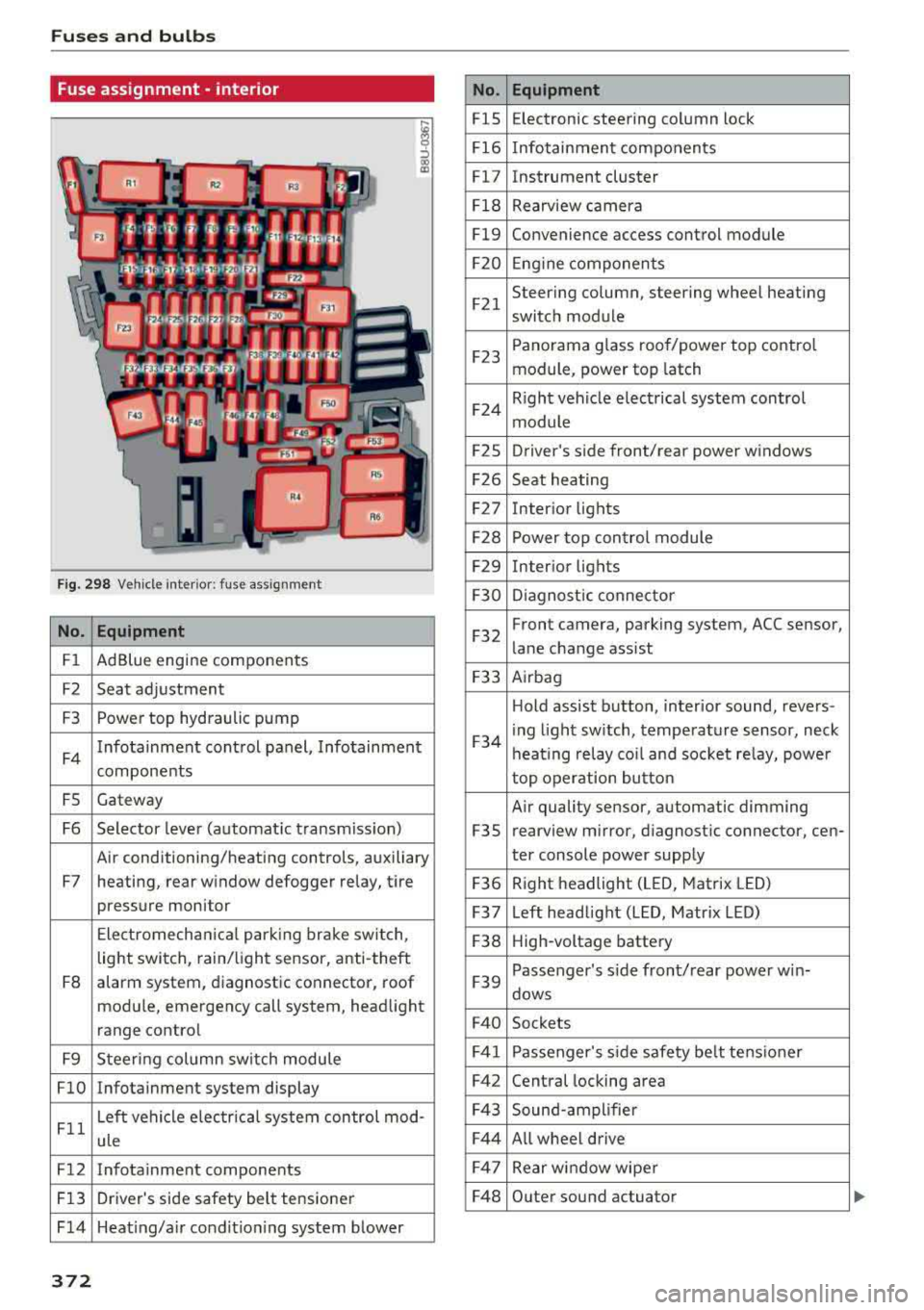
Fuses and bulbs
Fuse ass ignment - interior
ij
::, CX) ID
F ig. 298 Vehicle interior: fuse assignment
No. Equipment
Fl Ad Blue engine components
F2 Seat adjustment
F3 Power top hydraulic pump
F4 Infotainment control panel,
Infotainment
components
FS Gateway
F6 Selector lever (automat ic transm iss ion)
Air conditioning/heating controls, auxiliary
F7 heating, rear window defogger relay, tire pressure monitor
Electromechan ical park ing brake switch,
light switch, rain/light sensor, anti-theft
F8 alarm system,
diagnostic connector, roof
module, emergency call system, head light
range control
F9 Steering col umn sw itch module
FlO Infotainment system display
Fll Left vehicle electrica
l system control mod-
ule
F12 Infotainment components
F13 Driver's side safety belt tensioner
F 14 Heat ing/a ir condit ion ing system blower
372
No . Equipment
FlS Electronic
steering column lock
F16 Infotainment components
Fl7 Instrument cluster
Fl8 Rearview camera
Fl9 Convenience access control module
F20 Engine components
F21 Steering column, steering wheel heating
switch module
F23 Panorama glass
roof/power top control
module, power top latch
F24 R
ight vehicle electrical system control
module
F2S Driver
's side front/rear power windows
F26 Seat heating
F27 Interior
lights
F28 Power top control module
F29 Interior lights
F30 Diagnostic connector
F32 Front camera, parking
system, ACC sensor,
lane change assist
F33 Airbag
Hold assist button, interior sound, revers-
F34 i
ng light sw itch, temperature sensor, neck
heating relay coil and socket relay, power
top operation button
Air quality sensor, automatic dimming
F3S rearview
mirror, diagnostic connector, cen-
ter console power supply
F36 Right
headlight (LED, Matrix LED)
F37 Left headlight (LED, Matrix LED)
F38 High-voltage battery
F39 Passenger
's side front/rear power w in-
dows
F40 Sockets
F41 Passenger's sid e safe ty be lt tens ioner
F42 Central locking area
F43 Sound-amplifier
F44 All wheel drive
F47 Rear window wiper
F48 Outer sound actuator
Page 390 of 404
Index
Audi pre sense . . . . . . . . . . . . . . . . . . . . . . . 130
Messages . . . . . . . . . . . . . . . . . . . . . . 130, 133
Aud i Service Repair Manuals and Literature 383
Audi side assist . . . . . . . . . . . . . . . . . . . . . . . 136
Cleaning the sensors . . . . . . . . . . . . . . . . . 355
Messages . . . . . . . . . . . . . . . . . . . . . . . . . . 140
Rear cross-traffic assist . . . . . . . . . . . . . . . 139
Audi smartphone interface . . . . . . . . . 241, 245
Aud i virtual cockp it
refer to Instrument cluster . . . . . . . . . . . . . 10
AUTO
Automatic climate control system . . . . . . .
69
Automatic headlights . . . . . . . . . . . . . . . . . 49
Auto Lock (centr al locking system) . . . . . . . . 31
Automatic belt retractor . . . . . . . . . . . . . . . 264
Automatic climate control system
refer to Climate control system
(automatic) . . . . . . . . . . . . . . . . . . . . . .
68, 69
Automatic power top
refer to Power top . . . . . . . . . . . . . . . . . . . . 42
Automatic transmission . . . . . . . . . . . . . . . . . 83
Driving tips . . . . . . . . . . . . . . . . . . . . . . . . . . 86
Emergency mode . . . . . . . . . . . . . . . . . . . . . 89
Hill descent control . . . . . . . . . . . . . . . . . . . 87
Kick -down . . . . . . . . . . . . . . . . . . . . . . . . . . .
88
Launch control program . . . . . . . . . . . . . . . 89
Malfunction . . . . . . . . . . . . . . . . . . . . . . . . . 84
Manual shift ing (tiptronic mode) . . . . . . . . 88
Selector lever . . . . . . . . . . . . . . . . . . . . . . . . 86
Selector lever emergency re lease . . . . . . . . 90
Selector lever lock . . . . . . . . . . . . . . . . . . . . 84
Selector lever positions . . . . . . . . . . . . . . . . 84
Shift padd les . . . . . . . . . . . . . . . . . . . . . . . . 88
Automatic wipe/wash system . . . . . . . . . . . . 55
Auto Safety Hotline . . . . . . . . . . . . . . . . . . .
258
Auxiliary climate contro l . . . . . . . . . . . . . . . 116
AUX input . . . . . . . . . . . . . . . . . . . . . . . . . . . 230
Average consumption ........... .... . 17, 18
Average speed . . . . . . . . . . . . . . . . . . . . . 17, 18
B
BACK button . . . . . . . . . . . . . . . . . . . . . . . . . 154
Bag hooks . . . . . . . . . . . . . . . . . . . . . . . . .
63, 65
Balance (sound) . . . . . . . . . . . . . . . . . . . . . . 247
Bass (sound) . . . . . . . . . . . . . . . . . . . . . . . . . 247
388
Battery
In the key . . . . . . . . . . . . . . . . . . . . . . . . . . .
32
also refer to High-voltage battery . . . . . . . 92
also refer to Vehicle battery . . . . . . . . . . . 326
Before driv ing . . . . . . . . . . . . . . . . . . . . . . . . 249
Belt tensioners . . . . . . . . . . . . . . . . . . . . . . . 267
Blended gasoline . . . . . . . . . . . . . . . . . . . . . 314
Blower
Automat ic climate control system . . . . . . .
70
Bluetooth
Audio player . . . . . . . . . . . . . . . . . . . . . . . .
226
Connecting a cell phone . . . . . . . . . . . . . . 177
Settings . . . . . . . . . . . . . . . . . . . . . . . . . . . 246
Boost . . . . . . . . . . . . . . . . . . . . . . . . . . . . . . . . 19
Booster seats . . . . . . . . . . . . . . . . . . . . . . . . 304
Boost pressure indicator . . . . . . . . . . . . . . . . 19
Brakes . . . . . . . . . . . . . . . . . . . . . . . . . . . . . . 150
Brake assist . . . . . . . . . . . . . . . . . . . . . . . . 148
Brake fluid . . . . . . . . . . . . . . . . . . . . . . . . . 326
Electromechanical parking brake . . . . . . . . 81
Emergency braking function . . . . . . . . . . . . 82
New brake pads . . . . . . . . . . . . . . . . . . . . . 150
Break-in security feature . . . . . . . . . . . . . . . . 36
Breaking in
New brake pads . . . . . . . . . . . . . . . . . . . . .
150
New engine . . . . . . . . . . . . . . . . . . . . . . . . . 72
New tires . .... .. .. .. ............. .. 337
Browser
refer to Media center . . . . . . . . . . . . . . . . . 233
Bulbs . . . . . . . . . . . . . . . . . . . . . . . . . . . . . . . 373
Buttons
Control panel (MMI) . . . . . . . . . . . . . . . . .
154
Multifunction steering wheel . . . . . . . . 13, 16
Programming (multifunction steering
wheel) . . . . . . . . . . . . . . . . . . . . . . . . . . . . . . 15
Switching the Infotainment system display
on/off . . . . . . . . . . . . . . . . . . . . . . . . . . . . .
155
C
Cable (USB adapter/AUX connector cable) 229
California Proposition 65 Warning . . . . . . . 319
Battery specific . . . . . . . . . . . . . . . . . . . . . 327
Call list . . . . . . . . . . . . . . . . . . . . . . . . . . . . . 180
Call options . . . . . . . . . . . . . . . . . . . . . . . . . . 188