ESP AUDI S3 SEDAN 2018 Repair Manual
[x] Cancel search | Manufacturer: AUDI, Model Year: 2018, Model line: S3 SEDAN, Model: AUDI S3 SEDAN 2018Pages: 404, PDF Size: 62.3 MB
Page 262 of 404
Safety belts
Safety belts
General notes
Always wear safety belts!
Wearing safety belts correctly saves lives!
This chapter explains why safety belts are neces
sary, how they work and how to adjust and wear
them correctly.
"'Read all the information that follows and heed
all of the instructions and WARNINGS.
A WARNING
Not wearing safety belts or wearing them im
properly increases the risk of serious personal
injury and death.
- Safety belts are the single most effective
means available to reduce the risk of serious
injury and death in automobile accidents.
For your protection and that of your passen
gers, always correctly wear safety belts
when the vehicle is moving.
- Pregnant women, injured, or physically im
paired persons must also use safety belts.
Like all vehicle occupants, they are more
likely to be seriously injured if they do not
wear safety belts. The best way to protect a
fetus is to protect the mother
-throughout
the entire pregnancy .
Number of seats
Applies to: vehicles without power top: Your Audi
has a total of five seating positions: two in the
front and three in the rear . Each seating position
has a safety belt .
Applies to: vehicles with power top: Your Audi
has a total of four seating positions: two in the
front and two in the rear. Each seating position
has a safety belt .
A WARNING
Not wearing safety belts or wearing them im
properly increases the risk of serious personal
injury and death.
260
-Never strap more than one person, includ
ing small children, into any belt. It is espe
cially dangerous to place a safety belt over a
child sitting on your lap .
- Never let more people ride in the vehicle
than there are safety belts available.
- Be sure everyone riding in the vehicle is
properly restrained with a separate safety
belt or child restraint .
Safety belt warning light
Your vehicle has a warning system for the driver
and front seat passenger to remind you about the importance of buckling-up.
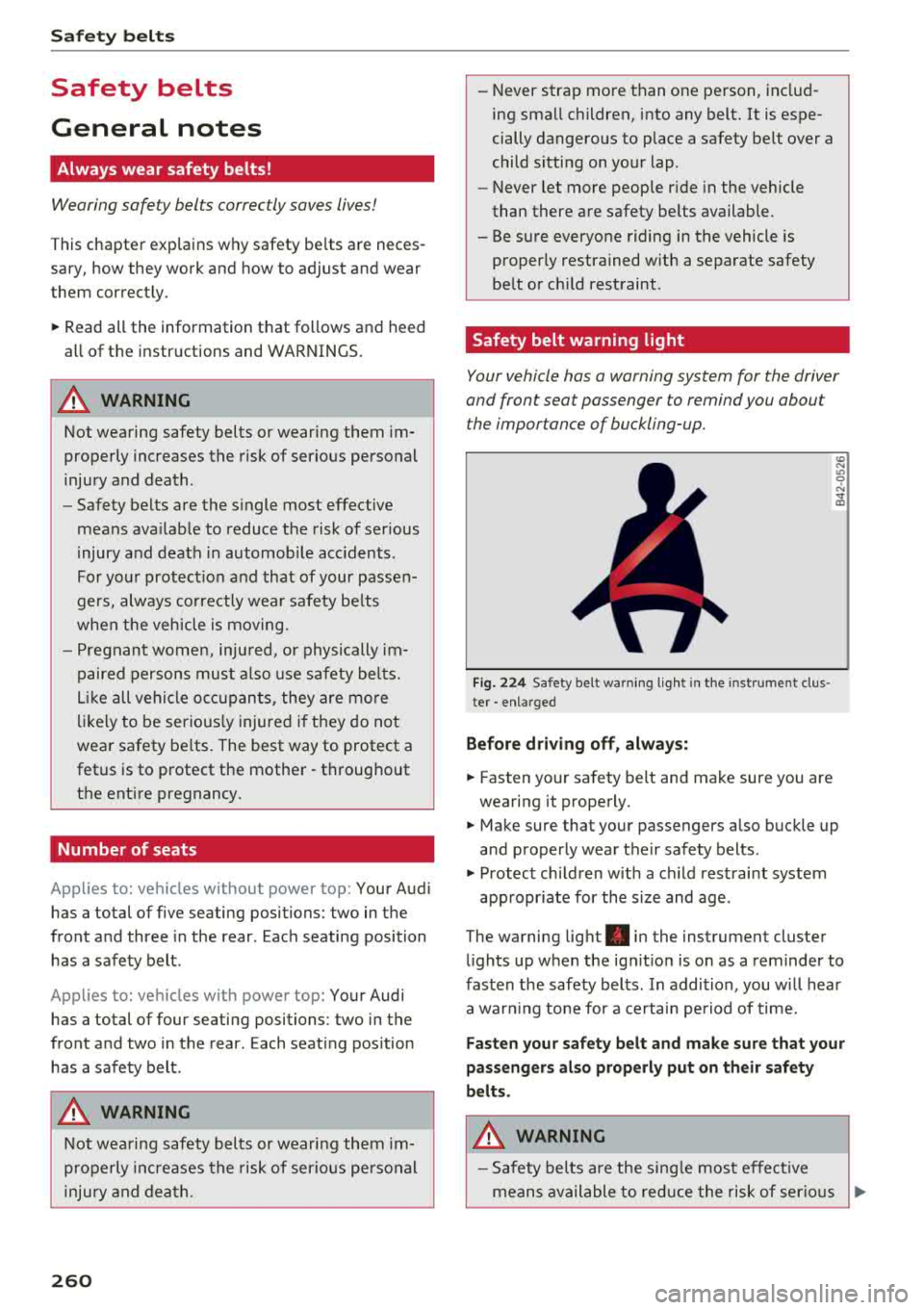
Fig. 224 Safety belt warning ligh t in the instrument clus
ter
-enlarged
Before driving off, always:
"' Fasten your safety belt and make sure you are
wearing it properly.
U) N Ill 0 ..:.
and properly wear their safety belts .
"' Protect children with a child restraint system
appropriate for the size and age .
The warning light . in the instrument cluster
lights up when the ignition is on as a reminder to
fasten the safety belts. In addition , you will hear
a warning tone for a certain period of time.
Fasten your safety belt and make sure that your
passengers also properly put on their safety
belts.
A WARNING -
- Safety belts are the single most effective
means available to reduce the risk of serious
~
Page 266 of 404
Safe ty belts
Safety belts
Fastening safety belts
Safety first -everybody buckle up!
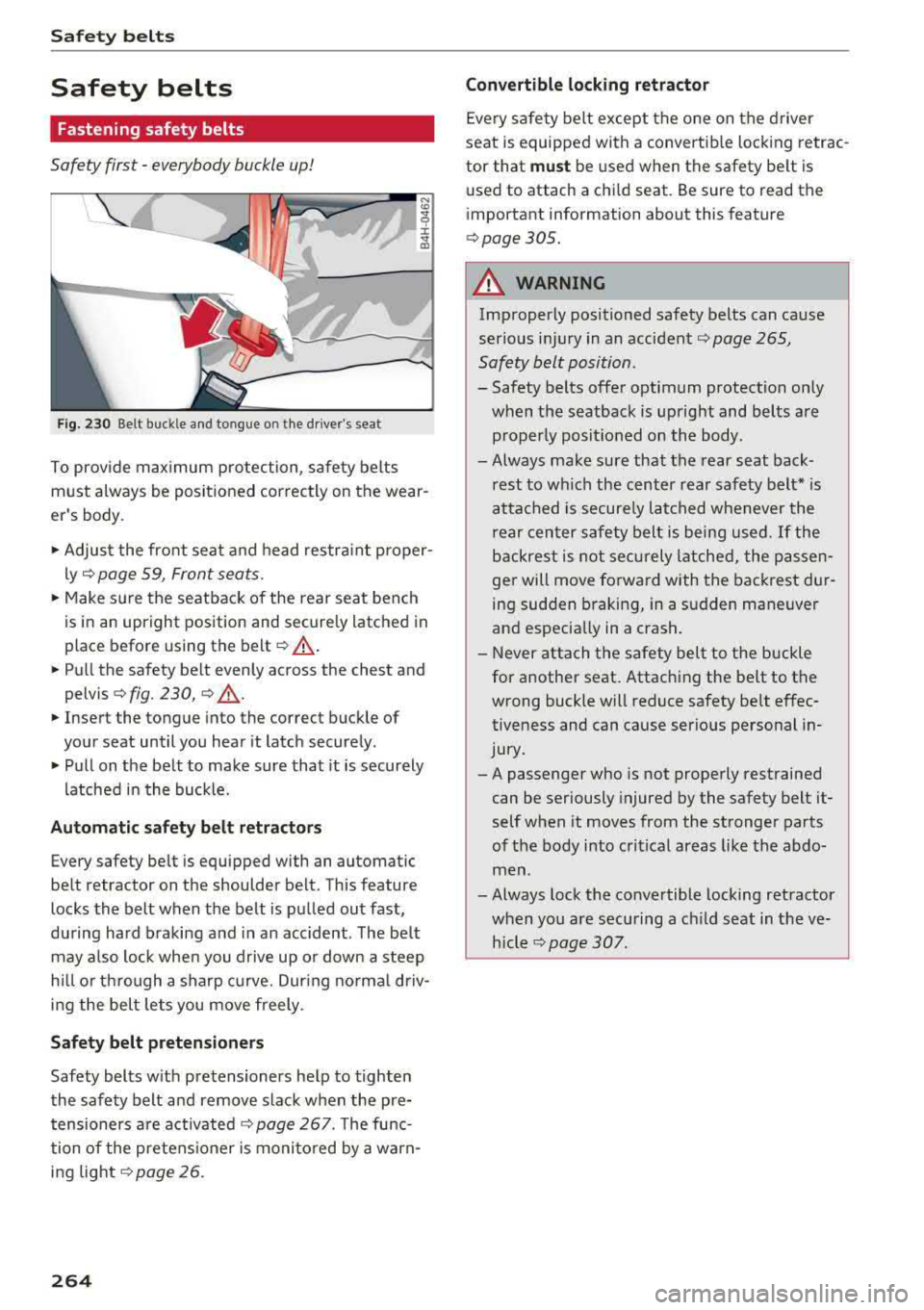
F ig. 230 Belt buckle and tong ue o n the dr iver's seat
N
To prov ide max imum protection, safety belts
must always be positioned correctly on the wear
er's body .
"'Adjust the fro nt sea t and head restra int proper
ly
¢ page 59 , Front seats .
"'Make su re the seatback of the rear sea t bench
is in an upright position and secure ly latched in
place before using the
belt ¢.&_ .
"'Pull the safety belt evenly across the chest and
pelvis ¢ fig. 230, ¢ .&_.
"'Insert the tongue into the correct buckle of
you r seat until you hear it latch securely .
"' Pull on the belt to make sure that it is securely
l atched in the buck le.
Autom atic safety belt retractors
Every safety belt is equipped with an automatic
belt retractor on the shoulder belt . This feature
locks the belt when the belt is pulled out fast,
du ring hard braking and in an accident . The be lt
may a lso lock when you drive up or down a steep
h ill or th rough a sharp curve. Dur ing no rma l dr iv
i n g the bel t lets you move freely.
Safety belt pretensioners
Safety belts w ith pretensioners help to tighten
the safety belt and remove slack when the pre tensioners a re
activated ¢ page 267. The func
tion of the pretens ioner is moni to red by a w arn
ing
light¢ page 26.
264
Convertible lock ing retractor
Eve ry safe ty belt except the one on t he d river
seat is equipped with a convertib le lock ing retrac
tor that
mu st be used when the safety be lt is
used to attach a ch ild seat. Be sure to read the
i mportant information about this feature
¢ page 305 .
A WARNING
Improperly positioned safety belts can cause
serious inj ury in an
accident ¢ page 265,
Safety belt position .
- Safety belts offer optimum protection only
when the seatback is up right and belts are
properly posit ioned on the body .
- Always make sure that the rear seat back
rest to which the center rear safety belt* is
at tached is securely latched whenever the
rear cen ter safety belt is being used.
If the
b ackrest is not sec urely latche d, the passen
ger will move forward with the bac krest du r
ing sudden b raking, in a sudden maneuver
and especia lly in a crash.
-Never attach the safety belt to the buckle
for another seat. Attaching the belt to the
wrong buckle will reduce safety be lt e ffec
tiveness and can cause serio us personal in
jury.
-A passenge r who is not properly restrained
can be seriously injured by the safety belt it
self when it moves from the stronger parts
of the body into cri tical areas like the abdo
men .
- Always lock the convertible locking retractor when yo u are securing a c hild seat in the ve
h icle
~ page 307.
Page 269 of 404
u. 00 .-< N l' N .-< 0 N > 00
Im proper seating posi tions reduce the effective
ness of safety be lts and wi ll even increase the
risk of injury a nd death by mov ing the safety belt
to crit ica l areas of t he body. Improper seating
posi tions also increase the risk of serious injury
a nd death when an airbag deploys and str ikes an
occupant who is not in the correct seat ing pos i
tion . A driver is respons ible for the safety of a ll
ve hicle occupants a nd espec ia lly for children.
Therefo re:
.,. Never permit anyone to assume an incorrect
s itting position in the veh icle wh ile travel ing
¢ & .
.&_ WARNING
Improperly worn safety belts increase the risk
o f serious personal injury and death whenever
a vehicle is being used .
- Always ma ke sure that a ll vehicle occupants
are correctly restrained and stay in a correct
seating position whenever the vehicle is be
ing used .
- Always read and heed all WARNINGS and
other important information
¢ page 263.
Belt tensioners
How safety belt pretensioners work
Reversible safety belt tensioners
The follow ing funct ions are ava ilable when safety
be lts with reve rsible safety belt tensioners are
fastened:
- In certai n driving situat ions, the safety belts
may tighten with a revers ible tens ion ing func
t ion
r=;, page 130 .
-The safety belts may a lso tighten with this re -
versible tensioning function in minor coll is ions .
Pyrotechnic safety belt pretensioners
Seat belts w ith pyrotechn ic safety belt preten
sioners are tens ioned automat ica lly in severe col
lisions, depend ing o n the c ircumstances . Th is
h elps to reduce t he forward mot ion of the occu
pants .
Safet y be lts
.&_ WARNING
--
- It is poss ible for the pretensioners to dep loy
incor rectly .
- The pyrotechnic system can only provide
protection for one collision. If the py rotech
n ic pretens ioners deploy, the pretensioning
system must be replaced.
(D Tips
- A fine dust is re leased when the pyrotechnic
safety belt pretensioners dep loy. This is no r
mal and is not caused by a fi re in the veh i
cle.
- The relevant safety requirements must be
observed when the vehicle or components
of the sys tem are scrapped . A q ual ified
dealership is familiar with these regulat ions
a nd w ill be pleased to pass on the informa
t ion to you.
Service and disposal of safety belt preten
sioner
The safety belt pretensione rs are parts of the
safety belts on your Aud i. Installing, removing,
servicing or repair ing of belt pretens ione rs can
damage the safety belt system and prevent it
from wo rking co rrectly in a co llision.
There are some important things you have to know to make sure that the effective ness of the
system will not be impa ired and that d iscarded
components do no t cause inju ry or pollute the
enviro nment .
.&_ WARNING -
Improper care, servicing and repair proce
d ur es can inc rease the risk of personal in jury
and death by p reventing a safety belt preten
sione r from activating when needed or act i
vating it unexpectedly:
- The belt pretensioner system can be activat
ed only once. If belt pretens ioners have
been activated, the system must be re
p laced.
- Never repair, adjust, or change any parts o f
the safety belt system.
267
Page 271 of 404
u. 00 .-< N l' N .-< 0 N > 00
Airbag system Important information
Importance of wearing safety belts and
sitting properly
Airbags are only supplemental restraints. For
airbags to do their job, occupants must always
properly wear their safety belts and be in a prop
er seating position.
For your safety and the safety of your passen
gers, before driving off, always :
.,. Adjust the driver's seat and steering wheel
properly~ page 250,
.,. Adjust the front passenger's seat properly
~page 251,
.,. Wear safety belts properly ~page 263,
.. Always properly use the proper child restraint
to protect children
r=> page 294.
In a collision, airbags must inflate within the
blink of an eye and with considerable force. The
supplemental airbags can cause injuries if the
driver or the front seat passenger is not seated
properly. Therefore in order to help the airbag to
do its job, it is important, both as a driver and as
a passenger to sit properly at all times .
By keeping room between your body and the
steering wheel and the front of the passenger
compartment, the airbag can inflate fully and
completely and provide supplemental protection in certain frontal collisions
r=> page 250, Correct
passenger seating positions .
For details on the
operation of the seat adjustment controls
r=>page 59.
It's especially important that children are proper
ly restrained
r::> page 294 .
There is a lot that the driver and the passengers
can and must do to help the individual safety fea
tures installed in your Audi work together as a
system .
Proper seating position is important so that the
front airbag on the driver side can do its job. If
you have a physical impairment or condition that prevents you from sitting properly on the driver
seat with the safety belt properly fastened and
Airbag system
reaching the pedals, or if you have concerns with
regard to the function or operation of the Ad
vanced Airbag System, please contact your au
thori zed Audi dealer or qualified workshop, or
call Audi Customer Relations at 1-800-822-2834
for possible modifications to your vehicle.
When the airbag system deploys, a gas generator
will fill the airbags, break open the padded cov ers, and inflate between the steering wheel and
the driver and between the instrument panel and
the front passenger. The airbags will deflate im
mediately after deployment so that the front oc
cupants can see through the windshield again
without interruption.
All of this takes place in the blink of an eye, so
fast that many people don't even realize that the
airbags have deployed. The airbags also inflate
with a great deal of force and nothing should be
in their way when they deploy. Front airbags in
combination with properly worn safety belts slow
down and limit the occupant's forward move
ment . Together they help to prevent the driver
and front seat passenger from hitting parts of
the inside of the vehicle while reducing the forces acting on the occupant during the crash . In this
way they help to reduce the risk of injury to the
head and upper body in the crash. Airbags do not
protect the arms or the lower parts of the body.
Both front airbags will not inflate in all frontal
collisions . The triggering of the airbag system de
pends on the vehicle deceleration rate caused by
the collision and registered by the electronic con
trol unit . If this rate is below the reference value
programmed into the control unit, the airbags
will not be triggered, even though the car may be badly damaged as a result of the collision. Vehi
cle damage, repair costs or even the lack of vehi
cle damage is not necessarily an indication of
whether an airbag should inflate or not .
Since the circumstances will vary considerably between one collision and another, it is not possi
ble to define a range of vehicle speeds that will
cover every possible kind and angle of impact
that will always trigger the airbags . Important
factors include, for example, the nature (hard or
soft) of the object which the car hits, the angle of
impact, vehicle speed , etc. The front airbags will
.,.
269
Page 272 of 404
Airbag syste m
also not inflate in side or rear co llisions, or in
ro ll- overs.
Alwa ys rem ember : Airbags will deploy only once,
and on ly in ce rtain k inds of coll is ions. Yo ur safety
be lts are always there to offer protection in those
situations in which airbags are not supposed to
deploy, or when they have already deployed; for
examp le, when your vehicle str ikes or is struck by
another vehicle after the first collision.
This is just one of the reasons why an airbag is a
supplementary restraint and is not a substitute
for a safety belt. The a irbag system works most
effect ively when used with the safety belts.
Therefore, always properly wear your safety belts
r;:;, page 260 .
A WARNING
Sitting too close to the steering wheel o r in
st rument panel will decrease the effective
ness of the airbags and will inc rease the risk
of personal injury in a co llision.
- Never sit closer than 1 0 inches (25 cm) to
the steering wheel or instrument panel.
- If you cannot sit mo re than 10 inches
( 2 5 cm) from the steering wheel, invest i
gate whether adaptive equipment may be
available to help yo u reach the pedals and
increase your seating distance from the
steering wheel.
- All vehicle occupants and especially children
must be restrained properly whenever riding
in a vehicle. An unrestrained or improperly
restra ined child could be injured by striking
the interior or by being ejected from the ve
hicle during a sudden maneuver or impact.
An unrestrained or imp roperly restrained
child is also at greate r risk of inju ry or death
through contact with an infla ting airbag .
-If you are unrestrained, leaning fo rwa rd, s it
t ing s ideways or o ut o f pos ition in any way,
yo ur risk of in ju ry is much h igher.
- Yo u will also receive serious injuries and
could even be killed if you are up aga inst the
air bag or too close to it when it inflates -
even with an Advanced Airbag.
270
-
- To reduce the r is k of i njury when an a irbag
inflates, always wear safety belts prope rly
r;:;, page 264, Safety belts.
- Always make certa in that children age 12 or
younge r always ride in the rear seat. If chil
dren are not properly restrained, they may be severely injured or killed when an airbag
inflates.
- Never let ch ildren r ide unrestra ined or im
properly restrained in the vehicle . Ad just the
front seats properly .
- Never ride with the back rest recl ined .
- Always sit as far as possible from the steer-
ing wheel or the instrument panel
r;:;, page 250 .
-Always sit upright w ith your back against
the backrest of your seat .
- Never p lace your feet on the instrument
panel or on the seat . Always keep both feet
on the floor in front of the seat to help pre
vent serious injur ies to the legs and hips if
the airbag inflates.
- Never recl ine the front passenger's seat to
transpo rt objects . Items can also move into
the area of the s ide airbag or the front air
bag du ring brak ing o r in a sudden maneu
ver . Obje cts nea r the airbags can become
pro jecti les and cause injury when an airbag
inflates.
A WARNING
Airbags that have deployed in a crash m ust be
replaced.
- Use on ly original equipment airbags ap
proved by Audi and installed by a trained
technician who has the necessary tools and
diagnostic equipment to properly replace
any airbag in yo ur vehicle and assure system
effectiveness in a crash.
- Never perm it salvaged or recycled airbags to
be installed in your vehicle .
Child restraints on the front seat - some
important things to know
.,. Be s ure to re ad the impo rtan t in format ion an d
hee d the WARN IN GS for impo rt a nt deta ils
..,.
Page 273 of 404
u. 00 .-< N l' N .-< 0 N > 00
about children and Advanced Airbags
~page 294 .
Even though yo ur vehicle is equ ipped with an Ad
vanced Airbag System, make certain that a ll chil
dren, especially those 12 years and younger, al
ways ride in the back seat proper ly restrained for
their age and size. The airbag on the passenger
side makes the front seat a potentially dangerous
place for a child to ride. The front seat is not the
safest place for a child in a forward-facing child
seat .
It can be a very dangerous place for an in
fant or a ch ild in a rea rward-fac ing seat.
The Advanced Airbag System i n your veh icle has
been certified to comply w ith the requ irements
of United States Federal Motor Vehicle Safety
Standa rd (FMVSS) 208, as well as Canada Motor
Ve hicle Safety Standa rd (CMVSS) 208 as applica
b le at the time your veh icle was man ufactu red.
According to requirements, the front Advanced
Airbag System on the passenger side has been
certified for "suppression" for infants of about 12 month old and younger and for "low risk de
p loyment" for children aged 3 to 6 years o ld (as
defined in the standard) .
T he
PASSENGER AIR BAG O FF light in the instru
ment panel tells you when the front Advanced
Airbag on the passenger side has been turned off by the electronic control unit .
Each time yo u switch on the ignition, the
PA S·
S ENGER AIR BAG OFF
light will come on for a
few seconds and:
- wi ll stay on if the front passenger seat is not
occupied,
- wi ll stay on if the electrical capacitance meas
ured by the capacitive passenger detection sys
tem for the front passenger seat equals the combined capacitance of an infant up to about
one year of age and one of the rearward-facing
or forward-facing child restraints listed in Fed
eral Moto r Vehicle Safety Standard 208 w it h
wh ich the Advanced Airbag System in your veh i
cle was cert ified . F o r a listing of the child re
straints that were used to ce rt ify you r vehicle 's
compliance with the U.S. Safety Standard
~ page 297 .
Airbag syste m
- wi ll stay on if there is a small child or child re
straint on the front passenger seat,
- wi ll go off if the front passenger seat is occu
pied by an adu lt as registered by the capacitive
passenger detection system
~ page 281, Mon
itoring the Advanced Airbag System.
T he PAS SEN GER AIR BAG OFF lig ht comes on
when e lectrica l capacitance registered on the
front passenger seat is equal to or less t han the
combined capacitance of a typical 1 year-old in
fant and one of the rearward-facing or forward
facing child restrai nts listed in Federal Motor Ve
hicle Safety Standard 208 w it h which the Ad
vanced Airbag System in your vehicle was ce rti
fied.
If the to tal electr ical capacitance reg istered o n
the front passenger seat is more than that of a
typ ical 1 year-old ch ild but less than the weight
of a sma ll adult, the front airbag on the passen
ger side can deploy (the
PASSENGER AIR BAG
OFF
light does not come on).
If the
PASSENGER AIR BAG OFF light does not
come on, the front airbag on the passenger s ide
has not been turned off by the electronic cont rol
u nit and can dep loy if the control unit senses an
impact t hat meets the conditions stored in its
memory.
For example , the airbag ma y deplo y if:
- a small ch ild that is heav ier than a typ ical 1
year-old child is on the front passenger seat (regardless of whethe r the child is in one of t he
child seats listed
~ page 297), or
- a child who has outgrown c hild rest raints is on
the front passenge r seat.
If the front passenger airbag is turned off, the
PASSENGER AIR BAG OFF light comes on in the
i nst rument cluste r and stays on .
If the front passenger airbag deploys, the Feder
al Standard requires the airbag to meet the "low
risk" deployment cr iteria to reduce the r isk of in
jury through interact ion w ith the airbag . "Low
r isk " deployment occurs in t hose crashes that
take place at lowe r decele rations as defined in
the e lectronic co ntrol
unit~ page 281, PASSEN -
GER AIR BAG OFF light.
...
271
Page 275 of 404
LL co ..... N
" N ..... 0 N > co
-An improper ly installed child restraint can
interfere with the airbag as it deploys and
seriously injure or even kill the child
-even
with an Advanced Airbag System.
- Always carefully follow the manufacturer's
instructions provided with the child seat or
carrier .
- Always make sure that there is nothing on
the front passenger seat that will cause the capacit ive passenger detection system in
the seat to signal to the Airbag System that
the seat is occupied by a person when it is
not, or to signal that it is occupied by some
one who is heavier than the person actually
sitting on the seat. The presence of addi
tional objects could cause the passenger
front airbag to be turned on when it should be off, or could cause the airbag to work in a
way that is different from the way it would have worked without the object on the seat .
Front airbags
Description of front airbags
The airbag system can provide supplemental
protection to properly restrained front seat occu
pants.
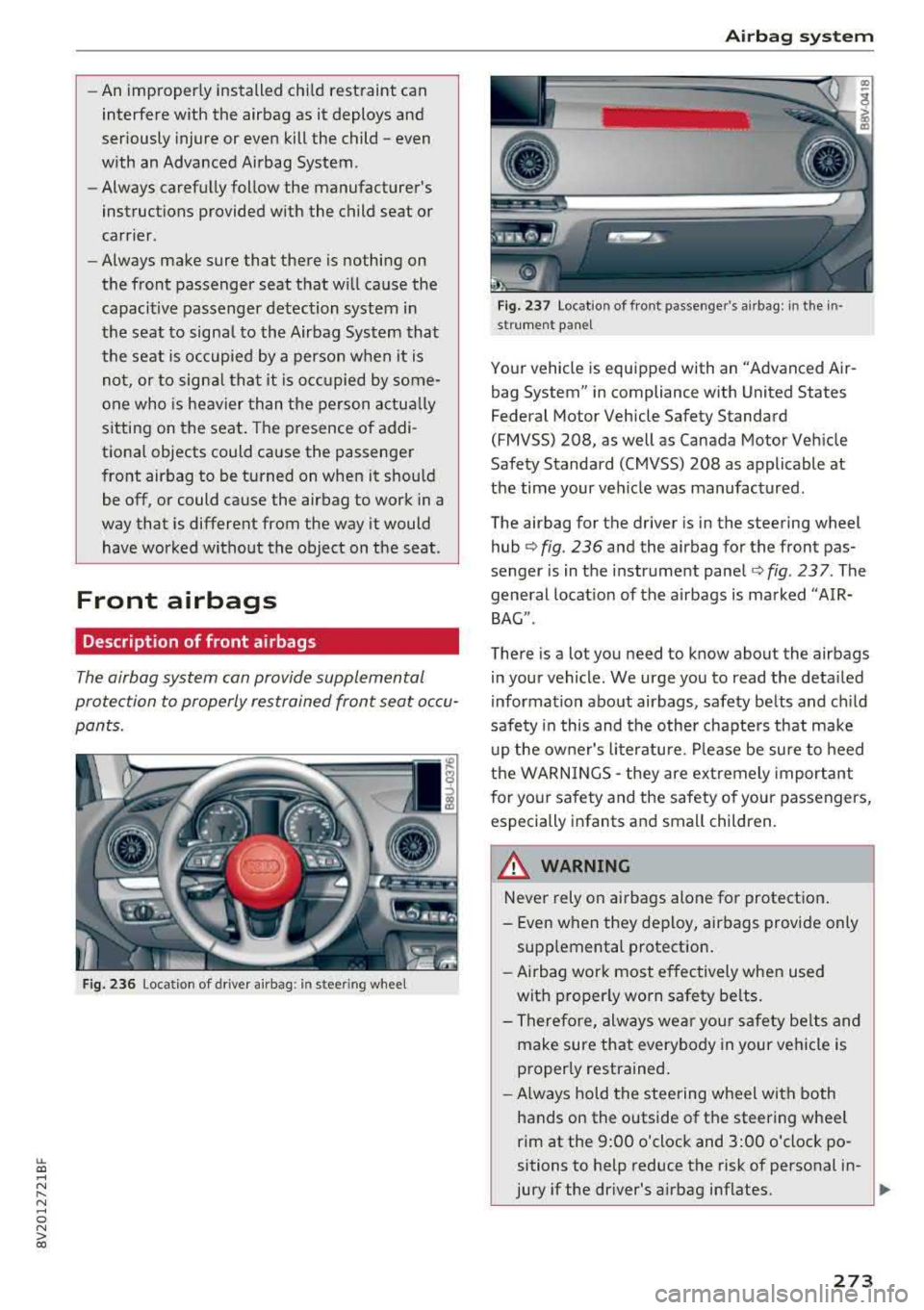
Fig. 236 Loc ation of driver a irbag: in ste .e ring wheel
Airbag system
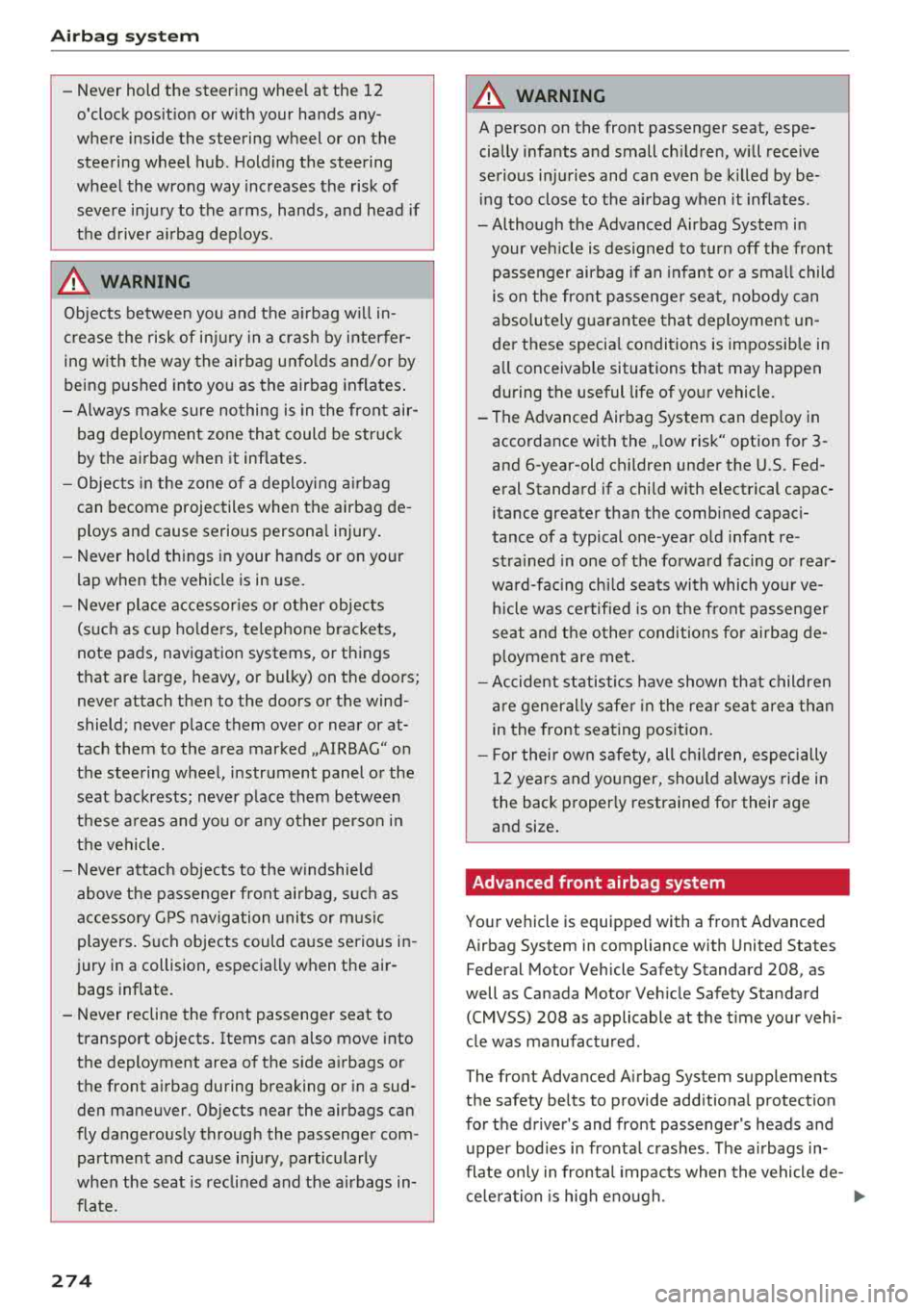
Fig. 237 Location of front passenger's airbag: in the in
st rum ent panel
Your vehicle is equipped with an "Advanced Air
bag System" in compliance with United States
Federal Motor Vehicle Safety Standard
(FMVSS) 208, as well as Canada Motor Vehicle
Safety Standard (CMVSS) 208 as applicable at
the time your veh icle was manufactured.
The airbag for the driver is in the steering wheel
hub
¢ fig. 236 and the airbag for the front pas
senger is in the instrument panel
¢fig . 237. The
general location of the airbags is marked "AIR
BAG ".
There is a lot you need to know about the airbags
in your vehicle . We urge you to read the detailed
information about airbags, safety belts and child
safety in this and the other chapters that make
up the owner's literature. Please be sure to heed
the WARNINGS
-they are extremely important
for your safety and the safety of your passengers,
especially infants and small children.
_& WARNING
-Never rely on airbags alone for protection .
- Even when they deploy, airbags provide only
supplemental protection.
- Airbag work most effectively when used
with properly worn safety belts.
- Therefore, always wear your safety belts and
make sure that everybody in your vehicle is
properly restrained.
- Always hold the steering wheel with both
hands on the outside of the steering wheel
rim at the 9:00 o'clock and 3:00 o'clock po
sitions to help reduce the risk of personal in-
jury if the driver's airbag inflates.
..,.
273
Page 276 of 404
Airbag syste m
-Never hold the steering whee l at the 12
o'clock pos it ion or w ith your han ds any
where inside the steering wheel or on the steering wheel hub. Holding t he steering
wheel the wrong way increases the risk of severe injury to the arms, hands, and head if
the d river a irbag deploys.
A WARNING
Objects between you and the a irbag w il l in
crease the risk of inj ury in a crash by interfer
ing w ith the way the airbag unfo lds and/or by
being pushed into you as the airbag inflates .
- Always make sure nothing is in the front air-
bag deployment zone that could be str uck
by the airbag when it inflates.
-
- Objects in the zone of a deploying airbag
can become projectiles when the airbag de
ploys and cause serious persona l injury .
- Never hold th ings in your hands or on your
lap when the vehicle is in use.
- Never place accessor ies or other objec ts
(s uch as c up ho lders, telephone brackets,
note pads, navigation systems, or things
that are large, heavy, o r bulky) on the doors;
never attach then to the doors or the wind
shield; never place them over or near or at
tach them to the area marked
,,AIRBAG" on
the steering wheel, instrument panel or the seat backrests; never p lace them between
these a reas and yo u or any other person in
the vehicle.
- Never attach objects to the w indshield
above the passenger front airbag, s uch as
accessory GPS navigation uni ts or mus ic
players . S uch objects could ca use serio us in
jury in a collision, especially when the air bags inflate.
- Never recline the front passenger seat to transport objects . Items can also move into
the deployment area of the side a irbags or
the front a irbag during breaking o r in a sud
den maneuver. Objects near the airbags can
fly dangerous ly through the passenger com
partment and cause injury, particularly
when the seat is reclined and the airbags in
flate.
274
A WARNING
A person on the front passenger seat, espe
cially infants and small ch ildren, wi ll receive
serious in juries and can even be k illed by be
ing too close to the airbag when it inflates .
- Although the Advanced Airbag System in your veh icle is designed to turn off the front
passenger airbag if an infant o r a small child
is on the fron t passenger sea t, nobody can
absolu tely guarantee tha t deployment un
de r these specia l condi tions is impossible in
all conceivable situations that may happen
during the useful life of yo ur vehicle.
- The Advanced Airbag System can dep loy in
accordance with the
,. low risk" option for 3-
and 6-year-old children under the U.S. Fed
eral Standard if a child w ith electrical capac
itance greater than the combined capac i
tance of a typical one-year o ld infant re
strained in one of the forward facing or rea r
ward-facing chi ld seats with which yo ur ve
hicle was certified is on the front passenger
seat and the o ther conditions for airbag de-
ployment are me t.
- Accident s tatisti cs have shown th at children
are generally safer in the rear seat are a than
in the front seat ing pos ition.
- For their own s afety, all ch ildren, especi ally
12 years and younger, should alw ays ride in
the back proper ly restrained for their age
and size .
Advanced front airbag system
-
Your vehicle is equipped with a front Advanced
Airbag System in compliance with United States
Federal Motor Vehicle Safety Standard 208, as
well as Canada Motor Veh icle Safety Standard
(CMVSS) 208 as applicable at the t ime your vehi
cle was manufactu red .
The front Advanced A irbag System supplements
the safety belts to provide add itiona l protect ion
for the driver 's and front passenger's heads and
upper bod ies in fronta l crashes. The a irbags in
flate only in frontal impacts when the vehicle de-
ce le ra tion is high e no ugh.
II>-
Page 279 of 404
u. 00 .-< N l' N .-< 0 N > 00
Airbag System for the front passenger seat from
doing its job in a crash.
The front Ad vanced Airbag System con sists
o f th e follo wing :
-Cras h sensors in the front of the vehicle that
measure vehicle acceleration/deceleration to
provide information to the Advanced Airbag
System a bout the severity of the crash.
- An electronic control unit, with integrated
crash sensors for front and side impacts. The
contro l unit "decides" whether to fire the front
airbags based on the information received from
the crash sensors . The control unit also "de
c ides" whether the safety belt pretens ioners
shou ld be activated .
-An Advanced Airbag with gas generator for the
dr iver inside the steering wheel hub.
-An Advanced Airbag with gas generator ins ide
the instrument panel for the front passenger.
-A capac itive passenger detect io n system under
neath the front passenger seat cover. This sys
tem measures the elect rical capac ita nce of the
person in the seat. The info rmat ion registe red
is sent cont inuous ly to the electro nic cont rol
u nit to regula te deployment of t he front Ad
vanced Airbag on the passenge r side.
-An a irbag monito ring system and indica tor
li gh t in the ins trument
cluste r¢ page 281 .
-A se nso r in each front seat reg isters the dis
tance between the respec tive sea t and the
steering wheel or instrument pane l. The infor
mation registered is sent continuous ly to the
electronic control unit to regulate deployment
of the front Adv a need A irbags.
-T he PASSENGER AIR BAG OFF light comes on
and stays on in the center of the instrument
panel
¢ page 318 and tells you when the front
Advanced Airbag on the passenger side has been turned off .
-A sensor in the safety belt latch for the driver
and for the front seat passenger that senses
whether that safety belt is latched or not and
transm its this info rmat ion to the elect ronic
contro l unit.
Airbag syste m
.&, WARNING ~ -
Damage to the front passenger seat can pre
vent the front airbag from working properly.
-Improper repair or disassembly of the front
passenger and driver seat will p revent the
Advanced Airbag System from f unct ion ing
p roperly.
-Repairs to the front passenger seat must be
pe rformed by qualified and p roperly trained
wo rkshop personne l.
-Never remove the front passenger or driver
seat from the vehicle .
-Never remove the upholstery from the front
passenger seat.
-Never d isassemble or remove parts from the
seat o r disconnect w ires from it.
-Never carry sharp objects in your pockets or
put them on the seat. The capacit ive pas
senger de tect ion mat in the front passenger
seat will not function p roperly if i t is punc
tured.
-Never carry things on your lap or carry ob
jects on the front passenge r seat. S uch ob
jects can influence the capacitance reg is
tered by the cap aci tive passenger detection
sys tem, so that incorrect in formation is pro
vided to the ai rbag control unit.
-Never store i tems unde r the front passenger
seat . Parts of the Advanced Airbag System
under the passenger seat could be dam
aged, p reventing them and the airbag sys
tem from wor king p roper ly.
-Never p lace seat covers or replacement up
holstery that have not been specifically ap
proved by Audi on the front seats.
-Seat covers can prevent the Advanced Air bag System from recognizing chi ld re
stra ints or occupants on the front passenger
seat and prevent the side airbag in the seat
backrest from deploying properly.
-If a seat heater has been retrofitted or oth
erwise added to the front passenger seat,
never ins tall any child restra int system on
this seat.
-Never use cushions, p illows , blankets, or
similar items on the front passenge r seat .
T he addi tional laye rs prevent the capacit ive
277
Page 282 of 404
Airbag syste m
A WARNING
A child in a rearward-facing child seat instal
led o n the front passenger seat will be ser i
ously injured and can be k ille d if the front air
bag in flate s - even with an Advanced Airbag
System.
- The inflating a irbag w ill hit the child seat or
infant carrier w ith great force and will
smash the ch ild seat and child against the
backrest, cente r arm rest, door or roof.
- Always install rear-facing child seats on the
rea r seat.
- If you must install a rearward fac ing ch ild
seat on the front passenger seat because of
exceptional c ircumstances and the
PASSEN
GER AIR BAG OFF
light does not come on
and stay on, immediately insta ll the rear
facing child seat in a rear seating position and have the airbag system inspected by
your Audi dealer.
A WARNING
-
-
Objects between you and the a irbag w ill in
crease the risk of in jury in a crash by interfer
ing w ith the way the airbag unfolds or by be
ing pushed into you as the a irbag inflates.
- Never hold th ings in your hands or on your
lap when the vehicle is in use .
- Never transport items on or in the area of
the fron t passenger seat . Objects could
move into the area of the front airbags du r
ing bra king or other sudden maneuve rs and
become dangerous projec tiles that c an
ca use serious pe rsonal injury if the a irbags
inflate.
- Never pl ace or attach accessor ies or o ther
objects (such as cup ho lders, te lephone
brackets, large, heavy or bulky objects) on
the doors, over or nea r the area marked
"AIRBAG" on the steering wheel, instru
ment pane l, seat backrests or between
those areas and yourself. These objects could cause injury in a crash, especially
when the airbags infla te.
- Never recline the front passenger's seat to
transport objects . Items can also move into
the a rea of the side airbag o r the front a ir-
280
bag du ring brak ing o r in a sudden maneu
ver. Objects near the airbags can become pro jecti les and cause injury, part icularly
when the seat is reclined .
- Never p lace or transport objects on the
front passenger seat. Objects on the front passenger seat could cause the capacitive
sensor in the seat to signal to ai rbag system
that the seat is occ upied by a person when it
in fact is no t, or that the pe rson on the seat
is he avie r th an he or she act ually is. The
change in electric capacitan ce beca use of
such objects can cause the passenge r front
airbag to be turne d on when it should be
off, or can cause the airbag to work in a way
that is different from the way it would have
wo rked without objects on the seat.
- Always make sure that there is noth ing on
the front passenger seat that will cause the
capacitive passenger detection system in
the sea t to signal to the Airbag System that
the seat is occup ied by a person when it is
not, or to signal that it is occupied by some
one who is heavier th an the person actu ally
si tting on the sea t. The presence of an o b
ject could ca use the passenger front air bag
to be turned on when it should be off, or
could cause the airbag to work in a way that is diffe rent from the way it would have
worked without the object on the seat.
A WARNING
The fine dust created when airbags deploy can
cause breathing prob lems for people with a
h istory of asthma or othe r breath ing cond i
tions .
- To reduce the r isk of breathing p roblems ,
those wi th asthma o r other respiratory con
ditions sho uld get fresh a ir rig ht away by
getting out of the vehi cle or opening win
dows or doors.
- If you are in a co llision in which airbags de
ploy, w ash yo ur hands and f ace with m ild
soap and water be fore eating.
- Be ca refu l not to get the dust into your eyes,
or into any cuts or scratches.
- If the residue sho uld get into your eyes,
flush them w ith wate r.