oil level AUDI S4 2008 User Guide
[x] Cancel search | Manufacturer: AUDI, Model Year: 2008, Model line: S4, Model: AUDI S4 2008Pages: 342, PDF Size: 15.01 MB
Page 261 of 342
Checking and topping up fluids259
Controls
Safety
Driving tips
General maintenance
Self-help
Technical data
Applies to vehicles: without oil dipstickChecking the oil level (without dipstick)
You can check the engine oil level via the sound system or
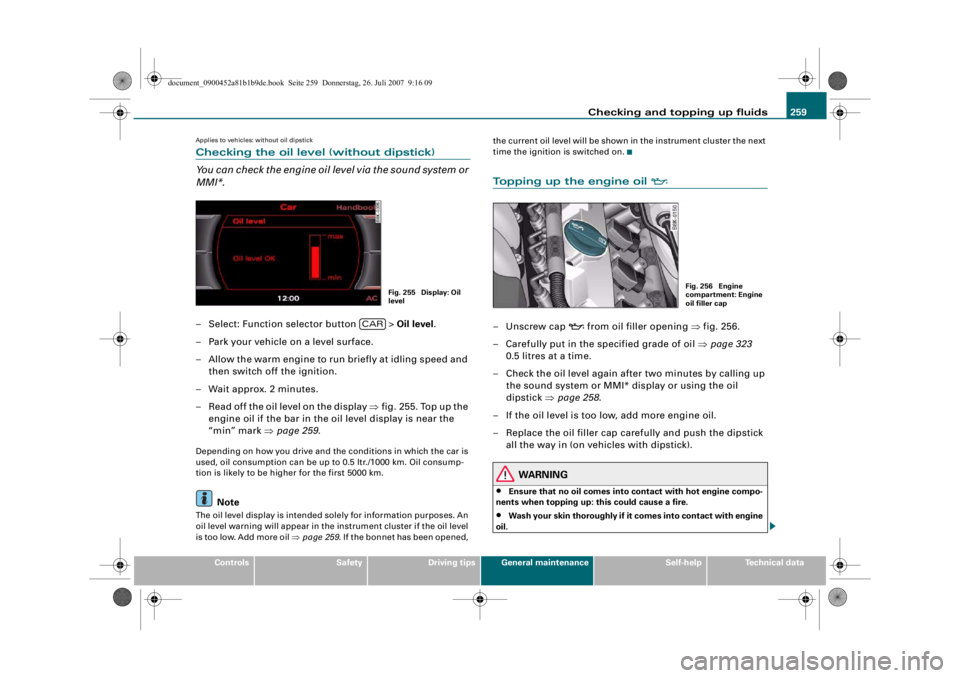
MMI*.– Select: Function selector button > Oil level.
– Park your vehicle on a level surface.
– Allow the warm engine to run briefly at idling speed and then switch off the ignition.
– Wait approx. 2 minutes.
– Read off the oil level on the display ⇒fig. 255. Top up the
engine oil if the bar in the oil level display is near the
“min” mark ⇒ page 259.Depending on how you drive and the conditions in which the car is
used, oil consumption can be up to 0.5 ltr./1000 km. Oil consump-
tion is likely to be hi gher for the first 5000 km.
Note
The oil level display is intended solely for information purposes. An
oil level warning will appear in the instrument cluster if the oil level
is too low. Add more oil ⇒ page 259. If the bonnet has been opened, the current oil level will be shown in the instrument cluster the next
time the ignition is switched on.
Topping up the engine oil
–Unscrew cap
from oil filler opening
⇒fig. 256.
– Carefully put in the specified grade of oil ⇒page 323
0.5 litres at a time.
– Check the oil level again after two minutes by calling up the sound system or MMI* display or using the oil
dipstick ⇒page 258 .
– If the oil level is too low, add more engine oil.
– Replace the oil filler cap carefully and push the dipstick all the way in (on vehicles with dipstick).
WARNING
•
Ensure that no oil comes into contact with hot engine compo-
nents when topping up: this could cause a fire.
•
Wash your skin thoroughly if it comes into contact with engine
oil.
Fig. 255 Display: Oil
level
CAR
Fig. 256 Engine
compartment: Engine
oil filler cap
document_0900452a81b1b9de.book Seite 259 Donnerstag, 26. Juli 2007 9:16 09
--4 -
-T
•
-+ +-
[I]
Page 262 of 342
Checking and topping up fluids
260
Caution•
The oil level must never be above area ⇒page 258, fig. 254,
as this may result in damage to the catalytic converter or to the
engine. On vehicles without an oil dipstick, you can check the oil
level via the sound system or MMI*. Contact a qualified workshop to
extract the engine oil if necessary.
•
No additives should be used with engine oil. Any damage caused
by the use of such additives would not be covered by the factory
warranty.For the sake of the environment
•
Never pour oil down drains or into the ground.
•
Always observe statutory requirements when disposing of
empty oil canisters.
Cooling systemCoolant
The purpose of the coolant is to carry heat away from the
engine. The correct amount of anti-freeze is important to
prevent the cooling system from freezing in winter.The cooling system is filled for life at the factory, so the coolant does
not need to be changed. The coolant consists of a mixture of water
and anti-freeze additive G12++. This is a glycol-based anti-freeze
with anti-corrosion additives.
Anti-freeze additive
The amount of anti-freeze additive required depends on the temper-
atures to be expected in the winter season. If the anti-freeze concen-
tration is too low the coolant can freeze, resulting in failure of the
cooling system and heater. The cooling system is filled at the
factory with the correct amount of
anti-freeze for the country concerned.
In most cases the mixture consists of 60% water and 40% additive.
This mixture gives the required anti-freeze protection at tempera-
tures down to -25 °C and protects the alloy parts of the cooling
system against corrosion. It also prevents scaling and raises the
boiling point of the coolant.
Countries with warm climate
The coolant concentration must not be reduced by adding plain
water, even in the summer or in warm climates. The concentration
of the anti-freeze additive must always be at least 40%.
Countries with cold climate
If greater anti-freeze protection is required in very cold climates, the
proportion of the anti-freeze additive G12++ can be increased. A
concentration of 60% offers protection down to about - 40 °C. The
concentration of the anti -freeze additive must not be more than
60% , otherwise this would reduce the anti-freeze protection. In addi-
tion, the cooling effect wi ll be adversely affected.
Vehicles for export to countries wi th a cold climate (such as Sweden,
Norway and Finland) are supplied wi th antifreeze protection down
to about -35 °C. The concentration of the antifreeze additive for
these countries should always be at least 50%.
Caution
•
It is advisable to have the cooling system checked before the
winter season to make sure that the antifreeze concentration is
adequate for the conditions to be expected. This applies particularly
if you intend to take the car into a colder climate zone. If necessary,
have the anti-freeze concentration increased to 50 - 60% as required.
•
Use only anti-freeze additive G12++, an additive meeting the
specification “TL 774 G”. Other additives may give considerably
inferior corrosion protection. The resulting corrosion in the cooling
system can lead to a loss of coolant, causing serious damage to the
engine.
Aa
document_0900452a81b1b9de.book Seite 260 Donnerstag, 26. Juli 2007 9:16 09
--4 -
-
0
T
-+
•
+-
0
Page 263 of 342
Checking and topping up fluids261
Controls
Safety
Driving tips
General maintenance
Self-help
Technical data
•
The coolant additive G12++ can be mixed only with additives
G12+ and G12.
Checking coolant level
The coolant level can be checked at a glance.– Switch off the ignition.
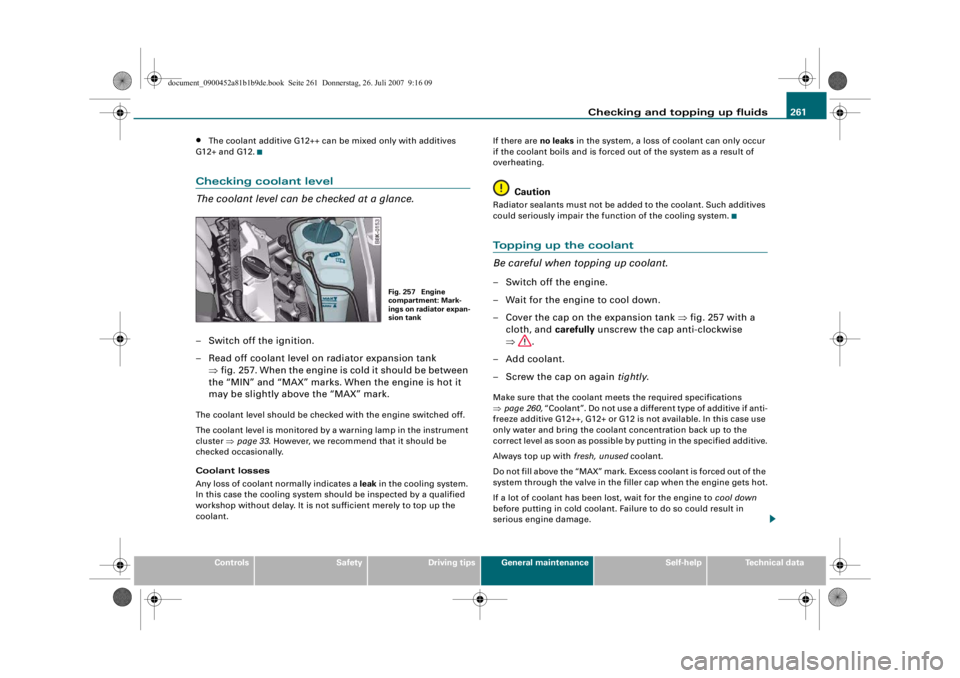
– Read off coolant level on radiator expansion tank ⇒fig. 257. When the engine is cold it should be between
the “MIN” and “MAX” marks. When the engine is hot it
may be slightly above the “MAX” mark.The coolant level should be checke d with the engine switched off.
The coolant level is monitored by a warning lamp in the instrument
cluster ⇒page 33 . However, we recommend that it should be
checked occasionally.
Coolant losses
Any loss of coolant normally indicates a leak in the cooling system.
In this case the cooling system should be inspected by a qualified
workshop without delay. It is not sufficient merely to top up the
coolant. If there are
no leaks in the system, a loss of coolant can only occur
if the coolant boils and is forced out of the system as a result of
overheating.
Caution
Radiator sealants must not be added to the coolant. Such additives
could seriously impair the function of the cooling system.Topping up the coolant
Be careful when topping up coolant.– Switch off the engine.
– Wait for the engine to cool down.
– Cover the cap on the expansion tank ⇒fig. 257 with a
cloth, and carefully unscrew the cap anti-clockwise
⇒ .
– Add coolant.
– Screw the cap on again tightly.Make sure that the coolant meets the required specifications
⇒page 260, “Coolant”. Do not use a different type of additive if anti-
freeze additive G12++, G12+ or G12 is not available. In this case use
only water and bring the coolant concentration back up to the
correct level as soon as possible by putting in the specified additive.
Always top up with fresh, unused coolant.
Do not fill above the “MAX” mark. Ex cess coolant is forced out of the
system through the valve in the filler cap when the engine gets hot.
If a lot of coolant has been lost, wait for the engine to cool down
before putting in cold coolant. Failure to do so could result in
serious engine damage.
Fig. 257 Engine
compartment: Mark-
ings on radiator expan-
sion tank
document_0900452a81b1b9de.book Seite 261 Donnerstag, 26. Juli 2007 9:16 09
--4 -
-T
•
---- 0
•
-+ +-
Page 290 of 342
Self-help
288•
Seek professional assistance if th e repair of a tyre puncture is
not possible with the sealing compound.
•
If tyre pressure is less than 1.3 bar after driving about 10
minutes, the tyre is too badly damaged. Do not drive on. You
should obtain professional assistance.Caution
Take special care if you have to repair a tyre on a gradient.
Note
•
Do not use the compressor for longer than 6 minutes at a time,
as it could overheat. When the compressor has cooled down, you
can use it again.
•
If tyre sealant should leak out, leave it to dry and then pull it off
like foil.
•
After carrying out a tyre repair remember to buy a new tyre
sealant can at a qualified workshop. This will ensure that the Tyre
Mobility System is operative again.
•
Please observe the relevant regulations.
Changing a wheelPreparations
Some preparations are necessary before changing a
wheel.– If you have a flat tyre, stop the car well away from moving traffic. Choose a location that is as level as possible.– All passengers should
leave the car. They should wait in
a safe place (for instance behind the roadside crash
barrier).
– Apply the parking brake to stop the vehicle moving acci-
dentally.
–Engage first gear (manual gearbox) or move selector
lever to position P (automatic gearbox).
– When towing a trailer: unhitch the trailer from your vehicle.
– Take the tools ⇒ page 283 and the spare wheel*
⇒ page 284 out of the luggage compartment.
WARNING
If you have a puncture in moving traffic, switch on the hazard
warning lights and place the warning triangle in a visible location.
This is for your own safety and also warns other road users.
Caution
If you have to change the tyre on a gradient, block the wheel oppo-
site the wheel being changed by placing a stone or similar object
under it to prevent the vehicle from rolling away.
Note
Please observe the relevant regulations.How to change a wheel
Change the wheel as described below.–Pull off the hub cap . Also refer to ⇒page 289, “Hub
caps”.
WARNING (continued)
document_0900452a81b1b9de.book Seite 288 Donnerstag, 26. Juli 2007 9:16 09
--4 -
-T
0 [I)
-+
I&
+-
0
•
•
Page 336 of 342
Index
334
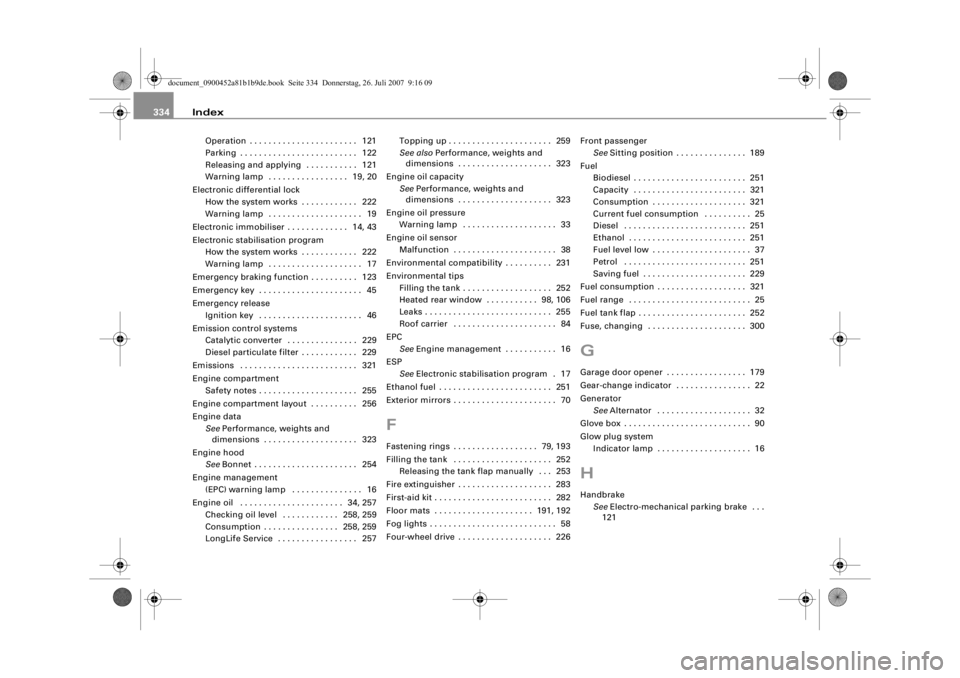
Operation . . . . . . . . . . . . . . . . . . . . . . . 121
Parking . . . . . . . . . . . . . . . . . . . . . . . . . 122
Releasing and applying . . . . . . . . . . . 121
Warning lamp . . . . . . . . . . . . . . . . . 19, 20
Electronic differential lock How the system works . . . . . . . . . . . . 222
Warning lamp . . . . . . . . . . . . . . . . . . . . 19
Electronic immobiliser . . . . . . . . . . . . . 14, 43
Electronic stab ilisation program
How the system works . . . . . . . . . . . . 222
Warning lamp . . . . . . . . . . . . . . . . . . . . 17
Emergency braking function . . . . . . . . . . 123
Emergency key . . . . . . . . . . . . . . . . . . . . . . 45
Emergency release Ignition key . . . . . . . . . . . . . . . . . . . . . . 46
Emission control systems Catalytic converter . . . . . . . . . . . . . . . 229
Diesel particulate filter . . . . . . . . . . . . 229
Emissions . . . . . . . . . . . . . . . . . . . . . . . . . 321
Engine compartment Safety notes . . . . . . . . . . . . . . . . . . . . . 255
Engine compartment layout . . . . . . . . . . 256
Engine data See Performance, weights and
dimensions . . . . . . . . . . . . . . . . . . . . 323
Engine hood See Bonnet . . . . . . . . . . . . . . . . . . . . . . 254
Engine management (EPC) warning lamp . . . . . . . . . . . . . . . 16
Engine oil . . . . . . . . . . . . . . . . . . . . . . 34, 257 Checking oil level . . . . . . . . . . . . 258, 259
Consumption . . . . . . . . . . . . . . . . 258, 259
LongLife Service . . . . . . . . . . . . . . . . . 257 Topping up . . . . . . . . . . . . . . . . . . . . . . 259
See also
Performance, weights and
dimensions . . . . . . . . . . . . . . . . . . . . 323
Engine oil capacity See Performance, weights and
dimensions . . . . . . . . . . . . . . . . . . . . 323
Engine oil pressure Warning lamp . . . . . . . . . . . . . . . . . . . . 33
Engine oil sensor Malfunction . . . . . . . . . . . . . . . . . . . . . . 38
Environmental compatibility . . . . . . . . . . 231
Environmental tips Filling the tank . . . . . . . . . . . . . . . . . . . 252
Heated rear window . . . . . . . . . . . 98, 106
Leaks . . . . . . . . . . . . . . . . . . . . . . . . . . . 255
Roof carrier . . . . . . . . . . . . . . . . . . . . . . 84
EPC See Engine management . . . . . . . . . . . 16
ESP See Electronic stabilisation program . 17
Ethanol fuel . . . . . . . . . . . . . . . . . . . . . . . . 251
Exterior mirrors . . . . . . . . . . . . . . . . . . . . . . 70
FFastening rings . . . . . . . . . . . . . . . . . . 79, 193
Filling the tank . . . . . . . . . . . . . . . . . . . . . 252 Releasing the tank flap manually . . . 253
Fire extinguisher . . . . . . . . . . . . . . . . . . . . 283
First-aid kit . . . . . . . . . . . . . . . . . . . . . . . . . 282
Floor mats . . . . . . . . . . . . . . . . . . . . . 191, 192
Fog lights . . . . . . . . . . . . . . . . . . . . . . . . . . . 58
Four-wheel drive . . . . . . . . . . . . . . . . . . . . 226 Front passenger
See Sitting position . . . . . . . . . . . . . . . 189
Fuel Biodiesel . . . . . . . . . . . . . . . . . . . . . . . . 251
Capacity . . . . . . . . . . . . . . . . . . . . . . . . 321
Consumption . . . . . . . . . . . . . . . . . . . . 321
Current fuel consumption . . . . . . . . . . 25
Diesel . . . . . . . . . . . . . . . . . . . . . . . . . . 251
Ethanol . . . . . . . . . . . . . . . . . . . . . . . . . 251
Fuel level low . . . . . . . . . . . . . . . . . . . . . 37
Petrol . . . . . . . . . . . . . . . . . . . . . . . . . . 251
Saving fuel . . . . . . . . . . . . . . . . . . . . . . 229
Fuel consumption . . . . . . . . . . . . . . . . . . . 321
Fuel range . . . . . . . . . . . . . . . . . . . . . . . . . . 25
Fuel tank flap . . . . . . . . . . . . . . . . . . . . . . . 252
Fuse, changing . . . . . . . . . . . . . . . . . . . . . 300
GGarage door opener . . . . . . . . . . . . . . . . . 179
Gear-change indicator . . . . . . . . . . . . . . . . 22
Generator See Alternator . . . . . . . . . . . . . . . . . . . . 32
Glove box . . . . . . . . . . . . . . . . . . . . . . . . . . . 90
Glow plug system Indicator lamp . . . . . . . . . . . . . . . . . . . . 16HHandbrakeSee Electro-mechanical parking brake . . .
121
document_0900452a81b1b9de.book Seite 334 Donnerstag, 26. Juli 2007 9:16 09
--4 -
-T
-+ +-
Page 338 of 342
Index
336
Exterior lighting . . . . . . . . . . . . . . . . . . 59
Front fog lights . . . . . . . . . . . . . . . . . . . 58
Headlight control . . . . . . . . . . . . . . . . . 57
leaving home . . . . . . . . . . . . . . . . . . . . . 59
Rear fog lights . . . . . . . . . . . . . . . . . . . . 58
Switching on and off . . . . . . . . . . . . . . 57
Loading luggage compartment . . . . . . . 192
Load-through hatch . . . . . . . . . . . . . . . . . . 82
Locking . . . . . . . . . . . . . . . . . . . . . . . . . . . . 47 Central locking system . . . . . . . . . . . . . 48
Locking and unlocking the vehicle from in- side
Central locking system . . . . . . . . . . . . . 49
Locking doors manually . . . . . . . . . . . . . . 51
LongLife Service . . . . . . . . . . . . . . . . . . . . 257
Luggage compartment . . . . . . . . . . . . . . . 79 Extending . . . . . . . . . . . . . . . . . . . . . . . . 81
Fastening rings . . . . . . . . . . . . . . . . . . . 79
Loading . . . . . . . . . . . . . . . . . . . . . . . . . 79
Side storage compartment . . . . . . . . . 80
Stretch net . . . . . . . . . . . . . . . . . . . . . . . 80
Transport bag . . . . . . . . . . . . . . . . . . . . 82
See also Loading luggage compartment .
192
Luggage rack See Roof carrier . . . . . . . . . . . . . . . . . . . 83
MMain beam headlights . . . . . . . . . . . . . . . . 62
Indicator lamp . . . . . . . . . . . . . . . . . . . . 18
Make-up mirrors . . . . . . . . . . . . . . . . . . . . . 64 Manual operation
Boot lid . . . . . . . . . . . . . . . . . . . . . . . . . . 52
Fuel tank flap . . . . . . . . . . . . . . . . . . . . 253
Manual release Selector lever (multitronic®) . . . . . . . 168
Maximum speed See Performance, weights and
dimensions . . . . . . . . . . . . . . . . . . . . 323
Memory for driver's seat . . . . . . . . . . . . . . 75 Activating remote control key . . . . . . . 77
Recalling settings . . . . . . . . . . . . . . . . . 76
Storing settings . . . . . . . . . . . . . . . . . . . 76
Messages . . . . . . . . . . . . . . . . . . . . . . . . . . . 30
Mileage recorder . . . . . . . . . . . . . . . . . . . . 14
Minimising pollution . . . . . . . . . . . . . . . . 229
Mirrors Anti-dazzle setting . . . . . . . . . . . . . . . . 69
Automatic anti-dazzle exterior mirrors 71
Automatic anti-dazzle interior mirror . 69
Exterior mirrors . . . . . . . . . . . . . . . . . . . 70
Interior mirror . . . . . . . . . . . . . . . . . . . . 68
Make-up mirrors . . . . . . . . . . . . . . . . . . 64
MMI control console, cleaning . . . . . . . . 247
MMI display, cleaning . . . . . . . . . . . . . . . 247
Mobile phones . . . . . . . . . . . . . . . . . . . . . 278
Modifications . . . . . . . . . . . . . . . . . . . . . . 277
multitronic® . . . . . . . . . . . . . . . . . . . . . . . 162 Driving with multitronic® . . . . . . . . . 162
NNatural leather . . . . . . . . . . . . . . . . . . . . . 248 Number plate light
Changing bulb . . . . . . . . . . . . . . . . . . . 315
OOctane rating . . . . . . . . . . . . . . . . . . . . . . . 251
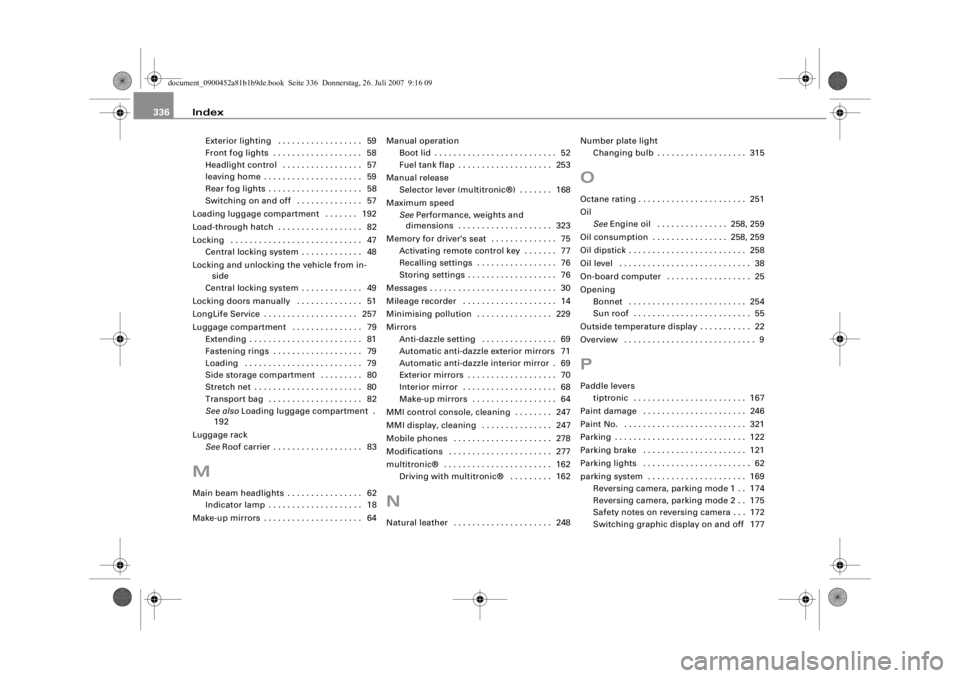
OilSee Engine oil . . . . . . . . . . . . . . . 258, 259
Oil consumption . . . . . . . . . . . . . . . . 258, 259
Oil dipstick . . . . . . . . . . . . . . . . . . . . . . . . . 258
Oil level . . . . . . . . . . . . . . . . . . . . . . . . . . . . 38
On-board computer . . . . . . . . . . . . . . . . . . 25
Opening Bonnet . . . . . . . . . . . . . . . . . . . . . . . . . 254
Sun roof . . . . . . . . . . . . . . . . . . . . . . . . . 55
Outside temperature display . . . . . . . . . . . 22
Overview . . . . . . . . . . . . . . . . . . . . . . . . . . . . 9PPaddle levers tiptronic . . . . . . . . . . . . . . . . . . . . . . . . 167
Paint damage . . . . . . . . . . . . . . . . . . . . . . 246
Paint No. . . . . . . . . . . . . . . . . . . . . . . . . . . 321
Parking . . . . . . . . . . . . . . . . . . . . . . . . . . . . 122
Parking brake . . . . . . . . . . . . . . . . . . . . . . 121
Parking lights . . . . . . . . . . . . . . . . . . . . . . . 62
parking system . . . . . . . . . . . . . . . . . . . . . 169 Reversing camera, parking mode 1 . . 174
Reversing camera, parking mode 2 . . 175
Safety notes on reversing camera . . . 172
Switching graphic display on and off 177
document_0900452a81b1b9de.book Seite 336 Donnerstag, 26. Juli 2007 9:16 09
--4 -
-T
-+ +-