tyre pressure AUDI S4 2008 User Guide
[x] Cancel search | Manufacturer: AUDI, Model Year: 2008, Model line: S4, Model: AUDI S4 2008Pages: 342, PDF Size: 15.01 MB
Page 232 of 342
Your vehicle and the environment
230Anticipate well in advance
A car uses most fuel when accelerating. If you anticipate hazards
and speed changes well in advance, you will need to brake less and
thus accelerate less. Wherever possible, let the car slow down grad-
ually with a gear engaged , for instance when you can see that the
next traffic lights are red. This takes advantage of the engine
braking effect, reducing wear on the brakes and tyres. Emissions
and fuel consumption will drop to zero due to the overrun fuel cut-
off.
Change gear early to save fuel
An effective way of saving fuel is to change up quickly through the
gears. Running the engine at high rpm in the lower gears uses an
unnecessary amount of fuel.
Manual gearbox: Shift up to second gear as soon as possible. If
possible, we recommend shifting up to the next gear at approx.
2,000 rpm.
Automatic gearbox: Press the accelerator slowly and avoid using
the “kick-down” feature.
Avoid driving at high speed
Avoid travelling at top speed. Fuel consumption, exhaust emissions
and noise levels all increase very ra pidly at higher speeds. Driving at
moderate speeds will help to save fuel.
Do not let the engine idle for longer than necessary
It is worthwhile switching off the engine when waiting in a traffic
jam, at level crossings or at traffic lights with a long red phase. The
fuel saved after only 30 - 40 seconds is greater than the amount of
fuel needed to restart the engine.
The engine takes a very long time to warm up when it is running at
idling speed. Mechanical wear and pollutant emissions are also
especially high during this initial warm-up phase. It is therefore best
to drive off immediately after starting the engine. Avoid running the
engine at high speed. Regular servicing
Regular servicing can establish a basis for good fuel economy
before you start driving. A well-serviced engine gives you the
benefit of
improved fuel efficiency as well as maximum reliability
and an enhanced resale value. A badly tuned engine can consume
up to ten percent more fuel than necessary.
Avoid short trips
The engine and emission control system need to reach their proper
working temperature in order to minimise fuel consumption and
emissions.
A cold engine uses disproportionately more fuel. The engine only
reaches its working temperature after about four kilometres, when
fuel consumption will return to a normal level. This is the reason
why we recommend avoiding short trips wherever possible.
Maintain the correct tyre pressures
Always make sure the tyres are in flated to the correct pressures
⇒ page 268 to save fuel. If the tyre pressures are just 0.5 bar too low,
this can increase the fuel consumption by as much as 5 %. Due to
the greater rolling resistance, under-inflation also increases tyre
wear and impairs handling.
Do not use winter tyres all through the year; they will increase fuel
consumption by up to 10 %.
Avoid carrying unnecessary loads
Every kilo of extra weight will increase the fuel consumption, so it is
worth checking the luggage comp artment occasionally to make
sure that no unnecessary loads are being transported.
A roof carrier is often left in place for the sake of convenience, even
when it is no longer needed. At a speed of 100-120 km/h your car will
use about 12 % more fuel as a result of the extra wind resistance
caused by the roof carrier - even when it is empty.
document_0900452a81b1b9de.book Seite 230 Donnerstag, 26. Juli 2007 9:16 09
--4 -
-T
-+ +-
Page 234 of 342
Towing a trailer
232Towing a trailerDriving the vehicle with a trailer or
caravanTechnical requirements
The towing bracket must comply with certain technical
requirements.Your car is intended mainly for transporting passengers and
luggage. However, if suitably equipped, it can also be used to tow a
trailer or caravan.
If the car is supplied with a factory-fitted towing bracket it will
already have the necessary technical modifications and meet the
statutory requirements.
A 13-pin socket is provided to make the electrical connection
between the car and the trailer. If the trailer has a 7-pin plug you can
use an adapter cable. This is available from Audi dealers.
WARNING
If a towing bracket is retrofitted, the installation should be carried
out by a qualified workshop.•
In particular in high outside tem peratures it is not possible to
drive up long steep gradients with out a suitable cooling system.
The engine would then overheat.
•
Incorrect installation can result in a safety risk.
Points to check before towingTrailer weights
Never exceed the maximum permitted trailer weights ⇒page 323 .If you do not load the trailer up
to the maximum permitted trailer
weight, you can then climb correspondingly steeper gradients.
The maximum trailer weights listed are only applicable for altitudes
up to 1000 m above sea level. With increasing altitude the engine
power and therefore the car's climbing ability are impaired because
of the reduced air density, so the maximum trailer weight has to be
reduced accordingly. The weight of the car and trailer must be
reduced by 10% for every further 1000 m (or part thereof). This
figure refers to the combined weight of the (loaded) vehicle and
(loaded) trailer.
The figures for the draw bar weight that appear on the identification
plate of the towing bracket are for certification purposes only. The
correct figures for your specific vehicle, which may be lower than
these figures for the towing bracket, are given in the registration
documents. Also refer to ⇒page 323 .
Distributing the load
Distribute loads in the trailer so th at heavy objects are as near to the
axle as possible. Loads carried in the trailer must be secured to
prevent them slipping.
Where possible, operate the trai ler with the maximum permitted
draw bar weight on the ball joint of the towing bracket, but do not
exceed the specified limit.
Tyre pressure
Check the tyre pressures on your car and adjust for “full load” condi-
tions (refer to the sticker listing the tyre pressures on the end face
of the driver's door). It may also be necessary to adjust the tyre pres-
sures on the trailer according to the recommendations of the trailer
manufacturer.
Exterior mirrors
Check whether you can see enough of the road behind the trailer
with the standard mirrors. If this is not the case you should have
document_0900452a81b1b9de.book Seite 232 Donnerstag, 26. Juli 2007 9:16 09
--4 -
-T
-+ +-
•
Page 235 of 342
Towing a trailer233
Controls
Safety
Driving tips
General maintenance
Self-help
Technical data
additional mirrors fitted. Both exterior mirrors should be mounted
on hinged extension brackets. Adjust the mirrors to give sufficient
vision to the rear.
Headlights
Before starting a journey, check
the headlight beam settings with
the trailer hitched up. If necessary, alter the height of the headlight
beams by means of the headlight range control ⇒page 60 .
Power supply
When you remove the ignition key the power supply to the trailer is
interrupted.
Removable ball joint coupling
Vehicles with a factory-fitted towing bracket are equipped with a
removable ball joint coupling. It is carried under the floor panel on
the left-hand side of the luggage compartment and is secured by a
strap.
Note
We recommend having the car serviced between the normal inspec-
tion intervals if it used frequently for towing a trailer.Applies to vehicles: with towing bracketTrailer stabilisation system
Trailer stabilisation helps to reduce the risk of the vehicle
skidding when towing a trailer.The trailer stabilisation system is operational only when the ESP is
switched on and there is no malfunction in the ESP ⇒page 17 .
When is the trailer stab ilisation system activated?
Trailer stabilisation is active when the following requirements are
met:•
The ESP must NOT be switched off ⇒page 222 ,
•
The trailer connector must be properly secured in the vehicle
socket.
•
Vehicle speed must be higher than approx. 60 km/h.
How trailer stabilisation works:
In many cases, the driver can stabilise a swaying trailer by manually
braking the vehicle.
However, if the ESP detects that th e trailer is swaying and this is
affecting the towing vehicle, it will automatically brake the vehicle
to stabilise the trailer by slowing it down. The warning lamp
will
light up in the instrument cluste r. If possible, do not turn the
steering wheel at this stage.
In order to warn traffic behind you, the brake lights will come on
during this automatic braking operation.
A trailer weighing less than 70% of the kerb weight of the towing
vehicle may sway quite considerably without the trailer stabilisation
system intervening. This can happen when the swaying movements
of the light-weight trailer are not or hardly passed on to the towing
vehicle and are therefore not detected by the ESP.
If the system for activating the trai ler brake lights is defective, this
will be indicated in the instrument cluster display ⇒page 37, “Bulb
monitor ”.
Requirements for correct functioning of the trailer
stabilisation system
If these conditions are not met in full, the trailer stabilisation system
will only intervene to a limited extent or not at all ⇒.
•
The electrical connection between the towing vehicle and the
trailer must be functioning correctly, without any defects.
•
The load on the trailer must be properly secured.
•
The tyre pressures on both the vehicle and the trailer must be
adapted to the load that is being carried.
•
Where possible, operate the trai ler with the maximum permitted
draw bar weight.
document_0900452a81b1b9de.book Seite 233 Donnerstag, 26. Juli 2007 9:16 09
--4 -
-T
-+ [[
+-
•
Page 270 of 342
Wheels and tyres
268Wheels and tyresWheelsGeneral notes–When driving with new tyres , be especially careful during
the first 500 km.
– If you have to drive over a kerb or similar obstacle, drive very slowly and as near as possible at a right angle to the
kerb.
– Inspect the tyres regularly for damage (cuts, cracks or blisters, etc.). Remove any foreign bodies embedded in
the treads.
– Damaged wheels and tyres must be replaced immedi- ately.
– Keep grease, oil and fuel off the tyres.
– Replace any missing valve caps as soon as possible.
– Mark the wheels before taking them off so that they rotate in the same direction when put back.
– When removed, the wheels or tyres should be stored in a cool, dry and preferably dark place.New tyres
New tyres do not give maximum grip straight away and should
therefore be “run in” by driving carefully and at moderate speeds for
about the first 500 km. This will also help to make the tyres last
longer.
The tread depth of new tyres may vary, according to the type and
make of tyre and the tread pattern. Concealed damage
Damage to tyres and rims is often
not readily visible. If you notice
unusual vibration or the car pulling to one side , this may indicate
that one of the tyres is damaged. Reduce speed immediately if there
is any reason to suspect that damage may have occurred. Inspect
the tyres for damage. If no external damage is visible, drive slowly
and carefully to the nearest qualified workshop and have the car
inspected.
Tyres with directional tread pattern
An arrow on the tyre sidewall indicates the direction of rotation on
tyres with directional tread. Always note the direction of rotation
indicated when mounting the wheel. This guarantees optimum grip
and helps to avoid aquaplaning, excessive noise and wear.
Tyre service life
Correct inflation pressures and sensible driving habits
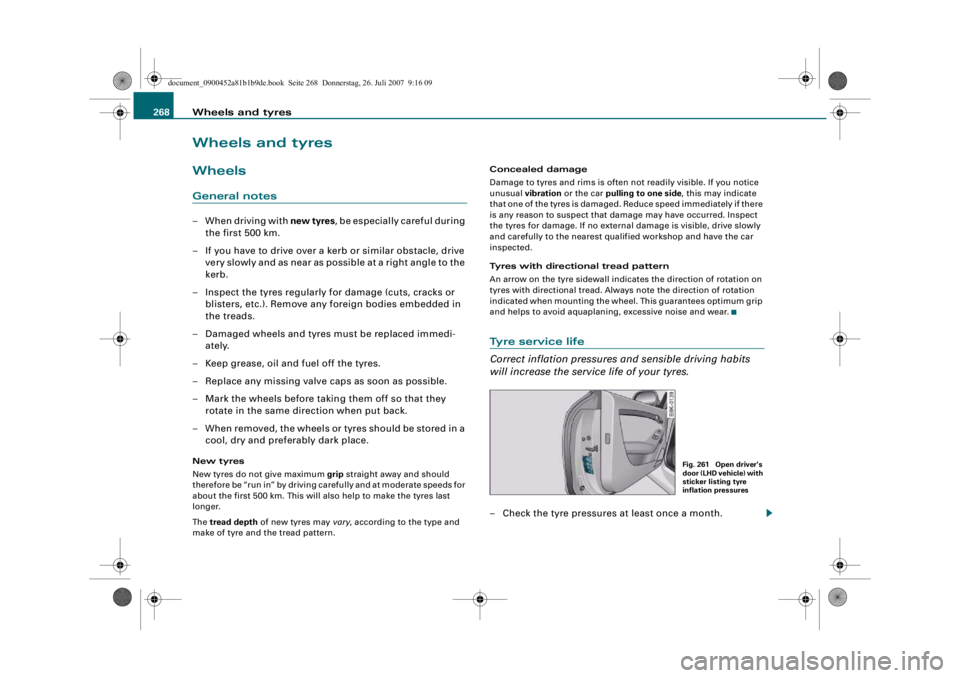
will increase the service life of your tyres.– Check the tyre pressures at least once a month.
Fig. 261 Open driver's
door (LHD vehicle) with
sticker listing tyre
inflation pressures
document_0900452a81b1b9de.book Seite 268 Donnerstag, 26. Juli 2007 9:16 09
--4 -
-T
-+
•
+-
Page 271 of 342
Wheels and tyres269
Controls
Safety
Driving tips
General maintenance
Self-help
Technical data
– The tyre pressures should only be checked when the
tyres are cold. The slightly raised pressures of warm tyres
must not be reduced.
– The pressures must be altered to suit major changes in the load being carried.
– Avoid fast cornering and hard acceleration.
– Inspect the tyres for irregular wear from time to time.Tyre pressure and vehicle loading
The tyre pressure must be adjusted according to the load the vehicle
is carrying. We recommend adhering to the tyre pressure specifica-
tions for a maximum load. The tyre inflation pressures are listed on
a sticker on the end face of the driver's door ⇒page 268, fig. 261.
However, if you prefer an extra-smooth ride and the vehicle is not
fully loaded, you can select the tyre pressure for a normal load (no
more than three people travelling in the vehicle). However, should
you wish to drive with a full load you must increase the tyre pressure
to the specified maximum.
Under-inflation or over-inflation will reduce the life of the tyres
considerably and also impair the car's handling. Correct inflation
pressures are very important, especially at high speeds. The pres-
sures should therefore be checked at least once a month and before
starting a journey.
Do not forget the spare wheel* when checking the tyre pressures.
Keep the spare tyre inflated to the highest pressure required for the
road wheels.
Driving habits
Fast cornering, heavy acceleration and hard braking (squealing
tyres) all increase tyre wear. Wheel balancing
The wheels on new vehicles are balanced. However, various factors
encountered in normal driving can cause them to become unbal-
anced, which results in steering vibration.
Unbalanced wheels should be rebalanced, as they otherwise cause
excessive wear on steering, suspension and tyres. A wheel must
also be rebalanced when a new tyre is fitted or if a tyre is repaired.
Incorrect wheel alignment
Incorrect wheel alignment causes excessive tyre wear, impairing the
safety of the vehicle. If you notice excessive tyre wear, contact your
Audi dealer.
WARNING
•
Always adapt the tyre pressure
accordingly when the vehicle
load changes.
•
Under-inflated tyres flex more an d can overheat at continuous
high speeds. This can cause trea d separation and tyre blow-out,
which could result in an accident.For the sake of the environment
Under-inflated tyres will increase the fuel consumption.
document_0900452a81b1b9de.book Seite 269 Donnerstag, 26. Juli 2007 9:16 09
--4 -
-T
-+ +-
•
Page 274 of 342
Wheels and tyres
272replacement parts, trained personnel and facilities for disposing of
the old tyres.
WARNING
•
It is very important to ensure that the tyres you have chosen
have adequate clearance. When selecting replacement tyres, do
not rely entirely on the nominal tyre size marked on the tyre; with
some makes of tyre the effective tyre size can differ significantly
from the nominal dimensions, even though the tyres have the
same size designation. Inadequate tyre clearance can result in
damage to the tyres or the vehicle, causing a serious safety risk. It
may also invalidate the vehicle' s type approval for use on public
roads.
•
Please ask your Audi dealer or qualified workshop whether run
flat tyres can be used on your ve hicle. Unauthorised use of these
tyres can invalidate the vehicle' s type approval for use on public
roads. Furthermore, this could cause damage to your vehicle and
possibly also result in an accident.
•
Avoid running the car on tyres that are more than 6 years old.
If you have no alternative, you should drive slowly and with extra
care at all times.For the sake of the environment
Old tyres must be disposed of according to the laws in the country
concerned.
Note
•
Never mount used tyres if you are not sure of their previous
history.
•
For technical reasons it is not normally possible to use wheel
rims from other vehicles. In some cases this also applies to rims
from other vehicles of the same model.
Wheel bolts
The wheel bolts are designed to suit the rims on your car.The wheel bolts are matched to the rims. When installing different
wheels (for instance wheels with winter tyres) it is important to use
the correct wheel bolts with the ri ght length and correctly shaped
bolt heads. This is essential for the secure fit of the wheels and for
the proper function of the brake system.
Audi dealers have full information on the technical requirements
when installing or changing tyres, rims or wheel trims.
The wheel bolts should be clean and turn easily.
A special adapter is required to turn the anti-theft wheel bolts*
⇒ page 292 .Winter tyres
Winter tyres will significantly improve the car's handling
in winter road conditions.–Use only radial ply winter tyres.
– Winter tyres must be fitted on all four wheels.
– Only use winter tyres of the correct type approved for your vehicle.
– Please note that the maximum permissible speed for winter tyres may be lower than for summer tyres.
– Also note that winter tyres are no longer effective when the tread is worn down.
– After fitting the wheels you must always check the tyre pressures. The correct tyre pressures are listed on the
sticker on the end face of the driver's door.
document_0900452a81b1b9de.book Seite 272 Donnerstag, 26. Juli 2007 9:16 09
--4 -
-T
•
-+ +-
[I)
•
Page 276 of 342
Wheels and tyres
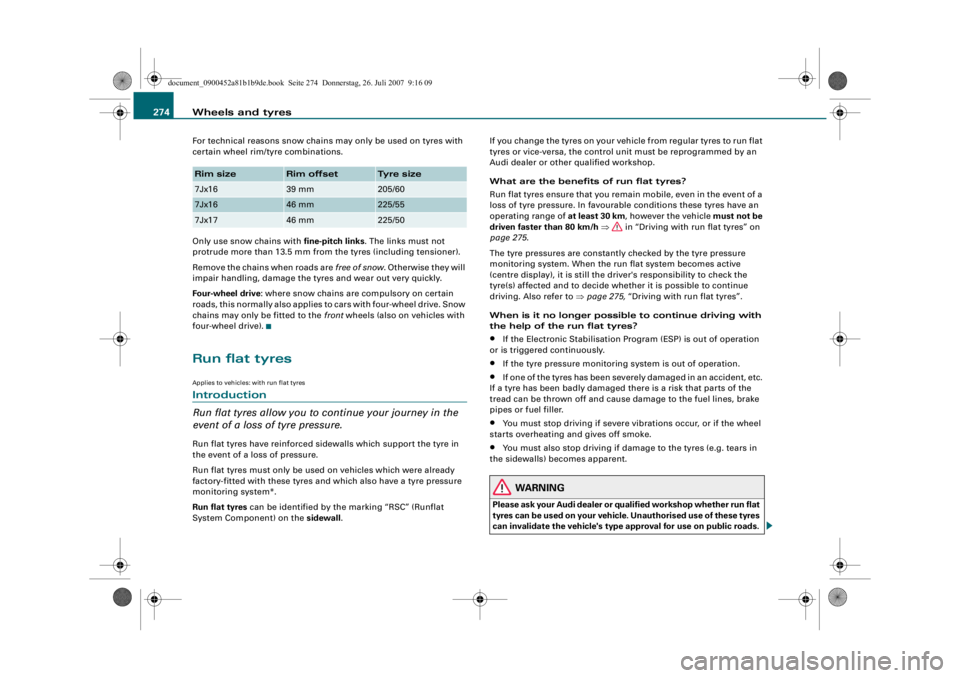
274For technical reasons snow chains may only be used on tyres with
certain wheel rim/tyre combinations.
Only use snow chains with fine-pitch links. The links must not
protrude more than 13.5 mm from the tyres (including tensioner).
Remove the chains when roads are free of snow. Otherwise they will
impair handling, damage the tyres and wear out very quickly.
Four-wheel drive : where snow chains are compulsory on certain
roads, this normally also applies to cars with four-wheel drive. Snow
chains may only be fitted to the front wheels (also on vehicles with
four-wheel drive).Run flat tyresApplies to vehicles: with run flat tyresIntroduction
Run flat tyres allow you to co ntinue your journey in the
event of a loss of tyre pressure.Run flat tyres have reinforced sidewalls which support the tyre in
the event of a loss of pressure.
Run flat tyres must only be used on vehicles which were already
factory-fitted with these tyres and which also have a tyre pressure
monitoring system*.
Run flat tyres can be identified by the marking “RSC” (Runflat
System Component) on the sidewall. If you change the tyres on your vehicle from regular tyres to run flat
tyres or vice-versa, the control unit must be reprogrammed by an
Audi dealer or other qualified workshop.
What are the benefits of run flat tyres?
Run flat tyres ensure that you remain mobile, even in the event of a
loss of tyre pressure. In favourable conditions these tyres have an
operating range of
at least 30 km, however the vehicle must not be
driven faster than 80 km/h ⇒ in “Driving with run flat tyres” on
page 275 .
The tyre pressures are constantly checked by the tyre pressure
monitoring system. When the run flat system becomes active
(centre display), it is still the driver's responsibility to check the
tyre(s) affected and to decide whether it is possible to continue
driving. Also refer to ⇒page 275, “Driving with run flat tyres”.
When is it no longer possibl e to continue driving with
the help of the run flat tyres?
•
If the Electronic Stabilisation Program (ESP) is out of operation
or is triggered continuously.
•
If the tyre pressure monitoring system is out of operation.
•
If one of the tyres has been severely damaged in an accident, etc.
If a tyre has been badly damaged there is a risk that parts of the
tread can be thrown off and cause damage to the fuel lines, brake
pipes or fuel filler.
•
You must stop driving if severe vibrations occur, or if the wheel
starts overheating and gives off smoke.
•
You must also stop driving if damage to the tyres (e.g. tears in
the sidewalls) becomes apparent.
WARNING
Please ask your Audi dealer or qualified workshop whether run flat
tyres can be used on your vehicle. Unauthorised use of these tyres
can invalidate the vehi cle's type approval for use on public roads.
Rim size
Rim offset
Tyre size
7Jx16
39 mm
205/60
7Jx16
46 mm
225/55
7Jx17
46 mm
225/50
document_0900452a81b1b9de.book Seite 274 Donnerstag, 26. Juli 2007 9:16 09
--4 -
-T
-+
•
+-
~-
Page 277 of 342
Wheels and tyres275
Controls
Safety
Driving tips
General maintenance
Self-help
Technical data
Furthermore, this could cause damage to your vehicle and
possibly also result in an accident.
Note
•
If you cannot continue driving even with run flat tyres please
obtain professional assistance.
•
You should obtain professional assistance if you are in any doubt
regarding the rims and tyres for your vehicle.
Applies to vehicles: with run flat tyresDriving with run flat tyres
Please remember that the vehicle's handling will be
impaired.Driving a vehicle with a deflat ed tyre, or with insufficient
tyre pressure, is an abnormal situation. However, since the
handling of a vehicle equipped with run flat tyres is only
slightly impaired, it is important to remember that you are
driving with a deflated tyre. If you have to make use of the
run flat system please remember the following points:
– The Electronic Stabilisation Program (ESP) must be switched on.
–Do not exceed 80km/h ⇒.
– Anticipate the traffic situation well in advance.
– Be careful when accelerating.
– Avoid unnecessary braking and steering manoeuvres.
– Reduce speed in good time before corners and potential hazards.
Please refer to ⇒page 274, “ When is it no longer possible to
continue driving with the help of the run flat tyres?”
Effects on handling when dr iving with defective tyres
If one of the front tyres is defective , your vehicle will tend to pull
slightly towards that side and braking performance will be
impaired.
A defective rear tyre will also make the vehicle pull slightly to one
side, and the braking response will again be slightly impaired.
These effects will be most noticeable when driving in a corner.
WARNING
•
When using the run flat system the changes in vehicle handling
will be noticeable when braking, in corners and during fast accel-
eration.
•
The maximum permitted speed of 80 km/h is subject to road
and weather conditions. Always observe the relevant rules and
regulations. Run flat tyres allow you to continue your journey in
the event of a loss of tyre pressu re. However, the driver remains
responsible for the safety of the vehicle and for restoring the
correct tyre pressure and having defective parts replaced
⇒ page 276 . For these reasons you should always adjust your
driving to suit the circumstances.Caution
We recommend that you drive with great care when making use of
the run flat system. Avoid abrupt manoeuvres.
WARNING (continued)
document_0900452a81b1b9de.book Seite 275 Donnerstag, 26. Juli 2007 9:16 09
--4 -
-T
•
-+ +-
0
•
Page 278 of 342
Wheels and tyres
276Applies to vehicles: with run flat tyresRenewing defective components on run flat tyres
The run flat tyres have been specially developed for your
vehicle and matched to its requirements.Use and combine only the approved run flat tyres and rims. It is not
permissible to combine standard wheels and run flat tyres ⇒.
If you have to drive with low ty re pressure or with a completely
deflated tyre, you should always ta ke the vehicle to an authorised
qualified workshop and have the defective parts inspected and the
condition corrected.
WARNING
•
We recommend that you have the run flat tyre renewed and
also have the rim checked by a qual ified workshop to identify any
damage.
•
Using tyres or rims which have not been approved can cause
damage to the vehicle. Vehicle handling can be impaired and
driving safety can no longer be guar anteed. This can also void the
vehicle's certification for use on public roads.Note
Run-flat tyres can be repaired with the TMS ⇒page 285 .
document_0900452a81b1b9de.book Seite 276 Donnerstag, 26. Juli 2007 9:16 09
--4 -
-T
&
-+ +-
[I]
•
Page 287 of 342
Self-help285
Controls
Safety
Driving tips
General maintenance
Self-help
Technical data
How to use the compact temporary spare wheel
Should you ever have a punctu
red tyre, the compact temporary
spare wheel is only intended for temporary use until you can reach
a workshop. The standard-size road wheel should be refitted as
soon as possible.
Please note the following restrictions when using the compact
temporary spare wheel. The comp act temporary spare wheel is
designed specifically for this model. For this reason, do not use a
temporary spare from a different type of vehicle.
Snow chains
For technical reasons, snow chains must not be used on the
compact temporary spare wheel.
If you should have a puncture on one of the front wheels when using
snow chains, fit the compact tempor ary spare in place of one of the
rear wheels. You can then attach the snow chains to the wheel taken
from the rear and use this wheel to replace the punctured front
wheel.
WARNING
•
The tyre pressures must be checked and corrected as soon as
possible. The tyre pressure of the compact temporary spare wheel
must be 4.2 bar – an incorrectly inflated tyre can cause an acci-
dent.
•
Do not drive faster than 80 km/h - higher speeds can cause an
accident.
•
Avoid heavy acceleration, hard braking and fast cornering – risk
of accident.
•
Never use two or more compact spare tyres at the same time –
risk of accident.
•
No other type of tyre (normal summer or winter tyres) may be
fitted on the compact temporary spare wheel.
Ty r e r e p a i r sGeneral information and safety notes
Repaired tyres are only suitable for temporary use.Your vehicle is equipped with a tyre repair kit: the Tyre Mobility
System (TMS).
In the event of a puncture you will find the TMS, which consists of a
sealing compound and an electric compressor, located under the
floor panel in the luggage compartment.
The TMS will reliably seal tyres damaged by foreign bodies,
provided that the cuts or punctu res are no larger than approx. 4 mm
in diameter.
It is not necessary to remove the foreign body from the tyre.
The sealing compound must not be used:•
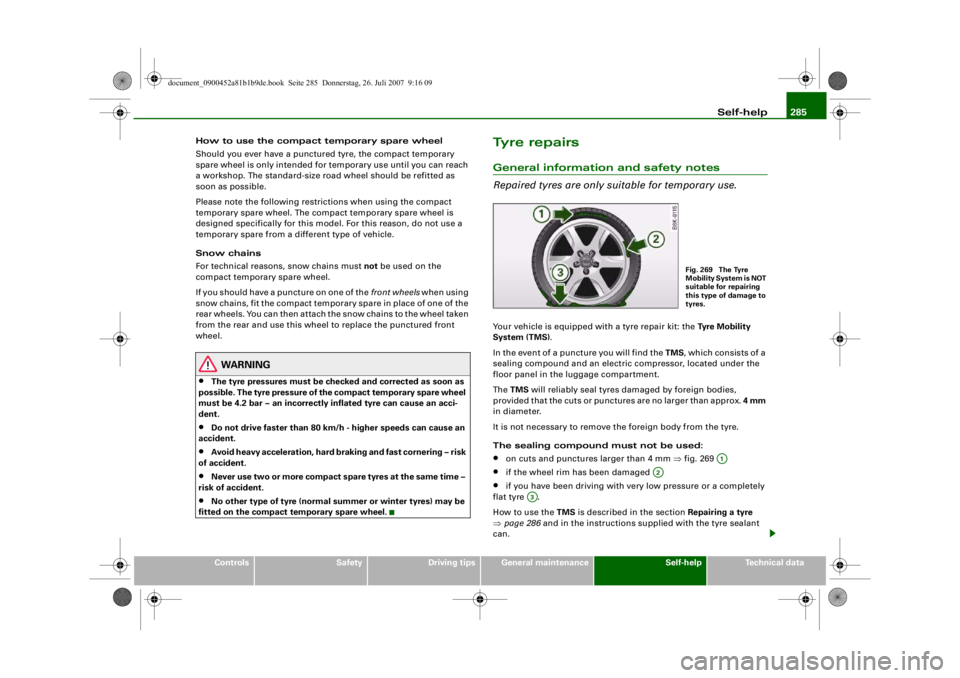
on cuts and punctures larger than 4 mm ⇒fig. 269
•
if the wheel rim has been damaged
•
if you have been driving with ve ry low pressure or a completely
flat tyre .
How to use the TMS is described in the section Repairing a tyre
⇒ page 286 and in the instructions supp lied with the tyre sealant
can.
Fig. 269 The Tyre
Mobility System is NOT
suitable for repairing
this type of damage to
tyres.
A1
A2
A3
document_0900452a81b1b9de.book Seite 285 Donnerstag, 26. Juli 2007 9:16 09
--4 -
-T
-+ +-
•