change wheel AUDI S4 2013 User Guide
[x] Cancel search | Manufacturer: AUDI, Model Year: 2013, Model line: S4, Model: AUDI S4 2013Pages: 302, PDF Size: 75.61 MB
Page 244 of 302
24 2 T ire s and wheel s
-Adjust the tire pressure to the load you are
carrying.
- Reinsta ll the va lve stem cap on the valve .
When should I check the tire pres sur e?
The correct tire pressure is especially impor
tant at high speeds. The pressure should
therefore be checked at least once a month
and a lways before starting a journey. Do not
forget to check the tire pressure for the spare
wheel.
When should I a dju st the tire p re ss ures?
Adjust the tire pressure to the load you are
carry ing . After changing a wheel
o r replacing
wheels you have to adjust the tire pressures
on all wheels . In addition, you must then initi
alize the new tire pressures in the tire pres
sure monitoring system*
r:!> page 253.
A WARNING
Incorrect tire pressures and/or underinf la
tion can lead sudden tire failure, loss of
control, collision, ser ious personal injury
or even death.
- When the
II] warning symbol appears in
the instrument cluster, stop and inspect
the tires .
- Incorrect tire pressure and/or underinfla
t ion can cause increased t ire wear and
can affect the handling of the veh icle and
stopp ing ability.
- Incorrect tire pressures and/or underin
flation can also lead to sudden tire fa il
ure, including a blowout and sudden de
flation, causing loss of vehicle control.
- The driver is responsible for the correct
t ire press ures fo r all tires on the vehicle .
T he applicable p ressure va lues are locat
ed on a sticker on the driver's side B -pil
lar.
- Only when a ll ti res on the vehicle are fi l
led to the correct pressure, the tire pres
sure monitoring system* can work cor
rect ly.
- The use of incorrect tire pressure values
can lead to accidents or other damage.
Therefore it is essential that the driver observe the specified t
ire pressure val ues
for the tires and the correct pressures for
the function of the ti re pressure monitoring system*.
- Always inflate tires to the recommended
and correct t ire pressure before dr iv ing
off.
- Driving with underinflated tires bend
more, letting them get too hot resulting
in tread separation, sudden tire failure
and loss of control.
- Excessive speed and/overloading can
cause heat build-up, sudden tire failure
and loss of cont rol.
- If the tire pressure is too low or too high,
the t ires will wear prematurely and the
veh icle w ill not ha ndle well.
- If the tire is not flat and you do not have
to change a wh eel immediately, drive at
red uced speed to the nearest service sta
tion to check the t ire p ressure and add
air as required.
Q) Note
D riving without valve stem caps can cause
damage to the tire valves. To prevent this,
a lways make sure tha t factory insta lled
valve stem caps on all whee ls are sec urely
mounted on the valve.
@ For the sake of the environment
U nderinflated tires w ill also incre ase the
fuel consumption .
Tires and vehicle load limits
There are limits to the amount of load or
weight that any veh icle and any tire can carry.
A vehicle that is over loaded will not handle
well and is more d iff icult to stop. Overloading
can not only lead to loss of vehicle control,
but can also damage important parts of the
vehicle and can lead to sudden tire fa ilure, in
cl ud ing a b lowout and sudden deflation tha t
can cause the vehicle to crash.
Your safety and that of your passengers also depends on making sure that load limits are .,..
Page 256 of 302
254 Tire s and wheel s
stored. You can find the recommended tire
pressures for your vehicle on the label on driv
er 's side 8-p illar
c> page 238.
Tire tread c ircumference and vibration charac
teristics can change and ca use a tire pressure
warning if :
- the tire pressure in one or more t ires is too
low,
- the tire has st ructu ral damage,
- the tire pressure was changed, wheels rotat-
ed o r replaced but the TPMS was not reset
c>page254.
Warning s ymbols
[DJ Loss of pressure in at least one tire c> .&..
Check the tire or tires and replace o r repair if
n ecessary. The
[DJ ind icator light in the instru
ment cluster also illuminates
c> page 13.
Chec k/correc t the pressures of all four tires
and reset TPMS via radio or
MMI* .
1181&1 (T ire Pressure Monitor ing System) Tire
pr essur e: Sy st e m malfuncti on !.
If!JHJL, appears after switching the ignition
on or wh ile driving and the
[DJ indicator light
i n the instrument cluster blinks for approxi
mately one mi nute and then stays on, the re is
a system ma lfunction .
Attempt to store the correct tire pressure
¢
page 254. If the ind icator light does not
turn
off or if it tu rns o n short ly thereafter, im
mediately drive your veh icle to an autho riz ed
Aud i dea le r or autho rized repair facility to
have the ma lfunction corrected.
A WARNING
- If the tire pressure indicator appears in
the instrument cl uster display, one or
more of your tires is significantly under
inflated. Reduce your speed immediately
and avoid any hard stee ring or braki ng
maneuvers. Stop as soon as possible and
check the t ires and the ir pressures. In
flate the tire pres sure to the proper p res
s u re as in dic ated on the vehicle 's t ire
pressure label ¢
page 238. Driving on a
significantly under-inf lated tire ca uses the tire to overheat and can
lead to tire
fa ilure. Under-inflation also is likely to
impair the vehicle's handling and stop
ping ability.
- The driver is responsible for maintaining
the correct tire pressures. You must
check the tire pressures regu larly .
- Under certain conditions (such as a spor
ty driving style, winter conditions or un paved roads), the pressure monitor indi
cato r may be delayed .
-Ask your authorized Aud i dea ler if run
flat t ires may be used on you r vehicle.
Your vehicle registration becomes invalid
if you use these t ires when not perm it
ted. Damage to your vehicle or accidents
could a lso result.
(D Tips
- The tire pressure mon itoring system
stops work ing whe n there is an ESC/ABS
m alfu nction.
- Us ing snow chains may result in a system
ma lf u nction.
- The tire pressure mon itoring system on
your Audi was deve loped using tires with
t he "AO" or "R O" ident ifi cat ion on the
tire s idewa ll
c> page 246 . We recom
mend using these tires.
Reset tire pressure monitoring system
Appl ies to vehicles: wit h tire p ressu re mo nito rin g system
If the tire pressure is adjusted, wheels are ro
tated or changed, the TPMS must be reset via
radio or MMI*.
.. Before resett ing the TPMS, the current pres
sures of a ll four tires must correspond to
the specified values . Ad just the tire p ressu re
and reset the pressure in the tire pressure
mon ito ring system according to the load
you are carrying
i=>page 238.
.. Turn on the ignition.
.. Select: the
ICARI funct ion button > Tire
pressur e monitoring
> Stor e now . Or
.,. Select: the
ICARI funct ion button> Car sy s
tem s*
cont ro l button > Servi cing & che ck s > .,.
Page 260 of 302
2 58 What do I do n ow ?
• Always store the vehicle too l kit, the jack*
and the replaced tire in the luggage com
partment ¢
page 133.
Stowing the infl ata ble spare tir e
• Re lease the air by unscrew ing the va lve
stem.
• Screw the valve stem back in afterwards .
• Wait a few hours before placing the whee l
in the spare wheel well¢
,A.
• Secure the wheel with the large screw.
• Fold the cargo floor back down.
Aft er using th e inflat able sp are wh eel
The inflatable spare tire can be re-used as
long as it is not damaged and is not worn
down to the tread wear indicators¢&. .
When you let the air out of the inflatable
spare tire, it does not assume its folded shape
again for several hours . Until then, it cannot
be p laced back in the spare wheel well and
stowed securely .
A WARNING
-Never use the spare tire if it is damaged
or if it is worn down to the tread wear in
dicators.
- If the inflatable spare tire is more than 6
years old, use it only in an emergency and w ith extreme caut ion and caref ul
dr iv ing .
- The inflatable spare tire is intended only
for temporary and short-term use.
It
should be replaced as soon as possible
with the norma l wheel and tire.
- T he tire pressure value for the inflatable
spare t ire is located on the drive r's side
8 -pilla r
¢page 238, fig. 192.
-Maximum perm iss ible speed is 50 mph
(80 km/h).
- Avoid full-throttle acce le rat ion, heavy
braking, and fast corner ing.
- When the air is let out of the inflatable
spare wheel, it does not ass ume its fold
ed shape for severa l hours. Until t hen, it
cannot be p laced back in the spare wheel
we ll and stowed secu rely . -
Never drive with more than one inflata
ble spare tire.
- For technical reasons, the use of tire
chains on the inflatable spare tire is not
perm itted. If it is necessary to drive with
tire chains, the inflatab le spare wheel
must be mounted on the rear axle in the
event of a f lat in a front tire . The newly
availab le rear whee l must then be instal
led in place of the front whee l with the
f lat t ire. Instal ling the tire chain before
mount ing the wheel and tire is recom
mended .
- L oose items in the passenger compart
ment can cause serious personal injury
during hard braking or in an accident.
Never store the inflatable spare tire or
jack* and too ls in the passenger com
partment.
(D Note
- The inflatable spa re tire has been deve l
oped specifically for this vehicle mode l.
It must not be exchanged or used for
other vehicle models. Sim ilarly, inflata
ble t ires from other vehicle models must
not be used.
- Normal summer or w inter tires must not
be installed on the inflatable t ire rim.
Inflating inflatable
spare tire
Applies to veh icles: w ith inflatable spare t ire
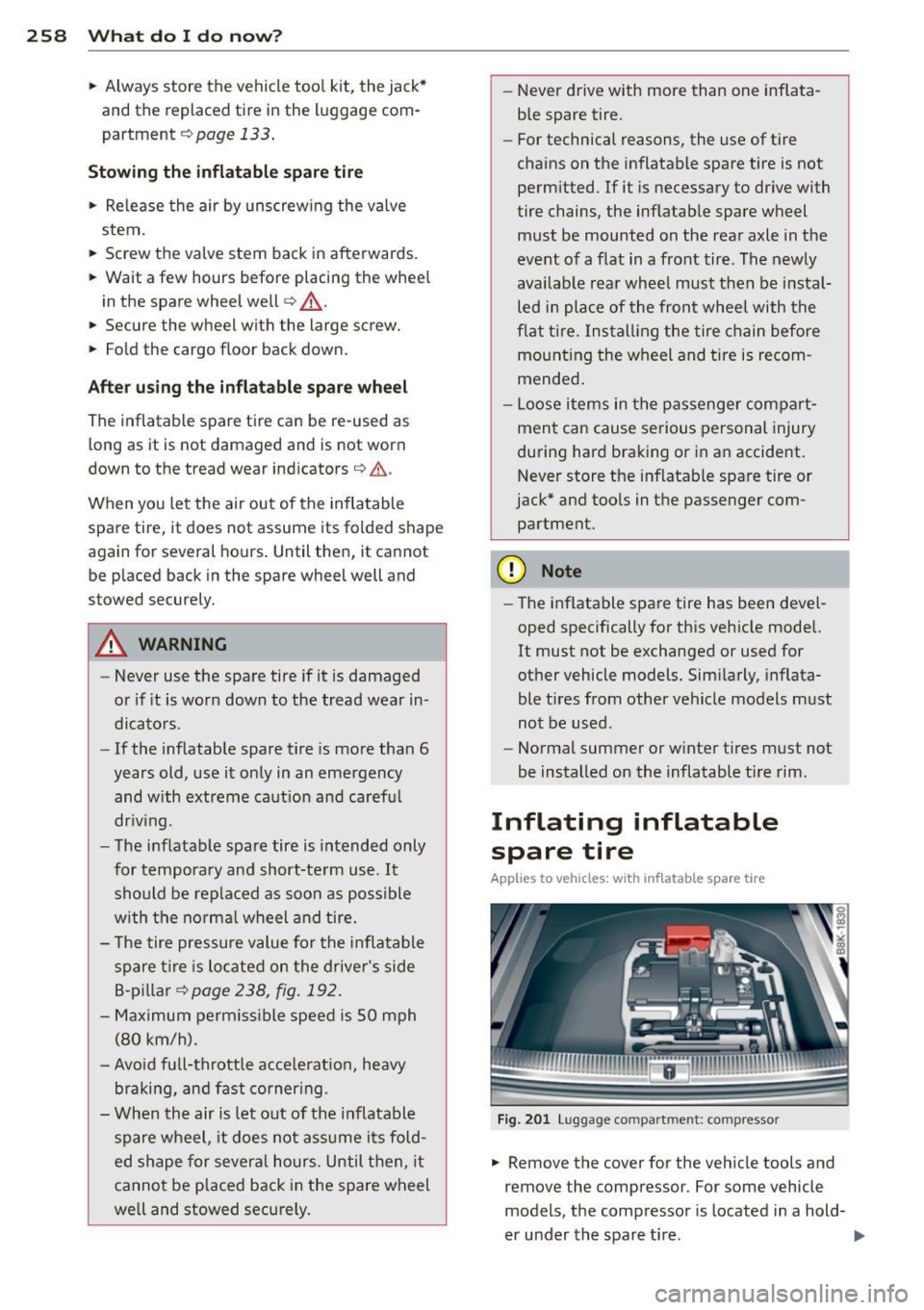
F ig. 201 Lu gg age compart ment: co mpressor
• Remove the cover for the veh icle tools and
remove the compressor. For some vehicle
models, the compressor is located i n a hold-
er under the spare tire . .,.
Page 261 of 302
~ Unscrew the valve stem from the spare tire.
~ Screw the tire filler hose from the compres
sor firmly onto the valve of the spare tire.
~ Insert the plug from the compressor into a
socket of the vehicle¢
page 64.
~ Switch the compressor on .
~ Let the compressor run until the value
specified on the tire pressure label is
reached
¢ page 238, fig. 192. Switch the
compressor off after running for 12 minutes
at the most -danger of overheating!
A WARNING
The compressor and the tire filler hose can
become extremely hot while they are run
ning -danger of burns!
(D Note
Switch the compressor off after running
for 12 minutes at the most -danger of
overheating! Allow the compressor to cool
down for a few minutes before you use it
again.
Changing a wheel
Before changing a wheel
Observe the following precautions for your
own and your passenger's safety when chang
ing a wheel .
~ After you experience a tire failure, pull the
car well away from moving traffic and try to
reach
level ground before you stop¢ L!)..
~ All passengers should leave the car and
move to a safe location (for instance, behind
the guardrail) ¢
A.
~ Engage the parking brake to prevent your
vehicle from rolling unintentionally ¢
A.
~ Shift into 1st gear on vehicles with manual
transmission, or move the
selector lever to
the P position
on vehicles with automatic
transmission .
~ If you are towing a trailer: unhitch the trail
er from your vehicle.
~ Take the jack¢ page 256 and the spare tire
¢ page 257 out of the luggage compart
ment.
What do I do now? 259
A WARNING
You or your passengers could be injured
while changing a wheel if you do not fol
low these safety precautions:
- If you have a flat tire, move a safe dis
tance off the road. Turn off the engine,
turn the emergency flashers on and use
other warning devices to alert other mo
torists.
- Make sure that passengers wait in a safe
place away from the vehicle and well
away from the road and traffic.
- To help prevent the vehicle from moving
suddenly and possibly slipping off the
jack, always fully set the parking brake
and block the wheel diagonally opposite
the wheel being changed with the fold
ing chocks or other objects. When one
front wheel is lifted off the ground, plac ing the Automatic Transmission in "P"
(Park) will
not prevent the vehicle from
moving .
- Before you change a wheel, be sure the
ground is level and firm. If necessary,
use a sturdy board under the jack.
- Always store the vehicle tool kit, the
jack* and the replaced tire in the luggage compartment
¢page 133.
(D Note
If you are changing the wheel on a steep
incline, use a rock or similar object to
block the opposite wheel to prevent the
vehicle from moving.
(D Tips
Obey all laws.
Changing a wheel
When you change a wheel , follow these
quence described below step-by-step and in
exactly that order.
l. Remove the decorative wheel cover* or
-
the wheel bolt caps*. For more details see..,.
•
•
Page 262 of 302
260 What do I do now ?
also c:> page 2 60 , Decorative wheel cov
ers
or c:> page 260, Wheels with wheel
bolt caps.
2 . Loosen the wheel b olts c:> page 261.
3 . Locate the proper mounting point for the
jack and align the jack below that point
<=> page 261.
4. Li ft the car with the jack c:> page 261 .
5. Remove the wh eel with th e flat tir e and
then install the
s par e tir e c:> page 262 .
6 . Tighten all wheel bolts light ly .
7 .
Lowe r the ve hicle with the jack .
8 . Use the wheel bolt wrench and
firml y
tighten all whee l bolts in a crisscross pat
tern
c:> page 261.
9 . Replace the decora tive whe el c ov er* or
the
wh eel b olt caps *.
A WARNING
Always read and follow all WARNINGS and
information
c:> .&. in Raising the vehicle on
page
262 and c:>page 263.
After changing a wheel
A wheel change is not complete without the
doing the following .
.,. Always store the vehicle tool kit, the jack*,
and the replaced tire in the l uggage com
partment
c:> page 133 .
.,. Check the tire pre ssure of the spare tire as
soon as poss ible .
.,. As soon as possible, have the
tightening
torqu es
on all wheel bo lts checked with a
torq ue wrench . The correct tightening tor
que is 90
ft lbs. (120 Nm) .
.,. Have the flat tire
repl aced as soon as poss i
ble .
(j) Tips
-If you notice that the whee l bolts are
corroded and difficult to turn while
changing a t ire, they should be replaced
before you check the tighten ing torque.
- Drive at reduced speed unt il you have the
tightening torques checked .
Decorative wheel covers
Applies to vehicles: with decorative whee l covers
The decorative wheel covers must be removed
first to access the wheel bolts .
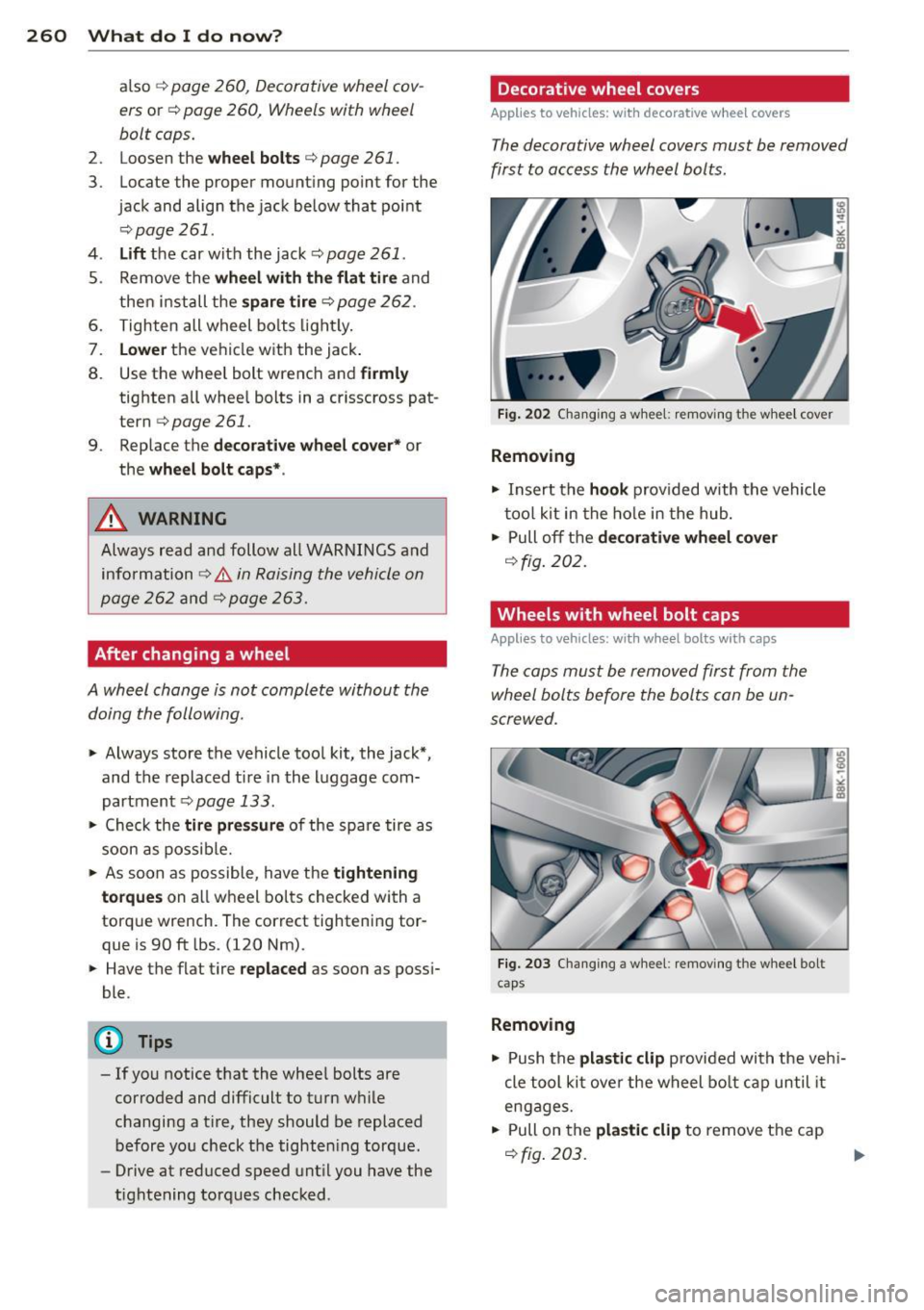
Fig . 202 Cha ng in g a w hee l: removing t he w heel cover
Removing
.,. Insert the hook prov ided with the vehicle
too l kit in the hole in the hub.
.,. Pull off the
dec ora ti ve wh eel cove r
<=>fig. 202.
Wheels with wheel bolt caps
Applies to vehicles: with wheel bolts with caps
The caps must be removed first from the
wheel bolts before the bolts can be un
screwed .
Fig. 203 Changing a wheel: removing t he wheel bolt
caps
Removing
.,. Push the plast ic clip provided with the ve hi
cle tool ki t over the wheel bo lt cap until it
engages.
.,. Pull on the
plastic clip to remove the cap
r:!) fig. 203.
Page 263 of 302
Refitting
• Place the caps over the wheel bo lts and
push th em back on.
The caps are to protect and keep the wheel bolts clean.
Loosening and tightening the wheel
bolts
The wheel bolts must be loosened before ra is
ing the vehicle .
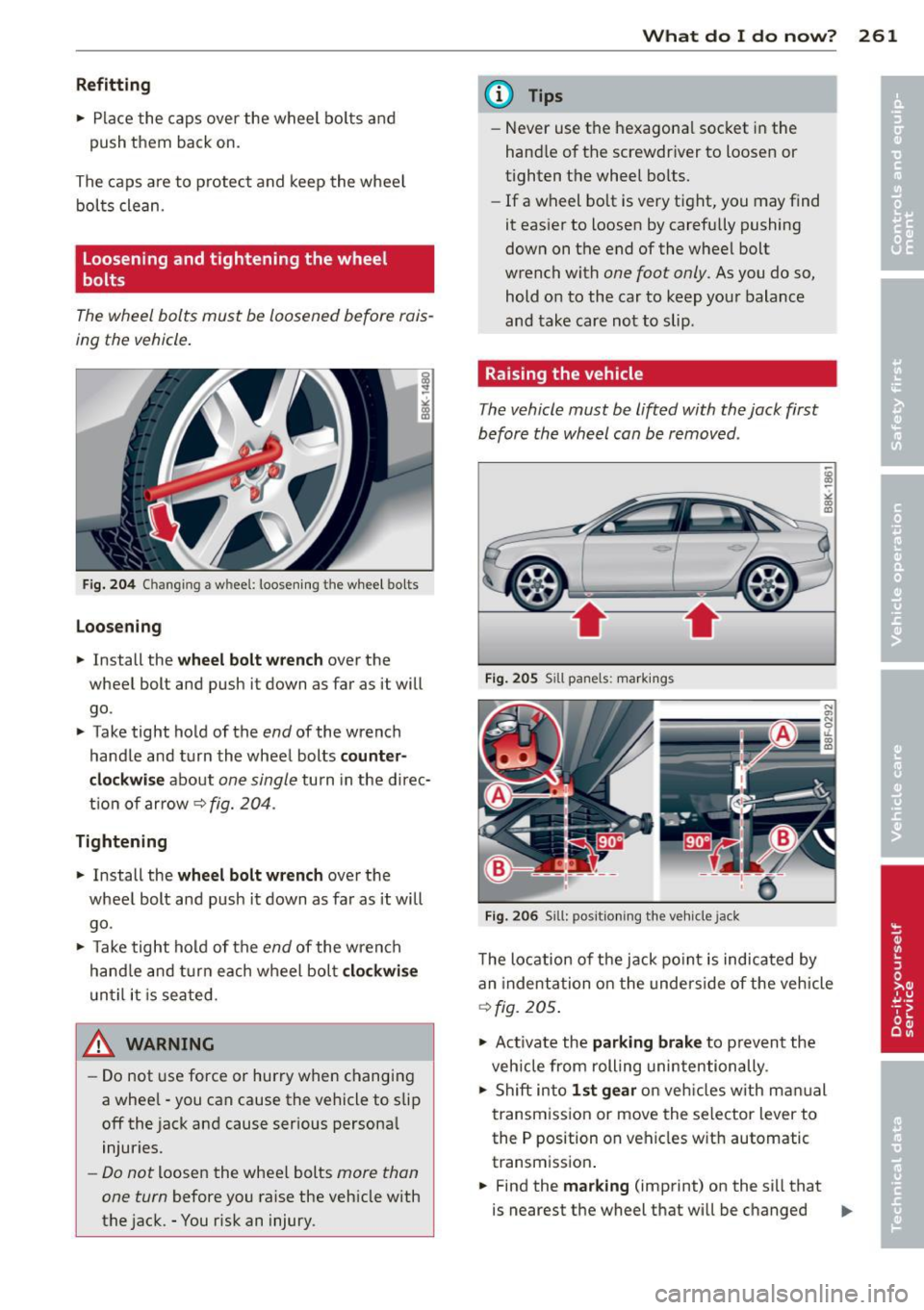
Fig. 204 C hangin g a whee l: l oosening t he w heel bolts
Loo sening
• Install the wheel bol t w rench over the
wheel bolt and push it down as far as it will
go .
• Take tight hold of the
end of the wrench
hand le and turn the whee l bolts
co unter
cl ock wise
about one single turn in the direc
t ion of arrow
9 fig. 204 .
Tightening
• Install the whe el bolt w rench over the
wheel bolt and push it down as far as it will go .
• Take tight hold of the
end of the wrench
hand le and turn each wheel bol t
clockwi se
until it is seated .
_& WARNING
-Do not use force or hurry when changing
a whee l -you can cause the vehicle to slip
off the jack and cause serious persona l
injuries.
- Do not Loosen the wheel bolts more than
one turn
before you raise the veh icle with
the jack. -You risk an injury .
What do I do now ? 261
@ Tips
-Never use the hexagona l socket in the
hand le of the screwdr iver to loosen or
tighten the wheel bolts.
- If a wheel bo lt is very tight, you may find
it eas ier to loosen by carefully pushing
down on the end of the wheel bolt
wrench with
one foot only . As you do so,
hold o n to the car to keep your balance
and take care not to slip .
Raising the vehicle
The vehicle must be lifted with the jack first
before the wheel can be removed .
Fig . 205 Sill panels: mark ings
Fig. 20 6 Sill: positi on ing the v eh icle ja ck
The location of the jack po int is indicated by
an indentation on the underside of the vehicle
9 fig . 205 .
• Act ivate the parking brak e to prevent the
veh icle from rolling unintentionally .
• Shift into
1st ge ar on veh icles with ma nual
transmiss ion or move the selector Lever to
the P position on vehicles w ith automatic
transm iss ion .
• Find the
m arking (impr int) on the sill that
i s nearest the wheel that will be changed .,..
Page 265 of 302

Removing the wheel
"' Remove the topmos t wheel bo lt completely
with the
he xagonal socket in t he screwdriv
er hand le (vehicle tool kit) ¢
fig. 207 and
set it aside on a
clean surface.
"' Screw the threaded end of the
alignment
pin
from the tool k it hand-tight into the
empty bolt hole ¢
fig. 208.
"' Then remove the o ther wheel bo lts as de
scribed above .
"' Take off the wheel leav ing the alignment
pin in the bo lt ho le
~ CD .
Putting on the spare tire
"' all road : Inflate the inflatable spare tire
~ page258
"' Push the spare tire over the a lignment pi n.
"' Screw o n the whee l bolts and tighten them
slightly using the hexagonal socket .
"' Remove the alignment pin and insert an d
t ighten the remaining whee l bo lt s light ly
li ke the rest .
"' Turn the jack handle counter-clockw ise to
lower the vehicle unt il the jack is f ully re
l eased .
"' Use the whee l bolt wrench to t ighten a ll
wheel bolts firmly ¢
page 261. Tighten
them
in a crisscross pattern, from one bo lt
to the (approx imately) opposi te o ne, to keep
t h e whee l cen te red .
"' Perform the steps requ ired after cha nging
the wheel ~
page 260 , After changing a
wheel .
The hex agonal so cket m akes it easier to re
move the w heel bo lts from the r im . Care
should be taken when removing the reversible
b lade .
@ Note
When removing or ins tall ing the wheel,
the rim could hit the brake rotor an d dam
age the rotor . Wor k carefully and have a
second person to he lp you .
@ Tips
-When mounting tires with unidirectional
tread design
ma ke s ure the tread pat-
What do I do now? 263
'
tern is po inted the righ t way
¢ page 263.
- The w heel bolts shou ld be clean an d easy
to t urn . Check fo r dirt an d corrosion on
the mating surfaces of both the w heel
and the hub. Remove all d irt from these
surfaces before remounting the whee l.
- Do not use the hexagonal socket in the
sc rewd river handle to loosen or t ighten
the whee l bolts.
Tires with unidirectional tread design
Tires with unidirectional tread design must be
mounted with their tread pattern pointed in the right direction.
Us ing a spa re tire with a tread pattern
intended for use in a specific di rection
When using a spare t ire with a tread patter n
intended for use in a spec ific d irection, please
note the following :
- The d irect ion of rotation is marked by an
ar
row on the side of the t ire .
-If the spare tire has to be insta lled in the in
correct d irect ion, use the spare tire only
temporarily s ince the tire will not be able to
achieve its optimum performance cha racte r
istics w it h regard to aquap la ni ng, no ise and
wear .
- We recommend that you pay part icu lar at
t en tion to th is fact during we t weather and
that you adjust your speed to match road
condi tions.
- Replace the flat t ire wi th a new one a nd
have it insta lled o n you r vehicle as soo n as
pos sible to res to re the hand ling advant ages
o f a u nidirec tional tire.
Notes on wheel changing
Please read t he info rmation ~ page 24 6, New
tires and replacing tires and wheels
if yo u a re
going to use a spare tire wh ich is different
from the tires on your vehicle.
After yo u change a tire:
IJI,-
•
•