oil AUDI S4 2013 User Guide
[x] Cancel search | Manufacturer: AUDI, Model Year: 2013, Model line: S4, Model: AUDI S4 2013Pages: 302, PDF Size: 75.61 MB
Page 85 of 302
CD Note
If the engine has been under heavy load
for an extended period, heat builds up in
the engine compartment after the engine
is switched off- there is a risk of damaging
the engine . Allow the engine to run at idle
for about two minutes before switching it
off.
Convenience key
Starting the engine
Applies to vehicles: with convenience key
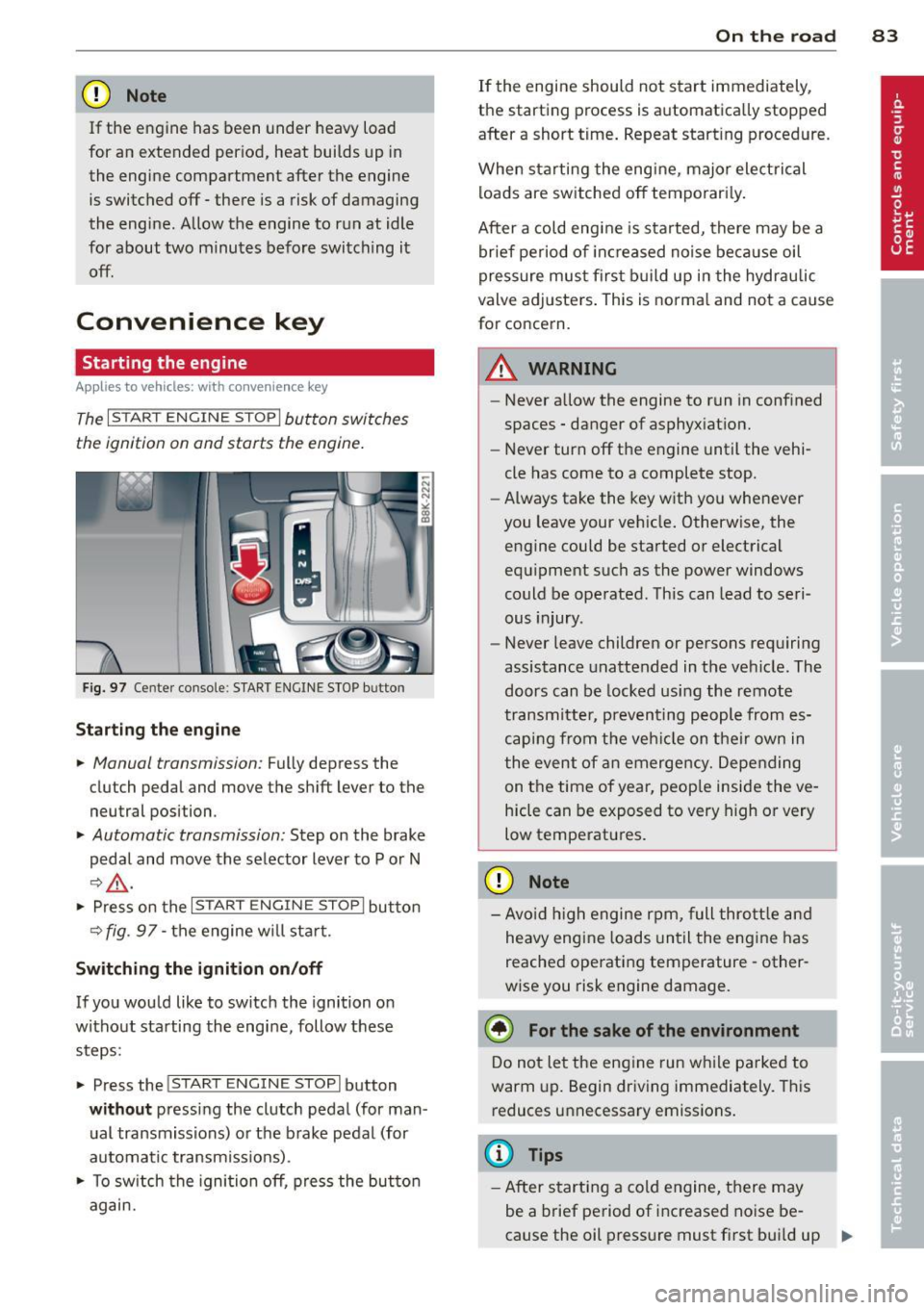
The I STAR T ENGINE ST OPI button switches
the ignition on and starts the engine.
Fig. 97 Center console : S TART ENGINE STOP b utto n
Starting the engine
.. Manual transmission: Fully depress the
clutch pedal and
move the shift lever to the
neutral position .
.. Automatic transmission: Step on the brake
pedal and
move the selector lever to P or N
~ .&, .
.. Press on the I STAR T ENGINE S T OPI button
~fig . 97-the engine will sta rt.
Switching the ignition on/off
If you would like to switch the ignition on
without starting the engine, follow these
steps :
.. Press the
!START E NGIN E STOPI button
without pressing the clutch pedal (for man
ual transmissions) or the brake pedal (for
automatic transmissions) .
.. To switch the ignition off, press the button
again.
On the road 83
If the engine should not start immediately,
the starting process is automatically stopped
after a short time. Repeat starting procedure .
When starting the engine , major electrical
loads are switched off temporari ly.
After a cold engine is started, there may be a
brief period of inc reased noise because oil
pressure must first build up in the hydraulic
valve adjusters. This is norma l and not a cause
for concern.
A WARNING
- Never allow the engine to run in confined
spaces - danger of asphyxiation.
- Never turn off the engine until the vehi
cle has come to a complete stop.
- Always take the key with you whenever
you leave your vehicle. Otherwise, the
engine could be started or electrical
equipment such as the power windows
could be operated . This can lead to seri
ous injury .
- Never leave children or persons requiring
assistance unattended in the vehicle. The
doors can be locked using the remote
transmitter, preventing people from es
caping from the vehicle on their own in
the event of an emergency. Depending
on the time of year, peop le inside the ve
hicle can be exposed to very high or very
low temperatures .
CD Note
-Avo id high engine rpm, full throttle and
heavy engine loads until the engine has
reached operating temperature - other
wise you risk engine damage.
@ For the sake of the environment
Do not let the engine run while parked to
warm up. Begin driving immediately. This
reduces unnecessary emissions.
(D Tips
-After starting a cold engine, there may
be a brief period of increased noise be-
cause the oil pressure must first bui ld up
II-
Page 192 of 302
190 Intelligent technology
to brake. This may cause the brakes to
overheat, premature wear and increased
stopp ing distance.
- Under certain climatic and operating
condit ions such as passing through wa
ter, driving in heavy ra in or after wash ing
the vehicle, the effect iveness of the
brakes can be reduced . In winter, ice can
accumulate on the brake pads, linings,
discs and drums. Carefully apply brakes
f or a test . B rakes will dry a nd ice coat
ings will be cleaned off after a few ca re
ful brake applications.
- Driv ing for an extended pe riod of time on
salt -covered roads without using you r
brakes can also affect braking efficiency.
Clean off accumulated salt coating from
brake discs and pads w ith a few careful
brake applicat ions.
- If you damage the front spoiler, or if you
install a different spoiler, be sure the air
flow to the front brakes is not obstruct
ed . O therwise the brake system could
overheat reducing the effectiveness of
the ent ire brake system.
- Failure of one brake c ircuit will impair
the braking capability resulting in an in creased stopp ing distance. Avoid driv ing
the vehicle and have it towed to t he near
est author ized Audi dealer or qualif ied
workshop.
- Never let the vehicle roll to a stop w ith
the engine shut off.
- If the brake booster is not working, for
example when towing your ve hicle, or
because the b rake booste r has somehow
been damaged, the brake pedal must be
pressed considerab ly harder to make up
for the lack of booster assistance.
Electro-mechanical
power assist, dynamic
steering
The electro-mechanical power assist helps
the driver when steering.
Power steer ing adapts electronically based on
the veh icle speed.
Indicator lights and messages
• Ste ering d efe ct ive ! Do not d rive vehicle!
If this indicator light turns on and stays on
a nd this message appears, the power steering
may have failed .
Do
not continue driving. See your authorized
Audi dealer or other qualified repair facility
for assistance.
'Tij D ynamic steer ing: Sy stem f au lt! You c an
cont inue d riving
If the indicator l ight turns on and the mes
sage appears, the stee ring may be more diffi
c ul t to move o r more sensitive than usua l. The
steering wheel may a lso be at an ang le when
driv ing straight.
Drive slowly to your authorized Audi dea ler or
qualified workshop to have the ma lf u nction
corrected.
'Tij Dynamic stee rin g: initializing
If this driver message appears and the indica
tor light is flashing on the instrument panel, dynamic steer ing* is being re initia lized . On ce
you start the engine after t his is finished, the
steering wheel will be easy to move . Re-initi
alizat ion might be necessary if the steering
whee l was moved hard to the left and right
whi le the vehicle was not moving. The display
goes out as soon as initiali zation is complete.
A WARNING
-Have the dynamic steering* system mal
function repa ired as soon as possible by an
authorized Audi dealer or any qualified
workshop - r is k of accident!
-
Page 196 of 302
194 Driving and environment
Driving and
environment
The first 1,000 miles
(1,500 km) and
afterwards
New engine
The engine needs to be run-in during the first
1,000 miles (1,500 km).
For the fir st 600 miles (1,000
kilometers ):
.,. Do not use full throttle.
... Do not drive at engine speeds that are more
than 2/3 of the max imum permitted RPM.
From 600 to 1,000 miles (1 ,000 to
1,500 kilometers):
.,. Speeds can gradually be increased to the
max imum pe rm iss ible road or eng ine speed .
During and after break-in per iod
... Do not rev the eng ine up to h igh speeds
when it is cold. Th is app lies whether the
transmission is in N (Neutral) or in gear.
After the break- in period
... Do not exceed max imum eng ine speed un
der any circumstances .
... Upshift into the next higher gear
before
reaching the red area at the end of the tach
ometer scale¢
page 10.
During the first few hours of driving, the en
g ine's inter na l friction is higher tha n later
when alt the moving parts have been broken
i n. How welt this break- in process is done de
pends to a conside rable extent on the way the
ve hicl e is driven du ring the first 1,000 miles
(1, 500 kilome ters).
(D Note
E xtremely high engi ne speeds are auto
mat ica lly re duced. However, these rpm
lim its are programmed for a n engine welt
r u n- in, not a new eng ine.
{® For the sake of the environment
Do not drive with unnecessarily high en
g ine speeds - upshifting ear ly saves fuel,
reduces no ise and protects the environ
ment.
, New tires
If your vehicle is runni ng on new tires, drive
very carefully for the first 350 miles (500 kilo meters) after fitting.
_& WARNING
N ew tires tend to be slip pery a nd mus t al
so be "broken -in" . Be s ure to remembe r
this dur ing the fi rst 350 mi les (500 kilo
meters) . Brake gently . Avoid fo llow ing
closely behind other vehicles or other sit
uations that m ight require sudden, hard
braking.
Avoid damaging the
vehicle
When you a re d rivi ng on poo r roads, or over
cu rbs, ste ep ramps, etc., ma ke certai n that
low- ly ing parts s uch as spoile rs and ex ha ust
s ystem parts do not bot tom o ut and get dam
aged.
T his is espec ially true for veh icles with low
s lu ng chassis (s por ts chassis)* and fully load
ed vehicles.
Driving through water
on roads
Note th e following to avoid vehicle damage
whe n driving through water, for examp le on
flooded roads:
- The wa ter must not be any hig he r th an the
bottom of the vehicle body .
- Do not dr ive faste r than walk ing speed.
Page 197 of 302
A WARNING ,~ ~
After driving through water, mud, slush,
etc., the brakes may be slow to take effect
because of wet brake rotors and pads. Dry
the brakes first by braking carefully to re
store the full brak ing effect.
([) Note
Vehicle components such as the engine,
transmiss ion, suspension or electrical sys
tem can be severely damaged by driving
through wate r.
@ Tips
- Check the depth of the water before dr iv
i ng through it.
- Do not stop the veh icle, dr ive in reverse
or switch the engine off when driving
th rough water.
- Keep in mind that oncoming vehicles
may create waves that raise the water
level and make it too deep for you r vehi
cle to drive th rough safely.
- Avoid dr iving through sa lt water because
i t can ca use corrosion.
Catalytic converter
It is very important that your emission con
trol system (catalytic converter) is function
ing properly to ensure that your vehicle is run
ning in an environmentally sound manner.
11-Always use lead-free gasoline q page 214,
Fuel supply .
"'" Never run the tank down a ll the way to
empty.
11-Never put too much motor oil in your en-
gine
q page 224, ~ Adding engine oil .
11-Never try to push -or tow-start your veh icle .
The catalytic converter is an efficient "clean up" device built into the exhaust system of
the vehicle . The catalytic converter burns
many of the pollutants in the exhaust gas be
fore they are released into the atmosphere .
Drivin g and en vironm ent 195
The exclusive use of unleaded fuel is critically
important for the life of the catalytic convert
er and proper funct ion ing of the engine.
A WARNING
-
- Do not park or operate the vehicle in
areas where the hot exhaust system may
come in contact with dry grass, brush,
fuel spill or other mate rial wh ich can
cause a fir e.
- Do not apply additional undercoating or rustp roof ing on or near the exhaust
manifold, exhaust pipes, catalytic con
ve rter or heat shields. During driv ing, the
substance used for undercoating co uld
overheat and cause a fire.
(D Note
- Be aware that just one tank filling with
leaded fu el w il l already ser iously de
gra de the performance of the catalytic
c onverte r.
- Do not ex ceed t he cor rect eng ine oil level
qpage 224.
- Do not drive until the fue l tank becomes
comple tely empty. The engine co uld m is
fire . Unburned fuel could also get in to
the exhaust system and th is co uld cause
the catalytic converter to overheat .
- Do not turn off the ignition while the ve
hicle is moving.
- Do not continue to ope rate your veh icle
unde r these conditions, as otherwise fuel
can reach the catalytic converte r. T his
cou ld result in overheating of the con
verter, requir ing its replacement.
- To assure efficient operation of the Emis
sion Control System:
- H ave you r vehicle maintained prope rly
and in accorda nce w ith the serv ice rec
ommendat ions in yo ur Warranty &
M ain tenance boo klet.
- L ack of prope r maintenance as we ll as
improper use of the vehi cle w ill impair
the function of the em ission contro l
system and could lead to damage . ..,. •
•
Page 199 of 302
(D Note
Do not leave engine idling unattended af
ter starting . If warning lights should come
on to indicate improper operation, they
would go unheeded. Extended idling also
produces heat, which could result in over
heating or other damage to the vehicle or
other property .
Regular maintenance
A badly tuned engine unnecessarily wastes a
lot of fuel .
.,. Have your vehicle serv iced at regular inter-
vals .
By having your vehicle regularly serviced by an
author iz ed Audi dealer helps to ensure that it
runs properly and economically . The condition
of your vehicle not only affects its safety and
ab il ity to hold its value, it also affects
fu el
c onsump tion .
C hec k your oil each tim e you fill your t ank .
The amount of oil used is related to engine
load and speed.
It is normal for the oil consumption of a new
engine to reach its lowest value after a certain
mileage has been driven.
You must d rive yo ur vehicle about 3 ,000 miles
(5,000 kilometers) be fore you can properly
assess oi l consumption.
This a lso applies to fuel consumption and en
g ine output .
0 Note
-Have your vehicle maintained properly
and in accordance wit h the service rec
ommendat ions i n your Warranty
& Main
tenance booklet . Lack of proper mainte
nance as well as improper use of the ve
hicle wi ll impair the function of the
emission control system and could lead
to damage.
Dri vin g and en vironm ent 197
-Do not alter or remove any component of
the Emission Control System unless ap
proved by the manufacturer .
- Do not alter or remove any device, such
as heat shie lds, switches, ignition wires,
valves, which are designed to protect
your vehicle's Emission Control System and other important vehicle compo
nents .
Fewer short trips
Fuel consumption will always be rela tively
high on short trips .
.,. Try to avoid driving short distances with a
cold engine.
The engine and cata lytic converter have to
reach their opt imal
op erati ng t emper ature to
reduce fuel consumpt ion and noxious emis
s ions effectively .
Just after starting, a co ld engine in a mid-size
car only achieves a fuel economy of 6-8 mi les
per gallon (30-40 l/100 km). After about a
half a mile, fuel economy climbs to 12 mpg
(20 l/100 km) . After about
2 .5 miles (4 km),
the e ngine is at its proper operat ing tempera
ture and fue l economy has reached a normal
level. So you can see that you should avo id
short trips whenever poss ible.
T he
outs ide t emp erature is also cr itical in th is
regard. Your car consumes more fue l in the
winter than in the summer.
allroad : Driving offroad
General information
App lies to vehicles : allroad
When d riving offroad, the functions for the
electron ic stabilization control (ESC) are ex
panded. The ESC -Offroad -Mode can be act ivat
ed in driving situations in which a whee l lock
o r a d iffe rential lock function is needed
~ page 188. In addition , you r Audi p rov ides
continuous all wheel drive.
Your Audi i s ho wever, no t an offroad vehicl e.
Nev er drive the vehicle in terrain which i s not
lilJJ,,
•
•
Page 205 of 302
Automatic car wash
The vehicle can be washed in almost any
modern automatic car wash .
The vehicle paint is so durable that the vehicle
can normally be washed without problems in
an automatic car wash. However, the effect on
the paint depends to a large extent on the de
sig n of the fac ility, the filte ring of the wash
water, the type of wash and care mater ial , etc.
If the paint has a dull appearance afte r go ing
through the car wash or is scratched, bring
this to the attention of the operator immedi
ately. If necessary, use a different car wash.
Before going through a ca r wash, be s ure to
take the usual precautions such as closing the
windows and the roof . Factory installed an
tennas must not be removed.
If you have installed additional accessories on
the vehicle -such as spoilers, roof rack, etc. -
it is best to ask the car was h operator if these
should be removed .
A WARNING
Always read and heed a ll WARNINGS and
other information
r:=> page 202.
CD Note
-Before washing the vehicle in an auto
matic car wash, please make sure to re
tract the exterior m irrors to prevent
them from being damaged. Power fo ld
i ng exter ior mirrors* must not be folded
i n or out by hand . Always use the electri
ca l power control.
- Compare the width of your vehicle with the width of the tunnel at the fac ility.
Washing the vehicle by hand
A lot of water is needed when washing a vehi
cle by hand.
.,. Before you start washing, make sure you
have read and understood the WARNINGS
Q fr. .
Cleaning and protec tion 203
.,. First soak all dried dirt unti l it is soft, then
rinse it off.
.,. As you clean your vehicle, start w ith the
roof and work your way down to the bottom,
using a sponge, a sponge glove or a clean
brush .
.,. Rinse the sponge or the sponge glove often,
flushing it clean each time.
.,. Use spec ial car shampoo only fo r
very per
sistent d irt.
.,. Rinse the car thoroughly w ith water.
.,. Use a chamois leather to gent ly wipe the ex -
terior dry .
Use a separate sponge for cleaning the
whee ls, door s ills and other regions exposed
to road dirt. In this way, you wi ll not scratch
the paint with coarse particles imbedded in
the sponge the next time you wash the car.
A WARNING
- Wash your vehicle only when the ignition
is switched off to reduce the risk of a
crash .
- Always read and heed all WARNINGS and
other information
r=> page 202 .
CD Note
-Never try to remove dirt, mud or dust if
the surface of the veh icle is dry. Never
use a dry cloth or sponge, s ince this
could scratch your vehicle's paint or win
dows .
- Never wash your car in bright sunlight.
Drops of wate r act as magn ifying lenses
and may damage yo ur paint .
- When you wash your car in the winter: if you rinse your vehicle with a hose, be careful not to aim the stream of water
directly at locks, or at door or hatch
openings - they can freeze shut.
- Never use sponges designed to remove
insects, or any k itchen scouring sponges
or similar p rod ucts. They can damage
your paint finish .
- Never use a dry cloth or sponge to clean
the headlights . Only use wet cloths o r •
•
Page 206 of 302
204 Cleaning and protec tio n
sponges to prevent scratches. It is best
to use soapy water .
- You should remove debris (such as in
sects) from the headlight lenses on a
regular basis, for example when refuel
ing your vehicle. Never use a dry cloth or
sponge to clean the head lights. Only use
we t cloths or sponges to prevent
scratches . It is best to use soapy water .
@) For the sake of the environment
Only wash the vehicle in facilit ies specially
designed for that purpose. Th is w ill reduce
the risk of d irty water contaminated w ith
oil from entering the sewer system . In
some areas, wash ing vehicles outs ide of
these facilities is prohib ited.
Washing your vehicle with a power
washer
Cleaning the exterior of your car with a high
pressure power washer is safe as long as you
observe a f ew simple rules.
• Before using the power w asher , make sure
yo u have read and understood the WARN
INGS
q A in General information on
page 202.
• Always fo llow the operating instructions for
the power washer.
• Make sure that the jet o n the spray hose
produces a "fan shaped spray" .
• Do
not hold the spray nozzle too close to
soft materia ls .
Keep a d is tance from soft materials such as
rubber hoses o r insulat ing mater ial as we ll as
sensors and camera lenses .
When cleaning t he vehicle wit h a power wash
er
always fo llow the operating instructions .
This applies particularly to the operating pres
sure and the spraying distance . Do not po int
the spray direc tly at the sea ls around the s ide
windows, aro und t he doors, on the re ar lid or
on the sunroof* . Likew ise, do not point it di
rectly at tires, r ubber hoses, ins ulation mate
rial or sensors
q page 205. Hold the spray nozzle at least 1.3 ft (0.4 m) away from the
vehicl e.
Do no t use a high-pressu re power was her to
remove snow and ice .
Do not use a jet which sprays water in a d irect
st ream o r one that has a rotating je t.
Water temperature should not exceed 140 °F
(60 °() .
A WARNING ,..__
Neve r wash t ires with a jet that sprays wa
ter in a direct stream . Thi s could cause in
v is ible d amage to the t ires and weaken
them, even if the spray is from a relative ly
l ong distance and for a short time . Dam
aged and wea kened tires can fail a nd cause
accidents and personal in jury.
(D Note
To avoid damaging yo ur vehicle, a lw ays
make sure tha t the re is sufficien t distance
betwee n the spray head and soft materia ls
lik e rubbe r hoses, plast ic parts and sound
deaden ing mater ia ls as well as sensors
and camera lenses. Never a im the spray
head at the same point fo r a long time.
This also app lies to cleaning headlights
and paint ed bumpers . Remembe r: t he
closer the no zzle is to the surfa ce of the
m at erial , the gre ater t he s tress on the ma
terial.
Caring for vehicles with matte finish
paint
Applies to vehicles: wit h matte finish paint
Vehicles with matt e finish paint require spe
cial care due to the characteristics of the
paint.
Washing by hand
T o avoid damaging the pain t when was hing,
fi rst remove dust and la rge particles from
yo ur vehicle . Insects, grease spots and finger
prints are best removed with a
special cleaner
for matte finish pa int .
1111>
Page 208 of 302
206 Cleaning and protection
You can use a liquid car wax to protect your
paint as soon as one week after your vehicle
has been de livered.
Even if you regularly use a
waxing process in
automatic car washes, we recommend that
you manua lly app ly a coat of wax to give the
pa int extra protection, particular ly if water no
longer beads on the clean paint.
Protect plastic body parts with car wax in the
same way as the vehicle body.
During warm weather dead insects tend to
collect on the front bumper and on the for
ward area of the hood. They are much easier
to remove from paint that is waxed
often.
Polishing
Polish your vehicle only if the paint has lost its
shine and the gloss cannot be brought back
with wax.
If the polish used does not contain preserva
tive compounds, the paint must be waxed af
terwards.
A WARNING
Always read and heed all WARNINGS and
other information
¢page 202.
(D Note
Do not use car wax on
- matte or anod ized metal trim
- rubber or rubber-like trim .
Trim strips
Metal trim needs special care.
For environmenta l reasons, Audi fabricates
the bright trim strips and trim pieces from pure chromium-free aluminum.
Dirt and marks on the trim strips should be
removed with a
pH-balanced cleaning agent
(do not use a chrome cleaner). Authorized
Aud i dealers carry cleaning products which
have been tested for use on your vehicle and
are not harmful to the environment . T
o avoid corrosion on the exterior trim strips,
only a pH-ba lanced solution should be used
for the windsh ield washer.
A WARNING "--
Always read and heed all WARNINGS and
other information
¢ page 202.
Plastic and vinyl
Plastic needs special care .
Use a clean, damp cloth or sponge to remove
dust and light surface dirt. For other soil, use
a lukewarm all-purpose cleaning solution or a
mild saddle soap for vinyl trim. Remove water
spots and traces of soap with a clean, damp
cloth or sponge. Use a clean, soft cloth to rub
dry .
Grease, tar or oil stains can be removed with a
clean cloth or sponge soaked with all-purpose
cleaner or with a solvent designed espec ially
to clean v inyl.
Occasiona lly app ly a colorless vinyl or leather
preservative to retain the material's luster
and pliability .
A WARNING
Always read and heed all WARNINGS and
other information
¢ page 202.
Aluminum trim
Use only neutral-pH products to remove spots
and deposits from aluminum surfaces.
Chrome care products and alkaline cleaners
will attack aluminum surfaces and can dam
age them over time.
A WARNING
A lways read and heed all WARNINGS and
other information
¢ page 202.
Page 209 of 302
Touch-up paint
Minor paint damages should be touched up
immediately.
11-Use either a touch-up paint stick or spray
paint to cover minor scratches and nicks .
Your authorized Audi dealer has touch-up paint for minor scratches and stone chips.
Scratches should be touched up soon after
they occur to prevent corros ion.
If a spot starts to rust, however, a simple
touch-up job w ill not be enough. The affected
surface must be sanded smooth and coated
with an anti-rust pr imer before the pa inted
f inish can be restored.
The number for the original vehicle paint can be found on the vehicle ident ificat ion label
¢page 275.
A WARNING
Always read and heed a ll WARNINGS and
other information
¢ page 202.
Windows
Clear vision to all sides.
C lean a ll windows regularly to remove road
fi lm and car wash wax buildup.
11-Remove snow from windows using a br ush .
11-Use a plastic ice scraper to remove ice from
windows and mirrors.
11-Remove other res idue on the windows with
a spray-on glass cleaner.
11-Wipe the windows dry with a clean p iece of
cloth or kitchen paper towel.
The best way to remove snow from windows and mirrors is to use a brush. Use a non-abra
sive
p lastic ic e scraper -better still, a spray
de icer - to remove
ic e from windows and mir
r ors.
The windows must not be cleaned with insect remover or wax s ince these can interfere with
the function of the w indshield wiper blades
(chatter).
Cleaning and protec tion 207
Oil, grease, or si licone residue can be removed
with
gl ass clea ne r or s ilicon e remo ve r. How
ever, wax res idue requires the use of a spec ia l
l y formulated solvent. Please contact your au
thorized Audi dealer for advice on safe prod
ucts for wax removal.
Windows should also be cleaned on the inside
at regu lar intervals.
Never dry windows with the same chamois
that you use to dry painted surfaces . Wax resi
due on the chamois can impair v is ion through
the windows .
A WARNING
-Always read and heed all WARNINGS and
other information
c> page 202.
- The windsh ield must not be treated w ith
water-repellent materials. They can in crease glare under poor v is ibility condi
tions such as wetness, darkness, or when
the sun is low on the hor izon. In addi
tion, they can cause the w indshie ld w ip
ers to chatter.
0 Note
- Never use warm or hot wate r to remove
snow and ice from windows and mirro rs.
Th is could cause the glass to crack.
- To p revent damage to the w ires of the
rear defogger, do not place any adhesive
st ic kers on the ins ide of the rear w indow
over the wires.
- T o help p revent dirt from scratching the
w indow, always sc rape in a forward di
rection -pushing the sc raper away from
you - never back and forth .
- Wate r lea king from the ins ide of the rear
w indows may damage sensitive electrica l
components located either under the
rear parcel shelf or in the rear trunk area.
Always ensure that water never leaks through the body section of the vehicle.
You can do th is by using waterproof pro
tection over the vehicle's elect rical com
ponents (e .g. when instal ling window
tinting).
•
•
Page 212 of 302
210 Cleaning and protec tio n
grease or dye must be patted off using ab
sorbent materia l. It may be necessary to re
treat the areas with detergent paste and wa
te r.
I n the case of general soi ling of the uphols
tery and cover material, we recommend hiring
a specialist that has the equ ipment to clean
the seat cove rs and other fabric surfaces by
shampooing and spray ex traction.
A WARNING
Always read and heed all WARNINGS and
the information
~ page 202.
(D Tips
Open Velcro fasteners on your clothing can
damage the seat cover. Please make sure
that Velcro fasteners are closed.
Plastic parts and instrument panel
Always use a clean cloth moistened in clear
water to clean these areas. For pers istent dirt
use an Audi approved
s ol ve nt-fr ee plastic
cleane r/protectant.
A WARNING
So lvents can change the properties of
some plastics and make it harder for the
airbag to dep loy.
- Never clean the instr ument pane l or the
surface of airbag modules with cleaning
products that contain solvents .
- Products containing solvents wi ll make
the surface of th is part porous.
- Serious injuries can result if plastic parts
come loose when the airbag is deployed .
- Always read and heed all WARN INGS and
other information ~
page 202.
0 Note
Cleaning agents con taining solvents will
at tac k the mater ial and can change the
way it behaves .
Natural leather
Applies to vehicles: wit h natural leather
Audi makes great efforts to maintain the
properties, natural look and feel of interior
leather .
General
We offer many d ifferent types of leather on
our vehicles. Most are d ifferent types of nappa
leather, which has a smooth surface and
comes in various colors .
The intensity of the co lo r determines the visu
al characterist ics and appearance . If the sur
face of the leather has a typ ica l natural look,
then the leather is a nappa leather that has
been left in a relat ive ly natura l condit ion. This
leather offe rs particularly good comfort and
breathes we ll. Fine veins, closed grai ns, insect
bites, skin fo lds, and s ubt le va ria tions in color
remain visible . These characteristics demon
strate that the material is natura l.
Natura l na ppa le ather is not covered by a co l
o r finish. It is therefore mo re sensit ive to soil
ing and wea r, which is something you need to
consider if children, animals or other factors
might prove to be part icu larly hard on the
leather.
By contrast, leather types that are covered by
a colo red finish layer are more durable . This
has a positive effect on the leather's resist
ance to wear and soiling in dai ly use. On the
other hand, the typical characteristics of natu
ral leather are barely or not apparent . Howev
er, th is does not mean that the leathe r itself
is of infe rior quality .
Care and handling
Because of the exclusive nature of the types of
leather that Aud i uses and their unique prop
erties (such as sens it ivity to oils, grease, soil
i ng, etc.), you will need to be somewhat ca re
ful with these leathers, and a ce rtain type of
ca re is req uired. For example, dark clo thing
ma ter ials can disco lor le athe r seats (especia l
ly if such clothing is damp and was not dyed
correct ly). Dust and dirt particles in pores ,
folds, and seams can have an abrasive effect ..,..