parking brake AUDI S4 2013 User Guide
[x] Cancel search | Manufacturer: AUDI, Model Year: 2013, Model line: S4, Model: AUDI S4 2013Pages: 302, PDF Size: 75.61 MB
Page 125 of 302

Homelink®
Universal remote
control
Description
Applies to vehicles: with Home link
The HomeLink universal remote control con
be programmed with the remote control for
devices that ore already present.
With Home Link, you can control devices such
as the garage door, secu rity systems, ho use
lights , etc. comfortably from the inside of you
vehicle .
H omelink makes it poss ible for you to rep lace
three different remote controls from dev ices
i n your home with one universal remo te. Th is
featu re works for most garage door and exte
rior door motor signals. Programming the in
d ividual remote control for your remote con
trol takes p lace near the center of the radiator
grille. There is a control module attached at
this location .
A one-t ime programm ing of the sensor must
be performed before you are able to use sys
tems with Homelink. If the system does not activate after performing the one-t ime pro
gramming, check whether the system uses a rolling code ¢
page 126 for vehicles without
the MMI*.
,& WARNING
-
-Never use the Homelink ® transmi tter
with any garage door opener that does have not the sa fety stop and reverse fea
ture as requ ired by federa l safety stand
ards. Th is includes any garage door open
er mode l manufactured before April 1,
1982.
- A garage door opener which cannot de
tect an object, signaling the door to stop
and reverse does not meet current feder
al safety standards . Us ing
a garage door
opener without these features increases
risk of serious injury or death.
Homelink ® 123
-For safety reasons never re lease the
parking brake or start the eng ine while
anyone is standing in front of the vehicle .
- A garage door or an estate gate may
sometimes be set in motion when the Homelink ® remote control is being pro
grammed. If the device is repeatedly ac
tivated, th is can overstrain motor and
damage its e lectrical components -an
overheated mo to r i s
a fire hazard!
- To avoid possib le injuries or property
damage, please always make abso lutely
certain that no person s or objects are lo
cated in the range of motion of any
equ ipment being operated .
(D Tips
-If you would like more information on
Homelink ®, where to purchase the
Home link ® compatib le products, or
would like to purchase the Homelink ®
Home Lighting Package, please ca ll toll
free: l-800-355-3515.
- For Declaration of Compliance to United
States FCC and Industry Canada reg ula
tions¢
page 283.
- For security reasons, we recommend that
you clear the programmed b uttons be
fore selling the veh icle.
Operation
App lies to vehicles : with Homeli nk
~~''' r ·O : O ·) 1111
~
®
Fig . 1 36 Head li ner: controls
Req uirement : The buttons must be program-
med
<:!)page 124 or ¢page 125. ..,_
Page 203 of 302
Trailer towing tips
Important to know
Your vehicle hand les different ly when tow ing
a trailer because o f the addit ional weight and
d iffe ren t weight distribution . Safety, pe rform
ance and economy w ill greatly depend on how
caref ully you load your trailer and operate
your rig.
B efore you actua lly tow your trailer, pr actice
turning, stopp ing and bac king up in an area
away from traffic. Keep practicing until you have become comp lete ly fam iliar with the way
your veh icle-trailer comb ination behaves and
responds.
Backing up is d ifficu lt a nd requires practice .
Backing up with a tra iler genera lly requires
steer ing action opposite to that when backing
up your vehicle without a trailer.
M aintain a g reater distance betwee n your ve
h icle and the one in front o f you . You will need
mo re room to stop. To compensate for the
trailer, you will need a larger than normal
turning radius .
W hen pass ing, remember that yo u cannot ac
celerate as fast as yo u normally wo uld be
cause of the added load. Ma ke s ure you have
e nough room to pass . After passing , allow
p lenty o f room fo r your tra iler before chang
in g la nes aga in .
Avoid jerky starts, sharp turns or rap id lane
changes.
(D Tips
- Do not tow a tra iler during the break-in
period of you r vehicle.
- If you tow a trailer, your A udi may re
quire more frequent maintenance due to
the extra load
o page 280.
Trailer towin g 201
Parking on a slope
Do not park on a slope with a trailer . If it can
not be avoided, do so only after doing the fol lowing:
When parking:
.. App ly the foot brake.
.. Have someone p lace chocks under both the
veh icle and the tra iler wheels .
.,. With chocks in place, slowly release t he
bra kes unt il t he whee l choc ks absorb the
load .
.. Tur n the whee ls towa rds t he curb .
.,. App ly the parking brake.
.. Place an a utomat ic t ransm ission* in P, re
spectively a manual transmission in first or
reverse gear.
When restarting after parking:
.. App ly the foot br ake .
.. Sta rt t he engine.
.. Move the se lector lever to D/S, respectively
a man ual transmiss ion in first gear .
.. Release the parking brake and s low ly pull
out and away from the wheel chocks .
.. Stop and have someone retr ieve the wheel
chocks.
@ Tips
If you move the selector leve r of the auto
matic transmissio n* to P before applying
the pa rking brake and befor e bloc king the
whee ls, you may hav e to use mor e forc e
la ter to m ove the lever out of the P p osi
tion.
•
•
Page 221 of 302
Checking and filling Engine hood
Releasing and opening the engine hood
The engine hood is released from inside the
vehicle .
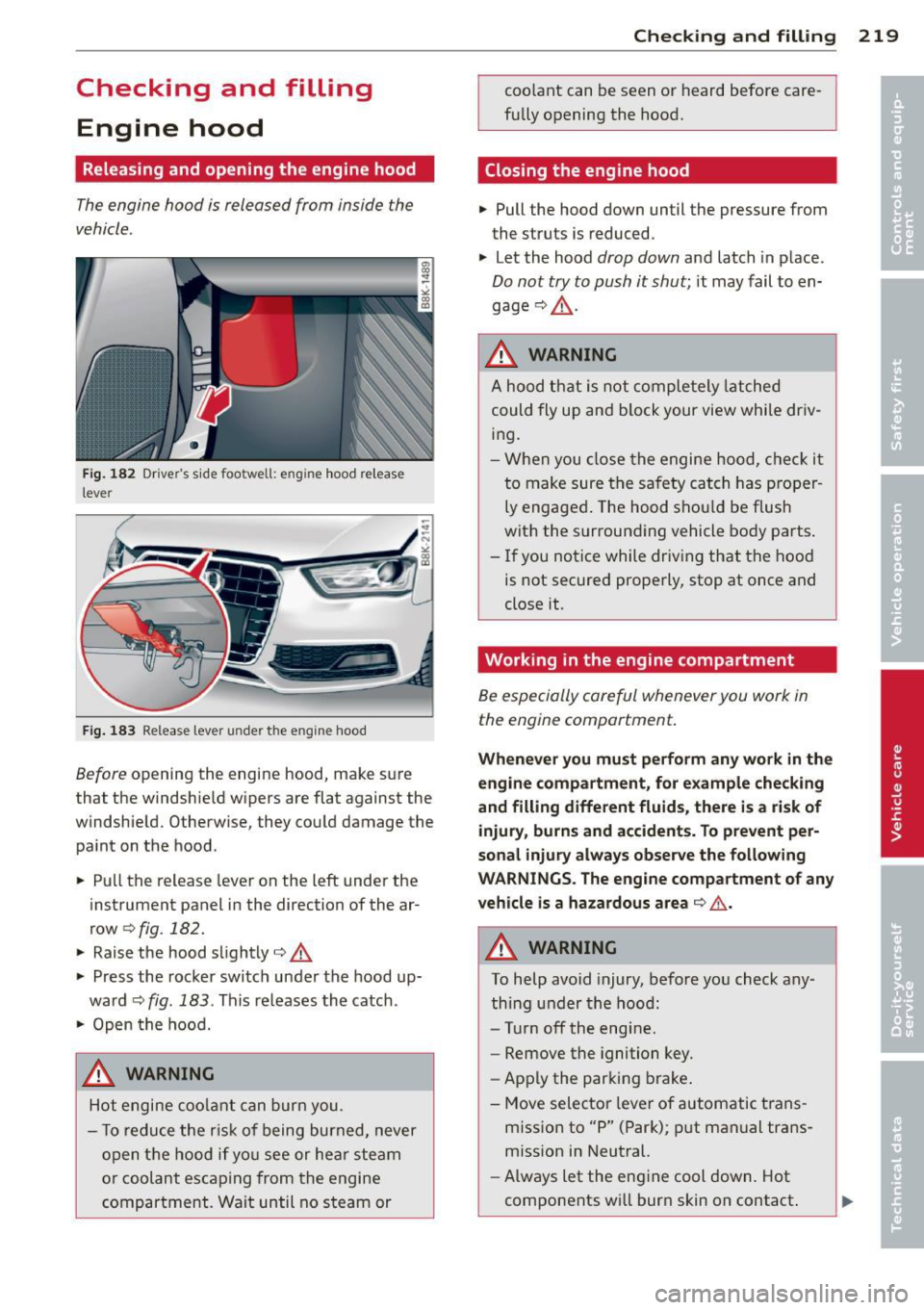
Fig . 182 Dr iver's side footwell: eng ine hood release
lever
... ~ - ---
F ig . 183 Re lease lever un der the engine hood
Before opening the engine hood, make sure
that the windshield w ipers are flat against the
windshield. Otherwise, they could damage the
paint on the hood.
.. Pull the release lever on the left under the
instrument panel in the direction of the ar
row
Q fig. 182.
.. Raise the hood slightly QA
.. Press the rocker switch under the hood up
ward
c::> fig . 183 . This re leases the catch .
.,. Open the hood.
& WARNING
Hot engine coo lant can burn you.
- To redu ce the r isk of being burned, never
open the hood if yo u see or hear steam
or coolant escaping from the engine
compartment. Wait until no steam or Checkin
g and fillin g 219
coolant can be seen or heard before care
fully opening the hood.
Closing the engine hood
.. Pull the hood down until the pressure from
the struts is reduced .
.. Let the hood
drop down and latch in place.
Do not try to push it shut; it may fail to en
gage
c::> .&, .
_&. WARNING
-
A hood that is not comple tely latched
could fly up and b lock your view while dr iv
ing.
- When you close the engine hood, chec k it
to make sure the safety catch has p ro pe r
ly engaged . The hood sho uld be flush
with the surrounding vehicle body parts .
-If you notice while driv ing that the hood
is not secured prope rly, stop at once and
close it.
Working in the engine compartment
Be especially careful whenever you work in the engine compartment .
Whenever yo u mu st p erform an y w or k in th e
eng in e compa rtment, for example checking
and filling differ ent fluid s, there i s a ri sk of
injury , burns and accidents. To prevent per
sonal injury always obser ve the following
WARNINGS . The eng ine compa rtment of any
v ehicle is a hazardous are a
QA .
_&. WARNING
To help avoid injury, before you check any
thing under the hood:
- Turn off the engine.
- Remove the ignition key.
- Apply the parking brake .
- Move selector lever of automatic trans -
mission to "P" (Park); p ut manual trans
miss ion in Neutral.
- Always let the engine cool down. Hot
components w ill burn skin on contact .
Page 222 of 302
220 Checking and filling
-To reduce the risk of being burned, never
open the hood if you see or hear steam
or coolant escaping from the engine
compartment . Wait until no steam or
coolant can be seen or heard before care
fully opening the hood .
- Keep children away from the engine com
partment .
- Never spill fluids on hot engine compo
nents. They can cause a fire.
- Never touch the radiator fan. The auxili
ary electric fan is temperature controlled
and can switch on suddenly.
- Never open the coolant reservoir cap
when the engine is still warm. The cool
ant system is pressurized and hot cool
ant could spray out.
- Protect your face, hands and arm from
steam or hot engine coolant by placing a
thick rag over the cap when you open the
coolant reservoir .
- Do not remove the engine cover under
any circumstances. This increases the
risk of burns.
- If work on the fuel system or the electri
cal system is necessary:
- Always disconnect the battery.
- Never smoke or work near heaters or
open flames. Fluids in the engine com partment could start a fire.
- Keep an approved fire extinguisher im
mediately available.
- To avoid electrical shock and personal in
jury while the engine is running or being
started, never touch:
- Ignition cables
- Other components of the high voltage
electronic ignition system.
- If you must perform a check or repair
with the engine running:
- First, fully apply the parking brake,
move selector lever of automatic trans- mission to
"P" (Park); put manual
transmission in Neutral.
- Always use extreme caution to prevent
clothing, jewelry, or long hair from get
ting caught in the radiator fan, V-belts
or other moving parts, or from contact ing hot parts . Tie back hair before
starting, and do not wear clothing that
will hang or droop into the engine .
- Minimize exposure to emission and
chemical hazards
~ /1. .
A WARNING
=
California Proposition 65 Warning:
- Engine exhaust, some of its constituents,
and certain vehicle components contain
or emit chemicals known to the State of
California to cause cancer and birth de
fects and reproductive harm. In addition,
certain fluids contained in vehicles and
certain products of component wear con
tain or emit chemicals known to the
State of California to cause cancer and
birth defects or other reproductive harm.
- Battery posts, terminals and related ac
cessories contain lead and lead com
pounds, chemicals known to the State of
California to cause cancer and reproduc
tive harms. Wash hands after handling.
(D Note
When adding fluids, always make sure that
they are poured into the proper container
or filler opening, otherwise serious dam
age to vehicle systems will occur.
@) For the sake of the environment
To detect leaks in time, inspect the vehicle
floor pan from underneath regularly. If
you see spots from oil or other vehicle flu ids, have your vehicle inspected by an au
thorized Audi dealer.
Page 261 of 302
~ Unscrew the valve stem from the spare tire.
~ Screw the tire filler hose from the compres
sor firmly onto the valve of the spare tire.
~ Insert the plug from the compressor into a
socket of the vehicle¢
page 64.
~ Switch the compressor on .
~ Let the compressor run until the value
specified on the tire pressure label is
reached
¢ page 238, fig. 192. Switch the
compressor off after running for 12 minutes
at the most -danger of overheating!
A WARNING
The compressor and the tire filler hose can
become extremely hot while they are run
ning -danger of burns!
(D Note
Switch the compressor off after running
for 12 minutes at the most -danger of
overheating! Allow the compressor to cool
down for a few minutes before you use it
again.
Changing a wheel
Before changing a wheel
Observe the following precautions for your
own and your passenger's safety when chang
ing a wheel .
~ After you experience a tire failure, pull the
car well away from moving traffic and try to
reach
level ground before you stop¢ L!)..
~ All passengers should leave the car and
move to a safe location (for instance, behind
the guardrail) ¢
A.
~ Engage the parking brake to prevent your
vehicle from rolling unintentionally ¢
A.
~ Shift into 1st gear on vehicles with manual
transmission, or move the
selector lever to
the P position
on vehicles with automatic
transmission .
~ If you are towing a trailer: unhitch the trail
er from your vehicle.
~ Take the jack¢ page 256 and the spare tire
¢ page 257 out of the luggage compart
ment.
What do I do now? 259
A WARNING
You or your passengers could be injured
while changing a wheel if you do not fol
low these safety precautions:
- If you have a flat tire, move a safe dis
tance off the road. Turn off the engine,
turn the emergency flashers on and use
other warning devices to alert other mo
torists.
- Make sure that passengers wait in a safe
place away from the vehicle and well
away from the road and traffic.
- To help prevent the vehicle from moving
suddenly and possibly slipping off the
jack, always fully set the parking brake
and block the wheel diagonally opposite
the wheel being changed with the fold
ing chocks or other objects. When one
front wheel is lifted off the ground, plac ing the Automatic Transmission in "P"
(Park) will
not prevent the vehicle from
moving .
- Before you change a wheel, be sure the
ground is level and firm. If necessary,
use a sturdy board under the jack.
- Always store the vehicle tool kit, the
jack* and the replaced tire in the luggage compartment
¢page 133.
(D Note
If you are changing the wheel on a steep
incline, use a rock or similar object to
block the opposite wheel to prevent the
vehicle from moving.
(D Tips
Obey all laws.
Changing a wheel
When you change a wheel , follow these
quence described below step-by-step and in
exactly that order.
l. Remove the decorative wheel cover* or
-
the wheel bolt caps*. For more details see..,.
•
•
Page 267 of 302

Fuses and bulbs
Fuses
Replacing a fuse
Fuses that have blown will have metal strips
that have burned through.
Fig. 20 9 Left cockp it : fuse panel cover
The fuses are located at the front left and
r igh t of the cockpit and behi nd the trim on
the right side of the luggage compartment .
.. Turn off the ign it ion a nd the affected elec-
t rical consumers .
.. Check the following table to see which fuse
belongs to the consume r .
.. Remove the appropriate cover¢
fig. 209 or
¢page 218, fig. 180 .
.. To remove the purple plastic cl ip if necessa
ry
ll, hold onto it at the small s ide and pull
it out of the fuse panel¢
page 265,
fig. 210 .
.. Remove the clamp from the rear side of the
fuse cover ¢
fig. 209 .
.. Remove the fuse using the clamp and re
pla ce the blown fuse w ith an identical new
one.
& WARNING , -
Do not repair f uses and never replace a
blown fuse w ith one that has a higher amp
rating. This can cause damage to the e lec
trical system and a fire.
11 You can dis pos e of the plastic clip after removing it.
Fu se s and bulb s 265
(D Note
If a new fuse burns out again after short ly
have you have insta lled it, have the electri
ca l system checked by your authorized
Audi dealer .
{!) Tips
-The following table does not list fuse lo
cat ions that are not used .
- Some of the equipment items listed are
opt ional or only available on certa in
mode l configurations.
Left cockpit fuse assignment
Fi g. 21 0 Left cockpit: fuse panel wit h plastic clip
No. Consumer
Amps
Fuse panel @(black)
1 Dynamic steering 5
2 ES C control module 5
A/C system pressure sensor,
electromechanical parking
3
brake, Homelink, automatic
5 dimming interior rear view
mirror, air quality/outside
ai r sensor, ESC button
Page 268 of 302

266 Fuses and bulbs
No.
5 Sound actuator/exhaust
sound tuning
6 Headlight
range control sys-
tern/cornering light
7 Headlight (cornering light)
Control modules (electro-
mechanical parking brake,
8 shock absorber, quattro
I
sport, trailer hitch), DCDC
converter
9 Adaptive cruise control
10 Shift gate
11 Side assist
12 Headlight range control,
parking system
13 Airbag
14 Rear wiper (allroad)
15 Auxiliary fuse (instrument
panel)
16 Auxiliary fuse
terminal 15
(engine area)
Fuse panel @ (brown)
2 Brake light sensor
3 Fuel pump
4
5 Left seat heating with/with-
out seat ventilation
6 E5C
7 Horn
-Front left door (window reg·
8 ulator, central locking, mir-
ror, switch, lighting)
9 Wiper motor
10 ESC
Two-door models: rear left
window regulator, Four-door
11 models: rear left door (win-
dow regulator, central
lock-
ing, switch, lighting)
12 Rain and light sensor
Fuse panel © (red)
3 Lumbar support
Amps
5/15
5/7,5 7,5
5
5
5
5
5
5
15
10
40
5
25
5
15/30
5
15
30
30
25
30
5
10
No. Consumer
4 Dynamic steering
6
7
8
9
Interior lighting (Cabriolet)
Windshield washer system ,
headlight washer system
Vehicle electrical system
control module 1
Vehicle electrical system
control module 1 Left rear window regulator
motor (Cabriolet)/sunroof
10 Vehicle electrical system
control module 1
11 Right rear window regulator
(Cabriolet)/sun shade motor
12 Anti-theft
alarm warning
system
Right cockpit fuse assignment Amps
35
5
35
20
30
7,5/20
30
7,5/20
5
Fig. 211 R ight cockpi t: fuse pane l wit h plastic cl ip
No. Consumer Amps
Fuse panel @ (black)
5 Steering column switch
5
module
7 Terminal 15 diagnostic
con-
nector 5
•
....
Page 269 of 302
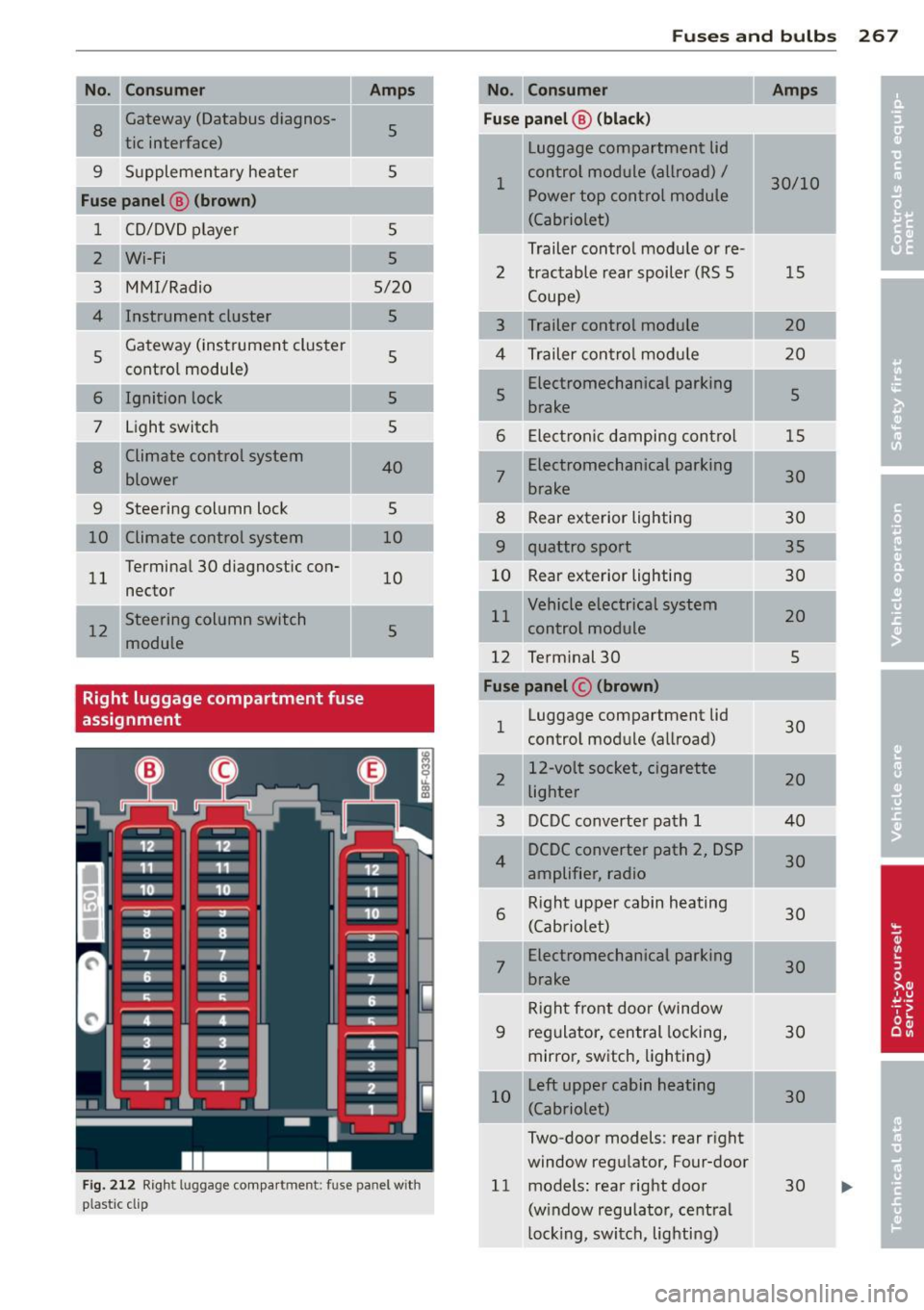
--No. Consumer Amps
I a
Gateway (Databus diagnos-
5 tic interface)
I
9 Supplementary heater
Fuse panel ® (brown )
1 CD/DVD playe r
2
Wi-Fi
3 MMI/Radio
4 Instrument cluster
5 Gateway (instrument cluster
control module)
6 Ignition lock
7 Light switch
8
Climate cont
rol system
blower
9 Steering column lock
10 Climate control system
11 Termina
l 30 diagnostic con-
nector
-
12 Steering column switch
module
Right luggage compartment fuse
assignment
5
5
5
5/20
5
5
5
5
40
5
10
10
5
F ig . 2 12 R igh t lu ggage compar tmen t: fu se pan el w ith
pla stic cl ip
-
Fu se s and bulb s 267
No . Consumer Amps
Fuse panel @ (blac k)
Luggage compartment lid
1 control module (all
road) /
30/10
Power top control module
(Cabriolet)
Trailer con trol modu le or re-
2 tractable rear spoiler (RS 5 15
Coupe)
3 Trailer control module 20
4 Trailer contro l modu le 20
5 Electromechanical parking
5
brake
6 E lectron ic damping con trol 15
7
Electromechanical parking
30
brake
8 R ear exterior lighting 30
9 quattro sport
35
10 Rear exterior lighting
30
11 Vehicle electrical system
20
con trol module
12 Term inal 30
5
Fuse panel © (brown )
1 Luggage compartment lid
30
control module (allroad)
-.
2 12-volt
socket, cigarette
20
lighter
3 DCDC converte
r path 1 40
4 DCDC converter path
2, DSP
30
amplifie r, radio
6
Right upper cabin heating
30
(Cabriolet)
7
Electromechanical parking
30
brake
R ig ht front door (window
9 regulator, central locking,
30
mirror, switch, lighting)
10 L
eft upper cabin heating
30
(Cabriole t)
Two-door models : rear r ight
window regu lator, Four-door
11 models : rear right door
30
(w indow regulato r, ce ntra l
l ock ing, switch , lighti ng)
Page 272 of 302
2 70 Emergency situations
@ Tips
The discharged battery must be properly
connected to the vehicle's electrical sys
tem. When jump starting or charging the
battery, never connect the negative
ground cable to the battery negative post
because the batte ry manager system must
be able to detect the battery 's state of
charge. Always connect the negative
ground cab le to the negative ground post
of the battery manager control unit.
Use of jumper cables
Make sure to connect the jumper cable
clamps in exactly the order described below!
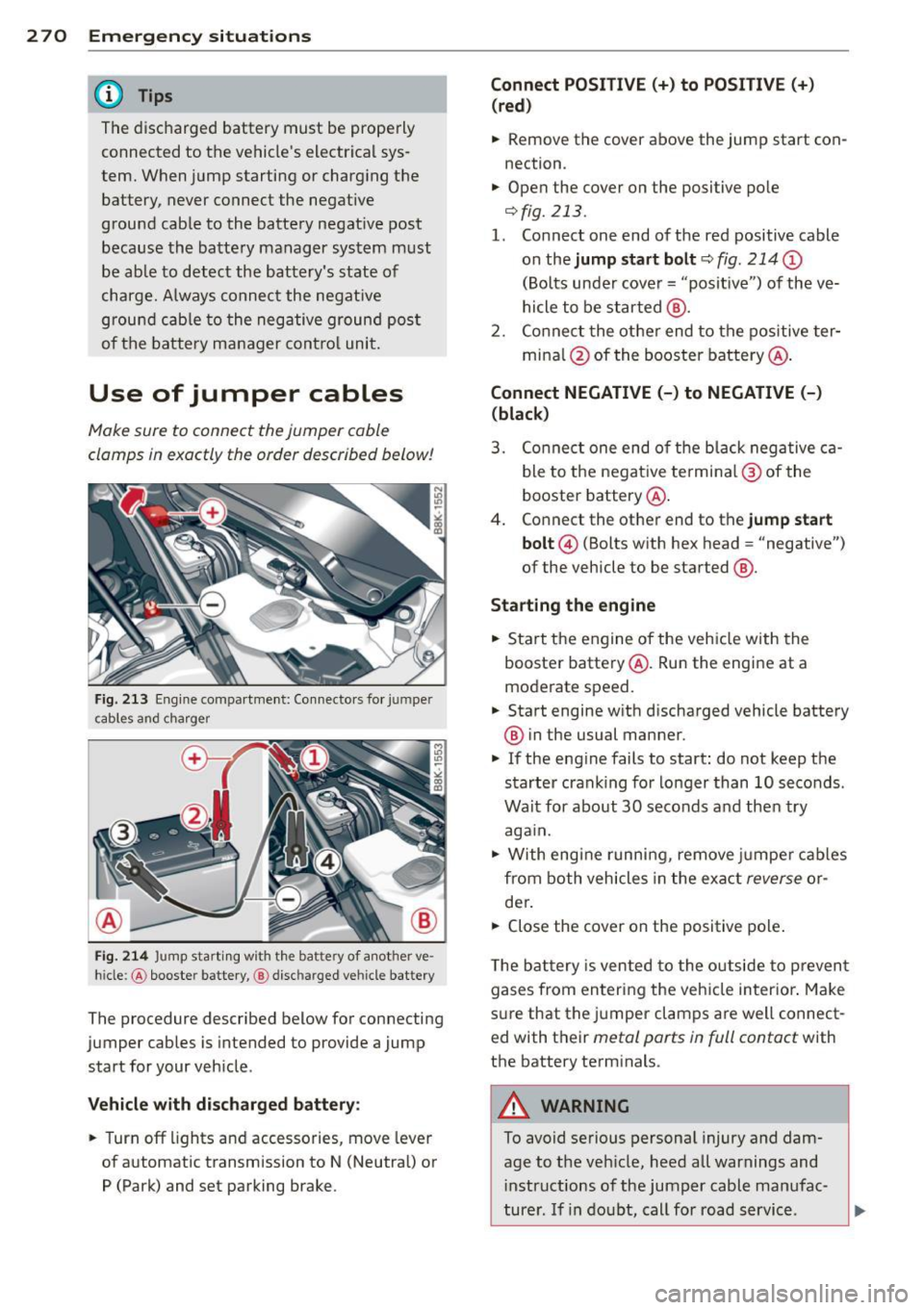
Fig. 213 Engine compartment: Connecto rs fo r jum per
cables and charger
Fig. 214 Jump sta rting wi th the battery of anot her ve ·
h ide :@ booster battery, @ disc harged vehicle battery
The procedure described below for connecting
jumper cables is intended to provide a jump
start for your vehicle .
Vehicle with discharged battery:
.. Turn off lights and accessories, move lever
of automatic transmission to N (Neutral) or
P (Park) and set parking brake .
Connect POSITIVE(+) to POSITIVE(+)
(red)
.. Remove the cover above the jump start con
nection .
.. Open the
cover on the positive pole
¢fig. 213 .
1. Connect one end of the red positive cable
on the
jump start bolt c::> fig. 214 @
(Bolts under cover= "positive") of the ve
hicle to be started @.
2. Connect the other end to the positive ter-
minal @of the booster battery@.
Connect NEGATIVE (-) to NEGATIVE (-)
(black)
3. Connect one end of the b lack negative ca
ble to the negative terminal @of the
booster battery @.
4. Connect the other end to the
jump start
bolt @
(Bolts with hex head= "negative")
of the vehicle to be started @.
Starting the engine
.. Sta rt the engine of the vehicle with the
booster battery@. Run the engine at a
moderate speed.
.. Start engine with discharged vehicle battery
@ in the usual manner .
.. If the eng ine fails to start: do not keep the
starter cranking for longer than 10 seconds .
Wait for about 30 seconds and then try
again .
.. With engine running, remove jumper cables
from both vehicles in the exact
reverse or
der .
.. Close the
cover on the positive pole .
T he battery is vented to the outside to prevent
gases from entering the vehicle interior . Make
sure that the jumper clamps are well connect
ed with their
metal parts in full contact with
the battery terminals.
A WARNING
--
To avoid serious personal injury and dam
age to the veh icle, heed all warnings and
i nstructions of the jumper cable manufac-
turer . If in doubt, call for road service . ..,.
Page 288 of 302
286 Index
Automatic climate control Air vents ... ............... .. .... .. 78
Operation . . . . . . . . . . . . . . . . . . . . . . . . . 77
Setup . .. ............... .. .. .... .. 79
Automatic Shift Lock (ASL) . . . . . . . . . . . . 93
Automatic transmission .......... ..... 91
Automatic Shift Lock (ASL) . . . . . . . . . . . 93
Driving .. ... ............ .. .. .. .. .. 93
Em ergency mode . . . . . . . . . . . . . . . . . . . 97
Em ergency release . . . . . . . . . . . . . . . . . . 98
K ick -down . . . . . . . . . . . . . . . . . . . . . . . . . 96
M anual shift program ....... .... .. .. 96
multitronic . . . . . . . . . . . . . . . . . . . . . . . . 91
Removal lock (ignition key) ... .. .. .. . . 80
Selector lever . . . . . . . . . . . . . . . . . . . . . . 92
S tronic .... .................. ... .. 91
tiptronic . . . . . . . . . . . . . . . . . . . . . . . . . . 91
Automatic wipers . . . . . . . . . . . . . . . . . . . . 53
Auto Safety Hotline ........ .. .. .... . 135
Average speed . . . . . . . . . . . . . . . . . . . . . . . 25
Avoid damaging the vehicle ....... ... . 194
B
Bag hooks . . . . . . . . . . . . . . . . . . . . . . . . . . 72
Battery . . . . . . . . . . . . . . . . . . . . . . . 17,229
Batter y location inside the luggage com-
partment .. ................ ... ... 230
Charging . ... ............ .. .. .. .. . 232
I mportant warnings when wo rking on
the battery ............... ... .... . 230
Jump starting ................ .... . 269
Low ..... .. ................ ..... . 192
Replacing the battery ..... .. .. .... . 233
State of charge .................... 192
Winter operation .................. 229
Working on the battery ......... .... 230
Before driving .............. ... .... . 127
Bio-ethanol (Fuel) . . . . . . . . . . . . . . . . . . . 215
Blended gasoline .......... .. .. .... . 214
Blow er (automatic climate control) . . . . . . 78
Body cavity sealing .............. ... . 208
Booster seats ...................... 174
Brake flu id
Changing the brake fluid ..... .. .. .. . 229
Checking the brake fluid level ... .. .. . 228
Reservoir . ................. ..... . 228 What
is the correct brake fluid level? . . 228
What shou ld I do if the brake fluid warn-
ing light comes on? ................ 228
Brak e system .. .. .. ............. .. .. 228
Anti- lock braking system ........ .... . 19
Brake assist system ................ 185
Brake fluid .... .. ................. 228
Brake fluid specifications for refill and re -
placement .... .. ... .......... .. .. 229
Brake light defective . . . . . . . . . . . . . . . . 21
Brake power assist unit ............. 188
Brakes ...... .. .. .. ..... ........ .. 188
Ceramic brakes . .. ................ . 188
Electromechanica l parking brake . .... . 85
Warning/ind icator lights ........ .. .. . 15
Worn brake pads symbo l . . . . . . . . . . . . . 20
Braking Emergency braking funct ion ........ .. 87
braking guard ... .. ............. .... . 99
Messages . .. .. .. ............. .. .. 107
Settings .. .. .. .. .. .... .... ... .... 106
Break-in period .... ................. 194
T ires ..... .... .. .. .............. . 194
Bulbs .......... .. ....... ......... . 268
C
California Proposition 65 Warning ... .. 220
Battery specific .. ............. .. .. 231
Capacities ......................... 277
Car care ........ .. .. .............. . 202
Interior ... .... .. .. .............. . 209
Plastic and vinyl ................... 206
Care of exterior .. .. ... .......... .. .. 202
Cargo area
refer to Luggage compartment. . . 68, 133
Catalytic converter . . . . . . . . . . . . . . . . . . 195
Center armrest . . . . . . . . . . . . . . . . . . . . . . 60
Central locking .. .. ... .......... .. .. . 32
Central locking switch .......... .... . 36
Convenience key . . . . . . . . . . . . . . . . . . . . 36
Remote control key ................. 35
Ceramic b rake rotors
New brake pads .. ............. .... 188
Certification . . . . . . . . . . . . . . . . . . . . . . . 283
Changing a flat tire . ................. 259
Changing a wheel .. ............. .... 259