remove seats AUDI S4 2013 User Guide
[x] Cancel search | Manufacturer: AUDI, Model Year: 2013, Model line: S4, Model: AUDI S4 2013Pages: 302, PDF Size: 75.61 MB
Page 176 of 302
174 Child Safety
to the backrest on the vehicle seat. Ad
just or remove the rear seat head restraint if it is difficult to install the
child seat with the head restraint in place
<=> page 61 . Install the head restraint
again immediately once the child seat is
removed. Driving without head restraints
or with head restraints that are not prop
erly adjusted increases the risk of serious
or fatal neck injury dramatically.
- Always read and heed all WARNINGS
whenever using a child restrained in ave
hicle is being used
<=>page 137, Safety
belts,<=> page 145, Airbag system
and
t::> page 166, Important things to know.
A WARNING
If exceptional circumstances require the
use of a forward-facing child restraint on
the front passenger's seat, the child's safe
ty and well -being require that the follow
ing special precautions be taken:
- Make sure the forward-facing seat has been designed and certified by its manu
facturer for use on a front seat with a passenger front and side airbag.
-Always follow the manufacturer's in
structions provided with the child safety
seat or infant carrier.
- Always move the front passenger seat in
to the rearmost position of the passen
ger seat's fore and aft adjustment range,
and as far away from the airbag as possi
ble before installing the child restraint.
- Always make sure that nothing prevents
the front passenger's seat from being
moved to the rearmost position in its
fore and aft adjustment range.
- Always make sure the backrest is in an
upright position.
- Make sure that the
PASSENGER AIR BAG
OFF
light comes on and stays on all the
time whenever the ignition is switched
on.
- If the light does not stay on, perform the
checks
<=> page 156, Monitoring the Ad
vanced Airbag System.
-
- Take the child restraint off the front pas
senger seat and install it properly at one
of the rear seat positions if the
PASSEN
GER AIR BAG OFF
light does not stay on
whenever the ignition is switched on.
Booster seats and safety belts
Properly used booster seats can help pro te ct
children weighing between about 40 lbs. and
80 lbs. (18 kg and 36 kg) who are less than 4
ft.
9 in . (57 inches/1 .45 meters) tall.
"' .....
"' 0 ±
o5
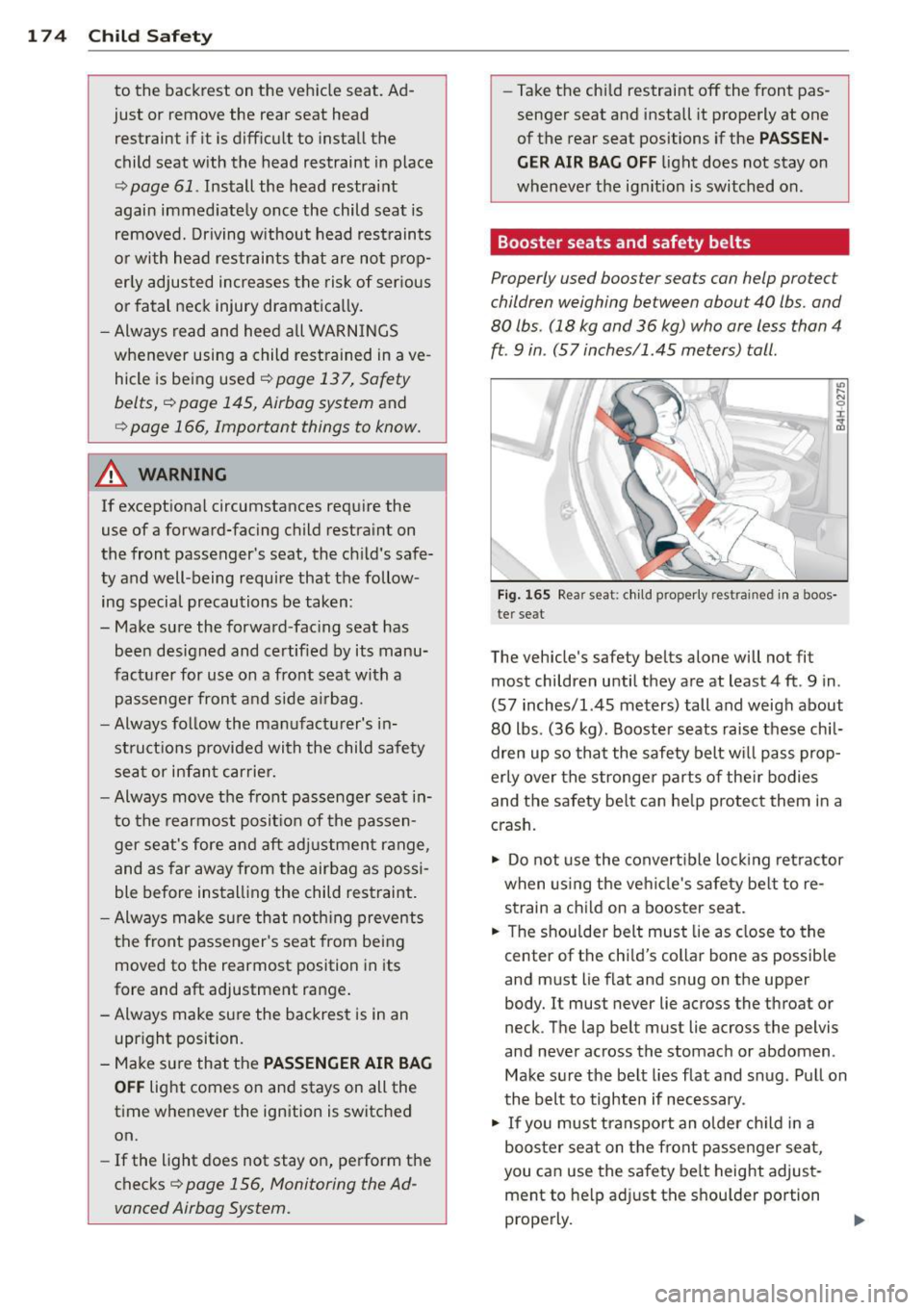
Fig. 165 Rea r seat: child properly rest rai ned in a boos
te r se at
The vehicle 's safety belts alone will not fit
most children until they are at least 4 ft . 9 in .
(57 inches/1.45 meters) tall and weigh about
80 lbs. (36 kg). Booster seats raise these chil
dren up so that the safety belt will pass prop
erly over the stronger parts of their bodies
and the safety belt can help protect them in a
crash.
.,. Do not use the convertible locking retractor
when using the vehicle's safety belt to re
strain a child on a booster seat.
.. The shoulder belt must lie as close to the
center of the child's collar bone as possible
and must lie flat and snug on the upper
body. It must never lie across the throat or
neck . The lap belt must lie across the pelvis
and never across the stomach or abdomen .
Make sure the belt lies flat and snug . Pull on
the belt to tighten if necessary .
.,. If you must transport an older child in a
booster seat on the front passenger seat,
you can use the safety belt height adjust
ment to help adjust the shoulder portion
properly.
Page 177 of 302
~ Secure unused safety belts on the rear seat
¢ page 171 .
Children up to about 40 lbs. (18 kg) are bes t
protected in child safety seats designed for
their age and weight . Expe rts say that the
skeleta l structure, particularly the pelvis, of
these children is not fully developed, and they must not use the vehicle safety belts without
a suitable ch ild restra int.
It is usually best to put these children in ap
propriate booster seats. Be sure the booster
seat meets all applicable safety standards .
Booster seats raise the seating position of the
chi ld and reposition both the lap and shou lder
parts of the safety belt so that they pass
across the child's body in the right places. The
routing of the be lt over the child's body is very
important for the ch ild's protection, whether
or not a booste r seat is used . Children age 12
and under must always ride in the rear seat.
C hi ldren who are at least 4
ft. 9 in. (57 in
ches/1.45 meters) tall can generally use the
vehicle's th ree po int lap and shoulder belts .
Never use the lap belt portion of the veh icle's
safety be lt a lone to restrain any child, regard
l ess of how b ig the child is. Always remembe r
that children do not have the pronounced pe l
vic structure required for the proper function
of lap belt portion of the vehicle's three point
l ap and shoulder be lts. The child's safety ab
solutely requ ires that a lap be lt portion of the
safety belt be fastened snugly and as low as
possible around the pelvis. Never let the lap
be lt portion of the safety belt pass over the
chi ld's stomach or abdomen.
In a cras h, airbags must i nflate within a blink
of an eye and with cons iderable force. In orde r
to do its job, the airbag needs room to inflate
so that it will be there to protect the occupant
as the occupant moves forward into the air bag.
A vehicle occupant who is out of pos ition and
too close to the airbag gets i n the way of an
inflat ing a irbag. When an occupant is too
close, he or she w ill be str uck violen tly and
Child Sa fet y 175
will receive serious or possib ly even fatal in
jury .
In orde r fo r the airbag to offer pro te ction, i t is
important tha t all veh icle occupants, espec ial
ly any children, who m ust be in the front seat
because of exceptiona l circumstances, be
properly restrained and as far away from the
airbag as possible. By keeping room between
the child's body and the front of the passen
ger compartment, the a irbag can inflate com
pletely and provide supplemental protection
in certain frontal collisions .
_&. WARNING
Not using a booste r seat, using the boos
ter seat imp roperly, in correc tly installing a
boos ter sea t or using the vehicle sa fe ty
belt imp roperly increases the risk of seri
ous persona l injury and death in a collision
or other emergency situat ion. To he lp re
d uce the risk of serio us personal injury
and/or death:
- The shou lder belt must lie as close to the
center of the ch ild's collar bone as possi
ble and must lie f lat and snug on the up
per body. It must never lie across the
throat or neck. The lap belt must lie
across the pelvis and neve r across t he
s tomach o r abdomen. Make s ure the belt
lies fla t and snug. Pull on the belt to
tighten if necessary.
- Failure to p roperly ro ute safety belts
over a child's body will ca use seve re inj u
ries in an accident or othe r emergency
situation
¢page 137 .
-The rear side o f the child sa fety seat
should be pos itioned as close as possib le
to the backrest on the vehicle seat. Ad
just or remove the rear seat head re straint if it is diffic ult to install the ch ild
seat with the head restraint in p lace
¢ page 61. Install the head restraint
aga in immediately once the ch ild seat is
removed . D rivi ng without head restraints
or w ith head restra in ts tha t are not prop
erly ad justed increases the risk of serious
.
or fatal neck inj ury drama tically . ~
•
•
Page 183 of 302
Description
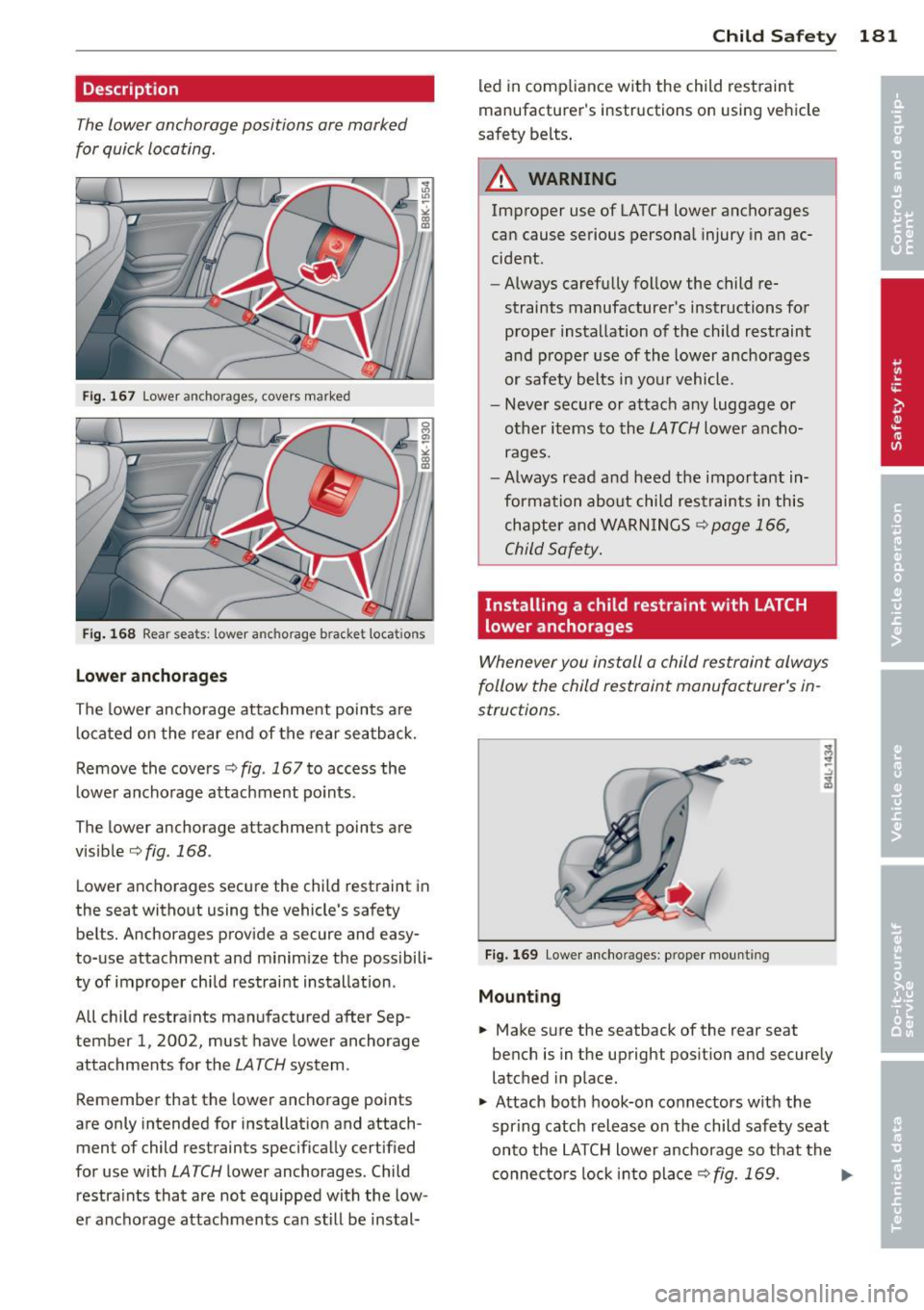
The lower anchorage positions are marked
for quick locating.
Fig . 167 Lower anchorages, covers marked
Fig . 168 Rear seats: lower anchorage b racket locat ions
Lowe r ancho rages
The lower anchorage attachment points a re
located on the rear e nd of the rear sea tback.
Remove the covers
c:;, fig . 167 to access the
l ower anchorage attachment po ints.
The lower anchorage attachment points are
visible
c:;, fig . 168 .
Lower anchorages secure the child restraint in
the seat without using the vehicle 's safety
belts. Anchorages prov ide a secure and easy
to-use attachment and minimize the possibili
ty of improper child restraint installation .
All ch ild restra ints manufactured after Sep
tember 1, 2002, must have lower anchorage
attachments for the
LATCH system .
Remember that the lower anchorage points
are only intended for installation and attach ment of child restraints specifically certified
for use w ith
LATCH lower anchorages . Child
restra ints that are not equipped with the low
e r anchorage attachments ca n still be instal-
Child S afety 181
led in compliance with the child restraint
manufacturer's instructions on using vehicle
safety belts .
_& WARNING
Improper use of LATCH lower anchorages
can cause serious personal injury in an ac
cident.
- Always carefully follow the child re
straints manufacturer's instructions for
proper installation of the child restraint
and p roper use of th e lower anchorages
or safety belts in yo ur vehicle.
- Never secure or attach any luggage or
other items to the
LATCH lowe r ancho
rages.
- Always read and heed the importa nt in
formation about child r estraints in this
chapter and WARN INGS
¢page 166,
Child Safety.
Installing a child restraint with LATCH
lower anchorages
Whenever you install a child restraint always
follow the child restraint manufacturer's in
structions.
F ig. 169 Lowe r anc horages: proper mount ing
Mounting
.,. Make sure the seatback of the rear seat
bench is in the upright pos it ion and securely
latched in place .
... Attach both hook-on co nnectors with the
spring catch rel ease on the child safety seat
onto the LATCH lower anchorage so that the
connec to rs lock into place
c:;, fig. 169 . ..,_
Page 211 of 302
-Always read and heed all WARNINGS and
other information
¢page 202.
Exhaust tail pipes
Road salt and other corros ive materia ls will
damage the mater ial in the exhaust tail pipes
if they are not cleaned regularly . Do not clean
the ta il p ipes with wheel cleaner, paint pol ish,
chrome po lish or other abrasive cleaners.
C lea n the ta il p ipes wi th car ca re p rod ucts
that are s uitabl e for s tain less stee l.
Your authorized Audi dealer can provide clean i n g p roducts t hat have been tested and ap
p roved fo r you r vehi cle.
Care of interior
Infotainment components
The Radio/MMI* display may be cleaned with
a soft cloth and commerc ially-avai lab le "LCD
cleane r" . The cloth should be coated l ightly
wh en the clean ing solution when cleani ng the
d isp lay.
The
MMI* contro ls must be cleaned first with
a br ush so that dirt does not e nte r the un it o r
ente r betwee n th e bu ttons and the hous ing.
Then w ip ing t he con tro ls w ith a cloth damp
e ned wi th dish de tergent and water is recom
mended .
(D Note
- To avoid sc ratch ing the disp lay, yo u
s ho ul d neve r clea n it dry.
- To prevent damage, ma ke s ure fl uids do
n ot en ter the co ntrols.
Aluminum trim
Use only neutral-pH products to remove spots
and deposits from alum inum surfaces.
C hrome ca re products and alkaline cleaners
will attack alum in um s urfaces and can dam
age them over time.
Cleaning and protec tion 209
A WARNING
A lways read and heed all WARNINGS and
other information
¢page 202.
Fabrics and fabric coverings
Fabr ics and fabric cover ings (e.g. seats, door
trim pa ne ls, etc.) shou ld be cleaned at regular
i n tervals w it h a vac uum cleaner. This removes
s ur face di rt particles which cou ld become em
bedded in the fabri c throug h use. Ste am
cleaners sho uld not be used, beca use the
steam tends to p ush the dirt deeper into the
fabric and lock it there .
Normal cleaning
Generally, we recommend using a soft sponge
o r a lint -free microfibe r clo th to the clean fab
ric. Br ushes shou ld only be used for carpets
and floor mats, since other fabric surfaces
could be harmed by br ushes.
Norma l su rface s tains c an be cleaned using a
commerc ially availab le foam cleaner . Spread
the foam on the s urface of t he fabric with a
soft sponge and work it in gently. Do not satu
rate the fabric. T hen pat the foam dry us ing
absorbe nt, dry cloths (e.g. m icrofiber cloth)
and vacuum it after it has dried completely.
Cleaning stains
Stains caused by beverages (e .g. coffee, fr uit
juice, etc.) can be treated with a mild deter
gent solution. Apply the detergent sol ution
with a spo nge. In the case of stubborn stains,
a detergent paste can be applied directly to
the stain and worked into the fabric. After
wards, use copious amounts of clean water to
remove the rem aining de terge nt. Apply the
w at er wit h a d am p clot h or sponge a nd pat
the fabric dry with an abso rbent, dry clot h.
Stains from choco late or makeup should have
de terge nt pa ste rubbed i nto them. After
w ards, remove the soa p with wa te r (damp
sponge).
Alcohol can be used to treat stains from grease, o il, lipstic k or a ballpoin t pen. Melted .,.
•
•
Page 213 of 302
and can damage the leather surface as well as
weaken seams .
The leather sho uld be cleaned reg ularly as
needed. After having been used for a re latively
l ong time, your leather seats will acquire a
rich aged finish. This is a characteristic of nat
ura l leather and a sign of true quality .
I n o rder to maintain the va lue of th is natura l
p roduct over the life of your vehicle, you
should follow the recommendations below :
(D Note
-To keep yo ur leather from bleach ing out,
do not a llow it to be exposed to bright
sunlight for long periods of time. If you
have to leave the vehicle parked outside
for long periods, cover the leather to
protect it from d irect exposure to sun
light.
- Sharp objects on clothing, such as zip
pers, rivets or sharp pieces on be lts can
leave permanent scratches or scrape
marks on the surface of the leather .
- After each time you clean the leather and
at regular inte rva ls, use a leather preser
vat ive cream that conta ins UV-blockers
and that works into the leather. This
c ream will nourish and moistur ize the
l eather, helping i t to brea the and stay
supple .
It also helps to b uild up a protec
tive coating on the s urface .
- Clean the leather every 2 -3 months,
and clean any areas that get soiled.
- Remove fresh mar ks made by ba llpoint
pens, ink, lipstick, shoe polish, e tc. as
soon as possib le .
- Preserve the colo r of the leather as need
ed by using a special colored leather care
cream to touch up areas of uneven co lor.
Cleaning and protec tion 21 1
Cleaning and caring for leather
upholstery and trim
Applies to vehicles : with natural lea ther
Natural leather requires special care and at
tention .
Normal clean ing
.. Clean soiled areas with a slightly moistened
cotton or woolen cloth .
More stubborn dirt
.. More st ubborn dirt can be removed using a
cloth saturated with a mild soap solut ion (2
tablespoons mild liquid soap).
.. Never allow the soap solution to saturate
the leather, and make certain that no water soaks into the seams.
.,. Wipe off the soap so lution with a soft, dry
cloth.
Cleaning spots
.. Remove fresh wat er-bas ed spots (such as
coffee, tea, juices, blood) with an absorbent
cloth or paper towel.
.. Remove fresh
grea se or oil-ba sed spot s
(such as bu tte r, mayonnaise, chocola te) with
an absorbent cloth or paper towel, or use
the cleaner from the leather care kit if the
spot has not yet penetrated into the surface
of the leather.
.. Use an oil/grease dissolving spray, if
oil/
grease spot s ha ve dried on.
.. Remove specific k inds of spots (ballpoint
pen, felt marker, fingerna il polish, water
based pa int, shoe po lish, etc.) with a spot
remover specifically fo rmu lated for leather.
Leather care
.. Every half year use an approved leather care
product (available from your authorized
Aud i dealer) to care for the leather.
.,. App ly the product very spar ingly.
.. Wipe it off with a damp clot h.
If you have any questions about clean ing and
caring for the leather in your vehicle, it is best
to contact you r authorized Audi dea ler, who
will be g lad to help you and tell you abo ut o ur
f ull range of leather care products, such as : .,..
•
•