seat adjustment AUDI S4 2013 User Guide
[x] Cancel search | Manufacturer: AUDI, Model Year: 2013, Model line: S4, Model: AUDI S4 2013Pages: 302, PDF Size: 75.61 MB
Page 172 of 302
1 70 Child Safety
&_ WARNING
Not using a child safety seat, using the
wrong child safety seat or improperly in
stalling a child restraint increases the risk
of serious personal injury and death .
-All vehicle occupants and especially chil
dren must always be restrained properly
whenever riding in a vehicle.
-
- An unrestrained or improperly restrain
ed child can be injured or killed by be
ing thrown against the inside of the ve
hicle or by being ejected from it during
a sudden maneuver or impact .
- An unrestrained or improperly restrain
ed child is at much greater risk of injury
or death by being struck by an inflating
airbag.
- Commercially available child safety seats
are required to comply with U.S. Federal
Motor Vehicle Safety Standard (FMVSS)
213 (in Canada CMVSS 213).
- When buying a child restraint, select
one that fits your child and the vehicle.
- Only use child restraint systems that
fully contact the flat portion of the
seat cushion. The child restraint must not tip or lean to either side. Audi does
not recommend using child safety
seats that rest on legs or tube -like
frames . They do not provide adequate
contact with the seat.
-Always heed all legal requirements per
taining to the installation and use of
child safety seats and carefully follow
the instructions provided by the manu
facturer of the seat you are using.
- Never allow children under 57 inches
(1.45 meters) to wear a normal safety
belt. They must always be restrained by a
proper child restraint system. Otherwise,
they could sustain injuries to the abdo
men and neck areas during sudden brak
ing maneuvers or accidents.
- Never let more than one child occupy a
child safety seat . -
Never let babies or older children ride in
a vehicle while sitting on the lap of an
other passenger .
- Holding a child in your arms is never a
substitute for a child restraint system.
- The strongest person could not hold
the child with the forces that exist in
an accident. The child will strike the in
terior of the vehicle and can also be
struck by the passenger.
- The child and the passenger can also
injure each other in an accident.
- Never install rearward-facing child safety
seats or infant carriers on the front pas
senger seat. A child will be seriously in
jured and can be killed when the passen
ger airbag inflates -even with an Ad
vanced Airbag System .
- The inflating airbag will hit the child
safety seat or infant carrier with great
force and will smash the child safety
seat and child against the backrest,
center arm rest, door or roof.
= Always install rearward-facing child
safety seats or infant carriers on the
rear seat.
- Forward-facing child safety seats instal
led on the front passenger's seat can in
terfere with the airbag when it inflates and cause serious injury to the child. Al
ways install forward-facing child safety seats on the rear seat .
- If exceptional circumstances require the
use of a forward-facing child restraint on
the front passenger's seat, the child's
safety and well-being require that the
following special precautions be taken:
- Make sure the forward-facing seat has
been designed and certified by its man
ufacturer for use on a front seat with a
passenger front and side airbag.
- Always carefully follow the manufac
turer's instructions provided with the
child safety seat or carrier.
- Always move the front passenger seat
into the rearmost position of the pas-
senger seat's fore and aft adjustment
~
Page 173 of 302
range, and as far away from the a irbag
as poss ible before instal ling the child
restraint.
- Always make sure that nothing pre
vents the front passenger's seat from be ing moved to the rearmost position
i n its fore and aft adjustment range.
- Always make sure that the backrest is
in the upr ight position.
- Always buckle the child safety seat firmly
in place even if a child is not sitting in it.
A loose ch ild safety seat can fly around
dur ing a sudden stop or in a coll is ion .
- Always read and heed all WARNINGS
whenever using a child restrained in ave
hicle is being used
c:::;,page 137, Safety
belts,
c:::;, page 145, Airbag system and
¢ page 166, Child Safety.
.8, WARNING
To reduce the risk of serious injury, make
sure tha t the
PASSENGER AIR BAG OFF
light comes on and stays on whenever a
child rest raint is installed on the front pas
senger seat and the ignition is switched
on.
- Take the child restraint off the front pas
senger seat and install it proper ly at one
of the rear seat positions if the
PASSEN
GER AIR BAG OFF
light does not stay on.
- Have the airbag system inspected by
your authorized Aud i dealer immediate
ly.
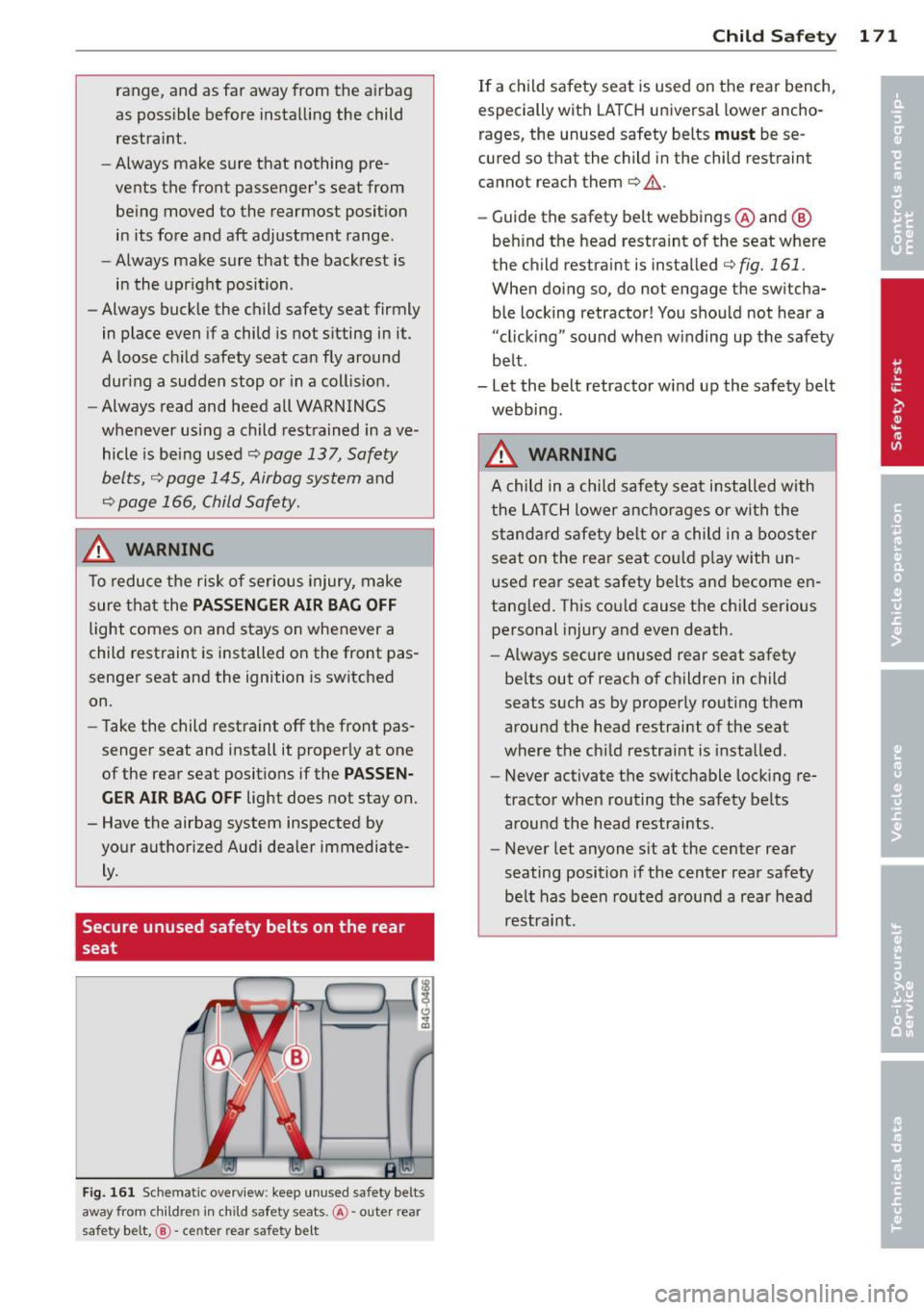
Secure unused safety belts on the rear
seat
F ig. 161 Schematic overview: kee p un used safety be lts
away from chil dren in child safe ty seats. @-oute r rear
safety be lt,
@ -center rear safety belt
.
Child S afety 1 71
If a child safety seat is used on the rea r bench,
especially with LATCH universal lower ancho
rages, the unused safety belts
must be se
cured so that the child in the child restraint
cannot reach them
c:::;, &,.
- Guide the safety belt webbings @and @
beh ind the head restraint of the seat where
the child restra int is insta lled
c:::;, fig. 161.
When doing so, do not engage the switcha
ble locking retractor! You shou ld not hear a
"cl icking" sound when w inding up the safety
be lt .
- Let the belt retractor wind up the safety belt
webbing.
.8, WARNING
A child in a chi ld safety seat i nstalled with
the LA TCH lower ancho rages or with the
standard s afety be lt or a child in a boos ter
seat on the rea r seat co uld p lay with un
use d rea r seat safety belts and become en
tang led . This could cause t he chi ld ser ious
personal injury and even death.
- Always secure unused rear seat safety
be lts out of reach of children in child
seats such as by proper ly rout ing t hem
around the head restrai nt of the seat
where the ch ild restraint is installed.
- Never activate t he switchable l ock ing re
tracto r when routing the safety be lts
arou nd the head restraints.
- Never let anyone s it at the center rear
seating position if the center rea r safety
be lt has been routed around a rear head
restraint.
Page 176 of 302
174 Child Safety
to the backrest on the vehicle seat. Ad
just or remove the rear seat head restraint if it is difficult to install the
child seat with the head restraint in place
<=> page 61 . Install the head restraint
again immediately once the child seat is
removed. Driving without head restraints
or with head restraints that are not prop
erly adjusted increases the risk of serious
or fatal neck injury dramatically.
- Always read and heed all WARNINGS
whenever using a child restrained in ave
hicle is being used
<=>page 137, Safety
belts,<=> page 145, Airbag system
and
t::> page 166, Important things to know.
A WARNING
If exceptional circumstances require the
use of a forward-facing child restraint on
the front passenger's seat, the child's safe
ty and well -being require that the follow
ing special precautions be taken:
- Make sure the forward-facing seat has been designed and certified by its manu
facturer for use on a front seat with a passenger front and side airbag.
-Always follow the manufacturer's in
structions provided with the child safety
seat or infant carrier.
- Always move the front passenger seat in
to the rearmost position of the passen
ger seat's fore and aft adjustment range,
and as far away from the airbag as possi
ble before installing the child restraint.
- Always make sure that nothing prevents
the front passenger's seat from being
moved to the rearmost position in its
fore and aft adjustment range.
- Always make sure the backrest is in an
upright position.
- Make sure that the
PASSENGER AIR BAG
OFF
light comes on and stays on all the
time whenever the ignition is switched
on.
- If the light does not stay on, perform the
checks
<=> page 156, Monitoring the Ad
vanced Airbag System.
-
- Take the child restraint off the front pas
senger seat and install it properly at one
of the rear seat positions if the
PASSEN
GER AIR BAG OFF
light does not stay on
whenever the ignition is switched on.
Booster seats and safety belts
Properly used booster seats can help pro te ct
children weighing between about 40 lbs. and
80 lbs. (18 kg and 36 kg) who are less than 4
ft.
9 in . (57 inches/1 .45 meters) tall.
"' .....
"' 0 ±
o5
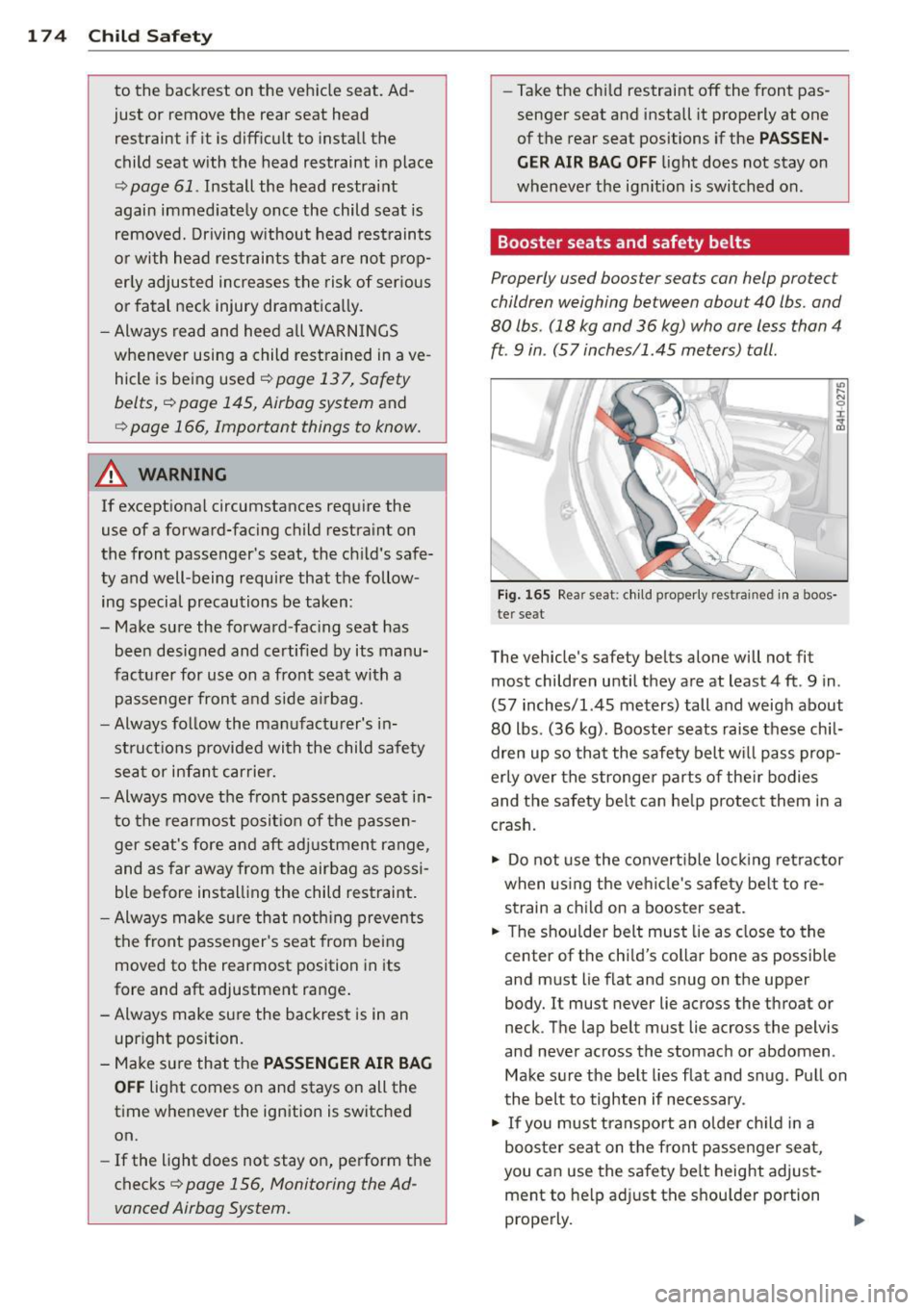
Fig. 165 Rea r seat: child properly rest rai ned in a boos
te r se at
The vehicle 's safety belts alone will not fit
most children until they are at least 4 ft . 9 in .
(57 inches/1.45 meters) tall and weigh about
80 lbs. (36 kg). Booster seats raise these chil
dren up so that the safety belt will pass prop
erly over the stronger parts of their bodies
and the safety belt can help protect them in a
crash.
.,. Do not use the convertible locking retractor
when using the vehicle's safety belt to re
strain a child on a booster seat.
.. The shoulder belt must lie as close to the
center of the child's collar bone as possible
and must lie flat and snug on the upper
body. It must never lie across the throat or
neck . The lap belt must lie across the pelvis
and never across the stomach or abdomen .
Make sure the belt lies flat and snug . Pull on
the belt to tighten if necessary .
.,. If you must transport an older child in a
booster seat on the front passenger seat,
you can use the safety belt height adjust
ment to help adjust the shoulder portion
properly.
Page 179 of 302
-The inflating airbag will hit the child
safety seat or infant carrier with great
force and will smash the child safety seat and child against the backrest, center
armrest, door or roof.
- Always install rearward-facing child safe
ty seats or infant carriers on the rear
seat.
- Forward-facing child safety seats or in
fant carriers installed on the front pas
senger's seat may interfere with the de ployment of the airbag and cause serious
injury to the child.
- It is safer to install a forward-facing
child safety seat on the rear seat.
- Always read and heed all WARNINGS
whenever using a child restrained in ave
hicle is being used ¢
page 166. Special
precautions apply when installing a child
safety seat on the front passenger seat
¢ page 146, Child restraints on the front
seat -some important things to know.
.&_ WARNING
-
Always take special precautions if you
must install a forward or rearward-facing
child restraint on the front passenger 's
seat in exceptional situations:
- Whenever a forward or rearward-facing
child restraint is installed on the front
passenger seat, the
PASSENGER AIR
BAG OFF
light must come on and stay on
whenever the ignition is switched on.
- If the
PASSENGER AIR BAG OFF light
does not come on and stay on, perform
the checks described ¢
page 156, Moni
toring the Advanced Airbag System.
-Take the child restraint off the front pas
senger seat and install it properly at one
of the rear seat positions if the
PASSEN
GER AIR BAG OFF
light does not stay on
whenever the ignition is switched on.
- Improper installation of child restraints
can reduce their effectiveness or even
prevent them from providing any protec
tion.
Child Safety 177
- An improperly installed child restraint
can interfere with the airbag as it de ploys and seriously injure or even kill the
child .
- Always carefully follow the manufactur
er's instructions provided with the child
safety seat or carrier .
- Never place additional items on the seat
that can increase the total weight regis
tered by the weight -sensing mat and can
cause injury in a crash .
A WARNING
Forward-facing child restraints:
- Always make sure the forward -facing
seat has been designed and certified by its manufacturer for use on a front seat
with a passenger front and side airbag.
- Never put the forward-facing child re
straint up, against or very near the in
strument panel.
- Always move the passenger seat into its
rearmost position in the seat's fore and
aft adjustment range, as far away from
the airbag as possible before installing
the forward-facing child restraint. The backrest must be adjusted to an upright
position.
- Make sure that the
PASSENGER AIR BAG
OFF
light comes on and stays on all the
time whenever the ignition is switched
on.
A WARNING
-
Rearward-facing child restraints:
-A child in a rearward-facing child safety
seat installed on the front passenger
seat will be seriously injured and can be killed if the front airbag inflates -even
with an Advanced Airbag System .
- The inflating airbag will hit the child
safety seat or infant carrier with great
force and will smash the child safety seat and child against the backrest, center
armrest, door or roof .
•
•
Page 232 of 302
230 Check ing and filling
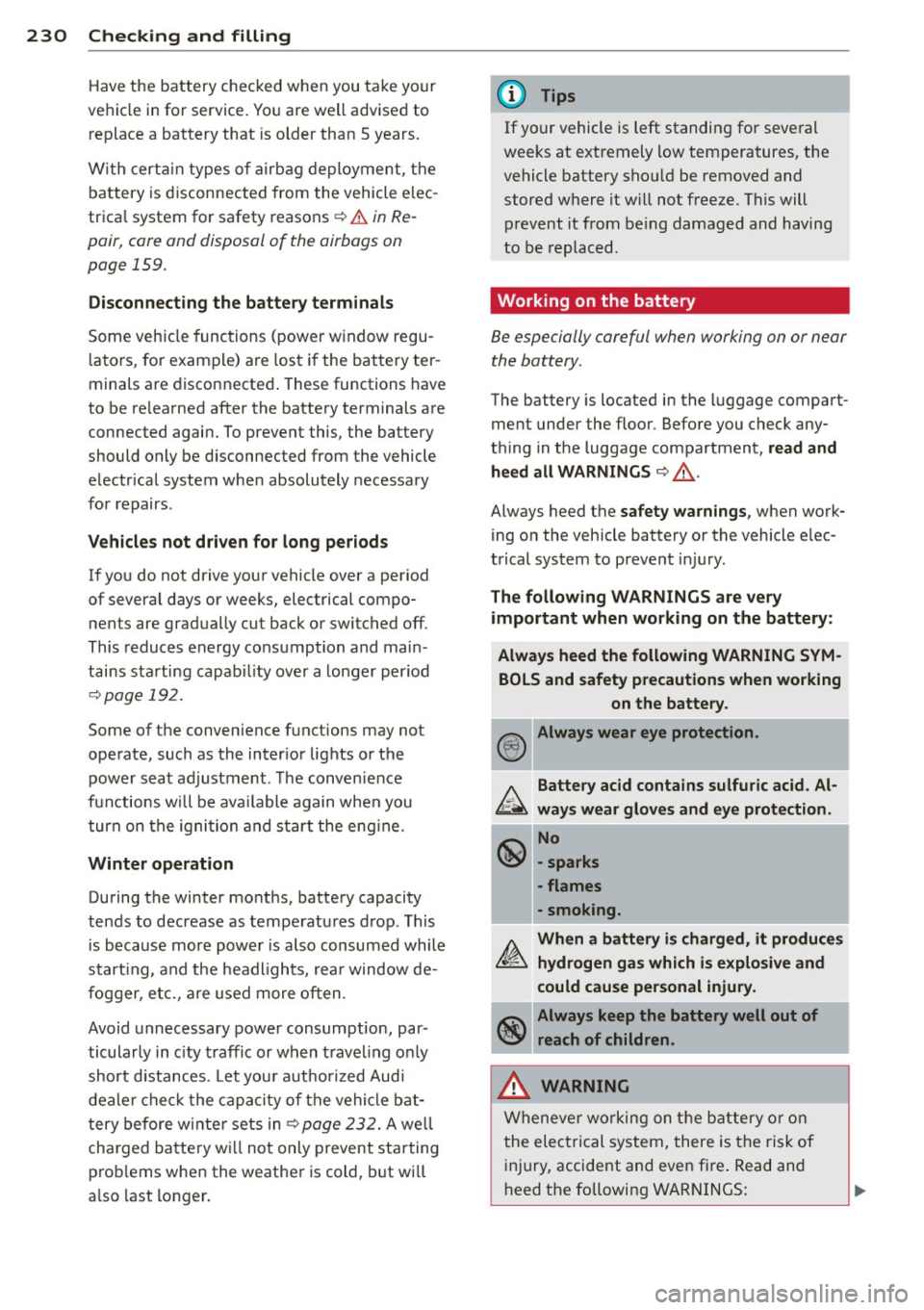
Have the battery checked when you take your
vehicle in for service. You are well advised to replace a battery that is older than 5 years.
W ith certa in types o f airbag deployment, the
battery is disconnected from the vehicle elec
trica l system for safety reasons¢
& in Re
pair, core and disposal of the airbags on
page 159.
Disconn ect ing the battery terminal s
Some vehicle functions (power window regu
lators, for example) are lost if the battery ter
minals are disconnected . These functions have
to be re learned after the battery terminals are
connected again. To prevent this, the battery
should only be disconnected from the vehicle
electrical system when absolutely necessary
for repairs .
Vehicles not dri ven fo r lo ng p eriod s
If you do not drive your vehicle over a period
of several days or weeks, electrical compo
nents are gradually cut back or switched off.
This reduces energy consumption and main
tains starting capabil ity over a longer period
¢ page 192.
Some of the conven ience functions may not
operate, such as the inter ior lights or the
power seat adjustment. The conven ience
functions will be ava ilable again when you
turn on the ignition and start the eng ine.
Winter operati on
During the winter months, battery capacity
tends to decrease as temperatu res drop . This
is because more power is also consumed while
start ing , and the headlights, rea r window de
fogger, etc., are used more often .
Avoid unnecessary power consumption, par
ticularly in c ity traffic or when traveling on ly
short distances. Let you r authorized Audi
dea ler check the capacity of the vehicle bat
tery before winter sets in
¢ page 232. A well
charged batte ry w ill not only prevent sta rting
prob lems when the weather is cold, but wi ll
a lso last longer.
(D Tips
If your vehicle is left standing for seve ral
weeks at extremely low temperatures, the
vehicle battery sho uld be removed and
stored where it w ill not freeze . This will
prevent it from be ing damaged and having
to be replaced .
Working on the battery
Be especially careful when working on or near
the battery.
The battery is located in the luggage compart
ment under the floor. Before you check any
t hi ng in the luggage compartment,
read and
heed all WARNINGS
¢ ,& .
Always heed the safety warnings , when work
ing on the vehicle battery or the vehicle e lec
trical system to prevent injury.
Th e follo wing WARNINGS are very
important when working on the battery :
Al ways heed the follo wing WARNING SYM
BOLS and safety prec aution s when working
on the battery .
® Always wear eye protection .
,0,. Battery acid contains sulfuric acid . Al
~ way s wear glov es and ey e prot ectio n.
~ No
\!SI -sparks
-flames
-smoking.
A Wh en a battery is charged , it produ ce s
~ hydro gen gas which is e xplosi ve and
c o uld cau se pe rson al injur y.
~ Always keep the battery well out of
'if!:11 reach of children .
_& WARNING
Whenever working on the battery or on
the electrical system, there is the risk of
injury, accident and even fire . Read and
heed the following WARNINGS:
-
Page 295 of 302
Optional equipment
Marked with an asterisk . . . . . . . . . . . . . . . 6
Othe r equipment (effic iency program) 28
Outside m irrors
refer to Exter ior mirrors . . . . . . . . . . . . . 50
Outside temperature display ... .. .. .. .. 24
Owner's manual How the Owner 's Manua l is o rganized . . . 6
p
Paint
Touch-up . .. .. .. .. .. .... ... .. .. .. . 207
Paint No ... .. ................. .. ... 275
P arce l shelf . ... .. ........ ... .. .. .. .. 75
Park assist . ................ ...... .. 116
Parking ..... .. .. .. .. .... ... .. .. .... 86
Automatic transmission . . . . . . . . . . . . . 93
Valet park ing ............ .... .. .. .. 45
P ark ing brake . ..... .... ... .. .. .. .. .. 85
also refer to Electromechanical parking
brake . ..... .. .. ... . .... ... .. .. .... 85
P ark ing system ............ .. .. .. .. . 116
C le a ning sensors/c amer a .... .. .. .. . 205
Rear . ..... ... .. .. ..... ... .. .. ... 116
Rear,withrearviewcamera ... .. .. .. . 117
P ark ing system (rear) ............ .... 116
Adj ust ing the wa rning tones .. .. .. .. . 117
Park ing system (rear, w ith rear v iew cam-
era) Park ing mode 1 . ............. ... .. 120
P ark ing mode 2 ............. ... ... 121
S afety precautions ........ .... .. .. . 118
Sw itchi ng on/off ......... .. .. .. .. . 119
Sw itching rear view camera on/off ... . 122
Part it ion net . . . . . . . . . . . . . . . . . . . . 70, 7 1
Parts rep lacement . ..... ... .. .. .. .. . 282
P ass-t hrough . . . . . . . . . . . . . . . . . . . . . . . . 7 4
PASSENGER AIR BAG OFF light . . . . . . . . 156
Passive safety system .... ... .. .. .. .. . 127
P eda ls .. .. ... ...... ............. .. 132
Phys ica l pr inc iples of a frontal coll is ion . 138
P olishing .. .. .... ............. .. .. . 20S
Pollutant filter (automatic AC system) . .. 76
Power seat adjustment . . . . . . . . . . . . . . . . . . . . 60
Inde x 293
Power locking system . . . . . . . . . . . . . . . . . 32
Emergency locking . .. ... ...... ... .. . 38
Power w indows . ... . .. ... .... ... .. . 43
Rear lid ... .. .. .. ................. . 39
Se lective unlock feature ............ . 3 7
Settings ........ .. ................ 37
Slid ing/tilting sunroof .. .. .. ... ... .. . 43
Power steering
refer to Electro-mechanical power as-
s ist ...... .. .. .. .. . .............. 190
Power w indow
Convenience opening/closing . ... .. .. . 43
Power w indows .. .. .... ........... .. . 42
Child safe ty locks . . . . . . . . . . . . . . . . . . . 42
Malfunctions .. .. ................. . 44
Pregnant women Spec ial considerations when wear ing a
safety belt . . . . . . . . . . . . . . . . . . . . . . . 142
Proper occupant seating positions ... .. 128
Proper safety belt position ..... ... .. .. 141
Proper seating posi tion
Front passenger ................... 129
O ccupants . .. .. .. .... ........... .. 128
Rea r passengers .. .... ........... .. 130
Protective liner .. .. .... ... .... .... .. . 7S
Q
Quart z clock . . . . . . . . . . . . . . . . . . . . . . . . 12
qua tt ro®
refer to all-wheel drive
191
Question What happens to unbelted occupants? 138
Why safe ty belt s? ............. .... 13 7
R
Radiator fan 228
Rain/ light sensor
Head lights .. .. .. .... ........... .. . 47
Intermittent (w indshield w ipers) . .. .. . S3
Sensor defective . . . . . . . . . . . . . . . . . . . . 22
Reading lights ....... . .. .. ..... ... .. . 50
Rea r doo r su n shade . . . . . . . . . . . . . . 52, 53
Rear fog lights .. ...... ............. . 47
Rea r lid
Automatic operation . .. ..... ... .. .. . 40
Emergency re lease . .. ... .... ... .. .. . 41
•
•
Page 296 of 302
294 Index
Escape hand le ...
..... ... .. .. .... .. 42
Opening and closing
Rear light 39
Defective . . . . . . . . . . . . . . . . . . . . . . . . . 21
Rear view camera Parking mode 1
Parking mode 2 120
121
Rear view mirror . . . . . . . . . . . . . . . . . . . . . 51
Rear window heating . . . . . . . . . . . . . . . . . 78
Rear window sun shade . . . . . . . . . . . . . . . 53
Rear window washer system . . . . . . . . . . . 53
Recirculation mode (automatic climate
control) . . . . . . . . . . . . . . . . . . . . . . . . . . . . 77
Refuelling . .. .. . .......... .. .. .... . 217
Release lever for hood . . . . . . . . . . . . . . . 219
Remote control
Hom elink .. ............. .. .. .. .. . 123
Remote control key ........... .. .... .. 33
Personalizing ............. ... .. .. .. 33
unlocking/locking ....... ... .. .. .. .. 35
Remote rear lid release . . . . . . . . . . . . . . . 39
Repair manuals .. ........ .. .. .. .. .. . 280
Repairs Airbag system ............ ... .. ... 158
Replacement key . . . . . . . . . . . . . . . . . . . . 33
Replacing Windshield wiper blades ..... .. .... .. 55
Replacing bulbs ............ ... .. .. . 268
Replacing tires and wheels ... .. .. .. .. . 246
Replacing wipe r blades . .. .. .. .. .. .. .. 54
Reporting Safety Defects .... .. .. .... . 135
Reset button .. .. ........ ...... .... .. 12
Retractor .... .......... ...... ... .. . 140
Reversible floor .. ........ .. .. .. .... .. 75
Reversible mat .. ........ .. .. .. .. .. .. 73
Right hand drive ........... .... .... .. 49
Rims Cast alloy . .. .... ........ .. .. .... . 208
Roof rack .. ... ............ .. .. .. .. .. 67
Roof load .. ... .......... .. .. .. .. .. 68
Roof weight . . . . . . . . . . . . . . . . . . . . . . . 68
s
SAFE . .. .. ... ............ .. .. .. .. .. 12
Safe driving hab its ......... .. .. .. .. . 127 Safety
belt position . . . . . . . . . . . . . . . . . 141
Safety belt height adjustment ... .. .. 143
Safety belts worn by pregnant women . 142
Safety belt pretensioner . . . . . . . . . . . . . . 143
Service and disposal ............... 144
Safety belts . . . . . . . . . . . . . . . . . . . . . . . . 140
Cleaning .. ... ... ................ . 212
Danger to passengers who do not wear a
safety belt .... .. ............. .... 138
Fastening . .. .. . .. ............ .. .. 140
Height adjustment .. ... ........ .. .. 143
Improperly worn ... ........... .. .. 143
Not worn . . . . . . . . . . . . . . . . . . . . . . . . 138
Safety be lt position . . . . . . . . . . . . . . . . 141
Safety instructions ............. .... 140
Securing child safety seats ....... ... 176
Spec ial considerations for pregnant
women ...... ... .. .............. . 142
Unfa stening ... .. ... .......... .. .. 142
Warning/indicator light ......... .... 13 7
Warning light . . . . . . . . . . . . . . . . . . . . . . 17
Why YOU MUST wear them .......... 137
Worn properly ... .. ........... .. .. 139
Safety belt warning light ......... .. .. 13 7
Safety compliance sticker ........ .... 275
Safety equipment . ... ........... .. .. 127
Safety features for occupant restraint and
protection . . . . . . . . . . . . . . . . . . . . . . . . . 12 7
Safety guidelines
Seats . .... .... .. ............. .... . 58
Safety instructions
Engine compartment ........... .. .. 219
for side c urtain airbags ............. 165
for using child safety seats ...... .... 169
for using safety belts ........... .. .. 140
Monitoring the Advanced Airbag Sys-
tem .. ..... ... .. .. .............. . 158
Seat adjustment Head restra ints ... ................ 131
Seat belts
refer to Safety belts . . . . . . . . . . . . . . . . 13 7
Seat heating . . . . . . . . . . . . . . . . . . . . . . . . 78
Seating capac ity ... ............. .... 137
Seating position Driver .. .. .... .. .. ........... .. .. 128
Front passenger .. ... .......... .. .. 129
How to adjust the front seats ........ 129