tire pressure AUDI S4 2013 User Guide
[x] Cancel search | Manufacturer: AUDI, Model Year: 2013, Model line: S4, Model: AUDI S4 2013Pages: 302, PDF Size: 75.61 MB
Page 239 of 302
Speed rating (letter code)
means the speed at wh ich a tire is des igned to
be driven for extended periods of t ime . The
ratings range from 93 mph (150 km/h) to
186 mph (298 km/h) ¢
page 247 . You may
not find this information on all tires because
it is not required by law.
The speed rating letter code, where applica ble, is molded on the tire sidewall and indi
cates the maximum permissible road speeds
¢ &. in Winter tires on page 250.
Tire pressure monitoring system*
means a system that detects when one or
more of a vehicle's tires are underinflated and
illuminates a low tire pressure warn ing te ll
tale .
Tread
means that port ion of a tire that comes into
contact with the road.
Tread separation
means pulling away of the tread from the tire
carcass .
Treadwear indicators (TWI)
means the projections within the pr incipal
grooves designed to give a visual ind ication of
the degrees of wear of the tread. See
¢
page 244, Tread Wear Indicator (TWI) for
mo re inf ormat ion on measuring tire wear.
Uniform Tire Quality Grading
is a tire information system developed by the
United States National Highway Traffic Safety
Admin istration (N HTSA) that is designed to
help buyers make relative comparisons among
tires . Th e U TQG is not a safety rating and not a
g ua ran tee that a tir e will last for a prescribed
number of mi les (kilometers) or perform in a
certain way. It simply gives tire buyers addi
tional information to combine with other con-
Tires and wheels 237
siderations, such as price, brand loyalty and
dealer recommendations. Under UTQG, tires
are graded by the t ire manufacturers in three
areas : treadwear, traction, and temperature
resistance. The UTQG informat ion on the tires,
molded into the sidewalls .
U.S. DOT Tire Identification Number (TIN)
This is the tire's "serial number". It begins
with the letters "DOT" and indicates that the
tire meets all federa l standards. The next two
numbers or letters indicate the plant where it
was manufactured, and the last four numbers
represent the week and year of manufacture.
For example,
DOT ... 2212 ...
means that the tire was produced in the 22nd
week of 2012. The other numbers are market
ing codes that may or may not be used by the
tire manufacturer. This information is used to
contact consumers if a tire defect requires a
recall.
Vehicle capacity weight
means the rated cargo and luggage load plus
150 lbs . (68 k ilograms) times the vehicle's to
tal seating capacity as listed on the label lo
cated on the driver's side B -pillar .
Vehicle maximum load on the tire
means that load on an individual tire that is
determined by distributing to each axle its
share of the maximum loaded vehicle weight
and dividing by two.
Vehicle normal load on the tire
means that load on an individual tire that is
determined by distributing to each ax le its
share of the curb weight, accessory weight,
and normal occupant weight (distr ibuted in
accordance with table below¢
page 238)
and dividing by two.
•
•
Page 240 of 302
238 Tires and wheels
Occupant loading and distribution for vehicle normal load for various designated seating
capacities
Designated seating capacity,
number of occupants Vehicle normal load
, number Occupant distribution in a nor-
of occupants _____ mally loaded vehicle
5 3 2 in fro nt, 1 in back seat
Cold tire inflation pressure
Tire pressure affects the overall handling, performance and safety of a vehicle.
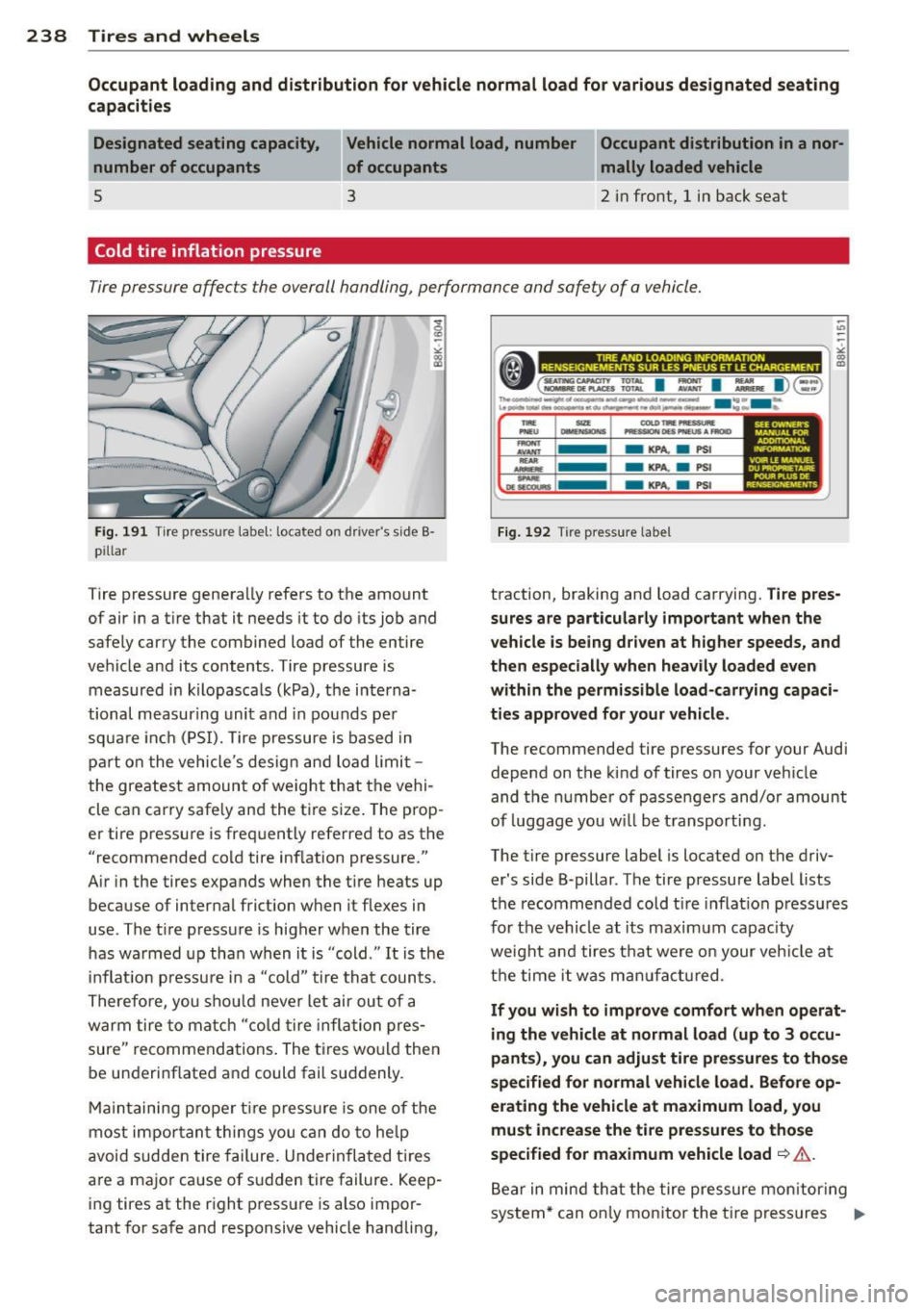
Fig. 19 1 T ire pressure label : located on driver's side B·
pillar
Tire pressure genera lly refers to the amount
of air in a t ire that it needs it to do its job and
safely carry the combined load of the entire
vehicle and its contents . Tire pressure is
measured in kilopasca ls (kPa), the i nterna·
tional measur ing unit and in pou nds pe r
squa re inc h (PSI). Tire pressure is based in
par t on the vehicle's desig n and load limit -
the greatest amoun t of weight that the vehi·
cle can carry safe ly and the t ire size . The prop·
er tire pressure is freq uently referred to as the
" recommended cold tire inf lation pressure."
A ir in the tires expands when the tire heats up
because of internal frict ion when it flexes in
use . The t ire p ressu re is higher when the tire
h as wa rmed up tha n when it is "cold ." It is the
in flat io n pressu re i n a "cold" tire that counts.
Th erefore, you shou ld neve r let air ou t of a
warm tire to match " co ld tire inflat ion pres
sure" recommendations . The t ires wo uld then
be underinflated and could fail su ddenly.
M ain taining p roper t ire pr essu re is one of the
most im po rt an t th ings you ca n d o to he lp
avoid sudden tire failure. Underin fla ted t ires
a re a ma jo r cause of s udden tire failure. Keep·
i n g tires at the right pressure is also impor
tant for safe and responsive vehicle handling,
-U'>
-
---------------------- ,;
•(=~= I: I::... 1)§ :l!: n-...,....,....,~ ...... ~-...,..., ..... _ ... U ........ ~-·~N.-..-.we..... .... lllt-
-AVANT ...,.
-...... .. _
-KPA. a PSI
-KPA. a PSI
-KPA. a PSI
Fig. 192 Ti re pr essure labe l
SEE OWNEJICS MANUA1 FOA A,DOITl<>N.IU. INfORMATlON
VOIR L£ MANUll DUPR0ftlET""" P"OUR i-t.US DE RENSEIGMEMENfS
traction, braking and load carrying. Tire pres
sures are particularly important when the
vehicle is being driven at higher speeds, and
then especially when heavily loaded even
within the permissible load-carrying capaci
ties approved for your vehicle .
The recommended tire pressures f or y our Audi
depe nd on the kind of tires o n your ve hicle
and the numbe r of passe ngers and/o r amount
of luggage you w ill be t ransporti ng .
The tire pressure label is located on the driv
er's side B-pillar . The tire pressure labe l lists
the recommended cold t ire inflat io n press ures
for the vehicle at its maximum capac ity
weig ht an d tires t hat were o n your veh icle at
t h e time it was m anufactur ed.
If you wish to improve comfort wh en operat
ing the vehicle at normal load (up to 3 occu
pant s), you can ad just tire pre ssure s to tho se
specified for normal vehicle load . Before op
erating the vehicle at maximum load, you
mu st increase the ti re pressures to those
specified for maximum vehicle load
~ ,&. .
Bear in min d that the tire pressure mon itor ing
system * can o nly mo nitor the tir e press ures .,.
Page 241 of 302
Tires an d wheel s 239
you have stored. The system does not recog
nize the load condition of your vehicle.
The effectiveness of the ti re pressu re monitor
ing sys tem* will be impaired if you store nor
mal load pressures but then operate the vehi
cle at its maximum load¢,& .
See the illustration ¢
fig. 191 for the location
of the label on dr iver's side B-pillar (co lor of
the actual labe l and exact location on the ve
hicle wi ll vary slig htly) .
Note that the fo llowing tab le is accurate a t
the t ime o f go ing to press and is subject to
I Model II Tire designation
c h ange. In the event of discrepancies, the ti re
pressure label is located on the driver's side B
pillar always takes precedence .
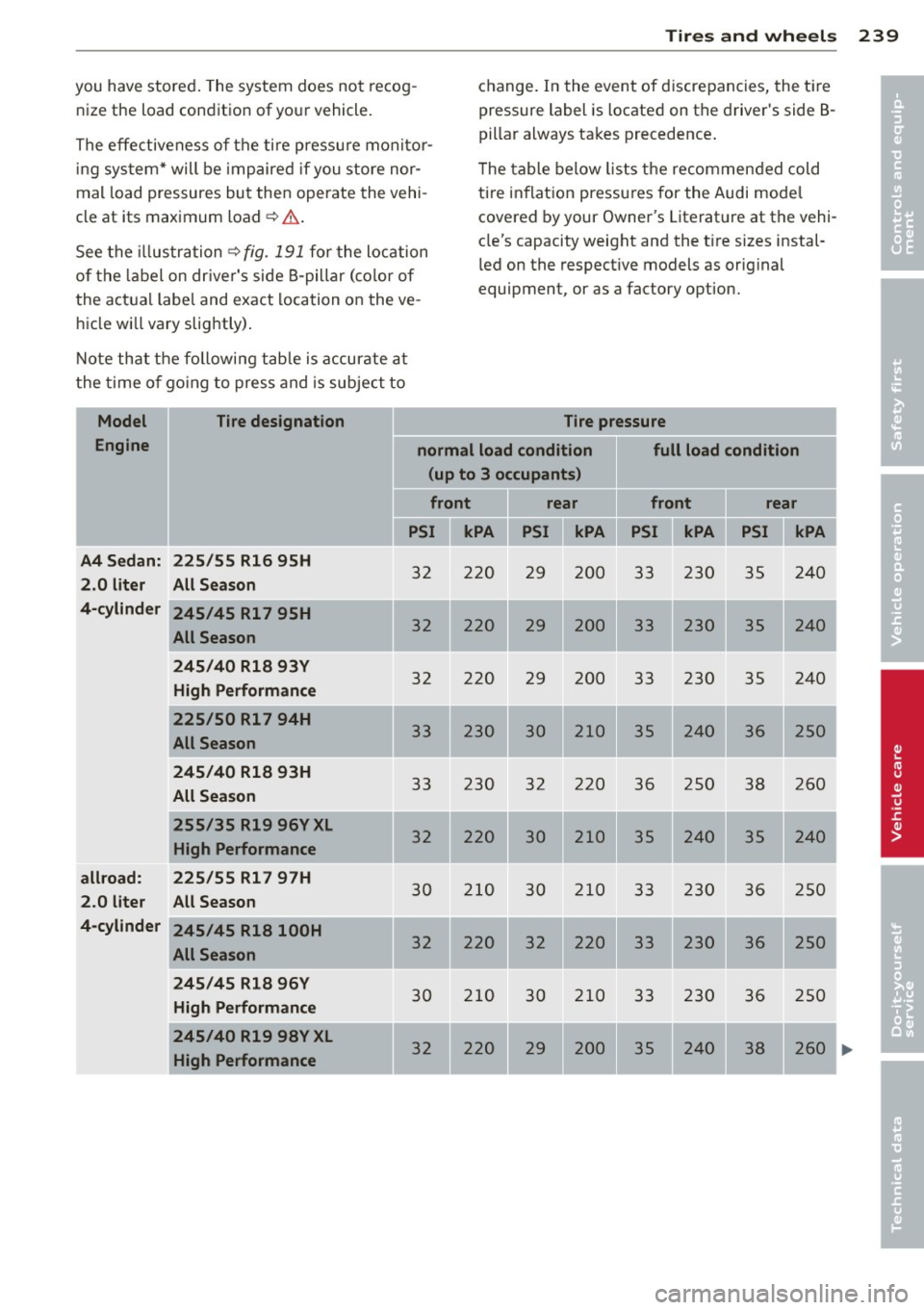
T he table below lists the recommended cold
ti re inflation pressures for the Audi mode l
covered by your Owner's Literat ure at the vehi
cle's capacity weight and the t ire sizes instal
l ed on the respective models as orig inal
equipment, or as a factory option.
Tire pressure
Engine normal load condition full load condition
A4 S edan:
2.0 liter
4-cylinder
all road:
2.0 liter
4-c ylinder 225
/55 R16 95H
All S eason
245 /45 Rl 7 95H
All Season
245 /40 R18 93Y
High Performan ce
225 /50 Rl 7 94H
All Season
245 /40 R18 93H
All Season
1 255 /35 R19 96Y XL
High Performance
225 /55 Rl 7 97H
All Season
245 /45 Rl8 l00H
All Season
245 /45 R18 96Y
High Performance
245 /40 R19 98V XL
High Performance (up to 3 occupants
)
front rear front rear
I
PSI j[ kPA PSI j[ kPA PSI Jl kPA PSI I[ kPA
32 220 29 200 33 230 35 240
32 220 29 200 33 230 35 240
32 220 29 200 33 230 35 240
•
33 230 30 210 35 2
40 36 250
I
33 230 32 220 36 250 38 260
'
32 220 30 210 35 2
40 35 240
I
30 210 30 210 33 230 36 250
32 220 32 220 33 230 36 250 30 210 30 210 33 230 36 250
32 220 29 200 35 2
4 0
38 260
-• - -. -
•
•
...
Page 242 of 302
240 Tires and wheels Model Tire designation Tire pressure
Engine normal load condition full load condition
(up to 3 occupants )
front rear front rear
I
PSI II kPA PSI II kPA PSI II kPA PSI II kPA :
S4 Sedan : 245 /40 Rl8 93H
3 .0 liter All Season
36 250 32 220 41 280 41
280
6-cylinder
24S/40 Rl8 93V
I High Performance
39 270 35 240 41 280 41 280
255/35 Rl9 96V XL
High Performance
39 270 33 230 41 280 41 280
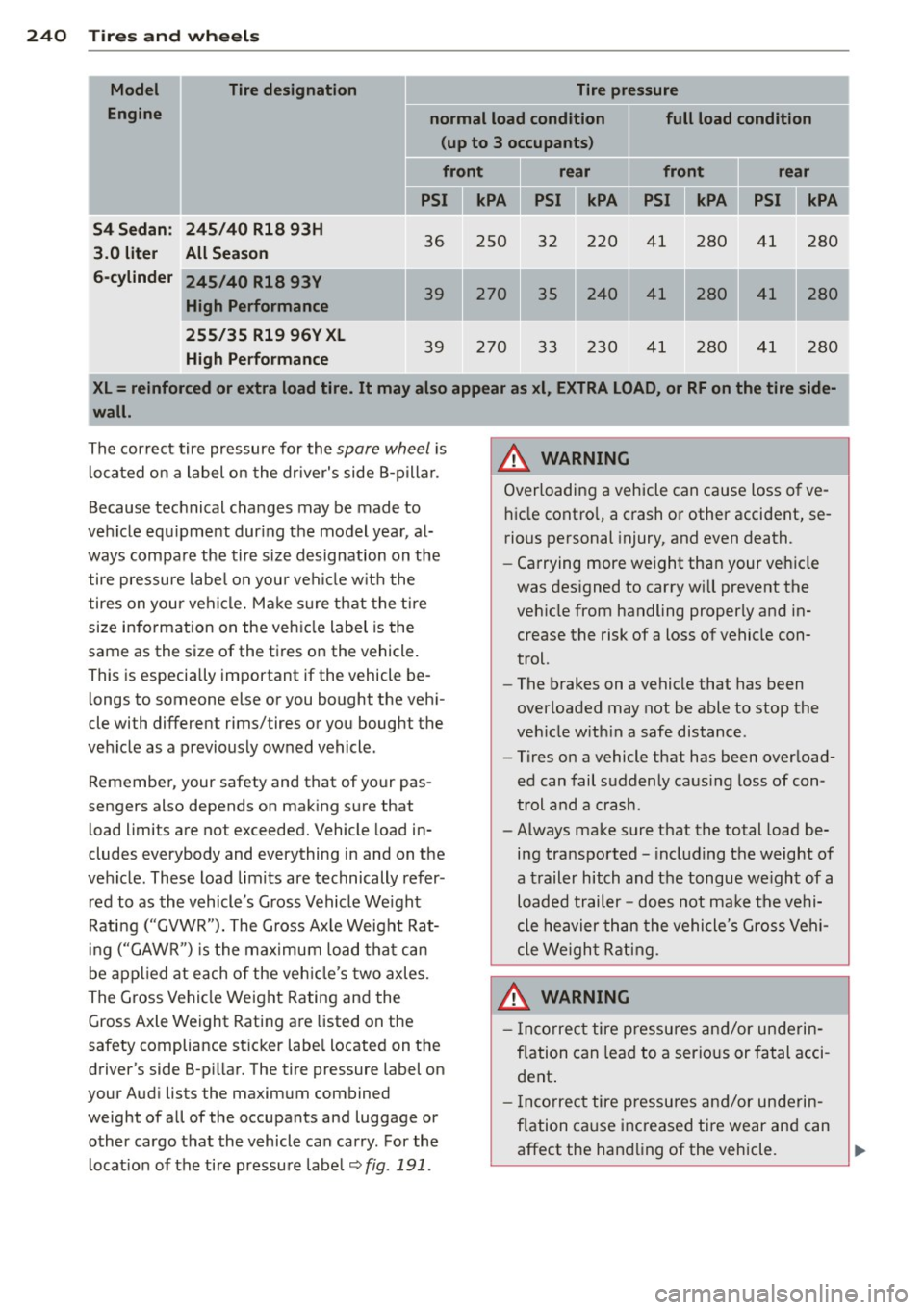
XL= reinforced or extra load tire. It may also appear as xl
, EXTRA LOAD, or RF on the tire side
wall.
The correct tire pressure for the spare wheel i s
l o cated on a label on the dr ive r's side B-p illa r.
Because tec hnical cha nges may be made to
ve hicle equ ipment dur ing the model yea r, a l
ways compa re the tire siz e designation on the
tire pressure labe l o n you r vehi cle w it h the
tires on your vehicle. M ake s ure that the t ire
size info rmation on the veh icle label is the
same as the size of the t ire s on the vehicle.
This is especially important if the vehicle be
l ongs to someone else or you bought the veh i
cle with different rims/tires or you boug ht the
ve hicle as a p reviously owned vehicle.
Remembe r, your safety and that of your pas
sengers also depends on mak ing s ure that
load limits are not exceeded. Vehicle load in
cludes everybody and everything in and on t he
ve hicle . These load lim its are technically refer
red to as th e vehicle's G ross Vehicle We ight
Rati ng ("GVWR"). The G ross Ax le Weight Rat
i ng ( "GA WR ") is the ma ximum load tha t can
be applied at each o f the veh icle 's two axles.
T he G ross Vehicle We ig ht Rating and the
Gross Axle Weight Rating a re listed on the
safety compliance st ic k er labe l located on the
driver's side B-p illar. The tire pressure label on
your Aud i lists the maximum combined
A WARNING
Overloadin g a vehicle can cause loss of ve
h icle cont ro l, a c rash or other accident, se
rious pe rsonal injury, and even death.
- Ca rrying more we ight tha n your veh icle
was des igned to carry will prevent the
veh icle from handling properly and in
crease the risk of a loss of vehicle con
trol.
- The brakes on a vehicle that has been
overloaded may not be able to stop the
veh icle w ith in a safe distanc e.
- Tires on a vehicle that has been overload
ed can fail s uddenly ca us ing loss of con
trol and a crash.
- Always make sure that the total load be
i n g transported - including the weight of
a trailer hitch and t he tongue we igh t of a
loaded tr ail er -does not ma ke t he ve hi
cle he avier th an the vehicle' s Gro ss V ehi
cle Weigh t Ra tin g.
.&_ WARNING
- In cor rect tire pressure s and /or u nderin
fl ation can lead to a serio us or fatal acci
dent .
- I nco rrec t tire pressures an d/or un derin
fla tion ca use increased ti re wear an d can
'
I
weight of all of the occupants and luggage or
other cargo tha t the vehicl e can carry . For the
l ocat io n of the ti re pressu re labe l~
fig . 191 .
affect the handling of the vehicle. ..,_
Page 243 of 302
-Incorrect tire pressures and/or underin
flation can also lead to sudden tire fa il
ure, including a blowout and sudden de
flation, causing loss of vehicle control.
Checking tire pressure
The correct tire pressure for the tires original
ly installed on your vehicle is listed on the tire
pressure label located on driver's side 8-pil lar .
The recommended t ire pressures are on the
tire pressure label and in the table
c:> page 238, Cold tire inflation pressure .Th is
means that the pressure must be checked and
adjusted when the tire has not been driven for
mo re tha n a couple of m iles (k ilome ters) at
l ow speeds during t he p revious three hours.
A ir in the tires expands when the ti re heats up
as a result of inte rna l friction as it flexes in
use. The tire press ure is higher when the tire
has warmed up than when it is "cold."
It is the i nflat ion p ressu re in a "cold" tire that
counts . Therefore, you shou ld never let air ou t
of a warm tire to match "Cold tire inflation pressure" recommendations
c:> page 238. The
tires would then be under inflated and could
fa il suddenly.
The tire press ure labe l on yo ur Audi lists the
recommended cold t ire inflat ion pressures at
maximum capacity for the new, origina l
equ ipment tires that were on your vehicle at
the time it was manufactured. For the loca
tion of the label
<=> page 238, fig . 191 .
Most tires lose a ir naturally over time. They
can also lose some a ir if you drive
over a pot
hole or hit a curb while parking. It is usually
not possible to see whether the radial t ires
used today are underi nflated just by looking
at them.
Therefore, be sure to check tire pressures at
least o nce a month and always before going
on a long tr ip . Make sure to take the number
of people and the amoun t of luggage into ac
coun t when adjusting tire pressure for a t rip -
even one that you would not consider to be
Tire s an d wheel s 241
"long." See c:> page 24 2, Tires and vehicle
load limits
for more important information.
A lways use an acc urat e tire pressu re ga uge
when checking and ad justing infla tion pres
s ur es . Check a ll of the tires and be sure not to
forget the spare tire. If the pressure in any t ire
is too h igh when the tire is "cold", let a ir o ut
of the t ire s low ly w ith the edge of the tire
gauge and keep checking the pressure until
you reach the pressure that is correct for the load (passengers and luggage) and k ind of
driv ing you plan to do.
If the pressure in any tire is too low, note the
difference between the pressure in the co ld
t ire a nd the pressure you need and add the air
that you need to reach the correct pressure for
t h e ve hicl e load (passenge rs and luggage) for
the tires on you r veh icle as l isted on the o n
yo ur vehicle and in this ma nual and the kind
of driving you plan to do.
Never exc eed the maximum inflation pr es
sure li ste d on the tire sidewall for any re a
s o n.
Remember that the vehicl e manufacture r, not
t h e tire manu fact urer, de termines t he cor re ct
t ir e p ress ure fo r th e tires on your ve hicl e.
It is important to check the t ire p ressu re whe n
the tires are co ld.
- Read the required tire pressure from the t ire
pressure labe l. The t ire pressure label is lo
cated o n the dr iver's side 8-pillar. The tire
pressure labe l lists the recommended co ld
tire inflation pressures for t he vehi cle at its
maxim um capacity weigh t and t he tires that
were on your ve hicle a t the time i t was man
ufactured . For recommended tire pressures
for normal load conditions, p lease see chap
ter
<=> page 238.
-Tu rn the va lve stem cap counter -clockwise
to remove it from the tire
va lve .
-Place t he ai r pressure gauge on the va lve.
- The tire pressu res should o nly be checked
and ad justed when the tires are co ld . The
slightly raised pressures of warm tires must
not be red uced.
Ill>-
•
•
Page 244 of 302
24 2 T ire s and wheel s
-Adjust the tire pressure to the load you are
carrying.
- Reinsta ll the va lve stem cap on the valve .
When should I check the tire pres sur e?
The correct tire pressure is especially impor
tant at high speeds. The pressure should
therefore be checked at least once a month
and a lways before starting a journey. Do not
forget to check the tire pressure for the spare
wheel.
When should I a dju st the tire p re ss ures?
Adjust the tire pressure to the load you are
carry ing . After changing a wheel
o r replacing
wheels you have to adjust the tire pressures
on all wheels . In addition, you must then initi
alize the new tire pressures in the tire pres
sure monitoring system*
r:!> page 253.
A WARNING
Incorrect tire pressures and/or underinf la
tion can lead sudden tire failure, loss of
control, collision, ser ious personal injury
or even death.
- When the
II] warning symbol appears in
the instrument cluster, stop and inspect
the tires .
- Incorrect tire pressure and/or underinfla
t ion can cause increased t ire wear and
can affect the handling of the veh icle and
stopp ing ability.
- Incorrect tire pressures and/or underin
flation can also lead to sudden tire fa il
ure, including a blowout and sudden de
flation, causing loss of vehicle control.
- The driver is responsible for the correct
t ire press ures fo r all tires on the vehicle .
T he applicable p ressure va lues are locat
ed on a sticker on the driver's side B -pil
lar.
- Only when a ll ti res on the vehicle are fi l
led to the correct pressure, the tire pres
sure monitoring system* can work cor
rect ly.
- The use of incorrect tire pressure values
can lead to accidents or other damage.
Therefore it is essential that the driver observe the specified t
ire pressure val ues
for the tires and the correct pressures for
the function of the ti re pressure monitoring system*.
- Always inflate tires to the recommended
and correct t ire pressure before dr iv ing
off.
- Driving with underinflated tires bend
more, letting them get too hot resulting
in tread separation, sudden tire failure
and loss of control.
- Excessive speed and/overloading can
cause heat build-up, sudden tire failure
and loss of cont rol.
- If the tire pressure is too low or too high,
the t ires will wear prematurely and the
veh icle w ill not ha ndle well.
- If the tire is not flat and you do not have
to change a wh eel immediately, drive at
red uced speed to the nearest service sta
tion to check the t ire p ressure and add
air as required.
Q) Note
D riving without valve stem caps can cause
damage to the tire valves. To prevent this,
a lways make sure tha t factory insta lled
valve stem caps on all whee ls are sec urely
mounted on the valve.
@ For the sake of the environment
U nderinflated tires w ill also incre ase the
fuel consumption .
Tires and vehicle load limits
There are limits to the amount of load or
weight that any veh icle and any tire can carry.
A vehicle that is over loaded will not handle
well and is more d iff icult to stop. Overloading
can not only lead to loss of vehicle control,
but can also damage important parts of the
vehicle and can lead to sudden tire fa ilure, in
cl ud ing a b lowout and sudden deflation tha t
can cause the vehicle to crash.
Your safety and that of your passengers also depends on making sure that load limits are .,..
Page 245 of 302
not exceeded . Vehicle load includes everybody
and everything in and on the vehicle. These
l oad limits are techn ica lly referred to as the
ve hicle's
Gross Veh icle Weight Rat ing
("GVWR").
The "GVWR" includes the weight of the basic
veh icle, all factory insta lled accessories, a full
tank of fu el, oil, coolant and other fluids plus
maximum load. The maximum load includes
the number of passengers that the vehicle is
in tended to carry ("seating capacity") w ith a n
assumed weight of 150 lbs . (68 kg) for each
passenger at a des igna ted sea ting pos ition
and the tota l we ight of any l uggage in the ve
h icle. If you tow a trailer, the weig ht o f the
trailer hitch and the tong ue weight of the
l oaded trailer must be included as part of the
veh icle load.
The
Gro ss A xle Weight Rating ("GAWR") is
the maximum load that can be applied at each
of the vehicle's two ax les.
The G ross Vehicle We ight Rating and the
Gross Axle Weight Rating are listed on the
safety compliance sticker labe l located on the
driver's side B -pi llar .Your Audi has 5 seating
positions, 2 in the front and 3 in the rear for
tota l seating capacity of 5. Each seating posi
tion has a seat belt¢
page 137, Safety belts.
The fact that there is an upper limit to your
veh icle's Gross Vehicle Weight Rating means
that the tota l weight of whatever is being car
ried in the vehicle (including the weight of a
trailer hitch and the tongue weight of the
loaded trailer) is limited. The more passen
ge rs in the veh icle or passengers who are
h eav ier than the standa rd weights assumed
mean that less weight can be ca rr ied as l ug
gage.
The tire pressure labe l on you r Audi also lists
the maximum combined we ight of all of the
oc cu pants and luggage o r othe r ca rgo that
the vehicle can carry . For the location o f the
l abe l
¢page 238, fig. 191.
Tires an d wheel s 243
A WARNING
Overloading a vehicle can cause loss of ve
h icle contro l, a crash or other accident, se
rious pe rsonal injury, and even death.
- Carrying more we ight than your veh icle
was des igned to carry will prevent the
veh icle from handling properly and in
crease the risk of the loss of vehicle con
trol.
- The brakes on a vehicle that has been
overloaded may not be able to stop the
veh icle w ith in a safe distance.
- Tires on a vehicle that has been overload
ed can fail suddenly, incl uding a blowout
and sudden defla tion, causing loss of
contro l and a crash.
- Always ma ke sure that the total load be
ing transpor ted - incl uding the weight of
a trailer hitch and the tongue weight of a loaded trailer -does not ma ke the vehi
cle heavier than the vehicle's Gross Vehi
cle We ight Rating.
Determining correct load limit
U se th e example below to ca l
culate the total weight of the
pa ssengers and lu ggage or oth
e r thing s that you pl an t o tran s
po rt so that you can make sur e
that your vehicle will not b e
o verloaded.
Steps for Determining
Correct Load Limit
1 . Lo cate th e statement "THE
C OMBINED WEIGHT OF O C
CUPANTS AND CARGO
SHOULD NE VER E XCEED XXX
KG OR XXX LBS"on your vehi-
c le 's pla card (tire inflation ..,
•
•
Page 246 of 302
244 Tires and wheels
pressure label) ¢ page 238,
fig.191.
2. Determine the combined
weight of the driver and pas sengers that will be riding in
your vehicle.
3. Subtract the combined
weight of the driver and pas sengers from
"XXX" kilo
grams or
"XXX" pounds
shown on the sticker
¢ page 238, fig. 191.
4. The resulting figure equals
the available amount of car
go and luggage load capaci
ty. For example, if the
"XXX"
amount equals 1400 lbs.
and there will be five 150
lbs. passengers in your vehi
cle, the amount of available
cargo and luggage load ca
pacity is 650 lbs. (1400-750
(5
X 150) = 650 lbs.)
5. Determine the combined weight of luggage and cargo
being loaded on the vehicle .
That weight may not safely exceed the available cargo
and luggage load capacity
calculated in Step 4.
6. If your vehicle will be towing
a trailer, load from your trail
er will be transferred to your vehicle
. Consult this manual
to determine how this re duces the available cargo
and luggage load capacity of
your vehicle .
.., Check the tire sidewall
(¢ page 246, fig. 195) to de
termine the designated load rating for a specific tire.
Tire service life
The service life of tires depends on a lot of
different things including proper installation
and balancing, correct tire pressure and driv
ing style.
Fig. 193 T ire tread: tread wear ind icato rs (TWI)
____ Jj
Fig. 194 Rotating tires for more even wear
Tread Wear Indicator (TWI)
The original tires on you r vehicle have
1/16 inch (1.6 mm) high "wear indicators"
¢ fig. 193 running across the tread. Depend-
ing on the make, there will be six to eight of
them evenly placed around the tire. Marks on
the tire sidewall (for example "TWI" or other ..,
Page 247 of 302
symbols) indicate the positions of the tread
wear indicators. Worn tires must be replaced.
Different fig ures may apply in other co untries
c:> .&. .
Tir e pres sure
Incorrect tire pressure causes premature wear
and can cause sudden tire blow -out. For this
reason, tire pressure must be checked at least
once a month
c:> page 241.
Driving sty le
Driving fast around curves , heavy acceleration
and hard braking increase tire wear .
Rotating tires for mo re even wear
For all four t ires on your vehicle to have the
same se rvice life, we recommend that the
fro nt and rea r tires are rotated according to
the t ire manufacture r's suggested tire rota
tion intervals. Please remember the follow
ing:
- T ire rotat ion inte rva ls may differ from the
vehicle service intervals outlined in your
Maintenance and Wa rranty Booklet .
- T he longer one tire is used in one location
on the vehicle, the more it wears at certa in
points; therefore, we recommend that you
fo llow the t ire manufacturer's suggested
t ire rotation intervals .
- Vehicles with front -wheel drive experience
more tread wear on the front wheels com
pared to all whee l drive (quattro ®).
- Please rotate tires as shown
c:> fig. 194.
-Extra care must be taken when rotating di-
rection-specific tires
c:> page 263 .
Wheel balancing
The wheels on new vehicles are balanced .
H oweve r, va rio us situations d uring eve ryday
driving can cause them to be come unbal
anced, resu lting in vibrations you can us ually
feel through the steering wheel.
Unba lanced wheels must be rebalanced to
avoid excessive wea r on s teer ing , suspens ion
and tires. A wheel must a lso be rebalanced
when a new tire is installed.
Tire s an d wheel s 245
Incorrect wheel alignment
Incor rect wheel alignment can cause exces
sive tire wear, impairing the sa fety of the vehi
cle . If tires show excessive wear, have the
whee l alignment checked by an a uthorized
Audi dealer or qualified workshop.
All wheel drive
Vehicles wi th quattro ® must a lways have tires
of the same size, construction and tread type. For details see
<=:> page 191.
_8 WARNING
Sudden tire fa ilure can lead to loss of con
trol, a crash and serious personal injury!
- Never drive a vehicle when the tread on
any tire is worn down to the wear indica
tors.
- Worn ti res are a safety hazard, they do
not grip well on wet roads and increase
your r isk of "hydroplaning" and loss of
control.
- Always keep chemicals that can cause
tire damage, such as grease, o il, gasoline
and brake fluid away from tires .
- Tires age even if they are not being used
and can fail sudden ly, especially at high
speeds. T ires that are more than 6 years
old can only be used in an emergency
and then w ith special care and at lower
speeds.
- Never mount used tires on your veh icle if
you are not sure of the ir "previous histo
ry ." O ld used tires may have been dam
aged even though the damage cannot be
seen that can lead to sudden tire fai lure
and loss of vehicle control. •
•
Page 248 of 302
246 Tires and wheels
New tires and replacing tires and wheels
New tires and wheels have to be broken in .
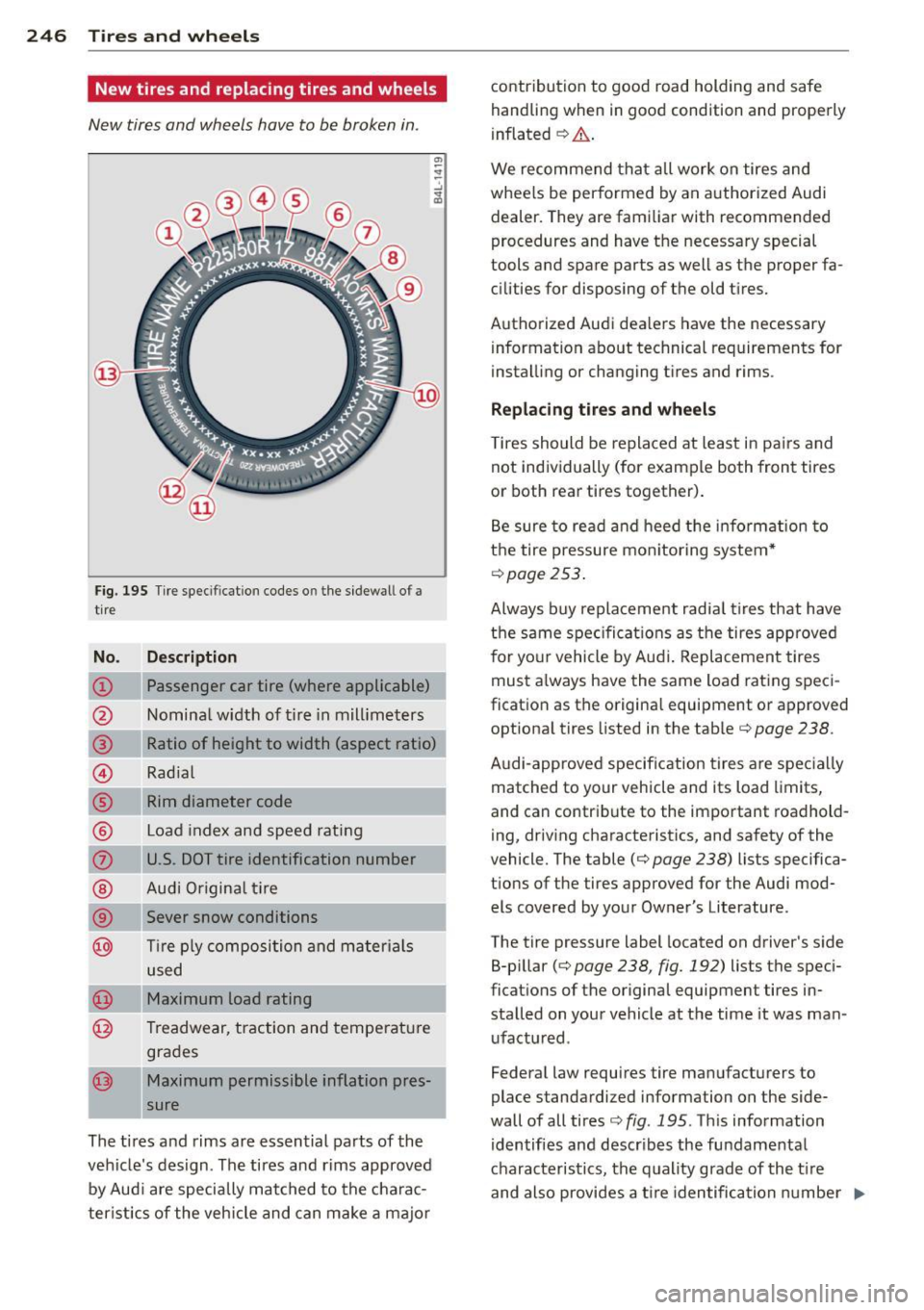
Fig. 195 Tire speci fication codes o n the sidewal l of a
t ir e
No. Description
(!) Passenger car tire (where applicable)
@ Nominal width of tire in mill imeters
@ Ratio of height to width (aspect ratio)
@ Rad ial
® Rim diameter code
@ Load index and speed rating
(j) U.S. DOT tire identification number
@ Audi Original tire
® Sever snow conditions
@) Tire ply composition and materials
used
Maximum load rating
Tr eadwear, traction and temperature
grades
Maximum permissible inflation pres
sure
The tires and rims are essential parts of the
vehicle's design . The tires and rims approved
by Audi are specially matched to the charac
ter istics of the vehicle and can make a major contribution to good road holding and safe
handling when in good condition and properly
inflated
¢
&..
We recommend that all work on tires and
whee ls be performed by an authorized Audi
dealer. They are familiar with recommended
procedures and have the necessary special
tools and spare parts as well as the proper fa
cilities for disposing of the old tires.
Authorized Audi dea lers have the necessary
information about technical requirements for
insta lling or changing tires and rims .
Replacing tires and wheels
Tires should be replaced at least in pairs and
not individually (for example both front tires
or both rear tires together).
Be sure to read and heed the i nformation to
the tire pressure mon itor ing system*
<:!> page 253 .
Always buy replacement radia l tires that have
the same spec ificat ions as the tires approved
for your vehicle by Audi. Replacement tires
must a lways have the same load rating speci
fication as the origina l equipment or approved
optiona l tires listed in the table¢
page 238 .
Audi-approved specification tires are specia lly
matched to your vehicle and its load limits,
and can contribute to the important roadhold
ing, driving characteristics, and safety of the
vehicle. The table
(c;, page 238) lists specifica
tions of the tires approved for the Audi mod els covered by your Owner's Literature .
The tire pressure label located on driver's side
B-pillar
(c;, page 238, fig. 192) lists the speci
fications of the original equipment tires in
stalled on your vehicle at the time it was man
ufactured .
Federal law requires tire manufacturers to
place standardized information on the side
wall of all tires co
fig. 195 . This information
identifies and descr ibes the fundamenta l
characteristics, the quality grade of the t ire
and also provides a tire identification number ..,.