battery AUDI S4 2013 Owner's Manual
[x] Cancel search | Manufacturer: AUDI, Model Year: 2013, Model line: S4, Model: AUDI S4 2013Pages: 302, PDF Size: 75.61 MB
Page 233 of 302
-Always wear eye protection. Do not let
battery acid or any lead particles get on
your skin or clothing. Shield your eyes .
Explosive gases can cause blindness or
other injury.
- Battery acid contains sulfuric acid . Sulfu
ric acid can cause blindness and severe
burns.
- Always wear gloves and eye protection.
Do not tilt the battery because acid
could leak out of the ventilation open
ings.
- If you get battery acid in your eyes or
on your skin, immediately rinse with
cold water for several minutes and get
medical attention .
- If you should ingest any battery acid,
seek medical attention immediately.
- Do not expose the battery to an open
flame, electric sparks or an open light.
- Do not smoke.
- Do not interchange the positive and neg-
ative cables .
= When working on the battery, be sure
not to short-circuit the terminals with
tools or other metal objects. This would cause the battery to heat up very quickly,
which could lead to damage or explosion and personal injury.
- When a battery is charged, it produces
hydrogen gas which is explosive and
could cause personal injury .
- Always keep the battery well out of the
reach of children.
- Before work is done on the electrical sys
tem, disconnect the negative ground ca ble .
- Before performing any work on the elec
trical system, switch off the engine and
ignition as well as any electrical equip
ment. The negative cable on the battery
must be disconnected . If you are just go
ing to replace a light bulb, then it is
enough to switch off the lights.
- Before disconnecting the battery, switch
off the anti-theft alarm system! Other
wise you will set off the alarm.
Checking and filling 231
-When disconnecting the battery, first
disconnect the negative cable and then
the positive cable.
- Before reconnecting the battery, make
sure all electrical consumers are switch
ed off. Reconnect the positive cable first
and then the negative cable . Never inter
change the cables -this could start a fire!
- Never charge a frozen or a thawed-out
battery . It could explode! If a battery has
frozen , then it must be replaced . A dis
charged battery can freeze over at 32°F
(QOC),
-Make sure the vent hose is always attach
ed to the opening on the side of the bat
tery .
- Never use batteries which are damaged.
There is the danger of an explosion! Al
ways replace a damaged battery.
&_ WARNING
California Proposition 65 Warning:
- Battery posts, terminals and related ac
cessories contain lead and lead com
pounds, chemicals known to the State of
California to cause cancer and reproduc
tive problems. Wash hands after han dling.
(D Note
- Do not disconnect the vehicle battery
when the ignition is switched on or when the engine is running, otherwise, you will
damage electronic components in the
electrical system.
- If your vehicle is going to stand for a
long period of time without being driven,
protect the battery from "freezing", oth
erwise it will be damaged and will then
have to be replaced.
•
•
Page 234 of 302
232 Checking and filling
Battery charging
Starting the engine requires a well charged
battery.
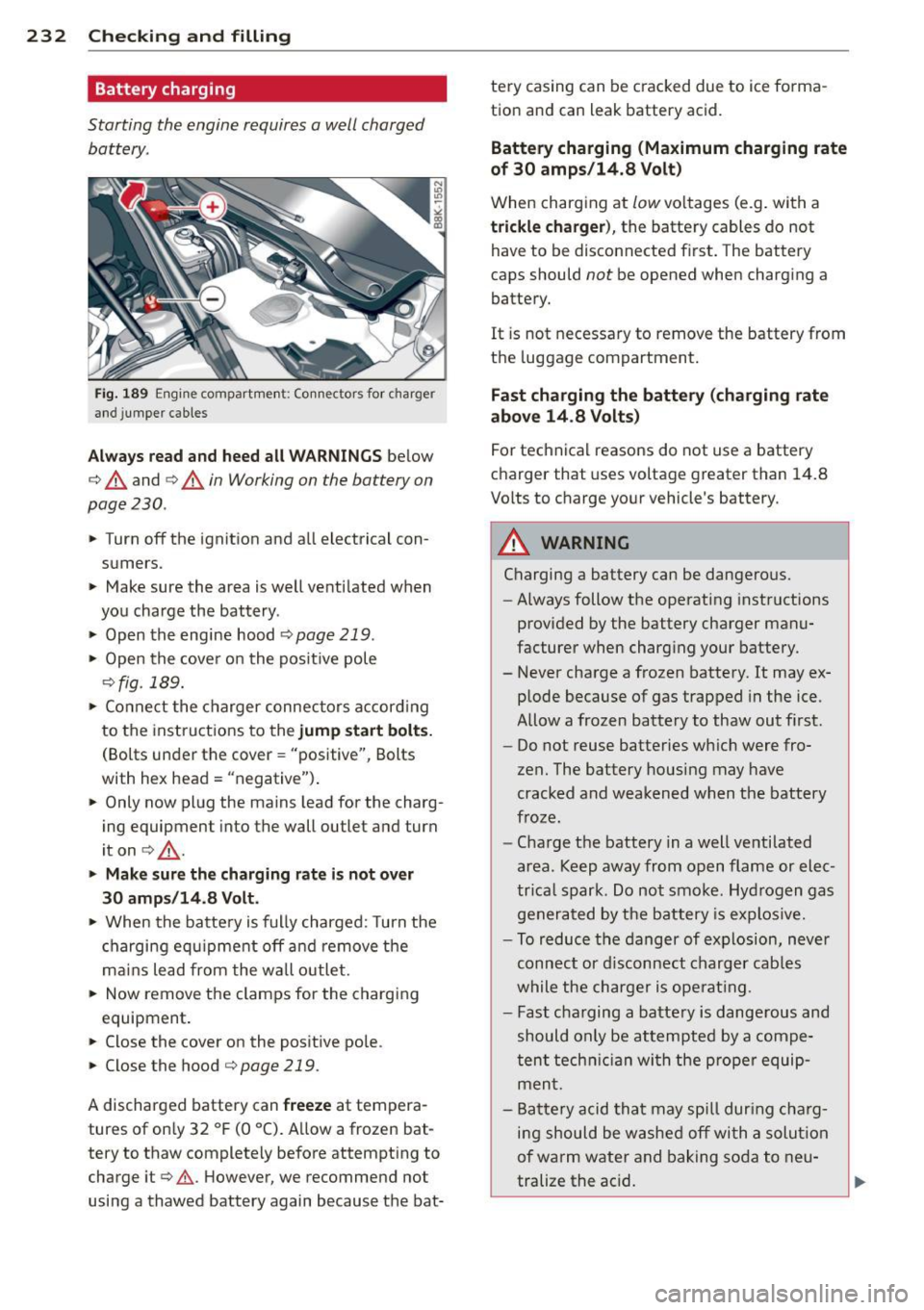
Fi g. 1 89 Engine co mpart ment: C onn ecto rs fo r charger
and jumper cab les
Always read and heed all WARNINGS be low
c:> A and c:> A in Working on the battery on
page 230 .
.,. Turn off the ignit ion and a ll electrical con
sumers.
.,. Make sure the area is well venti lated when
you cha rge the battery .
.,. Open the engine hood
r:::.> page 219 .
.,. Open the cover on the pos it ive pole
<::.> fig . 189 .
.,. Co nne ct the charger c onnec tors a ccord ing
to the instructions to the
jump start bolts.
(Bo lts under the cover = "positive" , Bolts
with hex head= "negative") .
.. Only now pl ug the mains lead for the charg
ing equipment into the wall outlet a nd turn
i ton
c:> &_ .
.,. Mak e sure the charging rate is not over
30 amp s/14 .8 Volt .
.,. When the ba tte ry is f ully charged: Turn the
c h arging e quipment o ff and
remove t h e
m ain s le ad from the w all outle t.
.,. Now remove the clam ps for the charging
equipment.
.,. Close the cover on the pos it ive po le .
.. Close the hood
c:> page 219 .
A discharged battery can freeze at tempera
tures of on ly 32 ° F (0 °C). A llow a frozen bat
tery to thaw completely before attempt ing to
charge it
c:> .& . However, we recommend not
usi ng a thawed battery again because the bat- tery casing can be cracked due to ice forma
t ion an d can leak battery acid.
Battery charging (Maximum charging rate
of 30 amps/14.8 Volt)
W hen charging at low vo ltages (e.g. wi th a
trickle charger ), the battery cables do not
have to be disconnected f irst . The battery
caps should
not be opened when charging a
battery.
It i s not necessa ry to remove the battery from
the luggage compartment.
Fast charging the battery (charging rate
abov e 14 .8 Volts)
F or technica l reasons do not use a battery
c h arger that uses voltage greater than 14.8
Volts to c harge yo ur vehicle's battery.
A WARNING
-----=--
Charging a battery can be dangero us .
- Always follow the operating instructions
provided by the battery cha rger manu
factur er when charg ing your battery .
- Never charge a frozen battery. It may ex
p lode because of gas trapped in the ice .
Allow a frozen batte ry to thaw out first.
- Do not reuse batteries w hich were fro
ze n. The battery hous ing may have
cracked and weakened when the battery
froze.
- Cha rge the battery in a well ventilated
a rea . Keep away from open flame or elec
tr ica l spar k. Do not smoke. Hy drog en gas
genera ted by t he battery is e xplos ive .
- To reduc e the danger of explosion,
neve r
connec t or d isconnect c harger cab les
while the charge r is ope rat ing .
- Fast c ha rging a ba tte ry is dange rous and
should o nly be attempte d by a compe
t en t tech nician wi th the p rope r equip
m en t.
- Batt ery acid tha t m ay sp ill dur ing c ha rg
i n g should be w ashe d off with a s olu tion
o f w arm water a nd baking so da to neu-
tralize the a cid. ....
L..__ _____________ _J ...
Page 235 of 302
(D Note
Never use a fast charger as a booster to
start the engine . This will seriously dam
age sensitive electronic components, such
as control units, relays, radio, etc ., as well
as the battery charger .
Battery replacement
The new battery mu st have the same specifi
cations and dimensions as the original equip
ment battery .
Intelligent energy management in your vehi
cle is responsible for d istributing the electr i
cal energy throughout your vehicle
c::>
page 192. The intelligent energy manage
ment system w ill keep the engine battery
charged bette r then vehicles w ithout t his sys
tem. To make sure the additional electr ica l en
ergy is available once again after you have
changed the battery, we recommend that you
install batteries of the same type and manu
facture only (the same as those installed at
the time your vehicle was delivered). Specifi
cations are listed on the bat tery hous ing. Your
author ized Audi dealer must code the battery
in the energy management system to enable
you to use the energy management functions
correctly after replac ing the battery .
If it is not possible to use a battery of this
type, the new battery must have the same ca
pac ity, voltage (12-volts), amperage, con
struction and plug sea ling.
When insta lling the battery, make sure the ig
nition and all electr ical consumers are turned
off.
(D Note
Make sure the venti lation hose on the s ide
of the battery is connected , othe rwise
fumes or battery ac id can leak out .
@ For the sake of the environment
Because of the problem of proper d isposal
of a battery, we recommend your author
ized Aud i dealer change the battery for
Checkin g and fillin g 233
you. Batteries contain sul fur ic acid and
l ead and must always be disposed of prop
erly in comp liance with a ll environmental
regulations. Disposing of vehicle batter ies
i mproperly is very dangerous to the envi
ronment .
Windshield/headlight*
washer container
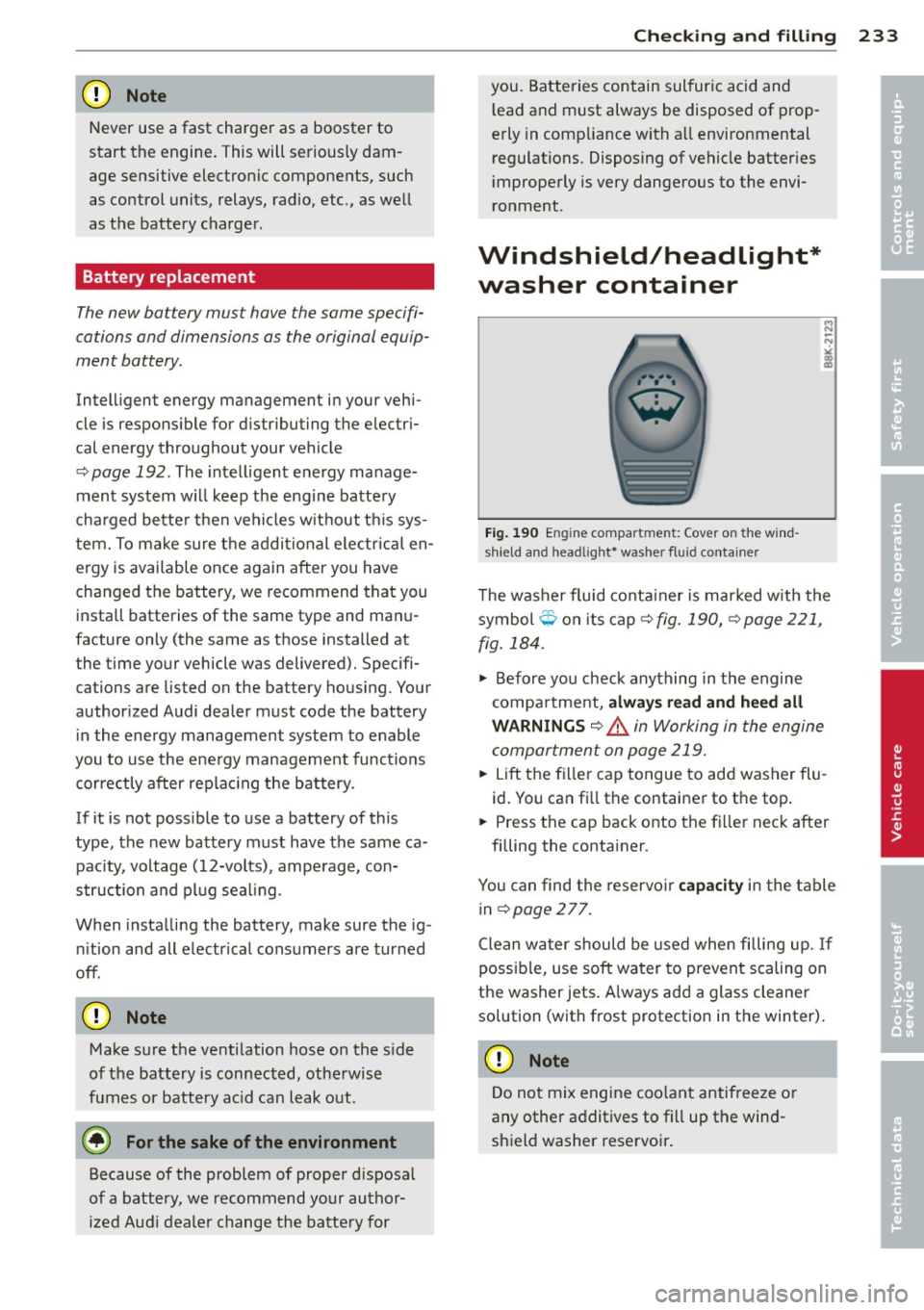
Fig. 190 En gin e compart men t: Cove r on the w ind
s hi eld an d headligh t* was her fl uid conta iner
The washer fluid container is marked w ith the
symbol
Q on its cap c::>fig. 190, c::>page 221,
fig. 184 .
.,. Before you check anything in the engine
compa rtment,
always read and heed all
WARNINGS
c::> .&. in Working in the engine
compartment on page 219.
.,. Lift the f iller cap tongue to add washer flu
id. You can fi ll the container to the top .
.. Press the cap back onto the fi ller neck after
filling the container .
You can find the reservoir
capacity in the table
in c::>
page 2 77 .
Clean water should be used when filling up.
If
possib le, use soft water to prevent scaling on
the washer jets . Always add a glass cleaner
solution (with frost protection in the winter) .
(D Note
Do not mix engine coolant antifreeze or
any other additives to fill up the wind
shield washer reservoir .
•
•
Page 238 of 302
236 Tires and wheels
Groove
means the sp ace between two ad jacent tread
ribs .
Load rating (code )
means the maximum load that a tire is rated
to carry fo r a g iven inflat ion pressu re. You
may not find this in fo rmat io n on all t ires be
c a use i t is no t re quir ed by law.
Maximum load rating
means the load rating for a t ire at the max i
mum permissible inflation pressure for that
tire.
Maximum loaded vehicle weight
means t he sum of:
(a) Curb weig ht
(b) Accessory weight
( c ) Vehicle c apa city we ight, and
(d) Prod uction opt ions we ight
Maximum (permissible) inflation pressure
means t he maximum co ld inflation pressure
to which a tire may be inflated . Also called
"maxim um infla tion p ressu re ."
Normal occupant weight
means 150 lbs. (68 k ilog rams) times the
n umber of occupants seated in the vehicle up
to the tota l seating capacity of yo ur vehicle .
Occupant distribution
means dist ribution o f occ upants in a veh icle.
Outer diameter
means t he overa ll diamete r of a n inflated new
tire.
Overall w idth
means the linea r distance between the exter i
ors of the sidewalls of an inflated tire, includ
ing e levations due to labeli ng, decorations, or
p rotectiv e bands o r ribs .
Ply
means a layer of rubber-coated para llel cords.
Production options weight
me ans the com bine d we igh t of tho se ins tall ed
regular prod uction opt ions we ighing over 5
lb s. (2 .3 kg) in excess of those stan da rd item s
which they replace, not previously considered
in curb weight or accessory we ight, including
heavy duty brakes, ride levelers , roof rack ,
heavy duty battery, and special tr im .
Radial ply tire
means a pneumat ic tire in wh ich the ply cords
t h at exte nd t o the beads are laid at substa n
t ia lly 90 deg rees to the center line of the
tread .
Recommended inflation pressure
see<=> page 235, Cold tire inflation pressure.
Reinforced tire
means a t ire des ign to operat e at h igher loads
and a t higher in flation pressures than t he cor
re spondi ng s tand ard tire. Reinfor ce d tires
may be iden tifie d as "X L" "xl" "E X TRA LOAD"
' ' '
or "RF " on the sidewa ll.
Rim
means a metal s upport for a ti re or a tire and
tube assembly upon whi ch t he tire bea ds are
sea ted.
Rim diameter
means nom inal d iameter of the bead seat. If
you change your wh eel s ize, you wi ll have to
purchase new ti res to match the new r im di
ameter.
Rim size designation
means r im diameter and width .
Rim width
means nominal distance between rim fla nges .
Sidewall
means tha t p ort ion of a tire betwee n the
t rea d and be ad.
Page 271 of 302
Emergency situations
General
This chapter is intended for trained emer
gency crews and working personnel who
have the necessary tools and equipment to
perform these operations.
Starting by pushing or
towing
(D Note
Vehicles with an automatic transmission
cannot be started by pushing or towing .
Starting with jumper
cables
If necessary, the engine can be started by
connecting it to the battery of another vehi
cle.
If the engine should fail to start because of a
discharged or weak battery, the battery can be
connected to the battery of
another vehicle,
using a
pair of jumper cables to start the en
g ine.
Jumper cables
Use only jumper cables of sufficiently
largecross section to carry the starter current
safe ly. Refer to the manufacturer's specifica
tions.
Use only jumper cables with
insulated termi
na l clamps which are distinctly marked:
plus(+) cable in most cases colored red
minus(-) cable
in most cases colored black .
A WARNING
Batteries contain electricity, acid, and gas.
Any of these can cause very serious or fatal
injury. Follow the instructions below for
safe handling of your vehicle's battery.
- Always shield your eyes and avoid lean
ing over the battery whenever possible.
Emergency situations 269
-A discharged battery can freeze at tem
peratures just below 32 °F (0 °C). Before
connecting a jumper cable, you must
thaw the frozen battery completely, oth
erwise it could explode.
- Do not allow battery acid to contact eyes
or skin . Flush any contacted area with
water immediately .
- Improper use of a booster battery to
start a vehicle may cause an explosion.
- Vehicle batter ies generate explosive gas
es. Keep sparks, flame and lighted c iga
rettes away from batteries.
- Do not try to jump start any veh icle w ith
a low ac id level in the battery.
- The voltage of the booster battery must
also have a 12-Volt rating. The capacity
(Ah) of the booster battery should not be
lower than that of the discharged bat
tery. Use of batteries of diff erent voltage
or substantially different "Ah" rat ing
may cause an exp losion and personal in
jury.
- Never charge a frozen battery. Gas trap
ped in the ice may cause an explosion.
- Never charge or use a battery that has
been frozen . The battery case may have
be weakened.
- Use of batter ies of different voltage or
substantially different capacity (Ah) rat
ing may cause an exp losion and injury .
The ca pa city (Ah) of the booster battery
should not be lower than that of the dis
charged battery.
- Before you check anything in the engine
compartment, always read and heed all
WARNINGS¢
page 213, Engine com
partment.
(D Note
- App lying a higher voltage booster bat
tery will cause expensive damage to sen
sit ive electronic components, such as
control units, relays, rad io, etc .
- There must be no electrical contact be
tween the vehicles as otherwise current
could already start to flow as soon as the
posit ive(+) terminals are connected. ..,. •
•
Page 272 of 302
2 70 Emergency situations
@ Tips
The discharged battery must be properly
connected to the vehicle's electrical sys
tem. When jump starting or charging the
battery, never connect the negative
ground cable to the battery negative post
because the batte ry manager system must
be able to detect the battery 's state of
charge. Always connect the negative
ground cab le to the negative ground post
of the battery manager control unit.
Use of jumper cables
Make sure to connect the jumper cable
clamps in exactly the order described below!
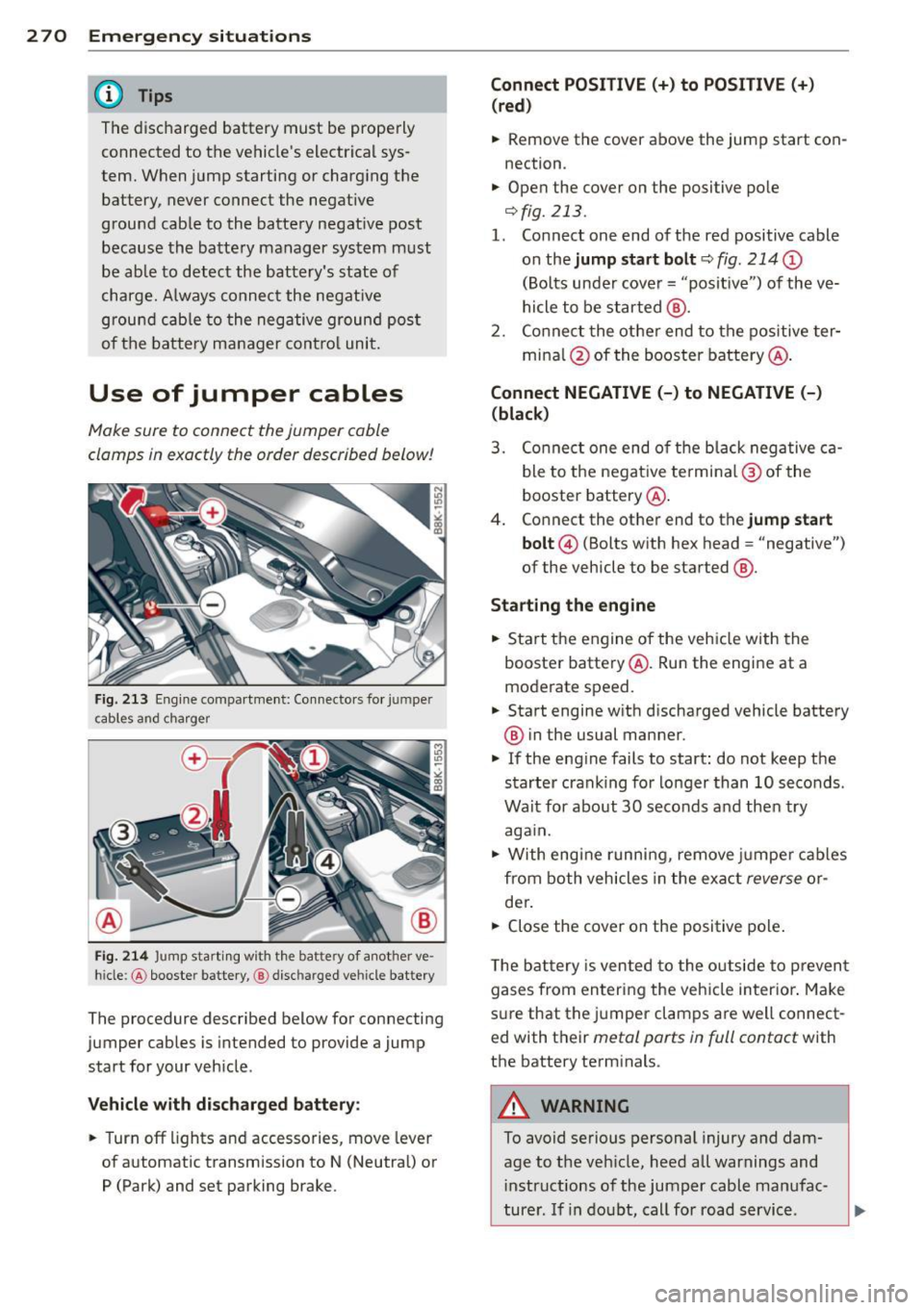
Fig. 213 Engine compartment: Connecto rs fo r jum per
cables and charger
Fig. 214 Jump sta rting wi th the battery of anot her ve ·
h ide :@ booster battery, @ disc harged vehicle battery
The procedure described below for connecting
jumper cables is intended to provide a jump
start for your vehicle .
Vehicle with discharged battery:
.. Turn off lights and accessories, move lever
of automatic transmission to N (Neutral) or
P (Park) and set parking brake .
Connect POSITIVE(+) to POSITIVE(+)
(red)
.. Remove the cover above the jump start con
nection .
.. Open the
cover on the positive pole
¢fig. 213 .
1. Connect one end of the red positive cable
on the
jump start bolt c::> fig. 214 @
(Bolts under cover= "positive") of the ve
hicle to be started @.
2. Connect the other end to the positive ter-
minal @of the booster battery@.
Connect NEGATIVE (-) to NEGATIVE (-)
(black)
3. Connect one end of the b lack negative ca
ble to the negative terminal @of the
booster battery @.
4. Connect the other end to the
jump start
bolt @
(Bolts with hex head= "negative")
of the vehicle to be started @.
Starting the engine
.. Sta rt the engine of the vehicle with the
booster battery@. Run the engine at a
moderate speed.
.. Start engine with discharged vehicle battery
@ in the usual manner .
.. If the eng ine fails to start: do not keep the
starter cranking for longer than 10 seconds .
Wait for about 30 seconds and then try
again .
.. With engine running, remove jumper cables
from both vehicles in the exact
reverse or
der .
.. Close the
cover on the positive pole .
T he battery is vented to the outside to prevent
gases from entering the vehicle interior . Make
sure that the jumper clamps are well connect
ed with their
metal parts in full contact with
the battery terminals.
A WARNING
--
To avoid serious personal injury and dam
age to the veh icle, heed all warnings and
i nstructions of the jumper cable manufac-
turer . If in doubt, call for road service . ..,.
Page 273 of 302
-Jumper cables must be long enough so
that the vehicles do not touch.
- When connecting jumper cables, make
sure that they cannot get caught in any
moving parts in the engine compart
ment.
- Do not bend over the batteries - danger
of chemical burns!
- The battery cell locking screws must be
tightened securely .
- Before you check anything in the engine
compartment, always read and heed all
WARNINGS
¢pag e 213, Engine com
partment .
(D Note
Improper hook -up of jumper cables can ru
in the generator.
- Always connect POSITIVE( +) to POSI
TIVE(+), and NEGATIVE( -) to NEGATIVE
( - ) ground post of the battery manager
control unit.
- Check that a ll screw plugs on the battery
cells are screwed in firmly. If not, tighten
plugs prior to connecting clamp on nega
tive battery terminal.
- Please note that the procedure for con
necting a jumper cable as described
above applies spec ifically to the case of
your vehicle be ing jump started. When
you are giving a jump start to another ve
hicle, do
not connect the negative(-) ca
ble to the negative( -) terminal on the
discharged battery@¢
fig. 214. In
stead, securely connect the negative(-)
cable to either a solid metal component
that is firmly bolted to the engine block
or to the engine block itse lf. If the bat
tery that is being charged does not vent
to the outside, escaping battery gas
could ignite and explode!
Emergency situations 2 71
Emergency towing
with commercial tow
truck
General hints
Your Audi requires special handling for tow
ing.
T he following information is to be used by
commercial tow truck operators who know
how to operate their equipment safely.
- Never tow your Audi, towing will cause
damage to the engine and transmission.
- Never wrap the safety chains or winch ca
ble s around the brake lines .
- To prevent unnecessary damage, your Audi
must be transported with a flat bed truck.
- To load the vehicle on to the flat bed , use
the towing loop found in the vehicle tools
and attach to the front or rear anchorage
r=:>page 272 and ¢page 272.
A WARNING
A vehicle being towed is not safe for pas
sengers. Never allow anyone to ride in a
vehicle be ing towed, for any reason.
-
•
•
Page 277 of 302
General information Explanation of
technical data
Som e of t he technical data listed in this man
ual requires further explanation.
The technical data for your vehicle is listed in
the charts starting on
c:> page 2 77. This sec
tion provides general information, notes and
r estr ictions wh ich app ly to this data.
Vehicle identification
The key data is given on the vehicle identifi ca
tion number ( VIN) plate and the vehicle data
sti cker .
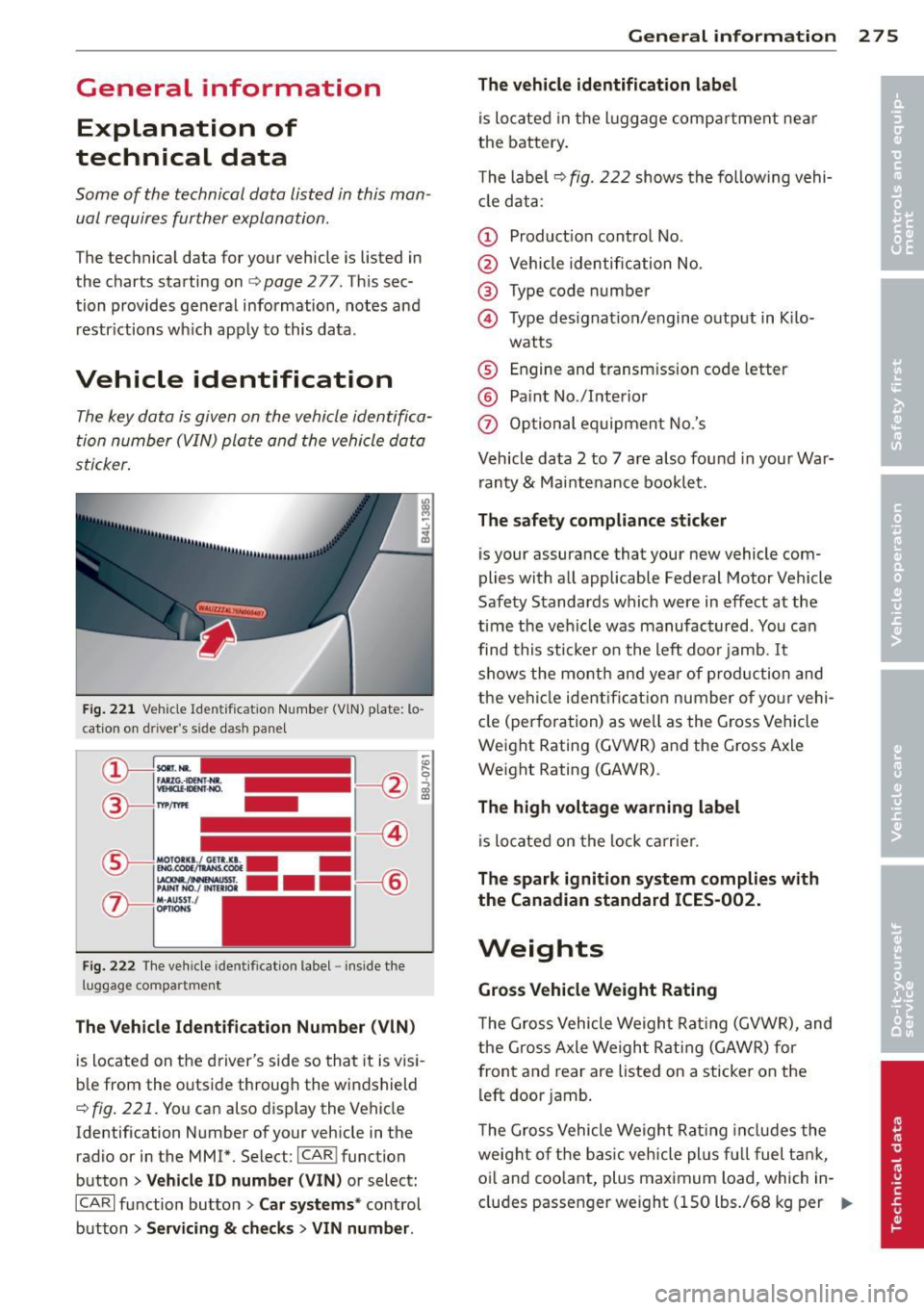
Fig. 221 Veh icle Identificat ion Num ber (VlN) p la te: lo
cation o n drive r"s side dash pa nel
Fi g. 22 2 The ve hicle identificat ion label -in side the
l u ggage compartme nt
The Vehicle Identification Number (VlN)
is located on the d river's side so tha t it is v is i
b le from the outside throug h the windshield
c:> fig . 221. You can also d isplay the Vehicle
Identification N umber of your vehicle in the
radio or in the MM!*. Select: ICAR!function
button
> Vehicle ID number (VIN) or select :
I CA R
I function butto n > Car systems* control
button
> Servicing & checks > VIN number .
General inform ation 275
The vehicle identification label
is lo cated in the l uggage comp artment near
the battery.
T he label~
fig. 222 shows th e fo llow ing vehi
cl e d ata:
(D Product ion cont ro l No.
@ Vehicle identific ation No.
@ Type code number
© Type designat ion/e ngine o utput in K ilo-
wat ts
® Engine and transm ission code letter
® Pa int No./lnterior
0 Option al eq uipmen t No.'s
Vehicle data 2 to 7 are a lso fo und in your War
ranty
& Mai nte nance bookle t.
The safety compliance sticker
is your assurance that your new vehicle com
plies wi th a ll applicable Fede ral Motor Vehicle
Safety S tandards which were in effect at the
tim e the ve hicle was manufactur ed. You ca n
find this sticke r o n the left doo r jamb.
It
sh ows the m onth and ye ar of pro duction and
t h e ve hicl e ident ifi cat io n number of yo ur vehi
cle (perfora tion) as well as the G ross Vehicle
Weight Rating (GVW R) and the Gross Axle
Weight Rating (GAWR) .
The high voltage warning label
is lo cated on the l ock ca rrie r.
The spark ignition system complies with
the Canadian standard ICES-002.
Weights
Gross Vehicle Weight Rating
T he Gro ss Vehicle Weigh t Rat ing (GVWR), and
the Gross Axle We igh t Ra tin g (GAWR) for
fron t and rear are listed on a sticker on the
l eft door jamb .
T he Gro ss Vehicle Weigh t Rat ing incl udes the
weig ht o f the bas ic vehicle plus f ull fuel t ank,
oi l and coo lant, p lus maximum load, which in
cludes passen ger we ight (150 lbs./68 kg per ..,.
Page 288 of 302
286 Index
Automatic climate control Air vents ... ............... .. .... .. 78
Operation . . . . . . . . . . . . . . . . . . . . . . . . . 77
Setup . .. ............... .. .. .... .. 79
Automatic Shift Lock (ASL) . . . . . . . . . . . . 93
Automatic transmission .......... ..... 91
Automatic Shift Lock (ASL) . . . . . . . . . . . 93
Driving .. ... ............ .. .. .. .. .. 93
Em ergency mode . . . . . . . . . . . . . . . . . . . 97
Em ergency release . . . . . . . . . . . . . . . . . . 98
K ick -down . . . . . . . . . . . . . . . . . . . . . . . . . 96
M anual shift program ....... .... .. .. 96
multitronic . . . . . . . . . . . . . . . . . . . . . . . . 91
Removal lock (ignition key) ... .. .. .. . . 80
Selector lever . . . . . . . . . . . . . . . . . . . . . . 92
S tronic .... .................. ... .. 91
tiptronic . . . . . . . . . . . . . . . . . . . . . . . . . . 91
Automatic wipers . . . . . . . . . . . . . . . . . . . . 53
Auto Safety Hotline ........ .. .. .... . 135
Average speed . . . . . . . . . . . . . . . . . . . . . . . 25
Avoid damaging the vehicle ....... ... . 194
B
Bag hooks . . . . . . . . . . . . . . . . . . . . . . . . . . 72
Battery . . . . . . . . . . . . . . . . . . . . . . . 17,229
Batter y location inside the luggage com-
partment .. ................ ... ... 230
Charging . ... ............ .. .. .. .. . 232
I mportant warnings when wo rking on
the battery ............... ... .... . 230
Jump starting ................ .... . 269
Low ..... .. ................ ..... . 192
Replacing the battery ..... .. .. .... . 233
State of charge .................... 192
Winter operation .................. 229
Working on the battery ......... .... 230
Before driving .............. ... .... . 127
Bio-ethanol (Fuel) . . . . . . . . . . . . . . . . . . . 215
Blended gasoline .......... .. .. .... . 214
Blow er (automatic climate control) . . . . . . 78
Body cavity sealing .............. ... . 208
Booster seats ...................... 174
Brake flu id
Changing the brake fluid ..... .. .. .. . 229
Checking the brake fluid level ... .. .. . 228
Reservoir . ................. ..... . 228 What
is the correct brake fluid level? . . 228
What shou ld I do if the brake fluid warn-
ing light comes on? ................ 228
Brak e system .. .. .. ............. .. .. 228
Anti- lock braking system ........ .... . 19
Brake assist system ................ 185
Brake fluid .... .. ................. 228
Brake fluid specifications for refill and re -
placement .... .. ... .......... .. .. 229
Brake light defective . . . . . . . . . . . . . . . . 21
Brake power assist unit ............. 188
Brakes ...... .. .. .. ..... ........ .. 188
Ceramic brakes . .. ................ . 188
Electromechanica l parking brake . .... . 85
Warning/ind icator lights ........ .. .. . 15
Worn brake pads symbo l . . . . . . . . . . . . . 20
Braking Emergency braking funct ion ........ .. 87
braking guard ... .. ............. .... . 99
Messages . .. .. .. ............. .. .. 107
Settings .. .. .. .. .. .... .... ... .... 106
Break-in period .... ................. 194
T ires ..... .... .. .. .............. . 194
Bulbs .......... .. ....... ......... . 268
C
California Proposition 65 Warning ... .. 220
Battery specific .. ............. .. .. 231
Capacities ......................... 277
Car care ........ .. .. .............. . 202
Interior ... .... .. .. .............. . 209
Plastic and vinyl ................... 206
Care of exterior .. .. ... .......... .. .. 202
Cargo area
refer to Luggage compartment. . . 68, 133
Catalytic converter . . . . . . . . . . . . . . . . . . 195
Center armrest . . . . . . . . . . . . . . . . . . . . . . 60
Central locking .. .. ... .......... .. .. . 32
Central locking switch .......... .... . 36
Convenience key . . . . . . . . . . . . . . . . . . . . 36
Remote control key ................. 35
Ceramic b rake rotors
New brake pads .. ............. .... 188
Certification . . . . . . . . . . . . . . . . . . . . . . . 283
Changing a flat tire . ................. 259
Changing a wheel .. ............. .... 259
Page 291 of 302

-----------------------------~I~ n~d~ e~x 289
Emergency operation
Emergency braking function (parking
brake) ... .. .. .. ........ ... .. .. .. .. 87
E me rgency sta rting ........ .. .. .. .. . 269
Emergency towing .. .... .... . .. .. .. . 271
Energy management .... ... .. .. .. .. . 192
Battery power . . . . . . . . . . . . . . . . . . . . . 1 7
Driver notification . . . . . . . . . . . . . . . . . . 17
E ng ine
Compartment ..... .... ... .. .. .. ... 221
Coolant .... .. ... ..... ... .. .. .. ... 226
Hood . ..... .. .. ... . .... ... .. .. ... 219
Starting . . . . . . . . . . . . . . . . . . . . . . 80, 83
Start ing with jumper cables .. .. .. .. . 269
Stopping . . . . . . . . . . . . . . . . . . . . . . 82, 84
Eng ine compartment
Safety instructions ..... ... .. .. .. .. . 2 19
Working the engine compartment 219
E ng ine coolan t
I ndicator light . . . . . . . . . . . . . . . . . . . . . 18
E ng ine coolant system .......... ... .. 226
Adding coolant .............. ... ... 227
Chec kin g coolant leve l ..... .. .. .. .. . 226
Checking the eng ine coolan t leve l .. .. . 226
Ra diato r fan ............. .... .. ... 228
E ng ine coolant temperature
Temperatu re ga uge .... ...... .... ... 10
Eng ine data .. ............. .... .. ... 277
E ng ine hood
C losing . . . . . . . . . . . . . . . . . . . . . . . . . . 219
How to release the hood ... .. .. .. .. . 2 19
E ng ine oi l .. ................. ... ... 221
Adding .. .. ............. .. .. .. .. . 224
Addi tives . .. ............. .... .. ... 224
Changing .. ... .. ..... ... .. .. .. ... 225
Check oil leve l .. .. .... ... .. .. .. ... 224
Consumption ..... .... ... .. .. .. ... 224
Indicator light ........... .... .. 17,21
O il consumption .......... .. .. .. .. . 223
O il grades .. ............. .... .. ... 221
O il level symbol ............. .... ... 21
Pressu re malfunction ...... .. .. .. .. .. 17
Sensor defective . . . . . . . . . . . . . . . . . . . . 2 1
Specification and vis cos ity .. .. .. .. .. . 22 1
Eng ine speed limitat io n ..... .. .. .. .. .. 21 Environment
Break-in period ..... . ... ...... ... .. 194
Catalytic converter . .. .. ..... ... .. .. 195
Dispos ing of your ve hicle battery ... .. 233
Driving at high speeds .............. 196
Driving to minimize po llution and noise 196
Fuel . . . . . . . . . . . . . . . . . . . . . . . . . . . . . 217
Fuel economy .. .. .. ..... ......... .
Lea ks unde r you r vehicle ........ ... .
Let ting the vehicle stand and warm up .
Proper disposal of d rained brake flu id .
Proper disposal of drained engine cool
ant
. ... .. .. .. .... . ... ...... ... ..
Proper disposal of drained eng ine 196
2 19
196
229
227
o il . . . . . . . . . . . . . . . . . . . . . . . . . 224, 22S
Recycling used engine oil ............ 224
Roof rack . . . . . . . . . . . . . . . . . . . . . . . . . 68
Un leaded fuel .. .. .. . .. .... .... .. .. 214
What shou ld I do with an o ld battery? . 233
EPC
refer to Electron ic power control . . . . . . 20
ESC ( Electronic Stabi lization Contro l)
Warning/indicator lights ..... ... .. .. . 19
E thy l alco ho l (Fuel) . ............. .. .. 215
Event Data Recorder (EDR) .......... .. 185
E xhaust tai l pipes
Cleaning . ... .... .. . .. .. ..... ... .. 209
Expansion tank
Exterior lighting
E xterior m irrors 226
. .. ............... .. . 47
Adjusting . . . . . . . . . . . . . . . . . . . . . . . . . SO
D' . 1mming .. .. .... .. . .. .. ..... ... .. . 51
Heating ... .. .. .. .. .. .. .. .... ... .. . SO
F
Fan
Radiator
Fasten ing
B oos ter sea ts 228
17 4
Convertib le child sa fe ty seats .... .. .. 173
Infant seats . . . . . . . . . . . . . . . . . . . . . . 172
Fasten ing eyes
refer to Tie-downs .... ........... .. . 72
Flat tire Chang ing . .. .. .. .. . .. ....... ... .. 259
flexib le fue l
Floor
. .. .... .. . .. .. ..... ... .. 215
75
•
•