wheel AUDI S4 2013 Owner's Guide
[x] Cancel search | Manufacturer: AUDI, Model Year: 2013, Model line: S4, Model: AUDI S4 2013Pages: 302, PDF Size: 75.61 MB
Page 187 of 302
Intelligent technology Notice about data
recorded by vehicle
control modules
Your vehicle is not equipped with an Event Da
ta Recorder (EDR), installed by some manu
facturers for the express purpose of capturing
data for retrieval after an accident or crash
event. EDR's are sometimes called "crash re
corders".
Some state laws restrict the retr ieval or down
loading of data stored by EDR's that were in
stalled in a vehicle for the express purpose of
retrieving data after an accident or crash
event without the owner's consent.
Although your vehicle is not equipped with an
EDR, it is equipped with a number of electron
ic control modules for various vehicle systems
such as, for examp le, engine function, emis
sion control, as well as for the airbags and
safety belts.
These electronic control modules also record
vehicle-related data during norma l vehicle op
eration for diagnostic and repair purposes.
The recording capacity of the electronic con
trol modules is limited to data (no sound is re
corded) and only a small amount of data is ac
tually recorded over a very limited period of
time and stored when a system fault or other
condition is sensed by a control unit. Some of
the data then stored may relate to vehicle
speed, direction, braking as we ll as restraint
system use and performance in the event of a
crash or other condition. Stored data can only be read and downloaded with special equip
ment.
Electronic Stabilization
Control (ESC)
Description
ESC helps to improve road holding and vehicle
dynamics to help reduce the probability of
skidding and loss of veh icle control. It works
only when the engine is running. ESC detects
Intelligent technology 185
certain difficult driving situations, including
when the vehicle is beginning to spin (yaw)
out of control and helps you to get the veh icle
back under control by se lectively braking the
wheels, and/or reducing engine power and
providing steering ass istance to help hold the
vehicle on the driver's intended course. The in
dicator light
JjJ in the instrument cluster
blinks when ESC is taking action to help you
control the vehicle.
ESC has limitations .
It is important to remem
ber that ESC cannot overcome the laws of
physics.
It will not always be able to help out
under all conditions you may come up against.
For example, ESC may not always be able to
help you master situations where there is a
sudden change in the coefficient of friction of
the road surface. When there is a section of dry road that is suddenly covered with water,
slush or snow, ESC cannot perform the same
way it would on the dry surface. If the vehicle
hydroplanes (rides on a cushion of water in
stead of the road surface), ESC will not be
able to help you steer the vehicle because con
tact with the pavement has been interrupted
and the vehicle cannot be braked or steered .
During fast cornering, particularly on winding
roads, ESC cannot always deal as effectively
with difficult driving situations than at lower
speeds. When towing a trailer, ESC is not able
to help you regain control as it would if you
were not tow ing a trailer.
A lways adjust your speed and driving style to
road, traffic and weather conditions. ESC can
not override the vehicle's physical limits, in
crease the available traction, or keep a vehicle
on the road if road departure is a result of
driver inattention. Instead, ESC improves the
poss ibility of keeping the vehicle under con
trol and on the road dur ing extreme maneu
vers by using the driver's steering inputs to
help keep the vehicle going in the intended di
rection. If you are traveling at a speed that
causes you to run off the road before ESC can
provide any assistance, you may not experi
ence the benefits of ESC.
•
•
Page 188 of 302
186 Intelligent technology
ESC includes and/or works together with the
anti-lock brake system (ABS), brake assist sys
tem, anti-slip regulation (ASR) , e lectronic dif
ferential lock (EDL), dynamic steering" and
e lectronic interaxle differentia l lock* /selective
wheel torque control* . ESC is switched on all
the t ime. I n certa in s ituations whe n you need
l ess t raction, you can switch
off ASR by p ress
i ng the bu tto n
[ru ¢ page 188, fig. 176 or
¢ page 188, fig. 177. Be sure to sw itch ASR
on aga in when yo u no longer need less t rac
tion .
Anti -lock braking system (ABS)
ABS prevents the wheels from locking up
when braki ng. The veh icle can still be steered
even d uring h ard br aking. Apply ste ady p res
sure to the brake pedal. Do no t pump the ped
a l. A pulsing in the brake peda l indicates t hat
the system is he lping yo u to b rake the vehicle .
Brake assist system
The brake assis t system can decrease b ra ki ng
d ista nce. It increases braking power w hen the
d river p resses the brake pedal quic kly in eme r
gency situations . You must p ress and hold the
brake peda l until the situation is over. In
vehicles w ith adapt ive cru ise contro l", the
brake assist system is more sensit ive if the
d ista nce detected to t he vehicle a head is too
small.
Anti-slip regulation (ASR)
ASR reduces engine power when the drive
wheels begin to spin and adapts the fo rce to
the road condit ions. This makes it eas ier to
start , accelerate and drive up hills.
Electronic differenti al lock (EDL )
The ED L brakes wheels that are spinn ing and
transfers the drive power to the other drive
wheel or whee ls if t he vehicle is equipped with
all-w heel drive*. This function is available up
to about 60 mph (100 km/h).
In extreme cases, EDL automat ica lly switches
off to help keep the bra ke on the braked whee l
from overheating. EDL wi ll switch on again au-tomat
ica lly when conditions have ret urned to
no rma l.
Dynamic steering*
On vehicles wi th dynam ic steering*, ESC he lps
st abi liz e the steer ing in cr itical situ ations.
Electronic interaxle differential lock* /
selective wheel torque control*
T he elec troni c int eraxle differentia l lock (front
whee l dr ive) o r th e se lec tive whee l torque
control (all-whee l dr ive) oper ates when dr iv
ing t hro ugh curves. The front wheel on the in
side of the c urve or both whee ls on the inside
of the c urve are b raked se lectively as needed.
This m inimizes sliding in the front wheels and
allows for more precise driving through
curves . The applicable system may not acti
vate when dr iving in wet o r snowy cond itions.
A WARNING
- ESC, ABS, ASR, EDL dynam ic steering*
a nd the ele ct roni c interaxle d ifferential
lo ck* /se lective whee l torque con trol *
cannot ove rcome the laws of physics .
This is especially important on sli ppery
or wet roads.
If the systems beg in acting
to stabilize your veh icle, yo u should im
mediately change your speed to match
the road and traffic conditions . Do not
let the increased safety prov ided by
these systems tempt you to take r isks.
Doing so will increase the risk of a loss of
veh icle cont ro l, col lision and ser ious pe r
sonal injur ies.
- Always ada pt your speed to road, traffi c
a nd wea ther conditions. The r isk of los-
ing con trol of the vehicle i ncreases when
d riving too fast, es pec ia lly through
curves and o n slippe ry or wet roads, an d
when dr iv ing too close to vehicles up
ahead. ESC, ABS, the brake ass ist sys
tem, ASR, EDL dynam ic steer ing* and the
e lectronic inte raxle differentia l lock*/se
lec tive whee l to rque control* cannot p re-
-
vent co llisi ons. ~
Page 189 of 302
-Always acce lerate with specia l care on
even, smooth surfaces s uch as those that
are wet or covered with ice and snow.
The drive wheels can spin even with
these assistance systems that cannot al
ways help to reduce the risk of loss of ve hicle control.
(0 Tips
- ABS and ASR on ly work correctly when
all four wheels are equ ipped w ith ident i
ca l tires. Different tire s izes can lead to a
reduct ion i n eng ine power.
- You may hear noises when the systems
described are wo rking .
- If the indicator light D] or m!S (USA
models) ;tiJ (Canada models) appears,
the re may be a malfunct ion
c:> page 19,
~ page 19.
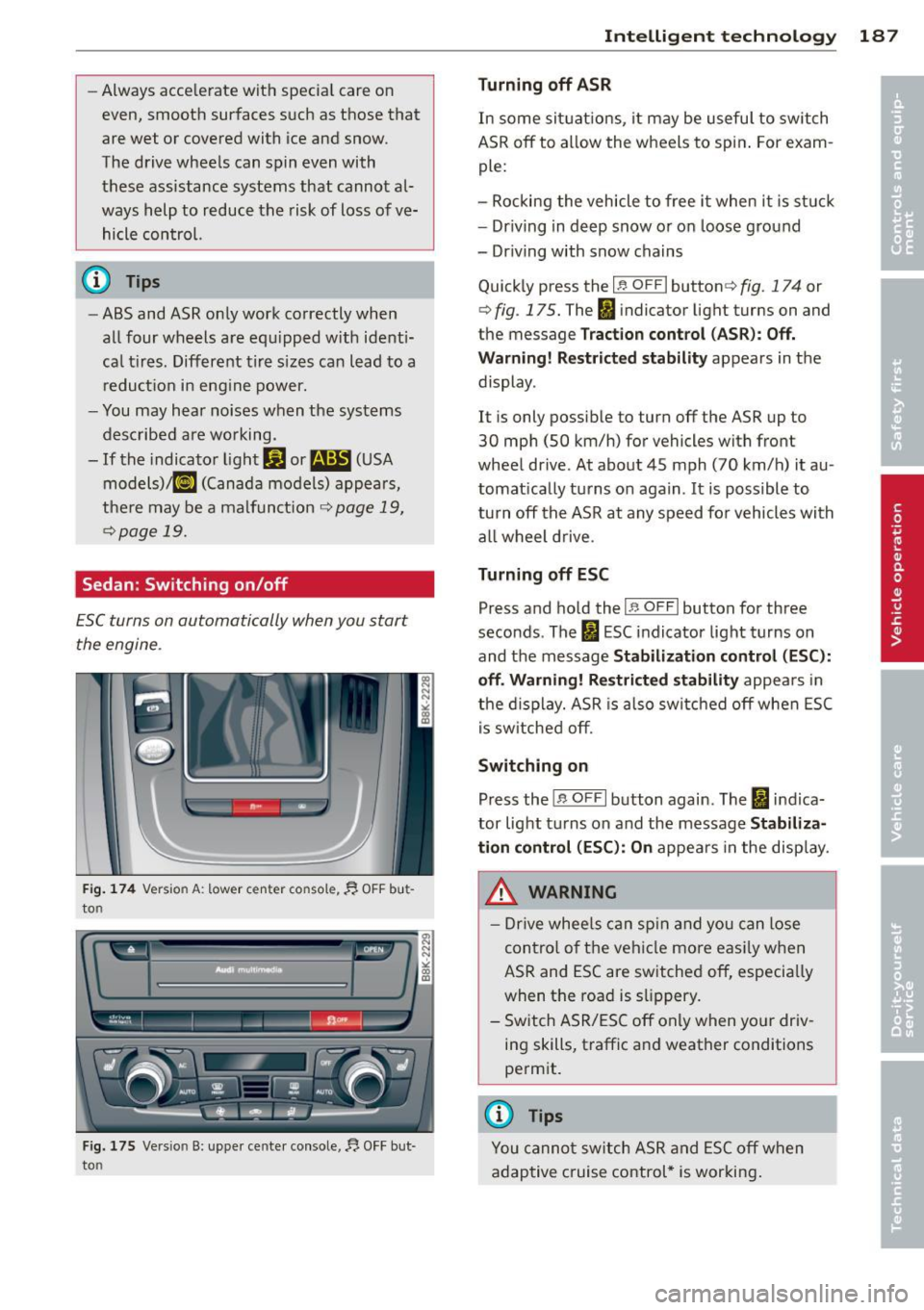
Sedan : Switching on/off
ESC turns on automatically when you start
the engine .
Fig . 174 Vers io n A: low er c en te r co nsol e, 1', O FF bu t
to n
Fig. 175 Ve rsio n B: upper ce nte r console,~ OFF bu t
to n
Intelligen t technolog y 187
Turning off ASR
In some sit uatio ns, it may be useful to switch
ASR
off to a llow the wheels to spin . For exam
ple:
- Rocking the vehicle to free it when i t is st uck
- Dr iving in deep snow or on loose ground
- Dr iving with snow chains
Qu ick ly press the
I~ O FF I button c:> fig. 174 or
c:>
fig . 175. The fil indica tor light turn s on and
t he me ssage
T rac tion control (A SR ): Off.
War ning! R estrict ed stability
appears in the
display .
It i s only possible to turn
off the ASR up to
30 mph (SO km/h) for vehicles wi th front
wheel drive . At about 45 mph (70 km/h) it au
tomat ically turns on again .
It is possible to
turn
off the ASR at any speed fo r vehicles with
all wheel drive .
Turning off ESC
Press and hold the I;; OFFI button for three
seconds . The
fl ESC indicator light turns on
and the message
Stabil ization cont rol (ESC ):
o ff . Warni ng ! Re str icted stab ilit y
appea rs in
the d isplay. ASR is also sw itched
off when ESC
i s sw itched off.
Switching on
Press the j ;; O FFI button again . The fi indica
tor light t urns on and the message
St abi liz a
t ion control (ESC ): On
appears in the disp lay.
_&. WARNING
- Drive whee ls can sp in and you can lose
contro l of the vehicle more eas ily when
ASR and ESC are switched off, especia lly
when the road is s lippery .
- Switch ASR/ESC
off only when yo ur driv
ing skills, traffic and weather conditions
permit.
@ Tips
You cannot sw itch ASR and ESC off when
adaptive cruise control* is working .
-
Page 190 of 302
188 Intelligent technology
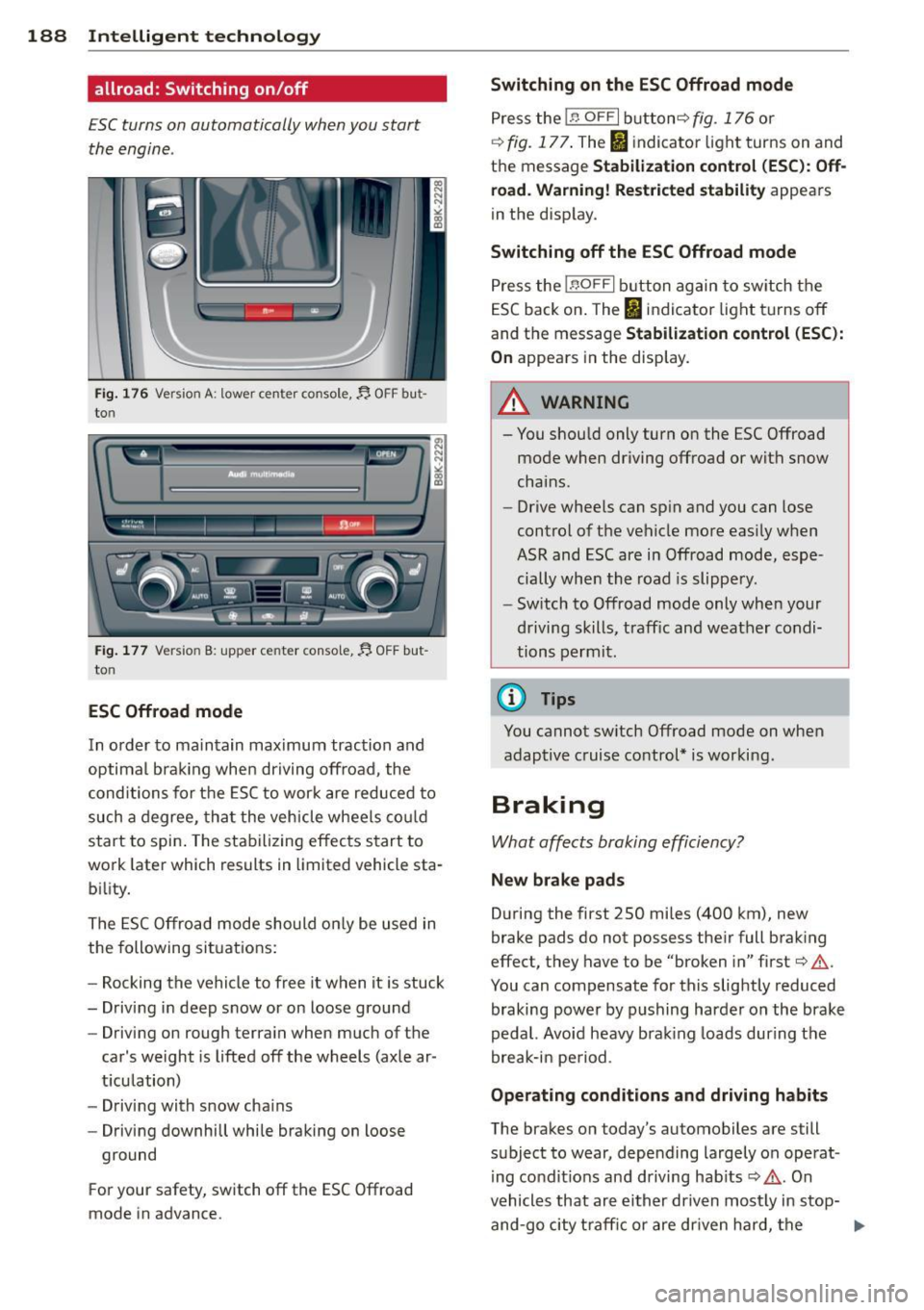
allroad: Switching on /off
ESC turns on automatically when you start
the engine .
Fig. 176 Version A: lower ce nter console,~ OFF but
to n
...... [ I I n-I _,,. .,., -------' -"~ __..,
Fig. 177 Versio n B: upper ce nter conso le,~ OFF but
to n
ESC Offroad mode
In order to maintain maximum traction and
optima l brak ing when driving offroad , the
conditions for the ESC to work are reduced to
such a degree, tha t the vehicle whee ls co uld
start to spin . The stabilizing effects start to
work later wh ich results in limited vehicle sta
b ili ty.
The ESC Offroad mode should on ly be used in
the following situations:
- Rocking the vehicle to free it when it is stuck
- Driving in deep snow or on loose ground
- Driving on rough terra in when much of the
car's weight is lifted off the wheels (axle ar
t icu lation)
- Driving with snow cha ins
- Driving downhill while braking on loose
ground
F or your safety, switch off the ESC Offroad
mode in advance.
Switching on th e ES C Offroad mode
Press the In OF FI button ¢ fig. 176 or
¢ fig. 177 . The I indicator light turns on and
the message
St abilization cont ro l ( ES C): Off
ro ad. Wa rning! Rest ricted stability
appears
in the disp lay.
Swit ching off th e ESC Offroad mode
Press the !.$ O FF I button again to sw itch the
ESC back on . The
IJ indicator light turns off
and the message
Stabil ization contro l (ESC ):
On
appears in the display.
_& WARNING
- You shou ld only turn on the ESC Offroad
mode when driving offroad or with snow
chains.
- Drive whee ls can sp in and you can lose
control of the vehicle more easi ly when
ASR and ESC are in Offroad mode, espe
cially whe n the road is slippery.
- Switch to Offroad mode only whe n your
driving skills, traff ic and weather condi
tions permit .
(D Tips
You cannot sw itch Offroad mode on when
adaptive cruise control* is working.
Braking
What affects braking efficiency?
New brake pad s
During the first 250 mi les (400 km), new
brake pads do not possess the ir full brak ing
effect, they have to be "broken in" first¢ .&,.
You can compensate for this slightly reduced
braking power by p ushing harde r on the brake
pedal. Avoid heavy brak ing loads dur ing the
break-in pe riod.
Oper ating cond ition s and driving habit s
The brakes on today's automobiles are still
subject to wear, depending largely on operat
ing co nd it ions and driving hab its
¢ .&, . On
vehicles that are either driven most ly in stop-
and-go city traff ic or are dr iven hard, the
lilJ,,
Page 191 of 302
brake pads should be checked by your a uthor
ized Audi dealer more often than specified in
the
War ranty & M aint enance booklet . Failure
to have your brake pads inspected can res ult
in reduced brake performance.
On steep slopes, you shou ld use the braking
effect of the engine . This way, you prevent un
necessary wear on the brake system. If you
must use your brakes, do not hold the brakes
down continuously . Pump the brakes at inter
vals.
Operating no ise
Noises may occur when braking depending on
the speed, braking force and outside condi
tions such as temperature and humidity.
Effect of w ater and ro ad salt
In certain sit uations, for example after driving
through water, in heavy rain, after overnight
condensation or after washing your car, the brak ing effect can be reduced by moisture or
ice on the brake rotors and brake pads. The
brakes must be dried first with a few careful
brake app lications.
At h igher speeds and with the w indshield w ip
ers turned on, the brake pads press against
the brake rotors for a short amount of time.
This occurs at regula r intervals without the
d river noticing and provides for better brake
response time under wet condit ions.
The effectiveness of the brakes can be reduced
when the vehicle is dr iven on a salt-covered
road and the brakes a re not used . L ikew ise,
you clean off a ccumulated sa lt coating from
brake discs and pads with a few ca utious ap
p lications of the brake
c:> .&. .
Cor rosion
There may be a tendency for dirt to bu ild up
on the brake pads a nd corrosion to form on
the discs if the car is not dr iven regular ly or
only for short t rips with little use of the
b rakes.
I f the b rakes are not used frequently, or if cor
r osion has formed on the discs, it is advisab le
t o clean off the pads and discs by brak ing
Int ellig ent technolog y 189
firmly a few times from a moderately h igh
speed
c:> .&. .
Faults in the brake s yst em
If you shou ld notice a sudden in crease in
brake pedal trave l, then one of the two brake
c ircuits may have fai led
c:> .&. .
Lo w brake fluid l ev el
Malfunctions can occur in the brake system if
the brake fluid level is too low . The brake flu id
level is monitored elect ro nica lly.
Brake booster
The brake booster increases the pressure that
you generate with the brake peda l. It works
only when the engine is running
.c:> .&
Brake lining wear statu s
Brake lining wear may be checked by visual in
spection of the condition of the brake pads
through the open ings in the wheel. If neces
sa ry, the wheel may be removed for th is in
spect ion
c:> page 259, Changing a wheel.
A WARNING
- New brake pads don' t have the best stop
ping power and m ust be "bro ken-in" dur
ing the initial
100 to 150 miles (150 to
200 kilometers) of normal c ity driving.
You can compensate for this by pressing the brake pedal more firmly. Th is also
applies later when new pads are instal
led.
- You should perform braking maneuvers for the purpose of cleaning the brake
system only if road conditions permit.
Other road use rs must not be put at risk -
you may ca use an accident!
- Before descend ing a steep grade, reduce
speed and sh ift transmission into a lower
gea r or l ower dr iving range . Do not ride
the brakes or hold t he pedal down too
long or too often . Th is could cause the
brakes to get hot and diminish braking
efficiency .
- Do not " ride the brakes" by res ting you r
foo t on the pedal when you do not intend .,..
•
•
Page 192 of 302
190 Intelligent technology
to brake. This may cause the brakes to
overheat, premature wear and increased
stopp ing distance.
- Under certain climatic and operating
condit ions such as passing through wa
ter, driving in heavy ra in or after wash ing
the vehicle, the effect iveness of the
brakes can be reduced . In winter, ice can
accumulate on the brake pads, linings,
discs and drums. Carefully apply brakes
f or a test . B rakes will dry a nd ice coat
ings will be cleaned off after a few ca re
ful brake applications.
- Driv ing for an extended pe riod of time on
salt -covered roads without using you r
brakes can also affect braking efficiency.
Clean off accumulated salt coating from
brake discs and pads w ith a few careful
brake applicat ions.
- If you damage the front spoiler, or if you
install a different spoiler, be sure the air
flow to the front brakes is not obstruct
ed . O therwise the brake system could
overheat reducing the effectiveness of
the ent ire brake system.
- Failure of one brake c ircuit will impair
the braking capability resulting in an in creased stopp ing distance. Avoid driv ing
the vehicle and have it towed to t he near
est author ized Audi dealer or qualif ied
workshop.
- Never let the vehicle roll to a stop w ith
the engine shut off.
- If the brake booster is not working, for
example when towing your ve hicle, or
because the b rake booste r has somehow
been damaged, the brake pedal must be
pressed considerab ly harder to make up
for the lack of booster assistance.
Electro-mechanical
power assist, dynamic
steering
The electro-mechanical power assist helps
the driver when steering.
Power steer ing adapts electronically based on
the veh icle speed.
Indicator lights and messages
• Ste ering d efe ct ive ! Do not d rive vehicle!
If this indicator light turns on and stays on
a nd this message appears, the power steering
may have failed .
Do
not continue driving. See your authorized
Audi dealer or other qualified repair facility
for assistance.
'Tij D ynamic steer ing: Sy stem f au lt! You c an
cont inue d riving
If the indicator l ight turns on and the mes
sage appears, the stee ring may be more diffi
c ul t to move o r more sensitive than usua l. The
steering wheel may a lso be at an ang le when
driv ing straight.
Drive slowly to your authorized Audi dea ler or
qualified workshop to have the ma lf u nction
corrected.
'Tij Dynamic stee rin g: initializing
If this driver message appears and the indica
tor light is flashing on the instrument panel, dynamic steer ing* is being re initia lized . On ce
you start the engine after t his is finished, the
steering wheel will be easy to move . Re-initi
alizat ion might be necessary if the steering
whee l was moved hard to the left and right
whi le the vehicle was not moving. The display
goes out as soon as initiali zation is complete.
A WARNING
-Have the dynamic steering* system mal
function repa ired as soon as possible by an
authorized Audi dealer or any qualified
workshop - r is k of accident!
-
Page 193 of 302
@ Tips
- If the . or
fT j indicator light on ly stays
on for a short t ime, you may continue
driving.
- The dynamic steering* stability systems
are not available in the event of a system
malfunction.
- For additional information on dynamic
steering*, refer to
c:> page 113.
Driving with your
quattro ®
Applies to vehicles: with a ll-wheel drive
With all-wheel drive, all four wheels are driv
en.
Gener al inform ati on
W ith all-wheel drive, power is distributed to
all four wheels . This happens automatically
depending on your dr iving style and the road
conditions at the t ime. See also
c:> page 185.
A center different ial distr ibutes the dr iv ing
power var iably to the front and rear axle . It
works together with selective wheel torque
control, which activates when driving throug h
curves
c:> page 186. With the spo rt d ifferen
tial*, power dist ribution to the rear wheels is
variable and can be adjusted with drive select
c:> page 113.
The all-wheel drive concept is designed for
h igh engine power. Yo ur vehicle is exception
ally powerful and has exce llent driving charac
teristics both under normal driving conditions
and on snow and ice. Always read and fo llow
safety precautions
c:> A .
Winter t ir e s
When driv ing in the w inter, your veh icle w ith
all-wheel drive has an advantage,
even with
regular tires. In winter road conditions it may
be advisable to mount winter tires (or all-sea
son t ires) for improved driveability and brak
ing: these tires must be mounted on
a ll four
w heels . See also c:> page 250, Winter tires .
Intellig ent technolog y 191
Tire chain s
Where tire chains are mandatory on certain roads, this no rma lly also applies to veh icles
with all-wheel drive
c:> page 251, Snow
chains.
Replacing wheels /tires
Vehicles with a ll-wheel drive must always
have tires of t he same s ize. A lso avoid tires
with different tread depths . For detai ls see
page
c:> page 246, New tires and replacing
tires and wheels .
Off-Road driving?
You r A udi does no t have enough ground clear
ance to be used as an off-road vehicle .
It is
therefore best to avoid rough tracks and un
even terrain as much as possib le . Also refer to
c:> page 194.
A WARNING
Always adjust your dr iving to road and traf
f ic conditions. Do not let the extra safety
afforded by all-wheel drive tempt you into
taking extra risks .
- Although the all-wheel drive is very ef
fective, always remember that braking
capacity is lim ited by tire traction. You
should therefore not d rive at excessive
speeds on icy or slippe ry road surfa ces.
- On wet road surfaces, be careful not to
drive too fast because the front wheels
co uld begin to slide on top of the water
(aquaplaning) . If this should occur, yo u
will have no warning from a s udden in
crease in engine speed as w ith a front
wheel drive veh icle. Always drive at
speeds which are su ited to the road con
ditions -risk of crash.
•
•
Page 199 of 302
(D Note
Do not leave engine idling unattended af
ter starting . If warning lights should come
on to indicate improper operation, they
would go unheeded. Extended idling also
produces heat, which could result in over
heating or other damage to the vehicle or
other property .
Regular maintenance
A badly tuned engine unnecessarily wastes a
lot of fuel .
.,. Have your vehicle serv iced at regular inter-
vals .
By having your vehicle regularly serviced by an
author iz ed Audi dealer helps to ensure that it
runs properly and economically . The condition
of your vehicle not only affects its safety and
ab il ity to hold its value, it also affects
fu el
c onsump tion .
C hec k your oil each tim e you fill your t ank .
The amount of oil used is related to engine
load and speed.
It is normal for the oil consumption of a new
engine to reach its lowest value after a certain
mileage has been driven.
You must d rive yo ur vehicle about 3 ,000 miles
(5,000 kilometers) be fore you can properly
assess oi l consumption.
This a lso applies to fuel consumption and en
g ine output .
0 Note
-Have your vehicle maintained properly
and in accordance wit h the service rec
ommendat ions i n your Warranty
& Main
tenance booklet . Lack of proper mainte
nance as well as improper use of the ve
hicle wi ll impair the function of the
emission control system and could lead
to damage.
Dri vin g and en vironm ent 197
-Do not alter or remove any component of
the Emission Control System unless ap
proved by the manufacturer .
- Do not alter or remove any device, such
as heat shie lds, switches, ignition wires,
valves, which are designed to protect
your vehicle's Emission Control System and other important vehicle compo
nents .
Fewer short trips
Fuel consumption will always be rela tively
high on short trips .
.,. Try to avoid driving short distances with a
cold engine.
The engine and cata lytic converter have to
reach their opt imal
op erati ng t emper ature to
reduce fuel consumpt ion and noxious emis
s ions effectively .
Just after starting, a co ld engine in a mid-size
car only achieves a fuel economy of 6-8 mi les
per gallon (30-40 l/100 km). After about a
half a mile, fuel economy climbs to 12 mpg
(20 l/100 km) . After about
2 .5 miles (4 km),
the e ngine is at its proper operat ing tempera
ture and fue l economy has reached a normal
level. So you can see that you should avo id
short trips whenever poss ible.
T he
outs ide t emp erature is also cr itical in th is
regard. Your car consumes more fue l in the
winter than in the summer.
allroad : Driving offroad
General information
App lies to vehicles : allroad
When d riving offroad, the functions for the
electron ic stabilization control (ESC) are ex
panded. The ESC -Offroad -Mode can be act ivat
ed in driving situations in which a whee l lock
o r a d iffe rential lock function is needed
~ page 188. In addition , you r Audi p rov ides
continuous all wheel drive.
Your Audi i s ho wever, no t an offroad vehicl e.
Nev er drive the vehicle in terrain which i s not
lilJJ,,
•
•
Page 200 of 302
198 Driving and en vironm ent
s uit able for the vehicl e, or w hic h ex ceed s
y ou r dr iving sk ill s. N eve r tak e an y unnec es
s a ry risks!
After driv ing offro ad
- After driving offroad, remove branches and
other debris from the rad iator grille, under
body, and whee ls. Look especia lly for objects
(stones) that have been caught in the tire
tread .
- Clean t he body and the vehicle underbody
and inspect the vehicle for possible damag
es.
- Clean off the dirty windows, headlights, tail
lights and the license plate.
- Perform a brake test (especially after driving
through water) .
A WARNING
- Be especially aware and attentive when
dr iv ing under d iff icult conditions. Dam
ages to the vehicle and injuries may oc
cur when driving at an excess ively high
speed or with incorrect driv ing maneu
vers.
- Always adjust your speed and handling
to the roads, terra in, traffic and weather
condit ions. Drive especially slow if off
road with low v is ibility.
- Please note that the wheels can spin and
the vehicle can brea k away when the ESC
Offroad Mode is switched off, espec ially
whentheroadisslipper~
- Driv ing stab ility is red uced in the ESC
Offroad mode.
@) For the sake of the environment
Avo id harming the environment and take
nature into conside rat ion.
@ Tips
Only drive where it is allowed and always
stay on the provided roads and paths.
Driver messages
App lies to veh icles : all road
There is only one right way to drive in difficult
conditions: slowly and with caution!
When driving offroad, observe the follow ing :
.. Never drive the vehicle in terrain which is
not suitab le for the vehicle, or which ex
ceeds your driving ski lls. Never take any un
necessary risks!
.. Drive slowly and caut iously!
.. Pay attention to the
ground clearanc e of
your veh icle! This may vary depending on
the load and composition of the ground and
t he environment. The d river is therefore re
sponsib le for deciding whether a veh icle can
handle a specific situation .
.. Activate the
ESC-Offroad-Mode r::;, page 187
as needed .
Difficult terrain
Never drive in areas that are not fam iliar to
you and d rive slowly when offroad and be p re
pared and expect the unexpected (e .g. pot
holes, boulders , tree stumps, etc.)
T o p reven t the veh icle from bottoming and
avo id damage to the unde rbody, yo u should
drive straight across severe bumps in the
ground with only one side of the ve hicle so
that only two of your whee ls cross the bumps.
Drive quickly th rough sandy or marshy offroad
sections and do not stop, if at all possible.
Driving through water on roads
Read the information on r::::> page 194 .
Page 203 of 302
Trailer towing tips
Important to know
Your vehicle hand les different ly when tow ing
a trailer because o f the addit ional weight and
d iffe ren t weight distribution . Safety, pe rform
ance and economy w ill greatly depend on how
caref ully you load your trailer and operate
your rig.
B efore you actua lly tow your trailer, pr actice
turning, stopp ing and bac king up in an area
away from traffic. Keep practicing until you have become comp lete ly fam iliar with the way
your veh icle-trailer comb ination behaves and
responds.
Backing up is d ifficu lt a nd requires practice .
Backing up with a tra iler genera lly requires
steer ing action opposite to that when backing
up your vehicle without a trailer.
M aintain a g reater distance betwee n your ve
h icle and the one in front o f you . You will need
mo re room to stop. To compensate for the
trailer, you will need a larger than normal
turning radius .
W hen pass ing, remember that yo u cannot ac
celerate as fast as yo u normally wo uld be
cause of the added load. Ma ke s ure you have
e nough room to pass . After passing , allow
p lenty o f room fo r your tra iler before chang
in g la nes aga in .
Avoid jerky starts, sharp turns or rap id lane
changes.
(D Tips
- Do not tow a tra iler during the break-in
period of you r vehicle.
- If you tow a trailer, your A udi may re
quire more frequent maintenance due to
the extra load
o page 280.
Trailer towin g 201
Parking on a slope
Do not park on a slope with a trailer . If it can
not be avoided, do so only after doing the fol lowing:
When parking:
.. App ly the foot brake.
.. Have someone p lace chocks under both the
veh icle and the tra iler wheels .
.,. With chocks in place, slowly release t he
bra kes unt il t he whee l choc ks absorb the
load .
.. Tur n the whee ls towa rds t he curb .
.,. App ly the parking brake.
.. Place an a utomat ic t ransm ission* in P, re
spectively a manual transmission in first or
reverse gear.
When restarting after parking:
.. App ly the foot br ake .
.. Sta rt t he engine.
.. Move the se lector lever to D/S, respectively
a man ual transmiss ion in first gear .
.. Release the parking brake and s low ly pull
out and away from the wheel chocks .
.. Stop and have someone retr ieve the wheel
chocks.
@ Tips
If you move the selector leve r of the auto
matic transmissio n* to P before applying
the pa rking brake and befor e bloc king the
whee ls, you may hav e to use mor e forc e
la ter to m ove the lever out of the P p osi
tion.
•
•