seats AUDI S4 2013 Workshop Manual
[x] Cancel search | Manufacturer: AUDI, Model Year: 2013, Model line: S4, Model: AUDI S4 2013Pages: 302, PDF Size: 75.61 MB
Page 182 of 302
180 Child Safet y
LATCH Lower
anchorages and tether
for children
Child Restraint System anchors and how
are they related to child safety
To provide a simpler and more practicable way
to attach the child restraint on the vehicle
seat, Federal regulations require specia l lower
anchorages in veh icles and dev ices on new
child restraints to attach to the vehicle ancho
rages.
The combination of the tether anchorages and
the lower anchorages is now generally called
the
LA TC H system for "L ower Anchorages and
Tethers for C hildren ."
F orward-facing child restraints manufactured
after September 1, 1999, are required by U.S.
federal regulations to comply with new child
head movement performance requirements .
These new performance requirements make a
tether necessary on most new child seats.
I nstalling a child restraint that requires a top
tether without one can seriously impair the
performance of the child restraint and its abi l
ity to protect the child in a collision . Installing
a child restraint that requires a top tether
without the top tether may be a violation of
state law .
Ch ild restra int manufacturers offer LATCH
lower anchorages on their child seats with
hook-on or push-on connectors attached to
adj ustab le straps.
In addition to the LATCH lower anchorages,
these child restraint systems usually require
the use of tether straps to help keep the child
restra int firmly in place.
_&. WARNING
Imprope r insta llation of chi ld restraints
w ill increase the risk of inju ry and death in
a crash.
- Always fo llow the instructions p rov ided
by the manufacturer of the c hild re- straint yo
u intend to install in your vehi
cle.
- Never install a child restraint without a
properly attached top tether strap if the
child restraint manufacturer's instruc
tions require the top tether strap to be
used.
- Improper use of child restraint LATC H
lower anchorage points can lead to injury
in a collision . T he LATC H lower anchorage
points are designed to withstand on ly
those loads imposed by correctly fitted
chi ld res traints.
- Never mount two child restra int systems
on one LATC H lower anchorage point.
- Never secure or attach any luggage or
other item to the LATCH lower anchorag
es.
(D Tips
In Canada, the terms "top tether" with
"lower universa l anchorages" (or "lower
u niversa l anchorage ba rs") are used to de
scribe the system.
- In other countries, the term " ISOFIX" is
used to describe the lower a ncho rages.
Location
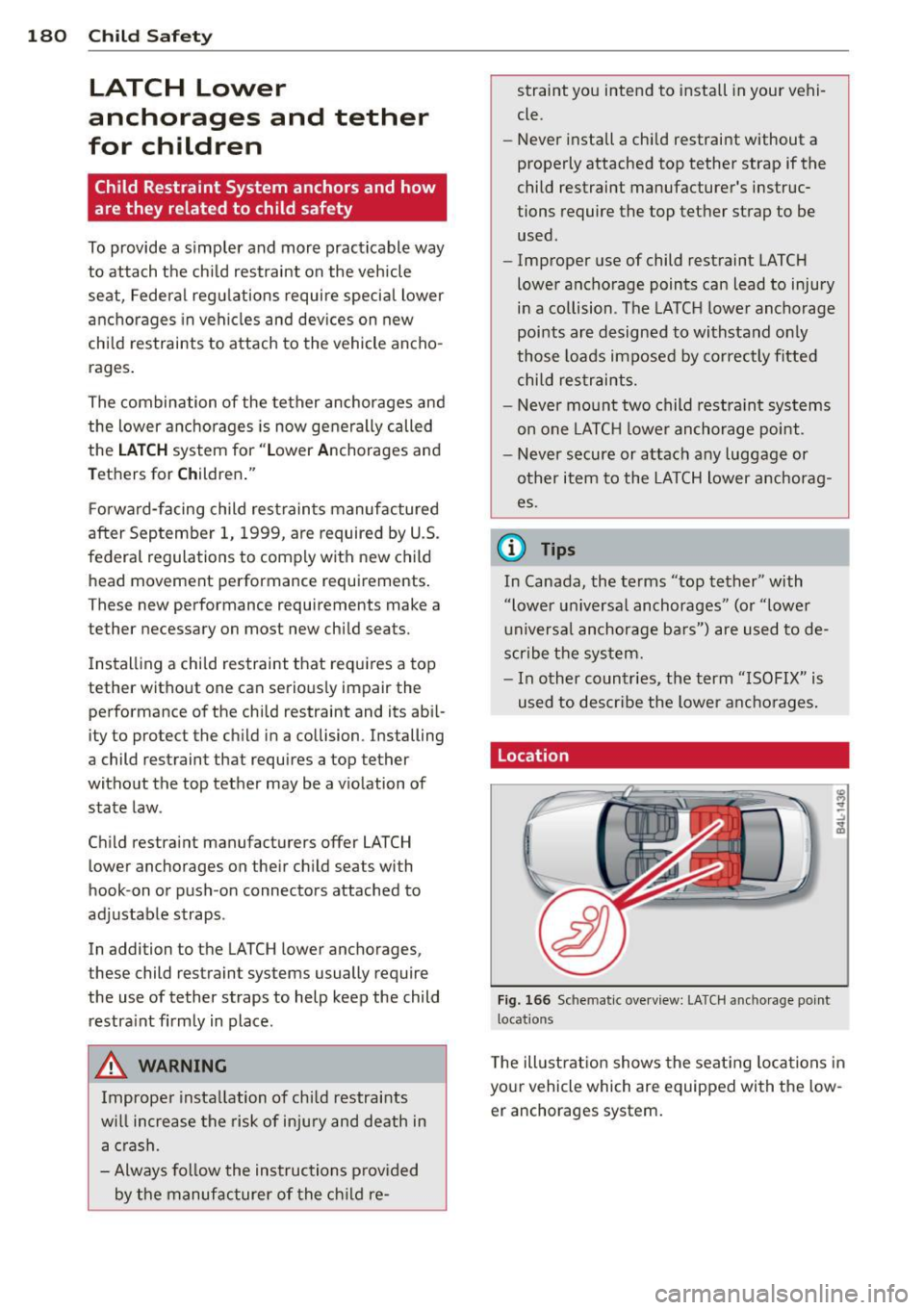
Fi g. 166 Sc hem atic overview: LA TCH ancho rage point
l ocations
T he illust rat ion shows the seat ing loca tions in
you r vehicle which are equipped with the low
er anchorages system.
Page 183 of 302
Description
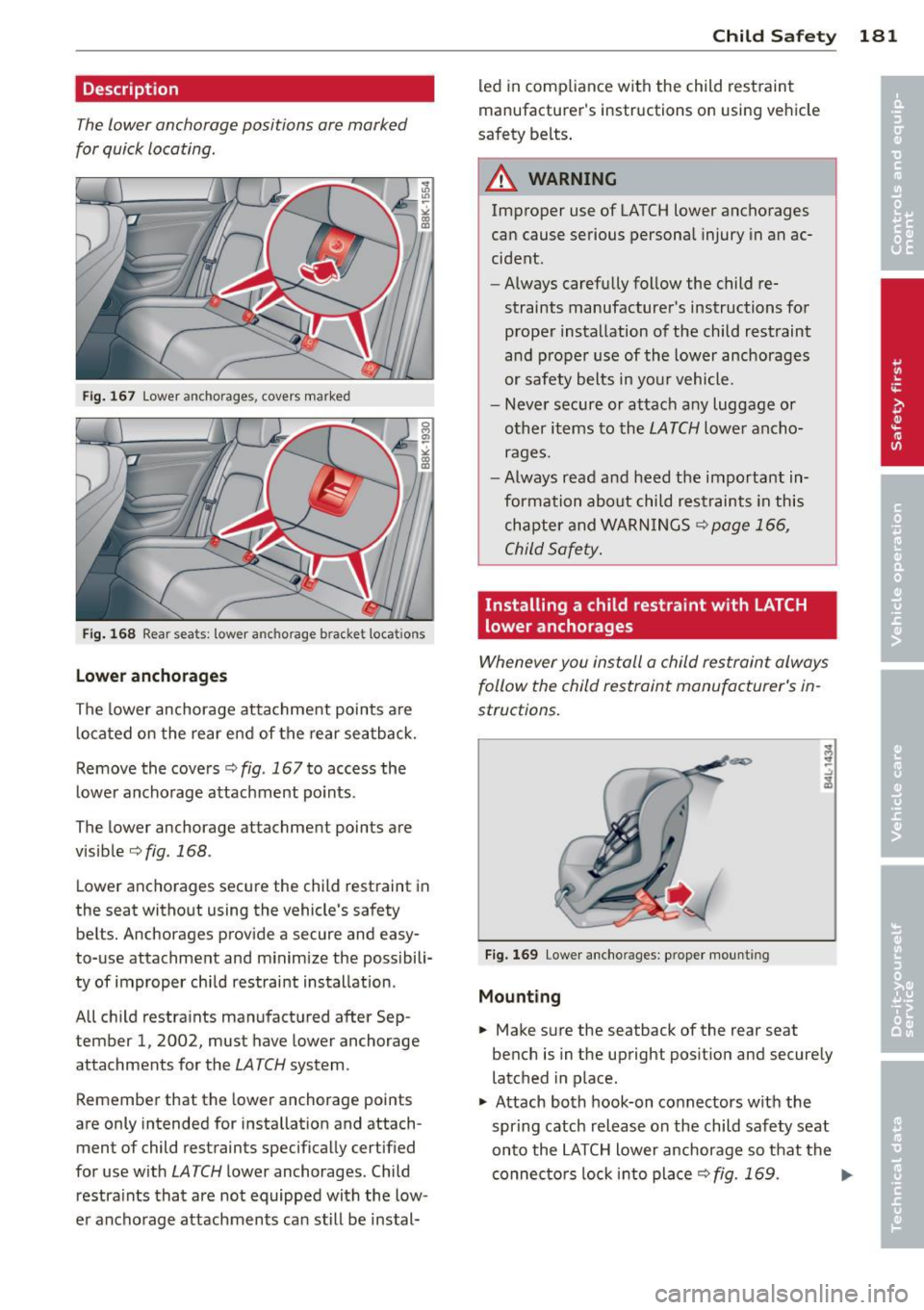
The lower anchorage positions are marked
for quick locating.
Fig . 167 Lower anchorages, covers marked
Fig . 168 Rear seats: lower anchorage b racket locat ions
Lowe r ancho rages
The lower anchorage attachment points a re
located on the rear e nd of the rear sea tback.
Remove the covers
c:;, fig . 167 to access the
l ower anchorage attachment po ints.
The lower anchorage attachment points are
visible
c:;, fig . 168 .
Lower anchorages secure the child restraint in
the seat without using the vehicle 's safety
belts. Anchorages prov ide a secure and easy
to-use attachment and minimize the possibili
ty of improper child restraint installation .
All ch ild restra ints manufactured after Sep
tember 1, 2002, must have lower anchorage
attachments for the
LATCH system .
Remember that the lower anchorage points
are only intended for installation and attach ment of child restraints specifically certified
for use w ith
LATCH lower anchorages . Child
restra ints that are not equipped with the low
e r anchorage attachments ca n still be instal-
Child S afety 181
led in compliance with the child restraint
manufacturer's instructions on using vehicle
safety belts .
_& WARNING
Improper use of LATCH lower anchorages
can cause serious personal injury in an ac
cident.
- Always carefully follow the child re
straints manufacturer's instructions for
proper installation of the child restraint
and p roper use of th e lower anchorages
or safety belts in yo ur vehicle.
- Never secure or attach any luggage or
other items to the
LATCH lowe r ancho
rages.
- Always read and heed the importa nt in
formation about child r estraints in this
chapter and WARN INGS
¢page 166,
Child Safety.
Installing a child restraint with LATCH
lower anchorages
Whenever you install a child restraint always
follow the child restraint manufacturer's in
structions.
F ig. 169 Lowe r anc horages: proper mount ing
Mounting
.,. Make sure the seatback of the rear seat
bench is in the upright pos it ion and securely
latched in place .
... Attach both hook-on co nnectors with the
spring catch rel ease on the child safety seat
onto the LATCH lower anchorage so that the
connec to rs lock into place
c:;, fig. 169 . ..,_
Page 184 of 302
182 Child Safet y
• Pull on the connector attachments to make
sure they are properly attached to the LATCH
lower anchorage.
• Pull straps tight following the child re
straint manufacturer's instructions.
Re leasin g
• Loosen the tension on the straps following
the chi ld restraint manufacturer 's instruc
tions .
• Depress the spring catche s to release the
anchorage hooks from the lower anchorag
es .
Remember: Use tether straps to help keep the
child restrain t firmly in place.
A WARNING ,.
Improper use of the LATCH system can in
crease the risk of ser ious personal injury
and death in an acc ident .
- T hese anchors were developed only for
child safety seats us ing the "LATCH" sys
tem .
- Never attach other child safety seats,
belts or ot her objects to these anchors .
-Always make sure that you hear a click when latching the seat in place . If you do
not hear a click the seat is not secure and
cou ld fly forward and h it the interior of
t he vehicle, or be ejected from the vehi
cle .
A WARNING
Improper insta llation of chi ld restraints
wi ll increase the risk of injury in an acc i
dent.
- Always follow the child restraint system manufacturer's instructions for proper
installation of the child restraint system
and proper use of tether straps as we ll as
the lower anchorages or safety belts in
your vehicle .
- Always read and heed the important in
format ion and WARNINGS about child
safety and the installation of child re
st raint systems ¢ page 166, Child Safe
ty.
-
Tether anchors and tether straps
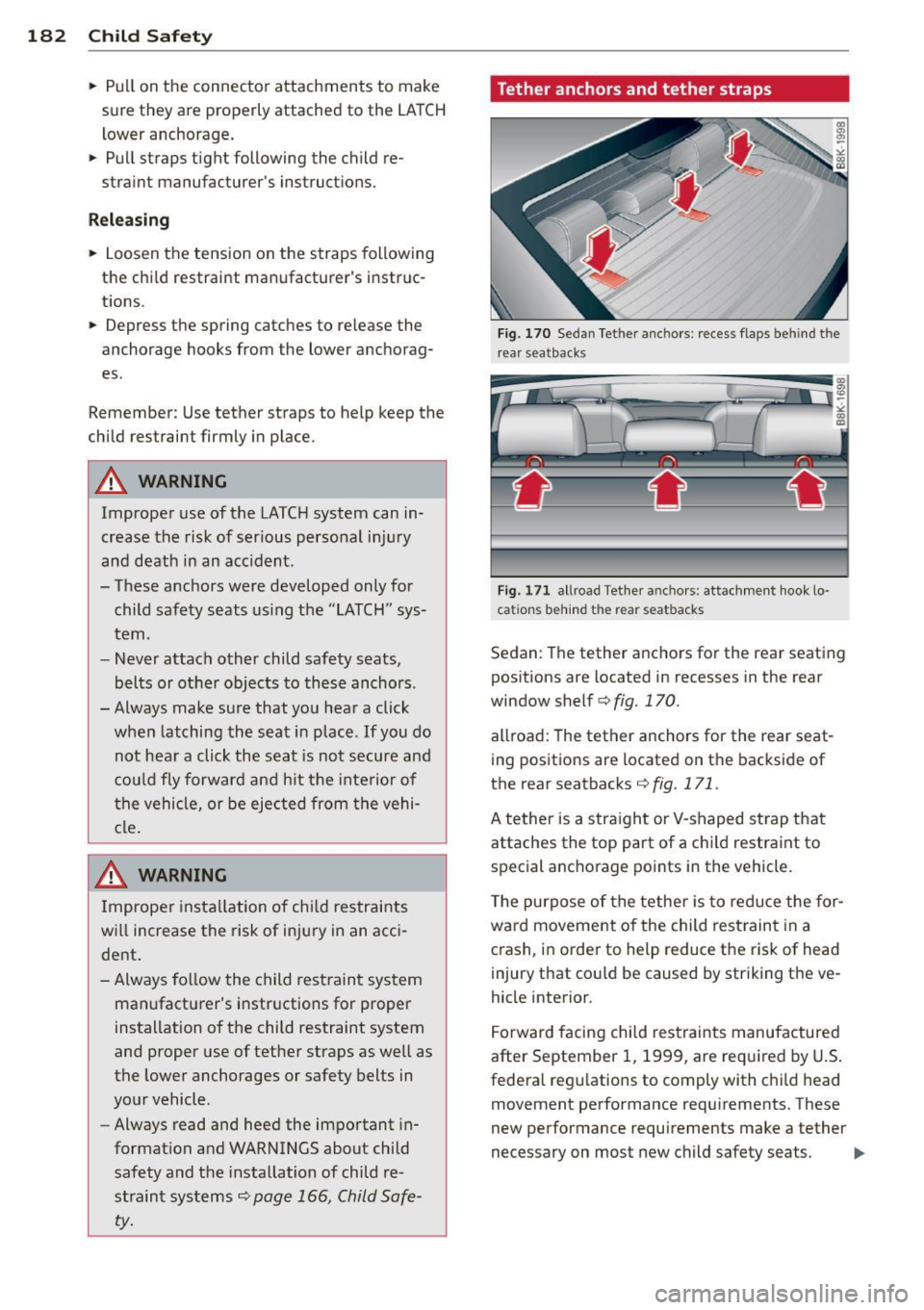
Fig. 170 Se dan Tet her an ch or s: r ecess flaps behind th e
rear sea tback s
Fig. 171 all road Tether a nch o rs: attachmen t hook lo
ca tions beh ind t he rear s eatb acks
Sedan: The tether ancho rs for the rea r seat ing
positions are located in recesses in the rear
windowshelf ¢fig.170.
allroad: The tether anchors for the rear seat
ing pos it ions are located on the backside of
the rear seatbacks
¢ fig. 171 .
A tether is a stra ight or V-shaped strap that
attaches the top part of a child restraint to
special anchorage points in th e vehicle.
T he purpose of the tethe r is to reduce the for
ward movement of the child restraint in a
crash, in order to help reduce the risk of head
injury that cou ld be caused by striking t he ve
hicle interior .
Forward facing child restraints manufactured
after September 1, 1999, are requ ired by U.S .
federal regu lations to comply with c hild head
movement performance requirements. These
new perfo rmance requirements make a tether
neces sary on mos t new child safety sea ts.
IIIJ.
Page 186 of 302
184 Child Saf ety
• Depress the spring catch on the hook and
release it from the anchorage .
(D Note
If you leave the child restraint with the
tether strap firmly insta lled for several
days, this cou ld leave a mark on the up
holstery on the seat c ushion and backrest
in the area where the tether strap was in
stalled. The upholstery would a lso be per
manently stretched around the tether
strap. Th is applies especially to leather
seats.
Using tether straps on rea rward-facing
child restraints
Currently, few rearward-facing child rest raint
systems come with a tether . P lease read and
heed the child restraint system manufactur
er's instructions carefully to determine how to properly instal l the tether.
A WARNING
-
A child in a rea rward-facing child sa fety
s e at insta lled on the front passenger seat
w ill be seriously injured and can be killed if
t he fron t air bag infl ates -even wit h an Ad
vanced Airbag System.
- T he inflati ng a irbag wi ll hit the child
sa fety sea t or infan t carrier w it h grea t
f orce and w ill smash the c hild safety sea t
and child against the backrest, cente r
armrest, or door.
- A tight tet her or ot her st rap on a rear
wa rd-facing child restra int attached to
the front passenger seat can put too much pressure on the weight-mat i n the
seat and register a heavier weight in the
Advanced Airbag System. The heav ie r
we ight registe red can make the system
wor k as though a n adu lt were on the seat
and dep loy the A dvan ced Airbag when i t
mus t be suppres sed c ausing seriou s or
eve n fa tal injury to the child.
- If you mus t install a rea rw ard fa ci ng
ch ild s afety se at on the front passenge r
sea t beca use of excep tional circ ums tan - ces and t
he
PASSENGER AIR BAG OFF
light does not come on and stay on, im
mediately install the rearward-fac ing
child safety seat in a rear seating posi·
tion and have t he ai rbag system inspec t
e d by your authorized A udi dealer .
Additional Information
'
Sources of information about child
restraints and their use
There are a number of sources of add itiona l
information about child restra int selection, in
sta llation and use:
NHTSA advises that the best ch ild safety seat
is the one that fits your ch ild and fits in your
vehicle, and that you will use correct ly and
cons istently .
Try before yo u buy!
U .S National Highway Traffi c Safet y Admin
istration
Tel.: 1 -888-327- 4236 (TIY: 1-800-424-9153)
www.n htsa.gov
National SAFE KIDS Campaign
Tel.: (202) 662 -0600
www.safek ids.org
Safet y BeltSafe U.S.A
Tel.: (800) 7 45-SAFE (English)
T el.: (800) 7 47-SANO (Spanis h)
www.carseat.org
Transport Canada Information Centre
T el.: 1 -800 -33 3-0371 o r ca ll
1-6 13-998-86 16 if yo u are i n the Ottawa area
http://www.tc.gc.ca/eng/roadsafety/
menu. htm
Audi Cu stomer Relation s
Tel.: (800) 822 -2834
Page 195 of 302
Please start the engine soon or the system
will be turned off.
The warning ind icates that the system will be
turned off automa tically after 3 minutes. If
you wish to continue using the functions, you
have to start the engine .
With the engine running
Although electrical energy is generated when
the vehicle is be ing driven , the battery can be
come discharged. This happens most ly when
litt le energy is being generated and a great
deal consumed and the battery's state of
charge is not optimal.
To br ing t he ene rgy balance back into equili
brium, consumers which require especially
l arge amounts of energy are temporarily cut
back or switched off. Heating systems in par
ticular requ ire a great deal of energy. If you
notice, for example, that the heated seats* or
the heated rear window are not heating, they
have been temporar ily cut back or switched
off. These systems will be ava ilable again as
soon as the energy ba lance has bee n restored.
You will also notice that engine idle speed has
been increased slightly . This is normal and not
a cause for concern. By increasing engine idle
speed the add itional ene rgy required is gener
ated and the ba ttery is charged.
Intelligent technology 193
•
•
Page 211 of 302
-Always read and heed all WARNINGS and
other information
¢page 202.
Exhaust tail pipes
Road salt and other corros ive materia ls will
damage the mater ial in the exhaust tail pipes
if they are not cleaned regularly . Do not clean
the ta il p ipes with wheel cleaner, paint pol ish,
chrome po lish or other abrasive cleaners.
C lea n the ta il p ipes wi th car ca re p rod ucts
that are s uitabl e for s tain less stee l.
Your authorized Audi dealer can provide clean i n g p roducts t hat have been tested and ap
p roved fo r you r vehi cle.
Care of interior
Infotainment components
The Radio/MMI* display may be cleaned with
a soft cloth and commerc ially-avai lab le "LCD
cleane r" . The cloth should be coated l ightly
wh en the clean ing solution when cleani ng the
d isp lay.
The
MMI* contro ls must be cleaned first with
a br ush so that dirt does not e nte r the un it o r
ente r betwee n th e bu ttons and the hous ing.
Then w ip ing t he con tro ls w ith a cloth damp
e ned wi th dish de tergent and water is recom
mended .
(D Note
- To avoid sc ratch ing the disp lay, yo u
s ho ul d neve r clea n it dry.
- To prevent damage, ma ke s ure fl uids do
n ot en ter the co ntrols.
Aluminum trim
Use only neutral-pH products to remove spots
and deposits from alum inum surfaces.
C hrome ca re products and alkaline cleaners
will attack alum in um s urfaces and can dam
age them over time.
Cleaning and protec tion 209
A WARNING
A lways read and heed all WARNINGS and
other information
¢page 202.
Fabrics and fabric coverings
Fabr ics and fabric cover ings (e.g. seats, door
trim pa ne ls, etc.) shou ld be cleaned at regular
i n tervals w it h a vac uum cleaner. This removes
s ur face di rt particles which cou ld become em
bedded in the fabri c throug h use. Ste am
cleaners sho uld not be used, beca use the
steam tends to p ush the dirt deeper into the
fabric and lock it there .
Normal cleaning
Generally, we recommend using a soft sponge
o r a lint -free microfibe r clo th to the clean fab
ric. Br ushes shou ld only be used for carpets
and floor mats, since other fabric surfaces
could be harmed by br ushes.
Norma l su rface s tains c an be cleaned using a
commerc ially availab le foam cleaner . Spread
the foam on the s urface of t he fabric with a
soft sponge and work it in gently. Do not satu
rate the fabric. T hen pat the foam dry us ing
absorbe nt, dry cloths (e.g. m icrofiber cloth)
and vacuum it after it has dried completely.
Cleaning stains
Stains caused by beverages (e .g. coffee, fr uit
juice, etc.) can be treated with a mild deter
gent solution. Apply the detergent sol ution
with a spo nge. In the case of stubborn stains,
a detergent paste can be applied directly to
the stain and worked into the fabric. After
wards, use copious amounts of clean water to
remove the rem aining de terge nt. Apply the
w at er wit h a d am p clot h or sponge a nd pat
the fabric dry with an abso rbent, dry clot h.
Stains from choco late or makeup should have
de terge nt pa ste rubbed i nto them. After
w ards, remove the soa p with wa te r (damp
sponge).
Alcohol can be used to treat stains from grease, o il, lipstic k or a ballpoin t pen. Melted .,.
•
•
Page 212 of 302
210 Cleaning and protec tio n
grease or dye must be patted off using ab
sorbent materia l. It may be necessary to re
treat the areas with detergent paste and wa
te r.
I n the case of general soi ling of the uphols
tery and cover material, we recommend hiring
a specialist that has the equ ipment to clean
the seat cove rs and other fabric surfaces by
shampooing and spray ex traction.
A WARNING
Always read and heed all WARNINGS and
the information
~ page 202.
(D Tips
Open Velcro fasteners on your clothing can
damage the seat cover. Please make sure
that Velcro fasteners are closed.
Plastic parts and instrument panel
Always use a clean cloth moistened in clear
water to clean these areas. For pers istent dirt
use an Audi approved
s ol ve nt-fr ee plastic
cleane r/protectant.
A WARNING
So lvents can change the properties of
some plastics and make it harder for the
airbag to dep loy.
- Never clean the instr ument pane l or the
surface of airbag modules with cleaning
products that contain solvents .
- Products containing solvents wi ll make
the surface of th is part porous.
- Serious injuries can result if plastic parts
come loose when the airbag is deployed .
- Always read and heed all WARN INGS and
other information ~
page 202.
0 Note
Cleaning agents con taining solvents will
at tac k the mater ial and can change the
way it behaves .
Natural leather
Applies to vehicles: wit h natural leather
Audi makes great efforts to maintain the
properties, natural look and feel of interior
leather .
General
We offer many d ifferent types of leather on
our vehicles. Most are d ifferent types of nappa
leather, which has a smooth surface and
comes in various colors .
The intensity of the co lo r determines the visu
al characterist ics and appearance . If the sur
face of the leather has a typ ica l natural look,
then the leather is a nappa leather that has
been left in a relat ive ly natura l condit ion. This
leather offe rs particularly good comfort and
breathes we ll. Fine veins, closed grai ns, insect
bites, skin fo lds, and s ubt le va ria tions in color
remain visible . These characteristics demon
strate that the material is natura l.
Natura l na ppa le ather is not covered by a co l
o r finish. It is therefore mo re sensit ive to soil
ing and wea r, which is something you need to
consider if children, animals or other factors
might prove to be part icu larly hard on the
leather.
By contrast, leather types that are covered by
a colo red finish layer are more durable . This
has a positive effect on the leather's resist
ance to wear and soiling in dai ly use. On the
other hand, the typical characteristics of natu
ral leather are barely or not apparent . Howev
er, th is does not mean that the leathe r itself
is of infe rior quality .
Care and handling
Because of the exclusive nature of the types of
leather that Aud i uses and their unique prop
erties (such as sens it ivity to oils, grease, soil
i ng, etc.), you will need to be somewhat ca re
ful with these leathers, and a ce rtain type of
ca re is req uired. For example, dark clo thing
ma ter ials can disco lor le athe r seats (especia l
ly if such clothing is damp and was not dyed
correct ly). Dust and dirt particles in pores ,
folds, and seams can have an abrasive effect ..,..
Page 213 of 302
and can damage the leather surface as well as
weaken seams .
The leather sho uld be cleaned reg ularly as
needed. After having been used for a re latively
l ong time, your leather seats will acquire a
rich aged finish. This is a characteristic of nat
ura l leather and a sign of true quality .
I n o rder to maintain the va lue of th is natura l
p roduct over the life of your vehicle, you
should follow the recommendations below :
(D Note
-To keep yo ur leather from bleach ing out,
do not a llow it to be exposed to bright
sunlight for long periods of time. If you
have to leave the vehicle parked outside
for long periods, cover the leather to
protect it from d irect exposure to sun
light.
- Sharp objects on clothing, such as zip
pers, rivets or sharp pieces on be lts can
leave permanent scratches or scrape
marks on the surface of the leather .
- After each time you clean the leather and
at regular inte rva ls, use a leather preser
vat ive cream that conta ins UV-blockers
and that works into the leather. This
c ream will nourish and moistur ize the
l eather, helping i t to brea the and stay
supple .
It also helps to b uild up a protec
tive coating on the s urface .
- Clean the leather every 2 -3 months,
and clean any areas that get soiled.
- Remove fresh mar ks made by ba llpoint
pens, ink, lipstick, shoe polish, e tc. as
soon as possib le .
- Preserve the colo r of the leather as need
ed by using a special colored leather care
cream to touch up areas of uneven co lor.
Cleaning and protec tion 21 1
Cleaning and caring for leather
upholstery and trim
Applies to vehicles : with natural lea ther
Natural leather requires special care and at
tention .
Normal clean ing
.. Clean soiled areas with a slightly moistened
cotton or woolen cloth .
More stubborn dirt
.. More st ubborn dirt can be removed using a
cloth saturated with a mild soap solut ion (2
tablespoons mild liquid soap).
.. Never allow the soap solution to saturate
the leather, and make certain that no water soaks into the seams.
.,. Wipe off the soap so lution with a soft, dry
cloth.
Cleaning spots
.. Remove fresh wat er-bas ed spots (such as
coffee, tea, juices, blood) with an absorbent
cloth or paper towel.
.. Remove fresh
grea se or oil-ba sed spot s
(such as bu tte r, mayonnaise, chocola te) with
an absorbent cloth or paper towel, or use
the cleaner from the leather care kit if the
spot has not yet penetrated into the surface
of the leather.
.. Use an oil/grease dissolving spray, if
oil/
grease spot s ha ve dried on.
.. Remove specific k inds of spots (ballpoint
pen, felt marker, fingerna il polish, water
based pa int, shoe po lish, etc.) with a spot
remover specifically fo rmu lated for leather.
Leather care
.. Every half year use an approved leather care
product (available from your authorized
Aud i dealer) to care for the leather.
.,. App ly the product very spar ingly.
.. Wipe it off with a damp clot h.
If you have any questions about clean ing and
caring for the leather in your vehicle, it is best
to contact you r authorized Audi dea ler, who
will be g lad to help you and tell you abo ut o ur
f ull range of leather care products, such as : .,..
•
•
Page 237 of 302
-Never mount used tires on yo ur vehicle if
yo u are not sure of their "previous histo
ry." Old used tires may have been dam
aged even though the damage cannot be
seen that can lead to sudden tire failure
and loss of vehicle control.
- If you notice unusual vibration or if the
vehicle pulls to one side when d riving, al
ways stop as soon as it is safe to do so
and check the wheels and tires for dam
age .
(D Note
Please note that summe r and wi nte r tires
are designed for the cond itions that are
Glossary of tire and loading terminology
Accessory weight means the comb ined weight (in excess of
those sta ndard items which may be rep laced)
of au toma tic transmission, power steer ing ,
power brakes, power windows, power seats,
radio, and heater, to the extent that these
items are availab le as factory-installed equip
ment (whether installed or not) .
Aspect ratio
means the rat io o f the height to the w idth of
the tire in percent . Numbers of 55 or lower in
dicate a low sidewall for improved steering re
sponse and better overa ll handling on dry
pavement .
Bead
means the part of the t ire t hat is made o f
steel wires, wrapped or reinforced by ply cords
and that is shaped to fit the r im.
Bead separation
means a b reakdown of the bond between
components in the bead .
Cord means the strands forming the plies in the
tire.
Tire s an d wheel s 235
typica l in those seasons . Aud i recommends
using winter tires during the winter
months . Low temperatures signif icant ly
dec rease the e lasticity of summer t ires,
which affects tract ion and brak ing ability.
If summer t ires are used i n very co ld tem
peratures, cracks ca n form o n the tread
bars , res ulting in perma nen t tire damage
that can cause loud driving noise and un
bala nced ti re s. Audi i s not respon sible for
th is type of damage .
Cold tire inflation pressure
means the t ire p ress ure recommended by t he
vehicle manufacture r fo r a tire o f a des ignated
s ize t hat has not bee n driven for more than a
coup le o f miles (k ilometers) at low speeds in
the three hour period before the tire press ure
is m easured or adjusted.
Curb weight
me ans the we ight of a motor ve hicle with
st andard equipmen t incl ud ing the max imum
capacity of fuel, oi l, and coolant, air condi
tioning and additional weig ht of optiona l
equipment.
Extra load tire
means a t ire design to oper ate a t higher load s
and at higher inflation pressures than the cor
responding standa rd tire . Extra load tires may
be identified as "XL", "x l", "EXTRA LOAD", o r
"RF" on the sidewal l.
Gross Axle Weight Rating ("GAWR")
me ans the load-ca rry ing capac ity of a single
axle system , measured at the tire -ground in
te rfaces.
Gross Vehicle Weight Rating ( "GVWR ")
mea ns the maximum total loaded we ight of
the ve hicl e. .,..
•
•
Page 288 of 302
286 Index
Automatic climate control Air vents ... ............... .. .... .. 78
Operation . . . . . . . . . . . . . . . . . . . . . . . . . 77
Setup . .. ............... .. .. .... .. 79
Automatic Shift Lock (ASL) . . . . . . . . . . . . 93
Automatic transmission .......... ..... 91
Automatic Shift Lock (ASL) . . . . . . . . . . . 93
Driving .. ... ............ .. .. .. .. .. 93
Em ergency mode . . . . . . . . . . . . . . . . . . . 97
Em ergency release . . . . . . . . . . . . . . . . . . 98
K ick -down . . . . . . . . . . . . . . . . . . . . . . . . . 96
M anual shift program ....... .... .. .. 96
multitronic . . . . . . . . . . . . . . . . . . . . . . . . 91
Removal lock (ignition key) ... .. .. .. . . 80
Selector lever . . . . . . . . . . . . . . . . . . . . . . 92
S tronic .... .................. ... .. 91
tiptronic . . . . . . . . . . . . . . . . . . . . . . . . . . 91
Automatic wipers . . . . . . . . . . . . . . . . . . . . 53
Auto Safety Hotline ........ .. .. .... . 135
Average speed . . . . . . . . . . . . . . . . . . . . . . . 25
Avoid damaging the vehicle ....... ... . 194
B
Bag hooks . . . . . . . . . . . . . . . . . . . . . . . . . . 72
Battery . . . . . . . . . . . . . . . . . . . . . . . 17,229
Batter y location inside the luggage com-
partment .. ................ ... ... 230
Charging . ... ............ .. .. .. .. . 232
I mportant warnings when wo rking on
the battery ............... ... .... . 230
Jump starting ................ .... . 269
Low ..... .. ................ ..... . 192
Replacing the battery ..... .. .. .... . 233
State of charge .................... 192
Winter operation .................. 229
Working on the battery ......... .... 230
Before driving .............. ... .... . 127
Bio-ethanol (Fuel) . . . . . . . . . . . . . . . . . . . 215
Blended gasoline .......... .. .. .... . 214
Blow er (automatic climate control) . . . . . . 78
Body cavity sealing .............. ... . 208
Booster seats ...................... 174
Brake flu id
Changing the brake fluid ..... .. .. .. . 229
Checking the brake fluid level ... .. .. . 228
Reservoir . ................. ..... . 228 What
is the correct brake fluid level? . . 228
What shou ld I do if the brake fluid warn-
ing light comes on? ................ 228
Brak e system .. .. .. ............. .. .. 228
Anti- lock braking system ........ .... . 19
Brake assist system ................ 185
Brake fluid .... .. ................. 228
Brake fluid specifications for refill and re -
placement .... .. ... .......... .. .. 229
Brake light defective . . . . . . . . . . . . . . . . 21
Brake power assist unit ............. 188
Brakes ...... .. .. .. ..... ........ .. 188
Ceramic brakes . .. ................ . 188
Electromechanica l parking brake . .... . 85
Warning/ind icator lights ........ .. .. . 15
Worn brake pads symbo l . . . . . . . . . . . . . 20
Braking Emergency braking funct ion ........ .. 87
braking guard ... .. ............. .... . 99
Messages . .. .. .. ............. .. .. 107
Settings .. .. .. .. .. .... .... ... .... 106
Break-in period .... ................. 194
T ires ..... .... .. .. .............. . 194
Bulbs .......... .. ....... ......... . 268
C
California Proposition 65 Warning ... .. 220
Battery specific .. ............. .. .. 231
Capacities ......................... 277
Car care ........ .. .. .............. . 202
Interior ... .... .. .. .............. . 209
Plastic and vinyl ................... 206
Care of exterior .. .. ... .......... .. .. 202
Cargo area
refer to Luggage compartment. . . 68, 133
Catalytic converter . . . . . . . . . . . . . . . . . . 195
Center armrest . . . . . . . . . . . . . . . . . . . . . . 60
Central locking .. .. ... .......... .. .. . 32
Central locking switch .......... .... . 36
Convenience key . . . . . . . . . . . . . . . . . . . . 36
Remote control key ................. 35
Ceramic b rake rotors
New brake pads .. ............. .... 188
Certification . . . . . . . . . . . . . . . . . . . . . . . 283
Changing a flat tire . ................. 259
Changing a wheel .. ............. .... 259