Child AUDI S4 2013 Repair Manual
[x] Cancel search | Manufacturer: AUDI, Model Year: 2013, Model line: S4, Model: AUDI S4 2013Pages: 302, PDF Size: 75.61 MB
Page 186 of 302
184 Child Saf ety
• Depress the spring catch on the hook and
release it from the anchorage .
(D Note
If you leave the child restraint with the
tether strap firmly insta lled for several
days, this cou ld leave a mark on the up
holstery on the seat c ushion and backrest
in the area where the tether strap was in
stalled. The upholstery would a lso be per
manently stretched around the tether
strap. Th is applies especially to leather
seats.
Using tether straps on rea rward-facing
child restraints
Currently, few rearward-facing child rest raint
systems come with a tether . P lease read and
heed the child restraint system manufactur
er's instructions carefully to determine how to properly instal l the tether.
A WARNING
-
A child in a rea rward-facing child sa fety
s e at insta lled on the front passenger seat
w ill be seriously injured and can be killed if
t he fron t air bag infl ates -even wit h an Ad
vanced Airbag System.
- T he inflati ng a irbag wi ll hit the child
sa fety sea t or infan t carrier w it h grea t
f orce and w ill smash the c hild safety sea t
and child against the backrest, cente r
armrest, or door.
- A tight tet her or ot her st rap on a rear
wa rd-facing child restra int attached to
the front passenger seat can put too much pressure on the weight-mat i n the
seat and register a heavier weight in the
Advanced Airbag System. The heav ie r
we ight registe red can make the system
wor k as though a n adu lt were on the seat
and dep loy the A dvan ced Airbag when i t
mus t be suppres sed c ausing seriou s or
eve n fa tal injury to the child.
- If you mus t install a rea rw ard fa ci ng
ch ild s afety se at on the front passenge r
sea t beca use of excep tional circ ums tan - ces and t
he
PASSENGER AIR BAG OFF
light does not come on and stay on, im
mediately install the rearward-fac ing
child safety seat in a rear seating posi·
tion and have t he ai rbag system inspec t
e d by your authorized A udi dealer .
Additional Information
'
Sources of information about child
restraints and their use
There are a number of sources of add itiona l
information about child restra int selection, in
sta llation and use:
NHTSA advises that the best ch ild safety seat
is the one that fits your ch ild and fits in your
vehicle, and that you will use correct ly and
cons istently .
Try before yo u buy!
U .S National Highway Traffi c Safet y Admin
istration
Tel.: 1 -888-327- 4236 (TIY: 1-800-424-9153)
www.n htsa.gov
National SAFE KIDS Campaign
Tel.: (202) 662 -0600
www.safek ids.org
Safet y BeltSafe U.S.A
Tel.: (800) 7 45-SAFE (English)
T el.: (800) 7 47-SANO (Spanis h)
www.carseat.org
Transport Canada Information Centre
T el.: 1 -800 -33 3-0371 o r ca ll
1-6 13-998-86 16 if yo u are i n the Ottawa area
http://www.tc.gc.ca/eng/roadsafety/
menu. htm
Audi Cu stomer Relation s
Tel.: (800) 822 -2834
Page 204 of 302
202 Cleaning and protection
Cleaning and protect ion
General information
Regular core preserves vehicle value .
Any automobile is exposed to industrial
fumes, corrosive road salt, etc. A well cared
for Audi can look like new many years after
purchase . Regular and correct care w ill con
tr ibute to maintaining the beauty and value of
your Aud i.
Furthermore, good care may be a condition
for substantiating a warranty claim should
corrosion damage or paint defects occur.
Your author ized Audi dealer has a variety of
dedicated vehicle-care products and can ad
vise which ones to use for cleaning the exter i
or and interior of your vehicle .
Whether you use products recommended by
Audi or other commercially available clean ing
agents, please make sure you apply them cor
rectly .
A WARNING
-Cleaning agents may be poisonous. Keep
them out of the reach of children.
- Heed all caut ion labels.
- Always read directions on the container
before using any product . Follow the di
rect ions carefu lly.
- Most chemical cleaners are concentrated
and have to be diluted.
- Use spot removing fluids only in well
ventilated areas.
- Do not use gasoline, kerosene, d iesel
fuel, nail pol ish remover or other volatile
fluids. They may be toxic, flammable or
hazardous in other ways. Do not wash,
wax or dry the vehicle with the ignit ion
on or the engine running.
- Do not clean the undersides of chassis,
fenders, wheel covers, etc. without pro
tecting your hands and arms. You may cut yourself on sharp-edged metal parts. -
Moisture and ice on brakes may impair
brak ing eff ic iency
c::> page 188. Test the
brakes carefully each time you wash the
veh icle.
@ For the sake of the environment
Select on ly environ mentally friendly clean
ing products. Leftover cleaning products
should not disposed of in the household
waste .
Care of exterior
Washing
Frequent washing protects the vehicle .
The best p rotection against environmental in
fluences is
frequent washing and waxing . How
often this is required depends on:
- How much the veh icle is used
- Where the vehicle is parked (garage, in the
open under trees, etc.)
- The seasona l and weather conditions
- Environmental influences
T he longer b ird droppings, insects, tree resin,
road and industria l gr ime, tar, soot, road salt
and other materials remain on the vehicle body, the more lasting their destructive ef
fects will be . High temperatures caused by ex
posure to intense sunlight intensify the corro
sive effect, particularly when humidity is high as well.
Under certain circumstances,
weekly washing
may be necessary. Under other conditions, a
monthly washing and waxing may be ade
quate .
After the winter, the underside of the vehicle
should be thoroughly washed, preferably in a
professional car wash.
Vehicles with matte finish paint
c::> page 204.
A WARNING
-A lways read and heed all WARNINGS and
other information
c::> page 202.
Page 212 of 302
210 Cleaning and protec tio n
grease or dye must be patted off using ab
sorbent materia l. It may be necessary to re
treat the areas with detergent paste and wa
te r.
I n the case of general soi ling of the uphols
tery and cover material, we recommend hiring
a specialist that has the equ ipment to clean
the seat cove rs and other fabric surfaces by
shampooing and spray ex traction.
A WARNING
Always read and heed all WARNINGS and
the information
~ page 202.
(D Tips
Open Velcro fasteners on your clothing can
damage the seat cover. Please make sure
that Velcro fasteners are closed.
Plastic parts and instrument panel
Always use a clean cloth moistened in clear
water to clean these areas. For pers istent dirt
use an Audi approved
s ol ve nt-fr ee plastic
cleane r/protectant.
A WARNING
So lvents can change the properties of
some plastics and make it harder for the
airbag to dep loy.
- Never clean the instr ument pane l or the
surface of airbag modules with cleaning
products that contain solvents .
- Products containing solvents wi ll make
the surface of th is part porous.
- Serious injuries can result if plastic parts
come loose when the airbag is deployed .
- Always read and heed all WARN INGS and
other information ~
page 202.
0 Note
Cleaning agents con taining solvents will
at tac k the mater ial and can change the
way it behaves .
Natural leather
Applies to vehicles: wit h natural leather
Audi makes great efforts to maintain the
properties, natural look and feel of interior
leather .
General
We offer many d ifferent types of leather on
our vehicles. Most are d ifferent types of nappa
leather, which has a smooth surface and
comes in various colors .
The intensity of the co lo r determines the visu
al characterist ics and appearance . If the sur
face of the leather has a typ ica l natural look,
then the leather is a nappa leather that has
been left in a relat ive ly natura l condit ion. This
leather offe rs particularly good comfort and
breathes we ll. Fine veins, closed grai ns, insect
bites, skin fo lds, and s ubt le va ria tions in color
remain visible . These characteristics demon
strate that the material is natura l.
Natura l na ppa le ather is not covered by a co l
o r finish. It is therefore mo re sensit ive to soil
ing and wea r, which is something you need to
consider if children, animals or other factors
might prove to be part icu larly hard on the
leather.
By contrast, leather types that are covered by
a colo red finish layer are more durable . This
has a positive effect on the leather's resist
ance to wear and soiling in dai ly use. On the
other hand, the typical characteristics of natu
ral leather are barely or not apparent . Howev
er, th is does not mean that the leathe r itself
is of infe rior quality .
Care and handling
Because of the exclusive nature of the types of
leather that Aud i uses and their unique prop
erties (such as sens it ivity to oils, grease, soil
i ng, etc.), you will need to be somewhat ca re
ful with these leathers, and a ce rtain type of
ca re is req uired. For example, dark clo thing
ma ter ials can disco lor le athe r seats (especia l
ly if such clothing is damp and was not dyed
correct ly). Dust and dirt particles in pores ,
folds, and seams can have an abrasive effect ..,..
Page 222 of 302
220 Checking and filling
-To reduce the risk of being burned, never
open the hood if you see or hear steam
or coolant escaping from the engine
compartment . Wait until no steam or
coolant can be seen or heard before care
fully opening the hood .
- Keep children away from the engine com
partment .
- Never spill fluids on hot engine compo
nents. They can cause a fire.
- Never touch the radiator fan. The auxili
ary electric fan is temperature controlled
and can switch on suddenly.
- Never open the coolant reservoir cap
when the engine is still warm. The cool
ant system is pressurized and hot cool
ant could spray out.
- Protect your face, hands and arm from
steam or hot engine coolant by placing a
thick rag over the cap when you open the
coolant reservoir .
- Do not remove the engine cover under
any circumstances. This increases the
risk of burns.
- If work on the fuel system or the electri
cal system is necessary:
- Always disconnect the battery.
- Never smoke or work near heaters or
open flames. Fluids in the engine com partment could start a fire.
- Keep an approved fire extinguisher im
mediately available.
- To avoid electrical shock and personal in
jury while the engine is running or being
started, never touch:
- Ignition cables
- Other components of the high voltage
electronic ignition system.
- If you must perform a check or repair
with the engine running:
- First, fully apply the parking brake,
move selector lever of automatic trans- mission to
"P" (Park); put manual
transmission in Neutral.
- Always use extreme caution to prevent
clothing, jewelry, or long hair from get
ting caught in the radiator fan, V-belts
or other moving parts, or from contact ing hot parts . Tie back hair before
starting, and do not wear clothing that
will hang or droop into the engine .
- Minimize exposure to emission and
chemical hazards
~ /1. .
A WARNING
=
California Proposition 65 Warning:
- Engine exhaust, some of its constituents,
and certain vehicle components contain
or emit chemicals known to the State of
California to cause cancer and birth de
fects and reproductive harm. In addition,
certain fluids contained in vehicles and
certain products of component wear con
tain or emit chemicals known to the
State of California to cause cancer and
birth defects or other reproductive harm.
- Battery posts, terminals and related ac
cessories contain lead and lead com
pounds, chemicals known to the State of
California to cause cancer and reproduc
tive harms. Wash hands after handling.
(D Note
When adding fluids, always make sure that
they are poured into the proper container
or filler opening, otherwise serious dam
age to vehicle systems will occur.
@) For the sake of the environment
To detect leaks in time, inspect the vehicle
floor pan from underneath regularly. If
you see spots from oil or other vehicle flu ids, have your vehicle inspected by an au
thorized Audi dealer.
Page 227 of 302
@ For the sake of the environment
-Under no circ umstances can the oil come
i n contact w ith the sewage network or
the soil.
- Observe and follow lega l regu lations
when disposing of empty oil containers.
Changing the engine oil
We r ecommend that hove your oil changed by
on authorized Audi dealer or a qualified serv
ice station .
Before you check anything i n the engine com
pa rtment,
alwa ys read and heed all WARN
INGS c:> &. in Working in the engine comport
men t on page 219.
The engine oil must be changed according to
the intervals specified in your Warranty
&
Maintenance book let . T his is very important
because the l ubricating proper ties of oil di
minish gradua lly dur ing no rmal veh icle use.
Under some circ umstances the engine o il
should be changed more frequently . Change
oil more often if you drive most ly short dis
tances, operate the vehicle in dusty areas or
under predominantly stop-and -go traff ic con
d itions, or have your ve hicle where tempera
tures remain below free zing fo r extended pe
ri ods.
Detergent addi tives in the o il w ill make fresh
oil look dark after the eng ine has been run
n ing fo r a short time. This is norma l and is not
a reason to change the o il mo re often tha n
recommen ded.
Because of the problem of prope r disposal,
a long w ith the special tools and necessary ex
p e rti se require d, we strong ly recommend tha t
you have you r o il change d by an author ized
Audi dealer or a q ualified service sta tion.
If you choo se to change your oil yourself ,
please note the following importa nt informa
tion :
Checkin g and fillin g 225
A WARNING
To reduce the risk of personal inj ury if you
must change the eng ine oil in your vehicle
yourself:
- Wear eye protect io n.
- To reduce the risk of burns from hot en- gi ne oil, let the engi ne cool down to the
touch.
- When removing the o il dra in p lug with
your fi ngers, stay as far away as possible.
Always keep you r fo rearm parallel to the
grou nd to help p revent hot o il from run
ning down yo ur arm.
- Dra in the oil into a containe r designed
for this purpose, one la rge enough to
hold at least the tota l am ou nt of oi l in
your eng ine .
- E ngine oil is poisonous . Keep it we ll out
of the rea ch of childre n.
- Con tinuous contact wit h used eng ine o il
is harmful to yo ur ski n. A lways p rote ct
your skin by w ashing oil off tho ro ughly
wit h soap and wate r.
@ Note
N eve r mix oil addi tiv es with yo ur engine
oi l. These additives can damage your e n
g ine and adver se ly affec t yo u r A udi L imit
ed New Veh icle Warran ty.
@ For the sake of the environment
- B efore changi ng your oil, first make su re
yo u k now where yo u can prope rly dispose
o f t he used oil.
- Always dispose of used eng ine o il proper
ly. Do not dump it on garden soil, wood
ed are as, into open streams o r down
sewage drains .
- Re cy cl e used engine oil by taking i t to a
used engi ne oil col lect ion facility in your
area, or contact a service station .
•
•
Page 230 of 302
228 Check ing and filling
scalding from hot coolant by following
these steps .
- Turn off the eng ine and allow it to cool
down.
- Protect your face, hands and arms from escaping flu id and steam by cover ing
the cap with a large, thick rag .
- Turn the cap slowly and very carefully
i n a counter-clockwise direction while
apply ing l ight, downwa rd press ure on
the top of the cap .
- To avo id being burned, do not spi ll an
tifreeze or coolant on the exhaust sys
tem or hot engine parts . Under certain
conditions, the ethylene glyco l in en
gine coolant can catch f ire .
- Antifreeze is poisonous . Always store an
tifreeze in its or iginal container and we ll
out of the reach of children.
- If you drain the coolant, it must be
caught and safely stored in a proper con
tainer clear ly marked "poison".
@ Note
- Coolant po llutes the env ironment and
could cause an engine fire . Excess coo l
ant will be forced out through the pres
sure re lief valve in the cap when the en
gine becomes hot.
- If, in an emergency, only water can be
added, the correct ratio between water
and antifreeze
c::> page 226 must be re
stored as soon as possible .
@ For the sake of the environment
Drained coolant should not be re used. Al
ways dispose of used coolant while observ
ing all environmental regulat ions .
Radiator fan
The radiator fan switches on automatically by
itself
T he radiator fan is driven by the engine via the
V-be lt . The viscous clutch regulates the speed
of the fan accord ing to the temperature of the
coolant. An a
uxiliary electric radiator fan* switches on
and off depend ing on coolant temperature
and other vehicle operat ing condit ions .
After yo u sw itch the engine off, the aux iliary
f an can continue running for up to 10 minutes
- eve n wit h the ignit ion off. It can even switc h
on again later by itself
c::> &. , if
- t he tempe rature of the engine coo lant rises
due to the heat build -up from the engine in
the engine compartment, or
- the engine compa rtment heats up because
the vehicle is parked in i ntense sunlight.
_& WARNING
- To reduce the risk of personal injury nev
er touch the radiator fan.
- The auxiliary electric fan is temperat ure
controlled and can sw itch on suddenly
even when the engine is not running.
- The a uxiliary radiator fan sw itches on au
tomatically when the engine coo lant
reaches a certai n temperature and will
continue to run until the coolant temper
ature drops .
Brake fluid
Checking brake fluid level
The brake fluid level can be checked with a
quick glance.
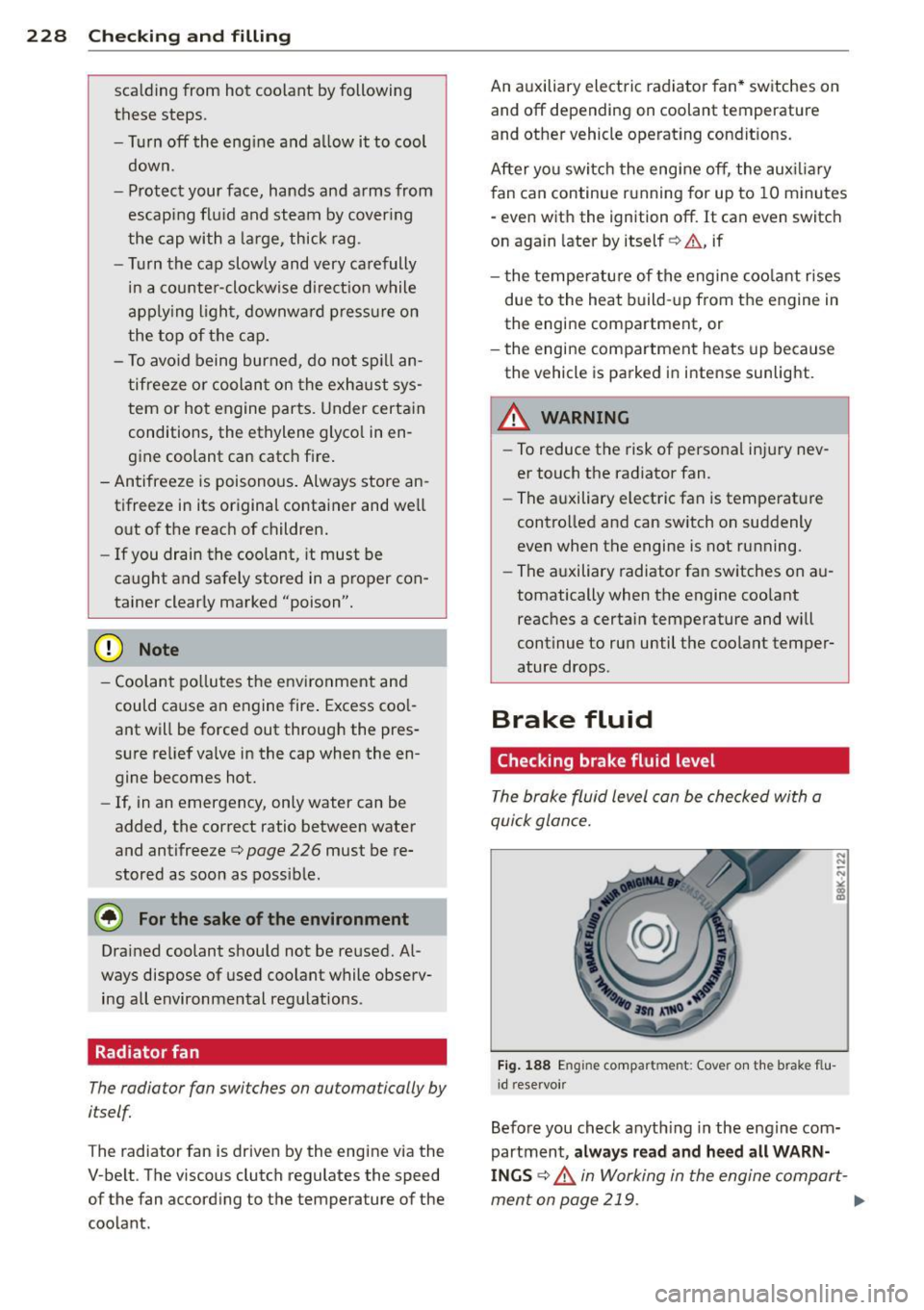
F ig . 1 88 Engin e compart men t: Cover on the b rak e flu
i d reservo ir
Before you check a nyth ing in the engine com
partment,
always read and hee d all WARN
INGS c::> .&. in Working in the engine compart-
ment on page 219 . .,..
Page 231 of 302
~ Read the brake fluid level from the brake
fluid reservoir ~
fig. 188, ¢ page 221,
fig . 184.
T he brake fluid level must be be
tween the "MIN" and "MAX" markings.
The brake f luid reservoir is located at the rear
partition of the engine compartment on the
l eft side
¢ page 221 .
The fluid level may drop slightly after some
time due to the automatic adjustment of the brake pads . This is not cause for alarm .
If the brake fluid level falls considerably be
l ow the "M IN" mark, the bra ke wa rning/ind i
cator light (U .S . mode ls:
1111 , Canadian
models: .) will come on
¢ page 15. Do not
continue to operate the vehicle. The complete
brake system shou ld be thoroughly checked
by an authorized Audi dealer or qualified
workshop and the cause co rrected . If the
b rake fluid level is too low, the b rake wa rn ing/
i nd icator lig ht w ill illuminate . Co ntact an a u
thor ized Audi dealer immediately.
@ Tips
The brake f luid rese rvoir is located unde r
neath the cove r.
Changing brake fluid
Have the brake fluid changed by an experi
enc ed technician .
Brake fluid ab sorbs moisture from the a ir. If
the water content in the brake fluid is too
hi gh, corrosion in the b rake system may result
after a per iod of t ime . The bo iling po int of t he
b ra ke fluid w ill also decrease con siderab ly and
d ec rease brak ing per forman ce.
Therefore, the brake flu id must be changed
every two year s. Always use new b ra ke fluid
which confo rms to Fede ral Motor Vehicle
S tand ard "FMVSS 1 16 DOT 4".
The brake flu id rese rvoir can be difficult to
r eac h, therefo re , we recommend that yo u
have the brake fl uid changed by yo ur aut ho r
iz ed Audi dealer. Your dealer has the correc t
Checking and fillin g 229
tools, the right brake fl uid and t he know -how
to do this for you .
A WARNING
- Brake fl uid is poisonous. It must be stor
ed only in the closed or iginal container
out of the reach of children!
- Brake failure can res ult from o ld or inap
propriate brake f lu id. Observe these pre
cautions:
- Use only brake fluid th at mee ts SA E
spe cificat ion
J 17 03 and conforms to
Fe dera l Mo to r Ve hicl e Standard 1 16.
Always check with yo ur autho rized Au di
dealer to make sure yo u are using the
correct brake fluid. The c orrect type of
brake f luid is also ind icated on t he
brake f luid reservoir .
- The bra ke fl uid must be new. Heavy use
of the brakes ca n cause a vapor lock if
the b rake fluid is left i n the system too
long. This can se riously affect the effi
c iency of the b rakes as well as your
safety , T his could result in an accide nt.
(!) Note
Brake fluid will damage the pai nt of your
vehicle.
@) For the sake of the environment
Because of the prob lem of proper disposal
of brake fluid as well as the spec ial too ls
r equired an d th e nec essary exper tise, w e
r ecomme nd that yo u have th e brake flu id
c hanged by yo ur aut ho rize d Aud i dea le r.
Battery
General information
U nder normal operating cond itions, the bat
te ry in your Audi does not need any ma inte
nance . With
high outside temperat ures or
lo ng da ily drives we recommend that you have
t h e e lectrolyte leve l che cked by an autho riz ed
A udi de aler or qu alified workshop. The elec
tro lyte leve l should also be checked e ach time
the battery is charged
¢ page 232 . 1J1>
•
•
Page 232 of 302
230 Check ing and filling
Have the battery checked when you take your
vehicle in for service. You are well advised to replace a battery that is older than 5 years.
W ith certa in types o f airbag deployment, the
battery is disconnected from the vehicle elec
trica l system for safety reasons¢
& in Re
pair, core and disposal of the airbags on
page 159.
Disconn ect ing the battery terminal s
Some vehicle functions (power window regu
lators, for example) are lost if the battery ter
minals are disconnected . These functions have
to be re learned after the battery terminals are
connected again. To prevent this, the battery
should only be disconnected from the vehicle
electrical system when absolutely necessary
for repairs .
Vehicles not dri ven fo r lo ng p eriod s
If you do not drive your vehicle over a period
of several days or weeks, electrical compo
nents are gradually cut back or switched off.
This reduces energy consumption and main
tains starting capabil ity over a longer period
¢ page 192.
Some of the conven ience functions may not
operate, such as the inter ior lights or the
power seat adjustment. The conven ience
functions will be ava ilable again when you
turn on the ignition and start the eng ine.
Winter operati on
During the winter months, battery capacity
tends to decrease as temperatu res drop . This
is because more power is also consumed while
start ing , and the headlights, rea r window de
fogger, etc., are used more often .
Avoid unnecessary power consumption, par
ticularly in c ity traffic or when traveling on ly
short distances. Let you r authorized Audi
dea ler check the capacity of the vehicle bat
tery before winter sets in
¢ page 232. A well
charged batte ry w ill not only prevent sta rting
prob lems when the weather is cold, but wi ll
a lso last longer.
(D Tips
If your vehicle is left standing for seve ral
weeks at extremely low temperatures, the
vehicle battery sho uld be removed and
stored where it w ill not freeze . This will
prevent it from be ing damaged and having
to be replaced .
Working on the battery
Be especially careful when working on or near
the battery.
The battery is located in the luggage compart
ment under the floor. Before you check any
t hi ng in the luggage compartment,
read and
heed all WARNINGS
¢ ,& .
Always heed the safety warnings , when work
ing on the vehicle battery or the vehicle e lec
trical system to prevent injury.
Th e follo wing WARNINGS are very
important when working on the battery :
Al ways heed the follo wing WARNING SYM
BOLS and safety prec aution s when working
on the battery .
® Always wear eye protection .
,0,. Battery acid contains sulfuric acid . Al
~ way s wear glov es and ey e prot ectio n.
~ No
\!SI -sparks
-flames
-smoking.
A Wh en a battery is charged , it produ ce s
~ hydro gen gas which is e xplosi ve and
c o uld cau se pe rson al injur y.
~ Always keep the battery well out of
'if!:11 reach of children .
_& WARNING
Whenever working on the battery or on
the electrical system, there is the risk of
injury, accident and even fire . Read and
heed the following WARNINGS:
-
Page 233 of 302
-Always wear eye protection. Do not let
battery acid or any lead particles get on
your skin or clothing. Shield your eyes .
Explosive gases can cause blindness or
other injury.
- Battery acid contains sulfuric acid . Sulfu
ric acid can cause blindness and severe
burns.
- Always wear gloves and eye protection.
Do not tilt the battery because acid
could leak out of the ventilation open
ings.
- If you get battery acid in your eyes or
on your skin, immediately rinse with
cold water for several minutes and get
medical attention .
- If you should ingest any battery acid,
seek medical attention immediately.
- Do not expose the battery to an open
flame, electric sparks or an open light.
- Do not smoke.
- Do not interchange the positive and neg-
ative cables .
= When working on the battery, be sure
not to short-circuit the terminals with
tools or other metal objects. This would cause the battery to heat up very quickly,
which could lead to damage or explosion and personal injury.
- When a battery is charged, it produces
hydrogen gas which is explosive and
could cause personal injury .
- Always keep the battery well out of the
reach of children.
- Before work is done on the electrical sys
tem, disconnect the negative ground ca ble .
- Before performing any work on the elec
trical system, switch off the engine and
ignition as well as any electrical equip
ment. The negative cable on the battery
must be disconnected . If you are just go
ing to replace a light bulb, then it is
enough to switch off the lights.
- Before disconnecting the battery, switch
off the anti-theft alarm system! Other
wise you will set off the alarm.
Checking and filling 231
-When disconnecting the battery, first
disconnect the negative cable and then
the positive cable.
- Before reconnecting the battery, make
sure all electrical consumers are switch
ed off. Reconnect the positive cable first
and then the negative cable . Never inter
change the cables -this could start a fire!
- Never charge a frozen or a thawed-out
battery . It could explode! If a battery has
frozen , then it must be replaced . A dis
charged battery can freeze over at 32°F
(QOC),
-Make sure the vent hose is always attach
ed to the opening on the side of the bat
tery .
- Never use batteries which are damaged.
There is the danger of an explosion! Al
ways replace a damaged battery.
&_ WARNING
California Proposition 65 Warning:
- Battery posts, terminals and related ac
cessories contain lead and lead com
pounds, chemicals known to the State of
California to cause cancer and reproduc
tive problems. Wash hands after han dling.
(D Note
- Do not disconnect the vehicle battery
when the ignition is switched on or when the engine is running, otherwise, you will
damage electronic components in the
electrical system.
- If your vehicle is going to stand for a
long period of time without being driven,
protect the battery from "freezing", oth
erwise it will be damaged and will then
have to be replaced.
•
•
Page 287 of 302

A
Accessories . . . . . . . . . . . . . . . . . . . . 64, 282
AC (automatic climate control) ... .. .. .. 77
adaptive cruise control
Vehicles with manual transmission .. .
101
Adaptive cruise control ...... .. .. .. .. .. 99
C leaning sensors/camera ... ... .. .. . 205
Messages .. ................ ... ... 107
Request for driver intervention . . . . . . . 105
Setting the driving program .. .. .. .. . 104
Adaptive dampers .......... .. .. .. .. . 113
Adaptive light ................ ... ... . 47
Adaptive Light (defective) ......... .. .. 22
Adding
Engine coolant ........... .. .. .. ...
227
Engine oil .. ................ ... ... 224
Windshield washer fluid ......... .. . 233
Additional accessories
Additives 282
Engine oil .. ............. .... .. .. . 224
Adjustable steering column ... ... .. .. .. 80
Adjusting
Air distribution (automatic climate con-
trol) . . . . . . . . . . . . . . . . . . . . . . . . . . . . . .
78
Instrument illumination ... .. .. .. .. .. 50
Steering column .................... 80
Temperature (automatic climate control) 78
Airbag
Warning/indicator lights ... .. .. .. .. ..
20
Airbag system . . . . . . . . . . . . . . . . . 145, 162
Advanced Airbag System ....... ... .. 149
Advanced Airbag System components . 152
Care ... ... . .... ... ..... ..... .. ... 158
Children . .. ............. .... .. .. . 167
Child restraints ........... .. .. .. ... 168
Components (front airbags) . ... .. .. . 152
Danger of fitting a child safety seat on
the front passenger seat . . . . . . . . . . . .
146
Disposal . .. .. ........... .. .. .. ... 158
Front airbags . . . . . . . . . . . . . . . . 149, 150
How do the front airbags work? . . . . . . 154
How many airbags does my vehicle
have? ... ... ............. ...... ..
152
How the Advanced Airbag System com-
ponents work together .... .. .. .. .. .
153
Important things to know .. .. .. .. .. . 145 Index 285
Indicator light
..... ............... 156
Monitoring . ... .... ............... 156
PASSENGER AIR BAG OFF light ....... 156
Repairs ... .. .. .. ................. 158
Safety instructions ................. 158
Side airbags ..... .. ............... 160
Side curtain airbags .. .... .. .... .... 163
Weight-sensing mat ............... 167
When must the system be inspected? . 156
all-wheel drive .. .. ................. 191
Alloy wheels .. .... .. ............... 208
All wheel drive
Winter tires . .. .. .... ........... ..
250
Alternator
refer to Generator . . . . . . . . . . . . . . . . . . 17
Anti-freeze
refer to Engine coolant system ....... 226
Anti-lock braking system ............. 185
Warning/ind icator lights ........ .. .. . 19
Anti-slip regulation .. ... ....... .... . 185
Anti-theft alarm warning system ........ 32
Anti-theft systems
Electronic immobilizer .............. .
38
Armrest ...... .. .. ................. . 60
Ashtray . . . . . . . . . . . . . . . . . . . . . . . . . . . .
63
Asterisk
What does it mean when something is marked with an asterisk? . . . . . . . . . . . . . .
6
Audi braking guard
refer to braking guard ............. .. 99
Audi drive select ..... ............... 113
Adaptive dampers ................. 113
Description .. .. ...... ............. 113
Dynamic steering . ... ... .... ... .. .. 113
Setting the driving mode ............ 114
Sport differential . .. .. .. ...... .... . 113
Audi Service Repair Manuals and Litera-
ture
280
AUTO Automatic climate control .......... ..
78
Automatic headlights ............... 47
Auto Lock . . . . . . . . . . . . . . . . . . . . . . . . . . 32
Automatic belt retractor ......... .... 140
Automatic car wash
refer to Washing ... .............. . 203
•
•