check engine AUDI S4 2014 User Guide
[x] Cancel search | Manufacturer: AUDI, Model Year: 2014, Model line: S4, Model: AUDI S4 2014Pages: 296, PDF Size: 73.56 MB
Page 36 of 296
34 Openin g and clo sing
keys. Unguarded access to the keys pro
vides children the opportunity to start the engine and/or act ivate vehicle sys
tems such as the power w indows etc . Un
supervised operation of any veh icle sys
tem by ch ildren can res ult in serious in
Jury.
- Do not remove the key from the ignition
lock until the vehicle has come to a com
plete stop. Otherwise the steering col
um n loc k co uld suddenly e ngage -caus
ing the risk of an accident.
@ Tips
- The operation of the remote contro l key
c a n be tempo rarily disrupted by in terfer
ence from tran smi tters in t he v ici nity of
the veh icle work ing in the same frequen
cy ra nge (e.g . a ce ll phone, radio equip
ment).
- Fo r security reasons, replacement keys
are on ly available from author ized Audi
dealer.
- For Decla ration of Compliance to United
States FCC and Industry Canada regu la
tions
c:> page 2 78.
Removing the mechanical key
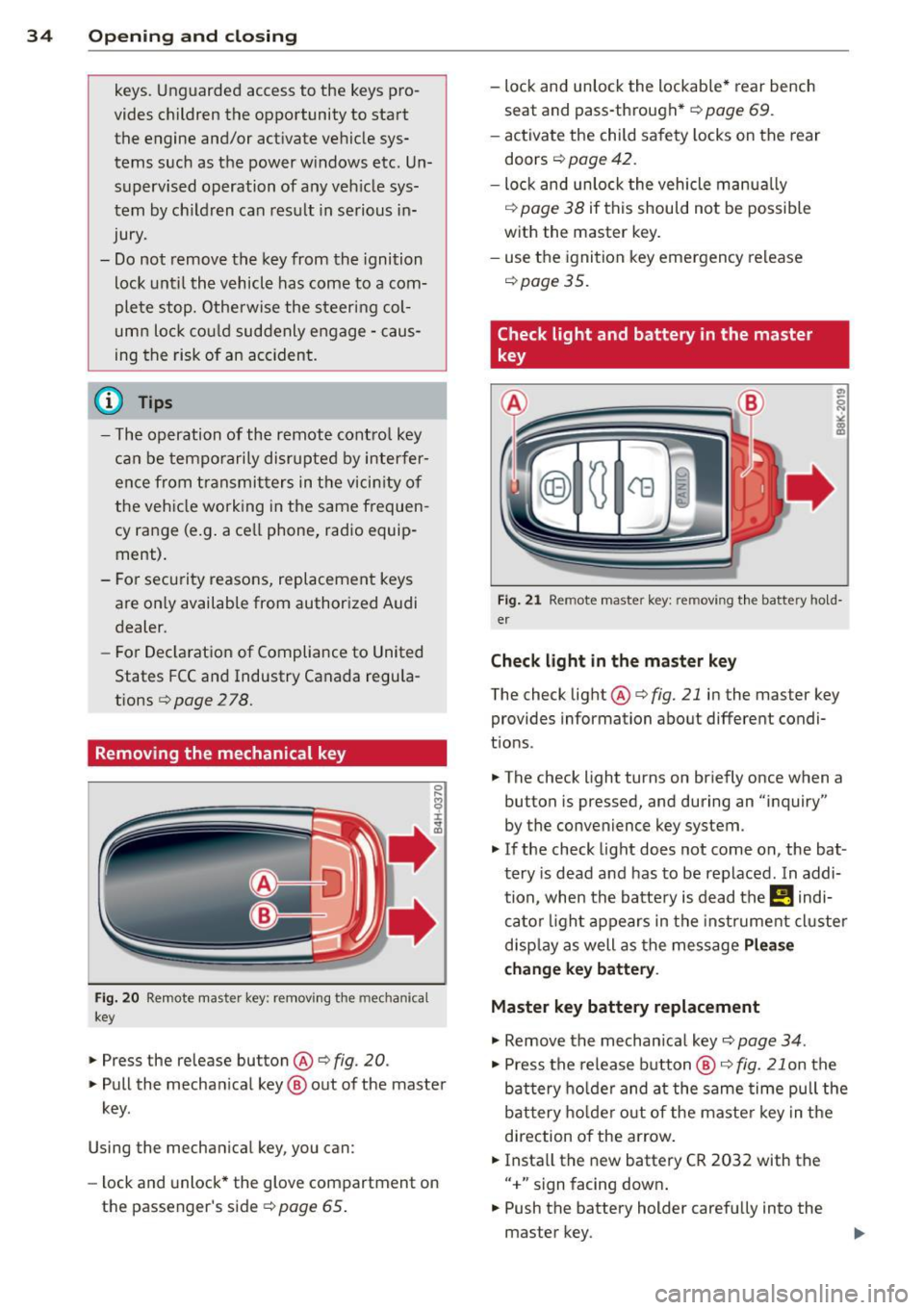
F ig . 20 Remote ma ster key : remov ing the mec hanic al
key
" Press the release button ® c:> fig. 20 .
"Pull the mecha nica l key @out of the maste r
key .
Using the mechan ica l key , you can :
- lock and unlock* the glove compartment on
the passenger's side ¢
page 65.
-lock and unlock the lockable* rear bench
seat and pass-through *
c:> page 69.
- activate the child sa fe ty locks on the rear
doors
c:> page 42 .
-lock and unlo ck the vehicle manu ally
¢
page 38 if this should not be possible
with the master key.
- use the ignition key emergency release
¢ page 35.
Check light and battery in the master
key
Fig . 2 1 Re mote mas te r ke y: r em ov ing th e batte ry hold
e r
Check light in the master key
The check light@¢ fig. 21 in the master key
provides information about different condi
t ions .
" The check light tu rns on br iefly once when a
button is pressed, and during an "inquiry"
by the convenience key system .
" If the check light does not come on, the bat
tery is dead a nd has to be replaced . In addi
tion, when the batte ry is dead
the m indi
ca to r li ght appears in the instr ument cluster
disp lay as well as the message
Plea se
change key battery .
Master key battery replacement
" Remove the mechan ica l key ¢ page 34 .
" Press the release button @ ¢fig. 21 on the
bat tery ho lde r and at the same time pull the
ba ttery holde r o ut o f the maste r key in the
di rection o f the arrow.
" Insta ll the new battery CR 2032 with the
"+ " sign facing down .
... Push the battery holder carefu lly into the
master key .
Page 82 of 296
80 On the road
On the road
Steering
Manually adjustable steering wheel
The steering wheel position is fully adjustable
up and down and forward and bock .
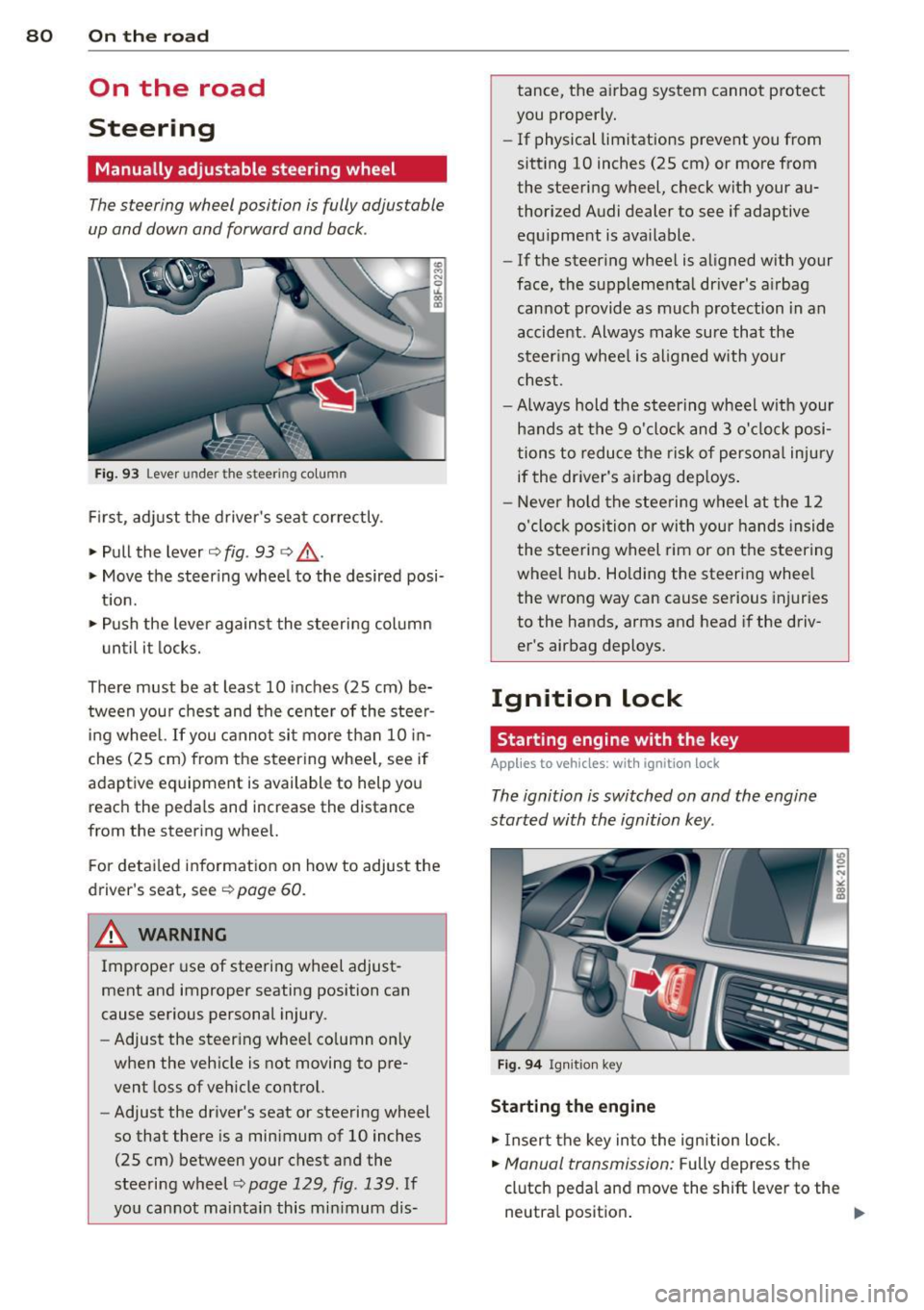
Fig. 93 Lever under the steering column
F irst, adjust the driver's seat correctly .
• Pull the lever
c> fig . 93 <=> &_ .
• Move the steer ing whee l to the desired posi
t ion.
• Push the lever against the steering column
until it locks.
There must be at least 10 inches (25 cm) be
tween you r chest and the center of the steer
i ng wheel. If you cannot sit more than 10 in
ches (25 cm) from the steering whee l, see if
adaptive equipment is available to help you
reach the pedals and increase the distance
from the steering wheel.
F or detai led information on how to adjust the
driver's seat, see
i=> poge 60.
A WARNING
Improper use of steeri ng wheel adjust
ment and improper seating position can
cause serious personal injury.
- Adjust the steering whee l co lumn on ly
when the veh icle is not moving to pre
vent loss of veh icle control.
- Adjust the driver's seat or steering wheel
so that there is a minimum of 10 inches
(25 cm) between your chest and the
steering wheel
c;, page 129, fig . 139. If
yo u cannot mainta in this min imum dis- tance, the airbag system cannot protect
you proper ly.
- If physical limitations prevent you from
sitting 10 inches (25 cm) or more from
the steering wheel, check with your au
thorized Audi dealer to see if adaptive
equ ipment is ava ilable .
- If the steer ing wheel is aligned with your
face, the supplementa l driver's a irbag
cannot provide as much protection in an
accident . Always make sure that the
steer ing wheel is aligned with your
chest.
- Always hold the steering wheel w ith your
hands at the 9 o'clock and 3 o'clock posi
tions to reduce the risk of persona l injury
if the driver's airbag dep loys .
- Never hold the stee ring wheel at the 12
o'clock position or with your hands inside
the steeri ng wheel rim or on the steering
wheel hub . Holding the steering wheel
the wrong way can cause se rious injuries
to the hands, arms and head if the driv
er's airbag deploys.
Ignition lock
Starting engine with the key
Applies to vehicles : w ith ign ition lock
The ignition is switched on and the engine
started with the ignition key .
Fig. 94 Ignit ion key
Sta rting th e engine
• Insert the key into the ignition lock .
• Manual transmission: Fully depress the
clutch pedal and move the shift lever to the
neutra l position .
Page 97 of 296
-Do not ride the brakes or press the brake
pedal too often or too long when driving
down a hill. Constant braking causes the
brakes to overheat and substantially re
duces braking performance, increases
braking distance or causes complete fail
ure of the brake system.
- To prevent the vehicle from rolling back
when stopping on inclines, always hold it
in place with the brake pedal or parking
brake.
- Never hold the vehicle on an incline with
a slipping clutch. The clutch opens auto
matically when it becomes too hot from
the overload. An indicator lamp
mJ illu
minates and a driver message appears
¢ page 9 7 when the clutch is overload
ed .
- If the engine must remain running, never
have any driving position engaged when
checking under the hood. Make sure the
selector lever has securely engaged and
is locked in P with the parking brake set
¢ page 214. Otherwise, any increase in
engine speed may set the vehicle in mo
tion, even with the parking brake ap plied .
0 Note
-S tronic- and tiptronic transmission:
When stopping on an incline, do not try
to hold the vehicle in place by pressing
the accelerator pedal while a driving gear
is selected. This can cause the transmis
sion to overheat and can damage it. Acti
vate the parking brake or press the brake
pedal to prevent the vehicle from rolling.
- S tronic- and tiptronic transmission: Al
lowing the vehicle to roll when the en
gine is stopped and the selector lever is in N will damage the transmission be
cause it is not lubricated under those cir
cumstances .
(D Tips
For safety reasons, the parking brake is re
leased automatically only when the driv
er's safety belt is engaged in the buckle.
Transmission 95
Hill descent control
App lies to vehicles : wi th mult itronic/ S tro nic/tiptro nic
The hill descent control system assists the
driver when driving down declines .
Hill descent control is activated when these
lector lever is in D/S and you press the brake
pedal. The transmission automatically selects
a gear that is suitable for the incline. Hill de scent control tries to maintain the speed ach
ieved at the time of braking, within physical
and technical limitations. It may still be nec
essary to adjust the speed with the brakes.
Hill descent control switches off once the de
cline levels out or you press the accelerator
pedal.
On vehicles with the cruise control system*
¢ page 89 , hill descent control is also activat
ed when the speed is set.
.&_ WARNING
-
Hill descent control cannot overcome
physical limitations, so it may not be able
to maintain a constant speed under all
conditions. Always be ready to apply the brakes .
Page 109 of 296
Audi adaptive cruise control and braking guard 107
-If you restrict or switch off the ESC, the
braking guard also switches itself off
¢page 188.
- Switch braking guard off when you are
loading the vehicle onto a vehicle carrier,
tra in, ship or other type of transporta
tion. This can prevent undesired warn i ngs from the braking guard system.
Messages
App lies to vehicles: with Audi adaptive cruise co ntrol
Braking guard: Off
This driver message appears if the system is
turned off via the radio/MM!*. Otherwise, if
the system is turned off, the information ap pears every time shortly after the start of the
tr ip.
The driver message also appears if the system is not avai lab le due to a malfunction or if the
ESC is not switched on¢
page 188. If this is
the case, the system will not provide warnings
about a possible collision.
Braking guard: Activated
This driver message appears if sharp brake
press ure was applied due to an acute warning.
•••
Three wh ite dots appear if a setting cannot be
selected with the operat ing lever . For exam
p le , this happens if you want to raise/lower
the speed even though there was no previous
l y saved speed .
ACC: Deactivation
The driver message appears in vehicles with
manual transmission . If the clutch pedal was
pressed down for too long, the adaptive cruise
control turns off . A chime sounds as a rem ind
er .
ACC: Sensor blocked
This message appears if the sensor view is ob
structed, for example by leaves, snow, heavy
spray or dirt. Clean the sensor <=>
page 99,
fig. 110.
ACC: not available
The driver message appears if there is a mal
function . The adaptive cruise contro l turns off .
A chime sounds as a reminder. Have the sys
tem checked by an authori zed Aud i dea ler or
authorized Aud i Service Fac ility.
ACC: unavailable
The driver message appears if, for example,
the brake temperat ure is too high. The adap
tive cruise control is temporarily unavailable .
A chime sounds as a reminder.
Engine speed!
This driver message appears in vehicles with
manua l transmission if the driver had not up
shifted or downs hifted in time while using
adaptive cruise control braking or accelerat
ing, caus ing the vehicle to exceed or no t reach
the permitted limit speed. The adaptive cruise
control turns off. A chime sounds as a remind
er .
Shift lever position!
Vehicles with an automat ic transmission: the
driver message appears if the selecto r lever is
shifted to the N position. Th e adaptive cruise
control is no t available while in this position.
Vehicles with manua l transm ission: the driver
message appears for vehicles with manual
transmission if there is no forward gear en
gaged, meaning if the reverse gear or the 1st
gear is engaged or if the selector leve r is in
the neutral position . The adaptive cr uise con
trol is not available while in th is position.
Stabilization control (ESC)
This message appears if the electronic stabili
z ation control ( ESC) is taking action to stab i
lize the vehicle. The adaptive cruise contro l
turns off. A chime sounds as a reminder .
Speed too low
This message appears if the current speed is
too low
to set or to maintain the desired
speed .
The speed be ing saved must be at least
20 mph (30 km/h). The cruise control is
turned off for speeds lower than 12 mph
Page 126 of 296
124 Homelin k
Homelink
Universal remote
control
Description
Appl ies to vehicles: wit h Homeli nk
The HomeLink universal remote control can
be programmed with the remote control for
devices that are already present.
W ith Home Link, you can control devices such
as the garage door, security systems, house lights, etc. comfortably from the inside of you
vehicle.
Homelink makes it possible for you to replace
three d ifferent remote controls from dev ices
in your home with one universal remote. This
feature works for most garage door and exte
rior door motor signals. Programming the in
div idual remote control for your remote con
trol takes place near the center of the radiator
grille. There is a control module attached at
this location .
A one -time programm ing of the sensor must
be performed before you are able to use sys
tems with Home link. If the system does not
activate after performing the one-time pro
gramm ing, check whether the system uses a
rolling code
q page 127 for vehicles without
the MMI*.
& WARNING
-
- Never use the Homelink transmitter
with any garage door opener that does
have not the safety stop and reverse fea
ture as required by federa l safety stand
ards. This includes any garage door open
er model manufactured before April 1,
1982.
- A garage door opener which cannot de
tect an object, signaling the door to stop
and reverse does not meet current feder
al safety standards. Using a garage door
opener without these features increases
risk of serious injury or death. -
For safety reasons never release the
parking brake or start the engine while
anyone is standing in front of the vehicle.
- A garage door or an estate gate may
sometimes be set in motion when the
Homelink remote control is being pro
grammed. If the device is repeatedly ac
tivated, this can overstrain motor and
damage its e lectrica l components - an
overheated mo tor is a fire hazard!
- To avo id possib le injuries or property
damage, please always make abso lutely
certain that no persons or objects are lo
cated in the range of motion of any
equipment being operated.
{D Tips
- If you would li ke more information on
Homel ink, where to purchase the Home
Link compat ible prod ucts, or wou ld like
to purchase the Homelink Home Light
ing Package, please call toll-free:
1-800-355-3515.
- For Declaration of Compliance to United
States FCC and Industry Canada regula
tions
¢ page 2 78.
- For security reasons, we recommend that
you clear the programmed buttons be
fore selling the vehicle.
Operation
Applies to veh icles : w it h Ho meli nk
~ ,.......,,...--, ........... ~
,;,,, r . o : o . ) .~
®
Fig. 136 Headl iner: controls
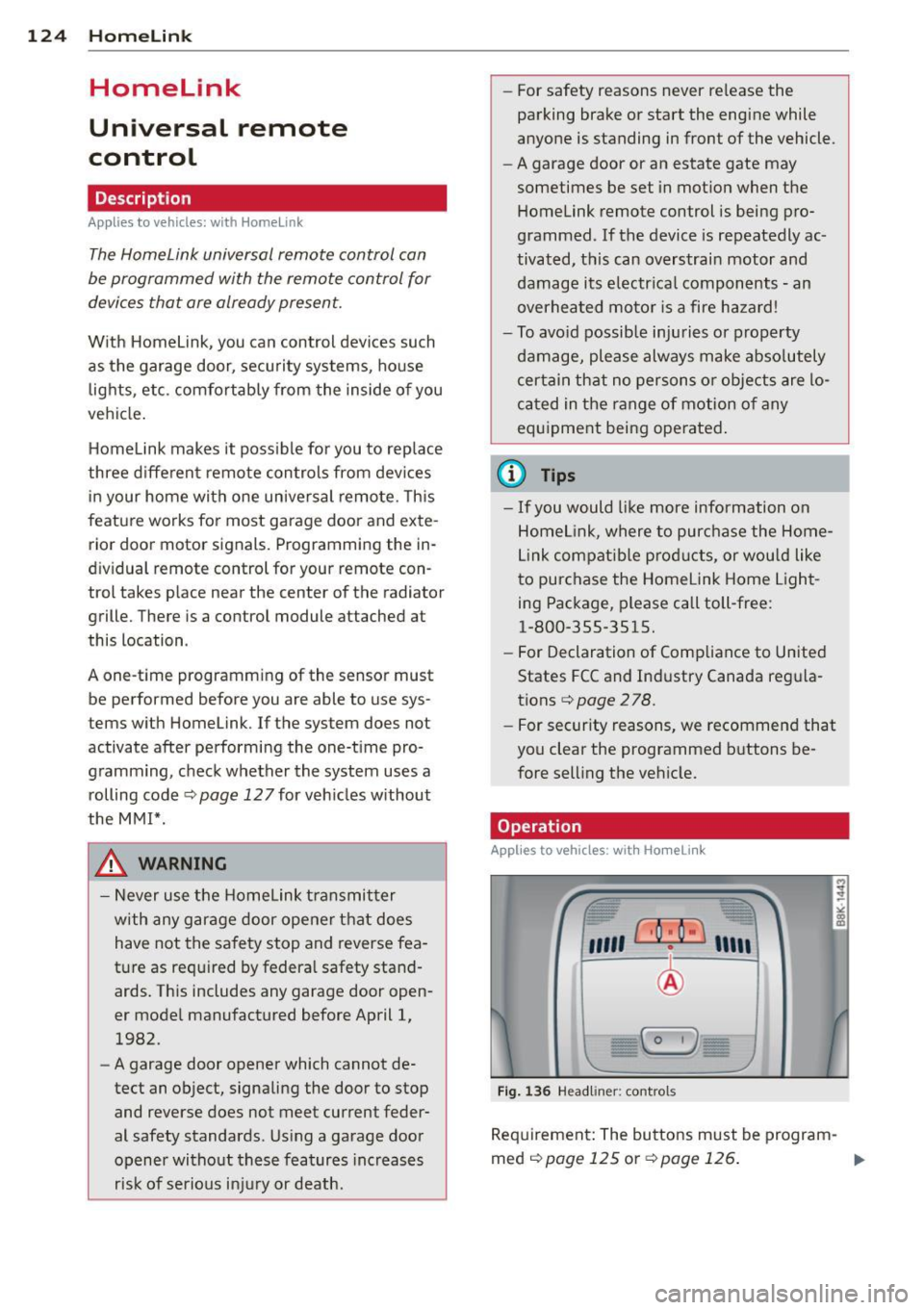
Requirement : The buttons must be program-
med
¢ page 125 or ¢page 126. II>
Page 192 of 296
190 Intelligent technology
Operating conditions and d riving hab it s
The brakes on today 's automob iles are st ill
subject to wear, depending largely on operat
ing conditions and driving habits
c::> ,& . On
vehicles that are either driven mostly in stop
and-go city traffic or are driven hard, the
brake pads should be checked by your author
ized Audi dealer more often than specified in
the
W arranty & M ainte nance booklet . Failure
to have your brake pads inspected can result
in reduced b rake pe rformance.
On steep slopes, you should use the brak ing
effect of the eng ine . This way, you prevent un
necessa ry wear on the brake system. If you
must use you r brakes, do not hold the brakes
down continuously . P u mp the b rakes at inter
va ls.
Operating nois e
Noises may occur when braking depending on
the speed, braking force and outside condi
tions such as temperature and humidity .
Effect of w ater and ro ad sa lt
In certain situat ions, for example after driving
through wate r, in heavy ra in, after overn ight
condensation or after washing your car, the brak ing effect can be reduced by moistu re or
i ce on the bra ke roto rs and b rake pads . The
b rakes must be dried fi rst with a few ca ref ul
brake app lications .
At h igher speeds and with the w indshie ld w ip
e rs turned on, the brake pads press agains t
the bra ke rotors for a short amount of time.
This occurs a t regular intervals without the
driver noticing and provides for better brake response time under wet conditions.
The effectiveness of the brakes can be reduced
when the vehicle is driven on a salt-covered
road and the brakes are not used. Likewise,
you clean off accumulated sa lt coating from
brake discs and pads with a few caut ious ap
plications of the brake
c::> ,& .
Cor rosion
There may be a tendency for dirt to bui ld up
on the brake pads and corrosion to form on the d
iscs if the car is not driven regu larly or
o n Ly for short trips with litt le use of the
brakes.
If t he brakes a re not used frequently, o r if cor
r os ion has formed on the discs, it is adv isable
to clean off the pads and discs by braking
firmly a few times from a moderately h igh
speed
c::> .&. .
Fault s in the brak e syst em
If you shou ld notice a sudden increase in
brake pedal trave l, then one of the two brake
circuits may have fai led
c::> .& .
Low br ake fluid lev el
Malfunctions ca n occu r in the b ra ke system if
t h e b rake fluid level is too low. The brake flu id
l evel is monitored electronica lly.
Brake booster
The brake booster inc reases the pressure that
you generate with the b rake peda l. It works
o n ly when the engine is runn ing
.c::> .&
Brake lining wear status
Brake lining wear may be checked by visual in
spect io n of the condition of the brake pads
th rough the open ings in the wheel. If neces
sary, the wheel may be removed fo r thi s i n
spe ct ion
c::> page 255, Changing a wheel.
.&, WARNING
- New b rake pads don' t have the bes t stop
ping power and m ust be "bro ken -in" dur
ing the initial 100 to 150 miles (150 to
200 kilometers) of normal c ity driving.
You can compensate for this by pressing the brake pedal more firmly. Th is also
applies later when new pads are instal
led.
- You shou ld perform braking maneuvers
for the purpose of cleaning the brake
system only if road conditions permit.
Othe r road use rs must no t be put at risk -
you may ca use an accident!
- Before descend ing a steep grade, reduce
speed and sh ift transmission into a lower
gear or lower dr iving range. Do not ride
~
Page 198 of 296
196 Driving and en vironm ent
8_ WARNING
After driving through water, mud, slush,
etc ., the brakes may be slow to take effect
because of wet brake rotors and pads . Dry
the brakes first by braking carefully to re
store the full braking effect.
(D Note
Vehicle components such as the engine,
transmiss ion, suspension or electrical sys
tem can be severely damaged by driving
through wate r.
@ Tips
- Check the depth of the water before dr iv
i ng through it .
- Do not stop the veh icle, dr ive in reverse
or switc h the engine off when driving
t hr ough water .
- Keep in mind that oncoming vehicles
may c reate waves that raise the water
l evel and make it too deep fo r you r vehi
cle to dr ive through safely.
-
- Avoid dr iving thro ugh salt water because
i t can ca use corrosion.
Catalytic converter
It is very important that your emission con
trol system (catalytic conv ert er) is function
ing properly to ensure that your vehicle is run
ning in on env ironm entally sound manner.
,,. Always use lead-free gaso line Q page 209,
Fuel supply .
,,. Never run the tank down a ll th e way to emp
ty.
,,. Never put too much moto r oil in your engine
Q page 219, "t':::r. Adding engine oil .
,,. Never try to push -or tow -start your ve hicle .
T he cata lytic converter is an eff ic ient "clean
up" device built in to the exhaust system of
the vehicle . The catalytic converter burns
many of the polluta nts in the exhaust gas be
fore they are released into the atmosphe re . The exclus
ive use of unleaded f uel is critica lly
important for the life of the catalytic conv ert
er and p roper funct ion ing of the eng ine .
A WARNING
=
-The temperature of the exhaust system
is high, both when driving and after stop
p ing the eng ine .
- Never touch the exhaust tail pipes once
they have become hot. This could result
in burns.
- Do not park or operate the vehicle i n
areas where the hot exhaust system may
come in co ntact with dry grass, brush,
fue l spill or other material wh ich can
cause a fire .
- Do not app ly additional undercoating or
r u stp roofing on or nea r the exhaust
manifold, exhaust pipes, cataly tic con
ver ter or he at s hields. Dur ing driv ing, the
substance used fo r undercoating could
overheat and cause a fire.
CI) Note
- Be aware tha t just o ne tank filling with
leaded fu el w ill alre ady ser io usly de
grade the performance of the cata lytic
converter .
- Do not exceed the cor rect engine oil level
Q poge 219.
-Do not drive until the fuel t ank becomes
comple tely empty . The engine cou ld mis
fire . Unburned fuel could also get into
the exhaust system and th is co uld cause
the catalytic converter to overheat.
- Do not turn off the ignition while the ve
hicle is mov ing.
- Do not contin ue to ope rate your veh icle
under these conditions, as otherwise fuel
can reach the catalyt ic converter. Th is
co uld result in overheating of the con
verter, requir ing its replacement.
- To assure efficient operation of the Emis -
sion Control System: .,..
Page 200 of 296
198 Driving and en vironm ent
Reducing unnecessary idling
Even when your car is just idling it burns up
fuel .
.,. Shut the engine off when you are not dr iving
the vehicle.
.,. Do not warm up the vehicle by letting the
engine run at idle .
It makes sense to shut
off the engine in traffic
jams, when waiting for trains to pass at ra il
road crossings, or at traff ic lights that have
l ong wa its on red . Turning the engine
off fo r
just 30-40 seconds saves more fue l than is
burned s tarti ng the eng ine again .
It takes a long time for the engine to warm up
fu lly when it is running at idle . Howeve r, wear
and nox ious em issions are especially high
when the engine is warming up. So you should
drive away as soon as you start the engine and
avoid running at high rpms while the engine is
still warming up .
(D Note
Do not leave engine idling unattended af
ter starting . If warning lights shou ld come
on to indicate improper operation, they
wou ld go unheeded. Extended idling also
produces heat, which cou ld result in over
heating or other damage to the vehicle or
other property .
Regular maintenance
A badly tuned engine unnecessarily wastes a
lot of fuel .
... Have your vehicle serviced at regular inter-
vals.
By having your vehicle regularly serviced by an
authorized Audi dealer he lps to ensure that it
runs properly and economically . The condition
of your vehicle not only affects its safety and
ab ility to hold its value, it also affects
fuel
consumpt ion .
Check you r oil ea ch time you fill you r tank.
The amount o f oi l used is re lated to engine
load and speed.
It i s normal fo r the oil consump tion of a new
engine to reach its lowest value after a certa in
mileage has been d riven.
You must drive your veh icle about 3,000 m iles
(S,000 kilometers) before you can properly
assess oil consumpt ion.
T his also app lies to fue l consumption and en
gine o utput.
(D Note
- Have your veh icle ma inta ined properly
and in acco rdance with the service rec
ommendations in your Wa rranty
& Main
t enance boo klet . Lack of p roper ma inte
nance as well as improper use of the ve
hicle will impair the function of the
emission contro l system and cou ld lead
to damage.
- Do not alter or remove any component of
the Emission Control System unless ap
proved by the manufacturer.
-Do not alter or remove any device, such
as heat sh ie lds, switches, ign it ion w ires,
valves, which are designed to protect
your vehicle's Emission Control System and other important vehicle compo
nents.
Fewer short trips
Fuel consumption will always be relatively
high on short trips .
.,. Try to avoid dr iv ing short distances w ith a
cold engine .
T he engine and cata lytic converter have to
reach their opt imal
operat ing temperature to
reduce fuel consumpt ion and nox ious emis
s ions effectively .
Just after starting, a co ld eng ine in a mid-s ize
car only achieves a fuel economy of 6-8 m iles
per gallon (30-40 l/100 km). After about a
half a mile, fuel economy cl imbs to 12 mpg
(20 l/100 km) . After about
2 .5 miles (4 km), ll>
Page 203 of 296
Trailer towing Driving with a trailer
General information
Your Audi was designed primarily for passen
ger transportation .
If you plan to tow a tra iler, p lease remember
that the addit ional load will affect durab ility,
economy and performance .
T railer towing not on ly places more stress on
the vehicle, it also calls for more concentra
tion from the driver.
F or this reason, a lways fo llow the operating
and driving instructions provided and use
common sense.
Technical requirements
Traile r hitch
Use a weight-carrying hitch conforming to the
gross trailer we ight. The hitch must be suita
b le for your veh icle and trailer and must be
mounted secure ly on t he veh icle's chassis at a
technically sound location . Use only a t railer
h itch w ith a removab le ball moun t. A lways
check with the tr ailer hitch man ufac tur er to
make sure that you are using the correct
hitch.
Do not use a bumper hitch.
T he hitc h must be installed in such a way that
it does not inte rfe re with the impac t-absorb
i ng b umper syst em. No modifica tions should
be made to the vehicle exhaus t and b rake sys
tems . From t ime to time, check that a ll hitch
mo unt ing bolt s remain securely fas tened.
W hen you are not tow ing a trailer, remove the
trai le r hi tch ball moun t. T h is prevents the
hi tch from causing damage sho uld your ve hi
cle be str uck from be hind
¢ &. .
Trailer brakes
If yo ur tra iler is equ ipped w it h a braking sys
tem, check to be su re that it conforms to a ll
r eg ulat io ns.
Trailer towin g 201
The trailer hyd ra ulic bra ke system must not be
direct ly connected to the vehicle's hydraulic
brake system
¢ &. .
Safety chains
Alw ays use s afety chains between your ve hicle
and t he tra ile r.
Trailer lights
Tra ile r lights m ust meet all reg ulations . Be
su re to check w ith your authorized Audi dealer
fo r c orrec t w iri ng, sw itches, and relays.
Mirrors
If you a re unable to see the traffic behind you
u sing the regula r outside m irrors, then you
must insta ll ext ended mir ro rs. It is important
t h at you
always have clea r vis io n to the rear .
.8, WARNING
- If a trai ler has elec trica l br ake s plea se
no te th at t hese bra kes are not activat ed
by the fa ctory -fit ted control unit -risk of
accident!
- After removing the t railer hi tch, do no t
s to re it in yo ur vehicle . In case of sudden
brak ing, the hitch could fly fo rward and
in ju re you or yo ur passenge rs .
Operating instructions
Maximum traile r we ight
-
A trai ler fo r you r vehicle is limited to a typical
class 1 or class 2 tra iler.
Trailer load distribution
B e sure the lo ad in the tra iler is h eld secure ly
i n p lace to p reven t it from shifting fo rward,
backward or sideways.
Never allow a passenger to ride in a trailer
¢ &. in Driving instru ctions on page 20 2.
Engine cooling system
Towing a t railer ma kes t he engine wor k hard
er . It is impo rta nt that the cooling system's
perfo rman ce is up to the additional load.
Make sure tha t the coo ling sys tem h as enough
f lu id . .,..
•
•
Page 204 of 296
202 Trailer towing
Tire pressure
When towing a trailer, inflate the tires of your
vehicle to the cold tire pressure listed under
"Full load" on the label located on the driver's
side B-pillar (visible when the door is open).
Inflate trailer tires to trailer and tire manufac
turers' specifications.
Lights
The headlight settings should be checked with
the trailer attached before driving off. Check
to make sure both vehicle and trailer lights
are working properly.
Safety chains
Be sure trailer safety chains are properly con
nected from the trailer to the hitch on the ve
hicle. Leave enough slack in the chains to per
mit turning corners. When you install safety
chains, make sure they will not drag on the road when you are driving.
The chains should cross under the trailer
tongue to prevent it from dropping in case of
separation from the hitch.
Driving instructions
Driving with a trailer always requires extra
care and consideration.
To obtain the best possible handling of vehicle
and trailer, please note the following:
.,. Do not tow a loaded trailer when your car it
self is not loaded.
.,. Be especially careful when passing other
vehicles.
.,. Observe speed limits .
.,. Do not drive at the maximum permissible
speed.
.,. Always apply brakes early.
.,. Monitor the temperature gauge.
Weight distribution
Towing a loaded trailer with an empty car re
sults in a highly unstable distribution of
weight . If this cannot be avoided, drive at very
low speeds only to avoid the risk of losing
steering control. A "balanced" rig is easier
to operate and con
trol. This means that the tow vehicle should be loaded to the extent possible and permissi
ble, while keeping the trailer as light as possi
ble under the circumstances. Whenever possi
ble, transfer some cargo to the luggage com
partment of the tow vehicle while observing
tongue load requirements and vehicle loading
considerations.
Speed
The higher the speed, the more difficult it be
comes for the driver to control the rig. Do not
drive at the maximum permissible speed. Re
duce your speed even more if load, weather or
wind conditions are unfavorable -particularly
when going downhill.
Reduce vehicle speed
immediately if the trail
er shows the slightest sign of swaying .
Do not
try to stop the swaying by accelerating.
Observe speed limits. In some areas, speeds
for vehicles towing trailers are lower than for
regular vehicles .
Always apply brakes early. When driving downhill, shift into a lower gear to use the en
gine braking effect to slow the vehicle . Use of
the brakes alone can cause them to overheat
and fail.
Coolant temperature
The coolant temperature gauge c> page 10
must be observed carefully . If the needle
moves close to the upper end of the scale, re
duce speed immediately and/or turn off the
air conditioner.
If the coolant temperature warning light •
in the instrument cluster starts flashing, pull
off the road, stop and let the engine
idle for
about two minutes to prevent heat build-up .
_& WARNING
Anyone not properly restrained in a mov
ing vehicle is at a much greater risk in an
accident. Never let anyone ride in your car
who is not properly wearing the restraints
provided by Audi.
-