instrument panel AUDI S4 2014 User Guide
[x] Cancel search | Manufacturer: AUDI, Model Year: 2014, Model line: S4, Model: AUDI S4 2014Pages: 296, PDF Size: 73.56 MB
Page 153 of 296
old chi ld is on the front passenger seat
and the other cond itions for airbag de
ployment are met.
- Accident statistics have shown that chil
dren are generally safer in the rear seat
area than in the front seating posit ion.
- For their own safety, all children, espe cially 12 years and younger, should al
ways ride in the back properly restrained
for their age and size .
Advanced front airbag system
Your vehicle is equipped w ith a front Advanced
Airbag System in compliance with Un ited
States Federal Motor Vehicle Safety Standard
208 as app licable at the time yo ur vehicle was
manufactured .
The front Advanced Airbag System supple ments the safety belts to provide add it io na l
protection fo r the d river's and fron t passeng
e r' s heads and upper bodies in fronta l crashes.
The airbags inflate only in frontal impacts
when th e vehicle dece le rat ion is high enough .
The front Advanced Airbag Sys tem for the
front seat occupants is not a substit ute for
your safety belts. Rather, it is part of the over
all occupant restraint system in your vehicle.
A lways remember that the ai rbag system can
only help to protect you, if you are sitting up
right, wearing you r safety belt and wearing it
properly . This is why you and you r passengers
must always be properly restrained, not just
because the law requires you to be.
T he Advanced Airbag System in your veh icle
has been cert ified to meet the "low risk " re
qu irements for 3 and 6 year-o ld children on
the passenge r side and very small adu lts on
the dr iver side . The low risk dep loymen t crite
ria are intended to he lp red uce the risk of i n
jury through interaction with the front airbag
that can occ ur, for example , by being too
close to the steer ing whee l and instrument
panel when the airbag inflates.
I n addition, the system has been certif ied to
comp ly with the "suppression" requirements
A irbag system 15 1
of the Safe ty Standa rd, to turn off the front
airbag for infants 12 months old and younger
who are restrained on the front passenger
seat in child restraints that are listed in the Standa rd
¢ page 169 , Child restraints and
Advanced Airbags .
"Suppression" requires the front a irbag on the
passenger side to be turned off if:
- a child up to abo ut one year o f age is re
strained on the front passenger seat i n one
of the rear-fac ing or forward-facing infant
restraints listed in Federal Motor Vehicle
Safety Standard 208 with which the Ad
vanced Airbag System in your ve hicle was
cert ified . Fo r a listing o f the child restraints
that were used to certify your vehicle's com plia nce w ith the US Safety Standa rd
¢ page 169,
-weight less than a thres ho ld level stored in
t he control uni t is de te cted on the fron t pas
senge r seat.
When a person is detected on the front pas
senger seat, weighing more than the total
weight of a ch ild tha t is abou t 1 year old re
stra ined in one of the rear -faci ng or forward
f acing infa nt res traints ( listed in Fede ral Mo
tor Vehicle Safety Standard 208 w it h which
the Advanced Airbag System in yo ur vehicle
was certified), the front airbag on the passen ger side may or may not deploy.
The
PASSENGER AIR BAG OFF light comes on
when the elect ronic contro l unit detects a to
ta l we ight on the front passenger seat that re
quires the front airbag to be tu rned off. If the
PASSENGER AIR BAG OFF light does not
come on, the front ai rbag on the passenger
s ide has not been turned off by the cont ro l
unit and ca n dep loy if t he control un it senses
an impact that meets the cond itions stored i n
its memory.
If the total weig ht on the front passenge r
seat is more than that of a typical 1 yea r-o ld ,
bu t less than the we igh t of a small ad ult, t he
fron t airbag on the passenger side may dep loy
(the
PASSENGER AIR BAG OFF light does not
come on). ..,. •
•
Page 154 of 296
152 Airbag sys te m
For exa mpl e, the air b ag ma y depl oy if:
- a small child that is heavier than a typical 1
year-o ld child is on the front passenger seat
(regardless of whe ther the child is in one of
the chi ld safety seats listed
¢ page 169),
-a ch ild who has outgrown child rest raints is
on the front passenger seat.
If the front passenger airbag is turned off, the
PA SSENGER AIR BAG OFF light in the cente r
of the instrument panel w ill come on and stay
on.
The front a irbag on the passenger side may
not deploy (the PAS SENGER AIR BAG OFF
light does not illuminate and stay lit) if:
- a small adult or teenager is on the front pas
senger seat
- a passenger who is not sitt ing upright wit h
their back against a non-reclined backrest
with their feet on the veh icle floo r in front
of the seat is on the front passenger seat.
If the front passenger airbag deploys, the Federal Standard requires the airbag to meet
the "low risk" deployment criteria to help re
d uce the risk of inju ry through interaction
with the airbag. " Low risk" deployment occurs
in those crashes that take place at lower de
celerations as defined in the e lectronic control
un it.
¢ page 156
Alw ays remember : Even though you r vehicle
is equipped with Advanced Airbags, the safest
p lace for children is properly restrained on the
back seat . Please be sure to read the impor
tant information in the sect ions that follow
and be sure to heed all of the WARNINGS.
A WARNING
To reduce the risk of injury when an airbag
inf lates, always wear safety belts properly.
- If you are unrestrained, lean ing forward,
sitting sideways or out of position in any
way, your risk of in jury is much higher.
- You w ill also receive serious injuries and
cou ld even be killed if you are up against
the a irbag or too close to it when it in- f
lates - even with an Advanced A irbag
¢page 146.
A WARNING
-A child in a rearward-fac ing ch ild safety
seat installed on the front passenger seat
will be serious ly injured and can be killed if
the front airbag inflates - even with an Ad
vanced A irbag System.
- Although the Advanced Airbag System in your veh icle is designed to turn off the
front airbag when a rearward-facing child restraint has been instal led on the
front passenger seat, nobody can abso
lutely g uarantee that dep loyment is im
possible in all conceivable situations that
may happen during the usefu l life of your
veh icle.
- The inflating airbag will hit the child
safety seat or infant carrier with great
force and will smash the child safety seat
and child aga inst the backrest, center
armrest, door, or roof.
-Always install rearward -facing ch ild re
straints in the back seat.
- If you must install a rearward fac ing
child safety seat on the front passenger
seat because of exceptiona l circumstan
ces and the
PASSENGER AIR BAG OFF
light does not come on and stay on, im
mediately insta ll th e rear-fac ing ch ild
safety seat in a rear seating position and
have the airbag system inspected by your
authorized Audi dealer .
A WARNING
If, in exceptional circumstances, you m ust
insta ll a forward -facing child restraint on
the front passenger's seat:
- Always make sure the forward-facing
seat has been designed and certified by
its manufacturer for use on a front seat
with a passenger front and s ide a irbag.
- Never p ut the forward-facing child re
straint up against or very near the instru- ment panel.
~
Page 155 of 296
-Always move the passenger seat into its
rearmost position in the seat's fore and
aft adjustment range, as far away from
the a irbag as poss ible, before insta lling
the forward-facing child restraint. The backrest must be adjusted to an upr ight
posit ion.
- Make sure that the
PASSENGER AIR BAG
OFF
light comes on and stays on all the
t ime w henever the ignition is sw itched
o n.
Advanced Airbag System components
The fron t passenger seat in your vehicle has a
lot of very important parts of the Advanced
Airbag System in it. These parts include the
weight-sens ing mat, sensors, wiring, brack
ets, and more. The function of the system in
the front passenger seat is checked by the
e lectronic control u nit when the ignit ion is on .
The control un it mon itors the Advanced Air
bag System and turns the airbag indicator
l ight on whe n a ma lfunction in t he sys tem
components is de tected. The function of the
airbag indicator light is described in greater
detai l below . Because the front passenger
seat contains important parts of the Ad
vanced A irbag System, you m ust take care to
prevent it from being damaged. Damage to
the seat may prevent the Advanced Airbag for
the front passenger seat from doing its job in
a crash .
The front Advanced Airb ag Sy stem
consists of the following:
- Crash sensors in the front of the veh icle that
measure veh icle acceleration/decele ration
to provide information to the Advanced Air
bag System about the seve rity of the crash.
- An electronic co ntrol unit, with integrated
c rash se nsors for front and side impacts .
T he cont ro l unit " decides " whethe r to fire
the front airbags based on the inform ation
received from the crash senso rs . The contro l
unit a lso "decides" whether the safety belt
pretensioners should be activated .
Airbag system 153
-An Advanced A irbag w ith gas gene rator and
contro l valve fo r the driver ins ide the steer
ing wheel h ub.
- An Advanced Airbag w ith gas gene rator and
contro l valve inside the instrument pane l for
the front passenger.
- A weight-sensing mat under the upholstery
padding of the front passenger seat cushion
that measures the total weight on the seat.
The informat ion reg istered is sent continu
ously to the electronic control unit to regu
late deployment of the front Advanced Air
bag on the passenger side.
- An airbag monitor ing system and ind icator
light in the instrument cluster
q page 156 .
-A sensor in each front seat registers the dis
tance between the respective seat and the
steer ing whee l o r inst rument panel. The in
forma tion registered is sent cont inuo usly to
t he elect ron ic cont ro l uni t to regula te de
ployment o f the front Advance d Airbags .
- The
PASSENGER AIR BAG OFF ligh t comes
on and st ays on in the cen ter o f th e instr u
ment panel
<:!;> page 157, fig . 156 and tells
you whe n the front Advanced Airbag on the
passenger side has been tu rned
off .
-A sensor below the safety be lt latch fo r the
front seat passenger to measure the tension on the safety be lt . The tension on the safety
be lt and the weight registered by the
weight-sensi ng mat he lp the control unit
"decide" whether the front a irbag for the
front passenge r seat should be turned
off or
not
<=;> pag e 147, Child restraints on the
front seat -some important things to
know.
- A senso r in the safety belt latch fo r the d riv
er a nd fo r the fro nt sea t passenger tha t
senses w hethe r that safe ty belt is latched or
no t and transmi ts this informa tion to the
electronic control unit.
_&. WARNING
Damage to the front passenger seat can
prevent the front airbag from work ing
properly.
-
•
•
Page 158 of 296
156 Airbag sys te m
- Occupants who are unbelted, out of posi
t ion or too close to the airbag can be
seriously injured by an airbag as it un
folds with great force in the blink of an eye
~ page 147 .
A WARNING
-
A child in a rearward-facing child safety
seat installed on the front passenger seat
w ill be seriously injured and can be k illed if
the front a irbag inflates -even with an Ad
vanced Airbag System.
- T he inflating a irbag will hit the child
safety seat or infant carrier with g reat
force and wi ll smash the chi ld safety seat
and child against the backrest , center
armrest, door or roof .
- Always install rear -facing child safety
seats on the rear seat.
- If you must install a rearward facing
child safety seat on the front passenger
seat because of exceptional circ umstan
ces and the
PAS SENG ER A IR BAG OFF
light does not come on and stay on, im ·
med iately install the rear-facing child
safety seat in a rear seating position and
have the a irbag system inspected by your
authorized Audi dealer .
A WARNING
Objects between you and the a irbag will
increase the risk of injury in a crash by in
terfering with the way the airbag unfolds
or by being pushed into you as the a irbag
inflates.
- Never hold th ings in your hands or on
yo ur lap when the vehicle is in use.
- Never transport items on or in the area
of the front passenger seat . Objects
cou ld move into the area of the front air
bags during braking or other s udden ma
neuver and become dangerous projec
t iles that can cause serious personal in
jury if the airbags inflate .
- Never place or attach accessories or oth
er objects (such as cupholders, te le
phone brackets, large, heavy or bu lky ob -
-
jects) on the doors, over or near the area
marked "AIRBAG" on the steer ing whee l,
instrument panel, seat backrests or be
tween those areas and yourself . These
objects could cause inju ry in a crash, es
pecia lly when the airbags inflate .
- Never recline the front passenger's seat to transport objects . Items can a lso
move into the area of the s ide airbag or
the front a irbag du ring bra kin g or in a
sudden maneuver. Objects nea r the air
bags can become projectiles and cause
inj ury, partic ularly when the seat is re
clined .
A WARNING ~
The fine dust created when airbags deploy
can cause breathing prob lems for people
with a history of asthma or other breath i ng cond itions .
- To reduce the risk of breath ing problems,
those with asthma or other respiratory conditions shou ld get fresh air right
away by getting o ut of the veh icle or
open ing windows or doors .
- If you are in a collision in which airbags
deploy, wash your hands and face with
mild soap and wate r before eating.
- Be ca reful not to get the dust into your
eyes, o r into any c uts or sc ratches .
- If the res idue should get into your eyes ,
f lush them w ith wate r.
Monitoring the
Advanced Airbag
System
Airbag monitoring indicator light
T wo separate indicators monitor the function
of the Advanced Airbag System: the airbag
monitoring indicator light and the
PASSEN·
GER AIR BAG OFF
light.
The Advanced A irbag System (including the
electron ic cont ro l unit , sensor circu its and sys
tem wiring) is monitored continuously to make su re that it is funct io ni ng properly
Page 160 of 296
158 Airbag sys te m
make certain that the PA SSENGER AIR BAG
OFF
li ght stays on continuous ly whenever the
ignit ion is on. If the
PASS ENGER AIR BAG
OFF
light does not appear and not stay on all
the time, stop as soon as it is safe to do so
and
- react ivate the system by turning the ignition
off and then turning it on again;
- remove and reinstall the child restraint.
Make sure that the child restraint is properly
installed and that the safety belt for the
front passenger seat has been correctly
routed around the child restraint as descr i
bed in the child restraint manufacturer's in
structions;
- make sure that the convertible locking fea
ture on the safety belt for the front passen
ger seat has been activated and that t he
safety belt has been pulled tight. The belt
must not be loose o r have loops of slack so
that the sensor below the safety be lt latch
on the seat can do its job
c::> page 177 .
-make su re that th ings that may increase the
weight of the chi ld and child safety seat are
not being transported on the front passen
ger seat;
- make sure that the safety be lt tension sen
sor is not b locked. Shake the safety belt
latch on the front passenger seat back and
forth;
- If a strap or tether is being used to tie the child safety seat to the front passenger
seat, make sure that it is not so tight that it
causes the we ight-sensing mat to measure
more we ight than is actua lly on the seat.
If the PASSEN GER AIR BAG OFF light still
doe s not come on
and does not stay on con
tinuously (when the ignition is switched on),
- take the chi ld restraint off the front passen -
ger seat and install it properly at one of the
rear seat pos itions . Have the a irbag system
inspected by your authorized Audi dealer
immediately .
- move the ch ild to a rear seat pos it io n and
make sure that the child is properly restrain
ed in a child restraint that is appropriate for
i ts size and age. The
PA
SSENGER AIR BAG OFF light sho uld
NOT come on when the ignition is on and an
adult is s itting in a proper seating position on
the front passenger seat. If the
PAS SENGER
AIR BAG OFF
light comes on and stays on or
flashes for about 5 seconds wh ile driving, un
der these c ircumstances, make sure that:
- the adult on the front passenger seat is properly seated on the center of the seat
cushion with his or her back up aga inst the
backrest and the backrest is not recl ined
c::> page 129, Proper occupant seating posi
tions,
- the adult is not tak ing weight off the seat by
holding on to the passenger assist handle
above the fron t passenger door or support
ing thei r weig ht on the armrest,
- t he safety belt is being properly wo rn and
t hat there is not a lot o f slack in the safety
be lt webb ing,
- accesso ry seat covers or cushions o r othe r
t hings tha t may c ause an incorrect reading
or impression on the weight-sensing mat
under the upho lstery of the seat have been
removed from the front passenger seat,
- a sa fety belt extender has not bee n left in
the safety belt latch for the front passenger
seat.
In add ition to the
PASSENGER AIR BAG OFF
li ght in the center o f the instrument panel,
t h e message
PASSENGER AIR BAG OFF or
PASSENGER AIR BAG ON wi ll briefly appear
in the instrument cluster disp lay. This is to in
form the dr iver of the current front passenger
airbag status.
Important safety instructions on
monitoring the Advanced Airbag System
A WARNING
An a irbag system that is not functioning
properly cannot provide supplemental pro
tection in a frontal c rash.
- If the airbag ind icator light
c::> page 20
comes when the veh icle is being used,
have the system inspected immediately
by your au thorized A udi dealer .
It is
-
Page 161 of 296
possible that the airbag will inflate when
it is not supposed to, or will not inflate
when it should.
A WARNING
If the front airbag inflates, a ch ild without
a c hild restra int, in a rearward-facing c hild
safety seat or i n a forward-facing child re
st raint that has not been properly insta lled
w ill be seriously injured and can be k illed.
- Even though your veh icle is equipped
with an Advanced Airbag System, make certain that a ll children, especially 12
years and younge r, a lways ride on the
back seat properly restrained fo r their
age and size.
- Always instal l forw ard or rea r-facing
child safety seats on the rear seat -even
with an Advanced Airbag System.
- If you mus t install a rearward -facing
child safety seat on the front passenger
seat because of exceptional circ umstan
ces and the
PASSENGER AIR BAG OFF
light does not appear and stay on, imme
diately install the rear-fac ing ch ild safety
seat in a rear seating position and have
the a irbag system inspected by you r au
tho riz ed Aud i dea le r.
- A tight tether or other strap on a rear
wa rd-fac ing child restra int attached to
the fro nt passenger sea t can put too
much pressure on the weight-sens ing
mat in the seat and register mo re weight
than is ac tually on the seat. The heavier
weight registe red can make the system
wor k as though an adu lt were on the seat
and dep loy the Advanced Airbag when it
must be suppressed caus ing serious or
even fatal injury to the child .
- If, in exceptional circumstances, you
must install a forward-facing child re
st rain t on the front passenger seat, a l
ways move the seat into its rearmost po
sit ion in the seat's fo re and aft adjust
ment r ange, as far away from the airb ag
as possib le. The backrest m ust be adjus t
ed to an upr ight position. Make sure that
A irbag system 159
the PASSENGER AIR BAG OFF light
comes on and stays on all the time when
ever the ignition is switched on.
A WARNING
-
- If the PASSENGER AIR BAG OFF light
does not go out when an adult is sitting
on the front passenger seat after tak ing
the steps described above, make su re the
adu lt is prope rly seated and restra ined at
one o f the rea r seat ing pos itions.
- Have the airbag system inspected by
your author ized Audi dealer befo re trans
port ing anyone on the front pas senger
seat.
@ Tips
If t he weig ht-sensing mat in the front pas
senger seat detects an empty sea t, the
front airbag on the p assenger side will be
turned off, and
PASSENGER AIR BAG OFF
will stay on .
Repair, care and disposal of the airbags
Parts of the airbag system are installed at
many different p laces on your Aud i. Insta lling,
removing, servicing or repa iring a part in an
area of the vehicle can damage a part of an
a irbag system and p revent that system from
working p rope rly in a coll is ion.
There are some important t hings you have to
k n ow to make sure that the effectiveness of
t h e system w ill not be impaired and that d is
ca rded components do not cause injury o r pol
l ute the environment.
A WARNING
Im proper care, serv icing a nd rep air proce
d ur es can increase the risk of personal in
ju ry and death by preventing an a irbag
from deploying when needed or deploying
an a irbag unexpectedly:
- Never cover, obst ruct, or change the
steer ing whee l horn pad or airbag cover
or the instrument panel or mod ify them
in any way. •
•
Page 162 of 296
160 Airbag system
-Never attach any objects such as cu
pholders or telephone mountings to the
surfaces covering the airbag units.
- For cleaning the horn pad or instrument
panel, use only a soft, dry cloth or one
moistened with plain water. Solvents or
cleaners could damage the airbag cover
or change the stiffness or strength of the
material so that the airbag cannot de
ploy and protect properly.
- Never repair, adjust, or change any parts
of the airbag system .
- All work on the steering wheel, instru
ment panel, front seats or electrical sys
tem (including the installation of audio
equipment, cellular telephones and CB
radios, etc.) must be performed by a
qualified technician who has the training
and special equipment necessary.
- For any work on the airbag system, we
strongly recommend that you see your
authorized Audi dealer or qualified work
shop.
- Never modify the front bumper or parts
of the vehicle body.
- Always make sure that the side airbag
can inflate without interference:
- Never install seat covers or replace
ment upholstery over the front seat
backs that have not been specifically
approved by Audi.
- Never use additional seat cushions that
cover the areas where the side airbags
inflate.
- Damage to the original seat covers or
to the seam in the area of the side air
bag module must always be repaired
immediately by an authorized Audi
dealer.
- The airbag system can be activated only
once. After an airbag has inflated, it
must be replaced by an authorized Audi
dealer or qualified technician who has
the technical information, training and
special equipment necessary.
- The airbag system can be deployed only once. After an airbag has been deployed,
it must be replaced with new replace- ment parts designed and approved espe
cially for your Audi model version . Re
placement of complete airbag systems
or airbag components must be per
formed by qualified workshops only. Make sure that any airbag service action
is entered in your Audi Warranty
& Main
tenance booklet under
AIRBAG REPLACE
MENT RECORD.
- In accidents when an airbag is deployed,
the vehicle battery separates the alterna
tor and the starter from the vehicle elec
trical system for safety reasons with a pyrotechnic circuit interrupter.
- Work on the pyrotechnic circuit inter rupter must only be performed by a
qualified dealer -risk of an accident!
- If the vehicle or the circuit interrupter
is scrapped, all applicable safety pre
cautions must be followed.
@ For the sake of the environment
Undeployed airbag modules and preten
sioners might be classified as Perchlorate
Material -special handling may apply, see
www .dtsc.ca.gov/hazardouswaste/per
chlorate. When the vehicle or parts of the restraint system including airbag modules
safety belts with pretensioners are scrap
ped, all applicable laws and regulations
must be observed. Your authorized Audi
dealer is familiar with these requirements
and we recommend that you have your
dealer perform this service for you.
Other things that can affect Advanced
Airbag performance
Changing the vehicle's suspension system can
change the way that the Advanced Airbag Sys
tem performs in a crash. For example, using
tire-rim combinations not approved by Audi, lowering the vehicle, changing the stiffness of
the suspension, including the springs, suspen
sion struts, shock absorbers etc. can change
the forces that are measured by the airbag sensors and sent to the electronic control
unit. Some suspension changes can, for
Page 170 of 296
168 Child Safety
-If you must install a rearward facing
child safety seat on the front passenger
seat in exceptional circumstances and
the
PASSENGER AIR BAG OFF light does
not come on and stay on, immediately
install the rearward-facing child safety
seat in a rear seating position and have
the airbag system inspected immediately
by your authorized Audi dealer.
.&, WARNING
If, in exceptional circumstances, you must
install a forward-facing child restraint on
the front passenger's seat:
- Always make sure the forward-facing
seat has been designed and certified by
its manufacturer for use on a front seat
with a passenger front and side airbag.
- Always follow the manufacturer's in
structions provided with the child safety
seat or carrier.
- Always move the passenger seat into its
rearmost position in the seat's fore and
aft adjustment range, as far away from
the airbag as possible before installing
the child restraint. The backrest must be adjusted to an upright position .
- Always make sure that the
PASSENGER
AIR BAG OFF
light comes on and stays
on all the time whenever the ignition is
switched on.
(D Tips
Always replace child restraints that were
installed in a vehicle during a crash. Dam
age to a child restraint that is not visible
could cause it to fail in another collision
situation.
Advanced front airbag system and children
Your vehicle is equipped with a front "Ad
vanced Airbag System" in compliance with
United States Federal Motor Vehicle Safety
Standard (FMVSS) 208 as applicable at the
time your vehicle was manufactured . The
Advanced Airbag system in your vehicle
has been certified to meet the "low-risk" re
quirements for 3- and 6-year old children on
the passenger side and small adults on the driver side. The low risk deployment criteria
are intended to reduce the risk of injury
through interaction with the airbag that can
occur, for example, by being too close to the
steering wheel and instrument panel when
the airbag inflates . In addition, the system
has been certified to comply with the "sup
pression" requirements of the Safety Stand
ard, to turn off the front airbag for infants up
to 12 months who are restrained on the front
passenger seat in child restraints that are list
ed in the Standard.
Even though your vehicle is equipped with an
Advanced Airbag system, all children, espe
cially those 12 years and younger, should al
ways ride in the back seat properly restrained
for their age and size. The airbag on the pas
senger side makes the front seat a potentially
dangerous place for a child to ride . The front
seat is not the safest place for a child in a for
ward-facing child safety seat.
It can be a very
dangerous place for an infant or a larger child
in a rearward-facing seat.
Advanced Airbags and the weight
sensing mat in the front seat
The Advanced Airbag System in your vehicle detects the presence of an infant or child in a
child restraint on the front passenger seat us
ing the weight-sensing mat in the seat cush
ion and the sensor below the safety belt latch
on the front passenger seat that measures the
tension on the safety belt.
The weight-sensing mat measures total
weight of the child and the child safety seat
and a child blanket on the front passenger
seat. The weight on the front passenger seat
is related to the design of the child restraint
and its "footprint", the size and shape of the
bottom of the child restraint as it sits on the
seat. The weight of a child restraint and its "footprint" vary for different kinds of child re -
straints and for the different models of the .,.
Page 193 of 296
th e brakes or hold the pedal down too
long or too ofte n. This cou ld cause the
brakes t o get hot and dimi nish b raking
efficiency .
- Do not "r ide t he b rakes" by resting your
foot on the pedal when you do n ot intend
t o brake . Th is may cause the brakes to
overheat, premature wear and increased
stopp ing distance.
- Under certa in climat ic and operating
condit ions such as passing through wa
ter, driving i n heavy rai n or after wash ing
the vehicle, the effe ct iveness of the
brakes can be re duced. In winter, ice can
acc umulate on the brake pads, linings,
discs and drums. Carefully apply brakes
f or a test. Brakes will dry and ice coat
ings will be cleaned off after a few care
ful brake app lications.
- Driv ing for an extended period of time on
salt-covered roads w ithout using your
brakes can also affect braking efficiency .
Clean off accumulated salt coating from
brake discs and pads w ith a few caref ul
brake applicat io ns.
- If you damage the front spo iler, or if you
install a diff ere nt spoiler, be sure the air
flow to t he front b ra kes is not obstr uct
ed . Otherwise the br ake sys tem co uld
overheat red ucing the effectiveness of
the ent ire brake sys tem.
- F ailure of one br ake circui t will im pair
the brakin g capability res ulting in an in
creased stop ping distance . Avoid driving
the vehicle and have it towed to t he near
est author ized Audi dealer or qualified
workshop.
- Never let the vehicle ro ll to a stop w ith
the engine shut off.
- If the brake booster is not work ing, the
brake pedal must be pressed considera
bly harder to make up for the lack of
booster assistance.
Int ellig ent technolog y 191
Electro-mechanical
power assist, dynamic
steering
The electro-mechanical power assist helps
t he driver when steering.
Power steer ing adap ts electronically based on
t he ve hicl e spee d.
Indicator lights and messages
• Steering defect ive! Do not drive vehicle!
If this indicator light turns on and stays on
and t his message appears, the power steer ing
may have failed.
Do
not continue driving. See your authorized
Audi dealer or a qualified repair facility for as
s istance.
':rij Dynamic steering: Sy stem fault! You can
continue dr iving
If the indic ator ligh t turns on and the mes
sage appears, the steering may be more diffi
cu lt to move o r more sensitive tha n usual. The
steering wheel may a lso be at an ang le when
driv ing straight.
Drive slowly to your a uth orized Audi dea ler or
qualified workshop to have the ma lf u nction
corrected.
(;rij Dynamic ste ering : initializing
If this drive r message appea rs and the indica
tor light is flas hing on the instrument panel,
dynam ic steer ing* i s being rein itia lized. After
sta rting the engine, the stee ring w heel will
move s light ly . Re- initializa tion might be nec
essary if the stee ring wheel was moved hard
to the left and right whi le the vehicle was not
moving. The display goes out as soon as initi
alization is complete .
A WARNING
-Have the dy namic stee ring* system mal
f u nction repa ired as soon as possible by an
authorized Audi dealer or qualified work
shop - risk of acc ident!
-
•
•
Page 216 of 296
214 Checking and filling
Checking and filling
Engine hood
Releasing and opening the engine hood
The engine hood is released from inside the
vehicle .
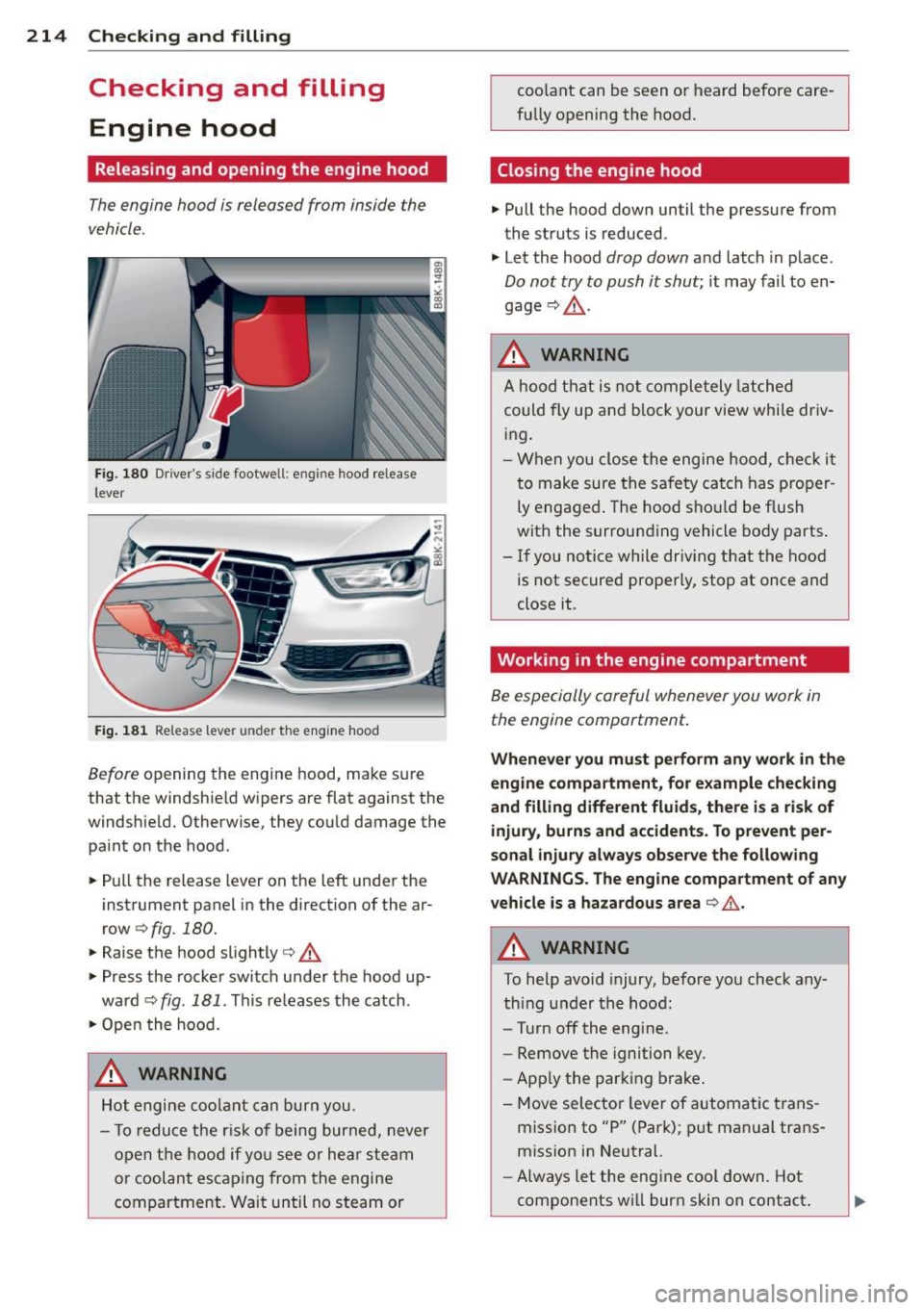
Fig. 180 Driver's side footwe ll: e ngin e hood release
lever
... -- - -=-
Fig. 181 Release lever u nde r the engine hood
Before opening the engine hood, make sure
that the windshield wipers are flat against the
windshield. Otherwise, they could damage the
pa int on the hood.
... Pull the release lever on the left under the
instrument panel in the direction of the ar
row
c;, fig . 180.
... Raise the hood slightly r::;, .&,
... Press the rocker switch under the hood up
ward
c;, fig . 181 . This releases the catch.
... Open the hood.
A WARNING
Hot engine coo lant can burn you.
- T o reduce the risk of being burned, never
open the hood if you see or hear steam
or coolant escaping from the engine
compartment. Wait until no steam or coo
lant can be seen or heard before care
fully opening the hood.
Closing the engine hood
... Pull the hood down until the pressure from
the struts is reduced .
... Let the hood
drop down and latch in place.
Do not try to push it shut; it may fail to en
gage
r::;, .&, .
A WARNING
-
A hood that is not completely latched
could fly up and b lock your view while driv
ing.
- When you close the engine hood, check it
to make sure the safety catch has proper
ly engaged . The hood shou ld be flush
with the surrounding vehicle body parts.
-If you notice while driving that the hood
is not secured properly, stop at once and
close it.
Working in the engine compartment
Be especially careful whenever you work in
the engine compartment.
Whenever you must perform any work in the
engine compartment, for example checking
and filling different fluids , there is a risk of
injury , burns and accidents. To prevent per
sonal injury always observe the following
WARNINGS. The engine compartment of any
vehicle is a hazardous area
r::;, ,&..
A WARNING
-To help avoid injury, before you check any-
thing under the hood:
- Turn off the engine.
- Remove the ignition key.
- Apply the parking brake.
- Move selector lever of automatic trans-
mission to "P" (Park); put manual trans
mission in Neutral.
- Always let the engine cool down. Hot
components will burn skin on contact .