seats AUDI S4 2014 User Guide
[x] Cancel search | Manufacturer: AUDI, Model Year: 2014, Model line: S4, Model: AUDI S4 2014Pages: 296, PDF Size: 73.56 MB
Page 71 of 296
Luggage compartment cover
Applies to vehicles: with luggage compartment cover
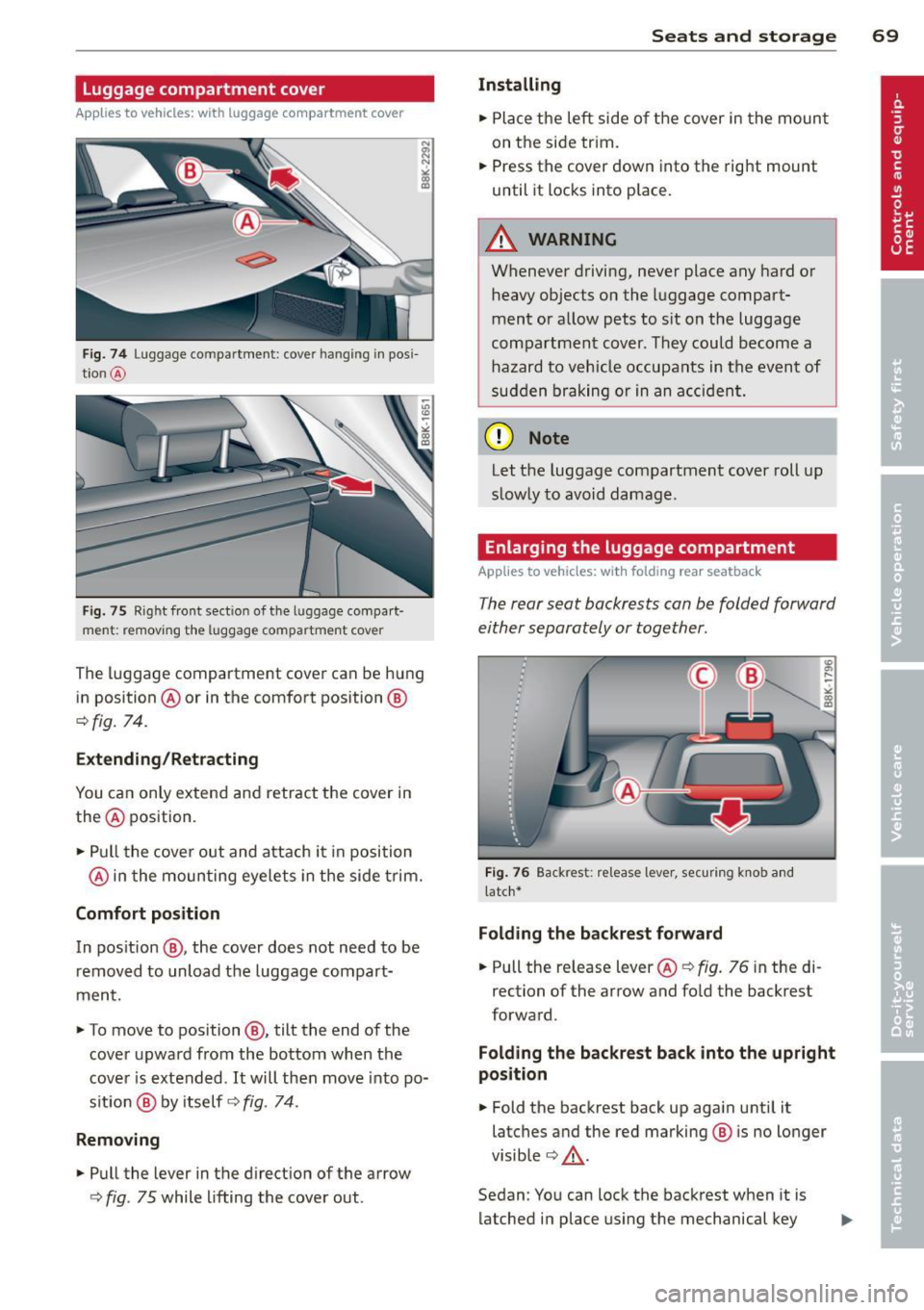
Fig. 74 Lugg age compartment: cover hanging in pos i
t ion @
Fig. 75 R ight front section of the luggage compart
ment: remov ing the luggag e compartment cover
The luggage compartment cover can be hung
in position @or in the comfort position @
¢fig. 74.
Extending /Retracting
You can only extend and retract the cover in
the @ position .
• Pull the cover out and attach it in position
@ in the moun ting eyelets in the side trim.
Comfort position
In pos ition @, the cover does not need to be
removed to unload the luggage compart·
ment.
• To move to position @, tilt the end of the
cover upward from the bottom when the
cover is extended. It will then move into po·
s ition @ by itself
c::;, fig . 7 4.
Removing
• Pull the lever in the direction of the arrow
c::;, fig . 75 while lifting the cover out .
Seats and storage 69
Installing
• Place the left side of the cover in the mount
on the side trim.
• Press the cover down into the right mount
until it locks into place.
A WARNING
=
Whenever driving, never place any hard or
heavy objects on the luggage compart·
mentor allow pets to s it on the luggage
compartment cover . They could become a
hazard to vehicle occupants in the event of
sudden braking or in an accident.
ffi Note
Let the luggage compartment cover roll up
slow ly to avoid damage.
Enlarging the luggage compartment
Applies to vehicles: wit h fo lding rear seatback
The rear seat backrests can be folded forward
either separately or together.
Fig. 76 Backrest : relea se lever, securing knob and
lat ch*
Folding the backrest forward
• Pull the release lever @¢
fig. 76 in the di
rection of the arrow and fold the backrest
forward.
Folding the backrest back into the upright
position
• Fold the backrest back up again until it
latches and the red marking @ is no longer
visible
c::;, _&. .
Sedan: You can lock the backrest when it is
latched in place using the mechanical key
Page 72 of 296
70 Seats and storage
.::> page 34 ©.::>fig. 76 . This prevents any ac
cess to the luggage compartment from the
vehicle inte rior.
You can on ly enlarge the luggage compar t
ment if the backrest is not locked .
~ WARNING
-
-The backrest must a lways be securely
latched so that the safety belt of the cen
ter seating pos ition can work properly to
help protect the occupant .
- The backrest must be secure ly latched in
posit ion so that no items contained in
the luggage compartment can slide for
ward upon sudden braking .
- Always check whether the latch is f ully
engaged by pu lling the seatback for
wa rd.
- Never allow safety belts to become dam
aged by being caught in doo r o r seat
hardware .
- Torn or frayed safety belts can tear and
damaged belt ha rdware can break in a
c rash . Inspect the be lts periodica lly.
B elt s showing damage to we bbing, bind
ings , bu ckles , or retractors must be re
placed .
(D Note
-If you move the front seat back when the
r ear seat ba ckrest is fo lded fo rward, yo u
could d amage t he head res trai nts on the
rear sea t.
- Slide the belt guide on the outside safety
belt all the w ay up before folding the
b ackrest back forward. Make su re the
seat belt is not pinched o r damaged
when the rear seat backrest if folded back. Other objects shou ld be removed
from the rear seat bench to protect the seatback from damage. Partition net (seatback in upright
position)
Applies to vehicles: with partition net
The partition net is designed to pr event loose
objects from flying forward into the passen
ger compartment (e.g. under sudden brak
ing).
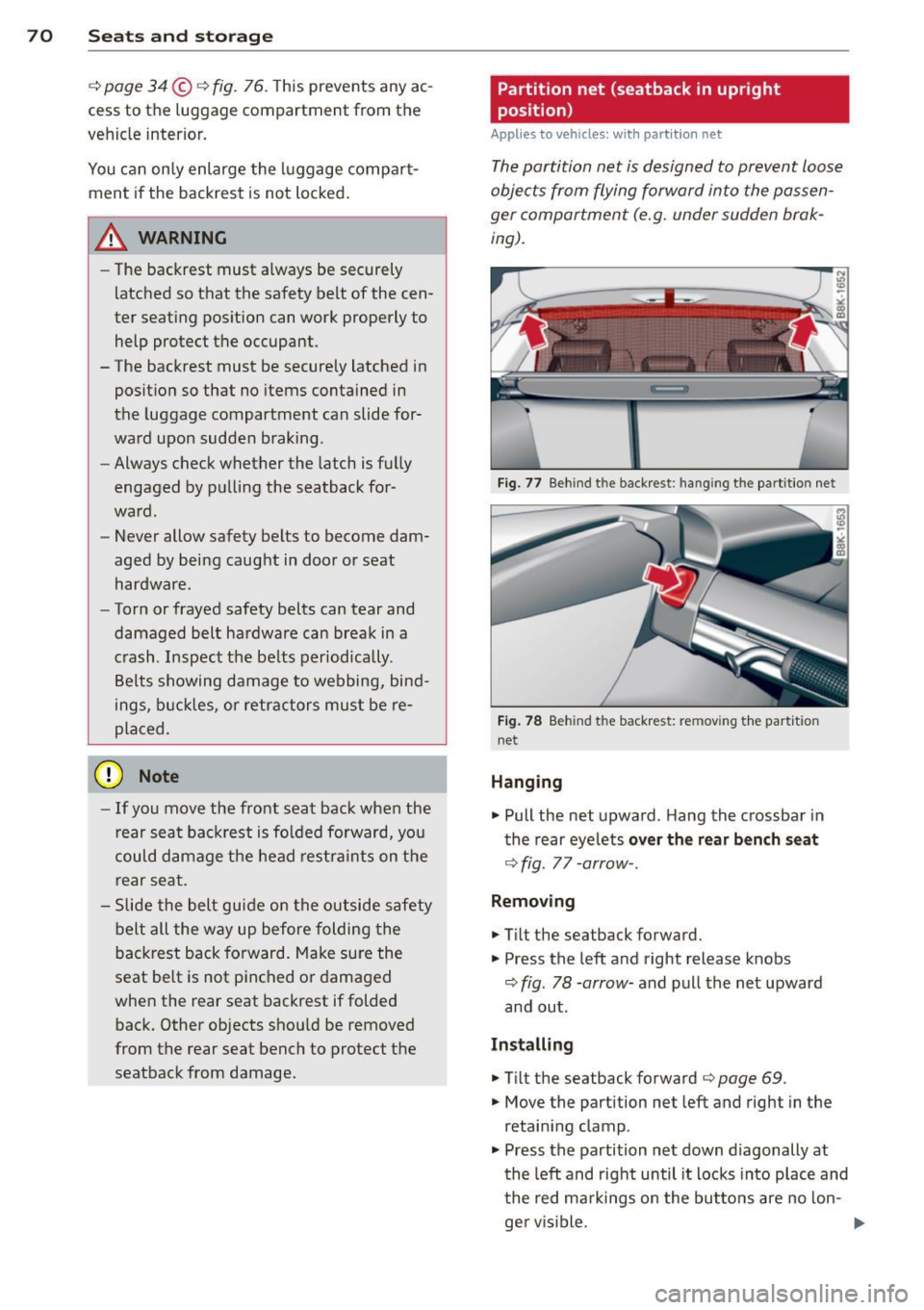
Fi g. 7 7 Behind t he backrest : hangin g th e p art itio n ne t
Fig. 78 Be hind t he backre st: rem ov ing the par tition
ne t
Hanging
.,. Pull the net upward . Hang the c rossbar in
the rear eye lets
over th e re ar bench seat
¢ fig. 77 -arrow-.
Removing
.,. Ti lt the seatback forwa rd.
.,. Press the left and right release knobs
¢ fig . 78 -arrow-and pull the net upward
and out.
Installing
• Ti Lt the seatback forward
¢ page 69 .
.,. Move the partition ne t left and r igh t in the
retain ing clamp .
.,. Press the partition net down diagonally at
t he left and right until it locks into place and
t he red ma rkings o n the bu ttons are no lon-
ger v is ible. ..,.
Page 73 of 296
(D Note
Let the partition net roll up slowly to pre
vent damage.
Partition net (seatback tilted forward)
Applies to vehicles: with partition net
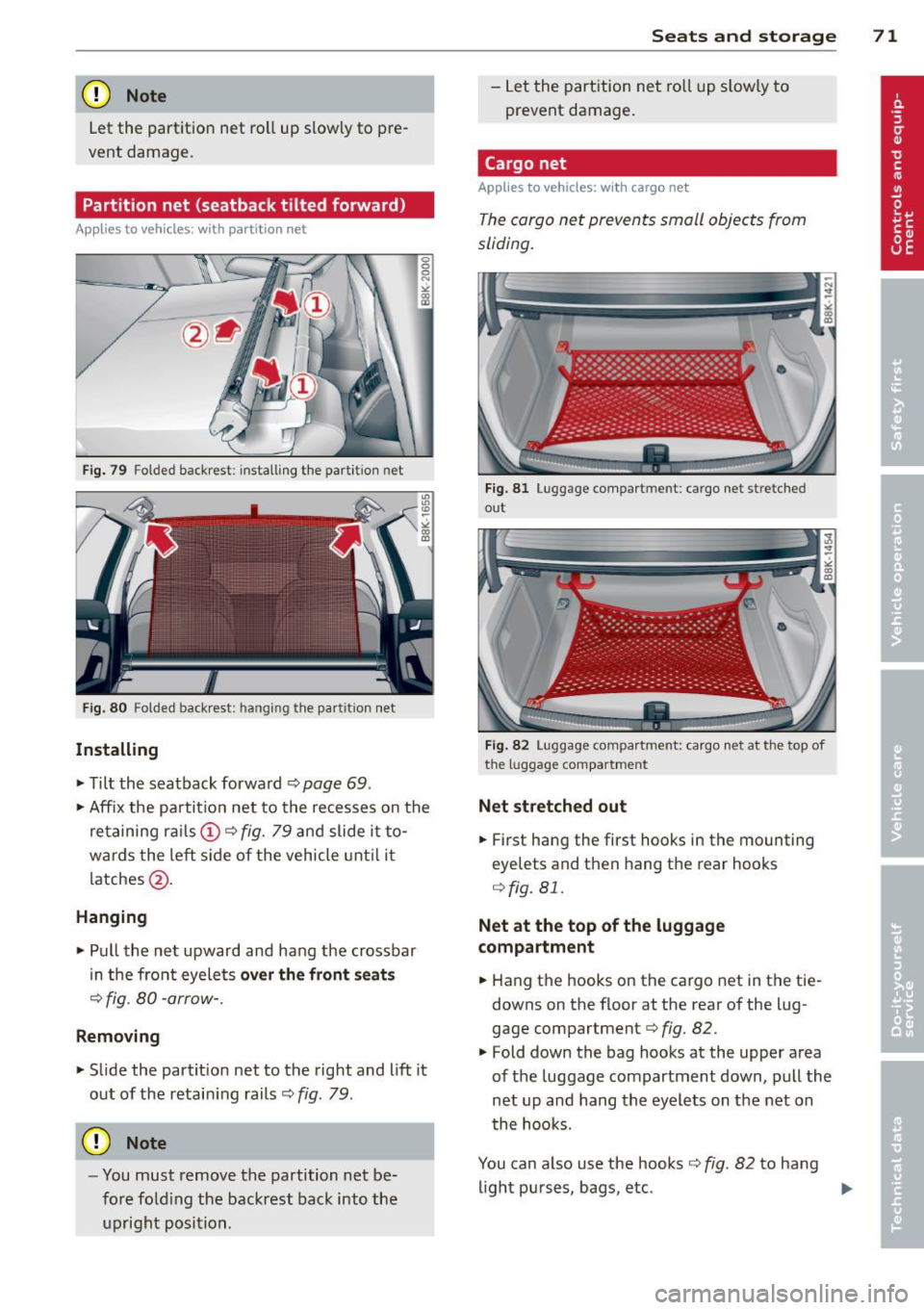
Fig. 79 Folded ba ckrest: install ing the part it ion net
Fig. 80 Folded backrest: hanging the partition net
Installing
• Tilt the seatback forward r::;, page 69.
0 0
0
~ gi
• Affix the partition net to the recesses on the
retaining rails
(D r::;, fig. 79 and slide it to
wards the left side of the vehicle until it
latches @.
Hanging
• Pull the net upward and hang the crossbar
in the front eyelets
over the front seats
r=> fig. 80 -arrow-.
Removing
• Slide the partit ion net to the right and lift it
out of the retaining rails
r::;, fig. 79.
@ Note
-You must remove the partition net be
fore foldi ng the backrest back into the
upright position.
Seats and storage 71
-Let the partition net roll up slow ly to
prevent damage.
Cargo net
Applies to vehicles: with cargo net
The cargo net prevents small objects from
sliding.
Fig. 81 Luggage compartment: cargo net stretched
out
Fig . 82 Luggage compartment: ca rgo net at the top of
the luggage compartment
Net stretched out
• First hang the first hooks in the mounting
eyelets and then hang the rear hooks
r::!>fig. 81.
Net at the top of the luggage
compartment
• Hang the hooks on the cargo net in the tie
downs on the floor at the rear of the lug
gage compartment
r::;, fig. 82.
• Fold down the bag hooks at the upper area
of the luggage compartment down, pull the
net up and hang the eyelets on the net on
the hooks .
You can also use the hooks
r=> fig. 82 to hang
light purses, bags, etc.
1JJ,,
Page 74 of 296
7 2 Seats and storage
If not hing is hung on the hooks, they wi ll fold
back in by themselves .
I n a coll is ion, the laws of phys ics mean that
even smaller items that are loose in the vehi
cle will turn into heavy missiles that can ca use
serio us injury . Items in the vehicle p ick up ki
netic energy which varies w ith the vehicle and
the we ight of the item . Veh icle speed is the
most significant factor .
F or example, in a frontal collisio n at a speed
of 30 mph (48 km/h), the forces acting on a 10- lb (5 kg) object a re about
20 times the
normal weight of the item . Th is means that
the we ight of the item would suddenly be the
equ ivalent of about 200 lbs (90 kg). O ne can
eas ily imagine the injuries that an item of that
weight flying free ly through the passenger
compartmen t can ca us e in a co llision a t a
speed considered relat ively low .
8_ WARNING
Weak, damage d or improper straps used
to secure items to tie -downs can fail du r
ing hard b rak ing or in a col lision and cause
serious personal in jury.
- Always use suitab le retaining straps and
properly secure items to the tie-downs in
t h e luggage compartment to help pre
vent items from shifting or flying for
wa rd .
- Never attac h a child seat tether strap to
a tie -down.
- For st rength-related reasons, the mount
ing hooks can only be used to secure ob
jects weighing up to 10 lb . (5 kg) . Heav i
er objec ts w ill not be a dequately secured
- the re is a r isk of injury.
Tie-downs
Applies to vehicles: with tie-downs
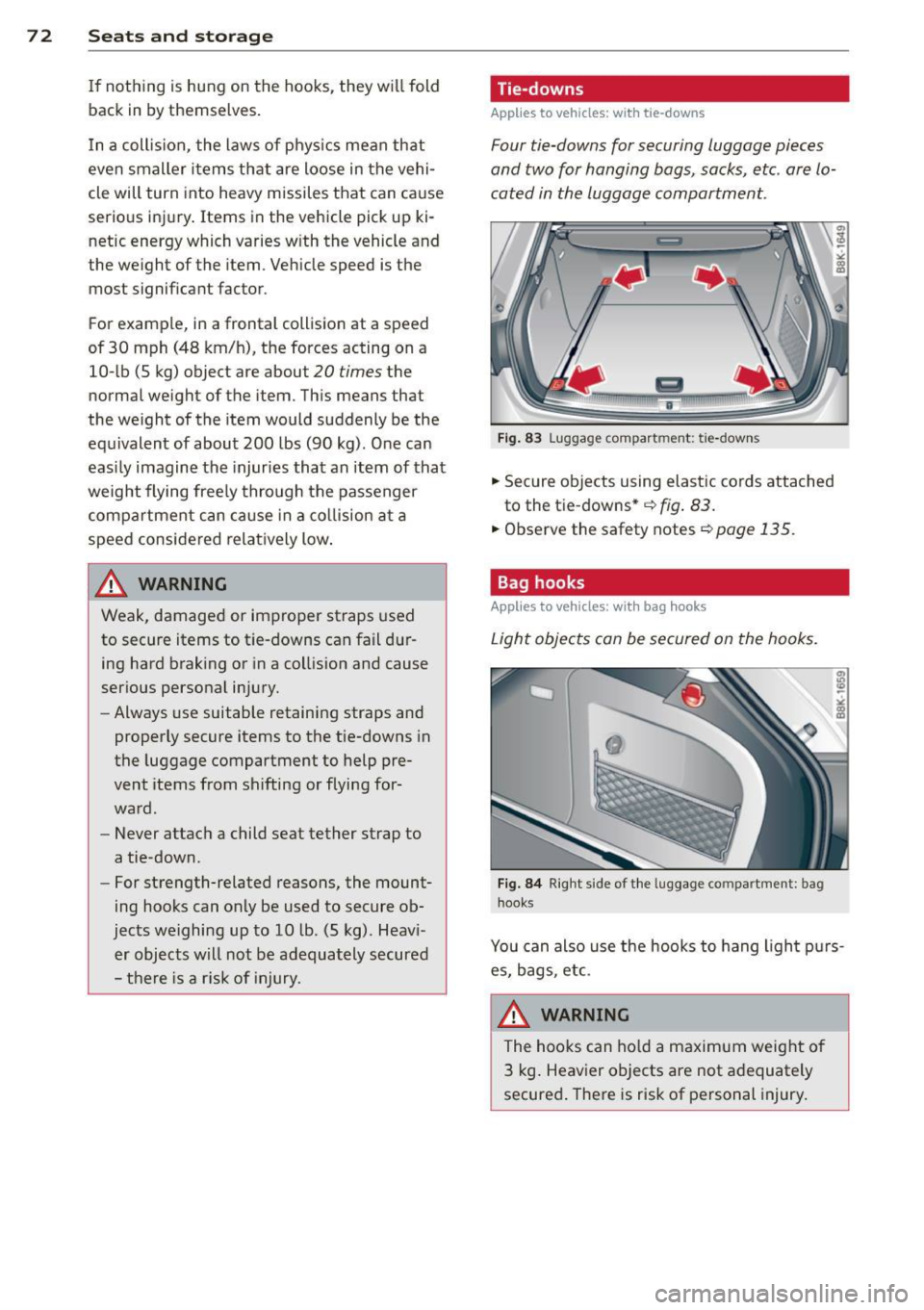
Four tie-downs for securing luggage pieces
and two for hanging bags , sacks, etc. are
lo
cated in the luggage compartment.
F ig . 83 Lu gg age compart ment: tie-down s
,.. Secure o bjects using elast ic co rds attached
to the t ie -downs* ¢
fig. 83.
,.. Obse rve the safety notes ¢ page 135.
Bag hooks
Applies to vehicles: with bag hooks
Light objects can be secur ed on the hooks.
Fi g. 84 R ig ht side of t he lu ggage co mpartment : bag
h ook s
You can also use the hooks to hang ligh t pu rs
es, bags, e tc.
8_ WARNING
The hoo ks can ho ld a maximum weight of
3 kg . Heav ier objects are not a dequately
secure d. There is risk of personal injury.
Page 75 of 296
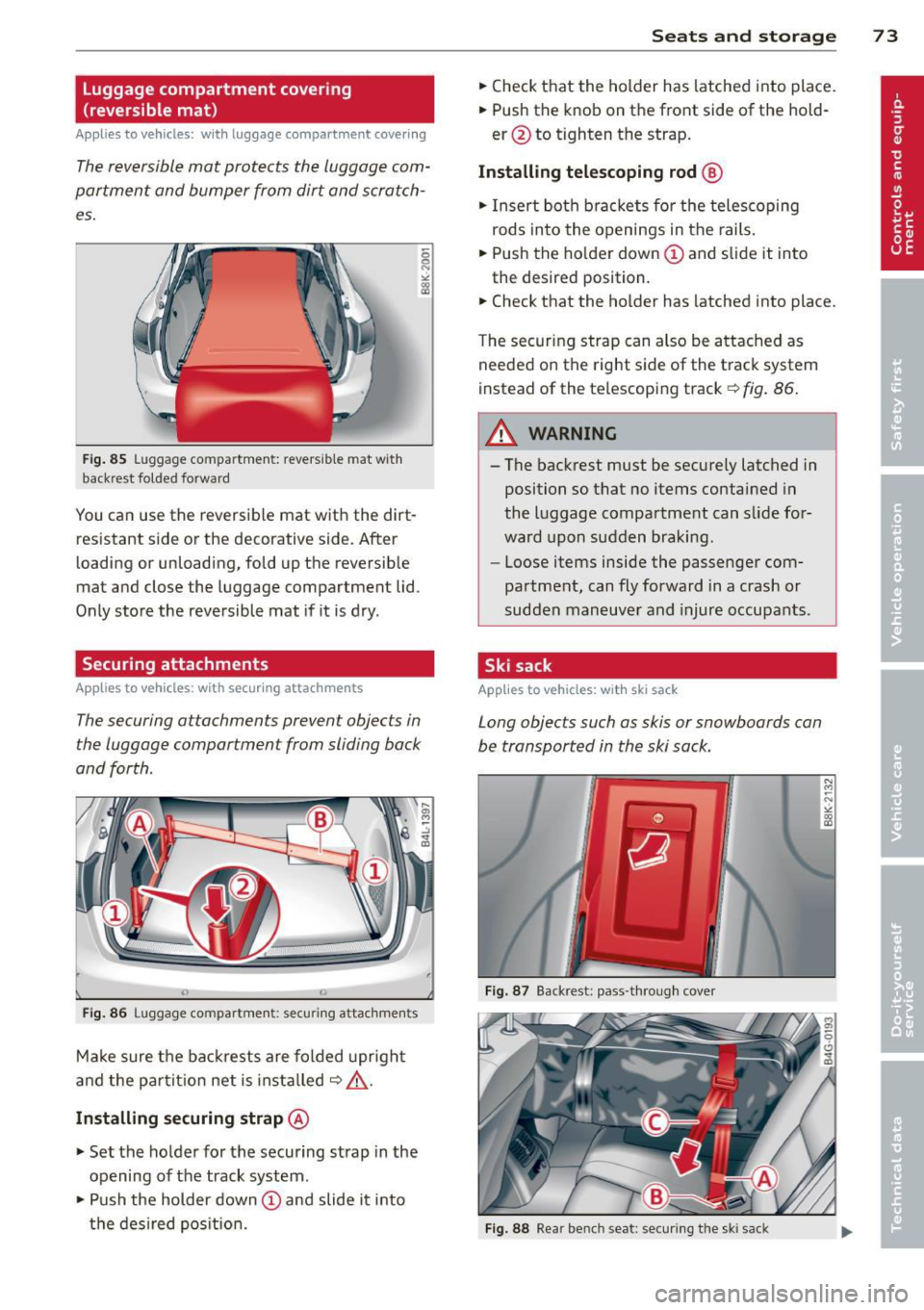
Luggage compartment covering (reversible mat )
Applies to vehicles: w it h lugg ag e compart men t cove ring
The reversible mat protects th e luggage com
partment and bumper from dirt and scratch es.
F ig. 85 Luggage compartment: reversib le mat w it h
backrest folded forward
You can use the reversible mat with the dirt
res istant side or the decorative side. After
l oadi ng or unloading, fold up the reversib le
mat and close the luggage compartment lid.
On ly store the reversible mat if it is d ry .
Securing attachments
Applies to vehicles: with sec uring attachments
The securing attachments prevent objects in
the luggage comportment from sliding bock
and forth.
,.
F ig. 8 6 Luggage compart men t: securi ng attac hments
M ake sure t he ba ckr ests are fo lded uprig ht
and the p artitio n net is inst alled¢ .&_.
Installing securing strap @
.,. Set the ho lder for the securing strap in the
opening of the track system .
.,. Push the holder down
(D and slide it into
t h e des ired pos ition.
Seats and storage 73
.,. Check t hat the holder has latched into place .
.,. Push the knob on the front side of the hold
er @ to tighten the strap.
Installing telescoping rod @
.,. Insert bo th bra ck ets fo r the telescoping
rods in to the o peni ngs in the rails .
.,. Push the holder down © and s lide it into
the desired position .
.,. Check that the holder has latched into place.
T he secur ing strap can also be a ttached as
needed on the right s ide of the t rack system
instead of the telescoping track¢
fig. 86 .
&_ WARNING ~
-The back rest must be secu rely latched in
position so that no items contai ned in
the l uggage compa rtme nt can s lide for
ward upon sudden braking.
- Loose items inside the passenge r com
pa rtment, can fly forward in a crash or
s udden maneuve r and injure occupants.
, Ski sack
App lies to vehicles: wit h ski sack
Long objects such as skis or snowboards con
be transported in the ski sock.
Fig. 87 Backrest: pass-t h ro ugh cover
Fig . 88 Rear bench seat: sec uring the sk i sack
Page 76 of 296
7 4 Seats and storage
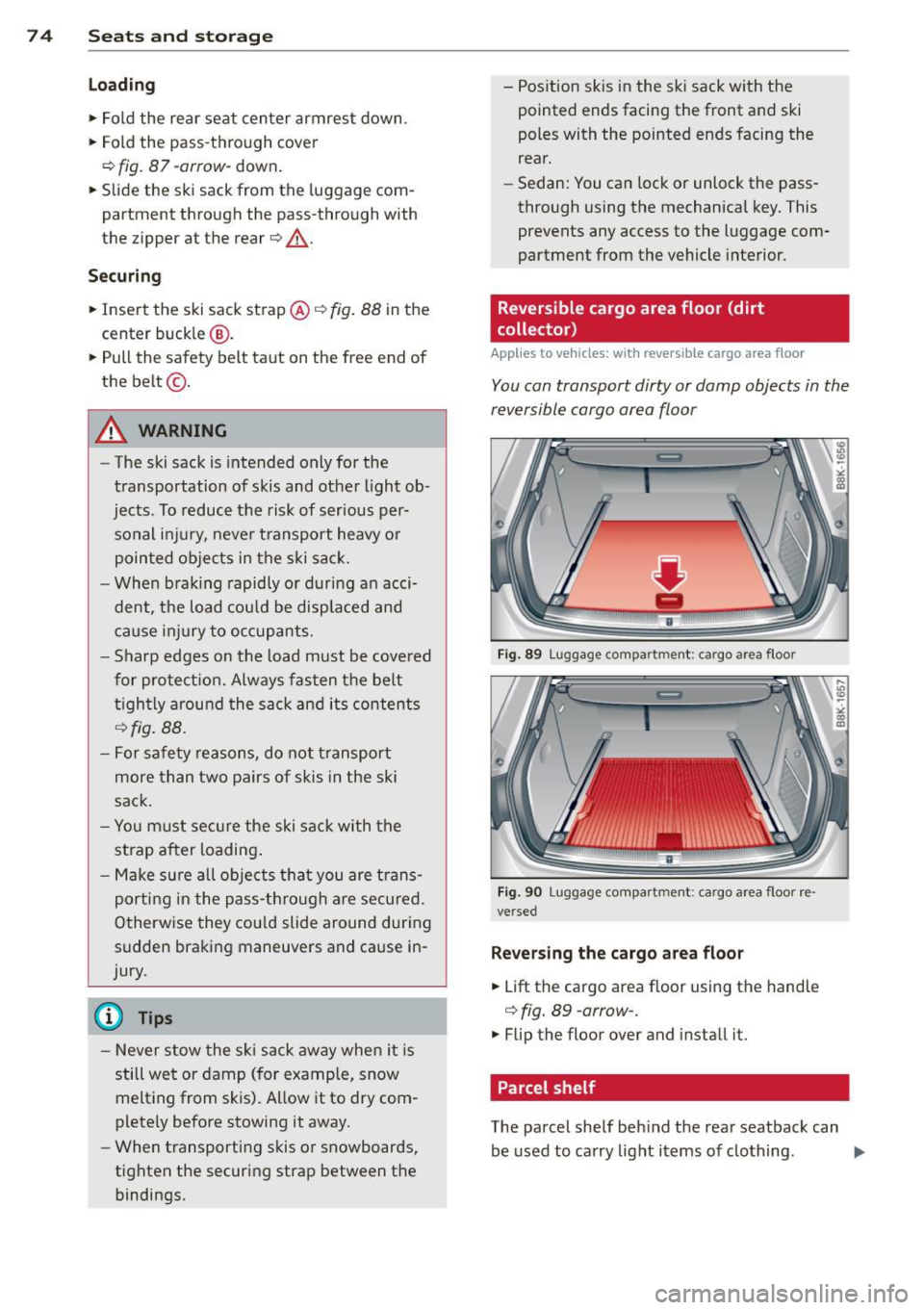
Loading
.,. Fol d the rear seat center armrest down .
.,. Fold the pass-thro ugh cover
¢
fig. 87 -arrow-down.
.,. Slide the ski sack
from the luggage com
partment through the pass-through with
the z ipper a t the rear ¢.&. -
Securing
.,. Inse rt the ski sack st rap @ co fig. 88 in the
center buck le @ .
.,. Pull the safety belt taut on the free end of
the belt @.
A WARNING
-The ski sack is intended only for the
transportation of skis and ot her light ob
jects . To reduc e the risk of serious p er
sonal injury, neve r transport heavy o r
poin ted objects in the ski sa ck.
- When bra king rapidly or d uring an acci
dent, the load could be displaced and
cause inju ry to occupants.
- Sharp edges on the load must be cove red
for pro tect ion. Always fas ten the belt
ti gh tly around the sac k an d its contents
c::> fig . 88.
- F or safety reasons, do not transport
more than two pa irs o f skis in the ski
sac k.
- You m ust sec ure the ski sack with t he
st rap a fter loading .
- M ake su re all obje cts tha t you are trans
porting in the pass- thro ugh a re secured.
O therwise they cou ld slide around during
s u dden braking maneuvers and cause in
jury.
(D} Tips
- Never stow the sk i sack away when i t is
still wet or damp (for examp le, snow
melt ing from sk is) . Allow it to dry com
plete ly before stowing it away.
- When transporti ng skis or snowboards,
tighten the securing strap between the
bindings. -
Pos ition skis in the ski sack with the
pointed ends facing the front and ski
poles with the pointed ends facing the
rear.
- Sedan: You ca n lock or unlock the pass
through using the mechanical key. This prevents any access to the luggage com
partment from the vehicle inte rior .
Reversible cargo area floor (dirt
collecto r)
Applies to vehicles: with reversible cargo area floor
You con transport dirty or damp objects in the
reversible cargo area floor
F ig . 89 Lu ggag e compar tmen t: cargo a rea floo r
F ig . 9 0 Lugg ag e co mpa rt m ent: cargo area floo r re ·
ve rse d
Reversing the cargo are a floor
.,. Lift the cargo area f loor using the handle
c::> fig. 89 -arrow- .
.,. Flip the floor over and install it.
Parcel shelf
., U1 .,
-><
~
The pa rcel shelf beh ind t he rea r seatback can
be used to ca rry light items of clothing .
ll>-
Page 77 of 296
A WARNING ,~
No heavy or hard objects should be placed
on the pa rcel she lf. They are a hazard to
th e vehicle occupants duri ng sudden b rak
ing. Th e is a r is k of injury .
(D Note
Please make s ure that the heat ing wires
for the rear window defogger are not dam
age by abras ive objects.
(D Tips
To ensure problem-free vent ilation, the
ve ntilation s lots between the rear w indow
and the parce l shelf must not be cove red.
Seats and storage 75
Page 81 of 296
(D Note
To avoid damage to the heating elements
in the seats, do not kneel on the seats or
place heavy loads on a small area of the
seat.
Setup
The basic climate control settings can be ad
justed in the radio or MM!*.
~ Select: ICARI function button> A/C control
button. Or
~ Select : ICARI funct ion button> Car systems*
control button > AC.
Automatic recirculation*
When switched on, automatic recirculation
controls the recirculation mode automatically.
If the windows fog up, press the
l q,i, FRONTI
button.
Synchronization*
When synchronization is sw itched on, the
same settings are applied to both the driver
and front passenger, except for the seat heat
ing/ventilation*. Synchronization switches off
when you adjust the settings on the front pas
senger's side.
You can a lso switch synchronization on by
press ing and ho lding the knob on the driver's
side.
Supplementary heater
The supplementa ry heater warms the interio r
of vehicles with flexib le fue l engines more
quickly. The supplementary heater is control led automatically in the
Auto setting.
Warm and cold 79
Page 130 of 296
128 Driving Safely
Driving Safely
General notes
Safe driving habits
Please remember -safety first!
This chapter contains important information,
tips, instructions and warnings that you need
to read and observe for your own safety, the
safety of your passengers and others . We have
summarized here what you need to know
about safety belts, airbags, child restraints as
well as child safety. Your safety is for us
priori
ty number 1.
Always observe the information
and warnings in this section - for your own
safety as well as that of your passengers.
The information in this section applies to all
model versions of your vehicle . Some of the
features described in this sections may be
standard equipment on some models, or may
be optional equipment on others. If you are
not sure, ask your authorized Audi dealer.
A WARNING
- Always make sure that you follow the in
structions and heed the WARNINGS in
this Manual. It is in your interest and in
the interest of your passengers.
- Always keep the complete Owner's Liter
ature in your Audi when you lend or sell
your vehicle so that this important infor
mation will always be available to the
driver and passengers.
- Always keep the Owner's literature handy
so that you can find it easily if you have
questions.
Safety equipment
The safety features are part of the occupant
restraint system and work together to help
reduce the risk of injury in a wide variety of
accident situations.
Your safety and the safety of your passengers
should not be left to chance. Advances in
technology have made a variety of features
available to help reduce the risk of injury in an accident.
The following is a list of just a few of
the safety features in your Audi:
- sophisticated safety belts for driver and all
passenger seating positions,
- belt force limiters for the front seats,
- belt pretensioners for the seats,
- head restraints for each seating position,
- front airbags,
- side airbags in the front seats,
- side curtain airbags,
- special LATCH anchorages for child re-
straints,
- adjustable steering column.
These individual safety features, can work to gether as a system to help protect you and
your passengers in a wide range of accidents .
These features cannot work as a system if
they are not always correctly adjusted and cor
rectly used.
Safety is everybody's responsibility!
Important things to do before driving
Safety is everybody's job! Vehicle and occu
pant safety always depends on the informed and careful driver.
For your safety and the safety of your passen
gers,
before driving always:
.,. Make sure that all lights and signals are op
erating correctly.
.,. Make sure that the tire pressure is correct .
.,. Make sure that all windows are clean and af
ford good visibility to the outside.
.,. Secure all luggage and other items carefully
qpage 64 .
.,. Make sure that nothing can interfere with
the pedals.
.,. Adjust front seat, head restraint and mirrors
correctly for your height.
.,. Instruct rear seat passengers to adjust the
head restraints according to their height.
.,. Make sure to use the right child restraint
correctly to protect children¢
page 167,
Child Safety. "'
Page 131 of 296
.. Sit properly in your seat and make sure that
your passengers do the same
¢ page 58,
Seats and storage.
.. Fasten your safety belt and wear it properly.
Also instruct your passengers to fasten their
safety belts properly¢
page 138 .
What impairs driving safety?
Safe driving is directly related to the condi
tion of the vehicle , the driver as well as the
driver's ability to concentrate on the road
without being distracted .
The driver is responsible for the safety of the
vehicle and all of its occupants. If your ability
to drive is impaired, safety r isks for everybody
in the vehicle increase and you a lso become a
hazard to everyone else on the road
~ .&_.
Therefo re:
.. Do not let yourself be dist racted by passen
gers or by using a cellular telephone .
.. NEVER drive when yo ur driving ability is im
paired (by medicat ions, alcohol, drugs, etc.).
.. Observe all traffic laws, rules of the road
and speed limits and plain common sense .
.. ALWAYS adjust your speed to road, traffic
and weather conditions .
.,. Take frequent breaks on long trips. Do not
drive for more than two hours at a stretch.
.. Do NOT drive when you are t ired, under
pressure or when you are stressed .
& WARNING
Impaired driving safety increases the risk
of serious personal injury and death when
ever a vehicle is being used.
Driving Safely 129
Proper occupant
seating positions
Proper seating position for the driver
The proper driver seating position is impor
tant for safe, relaxed driving.
Fig. 139 Co rrect seat ing pos it ion
For your own safety and to reduce the risk of
injury in the event of an accident, we recom
mend that you adjust the driver's seat to the
follow ing position:
.. Adjust the driver's seat so that you can easi
ly push the pedals all the way to the floor
wh ile keeping your knee(s) slightly bent
¢&_ .
.. Adjust the angle of the seatback so that it is
in an upr ight position so that your back
comes in full contact w ith it when you drive.
.. Adjust the steering wheel so that th ere is a
distance of at least 10 inches (25 cm) be
tween the steering wheel and yo ur breast
bone
~ fig. 139. If not possible, see your au
thorized Audi dealer about adaptive equip
ment.
.. Adjust the steering wheel so that the steer
ing wheel and airbag cover points at your
chest and not at your face .
.,. Grasp the top of the steer ing whee l with
your elbow(s) slightly bent .
.. App lies to veh icles with adjustable head re
straints: Ad just the head restraint so the up
per edge is as even as possible with the top
of your head. If that is not possible, try to
adjust the head restraint so that it is as
close to this posit ion as possible .
.. Fasten and wear safety belts correctly
¢ page 141 . .,._