battery AUDI S4 2014 Owner's Manual
[x] Cancel search | Manufacturer: AUDI, Model Year: 2014, Model line: S4, Model: AUDI S4 2014Pages: 296, PDF Size: 73.56 MB
Page 230 of 296
228 Check ing and filling
- To r educe the danger of explosion, never
co nnect or disconn ect cha rger cables
wh ile the c harger is operating.
- Fast char ging a battery is dangerous and
shou ld on ly be attempted by a compe
tent technician w ith the proper equip
ment .
- Battery acid that may spill during charg
ing should be washed
off with a solution
of warm water and baking soda to neu
tralize the acid.
(Q) Note
Never use a fast charger as a booster to
start the engine . This will seriously dam
age sensitive electronic components, such
as control units, relays, rad io, etc., as we ll
as the battery charger.
Battery replacement
The new battery must have the same specif/·
cations and dimensions as the original equip
ment battery.
Intell igent energy management in your veh i
cle is respons ible for d istributing the e lectr i
cal energy throughout you r vehicle
~ page 193. The intell igen t energy m anage
men t system w ill keep the engine ba tte ry
charged better then vehicles w ithout this sys
tem . To make sure the additional e lectrica l en
ergy is available once again after you have
changed the battery, we recommend that you install batteries o f the same type and ma nu
facture only (the same as those installed at
the time your vehicle was delivered). Specifi
cations are listed on the battery hous ing. Your
author ized Audi dealer must code the battery
in the ene rgy management system to enable
you to use the ene rgy management functions
correctly after replac ing the battery.
I f it is not poss ible to use a battery of this
type, the new bat tery m ust h ave the s ame ca
pac ity, voltage ( 12-volts), amperage, con
struction and plug sea ling. When installing the battery, make su
re the ig
nition and a ll electrical consumers are turned
off.
(D Note
Make sure the ventilation hose on the side
of the battery is connected, otherwise
fumes or battery acid can leak out .
@ For the sake of the environment
Because o f the p rob lem of p roper disposal
of a battery, we recommend your author
i zed Audi dealer change the battery for
you. Batteries contain sulfur ic acid and
l ead and must always be disposed of prop
erly in comp liance with all environmental
regulations. Dispos ing of veh icle batter ies
i mprope rly is very dange rous to the envi
r o nment .
Windshield/headlight*
washer container
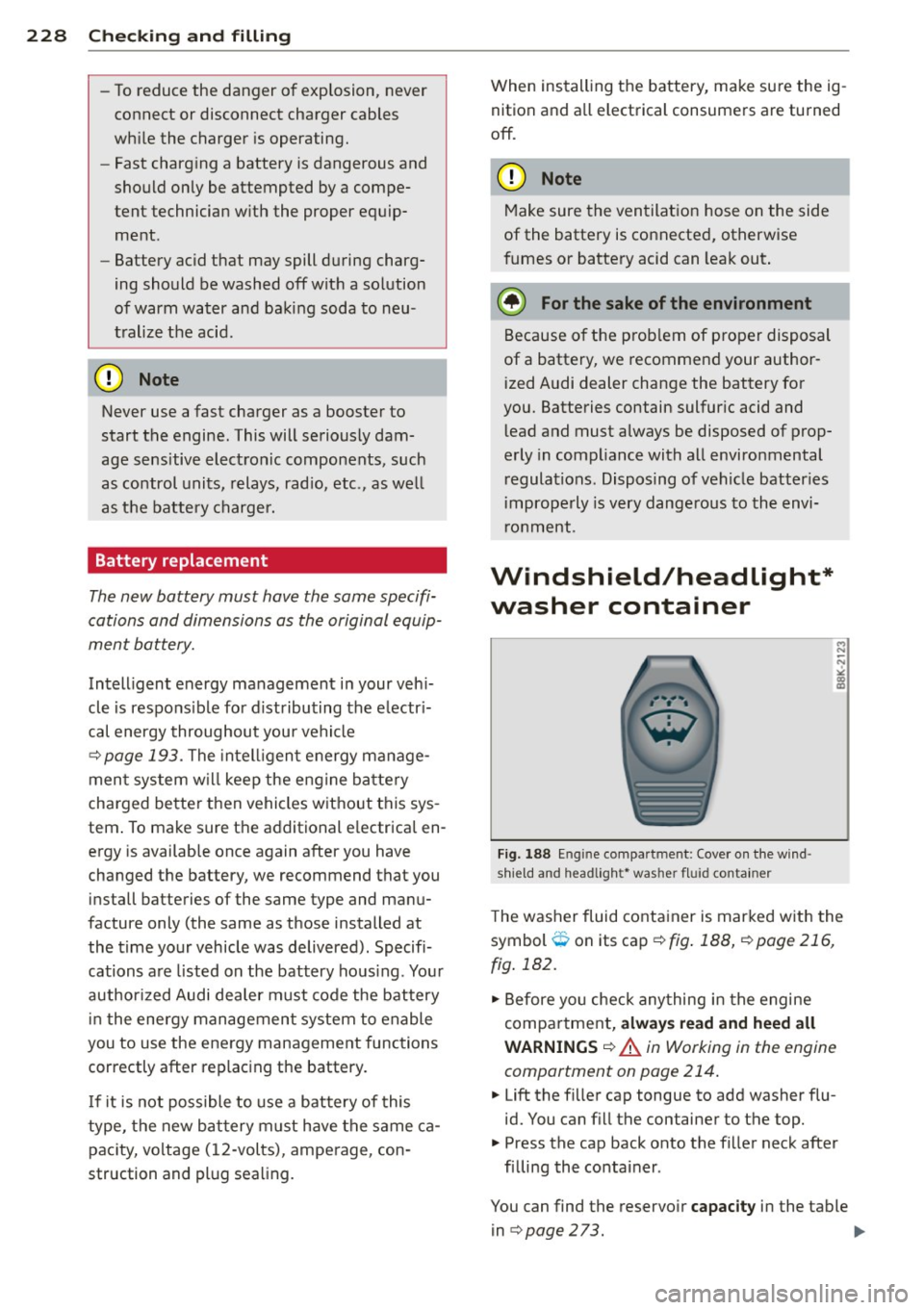
Fig. 188 E ngin e compa rt m en t: Cove r on the w ind·
s h iel d a nd h eadligh t• was her fluid conta in er
.., N
-~ (X) a,
The washer fluid conta iner is marked w ith the
symbol
O on its cap ~ fig . 188, ~page 216,
fig . 182.
.. Before yo u check any thing in the engine
compa rtment,
always read and heed all
WARNINGS q A in Working in the engine
compartm ent on page 214 .
.. Lift the fi ller cap tongue to add washer flu
id. You can f ill the container to the top.
.. Press the cap back onto the filler neck after
fi lling the conta iner .
You can find the reservo ir
capacity in the table
in
q page 273. .,.
Page 234 of 296
232 Tires and wheels
Gross Vehicle Weight Rating ("GVWR" )
means the maximum total loaded weight o f
the vehicle.
Groove
means the space between two adjacent tread
ribs.
Load rating (code)
means the maximum load that a tire is rated
to carry for a given inflat ion pressure. You
may not find this informat ion on all tires be
cause it is not requ ired by law .
Ma ximum load rating
means the load rating for a t ire at the maxi
mum permissible inflation pressure for that
tire .
Maximum loaded vehicle weight
means the sum of:
(a) Curb weight
(b) Accessory weight
(c) Vehicle capacity we ight, and
(d) Production opt ions weight
Maximum (permissible) inflation pressure
means the maximum cold inflation pressure
to which a tire may be inflated . Also called
"maximum inflation pressure."
Normal occupant weight
means 150 lbs. (68 kilog rams) times the
number of occupants seated in the vehicle up
to the tota l seating capacity of your vehicle.
Occupant distribution
means dist ribution of occupants in a veh icle.
Outer diameter
means the overall diameter of an inflated new
tire.
Overall width
means the linear distance between the exteri
ors of the sidewalls of an inflated tire, includ
ing elevations due to labeling, decorations, or
protective bands or ribs .
Ply
means a layer of rubbe r-coated parallel cords.
Production options weight
means the combined weight of those installed
regular production opt ions we ighing over 5
lbs. ( 2.3 kg) in excess of those standa rd items
wh ich they replace, not previously cons idered
in curb weight or accessory weight, including
heavy duty brakes, ride levelers, roof rack,
heavy duty battery, and special tr im.
Radial ply tire
means a pneumat ic tire in which the ply cords
that extend to the beads are laid at substan
tially 90 deg rees to the center line of the
tread.
Recommended inflation pressure
see c:::> page 231, Cold tire inflation pressure .
Reinforced tire
means a tire design to operate at higher loads
and at higher inflation pressures than the cor
responding standard tire. Reinforced tires
may be identified as "XL", "xl", "EXTRA LOAD",
or "RF" on the sidewall.
Rim
means a metal support for a tire or a t ire and
tube assembly upon which the tire beads are
seated .
Rim diameter
means nominal diameter of the bead seat. If
you change your wheel s ize, you w ill have to
purchase new tires to match the new rim di
ameter .
Rim size designation
means rim diameter and width.
Rim width
means nom inal distance between rim flanges.
Sidewall
means that portion of a tire between the
tread and bead .
Page 268 of 296
266 Emergency situations
Emergency situations
General
This chapter is intended for trained emer
gency crews and working per sonnel who
have the necessary tools and equ ipment to
perform these ope rations.
Starting by pushing or
towing
Q;) Note
Vehicle s with an automati c transmission
cannot be started by pushing or towing .
Starting with jumper
cables
If necessary, the engine can be started by
connecting it to the battery of another vehi
cle.
If the engine should fail to start because of a
discha rged or wea k batte ry, the battery can be
connected to the battery o f
another vehicle,
using a
pair of jumper cables to start the en
g ine .
Jumper cables
Use only jumper cab les of sufficiently
large cross section to carry the starter cur rent
safely. Refer to the manufact urer's spec ifica
ti ons.
Use on ly jumper cables with
insulated te rmi
na l clamps wh ic h are d istinctly mar ked :
plus (+) cable in most c ases co lore d red
minu s (-) cable
in most cases colored black .
A WARNING
Batterie s cont ain e lec tricity, a cid, a nd gas.
A ny o f these c an ca use ve ry ser io us or f atal
in ju ry . F ollow the i nstruc tio ns below for
safe ha ndling of your ve hicle's bat tery.
- Alw ay s sh ield yo ur eye s and a vo id le an
ing over the batte ry w henever p ossib le . -
A discharged battery can freeze at tem
pe rat ures just below 32 °F (0 °C). Before
connecting a jumper cable, you must
thaw the fr ozen battery complete ly , ot h
e rwise it cou ld explode.
- Do not allow batte ry acid to contact eyes
or skin . Fl ush any contacted a rea wi th
wate r im media tely.
- Imp roper use of a booster battery to
s tart a vehicle may cause an explosion.
- Vehicle batter ies generate explosive gas
es . Keep sparks, flame and lighted ciga
rettes away from ba tte ries .
- Do not try to jump start a ny ve hicle w ith
a low ac id leve l in the battery .
- The vo ltage of the booster batte ry m ust
a lso have a 12-Vo lt rat ing . The capacity
(A h) of the booster batte ry should not b e
lowe r than that of the discharged bat
tery . U se o f batt erie s of d iffe ren t voltage
or subs tanti ally diffe ren t "Ah" rat ing
may c ause an exp losion and person al in
ju ry .
- N ever ch arge a fr ozen bat te ry. Gas t rap
ped in the ice may ca use an ex plosion .
- N ever ch arge o r use a batt ery th at has
been fro zen. T he battery case may have
be weakened.
- Us e of batt erie s of di ffere nt vo ltag e or
substan tially differen t ca pa city (Ah) rat
i ng may cause an exp losion and injury.
T he capac ity (Ah) of the booster battery
should not be lower than that of the dis
charged batte ry.
- Before you check anything in the engine
compartment, always read and heed a ll
W ARNI NGS¢
page 214.
(D Note
- App lyi ng a hig her voltage booste r bat
tery wi ll cause expens ive damage to sen
sitive e lectronic components, such as
cont ro l units, relays, rad io, etc.
- There must be no electrical contact be twee n the vehicles as otherwise current
co uld already start to f low as soon as t he
posi tive(+) terminals a re con nected . ..,.
Page 269 of 296
@ Tips
The discharged battery must be properly
connected to the vehicle's electrical sys
tem. When jump starting or charg ing the
battery, never connect the negative
ground cable to the battery negat ive post
because the ba ttery manager system must
be ab le to detect the battery's state of
charge. Always connect the negative
g round cab le to the negative ground pos t
of t he battery manager cont ro l unit.
Use of jumper cables
Make sure to connect the jumper coble
clomps in exactly the order described b elow!
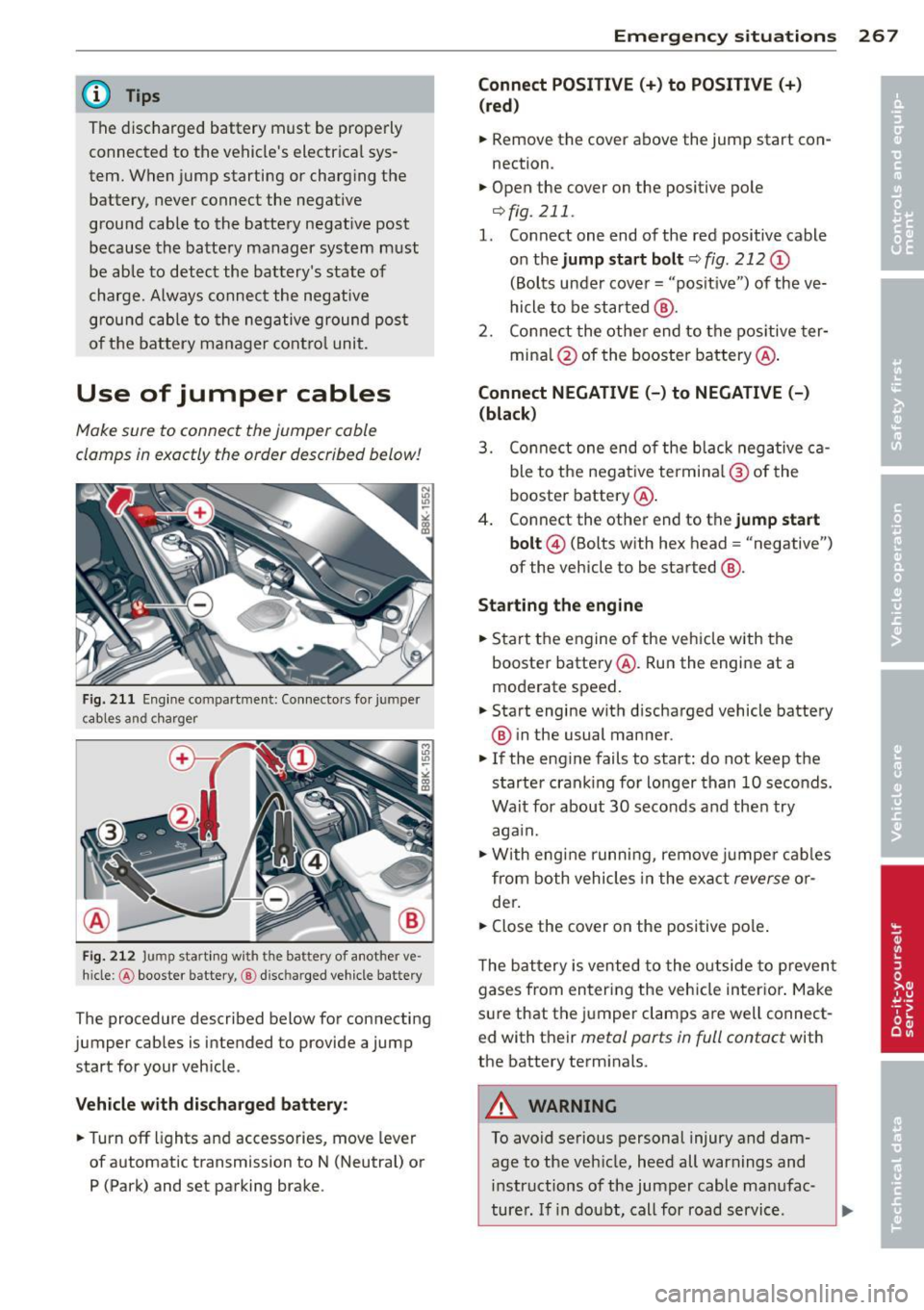
Fi g. 21 1 Eng ine co mpar tment: Co nnecto rs fo r jum per
c ab les a nd c har ge r
F ig. 212 Jump start in g w ith t he ba ttery of a not her ve ·
hi cle :@ booster battery, @ disc harged veh icle battery
The procedure described below for connecting
jumper cables is intended to provide a jump
start for your veh icle .
Vehicle with di scharged battery :
~Turnoff lights and accessories , move lever
of automatic transmission to N (Neutral) or P (Park) and set parking brake .
Emergency situ ation s 267
Connect POSITIVE(+) to POSITIVE(+ )
(red )
~ Remove the cover above the jump start con
nection .
~ Open the cover on the positive pole
¢fig . 211 .
1. Connect one end of the red positive cable
on the
jump sta rt bolt c::;, fig. 212 (D
(Bolts under cove r= "posit ive ") of the ve
hicle to be started @.
2 . Conne ct the othe r end to the pos itive ter -
mina l@ of the booster battery @.
Connect NEGATIVE (-) to NEGATIVE (-)
(black )
3. Co nnect one end o f the b lack neg ative c a
ble to the nega tive te rmi na l@ of the
booster battery @.
4 . Connect the other end to the
jump start
bolt @
(Bolts with hex head = "negative")
of the vehicle to be started @.
Starting the engine
~ Start the engine of the ve hicle with the
booste r batte ry @ . Run the engine at a
moderate speed.
~ Start engine with d ischarged vehicle battery
® in the usual manner .
~ If the engine fails to start: do not keep t he
s tarter cran king for lo nger than 10 seconds .
Wait for about 30 seco nds and the n try
aga in.
~ W ith engi ne runni ng, remove jumpe r cab les
from both vehicles in the exa ct
reverse o r
der .
~ Close the cover on the positive pole .
T he b attery is vented to the o utside to p reven t
gases from en tering the veh icle in ter ior . Ma ke
s ur e that the j umper clamps a re well connect
ed with their
metal ports in full contact with
the batte ry term inals.
A WARNING
To avoid serious personal injury and dam
age to the vehicle, heed all warnings and
in structions of the jumper cable ma nufac-
turer . If i n dou bt, call for road servic e.
Ill>
Page 270 of 296
268 Emergency sit uat ions
-Jumper cables mus t be long enough so
that the vehicles do not touch.
- W hen connecting jumper ca bles, ma ke
sure t hat they cannot get caught in any
moving parts in the eng ine compart
ment.
- Do not bend over the batteries - danger of chemical burns!
- The battery ce ll locking screws must be
tightened securely .
- Before you check anything in the engine
compartment, always read and heed all
WARNINGS
9 page 214.
Improper hook-up of jumper cables can r u
in the generator.
- Always connect POSITIVE( +) to POS I
TIVE(+), and NEGATIVE( -) to NEGATIVE
( - ) ground post of the battery manager
control unit.
- Check that a ll screw plugs on the battery
cells are screwed in firmly. If not, tighten
plugs p rior to connecting clamp on nega
tive battery terminal.
- Please note that the procedure for con nect ing a jumper cable as described
above applies spec ifically to the case of
you r vehicle being jump started. When
you are giving a jump start to another ve hicle, do
not connect the negat ive( -) ca
ble to the negat ive (-) term inal on the
discharged battery@)
9fig. 212. In
stead, securely connect the negative(- )
cable to e ither a solid metal component
that is firm ly bolted to the engine block
or to the engine block itse lf. If the bat
tery that is being charged does not vent
to the outside, escaping battery gas
could ignite and explode!
Emergency towing
with commercial tow
truck
General hints
Your Audi requires special handling for tow
ing.
T he following information is to be used by
commercial tow truck operators who know
how to operate their equipment safely.
- Ne ver tow your Audi , towing will cau se
damage to the engine and tr an smi ssion .
- Ne ver wrap th e safet y chain s or winch ca
ble s around the brak e lines.
- To prevent unne ces sary damage, your Audi
must be tr an sp o rt ed with a flat bed tru ck.
- To load th e vehi cle on to th e flat b ed, use
the towing l oop found in the ve hicle to ols
an d att ach to th e front or rea r anchorage
~page 269 and ~page 269 .
& WARNING
= -
A vehicle being towed is not safe for pas-
sengers. Never allow anyone to ride in a
vehicle being towed, for any reason.
Page 274 of 296
272 Technical Data
Technical Data
Vehicle identification
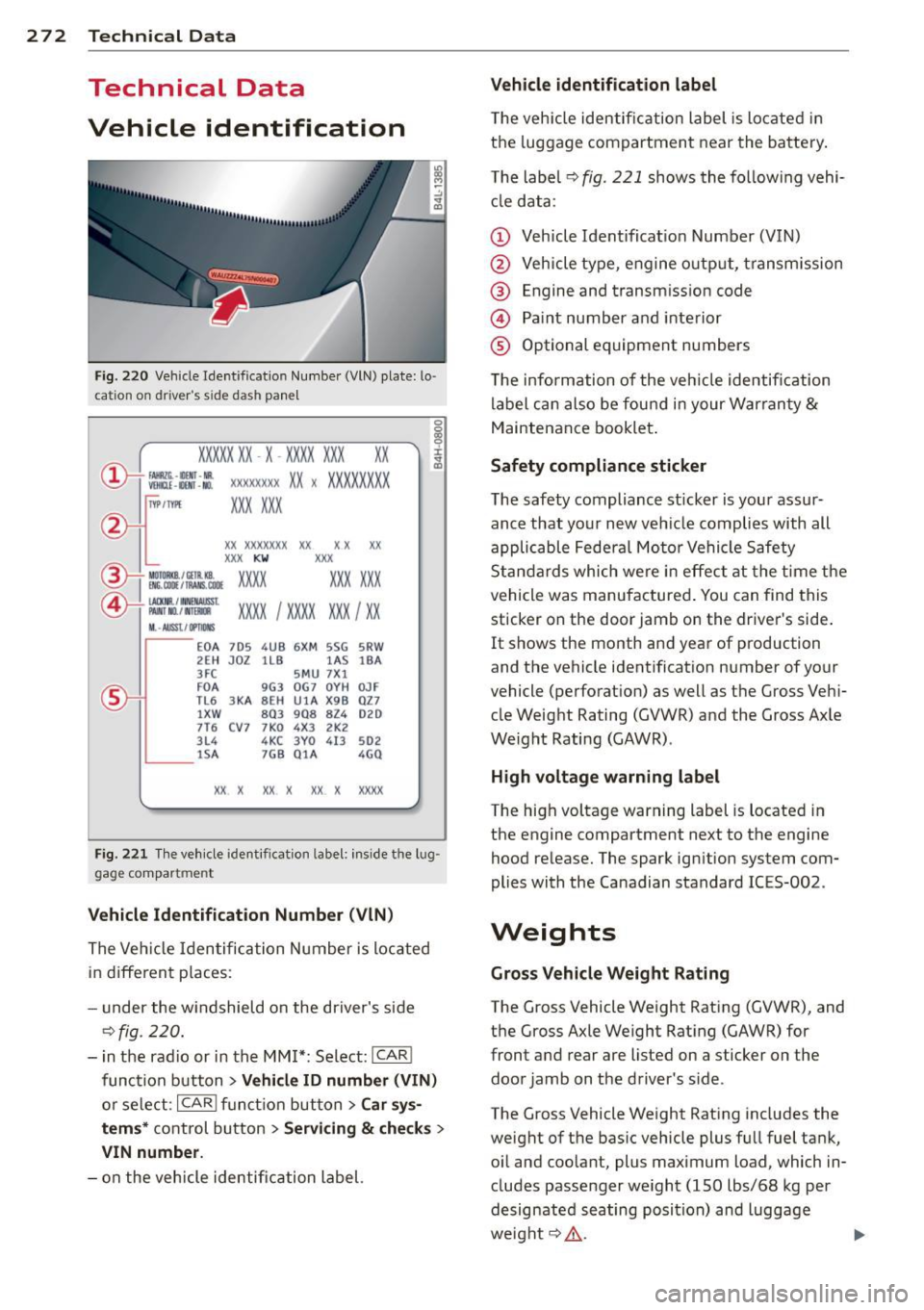
Fig . 220 Vehicle Ident ification Number (VlN) plate: lo ·
cation on driver 's s ide dash panel
XXXXX XX · X -XXXX XXX
r,"\__l f~ -11!111 · NII. ~ V!Hlll -llllll . NO.
xx
XXXXXXXX XX X XXXXXXXX
XXX XXX IYP IT'fl'E
XX XXXXXXX XX X X XX
XXX
KW XXX
®i ~~:f :l~~ XXXX XXX XXX
@+ ~~r= XXXX I XXXX XXX I XX M ,. AIIISl./ lflllllS
EOA 7D5 4 UB 6XM SSG 5RW
2E H JDZ llB l AS lBA
3FC 5MU 7Xl
FO A
9G3 OG7 O
YH OJF
TL6 3
KA BEH
UlA X9B QZ 7
l XW
8Q3 9Q8 82 4 020
7T6 CV 7 7KO 4X3 2K2
3L4 4 KC 3YO 4I3 502
lS A 7GB Q1A 4GQ
XX X
XX X XX X XXXX
Fig. 221 The vehicle identi fication label: ins ide the l ug
gage compart men t
Vehicle Identification Number (VlN)
The Vehicle Identification Number is located
in different pla ces :
- under the windshield on the driver's side
~fig. 220.
-in the radio or in the MM!": Select: I CAR!
function button >
Vehicle ID number (VIN)
or select: ICAR!function button> Car sys
tems* control button > Servicing & checks >
VIN number.
-on the vehicle identification label.
Vehicle identification label
The veh icle identification label is located in
the luggage compartment near the battery.
T he labe l~
fig. 221 shows the following vehi
cle data :
(D Vehicle Identificat ion Number (VIN)
@ Vehicle type, engine o utput, transmission
@ Engine and transm ission code
@ Paint number and interior
® Optional equipment numbers
T he information of the vehicle identification
label can also be found in your Warranty
&
Maintenance booklet.
Safety compliance sticker
The safety compliance sticker is your assur
ance that your new vehicle complies with all applicable Federal Motor Vehicle Safety
Standards which were in effect at the time the
vehicle was manufactured . You can find this
sticker on the door jamb on the driver's side .
It shows the month and year of production
and the vehicle ident ification number of your
vehicle (perforation) as well as the Gross Veh i
cle Weight Rating (GVWR) and the Gross Ax le
Weight Rating (GAWR) .
High voltage warning label
The high voltage warning label is located in
the engine compartment next to the engine
hood release. The spark ignition system com
plies with the Canadian standard ICES-002 .
Weights
Gross Vehicle Weight Rating
The Gross Vehicle Weight Rating (GVWR), and
the Gross Axle Weight Rating (GAWR) for
front and rear are listed on a sticker on the
door jamb on the driver 's s ide .
The Gross Vehicle Weight Rating includes the
weight of the basic vehicle plus full fuel tank,
o il and coolant, plus maximum load , which in
cludes passenger we ight (150 lbs/68 kg per
designated seating position) and luggage
we ight~ _&.
Page 283 of 296
Automatic climate control Air vents ... .... .. .... ... .. .. .. .... 78
Operation . . . . . . . . . . . . . . . . . . . . . . . . . 77
Setup ... .. ................. .. .... 79
Automatic S hift Lock (ASL) . . . . . . . . . . . . 93
Automatic transmission ......... ... ... 91
Automatic S hift Lock (ASL) . . . . . . . . . . . 93
D riving .. .. ............. .... .. .. .. 9 3
E mergency mode . . . . . . . . . . . . . . . . . . . 97
E me rgency release . . . . . . . . . . . . . . . . . . 98
Kick -down . . . . . . . . . . . . . . . . . . . . . . . . . 96
M anual shift program .. ... .. .. .. .. .. 96
Remova l lock (ignition key) ... .. .. .. .. 80
Selector lever . . . . . . . . . . . . . . . . . . . . . . 92
Automatic wipe rs . . . . . . . . . . . . . . . . . . . . 53
Auto Safety Hotline ............. .... 136
Average speed . . . . . . . . . . . . . . . . . . . . . . . 25
Avoid damag ing the vehi cle .. .. .. .. .. . 195
B
Bag hooks . . . . . . . . . . . . . . . . . . . . . . . . . . 72
Battery . . . . . . . . . . . . . . . . . . . . . . . 17,225
Battery location inside the luggage com -
partment .. .. ........... .. .. .. ... 225
Charging . ................ ... ... .. 227
Important war nings when wo rking on
the battery . ................ ... ... 225
J ump starti ng ............ .... .. .. . 266
L ow . .. .. .. .. .. ........... .. .. ... 193
Replacing the ba ttery .. ... .. .. .. .. . 228
State of charge . ....... ... .. .. .. ... 193
Winter operation . ..... ... .. .. .. .. . 225
Working on the battery .... .. .. .. .. . 225
B efore dr iving ............. .... .. .. . 128
Bio-ethanol (Fuel) ..... ..... .. .. .. .. . 210
Blended gasoline ... .... ... .. .. .. .. . 209
B lower (automatic climate cont rol) . . . . . . 78
Booster seats ............. .... .. .. . 175
B rake fl uid
C hanging the brake fl uid ... .. .. .. .. . 224
Chec king the brake fluid level ... .. .. . 224
Reservoir .. ............. .... .. ... 224
What is the correct brake flu id leve l? . . 224
What should I do if the brake fluid warn-
i ng light comes o n? .. ..... .. .. .. .. . 224
Inde x 281
Brake system . ..... ... .. .. ..... ... .. 224
Anti- lock b raking system ..... ... .. .. . 19
B rake assist system .. .. ..... ... .. .. 186
Brake fluid .. .. .. ................. 224
Brake fluid specifications for refill and re-
placement ...... .. ............... 224
B rake light defective ... .. .. ... ... .. . 21
B ra ke powe r ass ist unit ............ . 189
Br akes .. .. .. .. .. .. . .............. 189
Ce ram ic bra kes . .. .... ........... .. 189
El ec tromechanica l parking brake ... .. . 85
Warning/indicator lights ..... ... .. .. . 15
Wor n brake pads symbo l . . . . . . . . . . . . . 20
B ra kin g
E mergency b ra ki ng f unction ..... .. .. . 87
braking guard . . . . . . . . . . . . . . . . . . . . . . . 99
Messages . . . . . . . . . . . . . . . . . . . . . . . . 107
Settings ........ .. ............... 106
Break -in per iod .. .. .... ............. 195
Tires ... .. .. .. .. .. ............... 195
Bul bs . ... .. .. .... .. . .. .. ..... ... .. 2 64
C
Califor nia Proposition 65 War ning . .. .. 215
B attery spec ifi c .. ............. .. .. 226
Capacities ........ .. ............... 273
Carbon pa rts
Cleaning . . . . . . . . . . . . . . . . . . . . 206, 207
Care ..... .. .. .. .... ... .......... .. 20 4
Cargo a rea
refer to L uggage compartment . . . 68, 134
Catalytic converter ... .. ...... ... .. .. 196
Cen te r armrest . . . . . . . . . . . . . . . . . . . . . . 60
Central lock ing .. .. ................. . 32
Cen tral lock ing switch ............. .. 36
Co nvenience key . . . . . . . . . . . . . . . . . . . . 36
Remote cont ro l key . ........... .... . 35
Ceram ic brake rotors
New brake pads .. ............. .... 189
Ce rtification . ... .... . ... ...... ... .. 278
Chang ing a flat t ire . .. ... ....... .... . 255
Chang ing a wheel .. ............. .... 255
Chang ing engine oil ............. .... 220
Checking Engine coolant level .... ....... .... . 221
Checking t ire pressure ............... 237
•
•
Page 285 of 296
Index 283
-----------------------------------.......
Daytime running lights... ... .. .. .. 47, 48
Declaration of compliance Adapt ive cruise control .... .. .. .. .. . 278
Aud i side assist .......... .. .. .. ... 278
Cell phone pa ckage ....... .. .. .. .. . 278
Conve nience key ... .... ... .. .. .. ... 278
Elect ronic immobilizer .. ... .. .. .. .. . 278
Homelink universa l remote contro l .. . 278
Remote control key ....... .. .. .. .. . 278
D ecora tive parts/ trim
C lean ing ... .... ...... ... .. .. .. ... 206
Defective light bulb warning . . . . . . . . . . . 2 1
Defrosting (windows) ....... .. .. .. .. .. 78
D etermi ning correct load limi t ... .. .. . 239
Dig ita l clock ........... ...... .... ... 12
Dig ita l compass . .. ..... ... .. .. .. .... 56
D imensions .. ............. .... .. ... 273
Dimming the rearview mirror .. .. .. .. .. 51
D isp lays
C leaning ... .. .... .... ... .. .. .. ... 206
D oors
C hi ld safe ty loc ks ......... .. .. .. .. .. 4 2
emergency loc king ........ .. .. .. .. .. 38
Driver information system Enhanced sh ift indicato r .... ... ... ... 28
Open doo r or front lid warning . . . . . . . . 24
Outside temperat ure display .. .. .. .. .. 24
Sound system display . . . . . . . . . . . . . . . 24
Driver seat
refer to Seat ing pos ition 129
Driving off road ... ...... ... .. .. .. ... 199
D riving safe ly ............. .... .. ... 128
Driving through water . . . . . . . . . . . . . . . 195
D riving time . . . . . . . . . . . . . . . . . . . . . . . . 25
Dust filter
refer to Po llutant filte r (automatic AC
sys tem) .. .. ............. .... .. .. .. 76
Dynamic steering . . . . . . . . . . . . . . 113 ,191
E
E85 (Fue l) . . . . . . . . . . . . . . . . . . . . . . . . . 210
E ffi ciency program ......... .. .. .. .. .. 2 7
Fu el economy messages . . . . . . . . . . . . . 29
M emory leve ls . . . . . . . . . . . . . . . . . . . . . 25
Othe r equipment . . . . . . . . . . . . . . . . . . . 28
Shift indicator ........... .. .. .. .... 28 E
lectro -mechan ica l power ass ist ... .. .. 191
E lectromechanica l pa rk ing brake
E mergency bra king ................ . 87
Ind icator lig ht . .. .... ........... .. . 85
P arking ... .. .. .. ................. . 86
Re leas ing and closing ... .... ... .. .. . 85
Starting assist ...... .. .. ..... ... .. . 86
Starting from rest . ... .. .... ... .. .. . 86
Starting off w ith a trailer ........ .. .. . 87
Warning/ind icator lights .......... .. . 16
El ectronic differential lock
Warning/indicator lights ..... ... .. .. . 18
El ectronic d ifferential lock ( EDL) ... .. .. 186
Wa rning/ind icator lights ........ .. .. . 19
E lectronic immob ilizer . . . . . . . . . . . . 12, 38
E lectronic power con trol
(EPC) warning/indicator light . . . . . . . . . 20
El ectronic speed limi ter . . . . . . . . . . . . . . . 31
E lectronic stab ilizat ion contro l
offroad mode . . . . . . . . . . . . . . . . . . . . . 188
Sport mode . . . . . . . . . . . . . . . . . . . . . . 188
E lectronic Stabilization Cont ro l (ESC) ... 186
Warning/ind icator lights .......... .. . 18
Emergency ac tua tion
Doors . ... .. .... ... .. .. ..... ... .. . 38
Ignition key ..... .. . .. .. ..... ... .. . 35
Rea r lid . . . . . . . . . . . . . . . . . . . . . . . 41, 42
Slid ing/ti lting s unroof .............. . 45
E merge ncy br aking . .... ......... .. .. . 87
Emergency flasher ................. .. 49
w . /' d' l' h arnmg m 1cator 1g ts . . . . . . . . . . . . . 23
Emergency key .. ...... ............. . 33
Starting engine .. ............. .. .. . 82
Emergency operation Emergency bra king funct ion (parking
brake) . ... .. .... .. . .. .. ..... ... .. . 87
E mergency starti ng ............. .... 266
Emergency towing . ................. 268
Energy management .. .. ..... ... .. .. 193
Battery power . . . . . . . . . . . . . . . . . . . . . 17
Driver notification . . . . . . . . . . . . . . . . . . 17
En gine
Compartment .. ...... ........... .. 216
Coolant ... .. .. .... .. ... ..... ... .. 221
Data ... .. .. .... .. . .. .. ..... ... .. 274
Hood ... .. .. .... .. . .. .. ..... ... .. 214
Starting . . . . . . . . . . . . . . . . . . . . . . 80, 83
•
•
Page 286 of 296
284 Index
Starting with jumper cab les . ....... . 266
Stopping . . . . . . . . . . . . . . . . . . . . . . 82, 84
E ng ine compartment
Safety instructions ...... .. .. .. .. .. . 214
Working the engine compartment 214
Eng ine coolant
Indicator light . . . . . . . . . . . . . . . . . . . . . 17
E ngine coolant system ...... .. .. .... . 221
Adding coolant ........... .. .. .. .. . 222
Checking coolant level ..... .. .. .. .. . 221
Check ing the eng ine coolant level .. .. . 221
Radiator fan .............. ... .. .. . 223
E ngine coolant temperature
Temperature gauge ....... .. .. .... .. 10
Engine hood
C losing ......... ......... ... .... . 214
How to release the hood ............ 214
E ng ine oil . .... ........... ........ . 216
Adding .. .. ............. .. .. .. .. . 219
Addit ives ... ................ ..... . 219
Changing . ................. ..... . 220
Check oil level ............ ... .... . 219
Consumption ............ .. .. .. .. . 219
Indicator light . . . . . . . . . . . . . . . . . 17, 21
Oil consumption ............ .. .... . 218
Oil grades .. ................ ... .. . 216
Pressure malfunction ...... .. .. .. .. . . 17
Sensor defective . . . . . . . . . . . . . . . . . . . . 21
Specification and viscos ity .. .. .. .... . 216
Engine speed limitation . . . . . . . . . . . . . . . 21
Environment Break- in period ............ ... .... . 195
Cata lytic converter ............ .. .. . 196
Disposing of your vehicle battery ..... 228
Driving at high speeds ..... .. .. .. .. . 197
Driving to minimize pollution and noise 197
Fuel ..... .. ..... ........... ... .. . 212
Fuel economy ............. ... .. .. . 197
L eaks under your veh icle . .. .. .. .. .. . 214
L ett ing the vehicle stand and wa rm up . 198
Proper disposal of drained brake fluid . 224
Proper disposal of drained engine coo l-
ant ..... .. ................ ..... . 222
Proper disposal of dra ined engine
oil . . . . . . . . . . . . . . . . . . . . . . . . . 219, 220
Recycling used engine oil ... .. .. .. .. . 219
Roof rack .. ... .... ...... .. .. .. .. .. 68 Unleaded fuel
.... ................ . 209
What shou ld I do with an o ld battery? . 228
EPC
refer to E lectronic power control . . . . . . 20
Ethyl alcohol (Fuel) . .. .. ...... ... .. .. 210
Event Data Recorder (EDR) ............ 186
Exhaust tail pipes
Cleaning .. .... .. ............. .... 205
Expansion tank .... ............. .... 221
Exterior lighting ... ................ .. 47
Exterior m irrors
Adjust ing . .. .. .. .. ........... .. .. . SO
Dimming .. .... .. ............. ..... 51
Heating . .. .. .. . .............. .. .. . SO
F
Fan
Radiator 223
Fastening Booster seats . . . . . . . . . . . . . . . . . . . . . 17 5
Convertib le child safety seats .. ... ... 174
Infant seats ... .. ... .......... .... 173
Fa stening eye s
refer to Tie-downs . . . . . . . . . . . . . . . . . . 72
Flat tire Changing ..... .. ................ . 255
flexib le fue l ....... ............. .... 210
Floor .. .... .... .. ................. . 74
Floor mats . ..... .. ................ . 133
Fog lights/rear fog light(s) ......... ... . 47
Folding the rear seats ............ .... . 69
Foot pedals . .... .. ............. .... 133
For the sake of the environment Gasoline fumes and the env ironment .. 212
Letting the engine warm up . . . . . . 80, 83
Refueling . .. .. .. ... .......... .... 212
Sav ing fuel by early upshifting . .. .. .. . 11
Front airbags Description .. .. .. .......... ...... . 150
How they work . .. .......... ...... . 155
Frontal collisions and the laws of physics 139
Front passenger's door emergency lock ing 38
Front seats Adjusting ... .. .. ....... ...... .. .. 130
Child restraints in the front seat .. .. .. 147
Page 288 of 296
28 6 Index
Impor tan t th ings to do before driving .. 1 28
Improperly worn safety belts ..... .. ... 144
Indicator lights ............ .. .. .. .. .. 13
Airbag system . . . . . . . . . . . . . . . 156, 157
Dy namic steering ...... ... .. .. .. .. . 191
PASSENGER AIR BAG OFF ........ .. . 157
also refer to Warn ing/ indicator l ights .. 13
Infant seats ... ............. .. .... . 173
I nflatable spare t ire ...... .. .. .. .. .. . 2S3
I nflating .... .... ..... ... .. .. .... . 254
Installing ch ild safety seats
Safety belts . . . . . . . . . . . . . . . . . . . . . . 177
Instal ling the upper tether strap on the
anchorage . .. ............... .. .... . 184
I nstruments
Adjusting the lighting ... .. .. .... .. . . 50
I nstruments and contro ls ... .. .. .. .. . . 10
Gene ral illustration ..... .. .. .. .. .. . .. 8
Interior lights Front .. .. .. ................ ... ... . 50
Rear .. .... .......... ...... ... .. .. 50
Intermittent (windshield wipers) . . . . . . . 53
J
Jump-starting 266
Jumper cables ................ ... ... 267
K
Key .... ... .. ................ ... .. .. 33
Battery replacement . . . . . . . . . . . . . . . . 34
Check light . . . . . . . . . . . . . . . . . . . . . . . . 34
E mergency key . . . . . . . . . . . . . . . . . 33, 82
I gnition/engine on/off . . . . . . . . . . . . . . . 80
Key replacement .... ... .. .. .. .... .. 33
Mechanical key . . . . . . . . . . . . . . . . . 33, 34
removing . . . . . . . . . . . . . . . . . . . . . . . . . 82
un locking/locking . . . . . . . . . . . 35, 36, 38
Kick-dow n . . . . . . . . . . . . . . . . . . . . . . . . . . 96
L
Lane Change Ass istant
refer to side assist ........ .. .. .. .. . 109
LATC H .. .. .. ............. .. .. .. ... 181
Descr ipt ion .... .... ...... .. .. .. .. . 182
Install ing a child restraint ...... .. ... 182 Location .
..... .. ... .. ..... ... .. .. 181
Mounting and releasing the anchorage
hook ... .. .. .. .. ... .. ..... ... .. .. 182
Launch Control Prog ram ....... .. .. .. . 97
Leather cleaning/protect io n .. .. .. .. .. 207
Leav ing home ..... ... .. ..... ... .. .. . 48
Left hand drive .. .. ..... ........... .. 49
Lifting jack . .... .. ............. .... 257
L ifting vehicle ... .. ............. .... 270
Light adaptive light .. .. ................ .. 47
Coming/Leav ing home ........ .. .. .. . 48
Daytime runn ing lights . . . . . . . . . . 47, 48
E xterior lig hting . . . . . . . . . . . . . . . . 47, 48
F og lights/rea r fog light(s) . ... .. .. .. . 47
Interior/reading . . . . . . . . . . . . . . . . . . . . 50
Low beam ..... .. ... .. ..... .... . .. . 47
Rear fog lights . .. ... .......... .. .. . 47
S ide marker lig hts ............. .... . 47
Trave l mode . . . . . . . . . . . . . . . . . . . . . . . 49
Light/rain sensor Headlights . ..... .. ... ..... ... .. .. . 47
I ntermittent (w indshield w ipers) . .... . 53
Sen sor defe ctive . . . . . . . . . . . . . . . . . . . . 22
Lights
Emergency flashe rs ..... .... ... .. .. . 49
High beam .... .. .. ... ..... ... .. .. . 48
Tu rn signals ... ... ................ . 48
Locking Rea r lid ... .... .. .. .... .... ... .. .. . 39
Locking/unlock ing
at the lock cy linder . . . . . . . . . . . . . . . . . . 38
by remote control ............. .... . 35
with the centra l locki ng switch ... .... . 36
with the conven ience key . . . . . . . . . . . . . 36
Low beams ..... .. ..... ........... .. 47
Lower anchorage locator button ... .. .. 182
Lower unive rsal anchorage bars (Canada) 181
Lower universal anchorages (Canada) 181
Luggage Stowing . ..... .. ... .. ..... .... . .. 134
Luggage compartment . . . . . . . . . . . . . . . . 68
Cargo ne t ... .. .. ............. .. .. . 71
Cover ... .. .... .. .. .... .... ... .. .. . 69
Enlarging . . . . . . . . . . . . . . . . . . . . . . . . . 69
Floor ... .. .... .. .. .... .... ... .. .. . 74
L id ....... .... .. ................. . 39