weight AUDI S4 2014 Service Manual
[x] Cancel search | Manufacturer: AUDI, Model Year: 2014, Model line: S4, Model: AUDI S4 2014Pages: 296, PDF Size: 73.56 MB
Page 236 of 296
234 Tires and wheels
Occupant loading and distribution for vehicle normal load for various designated seating
capacities
Designated seating capacity, Vehicle normal load , number Occupant distribution in a nor -
number of occupants of occupants mally loaded vehicle
5 3 2 in fron t, 1 in back seat
Cold tire inflation pressure
Tire pressure affects the overall handling, performance and safety of a vehicle.
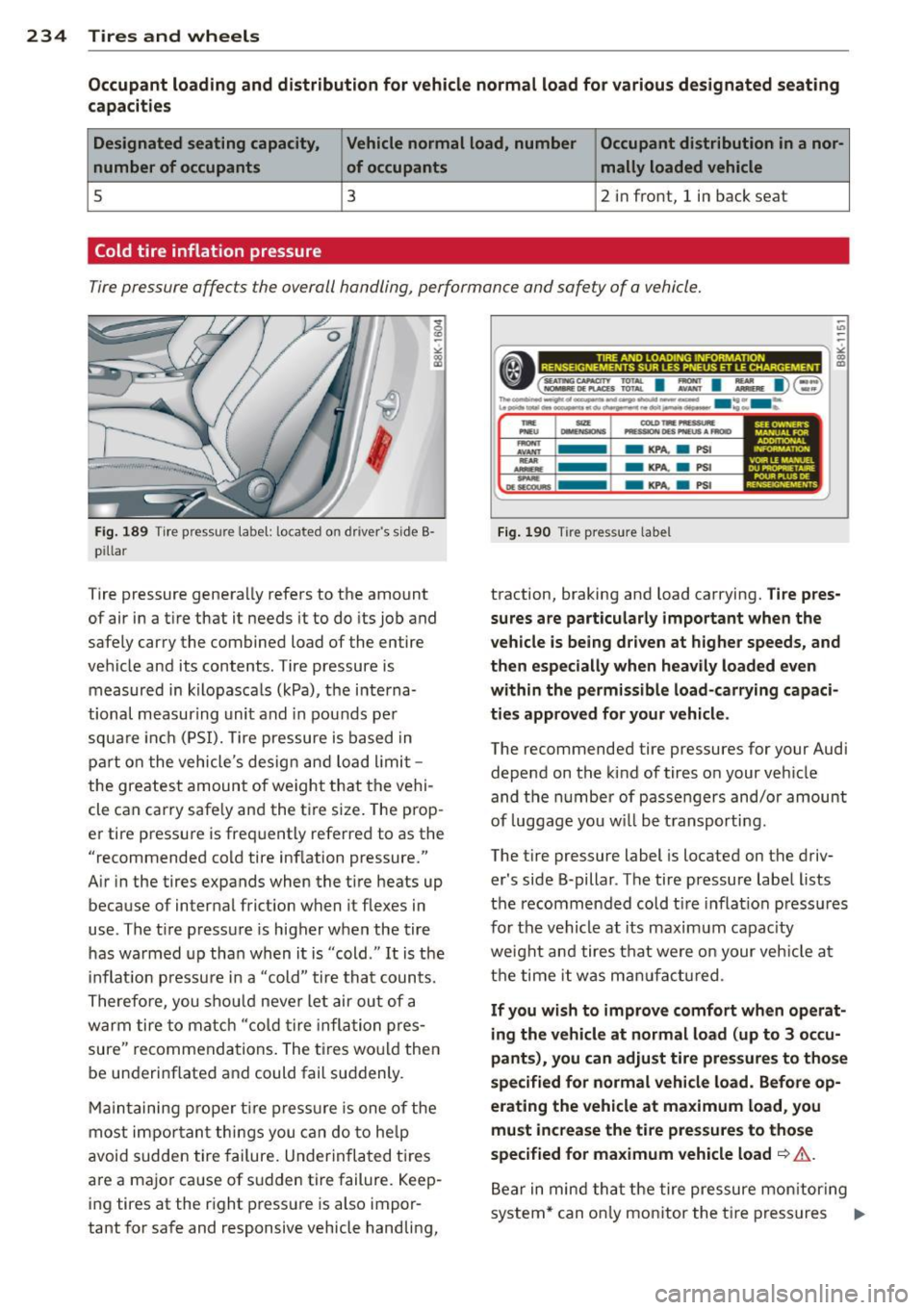
Fi g. 189 T ire press ure label : located on driver's side B·
p ill ar
Tire pressure genera lly refers to the amount
of air in a t ire that it needs it to do its job and
safely carry the combined load of the entire
vehicle and its contents . Tire pressure is
measured in kilopasca ls (kPa), the i nterna·
tional measur ing unit and in pou nds pe r
squa re inc h (PSI). Tire pressure is based in
p art o n the vehicle's design and load limit -
the greatest amount of weight that the vehi·
cle can carry safe ly and the t ire size . The prop·
er tire pressure is freq uently referred to as the
"recommended cold tire inf lation pressure."
A ir in the tires expands when the tire heats up
because of internal frict ion when it flexes in
use . The t ire p ressu re is higher when the tire
has wa rmed up tha n when it is "cold ." It is the
in flat ion pressu re i n a "cold" tire that counts.
Therefore, you shou ld neve r let air ou t of a
warm tire to match " co ld tire infl ation pres
sure" recommendations . The t ires wo uld then
be underinflated and could fail suddenly .
M ain taining p roper t ire pr essu re is one of the
most im po rt an t th ings you can do to he lp
avoid sudden tire failure. Underin fla ted t ires
a re a ma jo r cause of s udden tire failure. Keep·
i n g tires at the right pressure is also impor
tant for safe and responsive vehicle handling,
-U'>
-
---------------------- ,;
•(=~= I: I::... 1)§ :l!: n-...,....,....,~ ...... ~-...,..., ..... _ ... U ........ ~-·~N.-..-.we..... .... lllt-
-AVANT ...,.
-...... .. _
-KPA. a PSI
-KPA. a PSI
-KPA. a PSI
Fig. 190 Ti re pr essure labe l
SEE OWNEJICS MANUA1 FOA A,DOITl<>N.IU. INfORMATlON
VOIR L£ MANUll DUPR0ftlET""" P"OUR i-t.US DE RENSEIGMEMENfS
traction, braking and load carrying. Tire pres
sures are particularly important when the
vehicle is being driven at higher speeds, and
then especially when heavily loaded even
within the permissible load-carrying capaci
ties approved for your vehicle .
The recommended tire pressures for your Audi
depe nd on the kind of tires o n your ve hicle
and the numbe r of passe ngers and/o r amount
of luggage you w ill be t ransporti ng .
The tire pressure label is located on the driv
er 's side B-pillar . The tire pressure labe l lists
the recommended cold t ire inflat io n press ures
for the vehicle at its maximum capac ity
weight and tires t hat were o n your veh icle at
t h e time it was m anufactur ed .
If you wish to improve comfort wh en operat
ing the vehicle at normal load (up to 3 occu
pant s), you can ad just tire pre ssure s to tho se
specified f or normal vehicle load . Before op
erating the vehicle at maximum load, you
mu st increase the ti re pressures to those
specified for maximum vehicle load
~ ,&. .
Bear in min d that the tire pressure mon itor ing
system * can o nly mo nitor the tir e press ures .,.
Page 237 of 296
you have stored. The system does not recog
nize the load condition of your vehicle.
The effectiveness of the ti re pressu re monitor
ing sys tem* will be impaired if you store nor
mal load pressures but then operate the vehi
cle at its maximum load¢,& .
See the illustration ¢
fig. 189 for the location
of the label on dr iver's side B-pillar (color of
the actual labe l and exact location on the ve
hicle wi ll vary slig htly) .
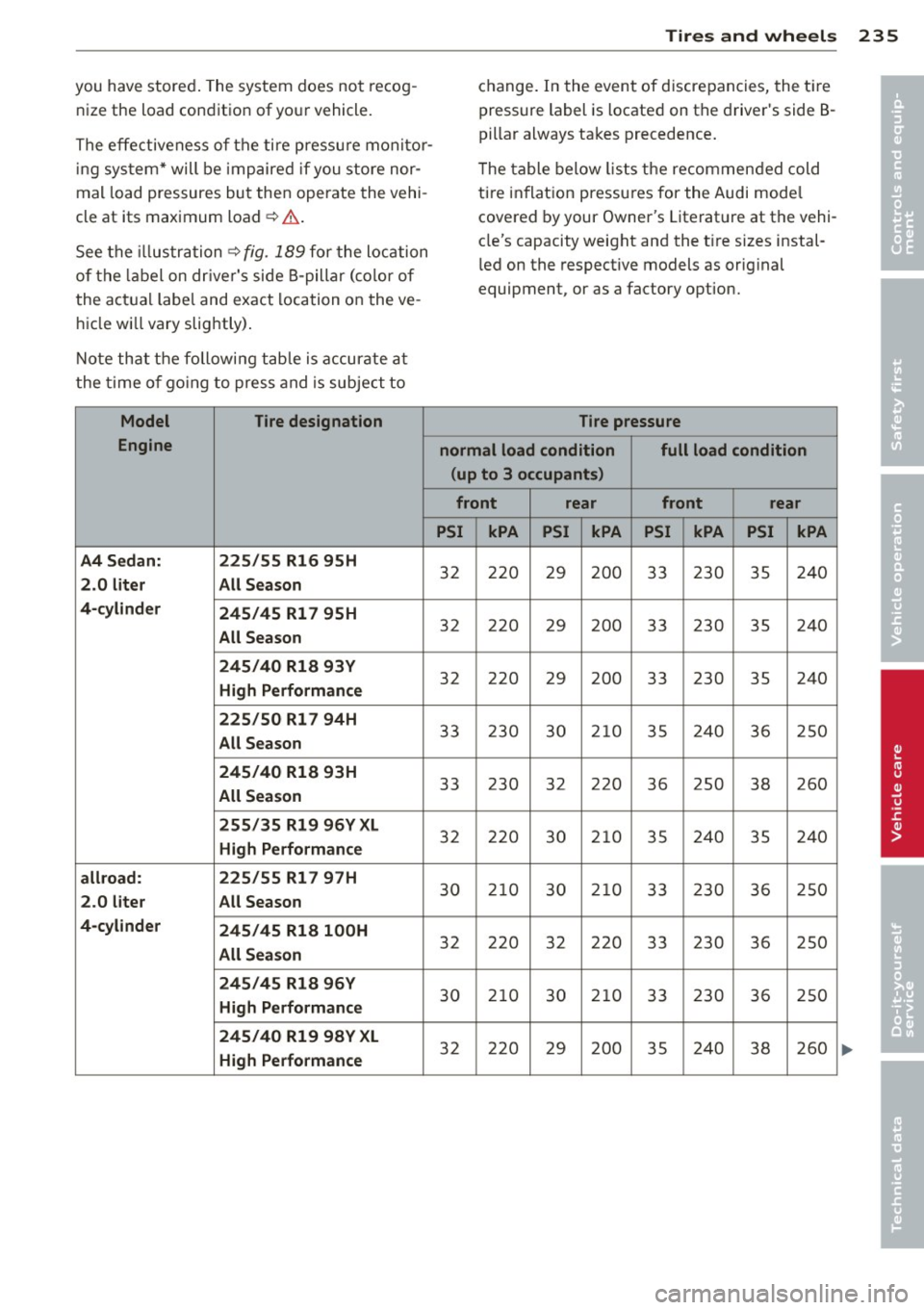
Note that the fo llowing tab le is accurate at
the t ime o f go ing to press and is subject to
Model Tire designation
Engine
A4 Sedan: 225/55 Rl6 95H
2 .0 lit er All Se ason
4 -cy linder
245/45 Rl 7 95H
All Se ason
2 4 5/ 40 Rl8 93Y
Hi gh P erf or mance
2 25/5 0 Rl 7 94H
All Sea son
2 4 5/ 40 Rl 8 93H
All Se ason
2 55 /35 Rl9 96Y XL
Hig h Perf ormanc e
a llro ad: 225/55 Rl 7 97 H
2.0 l it e r All Season
4 -cy lind er
245 /45 Rl 8 l00H
All Sea so n
2 45 /45 Rl8 96 Y
Hig h Perf or mance
245 /40 Rl9 98Y XL
High P erf or mance
Tire s an d wheel s 235
change. In the event of discrepancies, the ti re
pressure label is located on the driver's side B
pillar always takes precedence .
T he table below lists the recommended cold
ti re inflation pressures for the Audi mode l
covered by your Owner's Literature at the vehi
cle's capacity weight and the t ire sizes instal
l ed on the respective models as orig inal
equipment, or as a factory option.
Tire pressure
normal load condition full load condition
( up to 3 occupants )
f r ont rear front rear
PSI kPA PSI kPA PSI kPA PSI kPA
32 220 29 200 33 230 35 240
32 220 29 200 33 230 35 240
32 220 29 200 33 230 35 240
33 230 30 210 35 240 36 250
33 230
32 220
36 250
38 260
32 220 30 210 35 240 35 240
30 2 10 30 2 10 33 230 36 250
32 220 32 220 33 230 36 250
30 210 30 2 10 33 230 36 250
32 220 29 200 35 240
38 260
•
•
Page 238 of 296
236 Tires and wheels
Model Tire designation Tire pressure
Engine normal load condition full load condition
(up to 3 occupants)
front rear front rear
PSI kPA PSI kPA PSI kPA PSI kPA
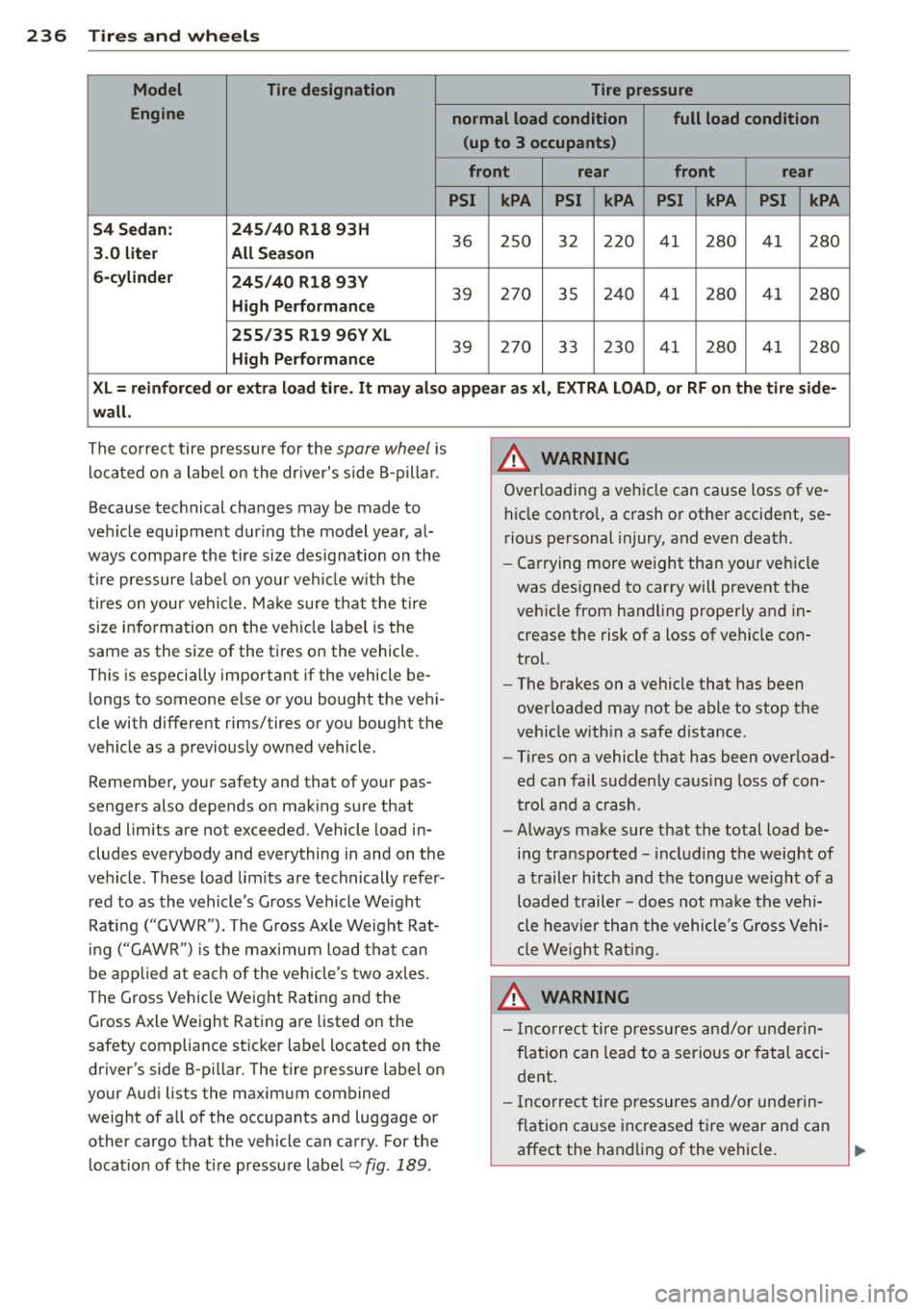
S4 Sedan : 245/40 Rl8 93H
36 250 32 220 41
280 41
280 3.0 liter All Sea son
6-cylinder 245/40 Rl8 93V
High Performance
39 270 3 5 24 0 41 28 0 41 280
255/35 Rl9 96V XL
39 270
33 230 41
280 41 280 High Perfo rmance
XL= reinforced or extra load tire. It may al so appear a s xl , EXTRA LOAD, or RF on the tire side-
wall.
The correct tire pressure for the spare wheel i s
l o cated on a label on the dr ive r's side B-p illa r.
Because tec hnical cha nges may be made to
ve hicle equ ipment dur ing the model yea r, a l
ways compa re the tire size designation on the
tire pressure labe l o n you r ve hicl e w it h the
tires on your vehicle. M ake s ure that the t ire
size info rmation on the veh icle label is the
same as the size of the t ire s on the vehicle.
This is especially important if the vehicle be
l ongs to someone else or you bought the veh i
cle with different rims/tires or you boug ht the
ve hicle as a p reviously owned vehicle.
Remembe r, your safety and that of your pas
sengers also depends on mak ing s ure that
load limits are not exceeded. Vehicle load in
cludes everybody and everything in and on the
ve hicle . These load lim its are technically refer
red to as th e vehicle's G ross Vehicle We ight
Rati ng ("GVWR"). The G ross Ax le Weight Rat
i ng ("GA WR") is the ma ximum load tha t can
be applied at each o f the veh icle's two axles.
T he G ross Vehicle We ig ht Rating and the
Gross Axle Weight Rating a re listed on the
safety compliance st ic k er labe l located on the
driver's side B-p illar. The tire pressure label on
your Aud i lists the maximum combined
weight of all of the occupants and luggage or
o ther cargo tha t the vehicl e can carry. For the
l ocat io n of the ti re pressu re labe l~
fig . 189 .
A WARNING
Overloadin g a vehicle can cause loss of ve
hi cle cont ro l, a c rash or other accident, se
rious pe rsonal injury, and even death.
- Ca rrying more we ight tha n your ve hicle
was des igned to carry will prevent the
veh icle from handling properly and in
crease the risk of a loss of vehicle con
trol.
- The brakes on a vehicle that has been
overloaded may not be able to stop the
ve hicle w ith in a safe distanc e.
- Tires on a vehicle that has been overload
ed can fail s uddenly ca us ing loss of con
trol and a crash.
- Always make sure that the total load be
i n g transported -including t he weight of
a trailer hitch and t he tongue we igh t of a
loaded tr ail er -does not ma ke t he ve hi
cle he avier th an the vehicle' s Gro ss V ehi
cle Weigh t Ra tin g.
.8_ WARNING
- In co rrec t tire pressure s and /or u nderin
fl ation can lead to a serio us or fatal acci
dent .
- I nco rrec t tire pressures an d/or un derin
fla tion ca use increased ti re wear an d can
affect the handling of the vehicle. .,.
Page 240 of 296
238 Tire s and whee ls
- Adjust the tire pressure to the load you are
carrying.
- Reinsta ll the va lve stem cap on the valve .
When should I ch eck the tire pres sur e?
The correct tire pressure is especially impor
tant at high speeds. The pressure should
therefore be checked at least once a month
and a lways before starting a journey. Do not
forget to check the tire pressure for the spare
wheel.
When should I adj ust the tire p re ss ures?
Adjust the tire pressure to the load you are
carry ing . After changing a wheel
o r replacing
wheels you have to adjust the tire pressures
on all wheels . In addition, you must then initi
alize the new tire pressures in the tire pres
sure monitoring system*~
page 249.
A WARNING
Incorrect tire pressures and/or underinf la
tion can lead sudden tire failure, loss of
control, collision, ser ious personal injury
or even death.
- When the
RI] warning symbol appears in
the instrument cluster, stop and inspect
the tires .
- Incorrect tire pressure and/or underinfla
t ion can cause increased t ire wear and
can affect the handling of the veh icle and
stopp ing ability.
- Incorrect tire pressures and/or underin
flation can also lead to sudden tire fa il
ure, including a blowout and sudden de
flation, causing loss of vehicle control.
- The driver is responsible for the correct
t ire pressures fo r all tires on the vehicle .
T he applicable p ressure va lues are locat
ed on a sticker on the driver's side B-pil
lar.
- Only when a ll ti res on the vehicle are fi l
led to the correct pressure, the tire pres
sure monitoring system* can work cor
rect ly.
- The use of incorrect tire pressure values
can lead to accidents or other damage.
Therefore it is essential that the driver observe the specified t
ire pressure values
for the tires and the correct pressures for
the function of the ti re pressure monitoring system*.
- Always inflate tires to the recommended
and correct t ire pressure before dr iv ing
off.
- Driving with underinflated tires bend
more, letting them get too hot resulting
in tread separation, sudden tire failure
and loss of control.
- Excessive speed and/overloading can
cause heat build-up, sudden tire failure
and loss of cont rol.
- If the tire pressure is too low or too high,
the t ires will wear prematurely and the
veh icle w ill not handle well.
- If the tire is not flat and you do not have
to change a wh eel immediately, drive at
reduced speed to the nearest service sta
tion to check the t ire p ressure and add
air as required.
Q) Note
D riving without valve stem caps can cause
damage to the tire valves. To prevent this,
a lways make sure tha t factory insta lled
valve stem caps on all whee ls are sec urely
mounted on the valve.
@ For the sake of the environment
U nderinflated tires w ill also incre ase the
fuel consumption .
Tires and vehicle load limits
There are limits to the amount of load or
weight that any veh icle and any tire can carry.
A vehicle that is over loaded will not handle
well and is more d iff icult to stop. Overloading
can not only lead to loss of vehicle control,
but can also damage important parts of the
vehicle and can lead to sudden tire fa ilure, in
clud ing a b lowout and sudden deflation tha t
can cause the vehicle to crash.
Your safety and that of your passengers also depends on making sure that load limits are .,..
Page 241 of 296
not exceeded . Vehicle load includes everybody
and everything in and on the vehicle. These
l oad limits are techn ica lly referred to as the
ve hicle's
Gross Veh icle We ight Rat ing
("GVWR").
The "GVWR" includes the weight of the basic
veh icle, all factory insta lled accessories, a full
tank of fu el, oil, coolant and other fluids plus
maximum load. The maximum load includes
the number of passengers that the vehicle is
i n tended to carry ("seating capacity") with a n
assumed weight of 150 lbs . (68 kg) for each
passenger at a des igna ted sea ting pos ition
and the tota l we ight of any l uggage in the ve
h icle. If you tow a trailer, the weight o f the
trailer hitch and the tong ue weight of the
l oaded trailer must be included as part of the
veh icle load.
The
Gro ss A xle Weight Rating ("GAWR") is
the maximum load that can be applied at each
of the vehicle's two ax les.
The G ross Vehicle We ight Rating and the
Gross Axle Weight Rating are listed on the
safety compliance sticker labe l located on the
driver's side B -pi llar . Your Audi has 5 seating
positions, 2 in the front and 3 in the rear for
tota l seating capacity of 5. Each seating posi
tion has a seat belt¢
page 138, Safety belts.
The fact that there is an upper limit to your
veh icle's Gross Vehicle Weight Rating means
that the tota l weight of whatever is being car
ried in the vehicle (including the weight of a
trailer hitch and the tongue weight of the
loaded trailer) is limited. The more passen
ge rs in the veh icle or passengers who are
h eav ier than the standa rd weights assumed
mean that less weight can be ca rr ied as l ug
gage.
The tire pressure labe l on you r Audi also lists
the maximum combined we ight of all of the
oc cu pants and luggage o r othe r ca rgo that
the vehicle can carry . For the location o f the
l abe l
¢page 234, fig. 189.
Tires an d wheel s 239
A WARNING
Overloading a vehicle can cause loss of ve
h icle contro l, a crash or other accident, se
rious pe rsonal injury, and even death.
- Carrying more we ight than your veh icle
was des igned to carry will prevent the
veh icle from handling properly and in
crease the risk of the loss of vehicle con
trol.
- The brakes on a vehicle that has been
overloaded may not be able to stop the
veh icle w ith in a safe distance.
- Tires on a vehicle that has been overload
ed can fail suddenly, incl uding a blowout
and sudden defla tion, causing loss of
contro l and a crash.
- Always ma ke sure that the total load be
ing transpor ted - incl uding the weight of
a trailer hitch and the tongue weight of a loaded trailer -does not ma ke the vehi
cle heavier than the vehicle's Gross Vehi
cle We ight Rating.
Determining correct load limit
U se th e example below to ca l
culate the total weight of the
pa ssengers and lu ggage or oth
e r thing s that you pl an t o tran s
po rt so that you can make sur e
that your vehicle will not be
o verloaded.
Steps for Determining
Correct Load Limit
1 . Lo cate th e statement "THE
COMBINED WEIGHT OF O C
CUPANTS AND CARGO
SHOULD NE VER E XCE ED XXX
KG OR XXX LBS"on your vehi-
c le 's pla card (tire inflation ..,
•
•
Page 242 of 296
240 Tires and wheels
pressure label) ¢ page 234,
fig. 189.
2. Determine the combined
weight of the driver and pas sengers that will be riding in
your vehicle.
3. Subtract the combined
weight of the driver and pas sengers from
"XXX" kilo
grams or
"XXX" pounds
shown on the sticker
¢ page 234, fig. 189.
4. The resulting figure equals
the available amount of car
go and luggage load capaci
ty. For example, if the
"XXX"
amount equals 1400 lbs.
and there will be five 150
lbs. passengers in your vehi
cle, the amount of available
cargo and luggage load ca
pacity is 650 lbs. (1400-750
(5
X 150) = 650 lbs.)
5. Determine the combined weight of luggage and cargo
being loaded on the vehicle .
That weight may not safely exceed the available cargo
and luggage load capacity
calculated in Step 4.
6. If your vehicle will be towing
a trailer, load from your trail
er will be transferred to your vehicle
. Consult this manual
to determine how this re duces the available cargo
and luggage load capacity of
your vehicle .
... check the tire sidewall
(¢ page 242, fig. 193) to de
termine the designated load rating for a specific tire.
Tire service life
The service life of tires depends on a lot of
different things including proper installation
and balancing, correct tire pressure and driv
ing style.
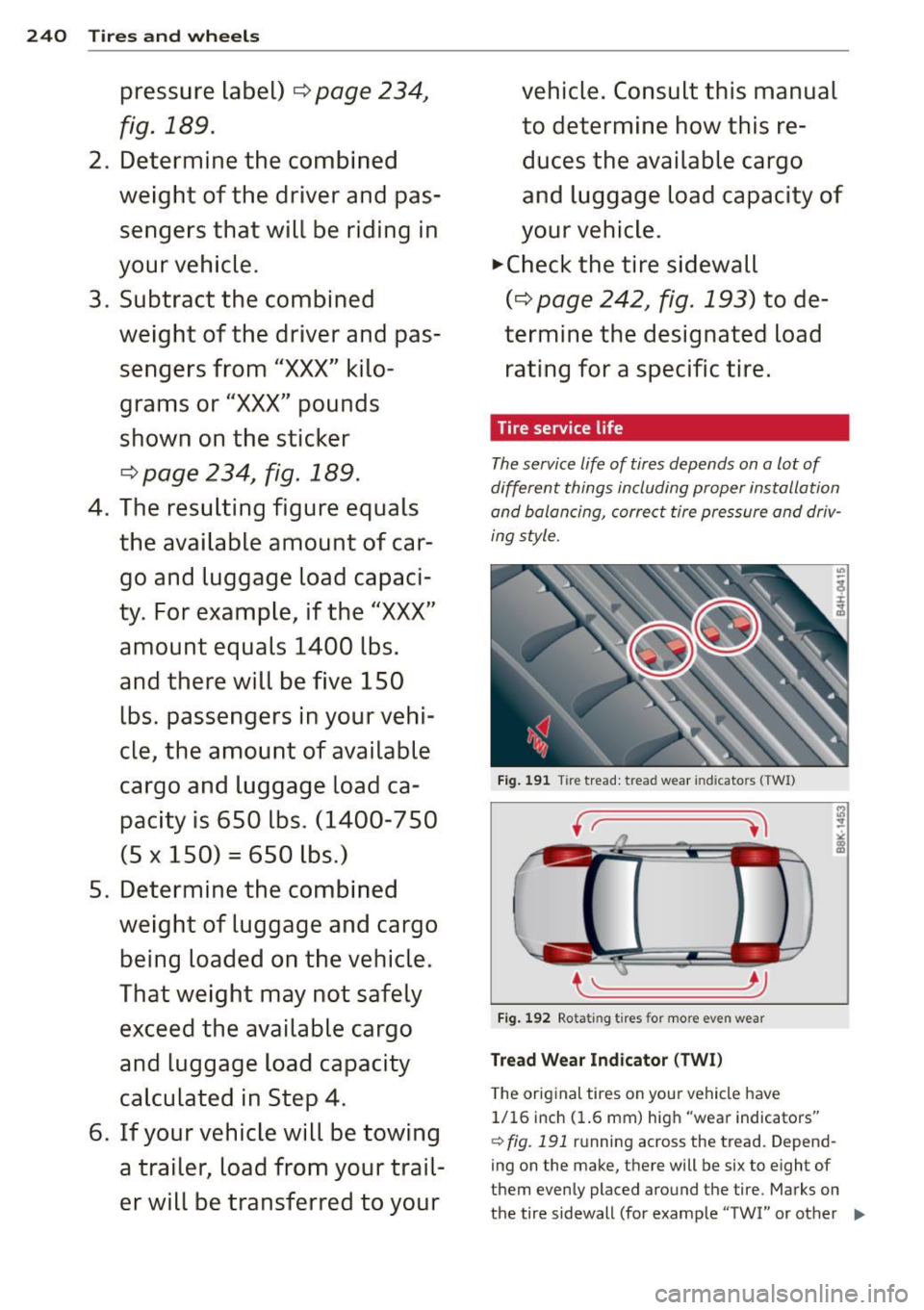
Fig. 191 T ire tread: tread wear ind icato rs (TWI)
____ Jj
Fig. 192 Rotating tires for more even wear
Tread Wear Indicator (TWI)
The original tires on you r vehicle have
1/16 inch (1.6 mm) high "wear indicators"
cf> fig. 191 running across the tread. Depend-
ing on the make, there will be six to eight of
them evenly placed around the tire. Marks on
the tire sidewall (for example "TWI" or other ..,.
Page 246 of 296
24 4 T ire s and wheel s
Tire pl y compo sit ion and materi als used
The numbe r of plies ind icates the n umber of
l ayers of rubber -coated fabric in the tire. In
general, the greater the number of p lies, the
more weight a tire can support . Tire manufac
turers also must indicate the materials in the
tire, wh ic h include steel, nylon, polyester, and
others.
M ax imum Load R ating
This number indicates the maximum load in
kilograms and pounds that can be carried by
the tire .
Tire quality grading for treadw ear ,
tr act ion, a nd t emper ature re sis tan ce
Tread wear, traction and temperature grades
c:> page245.
Max imum Permiss ibl e Inflation Pressur e
This numbe r is the greates t amo unt of air
p ress ure that sho uld ever be put in the ti re
under normal driving conditions .
A WARNING
-Us ing incorrect or unmatched tires and/
or wheels or improper tire and wheel
combinations can lead to loss of contro l,
co llision and serious persona l injury .
- Always use tires, rims and wheel bo lts
that meet the specifications of orig inal
factory-installed t ires or other combina
t ions that have been spec ifically ap
proved by the vehicle manufacturer.
- Tires age even if they are not be ing used
and can fail suddenly, especially at high
speeds. Tir es that are more than 6 years
o ld can only be used in an emergency
and then with special care and at lower
speeds.
- Never mount used ti res on yo ur vehicle if
yo u are not su re of their "previous histo
ry ." Old used tires may have been dam
aged even though the damage cannot be
seen that can lead to sudden tire failure and loss of vehicle control.
- All four wheels must be fitted with radia l
t ires of the same type, size (roll ing c ir- cumference) and the same tread pattern
.
Driving with different tires reduces vehi
cle handling and can lead to a loss of
control.
- If the spare tire is not the same as the
tires that are mounted on the vehicle -
for example with winter tires - only use
the spare t ire fo r a short pe riod of time
and d rive with extra care . Refit the nor
mal road wheel as soon as safely poss i
b le.
- Never d rive faster than the max imum
speed for which the tires on you r vehicle
are rated because tires that are dr iven
faster than their rated speed can fai l
suddenly .
- Overloading tires cause heat build-up,
sudden tire fa ilure, including a blowout
and sudden deflation and loss of cont ro l.
- Temperature grades apply to tires that are properly inflated and not over or un
de rinf lated .
- For technica l reasons it is not always
possible to use whee ls from other
veh icles -in some cases not even wheels
from the same veh icle model.
- If you install wheel trim discs on the ve
hicle wheels, make sure that the a ir flow
to the brakes is not blocked. Reduced air
f low to the brakes can them to overheat,
increas ing stopp ing distances and caus
ing a co llision.
- Run flat tires may only be used on veh icles that were equipped with them
at the factory. The veh icle must have a
chassis designed for run flat tires and a
f a ctory -inst alled tire pressure monitor
ing sys tem * that indicates a loss of tire
pressu re . I ncorrect use of run flat tires
can lead to vehicle damage or accidents.
Check with an authorized Audi dealer or
tire specialist to see if your vehicle can be
equ ipped w ith run flat t ires. If run flat
tires are used, they must be installed on
all fo ur wheels . Mix ing tire types is not
pe rm itted.
Page 272 of 296
2 70 Emergency situations
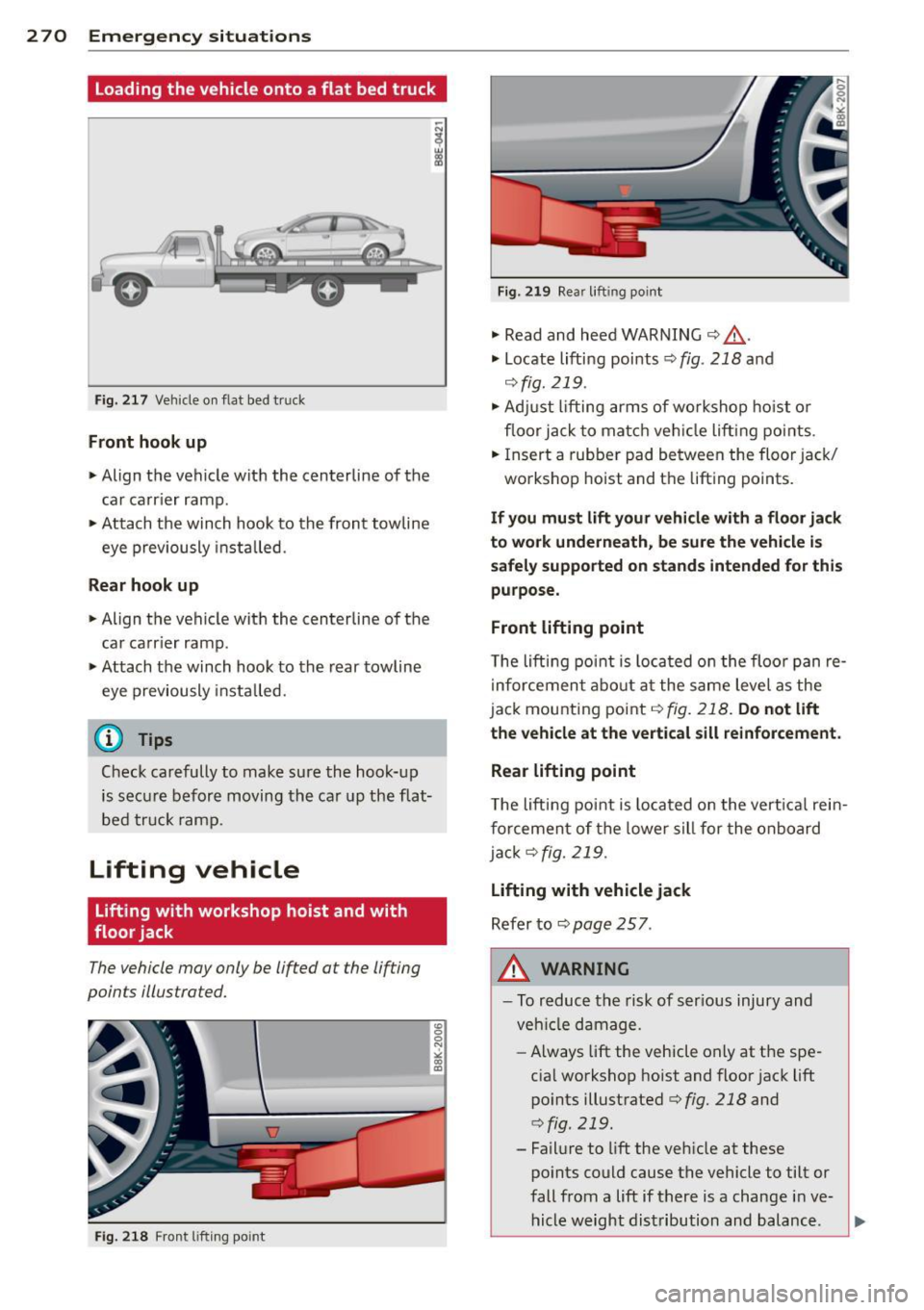
loading the vehicle onto a flat bed truck
Fig. 217 Vehicle on flat bed tr uck
Front hook up
• Align the vehicle with the centerline of the
car carr ier ramp .
• Attach the winch hook to the front towline
eye previously insta lled .
Rear hook up
• Align the vehicle with the centerline of the
car carr ier ramp.
• Attach the winch hook to the rear towline
eye previously insta lled.
@ Tips
Check carefully to make sure the hook-up
is secure before moving the car up the flat·
bed truck ramp .
Lifting vehicle
lifting with workshop hoist and with
floor jack
The vehicle may only be li~ed at the lifting
points illustrated.
Fig. 218 Front lift ing po int
:g 0 N
" O> a,
Fig. 219 Rear lifting point
• Read and heed WARNING ¢ &_ .
• Locate lifting points r::!> fig . 218 and
¢ fig. 219 .
• Adjust lifting arms of workshop hoist or
floor jack to match vehicle lifting points .
• Insert a rubber pad between the floor jack/
workshop hoist and the lifting points.
If you must lift your vehicle with a floor jack
to work underneath, be sure the vehicle is
safely supported on stands intended for this
purpose.
Front lifting point
The lifting point is located on the floor pan re
i nforcement about at the same leve l as the
jack mounting point
¢ fig. 218. Do not lift
the vehicle at the vertical sill reinforcement.
Rear lifting point
The lifting point is located on the vert ical rein
forcement of the lower sill for the onboard
jack ¢
fig. 219 .
lifting with vehicle jack
Refer to r:!> page 2 5 7.
A WARNING
= -
-To reduce the risk of ser ious injury and
veh icle damage.
- Always lift the vehicle only at the spe
cial workshop hoist and floor jack lift
points illustrated
¢ fig. 218 and
¢ fig. 219.
- Failure to lift the vehicle at these
points could cause the vehicle to tilt or
fall from a lift if there is a change in ve-
hicle weight distribution and balance.
~
Page 273 of 296
This might happen, for example, when
heavy components such as the engine
b lock or transmiss io n are removed .
- When removing heavy components like
these, anchor vehicle to ho ist or add cor
responding weig hts to mai nta in the cen
ter of g ravity. Otherwise, the veh icle
m ight tilt o r slip off t he hois t, causi ng
serious p ersona l injury.
(I) Note
- Be awa re of th e fo llowing points befo re
li fting the vehicle:
- The vehicle should never be lifted or
jacked up from underneath the engine oil pan , the transmission housing , the
front or rear axle or the body s ide
members. This could lead to ser ious
damage.
- To avoid damage to the underbody or
chassis frame , a rubber pad must be
inserted between the floor jack and
the lift points .
-Before driv ing over a workshop hoist,
check that the vehicle weight does not
exceed the permi ssible lifting capacity
of the hoi st.
- Before driv ing over a workshop hoist,
ensure that there i s sufficient clear
ance between the hoist and low parts
of the vehicle.
Emergency situations 2 71
•
•
Page 274 of 296
272 Technical Data
Technical Data
Vehicle identification
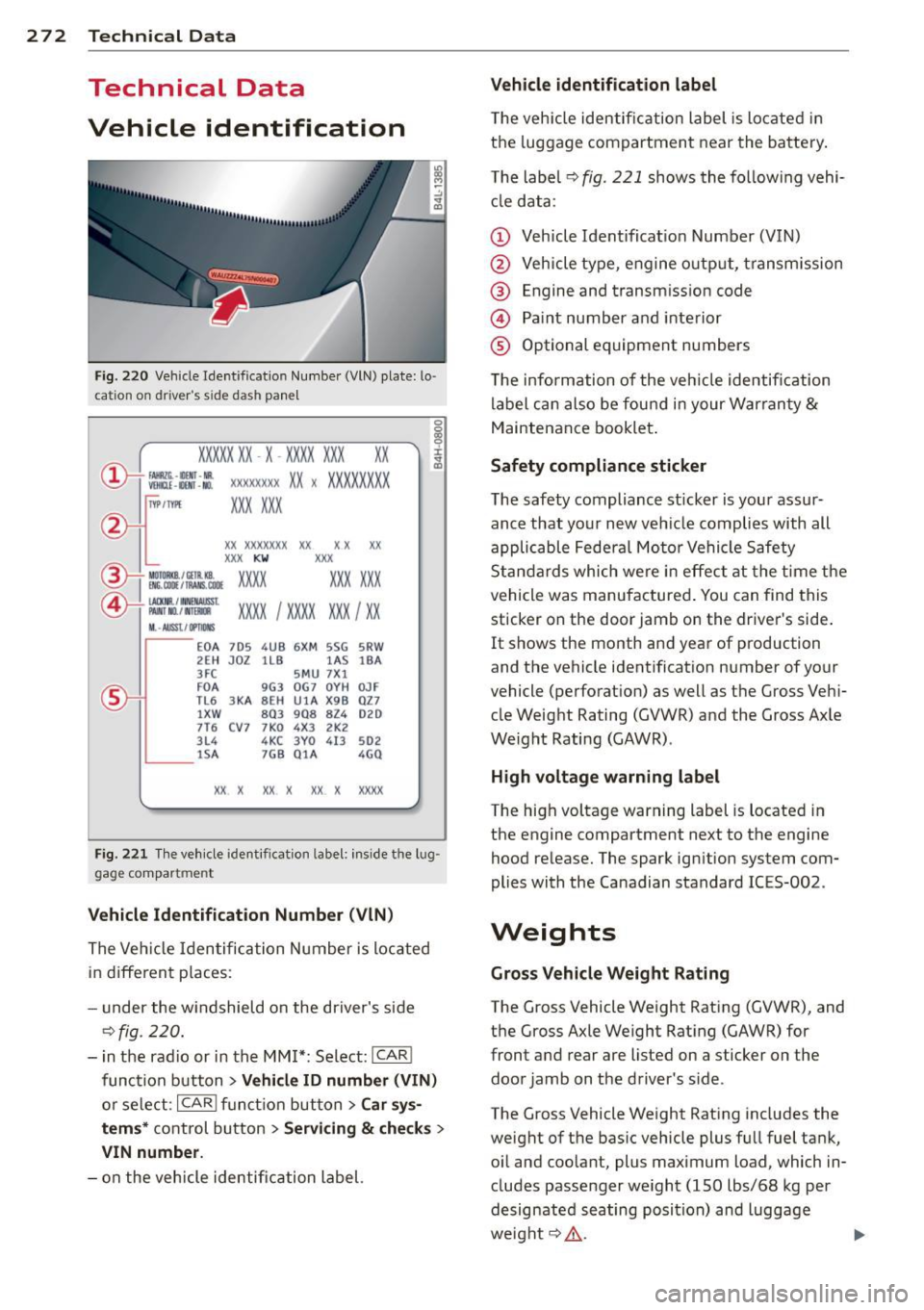
Fig . 220 Vehicle Ident ification Number (VlN) plate: lo ·
cation on driver 's s ide dash panel
XXXXX XX · X -XXXX XXX
r,"\__l f~ -11!111 · NII. ~ V!Hlll -llllll . NO.
xx
XXXXXXXX XX X XXXXXXXX
XXX XXX IYP IT'fl'E
XX XXXXXXX XX X X XX
XXX
KW XXX
®i ~~:f :l~~ XXXX XXX XXX
@+ ~~r= XXXX I XXXX XXX I XX M ,. AIIISl./ lflllllS
EOA 7D5 4 UB 6XM SSG 5RW
2E H JDZ llB l AS lBA
3FC 5MU 7Xl
FO A
9G3 OG7 O
YH OJF
TL6 3
KA BEH
UlA X9B QZ 7
l XW
8Q3 9Q8 82 4 020
7T6 CV 7 7KO 4X3 2K2
3L4 4 KC 3YO 4I3 502
lS A 7GB Q1A 4GQ
XX X
XX X XX X XXXX
Fig. 221 The vehicle identi fication label: ins ide the l ug
gage compart men t
Vehicle Identification Number (VlN)
The Vehicle Identification Number is located
in different pla ces :
- under the windshield on the driver's side
~fig. 220.
-in the radio or in the MM!": Select: I CAR!
function button >
Vehicle ID number (VIN)
or select: ICAR!function button> Car sys
tems* control button > Servicing & checks >
VIN number.
-on the vehicle identification label.
Vehicle identification label
The veh icle identification label is located in
the luggage compartment near the battery.
T he labe l~
fig. 221 shows the following vehi
cle data :
(D Vehicle Identificat ion Number (VIN)
@ Vehicle type, engine o utput, transmission
@ Engine and transm ission code
@ Paint number and interior
® Optional equipment numbers
T he information of the vehicle identification
label can also be found in your Warranty
&
Maintenance booklet.
Safety compliance sticker
The safety compliance sticker is your assur
ance that your new vehicle complies with all applicable Federal Motor Vehicle Safety
Standards which were in effect at the time the
vehicle was manufactured . You can find this
sticker on the door jamb on the driver's side .
It shows the month and year of production
and the vehicle ident ification number of your
vehicle (perforation) as well as the Gross Veh i
cle Weight Rating (GVWR) and the Gross Ax le
Weight Rating (GAWR) .
High voltage warning label
The high voltage warning label is located in
the engine compartment next to the engine
hood release. The spark ignition system com
plies with the Canadian standard ICES-002 .
Weights
Gross Vehicle Weight Rating
The Gross Vehicle Weight Rating (GVWR), and
the Gross Axle Weight Rating (GAWR) for
front and rear are listed on a sticker on the
door jamb on the driver 's s ide .
The Gross Vehicle Weight Rating includes the
weight of the basic vehicle plus full fuel tank,
o il and coolant, plus maximum load , which in
cludes passenger we ight (150 lbs/68 kg per
designated seating position) and luggage
we ight~ _&.