brake fluid AUDI S4 2014 Owners Manual
[x] Cancel search | Manufacturer: AUDI, Model Year: 2014, Model line: S4, Model: AUDI S4 2014Pages: 296, PDF Size: 73.56 MB
Page 17 of 296
Instruments and warning/indicator lights 15
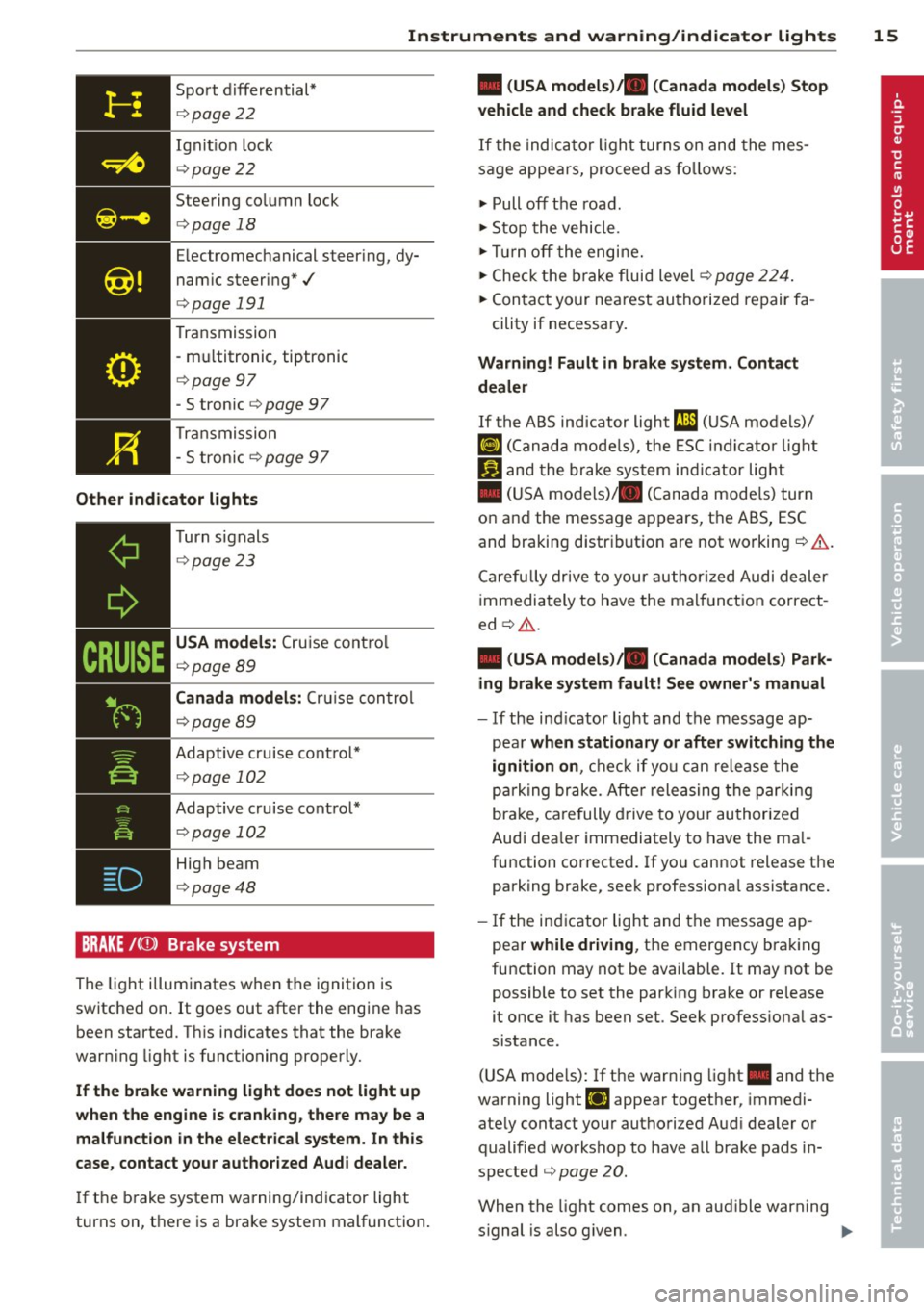
Sport d iffer ential*
¢ page 22
Ign it io n loc k
¢pag e 22
Steering co lumn lock
¢ pag e 18
Electromec hanical steer ing, dy
nam ic steer ing* ./
¢pag e 191
Transmission
- m ultitronic, tiptronic
¢ page 97
- S tronic
¢ page 97
T ran smi ssio n
- S tron ic
¢p age 9 7
Other indicator lights
CRUISE
Turn s ignals
¢ page 23
USA models: Cr uise con trol
¢page 89
Canada models: Crui se con tro l
¢p age89
Adaptive cruise cont ro l*
¢ page 102
Adaptive c ruise cont rol *
¢ page 1 02
High beam
¢ pag e48
BRAKE /((J)) Brake system
The light illum inates when the ignition is
switche d on .
It goes out after the engi ne has
been started. Th is in dicates that the bra ke
warn ing light is functioning properly.
If the brake warning light does not light up
when the engine is cranking , there may be a
malfunction in the electrical system. In this
case, contact your authorized Audi dealer.
I f t he b rake sy stem warning/ind icator light
turns on, t here is a bra ke system malfunction .
• (USA models)/ . (Canada models) Stop
vehicle and check brake fluid level
If t he indic ator lig ht tu rns on and the m es
s a ge a ppe ars, pro ceed as fo llows:
.,. Pull off t he roa d.
.,. Sto p t he vehicle .
.,. Turn off t he engi ne.
.,. Check t he bra ke fluid level ¢
page 224.
.,. Con tact yo ur nea rest au thorized re pair fa -
cility if necessary .
Warning! Fault in brake system. Contact
dealer
If the ABS ind icator light CD (USA mode ls)/
lG) < C anad a mo de ls), the ESC in dicato r light
If.) and the bra ke sys tem in dicat or lig ht
• (US A mo dels)/ . (Canada mode ls) turn
o n and the messa ge appears, the ABS, ESC
and brakin g distr ibution are not workin g¢ &. .
C arefu lly dr ive to your author ized Au di de aler
immedi ately to have the ma lf u nct ion correct
ed ¢&. .
• (USA models)/ . (Canada models) Park
ing brake system fault! See owner's manual
- If th e in di cator light and the m essag e ap -
pe ar
when stationary or after switching the
ignition on ,
check if yo u ca n re le a se the
p arki ng br ake. Afte r relea sing the park ing
bra ke, ca re fully drive to your au thori zed
A udi dea le r i mmediately to have the ma l
fu nct ion corrected . If yo u cannot release t he
parking brake, see k professiona l assistance .
- If the in dicator light and the message ap
pea r
while driving , th e e mergency bra king
fu nction may not be available. It may not be
possible to set the par king brake or re lease
it once it has been set. Seek profess io na l as
sistance.
( U SA mode ls) : If th e warn ing lig ht. and the
warning light
fi] appear togethe r, immedi
ate ly contact yo ur aut horized Aud i dealer o r
qualified wo rks hop t o have a ll brake pads in
s p ected
¢ page 20.
When the light comes on, an aud ible warning
s ignal is also g iven. .,.
Page 18 of 296
16 Instrum ent s and w arn ing /indic ato r light s
A WARNING
-Always observe the warnings in
i=> page 214, before opening the hood
and checking the brake fluid.
- Driv ing with low brake fluid is a safety
hazard. Stop the car and get professional
assistance.
- If the . (USA
models) ;II (Canada
models) brake system indicator l ight
turns on together with the ABS and ESC indicator lights, the ABS/ESC regu lating
function may have failed. F unctions that
stabilize the vehicle are no longer availa
ble. This could cause the vehicle to
swerve and increase the risk of sliding .
Drive carefu lly to the nearest authorized
Audi dealer or other qualified workshop
and have the malfunction corrected.
- If the brake warning/indicator light does not go out after a few seconds and the
park ing brake is released, or lights up
wh ile you are driving, the fluid level in
the brake fluid reservoir is too low . If you
believe tha t it is safe to do so, proceed
immediately at low speed to the nearest
authorized Audi dealer or qualified work shop and have the bra ke system inspect
ed.
- Always keep in m ind that after several
brake applications, yo u will need greater
pressure on the b rake peda l to stop your
vehicle. Do not re ly on strained brakes to
respond w ith maximum stopp ing power
in critical situations. You must allow for
increased brak ing distances . The extra
distance used up by fad ing brakes could
lead to an acc ident.
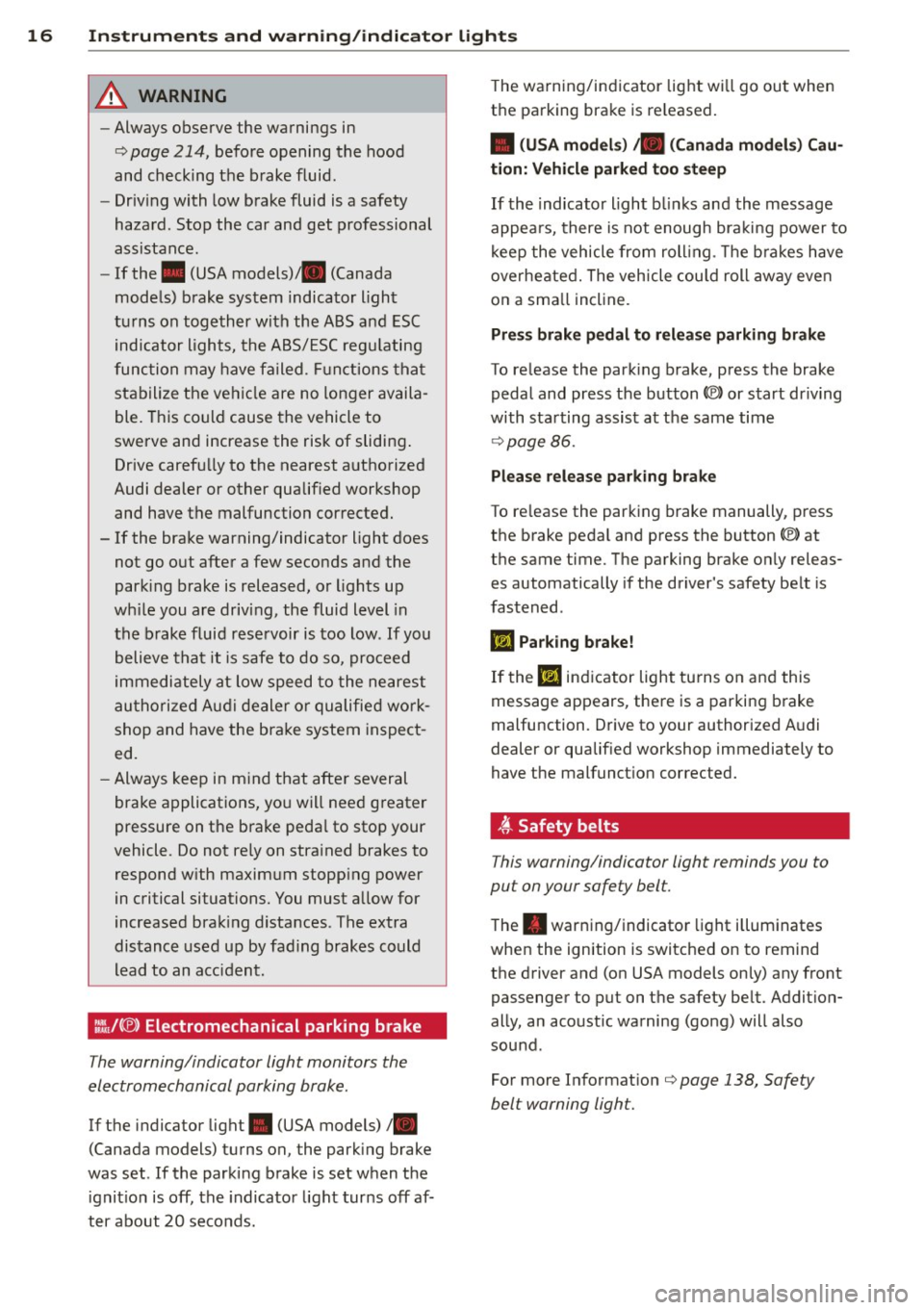
:fil.J(® ) Electromechanical parking brake
The warning/indicator light monitors the
electromechanical parking brake .
If the indicator light. (USA models)/ .
(Canada models) turns on, the park ing brake
was set . If the parking brake is set when the
ignit ion is off, the indicator light turns off af
ter about 20 seconds. T
he warn ing/indicator light wi ll go out when
the parking brake is re leased.
• (USA model s) /. (Canada mod els) Cau
ti on: Vehicle parke d too steep
If the indicato r light b links and the message
appea rs, there is not enough bra king power to
k eep the vehicle from roll ing . T he brakes have
overheated. The veh icle cou ld roll away even
on a sma ll incline.
Pre ss brak e pedal to rel eas e parking brake
To re lease the park ing brake, press the brake
pedal and press the button(®) or start driving
with sta rting assist at t he same time
i=> page 86.
Pl ease r elea se parking brake
To re lease the park ing brake manually, p ress
the brake pedal and press the button®) at
the same time. The parking brake on ly releas
es automatically if the driver's safety be lt is
fastened.
Iii Parking brake!
If t he Iii ind icator light tu rns o n and this
message appears, there is a parking brake
malfunction. Drive to your authorized A udi
dealer or qualified workshop immediately to
have the malfunct ion corrected.
~ Safety belts
This warning/indicator light reminds you to
put on your safety belt.
T he . warning/ indicator light illuminates
when the ignition is switched on to remind
the driver and (on USA models only) any front
passenger to put on the safety be lt. Addit ion
ally, an acoustic warning (gong) will also
sound.
For more Informat ion
c:> page 138, Safety
belt warning light.
Page 192 of 296
190 Intelligent technology
Operating conditions and d riving hab it s
The brakes on today 's automob iles are st ill
subject to wear, depending largely on operat
ing conditions and driving habits
c::> ,& . On
vehicles that are either driven mostly in stop
and-go city traffic or are driven hard, the
brake pads should be checked by your author
ized Audi dealer more often than specified in
the
W arranty & M ainte nance booklet . Failure
to have your brake pads inspected can result
in reduced b rake pe rformance.
On steep slopes, you should use the brak ing
effect of the eng ine . This way, you prevent un
necessa ry wear on the brake system. If you
must use you r brakes, do not hold the brakes
down continuously . P u mp the b rakes at inter
va ls.
Operating nois e
Noises may occur when braking depending on
the speed, braking force and outside condi
tions such as temperature and humidity .
Effect of w ater and ro ad sa lt
In certain situat ions, for example after driving
through wate r, in heavy ra in, after overn ight
condensation or after washing your car, the brak ing effect can be reduced by moistu re or
i ce on the bra ke roto rs and b rake pads . The
b rakes must be dried fi rst with a few ca ref ul
brake app lications .
At h igher speeds and with the w indshie ld w ip
e rs turned on, the brake pads press agains t
the bra ke rotors for a short amount of time.
This occurs a t regular intervals without the
driver noticing and provides for better brake response time under wet conditions.
The effectiveness of the brakes can be reduced
when the vehicle is driven on a salt-covered
road and the brakes are not used. Likewise,
you clean off accumulated sa lt coating from
brake discs and pads with a few caut ious ap
plications of the brake
c::> ,& .
Cor rosion
There may be a tendency for dirt to bui ld up
on the brake pads and corrosion to form on the d
iscs if the car is not driven regu larly or
o n Ly for short trips with litt le use of the
brakes.
If t he brakes a re not used frequently, o r if cor
r os ion has formed on the discs, it is adv isable
to clean off the pads and discs by braking
firmly a few times from a moderately h igh
speed
c::> .&. .
Fault s in the brak e syst em
If you shou ld notice a sudden increase in
brake pedal trave l, then one of the two brake
circuits may have fai led
c::> .& .
Low br ake fluid lev el
Malfunctions ca n occu r in the b ra ke system if
t h e b rake fluid level is too low. The brake flu id
l evel is monitored electronica lly.
Brake booster
The brake booster inc reases the pressure that
you generate with the b rake peda l. It works
o n ly when the engine is runn ing
.c::> .&
Brake lining wear status
Brake lining wear may be checked by visual in
spect io n of the condition of the brake pads
th rough the open ings in the wheel. If neces
sary, the wheel may be removed fo r thi s i n
spe ct ion
c::> page 255, Changing a wheel.
.&, WARNING
- New b rake pads don' t have the bes t stop
ping power and m ust be "bro ken -in" dur
ing the initial 100 to 150 miles (150 to
200 kilometers) of normal c ity driving.
You can compensate for this by pressing the brake pedal more firmly. Th is also
applies later when new pads are instal
led.
- You shou ld perform braking maneuvers
for the purpose of cleaning the brake
system only if road conditions permit.
Othe r road use rs must no t be put at risk -
you may ca use an accident!
- Before descend ing a steep grade, reduce
speed and sh ift transmission into a lower
gear or lower dr iving range. Do not ride
~
Page 216 of 296
214 Checking and filling
Checking and filling
Engine hood
Releasing and opening the engine hood
The engine hood is released from inside the
vehicle .
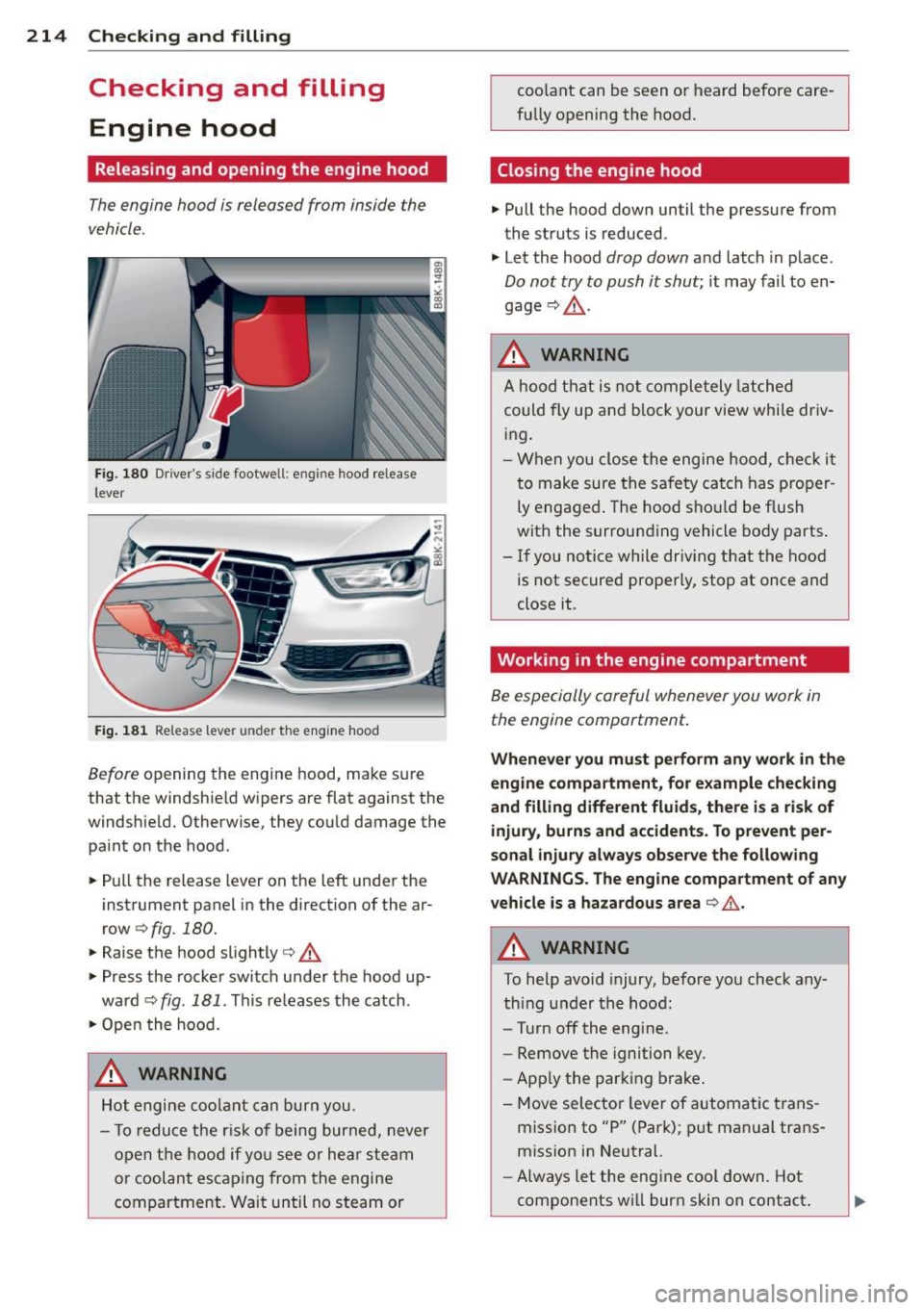
Fig. 180 Driver's side footwe ll: e ngin e hood release
lever
... -- - -=-
Fig. 181 Release lever u nde r the engine hood
Before opening the engine hood, make sure
that the windshield wipers are flat against the
windshield. Otherwise, they could damage the
pa int on the hood.
... Pull the release lever on the left under the
instrument panel in the direction of the ar
row
c;, fig . 180.
... Raise the hood slightly r::;, .&,
... Press the rocker switch under the hood up
ward
c;, fig . 181 . This releases the catch.
... Open the hood.
A WARNING
Hot engine coo lant can burn you.
- T o reduce the risk of being burned, never
open the hood if you see or hear steam
or coolant escaping from the engine
compartment. Wait until no steam or coo
lant can be seen or heard before care
fully opening the hood.
Closing the engine hood
... Pull the hood down until the pressure from
the struts is reduced .
... Let the hood
drop down and latch in place.
Do not try to push it shut; it may fail to en
gage
r::;, .&, .
A WARNING
-
A hood that is not completely latched
could fly up and b lock your view while driv
ing.
- When you close the engine hood, check it
to make sure the safety catch has proper
ly engaged . The hood shou ld be flush
with the surrounding vehicle body parts.
-If you notice while driving that the hood
is not secured properly, stop at once and
close it.
Working in the engine compartment
Be especially careful whenever you work in
the engine compartment.
Whenever you must perform any work in the
engine compartment, for example checking
and filling different fluids , there is a risk of
injury , burns and accidents. To prevent per
sonal injury always observe the following
WARNINGS. The engine compartment of any
vehicle is a hazardous area
r::;, ,&..
A WARNING
-To help avoid injury, before you check any-
thing under the hood:
- Turn off the engine.
- Remove the ignition key.
- Apply the parking brake.
- Move selector lever of automatic trans-
mission to "P" (Park); put manual trans
mission in Neutral.
- Always let the engine cool down. Hot
components will burn skin on contact .
Page 217 of 296
-To reduce the r isk of being burned, never
open the hood if you see or hear steam
or coolant escaping from the engine
compartment . Wait until no steam or
coolant can be seen or heard before ca re
fully opening the hood .
- Keep children away from the engine com
partment.
- Never spill flu ids on hot engine compo
nents. They can cause a fire .
- Never touch the radiator fan. The aux ili
ary e lectr ic fan is temperature controlled
and can switch on suddenly .
- Never open the coolant reservoir cap
when the eng ine is still warm . The cool
ant system is pressur ized and hot coo l
ant could spray out.
- Protect your face, hands and arm from
steam or hot eng ine coolant by placing a
thic k rag over the cap when you open the
coolant reservoir.
- Do not remove the engine cover under
any c ircumstances. Th is increases the
risk of bu rns.
- If wo rk on the fuel system or the electri
cal sys tem is ne cessary:
- Always disconnect the battery.
- Never smoke or work near heaters or
open flames . Fluids in the engine com
partment co uld start a fire.
- Keep an approved fire extinguisher im
mediately ava ilable.
- To avoid electrical s hock and persona l in
jury while the engine is running or being
started, never touch:
- Ignition cables
- Other components of the high voltage
electronic ignition system.
- If you must perform a check or repa ir
with the engine running:
- Fir st, fully apply the parking brake,
move se lector lever of a utomatic trans-
Checkin g and fillin g 215
mission to "P" (Park); put manual
transmission in Neutral.
- Always use extreme caution to prevent
clothing, jewe lry, or long hair from get
ting caught in the radiator fan, V-be lts
or other moving parts, or from contact i ng hot parts . Tie back hair before
starting, and do not wear clothing that
will hang o r droop into the engine .
- Minimize exposure to emission and
chemical hazards~&. .
A WARNING
California Proposition 65 Warning:
- Engine exhaust, some of its const ituents,
a nd certain vehicle components contain
or emit chemicals known to the State of
Ca lifornia to cause cance r and birth de
fects and reproductive harm. In addition, certain fl uids contained in veh icles and
certain products of component wear con
tain or emit chemica ls known to the
State of California to cause cancer and
birth defects or other reproductive harm.
- Battery posts, terminals and related ac
cessories conta in lead and lead com
pounds, chemicals known to the State of
California to cause cancer and reproduc
tive harms. Wash hands afte r handling.
Q) Note
When adding f lu ids, always make sure that
they are poured into the proper conta iner
or f iller opening, otherwise serious dam
age to vehicle systems w ill occur .
@ For the sake of the environment
To detect leaks in time, inspect the vehicle
floor pan from underneath regular ly . If
you see spots from oil or other veh icle flu
i ds, have your vehicle inspected by an au
thorized Audi dealer. •
•
Page 226 of 296
224 Checking and filling
Brake fluid
Checking brake fluid level
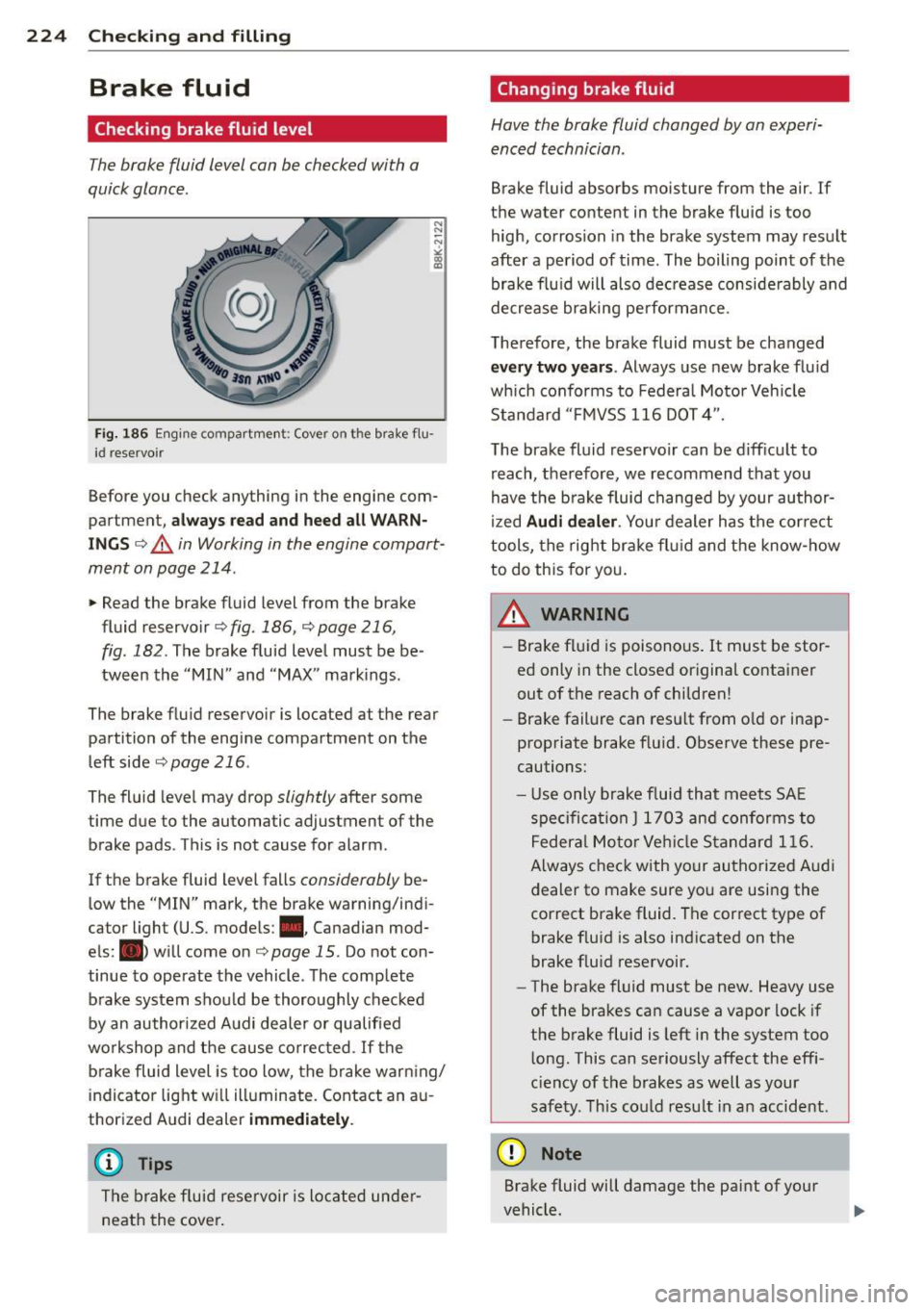
The brake fluid level can be checked with a
quick glance .
N N ~ N
" (X) (0
Fig. 186 Engine compart ment: Cover on the brake flu·
id reservo ir
Before you check anything in the engine com
partment,
always read and heed all WARN·
INGS ¢.&._ in Working in the engine compart
ment on page 214 .
.. Read the brake fluid level from the brake
fluid reservoir ¢
fig. 186, ¢ page 216,
fig . 182.
The brake fluid level must be be
tween the "MIN" and
"MAX" markings.
The brake fluid reservoir is located at the rear
partition of the engine compartment on the
left side
¢ page 216.
The fluid level may drop slightly after some
time due to the automatic adjustment of the
brake pads . This is not cause for alarm.
If the brake fluid level falls
considerably be
low the "MIN" mark, the brake warning/indi
cator light (U.S. models: ., Canadian mod
els: .) will come on¢
page 15. Do not con
tinue to operate the vehicle . The complete
brake system should be thoroughly checked
by an authorized Audi dealer or qualified
workshop and the cause corrected .
If the
brake fluid level is too low, the brake warning/
indicator light will illuminate. Contact an au
thorized Audi dealer
immediately .
@ Tips
The brake fluid reservoir is located under
neath the cover.
Changing brake fluid
Have the brake fluid changed by an experi
enced technician .
Brake fluid absorbs moisture from the air. If
t he water content in the brake fluid is too
high, corrosion in the brake system may result
after a period of time . The boiling point of the
brake flu id will also decrease conside rably and
decrease braking pe rformance.
Therefore, the brake fluid must be changed
every two years . Always use new brake flu id
which conforms to Federal Motor Vehicle
Standard "FMVSS 116 DOT 4".
The brake fluid reservoir can be difficult to reach, therefore, we recommend that you
have the brake fluid changed by your author
ized
Audi dealer. Your dealer has the correct
tools, the right brake fluid and the know-how
to do this for you .
A WARNING
- Brake fluid is poisonous . It must be stor
ed only in the closed original container
out of the reach of children!
- Brake failure can resu lt from o ld or inap
propriate brake fluid. Observe these pre
cautions:
- Use only brake fluid that meets SA E
specification
J 1703 and conforms to
Federal Motor Vehicle Standard 116.
Always check with your authorized Audi
dealer to make sure you are using the
correct brake fluid. The correct type of
brake f luid is also indicated on the
brake fluid reservoir.
- The brake fluid must be new. Heavy use
of the brakes can cause a vapor lock if
the brake fluid is left in the system too
long . This can seriously affect the effi
c iency of the brakes as well as your
safety. This could resu lt in an accident.
(D Note
Brake fluid will damage the paint of your
vehicle .
Page 227 of 296
@ For the sake of the environment
Because of the pr oblem of proper d isposa l
of brake flu id as we ll as the special tools
requ ired and the necessary expert ise, we
recommend that you have the brake fluid
changed by your author ized Audi dealer .
Battery
General information
Under normal operating conditions, the bat
tery in your Audi does not need any mainte
nance. With
high outside temperatures or
long daily dr ives we recommend that you have
the electro lyte level checked by an authorized
Aud i dealer or qualified workshop . The elec
trolyte leve l should also be checked each time
the battery is charged ¢
page 22 7.
H ave the battery checked when you take your
ve hicle in for service . Yo u are well adv ised to
replace a battery that is older than 5 yea rs .
W ith certa in types of a irbag deployment, t he
b attery is d isconnected from the vehicle elec
tr ica l system for safety reasons¢.&.
in Re
pair, care and disposal of the airbags on
page 159.
Disconnecting the battery terminals
Some vehicle functions (power w indow regu
lators , for example) are lost if the battery ter
m inals a re d isconnected. These func tions have
to be re lea rned after the batte ry term inals a re
connected agai n. T o prevent this , the bat tery
should only be d isconnec ted from the vehicle
e lec tric al system when absolu tely necessa ry
for repairs .
Vehicles not driven for long periods
If you do not drive you r vehicle over a period
of severa l days or weeks, elec trical compo
nen ts are gr adually cut b ack o r swi tched off .
This redu ces energy cons umption and main
tains starting capab ility over a longer per io d
¢ page 193.
Some o f the conven ience f unctions m ay not
ope rate, su ch as the in ter ior lig hts or t he
Checkin g and fillin g 225
power seat adjus tment. The convenience
funct io ns w ill be available again when yo u
turn o n the ign ition and start the engine.
Winter operation
D ur ing the w inte r mon ths, bat tery capa city
tends to dec rease as tempera tures drop . This
is beca use more power is a lso consumed wh ile
starting, and the headlights, rear window de
fogge r, etc., are used more often.
Avoid unnecessary powe r consumpt ion, pa r
ticular ly in city traffic or when traveling only
sho rt distances. Let yo ur authorized A udi
dealer check the capacity of the vehicle bat
tery before w inter sets in
¢ page 227. A well
charged battery will no t on ly prevent star tin g
problems w hen the weather is cold, but w ill
also last longer .
@ Tips
If your vehicle is left standing for seve ral
weeks at extremely low temperatures, the
vehicle battery s hou ld be removed and
stored where it will not freeze . This will
p revent it from be ing damaged and having
to be repla ced .
Working on the battery
Be especially careful when working on or near
the bat tery.
The battery is located in the luggage compar t
ment under the floor . B efo re you che ck any
thi ng in the luggage compartment,
read and
heed all WARNINGS
¢ ,&. .
Always heed the safety warnings , when work
i ng on the veh icle batte ry or t he vehicle e lec
t rical sys tem to p reven t inju ry.
The following WARNINGS are very
important when working on the battery:
Always heed the following WARNING SYM· BO LS and safety precautions when working
on the battery .
®
Always wear eye protection.
•
•
Page 241 of 296
not exceeded . Vehicle load includes everybody
and everything in and on the vehicle. These
l oad limits are techn ica lly referred to as the
ve hicle's
Gross Veh icle We ight Rat ing
("GVWR").
The "GVWR" includes the weight of the basic
veh icle, all factory insta lled accessories, a full
tank of fu el, oil, coolant and other fluids plus
maximum load. The maximum load includes
the number of passengers that the vehicle is
i n tended to carry ("seating capacity") with a n
assumed weight of 150 lbs . (68 kg) for each
passenger at a des igna ted sea ting pos ition
and the tota l we ight of any l uggage in the ve
h icle. If you tow a trailer, the weight o f the
trailer hitch and the tong ue weight of the
l oaded trailer must be included as part of the
veh icle load.
The
Gro ss A xle Weight Rating ("GAWR") is
the maximum load that can be applied at each
of the vehicle's two ax les.
The G ross Vehicle We ight Rating and the
Gross Axle Weight Rating are listed on the
safety compliance sticker labe l located on the
driver's side B -pi llar . Your Audi has 5 seating
positions, 2 in the front and 3 in the rear for
tota l seating capacity of 5. Each seating posi
tion has a seat belt¢
page 138, Safety belts.
The fact that there is an upper limit to your
veh icle's Gross Vehicle Weight Rating means
that the tota l weight of whatever is being car
ried in the vehicle (including the weight of a
trailer hitch and the tongue weight of the
loaded trailer) is limited. The more passen
ge rs in the veh icle or passengers who are
h eav ier than the standa rd weights assumed
mean that less weight can be ca rr ied as l ug
gage.
The tire pressure labe l on you r Audi also lists
the maximum combined we ight of all of the
oc cu pants and luggage o r othe r ca rgo that
the vehicle can carry . For the location o f the
l abe l
¢page 234, fig. 189.
Tires an d wheel s 239
A WARNING
Overloading a vehicle can cause loss of ve
h icle contro l, a crash or other accident, se
rious pe rsonal injury, and even death.
- Carrying more we ight than your veh icle
was des igned to carry will prevent the
veh icle from handling properly and in
crease the risk of the loss of vehicle con
trol.
- The brakes on a vehicle that has been
overloaded may not be able to stop the
veh icle w ith in a safe distance.
- Tires on a vehicle that has been overload
ed can fail suddenly, incl uding a blowout
and sudden defla tion, causing loss of
contro l and a crash.
- Always ma ke sure that the total load be
ing transpor ted - incl uding the weight of
a trailer hitch and the tongue weight of a loaded trailer -does not ma ke the vehi
cle heavier than the vehicle's Gross Vehi
cle We ight Rating.
Determining correct load limit
U se th e example below to ca l
culate the total weight of the
pa ssengers and lu ggage or oth
e r thing s that you pl an t o tran s
po rt so that you can make sur e
that your vehicle will not be
o verloaded.
Steps for Determining
Correct Load Limit
1 . Lo cate th e statement "THE
COMBINED WEIGHT OF O C
CUPANTS AND CARGO
SHOULD NE VER E XCE ED XXX
KG OR XXX LBS"on your vehi-
c le 's pla card (tire inflation ..,
•
•
Page 243 of 296
symbols) indicate the positions of the tread
wear indicators. Worn tires must be replaced.
Different fig ures may apply in other co untries
c:> .&. .
Tir e pres sure
Incorrect tire pressure causes premature wear
and can cause sudden tire blow -out. For this
reason, tire pressure must be checked at least
once a month
<=:> page 237.
Driving sty le
Driving fast around curves , heavy acceleration
and hard braking increase tire wear .
Rotating tires for mo re even wear
For all four t ires on your vehicle to have the
same se rvice life, we recommend that the
fro nt and rea r tires are rotated according to
the t ire manufacture r's suggested tire rota
tion intervals. Please remember the follow
ing:
- T ire rotat ion inte rva ls may differ from the
vehicle service intervals outlined in your
Maintenance and Wa rranty Booklet .
- T he longer one tire is used in one location
on the vehicle, the more it wears at certa in
points; therefore, we recommend that you
fo llow the t ire manufacturer's suggested
t ire rotation intervals .
- Vehicles with front -wheel drive experience
more tread wear on the front wheels com
pared to all whee l drive (quattro).
- Please rotate tires as shown
<=:> fig. 192.
-Extra care must be taken when rotating di-
rection-specific tires
c:> page 259 .
Wheel balancing
The wheels on new vehicles are balanced .
H oweve r, va rio us situations d uring eve ryday
driving can cause them to be come unbal
anced, resu lting in vibrations you can us ually
feel through the steering wheel.
Unba lanced whee ls must be rebalanced to
avoid excessive wea r on s teer ing , suspens ion
and tires. A wheel must a lso be rebalanced
when a new tire is installed.
Tire s an d wheel s 241
Incorrect wh eel alignment
Incor rect wheel alignment can cause exces
sive tire wear, impairing the sa fety of the vehi
cle . If tires show excessive wear, have the
whee l alignment checked by an authorized
Audi dealer or qualified workshop.
All wheel drive
Vehicles wi th quattro must always have tires
of the same size, construction and tread type.
For details see
<=:> page 192.
_8 WARNING
Sudden tire fa ilure can lead to loss o f con
trol, a crash and serio us personal in jury!
- Never drive a vehicle when the tread on
any tire is worn down to the wear indica
tors.
- Worn ti res are a safety hazard, they do
not grip well on wet roads and increase
your r isk of "hydroplaning" and loss of
control.
- Always keep chemicals that can cause
tire damage, such as grease, o il, gasoline
and brake fluid away from tires.
- Tires age even if they are not being used
and can fail sudden ly, especially at high
speeds. T ires that are more than 6 years
old can only be used in an emergency
and then w ith special care and at lower
speeds.
- Never mount used tires on your veh icle if
you are not sure of thei r "previo us histo
ry ." O ld used tires may have been dam
aged even thoug h the damage cannot be
seen that can lead to sudden tire fai lure
and loss of vehicle control. •
•
Page 279 of 296
-Always make sure the transm ission se
lector lever (automatic transmiss ion) is
in "P" (Park position) or Neutral (manual
transmission) and the park brake is firm
ly appl ied .
® For the sake of the environment
-Changing the eng ine settings w ill ad
versely affect em ission levels. This is det
rimental to the environment and increas
es fuel consumption .
- Always observe env ironmental regula
tions when d ispos ing of old engine oil,
used brake fluid, dirty engine coolant,
spent batter ies or worn out t ires.
- Undeployed airbag modules and p reten
s ioners might be classified as Perchlo
rate Material -special handling may ap
ply, see www.dtsc.ca .gov/hazardous
waste/perch lorate . When the veh icle or
parts of the restraint system including
airbag modules safety belts with preten
s ioners are scrapped, all applicable laws
and regulations must be observed. Your
authorized Audi dealer is familiar w ith
these requirements and we recommend
that you have your dealer perform this
serv ice for you .
Additional accessories,
modifications and
parts replacement
Additional accessories and parts
replacement
Always consult on authorized Audi dealer be
fore purchasing accessories.
Your veh icle incorporates the latest safety de
sign featu res ensu ring a high standard of ac
tive and passive safety.
This safety could be compromised by non-ap
proved changes to the veh icle. For this reason ,
if parts have to be replaced, p lease observe
the following points when installing addition
al accessories:
Con sumer In formation 2 77
Approved Audi accessories and genuine Audi
parts are available from authorized Audi deal
er.
T hese dea lers a lso have the necessary facili
ties, tools and trained specialists to install the
parts and accessories proper ly.
A WARNING
Using the wrong spare parts or using non
approved accessories can cause damage to
the vehicle and serious persona l injury.
- Use on ly accessories express ly approved
by Audi and genuine Audi spare parts
- These parts and accessories have been
specially designed to be used on your ve
hicle.
- Never install accessories such as tele
phone cradles or beverage holders on air
bag covers or within the airbag deploy
ment zones . Do ing so will increase the
risk of injury if a irbags are triggered in an
accident!
- Before you check anything in the engine
compartment, always read and heed all
WARNINGS ~
page 214.
(D Note
-If items other than genuine Audi spare
parts, add-on equipment and accessory
items are used or if repair work is not
performed accord ing to specified meth
ods, this can result in severe damage to
your vehicle's engine and body (such as
corrosion) and adversely affect your vehi
cle's warranty .
- If emergency repairs must be performed
elsewhere, have the vehicle examined by
an authorized Audi dealer as soon as
possible.
- The manufacturer cannot be held liable
for damage wh ich occurs due to failure
to comply with these stipulations.
•
•