roof AUDI S4 2015 Owner's Manual
[x] Cancel search | Manufacturer: AUDI, Model Year: 2015, Model line: S4, Model: AUDI S4 2015Pages: 304, PDF Size: 74.86 MB
Page 171 of 304
'"" N
0 ::.,: co ,...., \!) 1.1'1 ,...., 1.1'1 ,....,
A WARNING 1-=
Not using a child safety seat, using the
wrong child safety seat or improperly in
stalling a child restraint increases the risk
of serious personal injury and death .
-All vehicle occupants and especially chil dren must always be restrained properly
whenever riding in a vehicle.
~
- An unrestrained or improperly restrain
ed child can be injured or killed by be
ing thrown against the inside of the ve
hicle or by being ejected from it during
a sudden maneuver or impact.
- An unrestrained or improperly restrain
ed child is at much greater risk of injury
or death by being struck by an inflating
airbag.
- Commercially available child safety seats
are required to comply with U.S. Federal
Motor Vehicle Safety Standard (FMVSS)
213 (in Canada CMVSS 213).
- When buying a child restraint, select
one that fits your child and the vehicle.
- Only use child restraint systems that
fully contact the flat portion of the
seat cushion. The child restraint must
not tip or lean to either side. Audi does
not recommend using child safety
seats that rest on legs or tube-like
frames . They do not provide adequate
contact with the seat.
-Always heed all legal requirements per
taining to the installation and use of
child safety seats and carefully follow
the instructions provided by the manu
facturer of the seat you are using.
- Never allow children under 57 inches
(1.45 meters) to wear a normal safety
belt. They must always be restrained by a
proper child restraint system. Otherwise,
they could sustain injuries to the abdo
men and neck areas during sudden brak
ing maneuvers or accidents.
- Never let more than one child occupy a
child safety seat.
Child Safety 169
- Never let babies or older children ride in
a vehicle while sitting on the lap of an
other passenger.
- Holding a child in your arms is never a
substitute for a child restraint system.
- The strongest person could not hold
the child with the forces that exist in
an accident. The child will strike the in
terior of the vehicle and can also be
struck by the passenger.
- The child and the passenger can also
injure each other in an accident.
- Never install rearward-facing child safety
seats or infant carriers on the front pas
senger seat. A child will be seriously in
jured and can be killed when the passen
ger airbag inflates -even with an Ad
vanced Airbag System .
- The inflating airbag will hit the child
safety seat or infant carrier with great
force and will smash the child safety
seat and child against the backrest,
center arm rest, door or roof.
-Always install rearward-facing child
safety seats or infant carriers on the
rear seat.
- Forward-facing child safety seats instal
led on the front passenger's seat can in
terfere with the airbag when it inflates
and cause serious injury to the child. Al
ways install forward-facing child safety seats on the rear seat .
- If exceptional circumstances require the
use of a forward-facing child restraint on
the front passenger's seat, the child's
safety and well-being require that the
following special precautions be taken:
- Make sure the forward-facing seat has
been designed and certified by its man
ufacturer for use on a front seat with a
passenger front and side airbag .
- Always carefully follow the manufac
turer's instructions provided with the
child safety seat or carrier.
- Always move the front passenger seat into the rearmost position of the pas-
senger seat's fore and aft adjustment
~
•
•
Page 173 of 304
Child safety seats
Infant seats
Babies and infants up to about one year old
and 20 lbs. or 9 kg need special rearward -fac
ing child restraints that support the back,
neck and head in a crash.
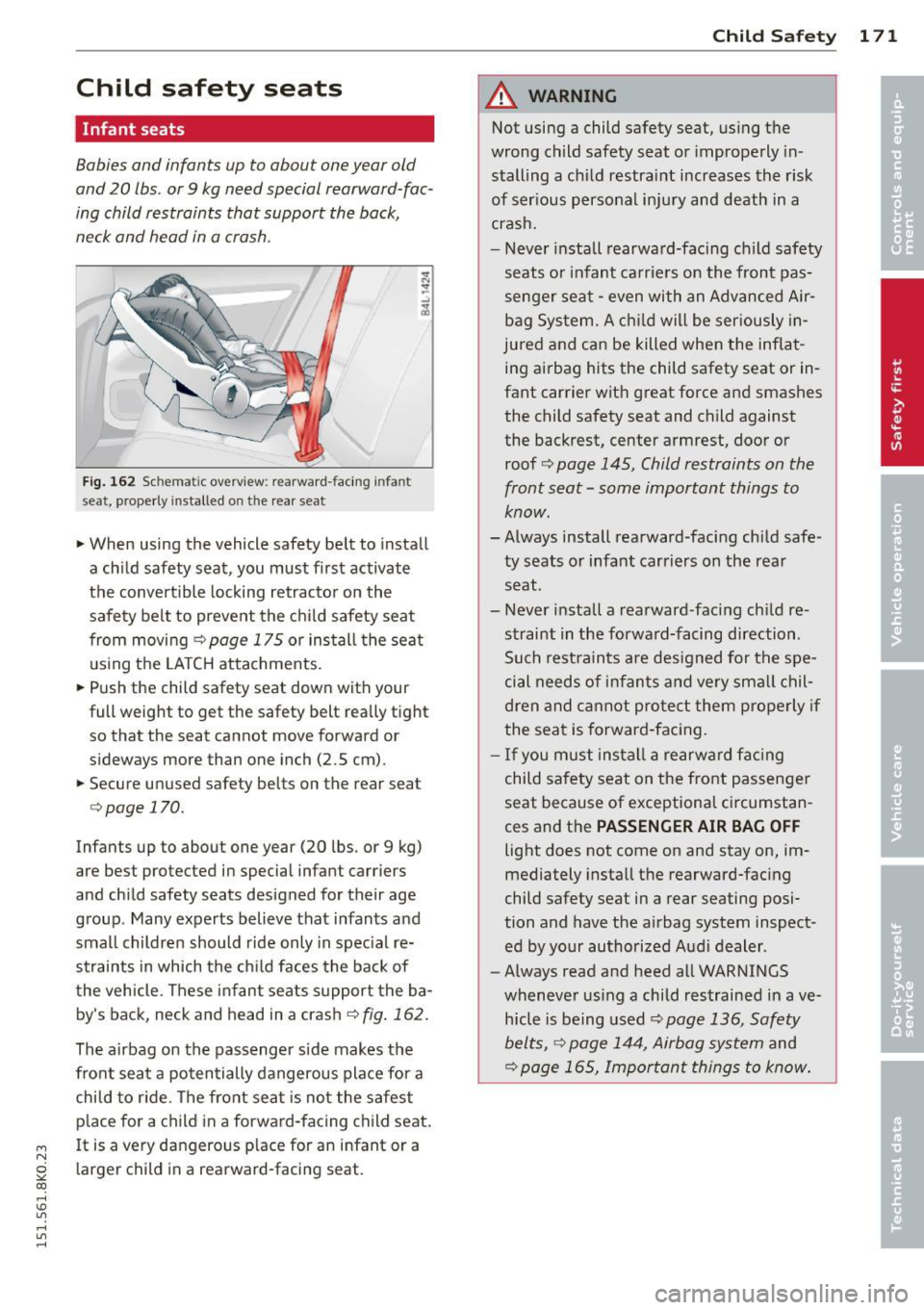
Fig . 162 Sche matic overv iew: rearward-fac ing infant
seat, properly installed o n the rear seat
.,. When using the vehicle safety belt to install
a ch ild safety seat, you must first activate
the convertible locking retracto r on the
safety be lt to prevent the child safety seat
from moving
¢ page 175 or install the seat
using the LA T CH attachments.
.,. Push the child safety seat down with your
full weight to get the safety belt rea lly tight
so that the seat cannot move forward or
sideways more than one inch (2.5 cm).
.,. Secure unused safety belts on the rear seat
¢page 170.
Infants up to about one year (20 lbs . or 9 kg)
are best protected in special infan t carriers
and child safety seats designed for their age
group . Many experts believe that infants and
small children should ride only in spec ial re
straints in which the ch ild faces the back of
the vehicle. These infant seats support the ba
by's back, neck and head in a crash
¢ fig . 162.
The airbag on the passenger side makes the
front seat a po tentially dangerous place for a
child to r ide . The front seat is not the safest
p lace for a child in a forward -facing child seat.
"" It is a very dangerous p lace for an infant or a
N
~ larger ch ild in a rearward-facing seat.
co
rl I.O
"' rl
"' rl
Child Safety 1 71
A WARNING
Not using a child safety seat, using t he
wrong child safety seat or improperly in
stall ing a ch ild restraint increases the risk
of ser ious personal injury and death in a
crash.
- Never install rearwa rd-facing child safety
seats or infant ca rr ie rs on the front pas
senger seat -even with an Advanced Air
bag Sys tem. A ch ild will be ser iously in
jured and ca n be killed when the inflat
ing airbag hits the child safety seat or in
fant carrier with great force and smashes the child safety seat and child against
the backrest, center armrest, door or
roof ¢
page 145, Child restraints on the
front seat- some important things to
know .
-Always install rearward -facing chi ld safe
ty seats or infant carriers on the rea r
seat .
- Never install a rea rward -facing ch ild re
straint in the forward-facing direction .
Such rest ra in ts are designed for the spe
cial needs of infants a nd ve ry sma ll chil
d ren and cannot pro te ct them p roperly if
the seat is forward -facing.
- If you must insta ll a rearwa rd fac ing
child safety seat on the front passenger
seat because of exceptiona l circumstan
ces and the
PASSENGER AIR BAG OFF
light does not come on and stay on, im
mediately install t he rearward-facing
child safety seat in a rear seating posi
tion and have the airbag system inspect ed by your autho riz ed Audi dealer .
- Always read and heed all WARNINGS
wheneve r us ing a child restrained in ave
h icle is being used ¢
page 136, Safety
belts,
Q page 144, Airbag system and
¢ page 165, Impor tan t thi ngs to know .
Page 174 of 304
172 Child Safety
Convertible child safety seats
Properly used convertible child safety seats
can help protect toddlers and children over
age one who weigh between
20 and 40 lbs. (9
and 18 kg) in a crash.
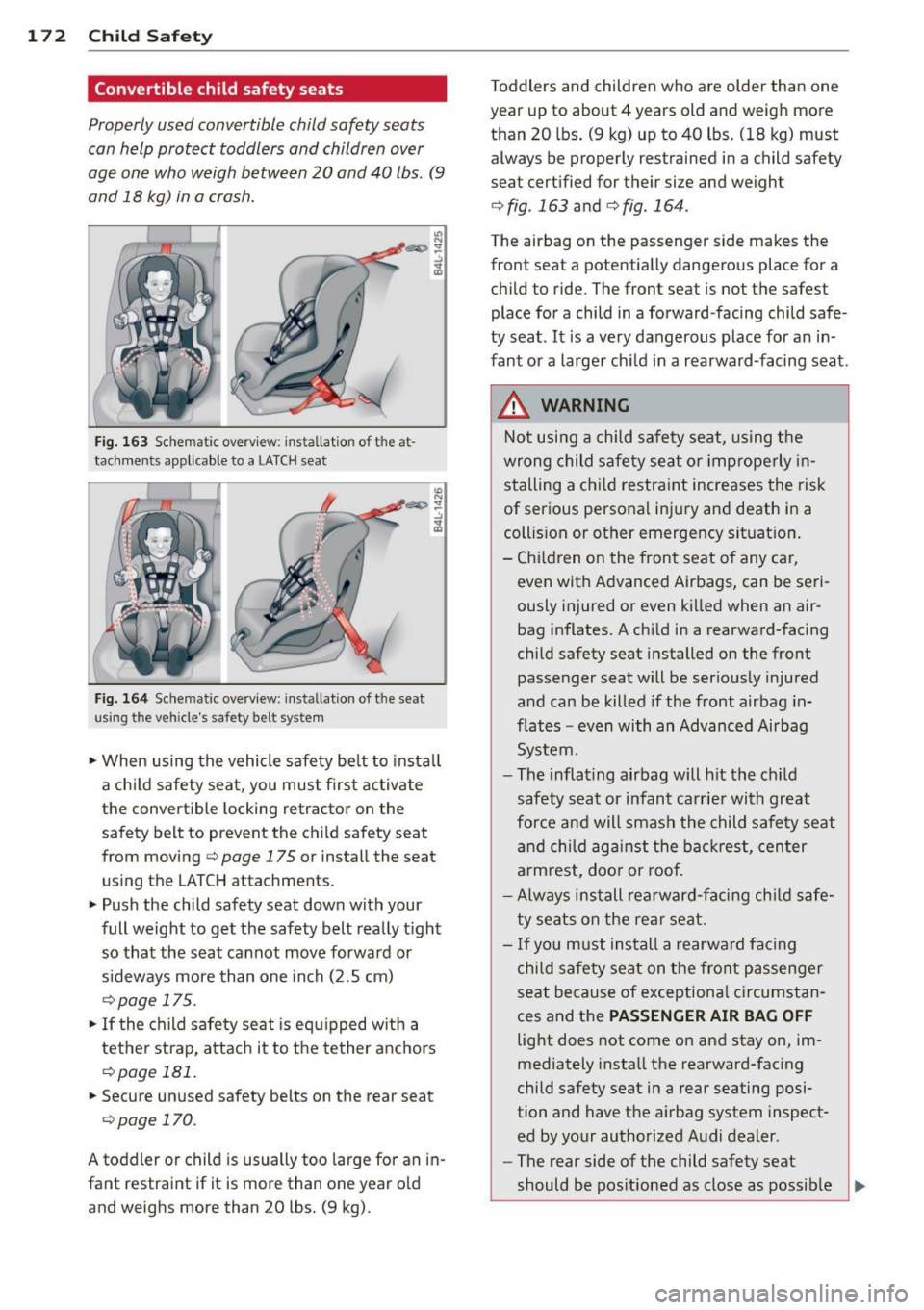
Fig. 163 Sche matic overview: installation of t he at
tachments applicable to a LATCH seat
Fig. 164 Schematic overview: installation of t he seat
us ing the veh icle's safety belt system
.. When using the vehicle safety belt to install
a child safety seat, you must first activate
the convertible locking retractor on the
safety belt to prevent the child safety seat
from moving
c:> page 175 or install the seat
using the LATCH attachments .
.. Push the child safety seat down with your
full weight to get the safety belt really tight
so that the seat cannot move forward or sideways more than one inch (2.5 cm)
c:>page 175.
.. If the child safety seat is equipped with a
tether strap, attach it to the tether anchors
c:> page 181.
.. Secure unused safety belts on the rear seat
c:> page 170.
A toddler or child is usually too large for an in
fant restraint if it is more than one year old
and weighs more than 20 lbs. (9 kg) . Toddlers
and children who are older than one
year up to about 4 years old and weigh more
than 20 lbs. (9 kg) up to 40 lbs. (18 kg) must
always be properly restrained in a child safety
seat certified for their size and weight
c:> fig . 163 and c:> fig . 164 .
The airbag on the passenger side makes the
front seat a potentially dangerous place for a
child to ride. The front seat is not the safest
place for a child in a forward -facing child safe
ty seat . It is a very dangerous place for an in
fant or a larger child in a rearward-facing seat.
_&. WARNING
Not using a child safety seat, using the
wrong child safety seat or improperly in
stalling a child restraint increases the risk
of serious personal injury and death in a
collision or other emergency situation.
- Children on the front seat of any car,
-
even with Advanced Airbags, can be seri
ously injured or even killed when an air bag inflates . A child in a rearward-facing
child safety seat installed on the front passenger seat will be seriously injured
and can be killed if the front airbag in
flates -even with an Advanced Airbag
System .
- The inflating airbag will hit the child
safety seat or infant carrier with great
force and will smash the child safety seat
and child against the backrest, center
armrest, door or roof.
- Always install rearward-facing child safe
ty seats on the rear seat.
- If you must install a rearward facing
child safety seat on the front passenger
seat because of exceptional circumstan
ces and the
PASSENGER AIR BAG OFF
light does not come on and stay on, im
mediately install the rearward-facing
child safety seat in a rear seating posi
tion and have the airbag system inspect
ed by your authorized Audi dealer .
- The rear side of the child safety seat
should be positioned as close as possible ..,.
Page 178 of 304
176 Child Safety
-The inflating airbag will hit the child
safety seat or infant carrier with great
force and will smash the child safety seat and child against the backrest, center
armrest, door or roof.
- Always install rearward-facing child safe
ty seats or infant carriers on the rear
seat.
- Forward-facing child safety seats or in
fant carriers installed on the front pas
senger's seat may interfere with the de
ployment of the airbag and cause serious
injury to the child.
-It is safer to install a forward-facing
child safety seat on the rear seat.
- Always read and heed all WARNINGS
whenever using a child restrained in ave
hicle is being used
¢page 165. Special
precautions apply when installing a child
safety seat on the front passenger seat
¢ page 145, Child restraints on the front
seat -some important things to know.
A WARNING
-
Always take special precautions if you
must install a forward or rearward -facing
child restraint on the front passenger's
seat in exceptional situations:
- Whenever a forward or rearward-facing
child restraint is installed on the front
passenger seat, the
PASSENGER AIR
BAG OFF
light must come on and stay on
whenever the ignition is switched on.
- If the PASSENGER AIR BAG OFF light
does not come on and stay on, perform
the checks described ¢
page 154, Moni
toring the Advanced Airbag System.
- Take the child restraint off the front pas
senger seat and install it properly at one
of the rear seat positions if the
PASSEN
GER AIR BAG OFF
light does not stay on
whenever the ignition is switched on.
- Improper installation of child restraints
can reduce their effectiveness or even
prevent them from providing any protec
tion. -
An improperly installed child restraint
can interfere with the airbag as it de
ploys and seriously injure or even kill the
child .
- Always carefully follow the manufactur
er's instructions provided with the child
safety seat or carrier.
- Never place additional items on the seat
that can increase the total weight regis
tered by the weight-sensing mat and can
cause injury in a crash .
A WARNING
-Forward-facing child restraints:
- Always make sure the forward -facing
seat has been designed and certified by its manufacturer for use on a front seat
with a passenger front and side airbag.
- Never put the forward-facing child re
straint up, against or very near the in
strument panel.
- Always move the passenger seat into its
rearmost position in the seat's fore and
aft adjustment range, as far away from
the airbag as possible before installing
the forward-facing child restraint. The backrest must be adjusted to an upright
position .
-Make sure that the PASSENGER AIR BAG
OFF
light comes on and stays on all the
time whenever the ignition is switched
on .
A WARNING
-
Rearward-facing child restraints:
- A child in a rearward-facing child safety
seat installed on the front passenger
seat will be seriously injured and can be killed if the front airbag inflates -even
with an Advanced Airbag System .
- The inflating airbag will hit the child
safety seat or infant carrier with great
force and will smash the child safety seat and child against the backrest, center
armrest, door or roof.
Page 196 of 304
194 Driving and en vironm ent
8_ WARNING
After driving through water, mud, slush,
etc ., the brakes may be slow to take effect
because of wet brake rotors and pads . Dry
the brakes first by braking carefully to re
store the full braking effect.
(D Note
Vehicle components such as the engine,
transmiss ion, suspension or electrical sys
tem can be severely damaged by driving
through wate r.
@ Tips
- Check the depth of the water before dr iv
i ng through it .
- Do not stop the veh icle, dr ive in reverse
or switc h the engine off when driving
t hr ough water .
- Keep in mind that oncoming vehicles
may c reate waves that raise the water
l evel and make it too deep fo r you r vehi
cle to dr ive through safely.
-
- Avoid dr iving thro ugh salt water because
i t can ca use corrosion.
Catalytic converter
It is very important that your emission con
trol system (catalytic conv ert er) is function
ing properly to ensure that your vehicle is run
ning in on env ironm entally sound manner.
,,. Always use lead-free gaso line Q page 207,
Fuel supply .
,,. Never run the tank down a ll th e way to emp
ty.
,,. Never put too much moto r oil in your engine
Q page 216, ~ Adding engine oil .
,,. Never try to push -or tow -start your ve hicle .
T he cata lytic converter is an eff ic ient "clean
up" device built in to the exhaust system of
the vehicle . The catalytic converter burns
many of the polluta nts in the exhaust gas be
fore they are released into the atmosphe re . The exclus
ive use of unleaded f uel is critica lly
important for the life of the catalytic conv ert
er and p roper funct ion ing of the eng ine .
A WARNING
=
-The temperature of the exhaust system
is high, both when driving and after stop
p ing the eng ine .
- Never touch the exhaust tail pipes once
they have become hot. This could result
in burns.
- Do not park or operate the vehicle i n
areas where the hot exhaust system may
come in co ntact with dry grass, brush,
fue l spill or other material wh ich can
cause a fire .
- Do not app ly additional undercoating or
r u stp roofing on or nea r the exhaust
manifold, exhaust pipes, cataly tic con
ver ter or he at s hields. Dur ing driv ing, the
substance used fo r undercoating could
overheat and cause a fire.
CI) Note
- Be aware tha t just o ne tank filling with
leaded fu el w ill alre ady ser io usly de
grade the performance of the cata lytic
converter .
- Do not exceed the cor rect engine oil level
Q poge 216.
-Do not drive until the fuel t ank becomes
comple tely empty . The engine cou ld mis
fire . Unburned fuel could also get into
the exhaust system and th is co uld cause
the catalytic converter to overheat.
- Do not turn off the ignition while the ve
hicle is mov ing.
- Do not contin ue to ope rate your veh icle
under these conditions, as otherwise fuel
can reach the catalyt ic converter. Th is
co uld result in overheating of the con
verter, requir ing its replacement.
- To assure efficient operation of the Emis -
sion Control System: .,..
Page 204 of 304
202 Vehicle care and cleaning
Vehicle care and
cleaning
General information
Regular, proper care helps to maintain your
ve hicle 's value. It can also be a requirement
when subm itting warranty claims for co rro
sion damage and paint defec ts on the body .
The required cleaning and care prod ucts can
be obtained from your authorized Audi dea ler
or qualified workshop . Read and follow t he in
structions fo r use on the pac kaging .
A WARNING
-Us ing cle aning and care products incor
rect ly can be dange rous to your he alth .
- Always store cleaning and care products
o ut o f reach of children to redu ce the r is k
of po ison ing.
@ For the sake of the environment
- Prefera bly use environmentally-frie ndly
p roducts when buying cleaning agents .
- Do not d ispose of leftover cleaning and
ca re p ro du cts with household trash .
Car washes
-
The longer deposits remai n on t he veh icle, the
mo re the surface ca n be damaged. H igh tem
pe rat ures such as those caused by su nlight in
crease the d amaging effe cts.
Before washing, wet heavy deposi ts w ith p len
ty of wate r.
Stubbor n depos its s uch as bird dropp ings or
tree sap are best removed with plen ty of wa
ter and a m icrofiber cloth .
A lso, was h the underside of your vehicle once
road salt stop s be ing used for the season.
Pres sure washers
When wash ing your ve hicles w ith a pressure
washer, always follow the operating instr uc
tions provided w ith the pressure washe r. T his
is especially important in regard to the pres- s
u re and sp raying dis tance. Do not aim the
s p ray direct ly at sea ls on side windows, doo rs,
t h e hood, the rear lid o r the sunroof* or at
t ires, rubber hoses, insu lating material, sen
sors" or camera lenses*. Keep a d ista nce of at
least 16 inches (40 cm) .
Do not remove snow and ice with a pressu re
washer.
Never use rotary nozzles or high pressure noz
zles .
T he wate r temperature m ust not be above
1 4 0
°F (6 0 °( ).
Automatic car washes
Sp ray off the ve hicle befo re washing .
Make sure that the w indows and roof * are
closed and the winds hield wipers are off. Fol
low instructions from the ca r wash operator,
especially if there are accesso ries attached to
you r vehicle .
If possible, use car washes that do not have
brushes .
Washing by hand
Clean the ve hicle starti ng from the to p and
wor king down using a soft sponge or cleaning
brush. Use solvent-free clean ing products .
Washing vehicles with matte finish paint
by hand
To avoid damaging the paint when washing,
first remove dust and large particles from
your vehicle. Insects, grease spots and fi nger
pr ints are best removed w ith a spec ial cleane r
for matte finish paint .
Apply t he prod uct using a microfiber cloth. To
avo id damaging the pa int surface, do not use
too much pressure.
Rinse the ve hicle thoroughly with water. Then
clean using a neutra l shampoo and a soft mi
crofiber cloth.
Rinse the ve hicl e thoro ughly again and let it
air dry. Remove any water residue using a
shammy.
Page 233 of 304
Maximum load rating
means the load rating for a tire
at the maximum permissible in
flation pressure for that tire.
Maximum loaded vehicle
weight
means the sum of:
(a) Curb weight
(b) Accessory weight
(c) Vehicle capacity weight, and
(d) Production options weight
Maximum (permissible)
inflation pressure
means the maximum cold infla
tion pressure to which a tire
may be inflated. Also called
"maximum inflation pressure."
Normal occupant weight
means 150 lbs. (68 kilograms)
times the number of occupants seated in the vehicle up to the
total seating capacity of your
vehicle.
Occupant distribution
means distribution of occu pants in a vehicle.
Outer diameter
means the overall diameter of
an inflated new tire.
Tires and wheels 231
Overall width
means the linear distance be
tween the exteriors of the side
walls of an inflated tire, includ ing elevations due to labeling,
decorations, or protective bands or ribs.
Ply
means a layer of rubber-coated
parallel cords.
Production options weight
means the combined weight of
those installed regular produc
tion options weighing over 5 lbs. (2 . 3 kg) in excess of those
standard items which they re place, not previously consid
ered in curb weight or accessory
weight, including heavy duty
brakes, ride levelers, roof rack,
heavy duty battery , and special
trim.
Radial ply tire
means a pneumatic tire in
which the ply cords that extend
to the beads are laid at sub stantially 90 degrees to the
centerline of the tread.
•
•
'
Page 272 of 304
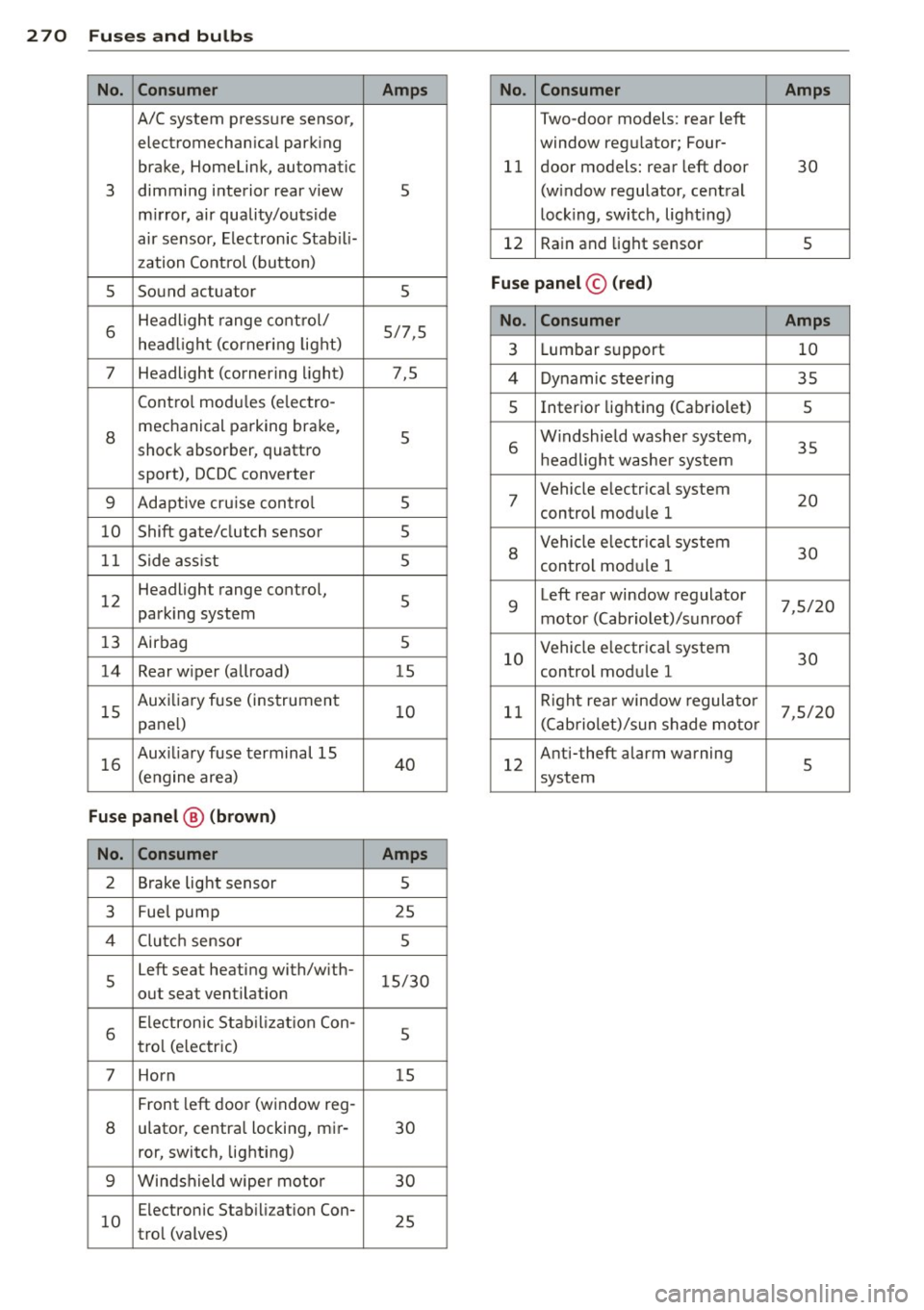
2 70 Fuses and bulbs
No. Consumer Amps No. Consumer Amps
A/C system pressure sensor, Two-door models: rear left
electromechanical parking window regulator; Four-
brake, Homelink, automatic 11 door models: rear
left door
30
3 dimming interior rear view
5 (window regulator, central
m irror, air quality/outside locking, switch, lighting)
air sensor, Electronic Stab ili-
12 Rain
and light sensor
5
zation Control (button)
5 Sound actuator 5
Fuse panel© (red)
6 Headlight
range control/
5/7,5
head light (corner ing light)
No . Consumer Amps
3 Lumbar support 10
7 Headlight (cornering light) 7,5
4 Dynamic steering
35
Contro l modu les (electro-
5 Interior lighting (Cabriolet)
5
8 mechanical parking brake,
5
shock absorber, quattro
sport), DCDC converter
9 Adaptive cruise control 5 6
W
indshield washer system,
35
headlight washer system
7 Vehicle electrical system
20
control module 1
10 Shift gate/clutch sensor
5
11 Side ass ist 5
8
Vehicle electr ica l system
30
control module 1
12 Headlight range control,
5
parking system 9 Left rear window regulator
7,5/20
motor (Cabriolet)/sunroof
13 Airbag 5
14 Rear wiper (allroad) 15 10
Vehicle e
lectrica l system
30
control module 1
15 Auxiliary fuse (instrument
10
pane l) 11 Right
rear window regulator
7,5/20
(Cabriolet)/sun shade motor
16 Aux
iliary fuse terminal 15
40
(engine area) 12 Anti-theft alarm warning
s system
Fuse panel
@ (brown)
No. Consumer Amps
2 Brake light sensor 5
3 Fuel pump 25
4 Clutch sensor 5
5 Left seat heating with/with-
15/30
out seat ventilation
6 Electronic Stabilization
Con-
5
trol (electric)
7 Horn 15
Front left door (window reg-
8 ulator, centra
I locking, mi r-
30
ror, switch, lighting)
9 Windshield wiper motor 30
10 Electronic Stabi
lization Con-
25
trol (valves)
Page 286 of 304
28 4 Con sum er Inf ormation
comp lexity of today's automobi les, have
steadi ly reduced the scope of maintenance
and repairs which can be carried out by vehicle
owners.
Also, s afety an d e nvir onm ent al con
cerns place very strict limits on the nature of repairs and adjustments to engine and trans
miss ion pa rts which an owner can perform .
Maintenance, adjustments and repa irs usua lly
require special tools, testing devices and oth
er equipment avai lab le to specially trained
workshop personnel in order to assure proper
performance, reliab ility and safety of the vehi
cle and its many systems .
Improper ma intenance, adjustments and re
pa irs can impair the operation and reliab ility
of your vehicle and even void your vehicle war ranty. Therefo re , proof of servici ng in accord
ance w it h the ma intenance sched ule may be a
condition for upholding a possible warranty
claim made within the warran ty period.
Above all, operational safety can be adve rsely
affected, c reating unnecessary risks for you
and your passengers.
If in doubt about any serv icing, have it done
by your author ized Audi dealer or any properly
equ ipped and qu alified workshop. We strong
l y urge you to give your authorized Audi dea ler
the opportunity to perform all scheduled maintenance and necessary repairs . Your deal
er has the facilities, or iginal parts and trained
specialists to keep your veh icle running prop
erly.
Performing lim it e d m aint en anc e y ourself
The following pages describe a limited num
ber of procedures which can be performed on
you r vehicle with ordinary tools, should the
need arise and trained personnel be unavaila
ble. Before performing any of these proce
dures, always thoroughly read all of the app li
cable text and ca refully follow the instruc
tions given. Always rigorously obse rve the
WARNINGS p rovided .
Before you ch eck anything in th e engine
compartm ent, alw ays read an d hee d all WARNINGS
¢ & a
nd ¢ & in Working in the
engine comportment on page 212 .
A WARNING
--Serious personal in jury may occur as a re-
sult of improperly performed mainte nance, adjustments or repa irs.
- Always be extremely careful when work
ing on the vehicle. Always follow com
monly accepted safety pract ices and gen
eral common sense. Never r isk personal
in jur y.
- Do not attempt any of the maintenance,
checks or repairs descr ibed o n the fol
lowing pages if you are not fu lly fam iliar
with these or other procedures with re spect to the ve hicl e, or are uncerta in how
to proceed .
- Do not do any work withou t the proper
too ls and equipment . Have the necessary
work done by your authorized A udi deal
er or any properly equipped and q ualified
workshop.
- The engine compar tment o f any motor
vehicle is a potentially hazardous area. Never reach into the area around or
touch the rad iator fan. It is temperature
control led and can sw itch on suddenly -
even when the engine is off and the igni
tion key has been removed. The rad iator
fan switches on automatically when the coo lant reaches a certain tempera ture
and will cont inue to run until the coo lant
temperature drops .
- Always remove the ign ition key befo re
a nyone gets under the veh icle.
- Always suppor t your veh icle with safety
s tands if it is necessary to work under
neath the vehicle. The jack s upplied with
the vehicle is not adequate for this pur
pose and co uld co llapse causing serio us
personal injury.
- If you must work unde rneath the vehicle
with the wheels on the ground, a lways
make sure the vehicle is on leve l ground,
that the wheels are always securely blocked and that the engine cannot be
started.
Page 292 of 304
29 0 Index
Child restra ints
D ang er of using child restraints in th e
front seat . . . . . . . . . . . . . . . . . . . . . . . . 145
Where can I get addit ional information
about child restra ints and their use? . . 183
C hild restraint system anchors ..... .. . 179
Ch ild safety .. ................ ... ... 165
Conve rtible locking retracto r .. .. ..... 175
I mportant safety instructions fo r using
ch ild safety seats ....... .. .. .. .. .. . 168
I mportant things to know when driving
with chi ldren .. .. ..... ... .. .. .... . 165
Installing a child restraint us ing the
LATCH system . . . . . . . . . . . . . . . . . . . . . 180
Lower anchorages .......... .. .... . 180
Mount ing and releasing the anchorage
hook .. .... .......... ...... ... .. . 180
Tether anchors ............... .. ... 181
Tether st raps .......... .. .. .. .. .. . 18 1
Ch ild safety locks
Power windows . ..... .... .. .. .. .. .. 42
Rear doors . .............. ... .. .. .. 41
C hild safety seats .. ..... ... .. .. .... . 17 1
Booster se ats . . . . . . . . . . . . . . . . . . . . . 173
Convertible c hild seats .... .. .. .... . 172
Convertible locking retracto r .. .. ..... 175
Danger of us ing c hild restra ints in the
front seat . . . . . . . . . . . . . . . . . . . . . . . . 145
H ow do I proper ly install a child safety
seat in my vehicle? ...... .. .. .. .. .. . 168
I nfant sea ts ............. .. .. .. .. . 17 1
I ns tall ing . . . . . . . . . . . . . . . . . . . . . . . . 17 5
LATCH system .. .. ..... ... .. .. .... . 180
Safety instructions ..... ... .. .. .... . 168
Unused safety belts on the rear seat . . 170
C igare tte lig hte r . . . . . . . . . . . . . . . . . . . . . 65
C leaning .. .. ................ ... .. .
202
Climate controls . . . . . . . . . . . . . . . . . . . . . 78
C lima te con trol system
Automat ic recircula tion .... .. .. .. .. . . 81
Supp lementary hea ter ... .. .. .. .... . . 81
synchronizing .. . ...... ... .. .. .... .. 81
C lock ....... .......... ...... ... .. .. 12
C losing
Power windows .......... .. .. .... .. 42
Sliding/tilting sunroof ...... ..... .. .. 43
Sunshade .. ................ ... ... . 43 Closing/opening
at the lock cylinder . . . . . . . . . . . . . . . . . . 3 7
by remote control . . . . . . . . . . . . . . . . . . 34
with the centra l locking switch ... .... . 3S
with the conven ience key ........ .... . 35
Co ld tire infla tion pressure ..... ... .. .. 234
Coming home . . . . . . . . . . . . . . . . . . . . . . . 50
Compact spare ti re . ............. .... 260
also refer to Spare tire .......... .. .. 260
Compartments . . . . . . . . . . . . . . . . . . . . . . 68
Compass in the m irror ... .. ... ..... .. . 58
Compliance ..... .. .. ... ..... ... .. .. 286
Consumer Informa tio n . . . . . . . . . . 134, 283
Contacting NHTSA . ... .......... .. .. 134
Controls Cleaning . ..... .. .. ... ..... ... .. .. 204
Convenience key Indi cator lights .. ... .......... .. .. . 86
Star ting engine (S TART E NGIN E STOP
button) ... .... .. ... .. ..... ... .. .. . 85
Stopping the engine (START ENGINE
STOP button) . . . . . . . . . . . . . . . . . . . . . . 86
Switching on ignition ........... .... . 85
unlocking/lock ing ............. .... . 35
Convenience opening/clos ing ... .. .. .. . 42
Convertib le child safe ty seats ........ . 172
Convertib le locking retractor
Activating . .. .. .. ............. .. .. 177
Deact ivat ing ... .. ... .... ...... .... 178
U sing to secure a child safety seat 1.75, 177
Coolant system .... .. ... ..... ... .. .. 218
Cooling mode (automat ic climate co ntrol) 79
Cooling System Expansion tank . .. .......... ...... . 218
Cornering light .... .. .... .... ... .. .. . 49
Cru ise cont ro l
Changi ng speed .. ............. .. .. . 91
Presett ing you r speed .......... .... . 92
Switching off .... .. ... ..... ... .. .. . 92
Switching on ..... ... .. ..... ... .. .. . 91
Cruisi ng range ... .. ............. .... . 24
( u pholder .. .... .. ............. .... . 67
D
Data recorder . . . . . . . . . . . . . . . . . . . . . . 184
Date d isp lay .... .. ............. .... . 12