ECU AUDI S4 2016 Owner's Manual
[x] Cancel search | Manufacturer: AUDI, Model Year: 2016, Model line: S4, Model: AUDI S4 2016Pages: 278, PDF Size: 70.26 MB
Page 128 of 278
Driving safety
_& WARNING
Pedals that cannot move freely can cause loss
of vehicle control and increase the risk of seri·
ous injury .
- Never place any objects in the driver's foot
well. An object could get into the pedal area
and interfere with pedal function . In case of
sudden braking or an accident, you would
not be able to brake or accelerate!
-Always make sure that nothing can fall or
move into the driver 's footwell.
Floor mats on the driver side
Always use floor mats that can be securely at
tached to the floor mat fasteners and do not in
terfere wi th the free movement of the pedals .
.,. Make sure that the floor mats are properly se
cured and cannot
mov e and interfere with th e
pedals
c:> ,& .
Use only floor mats that leave the pedal area un
obstructed and that are firmly secured so that
they cannot slip out of position. You can obtain
suitable floor mats from your authori zed Audi
dealer .
Floor mat fasteners are installed in your Audi.
Floor mats used in your vehicle must be attached
to these fasteners. Properly securing the floor
mats will prevent them from sliding into posi
tions that could interfere with the pedals or im
pair safe operation of your vehicle in other ways.
A WARNING
Pedals that cannot move freely can result in a
loss of vehicle control and increase the risk of
serious personal injury .
- Always make sure that floor mats are prop
erly secured.
- Never place or install floor mats or other
floor coverings in the vehicle that cannot be
properly secured in place to prevent them
from slipping and interfering with the ped als or the ability to control the vehicle.
- Never place or install floor mats or other
floor coverings on top of already installed
126
floor mats. Additional floor mats and other
coverings will reduce the size of the pedal
area and interfere with the pedals.
- Always properly reinstall and secure floor
mats that have been taken out for cleaning .
- Always make sure that objects cannot fall
into the driver footwell while the vehicle is
moving. Objects can become trapped under
the brake pedal and accelerator pedal caus ing a loss of vehicle control.
Storing cargo correctly
Loading the luggage compartment
All luggage and other objects must be properly stowed ond secured in the luggage compart
ment .
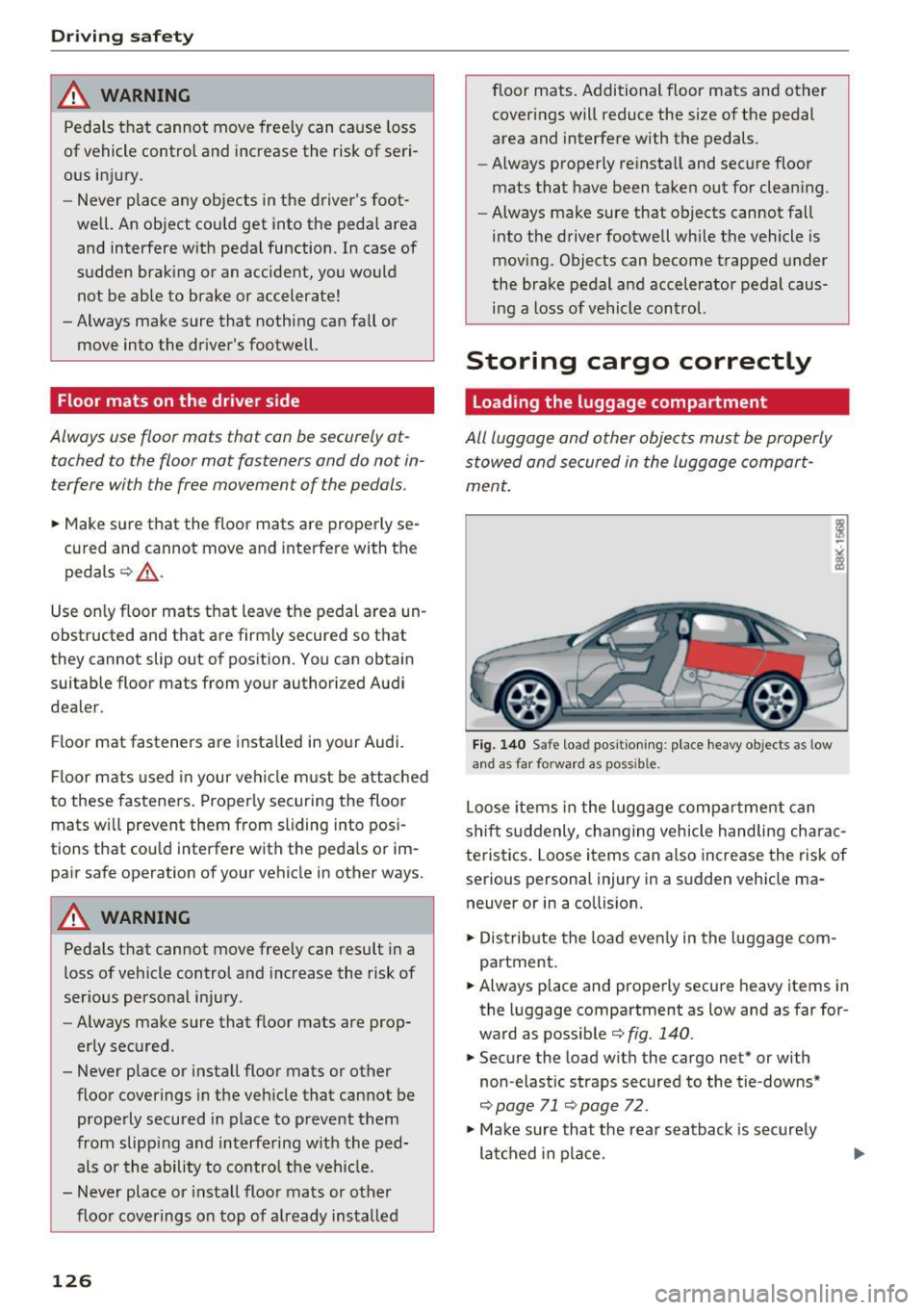
Fig. 140 Safe load positioning : place heavy ob jects as low
and as far forward as poss ib le.
Loose items in the luggage compartment can
shift suddenly, changing vehicle handling charac
teristics. Loose items can also increase the risk of
serious personal injury in a sudden vehicle ma
neuver or in a collision .
.,. Distribute the load evenly in the luggage com
partment.
.,. Always place and properly secure heavy items in
the luggage compartment as low and as far for
ward as possible
c:> fig. 140 .
.,. Secure the load with the cargo net* or with
non-elastic straps secured to the tie -downs*
c:> page 71 c:>page 72.
.,. Make sure that the rear seatback is securely
latched in place.
Page 129 of 278
..... N
0 ::..:: co .....
Improperly stored luggage or other items can
fly through the vehicle causing serious per
sonal injury in the event of hard braking or an
accident . To help reduce the risk of serious
personal injury:
- Always put objects, for example, luggage or
other heavy items in the luggage compart
ment.
- Always secure objects in the luggage com
partment using the tie-down eyelets and
suitable straps.
A WARNING
Heavy loads will influence the way your vehi
cle handles. To help reduce the risk of a loss
of control leading to serious personal injury:
- Always keep in mind when transporting
heavy objects, that a change in the center of
gravity can also cause changes in vehicle
handling:
-Always distribute the load as evenly as
possible .
- Place heavy objects as far forward in the
luggage compartment as possible.
- Never exceed the Gross Axle Weight Rating
or the Gross Vehicle Weight Rating specified
on the safety compliance sticker on the left
door jamb. Exceed ing permissible weight
standards can cause the veh icle to slide and
hand le differently.
- Please observe information on safe driving
qpage 121.
A WARNING
To help prevent poisonous exhaust gas from
being drawn into the vehicle, always keep the
rear lid closed while driving.
- Never transport objects larger than those
fitting completely into the luggage area be
cause the rear lid cannot be fully closed.
- If you absolutely must drive with the rear lid
open, observe the fo llowing notes to reduce
the risk of poisoning:
- Close all windows,
- Close the sunroof,
Driving safety
-Open all air outlets in the instrument pan
el,
- Switch off the air recirculation
,
- Set the fresh air fan to the highest speed .
A WARNING
=
Always make sure that the doors, a ll win-
dows, the sunroof and the rear lid are secure
ly closed and locked to reduce the risk of in
jury when the vehicle is not being used.
- After closing the rear lid, always make sure
that it is properly closed and locked .
- Never leave your vehicle unattended espe
cially with the rear lid left open . A child
could crawl into the vehicle through the lug
gage compartment and close the rear lid be
coming trapped and unable to get out . Be
ing trapped in a vehicle can lead to ser ious
personal injury.
- Never let children play in or around the vehi cle .
- Never let passengers ride in the luggage
compartment . Vehicle occupants must al
ways be properly restrained in one of the ve
h icle 's seat ing positions.
(D Tips
-Air circulation helps to reduce window fog
ging . Stale air escapes to the outs ide
through vents in the tr im panel. Be sure to
keep these slots free and open.
- The tire pressure must correspond to the
load. The t ire pressure is shown on the tire
pressure label. The tir e pressure label is lo
cated on the driver's side B-pillar . The tire
pressure label lists the recommended cold
tire inflation pressures for the vehicle at its
maximum capacity weight and the tires that
were on your vehicle at the time it was man
ufactured. For recommended tire pressures
for normal load conditions, please see chap
ter
q page 22 7
127
Page 130 of 278
Driving sa fe ty
Tie-downs
Applies to vehicles: with tie-downs
The luggage compartment is equipped with four
tie-downs to secure luggage and other items .
Use the tie-downs to secure your cargo properly
¢page 126, Loading the luggage compartment.
In a collision, the laws of physics mean that even
smaller items that are loose in the vehicle will
become heavy missiles that can cause ser ious in
jury. Items in the veh icle possess energy which
vary with vehicle speed and the weight of the
item . Veh icle speed is the most s ignificant facto r.
For examp le, in a frontal collision at a speed of
30 mph (48 km/h), the forces act ing on a 10-lb
(4 .5 kg) object are about 20 times the normal
weight of the item. Th is means that the weight
of the item would suddenly be about
200 lbs . (90 kg). You can imagine the injuries
that a 200 lbs. (9 0 kg) item flying free ly through
the passenger compartment could cause in a co l
lision like this.
/1. WARNING
Weak, damaged or improper straps used to secure items to tie-downs can fail d uring hard
brak ing or in a collision and cause serious per
sonal injury.
- Always use suitab le mounting straps and
properly secure items to the tie-downs in
the luggage compartment to help prevent
items from shifting or flying forwa rd as dan
gerous missiles .
- When the rear seat backrest is folded down, always use suitab le mounting straps and
prope rly secure items to the tie-dow ns in
the luggage compartmen t to help p reve nt
items from f lying forwa rd as dangerous
missiles into the passenger compartment .
- Never a ttach a child safe ty seat tether strap
to a tie-down.
128
-
Reporting Safety Defects
Applicable to U.S.A.
If you belie ve that your vehi cle
ha s a defect whi ch could cau se a
c rash or could cau se injur y or
d eath, you should immedi ate ly in
form the Nat ional Highw ay Traffic
Safet y Admini stration (NHTSA) in
a ddition to n otif yin g Audi of
Ameri ca, Inc.
If NHTS A re cei ves s imilar com
pl aint s, it m ay ope n a n inv estiga
tion , and if it find s that a saf ety
d efec ts ex ists in a group of
ve hicle s, it m ay ord er a re call and
r e med y campaign. H owe ver,
NHTSA cannot b ecome in volved in
indi vidual p robl em s between you,
your dealer, or Audi of America, In c.
To conta ct the NHTSA, you ma y
e ither call:
T el.: 1-888-327-4236 (TTY:
1-800-424-9153) or
1-800-424-9 393
or y ou may writ e to:
Page 135 of 278
,....,
N
0
""' ex:, ,....,
I.Cl U"I ,....,
I.Cl ,....,
_& WARNING
Not wearing safety belts or wearing them im
properly increases the risk of serious personal
injury and death . Safety belts can work only
when used correct ly.
-Always fasten your safety belts correctly be fore driving off and make sure all passen
gers are cor rect ly restrained.
- For maximum protection, safety belts must
always be posit ioned properly on the body .
- Never strap more than one person, includ
ing small ch ildren, into any belt .
- Never place a safety belt over a child sitt ing
on your lap.
- Always keep feet in the footwell in front of
the seat wh ile the vehicle is being driven.
- Never let any person ride w ith their feet on
the instrument panel or st icking out the
window or on the seat .
- Never remove a safety belt while the vehicle
is moving . Do ing so will increase your risk of
being injured or k illed.
- Never wear belts twisted.
- Never wear belts over rigid or breakable ob-
jects in or on your clothing, such as eye
glasses, pens, keys, etc., as these may cause
injury.
- Never allow safety belts to become dam
aged by being caught in door or seat hard
ware.
- Do not wear the shoulder part of the belt
under your arm or otherwise out of position .
- Several layers of heavy clothing may inter
fere with correct positioning of belts and re
duce the overall effectiveness of the system.
- Always keep belt buckles free of anything
that may prevent the buckle from latching
securely .
- Never use comfort clips or devices that cre
ate slack in the shoulder be lt . However, spe
cial clips may be requ ired for the proper use
of some child restraint systems.
- Torn or frayed safety belts can tear, and
damaged belt ha rdware can break in an acc i
dent. Inspect belts regularly.
If webbing,
bind ings, buckles, or re tractors are dam-
Safet y bel ts
aged, have belts rep laced by an authorized
Aud i dea ler .
- Safety belts that have been worn and loaded
in an accident must be replaced with the
correct replacement safety belt by an au
thorized Audi dealer. Replacement may be
necessary even if damage cannot be clearly
seen. Anchorages that were loaded must al
so be inspected.
- Never remove, mod ify, d isassemble, or try
to repair the safety belts yourse lf.
-Always keep the belts clean . Dirty belts may
not work properly and can impair the func
tion of the inert ia reel¢
page 193.
Safety belts
Fastening safety belts
Safety first -everybody buckle up!
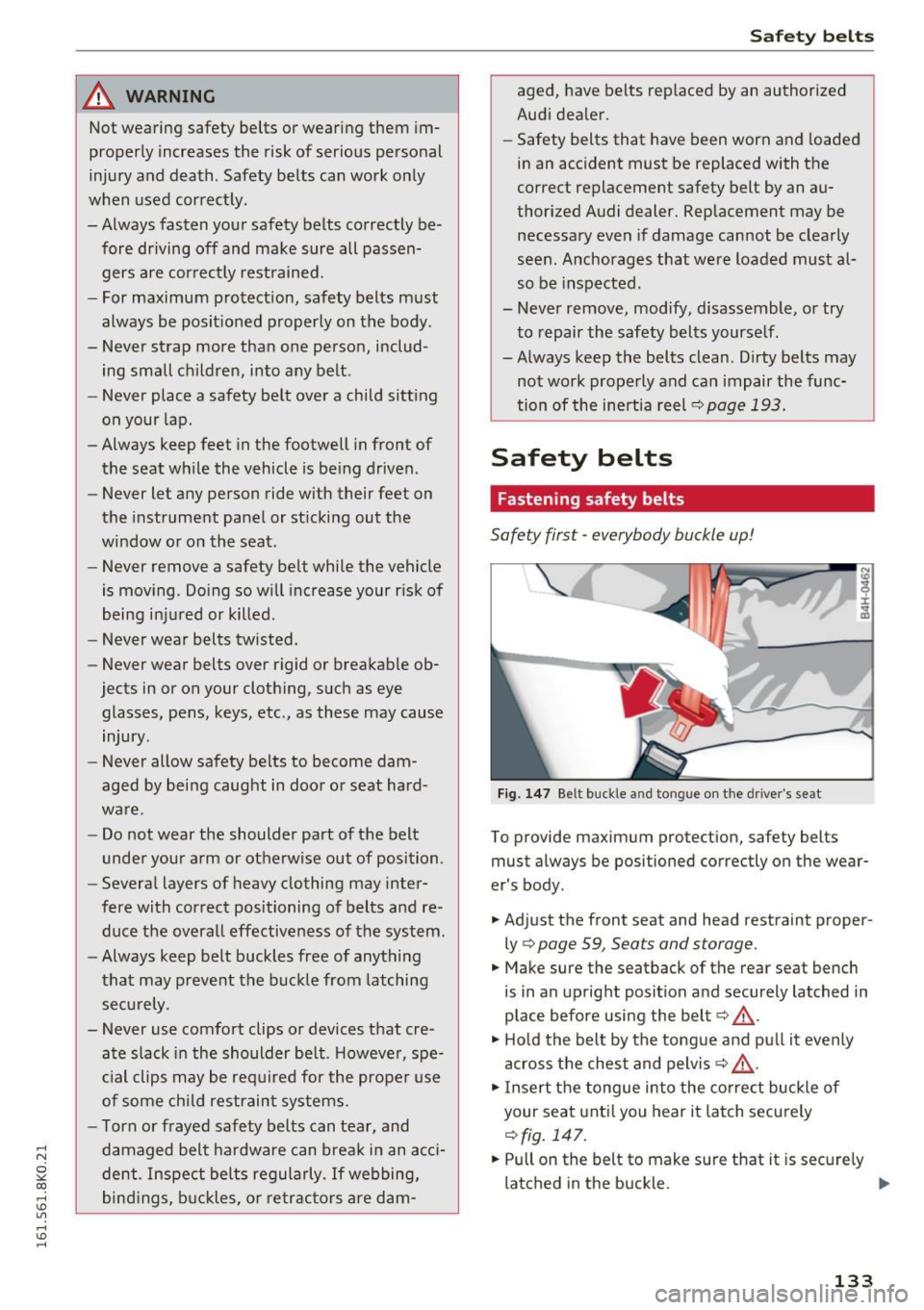
F ig. 14 7 Belt buckle and tongu e on t he d river' s se at
To provide maximum protection, safety belts
must always be positioned correctly on the wear
er 's body .
... Adjust the front seat and head restraint proper
ly
¢ page 59, Seats and storage.
... Make sure the seatback of the rear seat bench
is in an upright posit ion a nd securely latched in
place before using the belt
Q _&. .
"' Ho ld the bel t by the tongue and pu ll it evenly
across the chest and pelvis¢_&. .
... Insert the tongue in to the correct buckle of
your seat unti l you hear it latch securely
Qfig. 147.
... Pull on the belt to make sure that it is securely
latched in the buckle .
IIJ,,
133
Page 136 of 278
Safe ty belts
Autom ati c s afet y belt retr actors
Every safety belt is equ ipped with an automa tic
be lt retractor on the shoulder belt. This feature
locks the belt when the belt is pulled out fast,
during hard braking and in a n accident . The belt
may a lso lock when you drive up or down a steep
hill or through a sharp curve. Dur ing normal driv
ing the belt lets you
move freely .
Safety belt p ret en sion ers
The safety belts are equipped with a belt preten
sioner that helps to t ighten the safety belt and
remove slack when the pretensioner is activated.
The function of the pretensioner is mon itored by
a warning light
r:::') page 19.
Convertib le loc king retracto r
Every safety be lt except the one on the driver
seat is equipped with a convertible locking retrac
tor that
mus t be used when the safety belt is
used to attach a child safety seat. Be sure to read
the impo rtant information about this feature
c:;, page 167.
.&_ WARNING
Imprope rly pos itioned safety be lts can cause
ser ious injury in an accident
c:;, page 134,
Safety belt position.
- Safety belts offer optimum protection only
when the seatback is upright and belts are
properly positioned on the body.
- Always make sure that the rear seat back
rest to which the center rea r safety belt is
attached is secure ly latched whenever the
rear center safety belt is being used. If the
backrest is not securely latched, the passen
ger will move forward with the backrest dur
ing sudden braking, in a sudden maneuver
and especially in a crash.
- Never attach the safety belt to the buckle for another seat. Attaching the belt to the
wrong buckle will reduce safety belt effec
tiveness and can cause serious persona l in
jury.
- A passenger who is not properly restrained can be seriously in jured by the safety be lt it
self when it moves from the stronger parts
134
of the body into critical areas like the abdo men.
- Always lock the convertible locking retractor
when you are securing a child safety seat in
the vehicle
c:;, page 169.
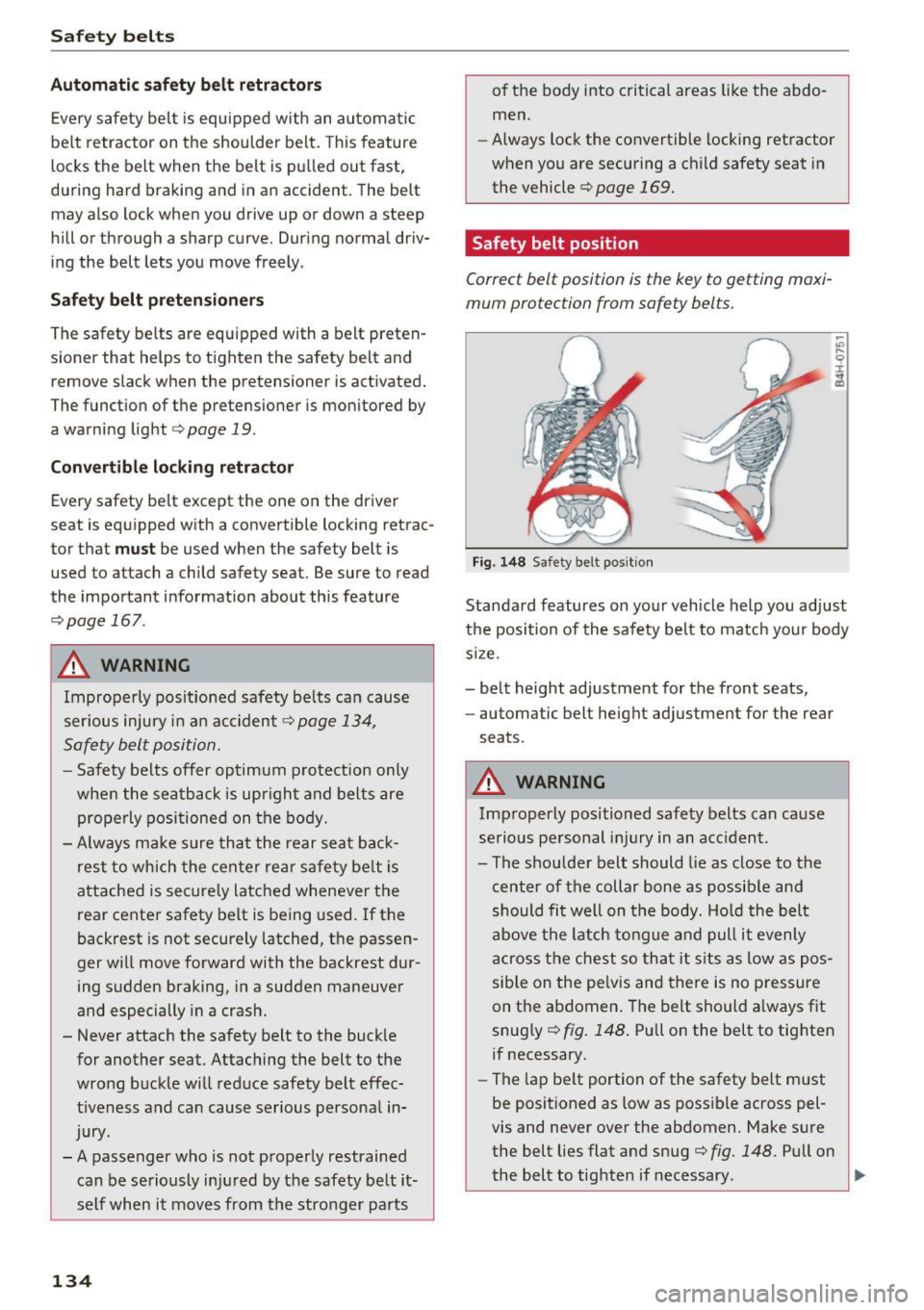
Safety belt position
Correct belt position is the key to getting maxi
mum protection from safety belts .
Fig. 148 Safety belt posit ion
-"' .... 9 I ... a,
Standard features on your vehicle help you adjust
the position of the safety belt to match your body
s ize.
- belt height adjustment for the front seats,
- automatic belt height adjustment for the rear
seats .
.&_ WARNING
Improperly positioned safety belts can cause
serious personal injury in an acc ident.
- The shou lder belt should lie as close to the
center of the collar bone as possible and
should fi t well on t he body. Hold the belt
above the latch to ng ue and pull it evenly
across the chest so tha t it s its as low as pos
sible on the pe lvis and there is no pressure
on the abdomen . The belt sho uld a lways f it
snug ly
c:;, fig. 148 . Pull on the belt to tig hten
if necessary.
- The lap be lt portion of the safety belt must
be positioned as low as poss ible across pel
vis and never over the abdomen. Make sure the belt lies flat and snug
c:;, fig. 148. Pull on
the belt to tighten if necessary. .,.
Page 137 of 278
,....,
N
0
""' CX) ,....,
I.Cl U"I ,....,
I.Cl ,....,
-A loose-fitting safety be lt can cause serious
injuries by shifting its pos ition on your body
from the strong bones to more vulnerable,
soft tissue and cause serious injury .
- Always read and heed all WARNINGS and
other important information
c!) page 132.
Pregnant women must also be correctly
restrained
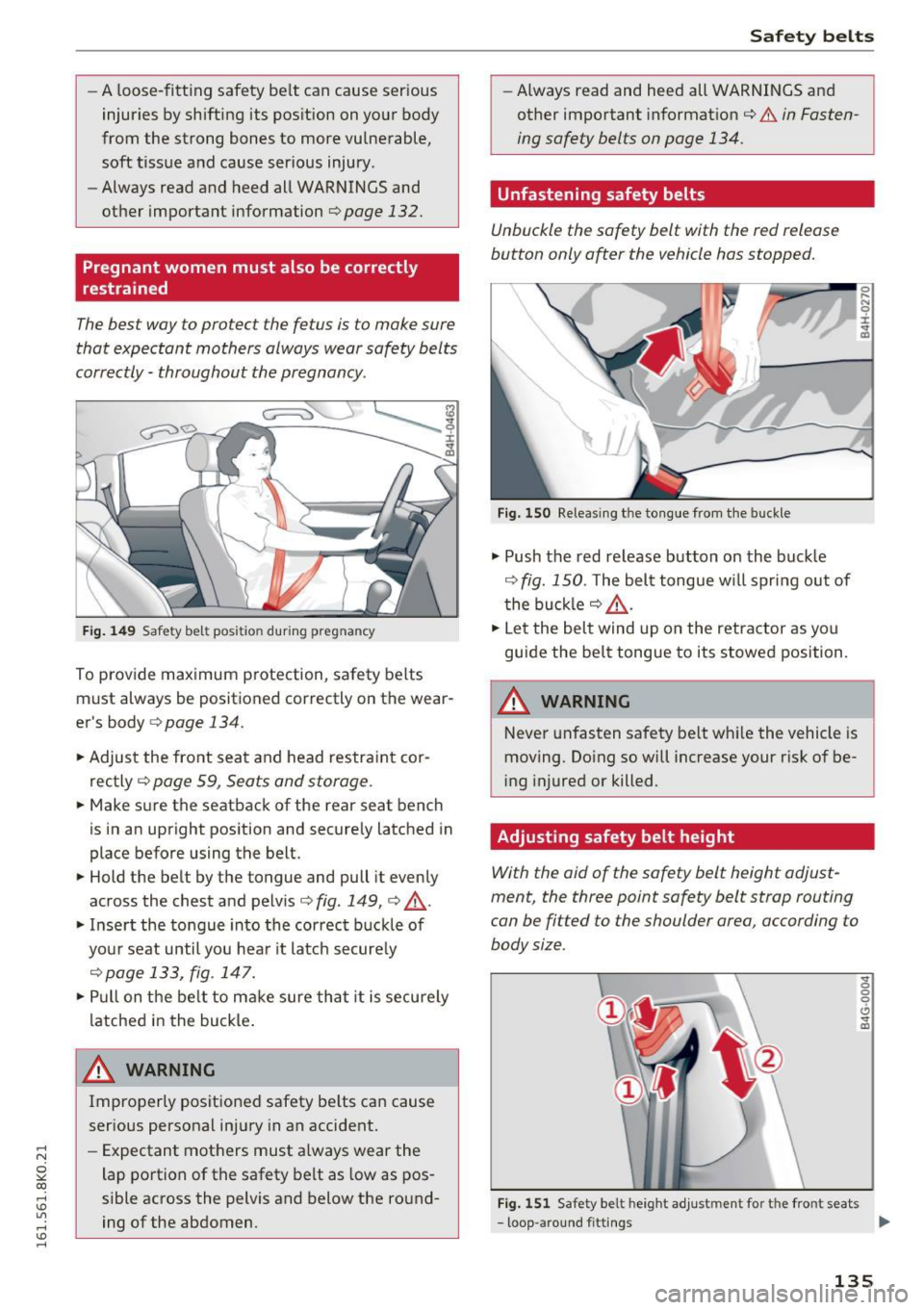
The bes t way to pro tec t the fe tus is to make sure
that expectant mothers always wear safety belts
correctly -throughout the pregnancy .
Fig . 14 9 Safe ty belt pos itio n dur ing pregn an cy
To provide max imum p rotection, safety belts
must always be positioned correctly on the wear
er's body
c:> page 134.
.,. Adjust the front seat and head restraint cor
rectly ¢
page 59 , Seats and storage .
.,. Make su re th e seatback of the rear seat bench
is in an upright position and secure ly latched in
place before using the belt.
.,. Hold the belt by the tongue and pull it even ly
across the chest and pelv is
c:> fig. 149, c:> ,& .
.,. Inse rt the tongue into the cor rec t buckle of
you r seat until you hea r it latch securely
,:!)page 133, fig . 147.
.,. Pull on the be lt to m ake sure that it is securely
latched in the bu ck le .
& WARNING
Improperly positioned safety be lts can cause
ser ious personal inj ury in an accident.
- Expectant mothers must a lways wear the
lap portion of the safety belt as low as pos
sible across the pelvis and below the round ing of the abdomen .
Safety bel ts
-Always read and heed all WARNINGS and
other important informat ion ¢
A in Fasten
ing safety belts on page 134.
Unfastening safety belts
Unbuckle the safety belt with the red release
button only o~er the vehicle has stopped.
.,
JJ
Fig. 150 Releasi ng t he to ngue from the buckle
.,. Push the red re lease but ton on the buck le
r:!) fig. 150 . The belt tongue w ill spr ing out of
t he buck le
c:> ,& .
.,. Let the belt wind up on the retra ctor as yo u
guide the belt tongue to its stowed posit ion.
& WARNING
Never unfasten safety belt whi le the vehicle is
moving . Do ing so will increase your r isk of be
i ng injured or killed .
Adjusting safety belt height
With the aid of the safety belt height adjust
ment, the three point safety belt strap rout ing
can be fi tted to the shoulder area, according to
body size .
Fig. 1 51 Safety belt height a dju stm ent fo r th e fro nt seat s
0 .... N 0
:i: .., co
... 0 0
0
6 ... co
-loop -a round fittings Ill>
135
Page 163 of 278
..... N
0 ::..:: co .....
after
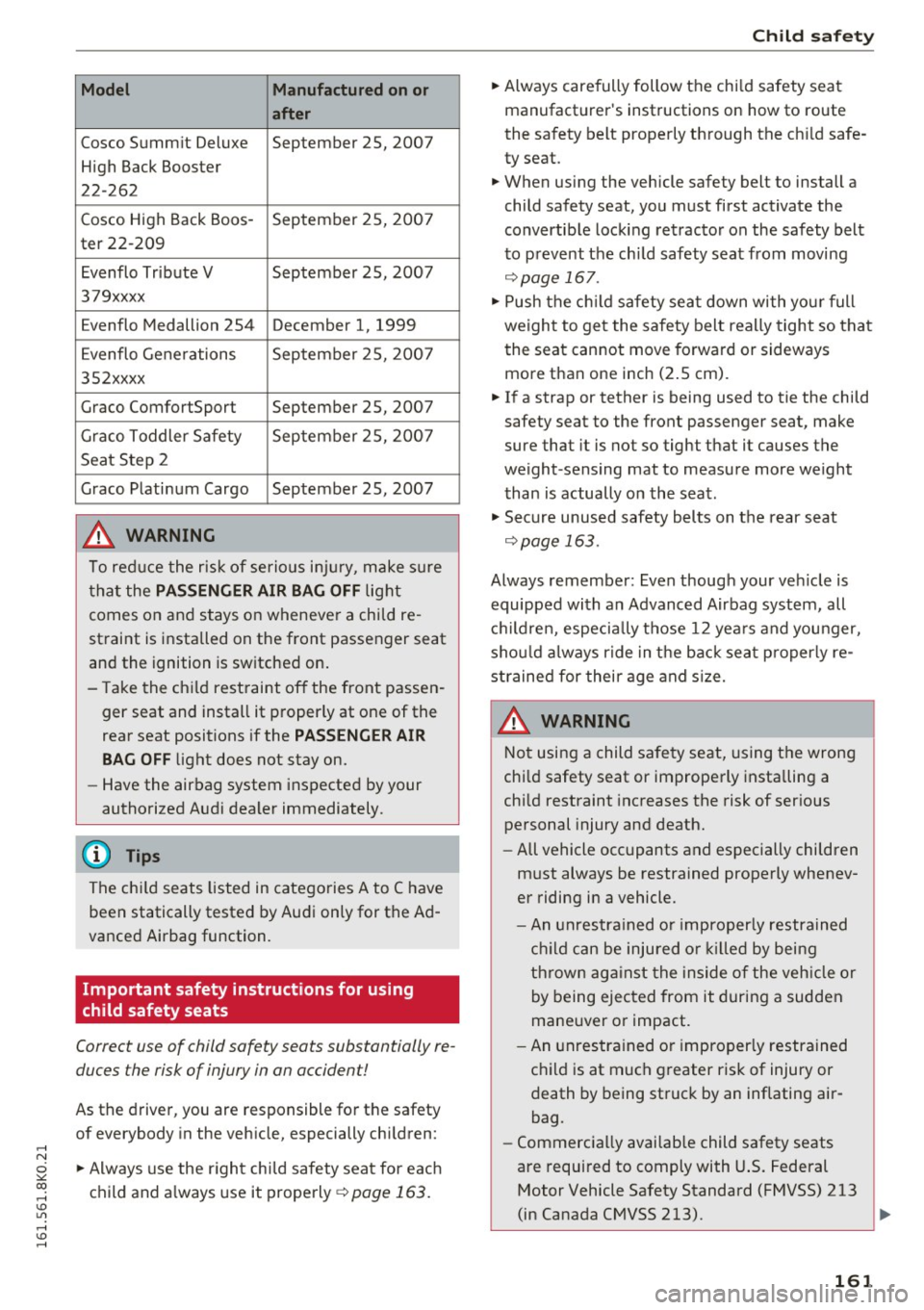
Cosco Summit Deluxe September 25, 2007
High Back Booster
22-262
Cosco High Back Boos -
September 25, 200 7
ter 22-209
Evenflo Tr ibute V September 25, 2007
379xxxx
Evenflo Medallion 254 December 1, 1999
Evenflo Generations September 25, 2007
352xxxx
Graco ComfortSport September 25, 2007
Graco Toddler Safety September 25, 2007
Seat Step 2
Graco Platinum Cargo September 25, 2007
.&, WARNING
To reduce the risk of serious inju ry, make sure
that the
PA SSEN GER AIR BAG OFF light
comes on and stays on whenever a child re
straint is installed on the front passenger seat
and the ignition is switched on.
- Take the child restraint off the front passen
ger seat and install it properly at one of the
rear seat positions if the
P A SSEN GER AIR
BAG OFF
light does not stay on.
- Have the airbag system inspected by your
authorized Audi dealer immediately.
(D Tips
The chi ld seats listed in categories A to C have
been statically tested by Audi only for the Ad
vanced Airbag function.
Important safety instructions for using
child safety seats
Correct use of child safety seats substantially re
duces the risk of injury in an accident!
As the driver, you are responsible for the safety
of everybody in the veh icle, especially children:
.,. Always use the right chi ld safety seat for each
child and a lways use it properly
q page 163 .
Child safety
.,. Always carefully follow the chi ld safety seat
manufacturer's instructions on how to route
the safety belt properly through the ch ild safe
ty seat.
.,. When using the vehicle safety belt to install a
child safety seat, you must first activate the
convertible locking retractor on the safety belt
to prevent the chi ld safety seat from moving
q page 167.
.,. Push the ch ild safety sea t down with yo ur full
weight to get the safety belt really tight so that the seat cannot move forward or sideways
more than one inch (2.5 cm).
.,. If a strap or tether is being used to tie the child
safety seat to the front passenger seat, make
sure that it is not so tight that it causes the
weight -sensing mat to measure more weight
than is actually on the seat .
.,. Secure unused safety belts on the rear seat
q page 163.
Always remember: Even though your veh icle is
equipped with an Advanced Airbag system, all
c hi ldren, especia lly t hose 12 yea rs and younger,
sho uld a lways ride in th e back seat p roper ly re·
strained for their age and s ize.
A WARNING
=
Not using a child safety seat, using the wrong
chi ld safety seat or improperly insta lling a
chi ld restraint increases the risk of serious
personal injury and death.
- All vehicle occupants and especially children
must always be restrained properly whenev
er riding in a vehicle.
- An unrestra ined o r improperly restrained
c hi ld can be injured o r killed by being
thrown aga inst the inside of the veh icle or
by being ejected from it during a sudden
maneuver or impact.
- An unrestra ined or improperly restrained
child is at much greater risk of injury or
death by being struck by an inflating air bag.
- Commercially availab le child safety seats
are requi red to comply with U .S. Federal
Motor Vehicle Safety Standard (FMVSS) 213
(in Canada CMVSS 213). ..,_
16 1
Page 165 of 278
,....,
N
0
""' CX) ,....,
I.Cl U"I ,....,
I.Cl ,....,
-Take the child restraint off the front passen
ger seat and install it properly at one of the
rear seat positions if the
PASSENGER AIR
BAG OFF
light does not stay on.
- Have the airbag system inspected by your
authorized Audi dealer immediately.
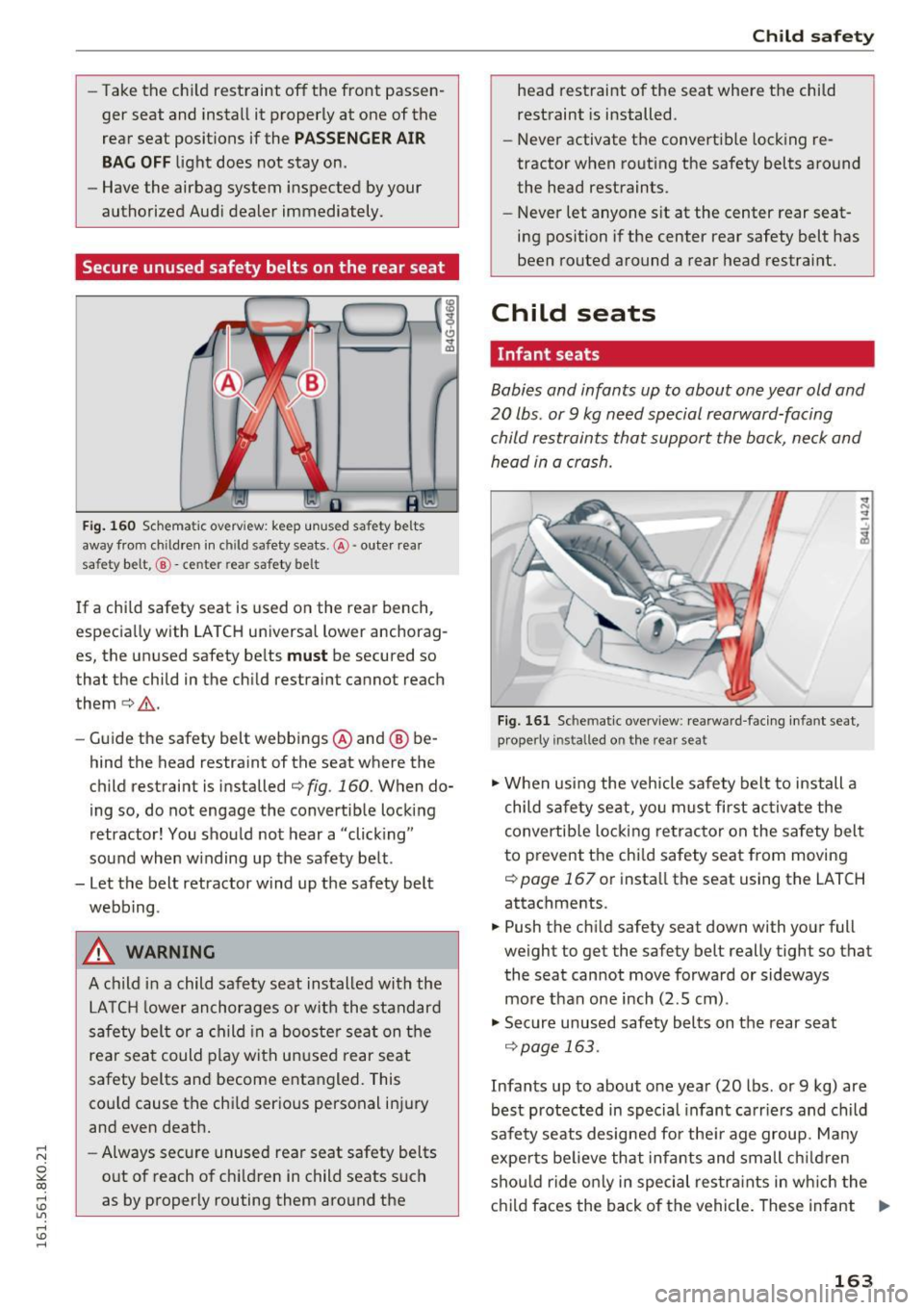
Secure unused safety belts on the rear seat
Fig . 160 Schemat ic overv iew: keep unused s-afety belts
away from children in chil d safety seats.@· oute r rear
sa fety belt,
@ -center rear safety bel t
If a chi ld safety seat is used on the rear bench,
especia lly with LA TCH universal lower anchorag
es, the unused safety belts
must be secured so
that the child in the child restraint cannot reach
them
c::> ,& .
-Gui de the safety belt webbings @ and @ be
hind the head restra int of the seat where the
child restraint is installed
c::>fig. 160. When do
ing so, do not engage the convertible locking
retractor! You should not hear a "click ing"
sound when w inding up the safety belt .
- Let the belt retractor wind up the safety belt
webbing .
A WARNING
A child in a child safety seat installed with the
LATCH lower anchorages or with the standard
safety belt or a child in a booste r seat on the
rear seat could play with unused rear seat
safety belts and become entangled. This
cou ld cause the chi ld serious personal injury
and even death.
- Always secure unused rear seat safety belts
out of reach of children in child seats such
as by proper ly routing them aro und the
Child safety
head restraint of the seat where the child
restraint is installed .
- Never activate the convertible locking re
tractor when routing the safety belts around
the head restraints.
- Never let anyone sit at the center rear seat
ing position if the center rear safety belt has
been routed around a rear head restraint.
Child seats
Infant seats
Babies and infants up to about one year old and
20 lbs. or
9 kg need special rearward-facing
child restraints that support the back, neck and
head in a crash.
Fig. 161 Sc hem atic overv iew: rearward -fac ing infa nt seat ,
proper ly i nsta lled o n the rear seat
., When using the vehicle safety belt to install a
child safety seat, you must first activate the
convertib le locking retractor on the safety belt
to prevent the chi ld safety seat from moving
c::> poge 167 or install the seat using the LATCH
attachments .
.. Push the child safety seat down with your full
weight to get the safety belt really tight so that
the seat cannot move forward or sideways
more than one inch (2 .5 cm) .
., Sec ure unused safety belts on the rear seat
c::> page 163.
Infants up to about one year (20 lbs . or 9 kg) are
best protected in special infant carriers and child
safety seats designed for the ir age group. Many
expe rts be lieve that infants and small children
shou ld ride only in special res tra ints in wh ich the
child faces the back of the vehicle. These infant ..,.
163
Page 166 of 278
Child safety
seats support the baby's back, neck and head in a
crash
c:>fig. 161.
The airbag on the passenger side makes the front
seat a potentially dangerous p lace for a child to
ride. The front seat is not the safest place for a
child in a forward -facing child seat. It is a very
dangerous place for an infant or a larger child in
a rearward-facing seat.
_&. WARNING
Not using a chi ld safety seat, using the wrong
child safety seat or improperly install ing a
child restra int increases the r isk of serious
personal injury and death in a crash.
- Never install rearward-fac ing ch ild safety
seats or infant carriers on the front passen
ger seat - even w ith an Advanced A irbag Sys
tem. A child w ill be seriously injured and can
be k il led when the inflat ing airbag hits the
child safety seat or infant carrier with great
force and smashes the child safety seat and
child against the backrest, center armrest,
door or roof
c:> page 139, Child restraints on
the front seat -some important things to
know.
-Always install rearward-fac ing ch ild safety
seats or infant carriers on t he rear seat.
- Never install a rearward-facing child re
straint in the forward-facing direction. Such
restra ints are des igned for the special needs
of infants and very small ch ildren and can
not protect them properly if the seat is for
ward-facing.
- If you must install a rearward fac ing ch ild
safety seat on the front passenger seat be
c a use of exceptiona l circumsta nces and the
PASSENGER AIR BAG OFF light does not
come on and stay on, immediate ly install
t h e rearward-facing child safety seat in a
rear seating position and have the airbag
system inspected by your authorized Audi
dealer.
-Always read and heed all WARNINGS when
ever using a child restrained in a vehicle is
being used
c:> page 130, Safety belts,
c:> page 138, Airbag system and
c:> page 158, Important information.
164
Convertible child safety seats
Properly used convertible child safety seats can
help protect toddlers and children over age one
who weigh between 20 and 40 lbs. (9 and 18 kg)
in a crash.
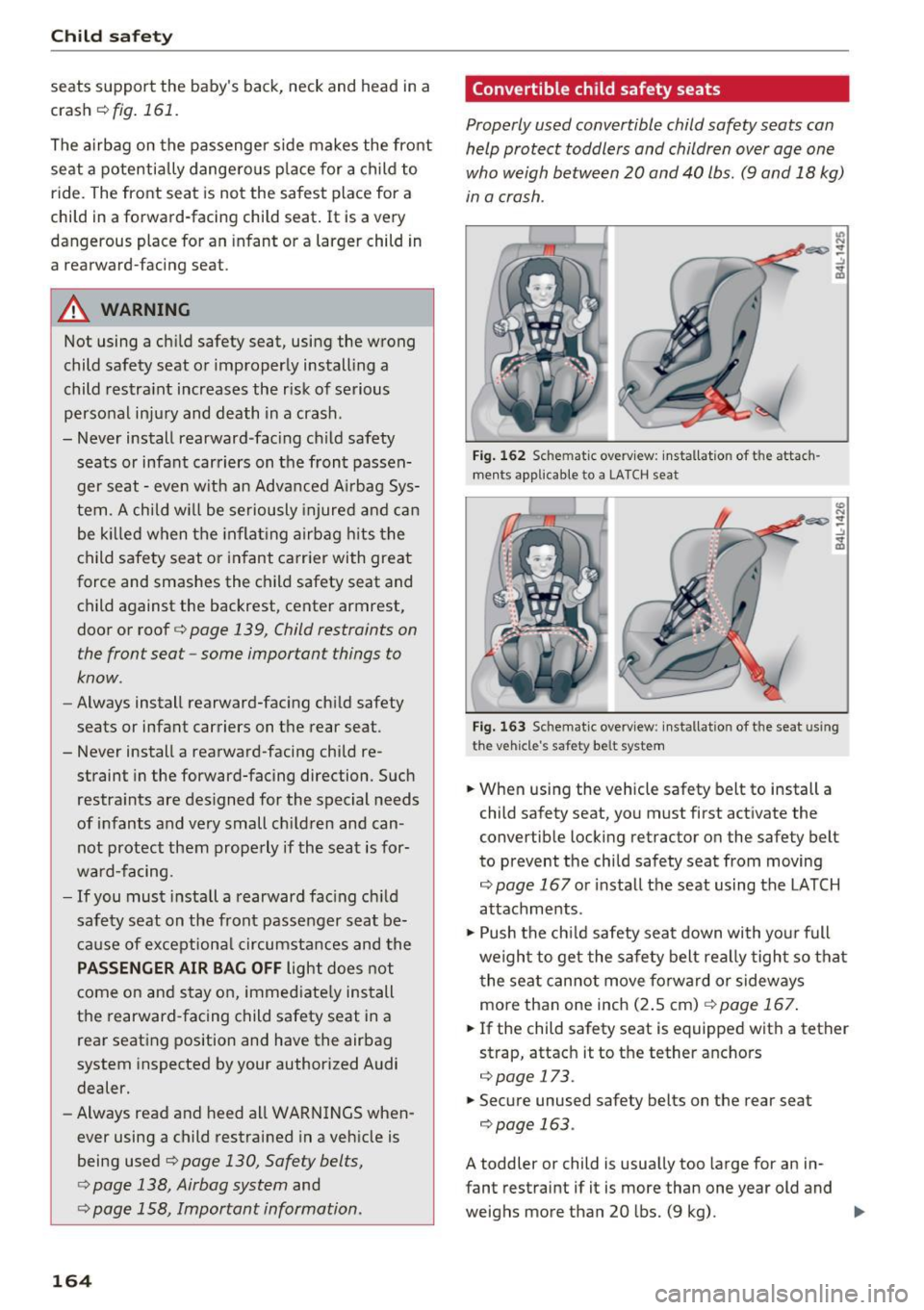
Fig . 162 Schemat ic overv iew : installat ion of the attach
ments applicable to a LA TCH seat
Fig. 163 Schemat ic overv iew: i nstallat ion of the seat using
the vehicle's safety belt system
.. When using the vehicle safety belt to install a
child safety seat, you must first activate the
convertib le locking retractor on the safety belt
to prevent the child safety seat from moving
c:> page 167 or install the seat using the LATCH
attachments .
.. Push the chi ld safety seat down wi th your full
we igh t to get the safe ty belt really tight so that
the seat cannot
move forward or sideways
more than one inch (2 .5 cm)
<=>page 167.
.. If the child safety seat is equipped with a tether
strap, attach it to the tether ancho rs
c:>page 173.
.. Secure unused safety belts on the rear seat
c:> page 163 .
A toddler or child is usually too large for an in
fant restraint if it is more than one year old and
weighs more than 20 lbs. (9 kg).
ll>-
Page 168 of 278
Child safety
BAG OFF light does not stay on whenever
the ignition is switched on.
Booster seats and safety belts
Properly used booster seats can help protect
children weighing between about 40 lbs. and 80
lbs. (18 kg and 36 kg) who ore less than 4 ft .
9
in. (57 inches/1.45 meters) tall.
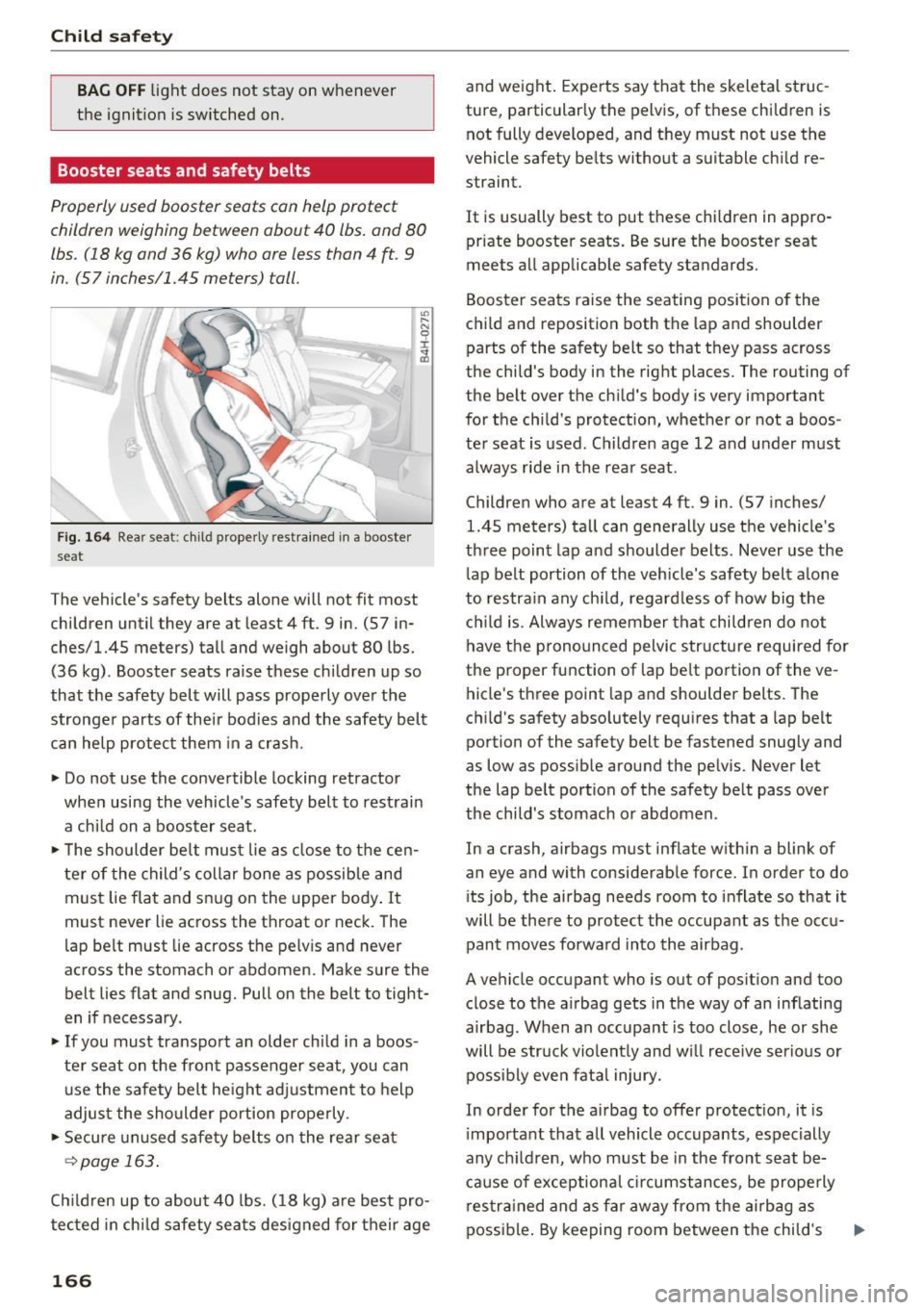
Fig. 164 Rear seat: child properly restra ined in a booster
seat
The vehicle's safety belts alone will not fit most
children until they are at least 4
ft. 9 in. (57 in
ches/1.45 meters) tall and weigh about 80 lbs.
(36 kg). Booster seats raise these children up so
that the safety belt will pass properly over the
stronger parts of their bodies and the safety belt
can help protec t them in a crash.
• Do not use the convertible locking retractor
when using the vehicle's safety belt to restrain
a child on a booster seat.
• The shoulder be lt must lie as close to the cen
ter of the child's collar bone as possible and
must lie flat and snug on the upper body. It
must never lie across the throat or neck. The
lap belt must lie across the pelvis and never
across the stomach or abdomen. Make sure the
belt lies flat and snug. Pull on the belt to tight
en if necessary .
• If you must transport an older child in a boos
ter seat on the front passenger seat, you can use the safety belt he ight adjustmen t to help
adjust the sho ulder portion properly .
• Secu re unu sed safety belts on the rear seat
~page 163.
Children up to about 40 lbs. ( 18 kg) are best pro
tected in ch ild safety seats designed for their age
166
and weight. Experts say that the skeletal struc
ture, particularly the pelvis, of these children is
not fully developed, and they must not use the
vehicle safety be lts without a suitable child re
straint.
It is usually best to put these children in appro
priate booster seats. Be sure the booster seat
meets all applicable safety standards.
Booster seats raise the seating position of the
child and reposition both the lap and shoulder
parts of the safety belt so that they pass across
the chi ld's body in the right places. The routing of
the belt over the child's body is very important
for the child's protection, whether or not a boos
ter seat is used. C hil dre n age 12 and u nder must
always ride in the rear seat.
Children who are at least 4 ft. 9 in. (57 inches/
1.45 meters) tall can generally use the vehicle's
three point lap and shoulder belts. Never use the
l ap belt portion of the vehicle's safety belt a lone
to restrain any child, regard less of how big the
child is . Always remember that children do not
have the pronounced pelvic structure required for
the proper function of lap be lt portion of the ve
hicle's three point lap and shoulder belts. The
ch ild's safety absolutely requires that a lap belt
portion of the safety belt be fastened snugly and
as low as possible around the pelvis. Never let
the lap belt portion of the safety be lt pass over
the chi ld's stomach or abdomen.
In
a crash, airbags must inflate w ithin a blink of
an eye and with considerable force. In order to do its job, the airbag needs room to inflate so that it
will be there to protect the occupant as the occu
pant moves forwa rd into the airbag.
A vehicle occupant who is out of pos it ion and too
close to the airbag gets in the way of an inflating
airbag. When an occupant is too close, he or she
will be struck vio lent ly and will receive serious or
possibly even fatal injury.
In order for the airbag to offer protect ion, it is
i mporta nt that all vehicle occupants, especially
any ch ildren, who must be in the fron t seat be
cause of exceptional circumstances, be properly
restrained and as far away from the airbag as
possible. By keeping room between the child's ..,_