seat adjustment AUDI S4 2017 User Guide
[x] Cancel search | Manufacturer: AUDI, Model Year: 2017, Model line: S4, Model: AUDI S4 2017Pages: 386, PDF Size: 96.32 MB
Page 262 of 386

Airbag syste m
seat. Please be sure to read the important infor
mation in the sections that follow and be sure to
heed all of the WARNINGS.
A WARNING
To reduce the risk of injury when an airbag in
flates, always wear safety belts properly.
- If you are unrestrained, leaning forward, sit ting s ideways or out of position in any way,
your risk of injury is much h igher.
- You will also receive serious injuries and could even be killed if you are up aga inst the
airbag or too close to it when it inflates -
even with an Advanced Airbag
r:::;, page 253 .
A WARNING
A child in a rearward-facing chi ld safety seat
installed on the front passenge r seat w ill be
ser iously injured and can be killed i f the front
airbag inflates -even w ith an Advanced Ai rbag
System.
- Although the Advanced A irbag System in
yo ur vehicle is designed to tu rn off the front
airbag when a rearwa rd -facing child re
straint has been insta lled on the front pas
senger seat, nobody can absolutely guaran
tee that deployment is impossible in all con
ceivable s ituations that may happen during
the useful life of your vehicle .
- The inflating a irbag w ill hit the child safety
seat or infant carrier with great force and
will smash the chi ld safety seat and child
against the backrest, center armrest , door,
o r roof .
- Always install rearward -facing ch ild re
straints on the rear seat .
- If you must install a rearward fac ing ch ild
safety seat on the front passenger seat be
cause of exceptiona l circumstances and the
PASSENGER AIR BAG OFF~; light does not
c ome on and stay on, immed iate ly install
the rear-fac ing ch ild safety seat in a rear
seating position and have the airbag system
inspected by your authorized Audi dea ler.
260
A WARNING ,_
If, in exceptional circumstances, you must in
stall a forward-facing child restraint on the
front passenger's seat:
- Always make sure the forward-facing seat
has been des igned and certified by its man
ufacturer for use on a front seat with a pas
senger front and side airbag.
- Never put the forwa rd-facing child restraint
up against or very nea r the instrument pan
el.
- Always move the front passenge r seat to
the highest posit ion in the up and down ad
justmen t range and move it back to the
rearmost posit io n in the seat's fo re and aft
adjustment range, as far away from the a ir
bag as poss ible, before install ing the for
ward-facing chi ld restraint.
- Always make sure that the safety be lt upper
anchorage is behind the chi ld rest raint and
not next to o r in front of the c hild restraint
so that the safety be lt will be p roper ly posi
tioned.
- Always make sure that there is noth ing on
the front passenger seat that will cause the
capacitive passenger detection system in
the seat to signal to the Airbag System that
the seat is occup ied by a person when it is
no t, or to signal that it is occupied by some
one who is heavier than the person ac tually
si tting on the sea t. T he presence of addi
tional objects could cause the passenger
front airbag to be turned on when it should
be
off, or could cause the airbag to work in a
way that is d ifferent from the way it wou ld
have worked without the object on the seat.
- Make sure that the
PASSENGER AIR BAG
OFF ~;
light comes on and stays on all the
time whenever the ign it ion is switched on.
Advanced Airbag System components
T he front passenger seat in your veh icle has a lot
of ve ry important parts of the Advanced A irbag
System i n it. These parts incl ude the capacitive
passenger detection system, wir ing , b rackets,
and more. The control uni t moni tors the system
on the front passenge r seat when t he ignit ion is ..,.
Page 280 of 386
Child safety
A WARNING
Children on the front seat of any car even with
Advanced Airbags can be seriously injured or even killed when an airbag inflates. A child in
a rearward-facing child safety seat installed
on the front passenger seat will be serious ly
injured and can be killed if the front a irbag in
flates .
- The inflating a irbag w ill hit the child safety
seat or infant carrier with great force and
will smash the chi ld safety seat and child
against the backrest, center armrest, or
doo r.
- Always install rear-facing child safety seats
on the rear seat.
-If you must install a rearward fac ing ch ild
safety seat on the front passenger seat in
exceptional circumstances and the
PASSEN
GER AIR BAG OFF~;
light does not come
on and stay on, immediately install the rear
facing child safety seat in a rear seating po
sition and have the airbag system inspected
immediately by your Audi dealer.
A WARNING
- Forward-facing child seats installed on the
front passenger seat may interfere with the deployment of the a irbag and cause serious
personal injury to the child .
- If except ional circumstances require the use
of a forward -facing child restraint on the
front passenger's seat , the child's safety
and well-being require the following special
precautions to be taken:
- Always make sure that the forward-facing
seat has been designed and certified by its
manufacturer for use on a front passenger
seat with a front and s ide a irbag.
-Always carefully follow the manufacturer's instructions provided with the child seat
or infant carrier.
- Never install a child restraint without a
properly attached top tether strap if the
child restraint manufacturer's instructions
require the top tether strap to be used.
278
-Never put the forward-fac ing child re
straint up against or very near the instru
ment panel.
- Always set the safety belt upper anchor
age to the adjustment position that per
mits proper installation in accordance
with the child restraint manufacturer's in
structions .
- Always move the front passenger seat to
the h ighest position in the up and down
adjustment range and move it back to the
r earmos t position in the seat's fore and
aft adjustment range, as far away from
the airbag as possible, before installing
the forward-facing child restraint.
- Always make s ure that the safety belt up
per anchorage is behind the child restraint
and not next to or in front of the child re
straint so that the safety belt wi ll be prop
erly pos itioned.
- Always make sure that nothing prevents
the front passenger's seat from being
moved to the rearmost position in its fore
and aft adjustment range.
- Never place objects on the seat (such as a
laptop, CD player, electronic games de
v ice, power inverter or seat heater for
ch ild seats). These may influence the elec
trical capacitance measured by the capaci
tive passenger detection system and can
also fly a round in an accident and cause
serious personal injury.
- Never place or use any elect rical device
(such as a laptop, CD player, electronic
games device, power inverter or seat heat
er for child seats) on the front passenger
seat if the device is connected to the 12-
vo lt socket or the cigarette lighter socket.
- If a seat heater has been retrofitted or
otherwise added to the front passenger
seat, never install any child restraint sys
tem on this seat.
- Make sure that there are no wet objects
(such as a wet towel) and no water or oth
er liquids on the front passenger seat
cush ion .
- Always make sure that the
PASSENGER
AIR BAG OFF~;
light comes on and stays
Page 284 of 386

Child safety
-The child and the passenger can also in
jure each other in an accident.
- Never install rear-facing child safety seats
or infant carriers on the front passenger
seat. A child will be seriously injured and
can be killed when the passenger airbag in
flates -even with an Advanced Airbag Sys
tem.
- The inflating airbag will hit the child safety
seat or infant carrier with great force and
will smash the child safety seat and child
against the backrest, center armrest, door
or roof.
- Always install rear-facing child safety seats
or infant carriers on the rear seat.
- Make sure there is enough space in front of
the child in the child seat. If necessary, ad
just the angle and position of the seat in
front of the child seat.
- Forward-facing child safety seats installed
on the front passenger's seat can interfere
with the airbag when it inflates and cause
serious injury to the child. Always install for
ward-facing child safety seats on the rear
seat.
- If exceptional circumstances require the use
of a forward-facing child restraint on the
front passenger's seat, the child's safety
and well-being require that the following
special precautions be taken:
- Make sure the forward-facing seat has
been designed and certified by its manu
facturer for use on a front seat with a pas
senger front and side airbag.
- Always carefully follow the manufacturer's
instructions provided with the child safety
seat or carrier.
- Always move the front passenger seat to the highest position in the up and down
adjustment range and move it back to the
rearmost position in the seat's fore and
aft adjustment range, as far away from
the airbag as possible, before installing
the forward-facing child restraint.
- Always make sure that the safety belt up
per anchorage is behind the child restraint
and not next to or in front of the child re-
282
straint so that the safety belt will be prop
erly positioned.
- Always make sure that nothing prevents
the front passenger's seat from being
moved to the rearmost position in its fore
and aft adjustment range.
-Always make sure that the backrest is in
the upright position.
- Never place or use any electrical device
(such as a laptop, CD player, electronic
games device, power inverter or seat heat
er for child seats) on the front passenger seat if the device is connected to the 12-
volt socket or the cigarette lighter socket.
- If a seat heater has been retrofitted or
otherwise added to the front passenger
seat, never install any child restraint sys
tem on this seat.
- Make sure that there are no wet objects
(such as a wet towel) and no water or oth
er liquids on the front passenger seat
cushion.
- Never place objects on the seat (such as a
laptop, CD player, electronic games de
vice, power inverter or seat heater for
child seats). These may influence the elec
trical capacitance measured by the capaci
tive passenger detection system and can
also fly around in an accident and cause
serious personal injury.
- Always buckle the child safety seat firmly in
place even if a child is not sitting in it. A
loose child safety seat can fly around during
a sudden stop or in a collision .
- Always read and heed all WARNINGS when
ever using a child restrained in a vehicle is
being used<::;>
page 245, Safety belts,
c::> page 253, Airbag system and
c::> page 277, Child safety.
.8. WARNING
To reduce the risk of serious injury, make sure
that the
PASSENGER AIR BAG OFF 11,;; light
comes on and stays on whenever a child re
straint is installed on the front passenger seat
and the ignition is switched on. .,_
Page 288 of 386

Child safety
restraint in place ~page 62. Install the
head restraint again immediately once the
child seat is removed. Driving without head
restraints or with head restraints that are
not properly adjusted increases the risk of
serious or fatal neck injury dramatically .
- Always read and heed all WARNINGS when
ever using a child restrained in a vehicle is
being used
~ page 245, Safety belts,
~ page 2 53, Airbag system and
~ page 2 77, Important information.
_& WARNING
If exceptional circumstances require the use
of a forward-facing child restraint on the
front passenger's seat , the child's safety and
well-being require that the following special precautions be taken:
- Make sure the forward-facing seat has been
designed and certified by its manufacturer
for use on a front seat with a passenger
front and side airbag.
- Always follow the manufacturer 's instruc
tions provided with the child safety seat or
infant carrier.
- Always move the front passenger seat to the highest position in the up and down ad
justment range and move it back to the
rearmost position in the seat's fore and aft
adjustment range, as far away from the air
bag as possible, before installing the for
ward-facing child restraint.
- Always make sure that the safety belt upper
anchorage is behind the child restraint and
not next to or in front of the child restraint
so that the safety belt will be properly posi
tioned.
- Always make sure that nothing prevents the
front passenger's seat from being moved to
the rearmost position in its fore and aft ad
justment range.
- Always make sure the backrest is in an up
right position.
- Never place or use any electrical device (such as a laptop, CD player, electronic
games device, power inverter or seat heater
for child seats) on the front passenger seat
286
if the device is connected to the 12-volt
socket or the cigarette lighter socket.
- If a seat heater has been retrofitted or oth
erwise added to the front passenger seat,
never install any child restraint system on
this seat.
- Make sure that there are no wet objects (such as a wet towel) and no water or other
liquids on the front passenger seat cushion .
- Never place objects on the seat (such as a
laptop, CD player, electronic games device,
power inverter or seat heater for child
seats) . These may influence the electrical
capacitance measured by the capacitive pas
senger detect ion system and can also fly
around in an accident and cause serious per
sonal injury.
- Make sure that the
PASSENGER AIR BAG
OFF
11,;; light comes on and stays on all the
time whenever the ignition is switched on.
- If the
PASSENGER AIR BAG OFF 11,;; light
does not come on and stay on, immediately
install the forward-facing child seat at a
seating position on the rear seat and have
the airbag system inspected by your author
ized Audi dealer.
- Take the child restraint off the front passen
ger seat and install it properly at one of the rear seat positions if the
PASSENGER AIR
BAG OFF
11,;; light does not stay on whenever
the ignition is switched on .
Page 289 of 386

Booster seats and safety belts
Properly used booster seats can help protect
children weighing between about 40 lbs. and 80
lbs. (18 kg and 36 kg) who are less than 4
ft. 9
in. (57 inches/1.45 meters) tall.
Fig. 233 Rear seat: child p roper ly restrained in a booster
seat
The vehicle's safety belts alone will not fit most
children until they are at least 4
ft. 9 in. (57 in
ches/1.45 meters) tall and weigh about 80 lbs.
(36 kg). Booster seats raise these ch ildren up so
that the safety belt will pass properly over the
stronger parts of their bodies and the safety belt
can help protect them in a crash.
.,. Do not use the convertible locking retractor
when using the vehicle's safety belt to restrain
a chi ld on a booster seat .
.. The shoulder belt must lie as close to the cen
ter of the child's collar bone as possible and must lie flat and snug on the upper body. It
must never lie across the throat or neck. The
lap belt must lie across the pelvis and never
across the stomach or abdomen. Make sure the
belt lies flat and snug. Pull on the belt to tight
en if necessary .
.,. If you must transport an older chi ld in a boos
ter seat on the front passenger seat, you can
use the safety belt height adjustment to help
adjust the shoulder portion properly .
.. Secure unused safety belts on the rear seat
r:=>page 283.
Children up to at least 8 years old (over 40 lbs. or
18 kg) are best protected in child safety seats de
signed for their age and we ight. Experts say that
the skeletal structure, part icularly the pelvis, of
these children is not fully developed, and they
Child safety
must not use the vehicle safety belts without a
suitable child restraint.
It is usually best to put these children in appro
priate booster seats. Be sure the booster seat
meets all applicab le safety standards .
Booster seats raise the seating position of the
child and reposition both the lap and shoulder
parts of the safety belt so that they pass across
the child's body in the right places. The routing of
the be lt over the chi ld's body is very important
for the ch ild's protection, whether or not a boos
ter seat is used. Children age 12 and under must
always ride in the rear seat.
Children who are at least 4
ft. 9 in. (57 inches/
1.45 meters) tall can generally use the vehicle's
three point lap and shoulder belts . Never use the
lap belt portion of the vehicle's safety belt alone
to restrain any ch ild, regard less of how big the
ch ild is. Always remember that child ren do not
have the pronounced pelvic structure required for
the proper function of lap be lt portion of the ve
hicle's three point lap and shoulder belts. The
child's safety absolutely requires that a lap belt
portion of the safety belt be fastened snug ly and
as low as possible around the pe lvis. Never let
the lap belt portion of the safety belt pass over
the child's stomach or abdomen .
In a crash, airbags must inflate within a blink of
an eye and with considerab le force. In order to do
its job, the airbag needs room to inflate so that it
will be there to protect the occupant as the occu
pant moves forward into the airbag .
A vehicle occ upant who is out of position and too
close to the a irbag gets in the way of an inflating
airbag. When an occupant is too close , he or she
will be struck violently and w ill receive serious or
possibly even fata l injury .
In order for the airbag to offer protect ion, it is
important that all vehicle occupants, especially
any children , who must be in the front seat be
cause of exceptiona l circumstances, be properly
restrained and as far away from t he airbag as
poss ible. By keeping room between the child's ..,_
287
Page 292 of 386

Child safety
-Never put the forward-facing child restraint
up, against or very near the instrument pan
el.
- Always move the front passenger seat to
the highest position in the up and down ad
justment range and move it back to the
rearmost position in the seat's fore and aft
adjustment range, as far away from the air
bag as possible, before installing the for
ward-facing child restraint.
- Always make sure that the safety belt upper
anchorage is behind the child restraint and
not next to or in front of the child restraint
so that the safety belt will be properly posi
tioned.
- Make sure that the
PASSENGER AIR BAG
OFF~ ;
light comes on and stays on all the
time whenever the ignition is switched on.
A WARNING
Rearward-facing child restraints:
- A child in a rearward-facing child safety seat
installed on the front passenger seat will be
seriously injured and can be killed if the
front airbag inflates -even with an Ad
vanced Airbag System.
- The inflating airbag will hit the child safety
seat or infant carrier with great force and
will smash the child safety seat and child
against the backrest, center armrest, door
or roof .
- Always be especially careful if you must in
stall a rearward facing child safety seat on
the front passenger seat in exceptional cir
cumstances .
- Make sure that the
PASSENGER AIR BAG
OFF~;
light comes on and stays on all the
time whenever the ignition is switched on.
- If the
PASSENGER AIR BAG OFF~; light
does not come on and stay on, immediately
install the rear-facing child safety seat in a
rear seating position and have the airbag
system inspected by your Audi dealer .
290
· Activating the convertible locking retractor
Use the convertible locking retractor to secure a
child restraint.
Always heed the child safety seat manufacturer 's
instructions when installing a child restrain t in
your vehicle . To activate the convertible locking
retractor:
.. Place the child restraint on a seat, preferably
on the rear seat .
.. Slowly pull the belt
all the way out .
.. Route it around or through the child restraint
belt path
~ ,&. .
.. Push the child safety seat down with your full
weight to get the safety belt really tight.
.. Insert the belt tongue into the buckle for that
seating position.
.. Guide the safety belt back into the retractor un
til the belt lies flat and snug on the child safety
seat.
.. You should hear a "clicking" noise as the belt
winds back into the inertia reel. Test the con
vertible locking retractor by pulling on the belt.
You should no longer be able to putt the belt
out of the retractor. The convertible locking re
tractor is now activated .
.. Make sure that the red release button is facing
away from the child restraint so that it can be
unbuckled quickly.
.. Pull on the belt to make sure the safety belt is
properly tight and fastened so that the seat
cannot move forward or sideways more than
one inch (2 .5 cm) .
A WARNING
Using the wrong child restraint or an improp
erly installed child restraint can cause serious
personal injury or death in a crash.
- Always make sure that the safety belt re
tractor is locked when installing a child
safety seat. An unlocked safety belt retrac
tor cannot hold the child safety seat in place
during normal driving or in a crash.
- Always buckle the child safety seat firmly in
place even if a child is not sitting in it. A
loose child safety seat can fly around during
a sudden stop or in a crash.
Page 314 of 386

Check ing and F illing
right brake fluid and the know -how to do this for
you.
A WARNING
- Brake fluid is poisonous. It must be stored
only in the closed orig inal container out of
the reach of chi ldren!
- B rake failure can resu lt from old or inappro
pr iate brake flu id. Observe these precau
t ions:
- Use on ly brake fluid that mee ts SA E speci
fi cation) 17 0 3 and confo rms to Fede ral
Motor Ve hicle Standard 116. Always check
wit h your authorized Audi dealer to make
sure you are using the correct brake fluid.
The cor rect type o f brake fluid is a lso indi
cated on the brake fluid reservoir.
- The brake fluid must be new. Heavy use of
the brakes can cause a vapor lock if the
brake flu id is left in the system too long.
This ca n ser iously affect t he efficiency of
the bra kes as well as your safety. This
could result in an acc ident.
{U) Note
Brake fluid w ill damage the pa int of yo ur vehi
cle.
@ For the sake of the environment
Because of the prob lem of proper disposal of
brake flu id as we ll as the special tools re
quired and the necessary expertise, we rec
ommend tha t you have the brake fluid
changed by your author ized Audi d ealer.
Battery
General information
Unde r normal operating conditions, the battery
i n your Audi does not need any maintenance.
W ith
high outs ide temperat ures o r long da ily
d rives we recommend that you have the electro
lyte leve l checked by an a uth orized Audi dea le r or
qua lified wor kshop. The e lectroly te leve l should
a lso be checked each time the batte ry is ch a rged
¢ page 314.
312
Have t he battery chec ke d when yo u take yo ur ve
hicle in for service . You are we ll advised to re
place a battery that is o lder than 5 yea rs .
With ce rta in types o f airbag deployment, t he
b atte ry is disconnected from the veh icle elect ri
ca l system for safety reasons ¢.&
in Repair, care
and disposal of the airbags on page 268.
Disconnecting the battery terminals
Some ve hicl e fu nctions (power window regula
tors, for examp le) are lost if the batte ry te rm i
nals a re disconnected . These f unc tions have to be
relearned after the battery term inals are con
nected again . To p revent this, the battery should
o nl y be disconnected from the vehicle electrical
system when absolute ly necessary for repairs.
Vehicles not driven for long periods
If you do not d rive yo ur vehicle ove r a period of
severa l days o r weeks, electr ica l components are
grad ua lly cut back or switched of f. T his reduces
energy consumpt ion and maintains start ing ca
pability over a longer period ¢
page 138.
Some of the convenience functions may not oper
ate, such as the inter ior lights or the power seat
adjustment . The convenience functions will be
available again w hen you turn on the ignit io n and
start the eng ine .
Winter operation
Dur ing the winte r months, battery capacity tends
to decrease as tempe ratures drop. This is be
ca use more power is also consumed while start
i ng, and t he headlights, rear w indow defogger,
etc ., are used more often.
Avo id unnecessary powe r consumption, partic u
l a rly in city traffic or when traveling o nly short
distances . Let your author ized Audi dealer check
the capacity of the vehicle battery before win ter
sets in ¢
page 314 . A well charged battery will
n ot only p reve nt sta rting prob lems when the
we ather is co ld , but will also last longer.
@ Tips
I f yo ur vehicle is left sta nding for several
weeks at extreme ly low te mpera tures, th e ve-
h icl e b att ery should be re mo ved and store d
II>-
Page 355 of 386
<( a, .... N ,....
N .... 0 0
3 a,
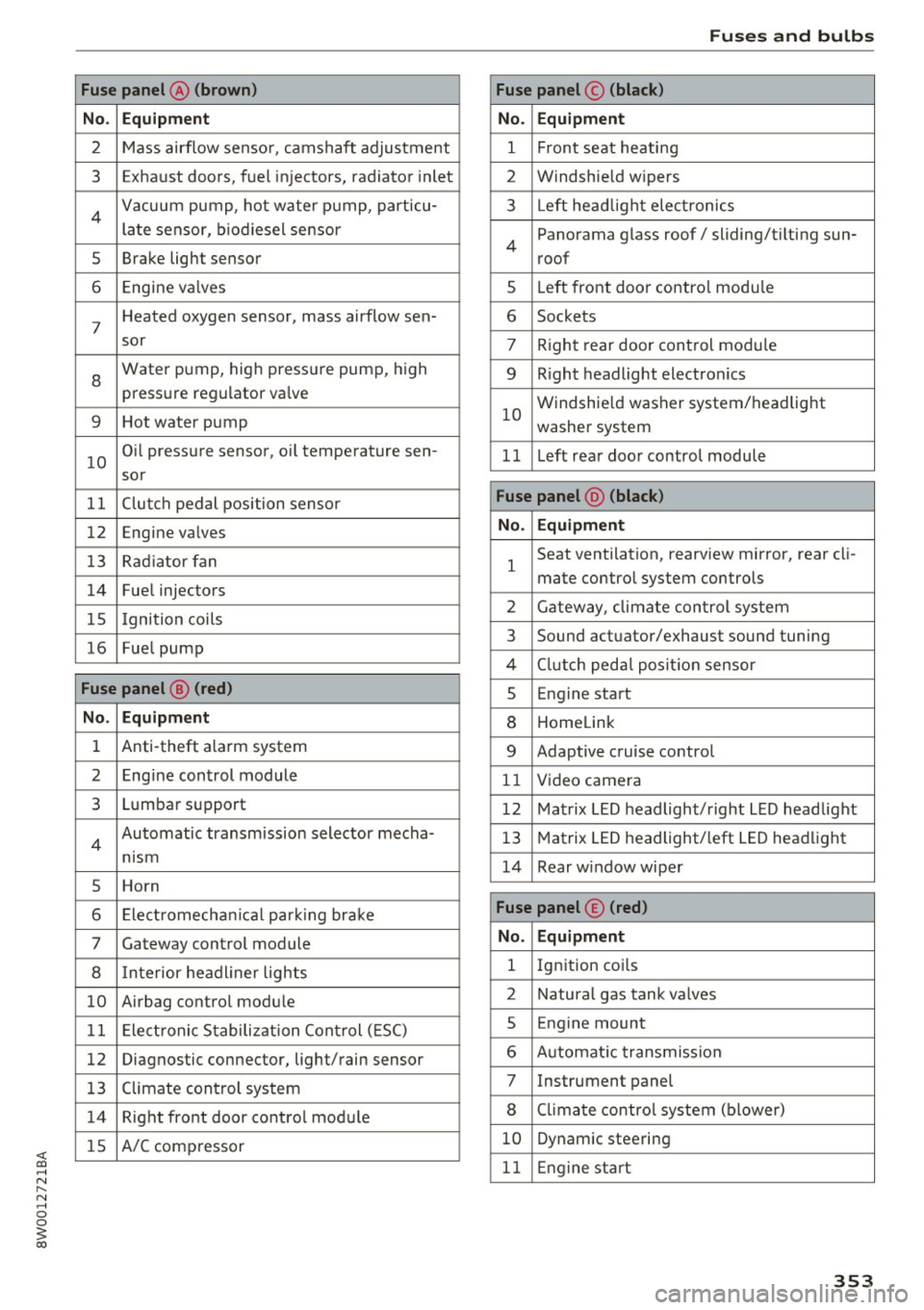
Fuse panel @ (brown)
No . Equipment
2 Mass airflow sensor, camshaft adjustment
3 Exhaust doors, fuel in jectors, radiator inlet
4 Vacuum pump, hot water pump, particu -
late senso r, biodiesel sensor
5 Brake light sensor
6 Engine va lves
7
Heated oxygen sensor, mass airflow sen-
sor
8
Water pump, high pressure pump, high
pressure regulator va lve
9 Hot water pump
10
Oil pressure sensor, oi l temperature sen-
sor
11 Clutch pedal position sensor
12 Engine valves
13 Radiator fan
14 Fuel injectors
15 I gnition coils
16 Fuel pump
Fuse panel @ (red)
No . Equipment
1 Anti-theft alarm system
2 Engine control module
3 Lumbar support
4
Automatic transmission selector mecha-
nism
5 Horn
6 Electromechan ical park ing brake
7 Gateway control module
8 I nterior headl iner lights
10 Airbag control module
11 Electronic Stabilization Control (ESC)
12 Diagnostic connector, light/rain sensor
13 Climate control system
14 Right front door control module
15 A/C compressor
Fuses and bulbs
Fuse panel © (black)
No . Equipment
1 Front seat heating
2 Windshield w ipers
3 L eft head light electronics
4
Panorama glass roof/ sliding/t ilting sun-
roof
5 L eft front door control module
6 Sockets
7 Right rear door control module
9 Right headlight electronics
10
Windshield washer system/headlight
washer system
1 1 Left rear door control module
Fuse panel @ (black)
No . Equipment
1
Seat ventilation, rearv iew mirror, rear cl i-
mate control system controls
2 Gateway , climate control system
3 Sound actuator/exhaust sound tuning
4 Clutch pedal pos ition sensor
s Engine start
8 Homelink
9 Adaptive cruise control
11 Video camera
12 Matrix LED headlight/right LED headlight
13 Matrix LED headlight/left LED headlight
14 Rear window wiper
Fuse panel © (red)
No . Equipment
l Ignition coi ls
2 Natural gas tank valves
5 Engine mount
6 Automat ic transmission
7 Instrument panel
8 Cli mate control system (blower)
10 Dynamic steering
11 Engine start
353
Page 379 of 386
<( a, .... N ,....
N .... 0 0
3 a,
Rear lid
Escape latch . . . . . . . . . . . . . . . . . . . . . . . . 343
also refer to Luggage compartment lid . . . 43
Rear Seat Entertainment preparation
refer to Audi Entertainment mobile
Rear seats 217
Folding . . . . . . . . . . . . . . . . . . . . . . . . . . . . . 65
Rearview camera
refer to Parking systems . . . . . . . . . . 125, 126
Rear window defogger . . . . . . . . . . . . . . . . . . 70
Reception area . . . . . . . . . . . . . . . . . . . . . . . 204
Recirculation mode (climate control system) 70
Recuperation . . . . . . . . . . . . . . . . . . . . . . . . . 16
Refueling . . . . . . . . . . . . . . . . . . . . . . . . . . . . 298
Fuel filler door emergency release . . . . . . 300
Fuel tank capacity . . . . . . . . . . . . . . . . . . . 362
Opening the fuel filler door . . . . . . . . . . . . 298
Remote control Garage door opener (Homelink) . . . . . . . . . 48
also refer to Remote control key . . . . . . . . 38
Remote control key . . . . . . . . . . . . . . . . . . . . 38
LED . . . . . . . . . . . . . . . . . . . . . . . . . . . . . . . . 39
Personali zation . . . . . . . . . . . . . . . . . . . . . . 38
Replacing the battery . . . . . . . . . . . . . . . . .
39
Unlocking/locking . . . . . . . . . . . . . . . . . . . . 40
Remote locking/unlocking
Audi connect Vehicle control . . . . . . . . . . . 182
Removing the caps (wheel bolts) . . . . . . . . . 346
Repair manuals . . . . . . . . . . . . . . . . . . . . . . . 363
Repairs Airbag system . . . . . . . . . . . . . . . . . . . . . . 268
Replacement key . . . . . . . . . . . . . . . . . . . . . . 38
Replacing Light bulbs . . . . . . . . . . . . . . . . . . . . . . . . . 355
Reporting Safety Defects . . . . . . . . . . . 243, 244
Reset
refer to Restart (MMI) . . . . . . . . . . . . . . . . 234
Reset button (trip odometer) . . . . . . . . . . . . 12
Resetting the trip odometer . . . . . . . . . . . . . 12
Res idual heat (climate control system) . . . . . 71
Restart
(MMI) . . . . . . . . . . . . . . . . . . . . . . . . 234
Retractor . . . . . . . . . . . . . . . . . . . . . . . . . . . . 248
Reverse gear . . . . . . . . . . . . . . . . . . . . . . . . . . 83
Rewinding (audio/video file) . . . . . . . . . . . . 217
Right control button. . . . . . . . . . . . . . . . . . . . 13
Index
Rims . . . . . . . . . . . . . . . . . . . . . . . . . . . . . . . 331
Cleaning . . . . . . . . . . . . . . . . . . . . . . . . . . . 339
Ringtone settings . . . . . . . . . . . . . . . . . . . . . 170
Road noise compensation . . . . . . . . . . . . . . 233
Roaming
refer to Data connection . . . . . . . . . . . . . . 178
Roof Emergency closing . . . . . . . . . . . . . . . . . . . . 47
Roof rack . . . . . . . . . . . . . . . . . . . . . . . . . . . . . 66
Roof load . . . . . . . . . . . . . . . . . . . . . . . . . . . 66
Route criteria . . . . . . . . . . . . . . . . . . . . . . . . 196
Route guidance
refer to Navigation . . . . . . . . . . . . . . . . . . . 187
Running direction (tires) . . . . . . . . . . . . . . . 348
s
Safe driving habits
Safety 236
Airbag system . . . . . . . . . . . . . . . . . . . . . . 253
Be lts . . . . . . . . . . . . . . . . . . . . . . . . . . . . . . 245
Cargo .... .. .. .. .. ............... .. 242
Correct seating position . . . . . . . . . . . . . . 23 7
Pedal area . . . . . . . . . . . . . . . . . . . . . . . . . . 241
Safety be lt height adjustment . . . . . . . . . . . 250
Safety belt position . . . . . . . . . . . . . . . . . . . 249
Safety belt height adjustment . . . . . . . . . 250
Safety belts worn by pregnant women . . . 250
Safety belt pretensioner Service and disposal . . . . . . . . . . . . . . . . . . 252
Safety belts . . . . . . . . . . . . . . . . . . . . . . 245, 248
Cleaning . . . . . . . . . . . . . . . . . . . . . . . . . . . 339
Danger to passengers who do not wear a
safety belt . . . . . . . . . . . . . . . . . . . . . . . . . 246
Fastening . . . . . . . . . . . . . . . . . . . . . . . . . . 248
Improperly worn . . . . . . . . . . . . . . . . . . . . 251
Indicator light . . . . . . . . . . . . . . . . . . . . . . . 31
Not worn . . . . . . . . . . . . . . . . . . . . . . . . . . 246
Safety belt pos it ion . . . . . . . . . . . . . . . . . . 249
Safety instructions . . . . . . . . . . . . . . . . . . . 247
Securing child safety seats . . . . . . . . . . . . 288
Special considerations for pregnant wom- en . . . . . . . . . . . . . . . . . . . . . . . . . . . . . . . . 250
Unfastening . . . . . . . . . . . . . . . . . . . . . . . . 250
Warning/indicator light . . . . . . . . . . . . . . 245
Worn properly . . . . . . . . . . . . . . . . . . . . . . 247
Safety belt warning light . . . . . . . . . . . . . . . 245
377
Page 380 of 386
Index
Safety equipment . . . . . . . . . . . . . . . . . . . . . 236
Safety features for occupant restraint and protection . .. .. .... ............... .. .
Safety instructions
f " d t . . b or s1 e cur ain air ags . ....... .. .. .. .
for using child safety seats ........ ... .
for using safety belts ................ .
Monitoring the Advanced Airbag System .
Safety systems (indicator light) ... .... .. . .
Saving fuel 236
276
281 247
267
33
Energy consumers . . . . . . . . . . . . . . . . . . . . 17
Recuperation . . . . . . . . . . . . . . . . . . . . . . . . 16
Scan (rad io) . . . . . . . . . . . . . . . . . . . . . . . . . . 20S
Screen refer to Display . . . . . . . . . . . . . . . . . . . 12, 15
Screwdriver . . . . . . . . . . . . . . . . . . . . . . . . . . 343
SD card reader (MMI) ........... .. .. ... 210
Search area (point of interest) . . . . . . . . . . . 190
Search function refer to Free text search
Seat adjustment 149,219
H ead restra ints . . . . . . . . . . . . . . . . . . . . . 239
Seat belts refer to Safety belts . . . . . . . . . . . . . . . . . . 245
Seat heating/ventilation . . . . . . . . . . . . . . . . 70
Seating capacity . . . . . . . . . . . . . . . . . . . . . . 245
Seating position Driver . . . . . . . . . . . . . . . . . . . . . . . . . . . . . 23 7
Front passenger . . . . . . . . . . . . . . . . . . . . . 238
H ow to adjust the front seats . . . . . . . . . . 238
Incorrect seat position . . . . . . . . . . . . . . . 240
Occupants .. .. .. ............. .... ... 237
Rear passengers . . . . . . . . . . . . . . . . . . . . . 239
Seats
d " f a JUS ing . . . . . . . . . . . . . . . . . . . . . . . . . . . 61
Cleaning . . . . . . . . . . . . . . . . . . . . . . . . . . . 340
Correct seating position . . . . . . . . . . . . . . 23 7
F olding . . . . . . . . . . . . . . . . . . . . . . . . . . . . . 65
Number of seats . . . . . . . . . . . . . . . . . . . . 245
Security Telephone . . . . . . . . . . . . . . . . . . . . . . . . . . 160
Selecting a source (media) ........... ... 217
Select ion menu . ... ............ 13, 143, 147
Selective catalytic reduction refer to Ad Blue . . . . . . . . . . . . . . . . . . . . . . 300
Selective wheel torque contro l . . . . . . . . . . 134
378
Selector lever
Selector lever positions . . . . . . . . . . . . . . . . 83
Se lf-learning nav igat ion
refer to Personal route assistance . . . . . . 193
Service and disposal Safety belt pretensioner . . . . . . . . . . . . . . 252
Service interval display. ................ 316
Set Rear (climate control system) . . . . . . . . . 71
Settings Directory . . . . . . . . . . . . . . . . . . . . . . . . . . . 170
Map. ..... .. .. .. .. .. ........ ..... .. 198
Media ....... ... ... ............. .. . 220
N . t· av 1ga 10n .. .. .. .. .. ... .......... . .
Radio .... .. .. .. .. .. ............. . .
System (MMI) . ... .. .. .............. . 195
207
229
T elephone. . . . . . . . . . . . . . . . . . . . . . . . . . 170
Voice recognition system . . . . . . . . . . . . . 229
Setting the language . . . . . . . . . . . . . . . . . . 229
Shift paddles . . . . . . . . . . . . . . . . . . . . . . . . . . 86
Shortcut keys ..... .. .. ........... 141,147
S ide airbags
Description .. .. .. .. .. .. .. .. .... ... . .
How they work . .. .. .. ............. . .
Side assist .. .. .. .. .. .. ............. . .
Adjusting the brightness ............. .
Cleaning the sensors .. ........ ..... . .
E ·t . x1 warning system . .. ... .. ..... ... . .
Rear cross -traff ic assist ............. . .
Sensor range .. .. .. .. ... .......... . .
Switching on and off . ............... .
also refer to Side assist .............. .
Side curtain airbags .... .............. .
Description .. .. .. .. .. ............. . .
How they work . .. .. .. .. ........... . . 271
273
115
118
338 118
119
116
117
115
274
274
275
Safety instructions . . . . . . . . . . . . . . . . . . . 276
SiriusXM alert notifications . . . . . . . . . . . . . 205
Slid ing/tilting sunroof . . . . . . . . . . . . . . . . . . 47
Sun shade . . . . . . . . . . . . . . . . . . . . . . . . . . . 47
Snow cha ins 332
Socket . . . . . . . . . . . . . . . . . . . . . . . . . . . . . . . 64
Software update refer to Map update . . . . . . . . . . . . . . . . . . 176
refer to System update (MMI) . . . . . . . . . . 232
Software (MMI) License agreement. . . . . . . . . . . . . . . . . . . 235
Update . . . . . . . . . . . . . . . . . . . . . . . . . . . . 232
ers1on . . . . . . . . . . . . . . . . . . . . . . . . . . . . 232
V .